
Note: This article contains affiliate links. If you click on these links and make a purchase, we may earn a small commission at no extra cost to you. This helps support our research and content. Read our full affiliate disclosure here.
If your home struggles with mineral buildup, a whole-house water filter for hard water can protect pipes, appliances, and fixtures while improving water quality everywhere it is used. Picking the right system matters because hardness solutions vary by household water chemistry, flow needs, and service access. This guide shortlists the top systems built for hard-water treatment and evaluates them on scale reduction effectiveness, flow capacity, maintenance, and installation practicality. Read on to compare features that matter for real-world use and find the systems that fit your home and plumbing setup.
Top Picks at a Glance
| Best Overall The best all-around choice for most situations | Express Water 3-Stage Whole House System |  |
| Best Quality Built to a higher standard if you want something more solid | iSpring WCFM500K Whole House Filter |  |
| Best Budget The cheapest option that still gets the job done reliably | Culligan WH-HD200-C Whole House Filter |  |
| Top Rated A top-rated pick with lots of positive feedback | iSpring WGB21B 2-Stage Whole House Filter |  |
| Most Popular A crowd favorite that many people choose with confidence | Waterdrop WHF21-PG Whole House Filter |  |
| Best Seller A high-volume bestseller chosen again and again | SimPure DB10P 10" Housing |  |
Express Water 3-Stage Whole House System

| Purification Method | Activated Carbon, KDF, Polyphosphate |
|---|---|
| Maximum Flow Rate | 17 gpm |
| Operating Pressure Range | 20-80 psi |
| Filter Life Cycle | 6 months |
| Supported Water TDS Level Maximum (PPM) | 800 |
This Express Water 3-stage whole-house system is built as a heavy-duty, freestanding setup that filters all incoming water to protect plumbing and improve taste and odor. It uses a sediment/activated carbon/KDF-style combination plus polyphosphate dosing to cut chlorine, sediment and several heavy metals while helping prevent scale before water reaches appliances. The included stainless steel stand, pressure gauges and pressure-release buttons make installation and routine cartridge changes more straightforward, and the system is rated for high flow so it should not noticeably reduce household water pressure. Filters are intended to be replaced every 6 to 12 months or roughly 100,000 gallons depending on use. Important limitations are that it does not lower TDS and it relies on cartridge replacements and polyphosphate for scale control rather than a dedicated water softener, so very hard water may still leave mineral deposits that require a separate softening solution.
Best for: Homeowners who want an all-round whole-house filtration solution to reduce chlorine, sediment and heavy metals while adding basic scale protection for pipes and appliances.
Less Ideal for: Homes with very hard water or buyers specifically seeking TDS reduction or full water softening should consider a dedicated softener or reverse osmosis system instead.
- Three-stage filtration targets sediment, chlorine, and heavy metals for broad contaminant reduction
- Stainless steel freestanding frame with pressure gauges and release buttons simplifies installation and maintenance
- High flow design (up to 17 gpm) that minimizes pressure loss for whole-house use
- Polyphosphate stage provides anti-scale protection to help protect pipes and appliances
- Does not reduce total dissolved solids (TDS), so it is not a substitute for a softener or reverse osmosis
- Requires periodic cartridge replacements and ongoing maintenance to preserve performance
Verdict: Choose this three-stage Express Water system when you want broad contaminant reduction and anti-scale protection across the whole house without sacrificing flow.
iSpring WCFM500K Whole House Filter

| Purification Method | Activated Carbon |
|---|---|
| Maximum Flow Rate | 12 gpm |
| Filter Life Cycle | 10 years |
| Capacity | 500000 gallons |
| Inlet / outlet | 3/4 inch or 1 inch NPT |
The iSpring WCFM500K is a point-of-entry whole-house filtration system built to tackle iron, manganese and hydrogen sulfide in well or municipal water and to trap solids down to about 3 microns. It installs at the main line and runs continuously to provide filtered water to every faucet, and its digital control head lets you set automatic backwash and regeneration intervals so the system largely runs unattended. Instead of chemical oxidizers the unit uses an air-injection oxidation step plus backwash and rapid rinse to refresh media, which extends life and reduces maintenance; iSpring rates the media life up to 10 years under expected conditions. The high flow capability and factory pre-loaded media suit larger households, but this is not a softener and it will not reduce hardness or TDS so a separate softener or RO is needed for those issues. It must be installed indoors and requires adequate drain and pressure conditions, so plan plumbing layout and access for servicing.
Best for: Homeowners who need a durable, low-maintenance solution to heavy iron, manganese, or sulfur issues and prioritize high flow performance and long media life.
Less Ideal for: Buyers seeking a combined softening and filtration solution or those who need TDS reduction or a simpler countertop/point-of-use drinking-water purifier.
- Specifically reduces iron (up to 12 ppm), manganese and hydrogen sulfide (up to 20 ppm combined)
- Self-cleaning air-injection regeneration removes contaminants without chemical oxidizers
- Programmable LED control head for personalized automatic backwash and vacation modes
- Pre-loaded media with a long rated filter life up to 10 years under normal conditions
- Does not reduce water hardness or Total Dissolved Solids, so a separate softener or RO is required for those concerns
- Requires indoor installation with proper drain and pressure, which can limit placement options
Verdict: Choose the WCFM500K when you need a high-flow, set-and-forget system that reliably removes iron, manganese and sulfur without chemical regeneration.
Culligan WH-HD200-C Whole House Filter

| Maximum Flow Rate | 10 gpm |
|---|---|
| Supported Water TDS Level Maximum (PPM) | 600 |
| Capacity | 16000 gallons |
| Material Type | Stainless Steel |
The Culligan WH-HD200-C is a stainless steel capped whole-house filter housing intended to provide sediment and particulate protection for a home when paired with the correct filter cartridge (sold separately). It installs inline at a 1-inch water main and includes a mounting bracket, bypass and shut-off valves, a pressure relief valve, and a housing wrench to simplify service. The clear sump makes it easy to visually monitor cartridge condition, and the unit is rated for up to 10 gpm flow and a 16,000 gallon cartridge capacity where that cartridge's performance allows. Because this listing is for the housing only, buyers must choose a compatible sediment or specialty cartridge for heavy-duty hard-water particulates or scale control, so expect additional cost and a small time investment to select the right cartridge. The stainless steel cap and integrated valve features give a durable, serviceable platform that helps protect appliances and plumbing from sediment and rust when correctly matched with a cartridge.
Best for: Homeowners who need a robust, serviceable whole-house sediment filtration platform on a tight budget and are willing to add the appropriate cartridge to target hard-water particulates.
Less Ideal for: Buyers who want a single-package solution that reduces dissolved hardness without adding a separate water softener or specialty cartridge should look elsewhere.
- Stainless steel cap and heavy-duty construction for durable, long-term use
- Includes bypass, shut-off and pressure relief valves for easy servicing without shutting off the whole house
- Clear sump lets you visually inspect the cartridge without disassembly
- Supports up to 10 gpm flow suitable for typical single-family household demand
- Mounting bracket and housing wrench included for straightforward installation and maintenance
- Filter cartridges are sold separately, so additional cost and cartridge selection are required
- Does not remove dissolved hardness minerals on its own; a compatible cartridge or additional treatment is needed
Verdict: A durable, budget-friendly whole-house filter housing that gives flexible, visible sediment protection when paired with the right cartridge.
iSpring WGB21B 2-Stage Whole House Filter
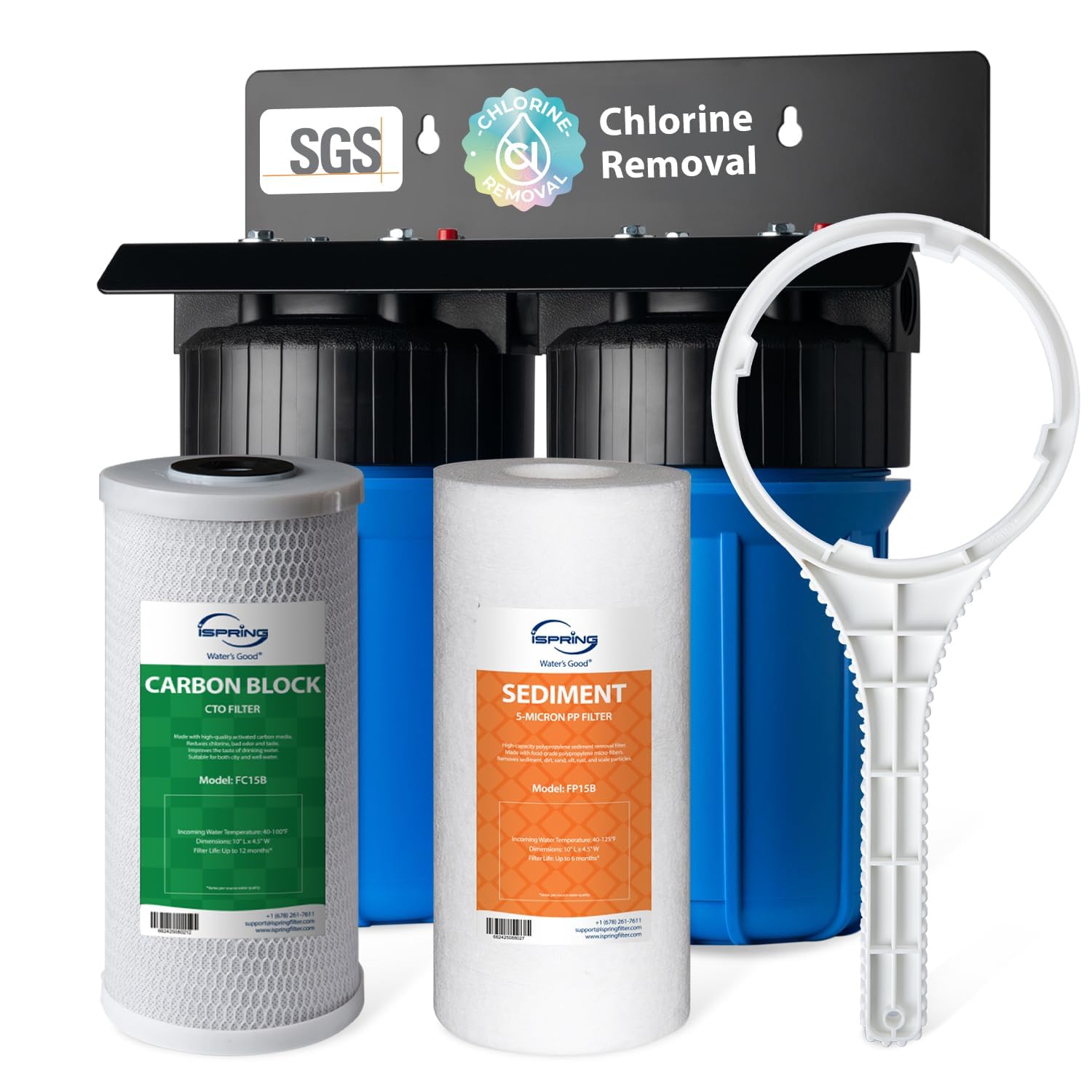
| Inlet / Outlet | 1 inch Female NPT |
|---|---|
| Maximum Flow Rate | 15 gpm |
| Operating Temperature | 40-100 ºF |
| Filter Life Cycle | 12 months |
| Capacity | 50,000 gallons |
The iSpring WGB21B is a point-of-entry two-stage filter assembled on a mounting bracket for whole-house use. The first stage is a 5-micron polypropylene sediment cartridge that traps dirt, sand, rust, and large particles while the second stage is a coconut-shell carbon CTO block that targets chlorine, taste, odor, and many volatile organic compounds. It is typically installed at the main water line to deliver cleaner water to all faucets and to protect appliances and plumbing from sediment buildup. The system supports up to 15 gpm flow and is built from polyethylene and steel housings for heavy-duty service; included fittings, a filter wrench, and a pressure relief valve make DIY installation and cartridge changes straightforward. Filters are rated for up to 50,000 gallons or about 12 months under typical use, but the system does not reduce total dissolved solids so it will not soften hard water or remove dissolved calcium and magnesium. For buyers prioritizing dependable sediment and chlorine removal across the house, this is a durable, serviceable option; those needing scale or TDS reduction will want an additional softener or RO stage.
Best for: Homeowners who want a robust, easy-to-service point-of-entry filter that reliably removes sediment and chlorine from all faucets and protects plumbing and appliances.
Less Ideal for: Homes primarily seeking scale reduction or softened water should choose a dedicated water softener or add an RO/softening stage instead.
- Two-stage filtration with 5-micron sediment and coconut-shell carbon CTO for reliable chlorine, taste, odor, and particle removal
- High capacity filters rated up to 50,000 gallons or about 12 months under typical use
- 1-inch inlet/outlet and up to 15 gpm flow to maintain household water pressure
- Pre-assembled on a mounting bracket with included installation kit, wrench, and pressure relief valve for easier DIY service
- Does not reduce TDS or remove dissolved hardness minerals, so it will not soften hard water
Verdict: Choose this two-stage iSpring unit if you need a heavy-duty, easy-to-maintain whole-house filter that reliably removes sediment and chlorine for long-term protection of plumbing and appliances.
Waterdrop WHF21-PG Whole House Filter

| Purification Method | Granular Activated Carbon, Sedimentation |
|---|---|
| Maximum Flow Rate | 15 gpm |
| Operating Pressure Range | 25 psi |
| Upper Temperature Rating | 100 °F |
| Filter Life Cycle | 6 months |
The Waterdrop WHF21-PG is a compact 2-stage whole-house filter built around a 10" x 4.5" polypropylene sediment cartridge plus a granular activated carbon (GAC) stage to address chlorine, taste, odor and some heavy metals. It is installed on the main line and delivers up to 15 gallons per minute, so it supports typical household flow while protecting appliances and plumbing from sediment and rust. The labeling and materials indicate NSF/ANSI approved components and the GAC uses coconut-shell carbon, which improves taste and reduces VOCs and chlorine. Filter life is marketed at roughly 3 to 6 months for the PP stage and about six months for the GAC stage depending on water quality, and replacement is handled with the included wrench and simple DIY instructions. The unit requires no power and is rated for normal household pressures and temperatures, but it is not a multi-stage softening system and will not remove dissolved hardness minerals like calcium or magnesium, so it will not address scale from hard water. For households seeking reliable sediment and chlorine reduction with straightforward installation, it is a sensible cartridge-style whole-house option; buyers with very hard water should combine it with a water softener or choose a system designed for scale removal.
Best for: Buyers who want a reliable, easy-to-install whole-house filter that improves drinking water taste and protects plumbing from sediment while relying on proven components and social-proof performance.
Less Ideal for: Homes primarily seeking scale reduction or softening for hard water should instead consider a dedicated water-softening system or a combined conditioner rather than this cartridge filter alone.
- Two-stage design with PP sediment and GAC carbon reduces sediment, chlorine, taste and odor
- Supports up to 15 gpm flow to supply typical household fixtures without noticeable restriction
- Includes wrench and mounting hardware for straightforward DIY installation
- NSF/ANSI approved components and food-grade housing for confidence in materials
- Does not remove dissolved hardness minerals and cannot replace a water softener
- Filter cartridges require periodic replacement (3–6 months for PP, ~6 months for GAC)
Verdict: Choose this Waterdrop if you want a compact, DIY whole-house cartridge filter that reliably reduces sediment, chlorine and bad taste while maintaining household flow.
SimPure DB10P 10" Housing

| Maximum Flow Rate | 20 gpm |
|---|---|
| Inlet/Outlet | 1" NPT Brass Port |
| Compatible Filter Dimensions | 10" x 4.5" |
| Working Water Pressure Range | 15-90 PSI |
| Applicable Water Temperature | 5-38 ℃ (41-100 ℉) |
The SimPure DB10P is a single-stage whole-house filter housing intended as a pre-filter or point-of-entry cartridge holder. It accepts universal 10" x 4.5" cartridges such as sediment or granular activated carbon, mounts to a wall with the included steel bracket, and uses 1" NPT brass inlet and outlet ports to support high flow up to 20 gallons per minute. Installation is straightforward: plumb it into the main line, use the supplied wrench and mounting hardware, and the red pressure-relief button makes cartridge changes easier. The polypropylene housing material and brass threads provide chemical resistance and a secure seal, and the unit is rated for municipal or well water with TDS up to 500 ppm and operating pressure from 15 to 90 PSI. This is a practical, no-frills solution for reducing sediment and chlorine taste when paired with the right cartridge, but buyers should remember cartridges are sold separately and the housing itself does not treat hardness minerals like calcium or magnesium. For hard-water issues you will still need a dedicated water softener or scale-control system downstream or alongside this pre-filter.
Best for: Homeowners who prioritize a reliable, easy-to-install pre-filter to protect plumbing and appliances from sediment and chlorine before investing in more complex treatment.
Less Ideal for: Homes seeking to remove hard-water minerals or prevent scale; those buyers should choose a water softener or dedicated descaling solution instead.
- Accepts common 10" x 4.5" cartridges for easy sourcing and replacement
- 1" NPT brass inlet/outlet supports higher household flow rates
- Included mounting bracket, wrench, and screws simplify installation
- Built-in red pressure-relief button speeds safe cartridge changes
- Reinforced food-grade polypropylene construction resists corrosion and impact
- Does not include filter cartridges so additional purchases are required
- Does not remove hardness minerals; not a substitute for a water softener
Verdict: A sturdy, easy-to-install 10" housing that reliably protects plumbing and appliances from sediment and chlorine when used with the appropriate cartridge.
Choosing the Right Whole-House Water Filter for Hard Water: Key Factors to Consider
Scale Reduction Method
How the system reduces or controls hardness minerals affects both results and expectations. Some whole-house systems remove hardness ions through ion exchange, producing measurable soft water at taps. Others use template-assisted crystallization or catalytic media to convert dissolved minerals into inert crystals that stay suspended and rinse away, which reduces scale without exchanging hardness ions. The chosen method influences maintenance, whether salt or regenerant is needed, and whether treated water will feel 'soft' to the touch.
Understanding the method matters because it determines downstream effects. Ion-exchange softeners can prolong appliance life and improve soap performance but require salt handling and periodic regeneration. Non-exchange catalytic approaches generally need less consumables but may be less effective in extremely hard water or with very high flow demands. Match the method to your hardness level, household water usage, and willingness to maintain regenerant supplies.
Flow Rate and Household Demand
Whole-house systems must deliver sufficient continuous flow so multiple fixtures can run without a drop in pressure. Flow capacity is typically given as gallons per minute or peak flow figures and should be matched to your household simultaneous demand. A family that runs multiple showers, laundry, and a dishwasher at once needs a higher-rated system than a single-occupant home.
Underrating flow capacity leads to pressure loss, noisy operation, or bypassing, which defeats the point of a whole-house installation. Check both peak and continuous flow specs and factor in any plan to expand plumbing fixtures or add appliances that use water.
Maintenance and Consumables
Different hardness-control technologies require different upkeep rhythms. Ion-exchange systems need periodic salt or regenerant and occasional resin replacement. Catalytic or template media can last multiple years before replacement but may still need backwashing or media refresh. Sediment pre-filters and post-filters add to maintenance tasks and can affect media life if not serviced regularly.
Think about how often you want to perform maintenance, whether you prefer simple cartridge swaps, and whether you have space and access for tanks and brine tanks. Maintenance considerations also affect operating cost and homeowner convenience over the system lifetime.
Installation and Space Requirements
Whole-house units vary from compact single-tank assemblies to multi-tank systems that require a dedicated closet or utility space. Installation may require cutting into the main water line, installing bypass valves, and ensuring proper drainage for backwash or regeneration cycles. Some systems need a nearby electrical supply or a gravity-fed drain line.
Before buying, confirm physical dimensions, plumbing connection types, and whether professional installation is required or recommended. Limited space or unusual pipe layouts can add complexity and cost to installation.
Water Quality and Safety
Any whole-house treatment must maintain potable-water safety. Materials in contact with water should be certified for drinking water, and treatment processes should not introduce harmful byproducts. Systems that use chemical regenerants or additives require proper handling and disposal. Consider whether the system retains beneficial minerals or removes them, depending on your drinking-water preference.
Also evaluate how the treatment affects chlorine or disinfectant residuals if your supply is municipally treated. Ensuring the system does not compromise microbiological safety is important for whole-home installations.
Ongoing Operating Cost
Operating cost includes consumables, electricity for powered components, water used in regeneration or backwash, and occasional media or cartridge replacements. Ion-exchange systems have predictable salt and water use for regenerations, while catalytic media systems may need less frequent consumables but could require branded media changes. Higher flow systems sometimes use more water during maintenance cycles.
Estimate annual operating cost based on your local utility rates and expected regeneration schedule. Factor these costs into the long-term value assessment rather than focusing only on upfront size or advertised performance.
How Hardness Levels Affect System Choice
Hardness is measured in grains per gallon or milligrams per liter, and the numeric level influences which whole-house approaches will work best. Mild to moderate hardness can often be managed by catalytic or scale-inhibiting media with minimal maintenance, while very hard water more commonly requires ion exchange for reliable scale control.
When assessing options, start with a water test to quantify hardness and check for iron, manganese, or high total dissolved solids. Ancillary contaminants can affect media life and may require pre-treatment steps such as sediment filtration or iron removal before hardness treatment.
- Test water hardness before selecting a system
- Account for iron and sediment that can foul media
- Match the treatment method to measured hardness level
Sizing a System for Your Home
Sizing combines two factors: the household flow demand and the total daily hardness load. A system must both pass peak flows without pressure loss and have enough treatment capacity or regeneration frequency to handle cumulative mineral loads between service intervals.
Use a realistic estimate of simultaneous fixture use rather than theoretical maximums. If you plan major plumbing changes or additions, size up to provide a buffer for future demand.
- Calculate peak simultaneous flow needs in gallons per minute
- Estimate daily hardness load to gauge regeneration frequency
- Allow headroom for future household changes
Pre-Filtration and Post-Filtration Considerations
Pre-filters protect main treatment media by removing sediment and large particles that accelerate fouling. A common approach is a multi-stage setup where an inexpensive sediment cartridge removes grit ahead of a catalytic or ion-exchange tank.
Post-filters can polish water for taste or remove residual particulates. Decide what level of sediment removal you need and whether a carbon polishing stage is desirable for chlorine taste reduction.
- Include sediment pre-filters to extend media life
- Consider carbon post-filters for taste and odor control
- Plan filter change intervals to avoid media clogging
Space, Drain, and Power Needs
Whole-house systems often require space for tanks and service access. Regenerating systems need a drain connection for backwash cycles and a safe place for brine handling if salt is used. Some systems run on low-voltage power for valve control or monitoring and need an outlet nearby.
Confirm the installation footprint, clearances for service, and drainage availability before purchasing. Limited access or tight utility rooms can restrict which models will fit.
- Measure the intended installation area including service clearances
- Verify availability of a drain and electrical outlet if required
- Check plumbing connection sizes to avoid adapter issues
Monitoring Performance and When to Service
Monitor treated water quality through periodic hardness tests and by watching for signs of scale returning on fixtures or reduced soap performance. Systems with electronic controllers may give status indicators for regeneration or service intervals.
Service schedules depend on hardness, household use, and system type. Keep a simple maintenance log to track consumable replacements and any observed changes in water behavior so you can anticipate service needs before problems escalate.
- Test hardness periodically after installation
- Watch for reduced soap lathering or new spotting on glassware
- Follow the manufacturer-recommended service intervals for media changes
How We Chose the Best Whole-House Water Filter for Hard Water
We focused on systems designed specifically to address hard-water challenges and picked options that balance measurable scale control with household plumbing compatibility and reasonable upkeep. Our evaluations prioritized demonstrated scale reduction methods, maximum continuous flow rates, and filter media life or softening longevity because those specs directly affect appliance protection and household water pressure. Installation complexity and required plumbing modifications were weighted heavily since many buyers install on existing supply lines. We also considered ongoing maintenance: media replacement frequency, ease of cartridge changes, and availability of standard-sized parts. Water treatment safety and adherence to common potable-water materials and certifications were included to ensure systems are suitable for drinking and domestic use. Excluded were general-purpose sediment-only units and point-of-use devices that do not treat whole-house hardness. The result is a list built from systems that meet the practical needs of homes facing hard-water issues.
Our full evaluation process is outlined in our review methodology.
FAQ
Do whole-house hardness systems remove calcium and magnesium entirely?
It depends on the treatment method. Ion-exchange systems remove calcium and magnesium ions and replace them with sodium or potassium, which produces soft water at taps. Template-assisted crystallization or catalytic systems do not remove those ions but alter their form so they are less likely to form scale.
How often will I need to service a whole-house system for hard water?
Service frequency varies by technology and household use. Ion-exchange units require periodic salt replenishment and occasional resin replacement, while catalytic media systems often need less frequent consumables but still require backwashing and media checks. Expect at least annual inspections.
Can a whole-house hardness system affect drinking water taste or mineral content?
Yes. Systems that remove hardness ions reduce mineral content and can change mouthfeel and soap performance. Non-exchange systems generally preserve dissolved minerals while limiting scale. If taste is a concern, adding a post-treatment polishing filter for flavor and odor can help.
Will a hardness system reduce iron or manganese too?
Some systems are designed to handle low levels of iron or manganese, but heavy iron loads often require dedicated iron-removal pre-treatment. High iron or manganese can foul hardness media, so test for these contaminants and plan pre-filtration if levels are significant.
Can I install a whole-house hardness system myself?
Some homeowners with plumbing experience can install simpler units, but many whole-house systems require cutting the main supply line, installing bypass valves, and connecting drains. Professional installation is recommended when electrical hookups, drains, or complex plumbing adaptions are needed.
Final Verdict
Choose a whole-house water approach that matches your measured hardness level, daily water demand, and willingness to perform routine maintenance. Prioritize scale reduction effectiveness and adequate flow capacity so fixtures and appliances stay protected without a drop in pressure. Balance upfront footprint and installation complexity against ongoing consumables and service needs to find the most practical long-term solution for your home.