
Note: This article contains affiliate links. If you click on these links and make a purchase, we may earn a small commission at no extra cost to you. This helps support our research and content. Read our full affiliate disclosure here.
If lead is a concern in your home's water supply, installing a whole-house water filter designed for lead removal can protect every tap, shower, and appliance. You want a system that reliably reduces lead concentrations without creating low flow or excessive maintenance. This guide highlights seven shortlisted whole-house water filters for lead removal selected for consistent filtration performance, certified media, and manageable upkeep. Below we summarize how each system handles lead reduction, flow-rate impact, and installation implications so you can match a system to your plumbing layout and household water demand.
Top Picks at a Glance
| Best Overall The best all-around choice for most situations | PRO+AQUA Elite Series PRO-100-E |  |
| Best Quality Built to a higher standard if you want something more solid | iSpring WGB32B Whole House Filter |  |
| Best Value The sweet spot between price and what you get | Waterdrop WHF21-PBL Whole House Filter |  |
| Best Budget The cheapest option that still gets the job done reliably | Culligan WH-HD200-C Whole House Filter |  |
| Top Rated A top-rated pick with lots of positive feedback | SimPure Whole House Filter DB10C-2KDF |  |
| Most Popular A crowd favorite that many people choose with confidence | iSpring WGB21B-CPB Whole House Filter |  |
| Best Seller A high-volume bestseller chosen again and again | SimPure DB10P Filter Housing |  |
PRO+AQUA Elite Series PRO-100-E

| Maximum Flow Rate | 15 gpm |
|---|---|
| Operating Pressure Range | 80 psi |
| Supported Water TDS Level Maximum (PPM) | 500 |
| Filter Life Cycle | 6 months |
| Capacity | 100000 gallons |
The PRO+AQUA Elite Series PRO-100-E is a three-stage whole-house filter intended to sit on the main supply line and deliver filtered water to every outlet in small to medium homes. Stage 1 is a sediment cartridge in a clear housing for visible monitoring, stage 2 uses a proprietary CRK media to target heavy metals such as iron and reduce hydrogen sulfide odors, and stage 3 is an activated coconut shell carbon cartridge for chlorine, VOCs and taste/odor improvement. Stainless steel pressure gauges make it easy to see when cartridges are approaching end of life, and the manufacturer recommends replacing filters about every six months for steady flow and performance. The system is built with commercial-grade fittings and 1-inch ports to support typical plumbing installs without backwash or chemical regeneration. Important limitations: it will not reduce TDS and it is not a drinking-water reverse-osmosis unit, so it reduces specific contaminants rather than desalting or polishing water to RO levels.
Best for: Buyers who want a balanced, whole-house filtration setup that reduces sediment, odors and many heavy metals without the complexity of backwashing or chemical regeneration and prefer easy visual maintenance.
Less Ideal for: Households seeking TDS reduction or RO-level drinking water treatment, or those wanting a filter-free, maintenance-free passive system.
- Three-stage design that targets sediment, heavy metals and chemical taste/odor issues
- Clear sediment housing for easy visual monitoring
- Stainless steel pressure gauges for straightforward maintenance signaling
- Commercial-grade 1" ports and fittings suitable for professional installation
- Activated coconut shell carbon and CRK media effective against chlorine, VOCs and certain heavy metals
- Does not reduce total dissolved solids (TDS) or replace reverse-osmosis for drinking-water polishing
- Requires periodic cartridge replacements roughly every six months to maintain flow and contaminant reduction
Verdict: A practical three-stage whole-house filter that reliably cuts sediment, odors and many heavy metals while keeping installation and maintenance straightforward for balanced household use.
iSpring WGB32B Whole House Filter

| Inlet / Outlet | 1 inch Female NPT |
|---|---|
| Operating Pressure Range | 25-80 psi |
| Operating Temperature | 40-100 °F |
| Filter Life Cycle | 12 months |
| Capacity | 100000 gallons |
The iSpring WGB32B-PFKDS+WSP50J is a wall‑mount whole‑house filter package built for demanding city or well water. It starts with a jumbo WSP50J spin‑down sediment prefilter to trap sand and rust and protect downstream cartridges, then routes water through an SGS‑tested PFAS carbon stage and a GAC+KDF heavy‑metals/chemical reduction stage, plus a scale‑inhibitor cartridge to limit calcification. Typical use is whole‑home protection at the main line so every faucet and appliance sees treated water; the system supports up to 25 GPM flow and standard 1 inch NPT plumbing for DIY installation. The high‑capacity filters are rated for long service life (up to 100k–250k gallons depending on cartridge) and the design preserves beneficial minerals while reducing lead, mercury, chlorine, PFAS, and sediments. Important limits: it does not soften water or remove dissolved solids, and performance will depend on incoming water quality so pretesting and occasional replacement of cartridges are required to maintain lead removal effectiveness.
Best for: Buyers focused on measurable contaminant reduction and long‑term whole‑home protection who want a high‑capacity, performance‑oriented system that targets PFAS and heavy metals across every tap.
Less Ideal for: Homes that need true water softening or TDS reduction as this system preserves hardness and does not replace a dedicated softener or RO unit.
- Jumbo spin‑down sediment prefilter protects downstream cartridges and maintains flow.
- SGS‑tested PFAS removal media that also reduces chlorine and organic contaminants.
- GAC+KDF stage targets heavy metals including lead and mercury.
- Includes scale inhibitor to reduce pipe and appliance buildup.
- High capacity filters designed for long run times before replacement.
- Does not soften water or reduce total dissolved solids.
- Installed system and cartridge replacements can be bulky and require periodic maintenance.
Verdict: Choose this system if you want a high‑capacity, whole‑home filter engineered to cut PFAS and heavy metals while protecting plumbing and appliances.
Waterdrop WHF21-PBL Whole House Filter

| Maximum Flow Rate | 12 gpm |
|---|---|
| Upper Temperature Rating | 100 °F |
| Supported Water TDS Level Maximum (PPM) | 500 |
| Filter Life Cycle | 9 months |
| Capacity | 90000 gallons |
The Waterdrop WHF21-PBL is a preassembled whole-house filter built to protect plumbing and deliver cleaner-tasting water from every faucet. It uses a pleated PP sediment first stage and a coconut-shell activated carbon plus advanced media second stage to attack lead, PFAS, heavy metals, chlorine, odors, and common sediment. With 1" FNPT inlet/outlet ports and a rated maximum flow of 12 gpm the unit supports standard household flow while the larger pleated element helps resist clogging and extends service life. The system is rated for up to 90,000 gallons and the manufacturer recommends changing filters every 6–12 months depending on water quality; a pressure-relief valve, filter wrench, mounting bracket, and dual O-ring sealing make installation and maintenance more straightforward. Practical limitations include the need to size plumbing adaptors if your house uses different fittings and the product is not intended for outdoor or extreme-temperature installations. For buyers focused on reducing lead and improving whole-home water quality this provides a strong, low-maintenance option.
Best for: Buyers who want a practical, low-maintenance whole-house solution that prioritizes lead and contaminant reduction for municipal or well water and values fewer filter changes and straightforward installation.
Less Ideal for: Homes needing outdoor or freeze-prone installations or those requiring specialized removal of dissolved minerals beyond carbon/adsorptive media should look at other treatment options.
- Targets lead, PFAS and several heavy metals with carbon block and advanced media
- Preassembled mounting bracket, pressure-relief valve and wrench simplify installation and filter changes
- Large pleated sediment element increases surface area to reduce clogging and extend cartridge life
- Supports up to 12 gpm flow and 1" FNPT plumbing for whole-house service
- Filter replacements recommended every 6–12 months depending on water quality
- Not rated for outdoor or extreme-temperature installation
Verdict: A practical whole-house filter that simplifies installation and maintenance while effectively reducing lead, PFAS and common heavy-metal contaminants.
Culligan WH-HD200-C Whole House Filter

| Maximum Flow Rate | 10 gpm |
|---|---|
| Supported Water TDS Level Maximum (PPM) | 600 |
| Capacity | 16000 gallons |
| Material Type | Stainless Steel |
The Culligan WH-HD200-C is a stainless steel-cap whole-house filter housing meant to be installed at the point of entry on a 1" water main and used with a compatible cartridge (not included). It provides visible filtration through a clear sump so you can watch sediment build-up and includes a mounting bracket, built-in shut-off and bypass, pressure relief valve, and a housing wrench to simplify servicing. The unit is rated for up to 10 gpm flow and is intended to reduce sediment, rust, scale, sand, silt, and off-tastes when paired with the correct cartridge. Its heavy-duty construction and WQA-tested cap make it durable and well suited to protect plumbing and appliances. Important limitations: this listing is the housing only, so buyers must choose and buy the appropriate cartridge for their specific contaminant target, and the product description does not claim certified lead-removal capability without the correct cartridge in place.
Best for: Buyers on a budget who want a sturdy, serviceable whole-house housing to pair with a cartridge chosen specifically for contaminants in their water and who value visible filter monitoring.
Less Ideal for: People who want a complete, certified lead-removal system out of the box or who prefer an all-in-one cartridge and housing sold together should consider alternative packaged systems.
- Durable stainless-steel cap and heavy-duty housing for long service life
- Clear sump lets you visually monitor sediment and filter condition
- Built-in shut-off, bypass and pressure relief valve simplify servicing
- Supports up to 10 gallons per minute flow suitable for most homes
- Filter cartridge is sold separately so additional purchase is required
- No lead-removal certification is provided with the housing alone
Verdict: A rugged, budget-friendly whole-house filter housing that lets you pick the cartridge needed for lead or sediment reduction while providing durable, serviceable plumbing protection.
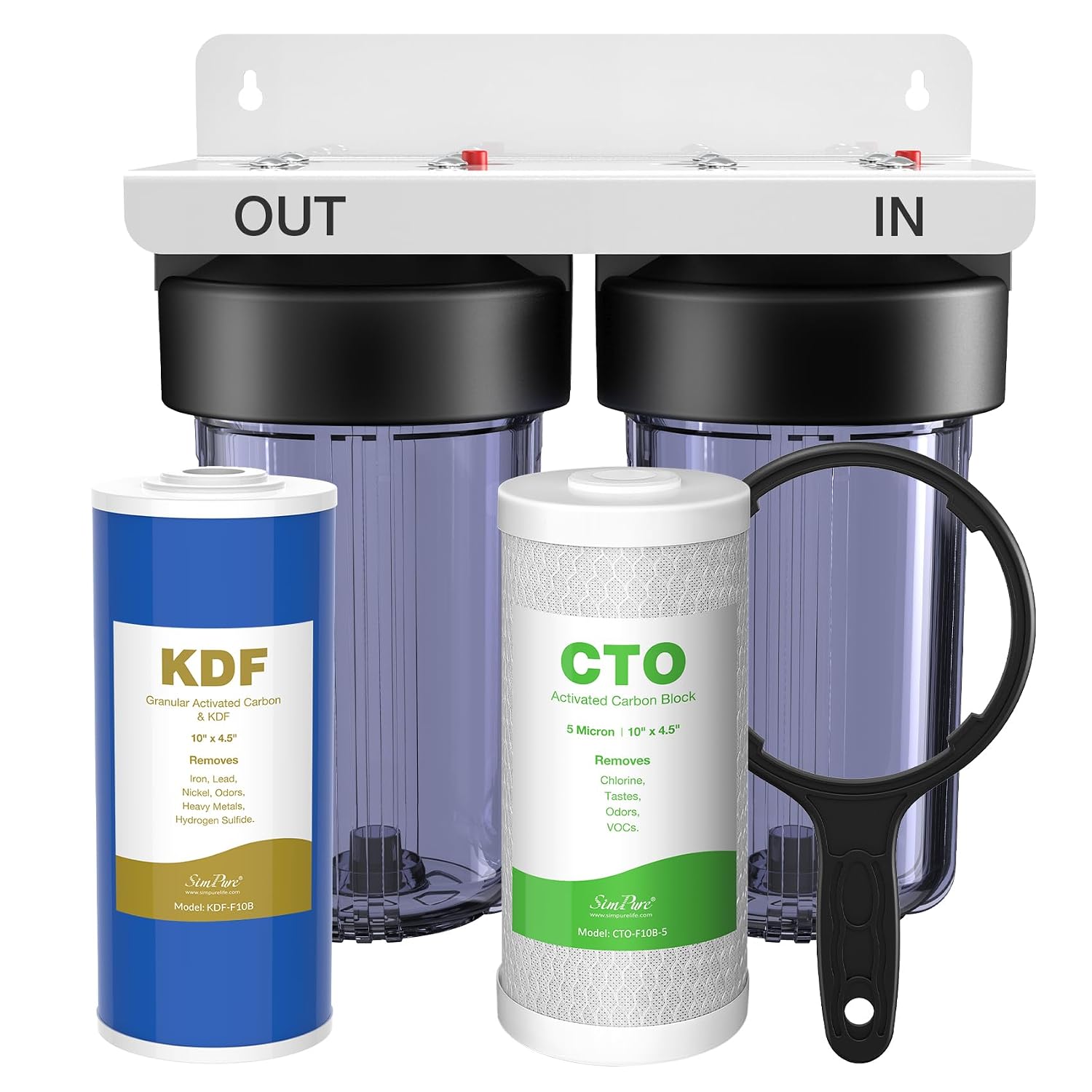
SimPure Whole House Filter DB10C-2KDF
| Filtration Rate | Max 15 gpm |
|---|---|
| Inlet/Outlet | 1" Female NPT Brass Port |
| Micron Rating | 5 μm |
| Filter Life | Sediment 3-6 months, KDF 6-12 months |
| Feed Water Temperature | 41-100°F |
The SimPure DB10C-2KDF is a compact two-stage whole-house filter that pairs a KDF media cartridge with a CTO carbon block to tackle heavy metals, chlorine taste and odor, and particles larger than 5 microns. Install it on the main line using the 1" female NPT brass ports and mount the transparent housings where you can visually monitor cartridge condition. Typical use is continuous whole-home pre-filtration to protect plumbing and appliances while improving water taste for drinking, cooking, bathing and laundry. Its clear housings make maintenance straightforward because you can see when cartridges are loaded and the upgraded brass inlet/outlet fittings reduce the risk of weak plastic connections. Filters have multi-month lifespans (carbon about 3-6 months, KDF 6-12 months) so replacements are periodic but not frequent. Expect straightforward DIY installation for most homeowners, though careful thread sealing is advised to avoid leaks. The system is sized for high flow applications and operates across common household pressures without notable pressure loss, making it a practical reliability-focused solution for lead and other heavy metal reduction at the point of entry.
Best for: Buyers who prioritize a reliable, easily monitored point-of-entry system to reduce lead, chlorine, and sediment across an entire home and who prefer a straightforward DIY install with durable fittings.
Less Ideal for: Households that need certified multi-stage contaminant removal beyond KDF and carbon (for example specific certified lead-point removal systems) or those unwilling to perform periodic cartridge changes and routine visual checks.
- KDF media specifically reduces heavy metals like lead and iron.
- Clear 10"x4.5" housings let you visually inspect cartridges without disassembly.
- 1" NPT brass inlet/outlet fittings for more durable plumbing connections.
- Rated for up to 15 gpm, suitable for whole-house flow demands.
- Multi-month filter life reduces how often you need replacements.
- Requires periodic cartridge replacement on a schedule that depends on water quality.
- Some users report potential for leaks if threads are over-tightened or not sealed properly.
Verdict: Choose this compact two-stage system if you want a reliable, easy-to-monitor whole-house filter that reduces lead and other heavy metals while preserving household water flow.
iSpring WGB21B-CPB Whole House Filter

| Capacity | 50000 gallons |
|---|---|
| Purification Method | Carbon Block, Sedimentation |
| Inlet / Outlet | 1 inch Female NPT |
| Supported Water TDS Level Maximum (PPM) | 300 |
| Operating Temperature | 40-100 ºF |
The iSpring WGB21B-CPB is a two-stage point-of-entry filter designed to treat all water entering a home by pairing a polypropylene sediment prefilter with a carbon/lead-reduction cartridge. It is typically mounted at the main water line and handles high flow thanks to 1 inch inlet and outlet ports, so it can feed fixtures and appliances without noticeable pressure loss. The sediment stage captures particles down to about 5 microns to protect the downstream lead-removal media, and the second-stage FC15B-PB cartridge is rated to remove up to 99% of lead over a high capacity life. The unit ships preassembled on a bracket with a wrench and video/manual instructions, so many homeowners can install it themselves though a plumber can speed the process. Practical benefits include long service life between changes, clear guidance for DIY installation, and lifetime access to technical support. Important limitations are that it does not lower TDS and outdoor installations require weather protection and insulation.
Best for: Buyers who prioritize verified contaminant reduction and want a whole-house solution that reliably removes lead and chlorine while offering high-capacity cartridges and documented user feedback.
Less Ideal for: People seeking a system that lowers TDS or one-step reverse osmosis style purification should consider other technologies instead.
- Dedicated lead-reduction second-stage cartridge rated to remove up to 99% of lead
- High-capacity filters with up to 50,000 gallons life for the lead filter
- 1" inlet/outlet ports and 15 GPM flow rating support whole-house demand with minimal pressure loss
- Comes preassembled on a mounting bracket with wrench and clear video/manual for DIY installation
- Durable housings and materials designed for long-term service under normal water pressure
- Does not reduce total dissolved solids so it will not lower overall mineral content
- Outdoor installation needs additional insulation and waterproofing to prevent weather damage
Verdict: Choose the iSpring WGB21B-CPB if you want a high-capacity, whole-house filtration setup focused on proven lead reduction and dependable DIY-friendly installation.
SimPure DB10P Filter Housing

| Inlet/Outlet | 1" NPT Brass Port |
|---|---|
| Compatible Filter Dimensions | 10" x 4.5" |
| Maximum Flow Rate | 20 gpm |
| Working Water Pressure Range | 15-90 PSI |
| Applicable Water Temperature | 5-38 ℃ (41-100 ℉) |
The SimPure DB10P is a single-stage whole-house filter housing intended as a pre-filter or cartridge holder for sediment or carbon cartridges. It mounts inline using 1" NPT brass inlet and outlet ports and accepts universal 10" x 4.5" filter cartridges so you can choose sediment, granular activated carbon, or pleated elements depending on the contaminant you want to address. The housing is molded from reinforced, food-grade polypropylene and includes a heavy-duty steel mounting bracket, wrench, screws, and a built-in red pressure-relief button to make cartridge changes easier. Its claimed 20 gpm max flow and 15-90 PSI operating range suit most residential supply lines, and brass threads help reduce leak risk when installed correctly. Limitations: the unit is a housing only so you must buy compatible cartridges separately, and it does not include fittings or a multi-stage configuration for targeted contaminants like lead without selecting an appropriate cartridge rated for lead reduction downstream or as part of a system.
Best for: Homeowners who prioritize a simple, robust pre-filter housing to protect downstream equipment and prefer a straightforward, serviceable component that works with standard 10" cartridges.
Less Ideal for: Buyers who want a complete certified lead-removal system out of the box or who need multi-stage filtration without sourcing specific cartridges and fittings separately.
- Fits common 10" x 4.5" cartridges so you can pick sediment or carbon cartridges to match needs
- 1" NPT brass inlet/outlet for high-flow installations and durable thread sealing
- Reinforced food-grade polypropylene construction for corrosion resistance and strength
- Includes mounting bracket, wrench, screws and a pressure-relief button for easier servicing
- Housing only — filter cartridges and push fittings are sold separately
- Not a certified multi-stage lead removal system by itself; lead reduction depends on the cartridge you install
Verdict: Choose the DB10P if you want a sturdy, easy-to-service housing that accepts standard 10" cartridges so you can build a tailored pre-filter solution focused on protecting plumbing and adding lead-capable cartridges as needed.
Choosing the Right Whole-House Water Filter for Lead Removal: Key Factors to Consider
Lead Reduction Method
Different whole-house systems use distinct mechanisms to remove lead, including specialized adsorption media, ion exchange, and fine mechanical filtration. Adsorption media capture dissolved lead ions onto a substrate; ion-exchange resins swap less harmful ions for lead; fine sediment or activated carbon filters can trap particulate-bound lead. Understanding the method matters because removal efficiency, maintenance, and media replacement schedules vary with the technology.
When deciding, look for documented removal rates for lead specifically, not just broad claims about heavy metals. Systems that combine a dedicated lead-adsorbing stage with prefiltration usually maintain effectiveness longer because coarse particles are removed before they foul the specialized media.
Certified Performance and Testing
Independent certification or laboratory testing gives verifiable assurance about how well a system reduces lead. Certification programs and third-party lab reports typically measure reduction for dissolved and particulate lead across a range of concentrations. These results indicate whether a system will meet your household goals and regulatory benchmarks.
Demand documentation that shows lead-specific performance rather than general contaminant removal. Also check whether the stated performance applies to new media only or includes tested life-to-exhaustion figures that reflect real-world use.
Flow Rate and Household Demand
Whole-house filters must deliver sufficient flow for simultaneous uses such as showers, laundry, and dishwashing. A system with excellent lead removal but low flow capacity can cause pressure drops or reduced performance when multiple fixtures run. Manufacturers often list maximum flow rates, but real-world throughput depends on inlet pressure and the condition of prefilters.
Consider peak demand and typical simultaneous fixture use in your home. Select a system with rated flow above your measured peak demand to avoid pressure loss. Some systems use parallel housings or larger vessels to preserve flow while providing needed contact time for adsorption media.
Filter Lifespan and Replacement Costs
The useful life of lead-removal media affects both convenience and operating cost. Some media cartridges are rated for a fixed number of gallons or months, while others require replacement only after measured breakthrough. Replacement frequency depends on incoming lead levels and overall water quality, including sediment and chlorine that can degrade media.
Estimate annual replacement costs using your household water use and expected feed-water quality. Systems with higher upfront cost but long-life media may be more cost-effective over time. Also evaluate whether replacement cartridges are easy to source and whether routine parts like O-rings or housings are standard size.
Installation Requirements
Whole-house systems vary from simple in-line housings that attach to existing shutoff valves to larger tanks requiring bypass valves and extra space. Some installations need additional components such as prefilters, pressure regulators, or softeners to protect media performance. Installation complexity affects both initial cost and the feasibility of DIY installation.
Check required clearances, plumbing connections, and whether a bypass valve is included. If your plumbing layout is compact or access is limited, choose systems with smaller footprints or modular components that can be staged in tight utility areas.
Maintenance and Monitoring
Routine maintenance keeps lead-removal systems functioning properly. This includes scheduled cartridge or media replacement, periodic prefilter changes, and occasional checks for pressure differentials that signal clogging. Some systems include simple visual indicators or pressure gauges to signal when media is approaching capacity.
Consider how comfortable you are performing routine service tasks or whether you will rely on a pro. Systems designed for straightforward cartridge swaps and clear service intervals are easier to maintain, while tank-style media systems may require more advanced servicing but offer longer intervals between replacements.
How Lead Gets Into Household Water
Lead rarely comes from water sources at treatment plants in modern supply systems. More commonly, lead enters household water through older plumbing materials such as lead solder, brass fittings, or lead service lines. Corrosive water can leach dissolved lead from these materials over time.
Testing your water is the only reliable way to determine whether lead is present and at what concentration. Understanding the likely source helps set expectations for treatment. If lead is particulate from pipe scale, mechanical filtration can help; if it is dissolved, adsorption or ion-exchange stages are often necessary.
- Corrosion of household plumbing can release dissolved lead
- Disturbed pipes may release particulate lead into the water
- Source water tests do not replace the need for home-specific testing
Prefiltration and Protecting Lead-Removal Media
A prefilter stage that removes sediment, silt, and large particulates extends the life and effectiveness of lead-specific media. Sediment that reaches adsorption media can blind pores and reduce contact efficiency, accelerating breakthrough.
Consider stacking a coarse sediment filter ahead of any lead-targeted stage and, where chlorine exposure is high, include activated carbon to remove oxidants that degrade some resins. Proper prefiltration reduces service frequency and ensures the lead-removal stage performs as rated.
- Sediment prefilters protect specialized media
- Activated carbon can remove chlorine that shortens media life
- Modular systems make adding prefilters simpler
Sizing a System for Peak and Average Use
Calculating household peak flow helps determine whether a single housing will suffice or whether you need a larger vessel or parallel units. Peak events include multiple showers, dishwasher runs, and laundry operating simultaneously. Average daily use is useful for estimating media life but peak flow dictates user experience.
When in doubt, choose a system with a flow rating comfortably above your peak demand. Systems with bypass valves allow you to maintain service while performing maintenance without disrupting household water.
- Measure fixture flow rates to estimate peak demand
- Allow a safety margin above measured peak flow
- Bypass valves are useful during maintenance
Monitoring Performance Over Time
Regular testing of treated water is the only way to confirm continued lead reduction. A system might perform well initially but degrade over time due to media exhaustion or changes in feed-water chemistry. Schedule periodic water tests, especially after media replacement or plumbing changes.
Watch for signs such as discolored water, taste changes, or increased particulate at faucets. Pressure differential gauges across prefilters are a practical, low-cost way to detect clogging before it impacts downstream media.
- Periodic post-treatment testing confirms ongoing protection
- Pressure gauges can indicate prefilter clogging
- Keep a maintenance log to track service intervals
When to Consider Additional Water Treatment
If your water has multiple issues beyond lead, such as heavy sediment, high hardness, or microbiological concerns, you may need a multi-stage approach. Hardness can shorten media life for some lead-removal resins, while biological growth in warm, nutrient-rich water can foul filters.
Plan for complementary systems like water softeners, UV disinfection, or larger sediment traps when feed-water quality warrants it. Make sure added components are compatible with the lead-removal stage and do not introduce chemicals that interfere with adsorption.
- Hard water may require a softener to protect media
- UV systems address microbiological risks not solved by adsorption
- Coordination of stages preserves overall system performance
How We Chose the Best Whole-House Water Filter for Lead Removal
We shortlisted systems that specifically address lead reduction using certified adsorption media or mechanical filtration methods known to capture lead particles and dissolved lead. We prioritized systems with independent third-party certification or clear test data for lead removal efficiency, and we favored designs that balance contaminant removal with realistic household flow rates. Evaluation criteria included laboratory-verified lead reduction performance, flow-rate retention under typical household demand, filter media lifespan and replacement cost, and installation practicality for common residential plumbing setups. We also considered maintenance needs such as backwashing or cartridge changes and the availability of prefiltration to extend media life. Excluded from consideration were point-of-use cartridges that treat only a single faucet, systems lacking any lead-specific data, and units that require unusual plumbing modifications for standard residential installations. The resulting list favors whole-house designs that deliver demonstrable lead reduction while maintaining usable water pressure and predictable upkeep.
Our full evaluation process is outlined in our review methodology.
FAQ
Will a whole-house filter remove all lead from my water?
Often it depends on the system and lead form. Some whole-house filters can reduce both particulate and dissolved lead to low levels when designed with appropriate media and prefiltration. Verify lead-specific performance data and plan for routine monitoring to confirm removal.
How often do I need to replace lead-removal media?
Replacement intervals vary widely based on incoming lead concentration and household water use. Some media cartridges are rated by gallons or months while tank-style media may last longer. Track your household water use and follow manufacturer guidance, backed by periodic water testing.
Can I install a whole-house lead filter myself?
Many whole-house units are designed for homeowner installation if you are comfortable with basic plumbing work and have necessary shutoffs and space. More complex tanks or systems that require bypass valves or electrical components may be best handled by a licensed plumber.
Do I still need point-of-use filters after installing a whole-house system?
Sometimes. Whole-house systems protect all taps from lead, but point-of-use filters can provide additional polishing at drinking and cooking fixtures if you want an extra layer of assurance or if your whole-house system has not been recently tested.
How can I check if my system is still removing lead effectively?
Have your treated water tested periodically by a certified laboratory or use reliable test kits for screening. Monitor pressure differentials and scheduled maintenance records, and test after any major plumbing work or suspected media exhaustion.
Final Verdict
Choosing a whole-house water filter for lead removal means balancing verified lead-reduction performance with system capacity and upkeep. Prioritize systems with documented lead-specific testing, adequate flow ratings for your household peak demand, and practical maintenance intervals. Tradeoffs typically involve upfront complexity versus long-term convenience. Aim for a solution that fits your plumbing layout, offers clear replacement schedules, and includes prefiltration to protect lead-specific media. With those priorities in mind, you can select a system that reliably reduces lead while maintaining everyday water availability.