
Note: This article contains affiliate links. If you click on these links and make a purchase, we may earn a small commission at no extra cost to you. This helps support our research and content. Read our full affiliate disclosure here.
Hard water deposits from calcium can shorten the life of fixtures, clog pipes, and reduce appliance efficiency. If your home has visible scaling or you notice frequent mineral buildup, installing a whole-house water filter designed for calcium removal protects plumbing and reduces maintenance. This guide presents seven shortlisted whole-house water filter options selected for their ability to lower calcium-related hardness across a whole-home plumbing system. We evaluated each option on measurable filtration performance, flow capacity, and maintenance demands to help you pick a system that matches your household water usage and installation constraints. Read on to compare the top choices and the factors that matter when treating calcium at the point of entry.
Top Picks at a Glance
| Best Overall The best all-around choice for most situations | iSpring WGB31B-DS Whole House Filter |  |
| Best Quality Built to a higher standard if you want something more solid | Aquasana Rhino Max Flow WH-1010-CT-LM |  |
| Best Value The sweet spot between price and what you get | PUREPLUS 2-Stage Whole House Filter |  |
| Best Budget The cheapest option that still gets the job done reliably | Culligan WH-HD200-C Whole House Filter |  |
| Top Rated A top-rated pick with lots of positive feedback | iSpring WGB32BM 3-Stage Filter |  |
| Most Popular A crowd favorite that many people choose with confidence | Express Water Ultimate Protection WH300SCKP |  |
| Best Seller A high-volume bestseller chosen again and again | SimPure DB10P Whole House Filter Housing |  |
iSpring WGB31B-DS Whole House Filter

| Inlet / Outlet | 1 inch Female NPT |
|---|---|
| Maximum Flow Rate | 15 gpm |
| Supported Water TDS Level Maximum (PPM) | 500 |
| Filter Life Cycle | 12 months |
| Purification Method | Carbon Block, polyphosphate |
The iSpring WGB31B-DS is a three-stage whole-house filter combining a sediment cartridge, a polyphosphate descaler and a coconut-shell carbon block to protect plumbing and improve water taste. It installs on a 1-inch supply line and is sized for apartments and smaller homes where space is limited but flow needs remain high. The sediment stage traps sand, rust and large particles, the descaler forms a protective layer to limit scale and corrosion on pipes and appliances, and the carbon block cuts chlorine, odors and many organic tastes. Built for low maintenance, cartridges last up to 12 months or about 80,000 gallons and include a pressure-release button for easier changes. Important limits: the system does not actually soften water or remove dissolved calcium and magnesium that define hardness, so you will still need a water softener if your goal is to lower hardness levels. Also, indoor installation and freeze protection are required for outdoor locations.
Best for: Buyers who want a compact, low-maintenance whole-house system that protects plumbing and improves taste without changing mineral content, especially for smaller homes or rentals.
Less Ideal for: Homes seeking actual water softening or significant reduction of dissolved calcium and magnesium should choose a dedicated water softener instead.
- Three-stage design combines sediment removal, anti-scale treatment, and carbon filtration for broader contaminant control.
- Rated for up to 15 gallons per minute to support whole-house demand in small homes and apartments.
- Long filter life up to 12 months or 80,000 gallons reduces replacement frequency.
- Pressure-release buttons simplify cartridge changes and reduce mess.
- Compact wall-mountable footprint fits tight utility spaces.
- Does not remove dissolved hardness minerals so it will not replace a dedicated water softener.
- Designed for indoor installation and needs insulation/protection if placed outside.
Verdict: Choose this system if you want compact, long-lasting whole-house protection against sediments, chlorine and scale buildup while retaining healthy minerals.
Aquasana Rhino Max Flow WH-1010-CT-LM

| Maximum Flow Rate | 7 gpm |
|---|---|
| Operating Pressure Range | 20-100 psi |
| Supported Water TDS Level Maximum (PPM) | 500 |
| Filter Life Cycle | 10 years |
| Capacity | 1000000 gallons |
The Aquasana Rhino Max Flow WH-1010-CT-LM is a whole-home filtration and conditioning system designed to supply treated water to multiple fixtures without frequent servicing. It uses a multi-stage approach with a 20" pre-filter, a large filter tank containing carbon and copper-zinc KDF media, salt-free scale control, and a 10" post-filter to reduce chlorine, sediment, and inhibit scale over an extended service interval. The system is built for high-flow household use and supports continuous demand with a rated flow and a long 10-year, 1,000,000-gallon filter life cycle, so replacements are infrequent. Installation includes fittings for 3/4" or 1" mains and a drain valve for flushing, but setup requires space and basic plumbing work and PEX is not included. While it conditionally reduces scale it is not a water softener and will not remove hardness minerals like calcium the way an ion-exchange softener would, so hard-water households seeking complete softening should pair it with a dedicated softener. For buyers who want long-lasting chlorine reduction and salt-free scale control across an entire home, this system delivers reliable high-flow performance with low maintenance needs.
Best for: Buyers who prioritize high-flow, low-maintenance whole-house filtration and want long-lasting chlorine reduction and salt-free scale control across multiple fixtures.
Less Ideal for: Homes that need full softening to remove calcium and manage very hard water should choose a dedicated water softener instead of this system alone.
- Multi-stage filtration combining carbon and KDF for broad chlorine and contaminant reduction
- Salt-free scale control that reduces scale buildup without chemicals or salt
- Long service life rated to 1,000,000 gallons or 10 years, minimizing replacement frequency
- Included pre- and post-filters plus installation kit components for standard 3/4" or 1" mains
- Does not perform ion-exchange softening and will not fully remove dissolved calcium hardness
- Requires significant space and basic plumbing skills or professional installation
- Rated contaminant reduction depends on flow rate and incoming water chemistry, so results vary
Verdict: Choose this system if you want a high-flow, low-maintenance whole-home filter that reliably reduces chlorine and provides salt-free scale control for years.
PUREPLUS 2-Stage Whole House Filter

| Purification Method | Polypropylene, Iron Removal, Natural Activated Carbon Block |
|---|---|
| Supported Water TDS Level Maximum (PPM) | 1000 |
| Upper Temperature Rating | 100 °F |
| Capacity | 30000 gallons |
| Included Components | Filtration System, Cartridges, Wrench, Pressure Gauge |
The PUREPLUS 2-Stage Whole House Filter pairs a composite polypropylene plus iron-removal cartridge with a coconut-based carbon block to cut sediment, iron, chlorine, taste and odor at the main line. It is installed inline at the house inlet and is sized for standard 10"x4.5" cartridges, so swapping filters uses off-the-shelf replacements and the included wrench and pressure gauge make maintenance straightforward. The first stage traps suspended particles and reduces iron and manganese, while the carbon block reduces chlorine and organic tastes for better-smelling, better-tasting water. Practical benefits include a compact footprint that fits most utility spaces and a simple mechanical setup that needs no power. Limits to note: this setup is focused on sediment, iron and chlorine reduction and does not include a softening stage for calcium or scale prevention, and the system rating and lifespan depend on local water hardness and TDS up to the listed maximums.
Best for: A homeowner who values straightforward, low-maintenance whole-house filtration that reduces sediment, iron and chlorine and prefers easy-to-service, standard-size cartridges.
Less Ideal for: Homes specifically seeking to control calcium or prevent scale should consider systems with a dedicated softener or scale-reduction stage rather than this particulate/charcoal filter setup.
- Two-stage filtration combining sediment/iron removal and coconut activated carbon for chlorine and odor reduction
- Standard 10"x4.5" housings allow easy cartridge replacement with common filters
- Includes pressure gauge and wrench to monitor flow and simplify service
- Compact, inline design fits typical whole-house installations and requires no electrical power
- Does not include a dedicated water softener or scale-removal media for calcium reduction
- Capacity and performance vary with local TDS and hardness and may require more frequent cartridge changes in hard-water areas
Verdict: Choose this compact two-stage filter when you want an easy-to-install, serviceable whole-house system that cuts sediment, iron and chlorine but not hard-water calcium.
Culligan WH-HD200-C Whole House Filter

| Maximum Flow Rate | 10 gpm |
|---|---|
| Supported Water TDS Level Maximum (PPM) | 600 |
| Capacity | 16000 gallons |
| Material Type | Stainless Steel |
The Culligan WH-HD200-C is a stainless steel whole-house filter housing intended to provide sediment and particulate protection for plumbing and appliances when fitted with the correct cartridge (sold separately). It installs inline at a 1-inch water main and includes a mounting bracket, built-in shut-off and bypass, pressure relief valve, and a housing wrench to simplify service. The clear sump lets you see cartridge condition and the heavy-duty construction and WQA-tested cap aim to keep a tight seal under regular household conditions. Because the unit is a housing only, performance against calcium or hardness depends entirely on the cartridge you pair with it — choose a cartridge rated for scale or calcium reduction or pair with a dedicated water softening cartridge or system. The non-powered design and integrated bypass make it straightforward to maintain, but budget buyers should factor in ongoing cartridge costs and the separate purchase of a cartridge sized to handle hard water or high TDS.
Best for: Buyers on a budget who want a durable, serviceable whole-house filter housing to add sediment or specialty cartridges and protect plumbing and appliances as part of a larger hard-water strategy.
Less Ideal for: People seeking an all-in-one calcium or hard-water solution out of the box should consider systems with integrated softening media rather than a housing-only product.
- Heavy-duty stainless steel cap and WQA-tested construction for reliable sealing
- Clear sump lets you visually inspect cartridge condition without disassembly
- Includes mounting bracket, bypass, pressure relief valve, and housing wrench for easier installation and maintenance
- Universal 1-inch inlet/outlet design fits standard whole-house plumbing
- Filter cartridge is sold separately so initial cost does not include filtration media
- Housing by itself does not reduce calcium or hardness without a specific cartridge or softening system
Verdict: A sturdy, easy-to-service whole-house filter housing that lets budget-minded buyers add the specific cartridge needed to tackle calcium or sediment rather than buying a full softening system.
iSpring WGB32BM 3-Stage Filter
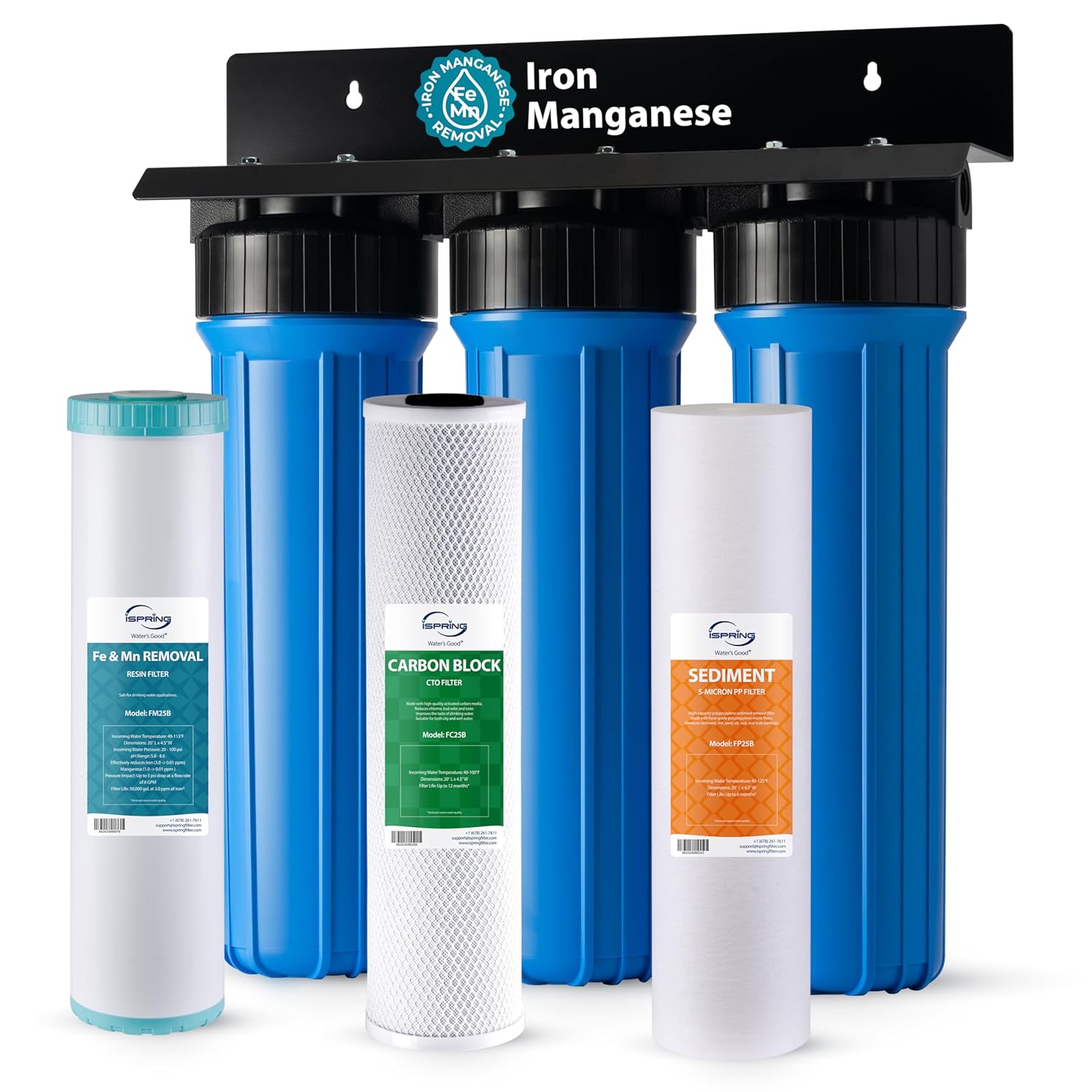
| Maximum Flow Rate | 15 gpm |
|---|---|
| Operating Pressure Range | 25 – 80 psi |
| Operating Temperature | 40 – 100 °F |
| Inlet / Outlet | 1 inch NPT |
| Capacity | 100000 gallons |
The iSpring WGB32BM is a tankless, permanent whole-house filter that uses a three-stage cartridge arrangement to protect plumbing and improve water quality for a household. It pairs a high-capacity PP sediment first stage with a coconut-shell carbon block second stage and a catalytic iron and manganese third stage, so it captures visible particles, reduces chlorine and removes iron and manganese down to near 0.01 ppm within its rated range. It is sized for standard 1-inch NPT plumbing and supports flows up to 15 gpm, which keeps pressure loss low for most homes. Cartridges are long-life items — the carbon and sediment stages are rated up to 100,000 gallons and the iron stage is rated for 50,000 gallons at specified iron levels — and replacements are straightforward thanks to common 20-inch Big Blue style housings and included wrench. Important limits to note are that it will not soften water or lower dissolved solids, and it is only intended for indoor, protected installation unless you add weatherproofing and insulation for outdoor use.
Best for: Buyers who prioritize a dependable, low-maintenance whole-house filter that reduces iron, manganese, sediment and chlorine while preserving flow for everyday household use.
Less Ideal for: Homes needing water softening or systems that reduce TDS, or locations with iron or manganese levels above the system limits where a specialized treatment is required.
- Three-stage filtration tailored for sediment, chlorine/taste/odor, and iron/manganese removal
- High flow capacity up to 15 gallons per minute with minimal pressure loss
- Long-life cartridges rated for up to 100,000 gallons for sediment/carbon stages
- Includes installation hardware and a wrench for DIY maintenance
- Does not reduce water hardness or total dissolved solids
- Not rated for iron or manganese levels above the specified maxima without upgrading to a different model
Verdict: Choose the WGB32BM when you need a reliable, high-flow whole-house filter that effectively removes sediment, chlorine and moderate iron and manganese for a year or more of service.
Express Water Ultimate Protection WH300SCKP

| Purification Method | Activated Carbon, KDF, Polyphosphate |
|---|---|
| Maximum Flow Rate | 17 gpm |
| Operating Pressure Range | 20-80 psi |
| Filter Life Cycle | 6 months |
| Supported Water TDS Level Maximum (PPM) | 800 |
The Express Water Ultimate Protection WH300SCKP is a freestanding three-stage whole-house filter built to treat incoming water for the entire home. It uses a combination of sediment, activated carbon and KDF/polyphosphate media to reduce chlorine, bad tastes and heavy metals while the polyphosphate stage helps prevent scale buildup in pipes and appliances. The unit mounts on a stainless steel stand and includes pressure gauges and pressure-relief buttons to make filter changes easier and to monitor system performance. With a stated maximum flow rate up to 17 gpm and a filter life cycle around 6 months (or up to 100,000 gallons depending on use), it can handle typical residential flow without noticeable pressure loss. Important limits: it does not reduce total dissolved solids (TDS) so it will not soften water or remove dissolved minerals responsible for hardness; polyphosphate delays scale formation but does not replace a dedicated water softener. Installation is manual and free-standing, so plan for space and basic plumbing hookups.
Best for: Buyers who prioritize proven contaminant reduction and visible social proof want a heavy-duty, monitored whole-house filter that protects plumbing and reduces heavy metals and chlorine across the home.
Less Ideal for: Homes needing true water softening or substantial TDS reduction should choose a dedicated softener or reverse osmosis solution instead.
- Three-stage filtration reduces chlorine, sediment and heavy metals across all house faucets.
- Polyphosphate stage provides anti-scale protection to help limit mineral buildup in pipes and appliances.
- Stainless steel freestanding frame with pressure gauges and relief buttons simplifies installation and maintenance.
- High flow capacity (up to 17 gpm) designed to supply whole-home demand without noticeable pressure loss.
- Does not reduce total dissolved solids or replace a water softener for true hard-water mineral removal.
- Filter lifetime quoted around 6 months may vary with local water quality and can require frequent replacements in high-use homes.
Verdict: Choose this three-stage Express Water system if you want a high-flow whole-house filter that cuts chlorine and heavy metals while offering anti-scale protection and visible system monitoring.
SimPure DB10P Whole House Filter Housing

| Maximum Flow Rate | 20 gpm |
|---|---|
| Inlet/Outlet | 1" NPT Brass Port |
| Compatible Filter Dimensions | 10" x 4.5" |
| Working Water Pressure Range | 15-90 PSI |
| Applicable Water Temperature | 5-38 ℃ (41-100 ℉) |
The SimPure DB10P is a single-stage whole-house filter housing that accepts universal 10" x 4.5" cartridges for sediment, granular activated carbon, or pleated filters and is intended as a pre-filter for plumbing and appliances. It mounts with the included heavy-duty bracket, installs to 1" NPT inlet/outlet brass ports, and has a built-in red pressure-relief button plus a wrench to make cartridge changes easier. Constructed from reinforced, food-grade polypropylene with brass threaded ports, it is built to resist corrosion and heavy flow up to 20 gallons per minute. In practice this housing is useful for removing sand, silt, and chlorine or improving taste when paired with the appropriate cartridge, and it protects downstream equipment like water heaters and washing machines. Limitations are that it is only a housing—cartridges are sold separately—and it is not a dedicated softening or scale-removal system, so it will not remove dissolved calcium without a specialized media or additional water-softening equipment.
Best for: Buyers who prioritize a reliable, factory-quality pre-filter housing to protect plumbing and appliances and who prefer proven, low-risk hardware they can pair with common cartridges.
Less Ideal for: Homes needing a water softening solution or active calcium scale removal should look at dedicated softeners or media specifically formulated to remove dissolved hardness rather than this housing alone.
- Fits standard 10" x 4.5" cartridges so replacement filters are widely available
- 1" NPT brass inlet/outlet supports high flow and provides a durable threaded connection
- Reinforced food-grade polypropylene body offers corrosion resistance and strength
- Built-in pressure relief button and included wrench simplify cartridge changes
- Includes heavy-duty mounting bracket and screws for secure installation
- Sold as a housing only so buyers must purchase compatible cartridges separately
- Does not remove dissolved minerals like calcium on its own because it relies on the cartridge media selected
Verdict: A sturdy, easy-to-service housing for standard 10" x 4.5" pre-filters that reduces particulate and chlorine risk to household plumbing when paired with the right cartridge.
Choosing the Right Whole-House Water Filter for Removing Calcium: Key Factors to Consider
Method of Calcium Control
Different whole-house systems use distinct approaches to control calcium. Some use media that soften water by ion exchange, replacing calcium with sodium or potassium. Others employ template-assisted crystallization or catalytic media that alter calcium into microscopic crystals that remain suspended instead of forming scale. Mechanical filtration alone rarely removes dissolved calcium because calcium ions are soluble and require chemical or catalytic treatment.
Understanding the method matters because it affects downstream concerns such as whether softened water adds sodium, whether crystalline conversion is compatible with appliances, and what level of hardness reduction you can realistically expect. Choose a method that aligns with your priorities for scale prevention, permitted water chemistry changes, and any health or irrigation considerations.
Flow Rate Capacity
Whole-house systems must handle peak household demand without significant pressure loss. Flow rate is often expressed in gallons per minute. If a system's capacity is too low, showers and faucets may suffer reduced pressure when multiple fixtures run simultaneously. Conversely, oversizing adds unnecessary cost and footprint.
Estimate peak simultaneous use in your home—multiple showers, laundry, and dishwasher running together—and select a system rated for that flow at typical inlet pressure. Also factor in future changes like bathroom additions or converted basements that could increase demand.
Maintenance Requirements and Consumables
All whole-house calcium-control systems require periodic servicing. Ion-exchange softeners need regeneration cycles and salt or potassium replenishment. Media-based or catalytic systems require media replacement on a schedule, and some systems use prefilters that must be changed more frequently. Maintenance frequency affects both ongoing cost and convenience.
Check how often the media or consumables need replacing, whether you can perform service yourself, and whether the system has clear indicators for maintenance. Systems that require specialized service or hard-to-source parts increase lifetime ownership complexity.
Material Compatibility and Corrosion Risk
Water chemistry changes introduced by calcium control technologies can affect plumbing materials. Ion exchange increases sodium concentration and may slightly alter pH. Some treated waters can be more aggressive toward certain metals if alkalinity drops. Even systems advertised as 'no-salt' can change mineral balance enough to influence corrosion over time.
Confirm that the chosen approach is compatible with your plumbing materials, fixtures, and water heater. If you have older copper or galvanized piping, consult a plumber about possible interactions between treated water and existing materials.
Footprint and Installation Needs
Whole-house systems vary widely in physical size and the plumbing modifications they require. Some need a dedicated bypass valve, floor space in a utility room, or a drain source for regeneration cycles. Installation complexity affects the total project cost and whether a do-it-yourself install is feasible.
Measure the available space, evaluate how the system will connect to your main supply, and consider noise or drain access requirements. Systems that offer standard plumbing fittings and clear installation guides reduce the chance of unexpected retrofit work.
Certification and Performance Documentation
Look for third-party performance data or certifications that verify calcium or hardness control claims. While not all effective systems carry the same certifications, documented lab reports or independent testing provide confidence that the system achieves stated reductions under realistic conditions.
Request performance data when possible and confirm the test conditions match your water profile. Certifications focused on contaminant reduction may not directly address hardness, so seek documentation specific to scale control or hardness reduction.
How Calcium Reduces Appliance Lifespan
Calcium deposits build up inside heaters, valves, and narrow passages, creating insulation and restricting flow. Over time this forces appliances to work harder to reach the same temperatures or flow rates, increasing energy use and accelerating wear on heating elements and seals.
Regularly treating incoming water for calcium reduces the rate at which mineral scale accumulates, lowering repair frequency and restoring more consistent performance. Addressing calcium at the point of entry protects every water-using device in the home rather than treating symptoms at individual fixtures.
- Reduced heat transfer efficiency in water heaters raises energy bills
- Clogged showerheads and reduced flow from faucets
- Shortened lifespan of washing machine and dishwasher components
Testing Your Water Hardness
Before choosing a system, test for hardness using a home test kit or a lab analysis. Hardness is usually reported in grains per gallon or parts per million. Knowing baseline hardness helps you choose an appropriately sized and specified system.
A full water report can also reveal alkalinity, iron, and pH, which influence how well certain calcium-control methods perform. For example, high iron can foul softening resin, while low alkalinity can change how treated water interacts with plumbing.
- Use test kits for a quick hardness estimate
- Consider a lab test for comprehensive chemistry before major system installs
Sizing a System for Your Home
Pair the required hardness reduction with daily water use to determine how robust a system you need. Owners of larger homes or those with frequent simultaneous water use should prioritize higher flow ratings and larger media beds.
Also check the system's pressure drop at the rated flow. Low pressure loss is important for preserving fixture performance. If you have low incoming pressure, choose systems explicitly rated for minimal pressure drop or consult with a plumber about booster options.
- Estimate peak gallons per minute for simultaneous fixtures
- Match system flow rating to peak demand plus a safety margin
Maintenance Tips to Maximize Performance
Keep a service log that records media replacements, salt or potassium additions, and prefilter changes. Many issues with calcium control stem from missed maintenance intervals rather than initial equipment choice.
Follow manufacturer guidance for winterizing, bypass operations during service, and how to flush systems after media changes. Where possible, choose setups that allow you to isolate and service the unit without shutting off water to the whole house.
- Replace prefilters on schedule to prevent media fouling
- Flush systems after media changes to remove trapped fines
Common Installation Considerations
Plan for access space around the unit to permit media swaps or softener salt additions. Ensure the unit's inlet and outlet orientation fits existing piping runs to avoid unnecessary rework. Consider installing a bypass valve to allow service without shutting off the main supply.
Check local plumbing codes for drain requirements if the system uses regeneration or backwash cycles. Some installations require a nearby drain or air gap to handle discharge during maintenance.
- Allow service clearance on all sides as specified in installation manuals
- Confirm drain access and electrical needs before purchase
How We Chose the Best Whole-House Water Filter for Removing Calcium
We focused on systems engineered specifically to reduce calcium scale at the point where water enters the home. Our selection criteria prioritized measurable hardness reduction or scale-control technology, whole-home flow capacity that supports typical household demands, and ease of maintenance because long-term upkeep affects whether a system actually delivers promised benefits. We also considered system durability and build quality to ensure filters and housings withstand continuous pressure and mineral-laden water. Installation flexibility and the availability of standard plumbing connections were important for minimizing retrofit work. Finally, we screened for systems with clear service intervals and accessible replacement components to keep maintenance predictable. We excluded single-fixture or point-of-use devices because they do not protect the entire plumbing system. Systems that only claim aesthetic improvements without demonstrable calcium or hardness reduction were not considered. The criteria we applied in practice were: measurable calcium or hardness reduction method, whole-home flow rate capacity, maintenance complexity and interval, material and build durability, and installation compatibility.
Our full evaluation process is outlined in our review methodology.
FAQ
Will a whole-house system remove existing scale inside pipes?
No. Most systems prevent new scale formation but do not remove existing deposits. Physical descaling or professional plumbing service is usually required to clear heavy buildup.
How often do I need to service a whole-house calcium-control system?
Service intervals vary by technology. Ion exchange systems need regular regeneration and periodic resin checks. Media replacement cycles often range from one to several years depending on water quality and usage. Check the system's maintenance schedule for specifics.
Can water treated for calcium affect my garden or plants?
That depends on the treatment method. Some softening processes increase sodium content, which may not be ideal for salt-sensitive plants. Crystallization or catalytic methods that do not add salts are usually safer for irrigation.
Will a calcium-control system change my water taste?
Some treatments can subtly alter taste by changing mineral balance. Ion exchange may make water taste slightly softer, while non-salt crystallization methods typically have minimal flavor impact.
Do these systems require electricity?
Not all systems require power. Salt-based softeners and many passive media systems operate without an electrical connection, while electronic timers, backwash controllers, or powered boosters will require electricity.
Final Verdict
Choosing the right whole-house water filter for removing calcium comes down to matching the treatment method to your priorities for scale control, maintenance, and plumbing compatibility. Prioritize measurable hardness reduction or proven scale inhibition, adequate flow capacity for peak household demand, and a maintenance cadence you can sustain. Remember that treating incoming water prevents new scale but does not remove heavy existing deposits, so combine system selection with a plan for descaling if needed. With those tradeoffs in mind, target systems that align with your home size and water chemistry to achieve reliable scale reduction and extended plumbing life.