
Note: This article contains affiliate links. If you click on these links and make a purchase, we may earn a small commission at no extra cost to you. This helps support our research and content. Read our full affiliate disclosure here.
If your household draws from a private well, untreated water can carry sediment, iron, sulfur, and microbial risks that affect plumbing, appliances, and daily use. Choosing the right whole-house water filter for home well water matters because the system you install determines water quality at every tap, maintenance burden, and how well pumps and fixtures perform. This guide shortlists the top whole-house water filter systems built for well-water conditions and evaluates them on filtration effectiveness, flow-rate impact, maintenance, and durability. Read on to find systems that match your water chemistry and household flow needs, with clear advice on sizing, media types, and upkeep before you buy.
Top Picks at a Glance
| Best Overall The best all-around choice for most situations | A. O. Smith Whole House Filter AO-WH-Filter |  |
| Best Quality Built to a higher standard if you want something more solid | Aquasana Rhino Well Water WH-WELL-CT-UVS |  |
| Best Value The sweet spot between price and what you get | DYLSDFQ 3-Stage Whole House Filter |  |
| Best Budget The cheapest option that still gets the job done reliably | PUREPLUS 2-Stage Whole House Filter |  |
| Top Rated A top-rated pick with lots of positive feedback | iSpring WGB32B Whole House Filter |  |
| Most Popular A crowd favorite that many people choose with confidence | iSpring WGB21B 2-Stage Whole House Filter |  |
| Best Seller A high-volume bestseller chosen again and again | SimPure DB10C 10" x 4.5" Housing |  |
A. O. Smith Whole House Filter AO-WH-Filter

| Purification Method | Activated Carbon |
|---|---|
| Maximum Flow Rate | 7 gpm |
| Operating Pressure Range | 20-100 psi |
| Filter Life Cycle | 6 years |
| Capacity | 600000 gallons |
The AO-WH-Filter is a tank-style whole-house carbon filter that reduces chlorine taste and odor across all household water uses without softening hard water. It installs on the main supply line and ships with a shut-off valve, nipple and hose adapter to support a mostly DIY install; AO Smith recommends a prefilter for heavy sediment. The unit is rated for up to 7 gpm flow and operates between 20 and 100 psi, so it will handle typical residential well and city supply pressures while letting you use filtered water for drinking, cooking and bathing. The carbon media is NSF/ANSI 42 certified for chlorine reduction and the cartridge life is long — advertised as 600,000 gallons or about six years — which cuts replacement frequency and running cost. Limits: it does not remove hardness, iron, sulfur long‑term, or reduce total dissolved solids, and very heavy sediment may require separate filtration ahead of the tank. Overall it is a straightforward, low‑maintenance chlorine/taste solution for homes with well or municipal water that need whole‑house odor control.
Best for: Buyers who want a durable, low‑maintenance central filter to remove chlorine taste and odor across the whole house and prefer a mostly DIY install for well or municipal supplies.
Less Ideal for: Homes that need water softening, iron or sulfur removal, or those with very high sediment loads should choose a targeted treatment or add prefiltration and specialized systems instead.
- NSF/ANSI 42 certified carbon media for verified chlorine taste and odor reduction
- Long service life rated at 600,000 gallons or about six years, reducing replacement frequency
- Designed for whole‑house coverage so filtered water is available at every tap and shower
- Includes shut-off valve, nipple and hose adapter to support DIY installation
- Does not soften water or remove hardness minerals
- Not designed to address sulfur, iron, or heavy sediment without additional treatment
Verdict: Choose this AO Smith whole‑house carbon tank when you want a long‑lasting, verified chlorine and odor filter that supplies every tap without frequent cartridge changes.
Aquasana Rhino Well Water WH-WELL-CT-UVS

| Maximum Flow Rate | 14.7 gpm |
|---|---|
| Operating Pressure Range | 20-100 psi |
| Supported Water TDS Level Maximum (PPM) | 1000 |
| Filter Life Cycle | 5 years |
| Capacity | 500000 gallons |
The Aquasana Rhino Well Water system is built to treat an entire home's water supply from a private well by combining pre- and post-filters with carbon, copper-zinc (KDF), a salt-free scale control media, and an inline UV purifier. It is installed on the main water line and is intended to deliver cleaner, better-tasting water to every tap while reducing chlorine, bacteria, viruses, and scale buildup that can affect appliances and plumbing. Notable features include an included installation kit for 3/4" or 1" lines, integrated drain valve for flushing, and a long rated life of 500,000 gallons or five years, which reduces replacement frequency. The unit supports up to 14.7 gallons per minute and works within common household pressures, making it suitable for multi-bath homes. Limitations to consider: it conditions rather than softens water so it will not remove hardness minerals, and its performance depends on pre-existing water chemistry — very high iron, extreme TDS, or hardness above the recommended range may require pretreatment or a dedicated softener. Professional or experienced DIY installation is recommended given the tank, UV power connection, and plumbing connections.
Best for: Buyers who prioritize high-capacity, whole-house contaminant reduction for well water and want a durable system that treats bacteria and scale across every tap.
Less Ideal for: Homes that need actual water softening or that have extreme iron, TDS, or hardness levels without planning for pretreatment or a dedicated softener.
- Multi-stage filtration including KDF, carbon, and UV for chemical and microbial reduction.
- Long rated service life of 500,000 gallons or five years reduces filter change frequency.
- Included installation kit with tank connections and an integrated drain valve simplifies service and flushing.
- High maximum flow rate (14.7 gpm) suitable for larger homes and simultaneous fixture use.
- Does not soften water; salt-free scale control conditions but does not remove hardness minerals.
- Performance can vary with very high iron, TDS, or hardness levels and may need additional pretreatment.
Verdict: Choose this system if you need a high-capacity, whole-house well water solution that combines carbon/KDF filtration with UV and long service life for broad contaminant and microbial control.
DYLSDFQ 3-Stage Whole House Filter
| Purification Method | Activated Carbon |
|---|---|
| Maximum Flow Rate | 15 gpm |
| Filter Life Cycle | 24 months |
| Supported Water TDS Level Maximum (PPM) | 1000 |
| Capacity | 10000 gallons |
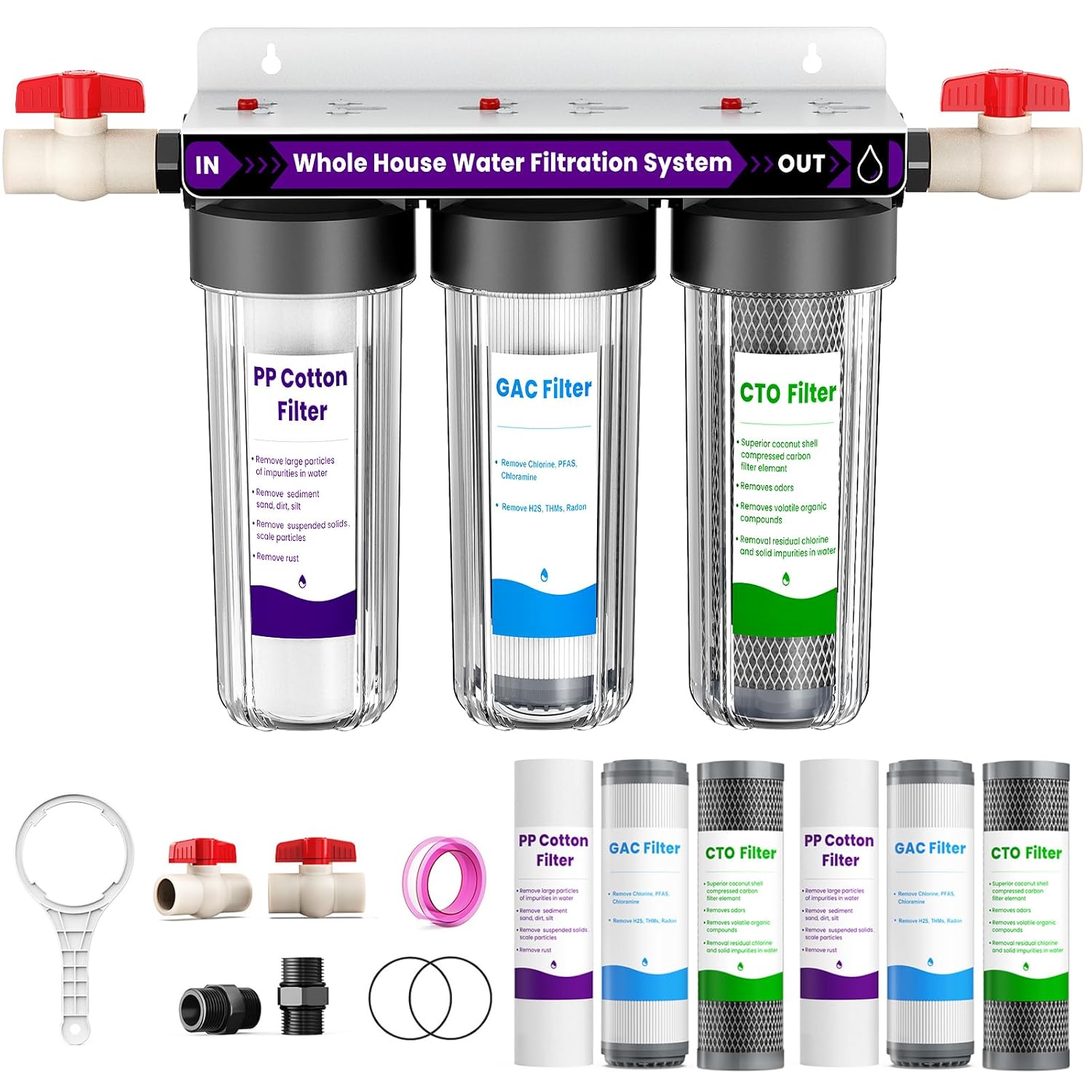
This DYLSDFQ 3-stage whole-house system is designed for point-of-entry use on city or well water and combines a 0.5 micron polypropylene sediment stage, granular activated carbon and CTO polishing cartridges to cut chlorine, sediment and off tastes. It installs inline and supports up to 15 gpm, so it can supply showers, laundry and kitchen taps without a noticeable drop in flow. The clear housings make it easy to inspect trapped debris and the included spare sets (two extra filter sets) cover many months of replacement cycles; cartridges are user-swappable with the supplied wrench and shut-off valves. The system claims to preserve beneficial minerals, so TDS will not change, and dual O-rings aim to prevent leaks. Practical buyers should note this is a mechanical/activated-carbon solution so it will not soften water or remove dissolved salts, and performance depends on incoming water quality and scheduled cartridge changes. For a straightforward, maintenance-friendly whole-home filter for well water, it delivers strong filtration and visible serviceability at a modest installation complexity.
Best for: Buyers who want a practical, easy-to-service whole-home filter that reduces chlorine, sediment and taste issues on well or city water while keeping household flow and simple maintenance top priorities.
Less Ideal for: Homes needing scale control or removal of dissolved minerals and heavy metals should choose a dedicated water softener or specialized treatment instead.
- Three-stage PP+GAC+CTO filtration down to 0.5 micron for sediment, chlorine and taste reduction
- Clear housings let you visually monitor debris and know when to replace cartridges
- Supports up to 15 gpm so it can handle simultaneous household demands
- Includes two extra filter sets and basic installation hardware for long initial service life
- Shut-off valves and wrench make cartridge swaps quick and mostly tool-free
- Does not soften water or remove dissolved salts or high TDS
- Filter life and effectiveness depend on incoming water quality and regular cartridge replacement
Verdict: A straightforward, visibly serviceable 3-stage system that delivers dependable chlorine and sediment removal for well or city whole-home use.
PUREPLUS 2-Stage Whole House Filter

| Capacity | 30000 gallons |
|---|---|
| Purification Method | Polypropylene, Iron Removal, Natural Activated Carbon Block |
| Supported Water TDS Level Maximum (PPM) | 1000 |
| Upper Temperature Rating | 100 °F |
| Included Components | Filtration System, Cartridges, Wrench, Pressure Gauge |
This PUREPLUS 2-stage system pairs a polypropylene/iron-removal composite cartridge with a coconut-activated carbon block to give whole-house pre-filtration suitable for well water. It is installed inline at the main supply and treats water for every faucet and appliance rather than a single point, so you notice reduced sediment, rust staining and chlorine taste throughout the house. The clear 10" housings and included pressure gauges make monitoring cartridge condition straightforward, and the package ships with a wrench and replacement cartridges for initial setup. Performance is practical for homeowners on a budget: the media targets iron, sediment and chlorine but does not replace specialty softening or heavy-duty iron filtration systems. The system is compact and uses standard 10"x4.5" cartridges, which keeps replacement parts common and affordable, though very high iron or turbidity may require more frequent cartridge changes.
Best for: Homeowners with well or municipal water seeking an affordable whole-house pre-filter that cuts sediment, iron traces, chlorine and bad tastes without a large upfront investment.
Less Ideal for: Homes with very high iron, heavy tannins, or extreme hardness that require specialized iron removal systems or a water softener should consider more robust solutions.
- Two-stage filtration combines sediment/iron removal and carbon block for chemical and taste improvement
- Includes pressure gauges and wrench for easy monitoring and maintenance
- Uses standard 10"x4.5" cartridges that are widely available and cost-effective
- Compact clear housings allow visual inspection of cartridge condition
- Not designed to replace a dedicated water softener or high-capacity iron filtration for very heavy contamination
Verdict: A budget-friendly 2-stage whole-house filter that reliably reduces sediment, iron traces and chlorine taste while using common, inexpensive 10" cartridges.
iSpring WGB32B Whole House Filter

| Maximum Flow Rate | 15 gpm |
|---|---|
| Inlet / Outlet | 1 inch Female NPT |
| Operating Pressure Range | 25 – 80 psi |
| Operating Temperature | 40 – 100 °F |
| Capacity | 100000 gallons |
The iSpring WGB32B is a tankless, three-stage whole-house filter built around a 20 x 4.5-inch Big Blue sediment cartridge plus two carbon block stages to tackle chlorine, taste, odor, and visible particulates. It is installed inline at the main water entry and is typically used to protect plumbing, appliances, and faucets while improving water smell and flavor for household use. The system is rated for up to 15 gpm flow and a 100,000-gallon or roughly 12-month filter life, so it can support most homes including well-served rural properties that need chlorine and sediment control but not hardness removal. Practical benefits include high chlorine removal with coconut-shell carbon, multi-layer sediment media to reduce clogs and pressure loss, and DIY-friendly installation with built-in 1-inch NPT connections and online video guidance. Limitations to consider are that it does not soften water or reduce TDS, it requires annual filter replacements under typical use, and indoor installation with freeze protection is recommended for longevity and leak management.
Best for: Homeowners who prioritize reliable, high-flow removal of chlorine, sediment, and odors to protect plumbing and improve tap water taste and who want an installable, low-maintenance whole-house filter.
Less Ideal for: Homes needing hardness reduction, TDS removal, or a compact under-sink solution should consider a water softener, RO system, or point-of-use alternative instead.
- Three-stage filtration combining 5-micron sediment and two coconut-shell carbon block filters for strong chlorine and taste removal
- High flow capacity up to 15 gallons per minute suitable for whole-house supply
- Large 20×4.5-inch cartridges and stated 100,000-gallon/12-month life reduce replacement frequency
- 1-inch female NPT inlet/outlet and DIY installation with video/manual make setup straightforward for competent homeowners
- Lab-tested carbon media and packaged components that ship with wrench and manual for maintenance
- Does not reduce water hardness or lower TDS so a separate softener is needed if hardness is a concern
- Requires annual or cartridge-based maintenance and replacement to maintain performance
- Intended for indoor installation and needs protection/insulation if placed outdoors
Verdict: Choose the iSpring WGB32B when you want a robust, high-flow whole-house filter that reliably removes chlorine, sediment, and odor for year-long service with straightforward DIY installation.
iSpring WGB21B 2-Stage Whole House Filter
| Inlet / Outlet | 1 inch Female NPT |
|---|---|
| Maximum Flow Rate | 15 gpm |
| Operating Temperature | 40-100 °F |
| Filter Life Cycle | 12 months |
| Supported Water TDS Level Maximum (PPM) | 2500 |
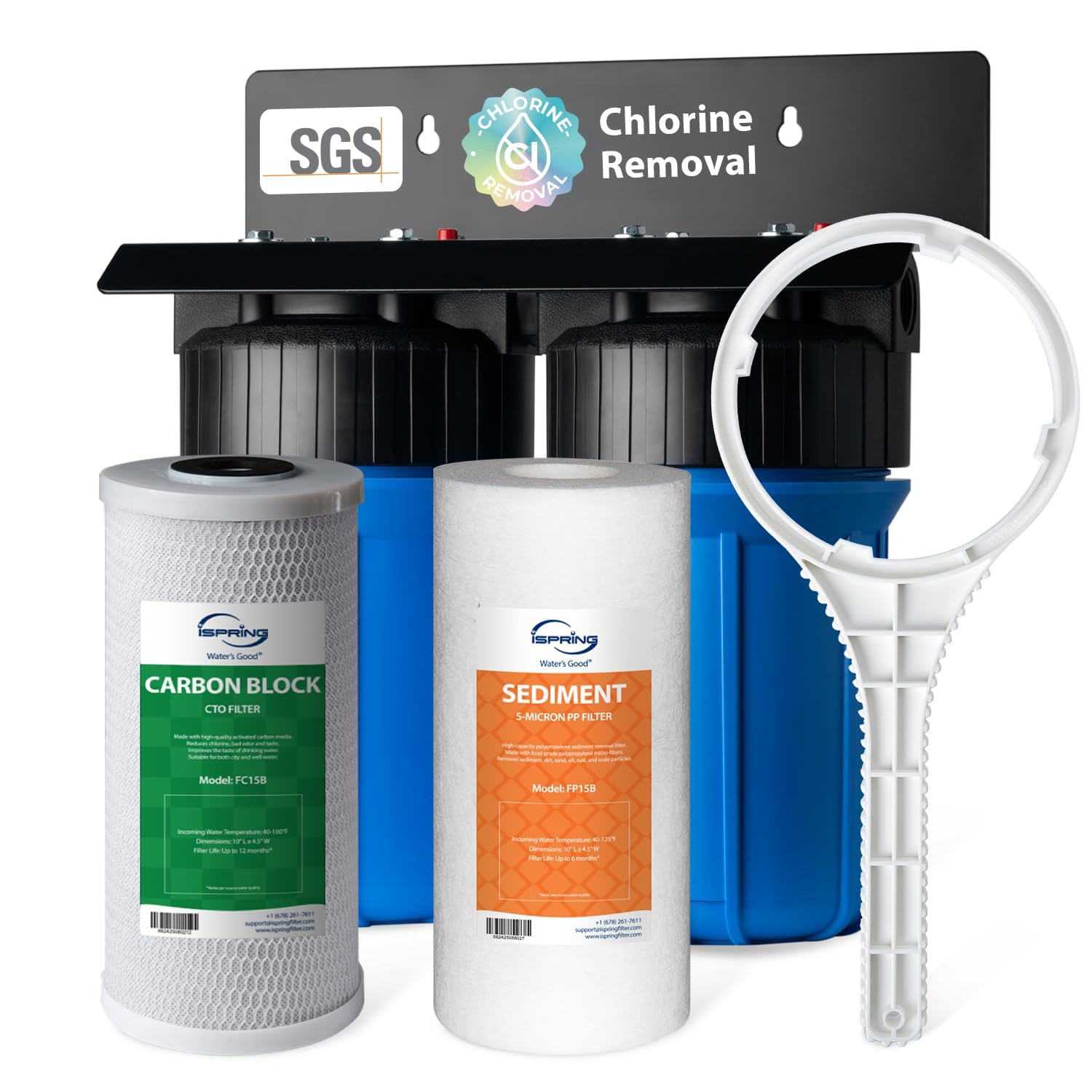
The iSpring WGB21B is a point-of-entry two-stage filter designed to improve water clarity and taste across an entire home. It uses a 5-micron polypropylene sediment cartridge followed by a coconut shell carbon CTO block to capture dirt, rust, and reduce chlorine and many VOCs, which helps protect plumbing and appliances. The unit ships preassembled on a mounting bracket and includes a filter wrench and pressure-release valve to simplify DIY installation and cartridge changes, and standard 1" ports support high flow with minimal pressure loss. Filters are rated for up to about 50,000 gallons or roughly a year of service for a typical family, making maintenance straightforward but still recurring. The system does not lower TDS, so it preserves beneficial minerals but will not address dissolved salts or heavy metals that require RO or specialized media. Built from polyethylene and steel housings and backed by customer support and a one-year limited warranty, it is a practical, serviceable solution for well and municipal supplies needing sediment and chlorine control.
Best for: Homeowners seeking a proven, serviceable whole-house filter to remove sediment, chlorine, and common taste and odor contaminants while preserving minerals and keeping installation mostly DIY-friendly.
Less Ideal for: Homes that need removal of dissolved solids, heavy metals, or nitrate contamination should consider RO systems or specialized media instead of this model.
- Two-stage setup targets both sediment and chlorine/VOC taste and odor issues
- Preassembled bracketed unit with wrench and pressure-release valve simplifies DIY installation and filter changes
- 1" inlet/outlet and 15 gpm max flow support whole-house flow with low pressure loss
- Filters up to about 50,000 gallons / ~12 months, reducing frequency of cartridge swaps
- Made from durable polyethylene and steel housings for long-term use under normal pressure
- Does not reduce total dissolved solids or remove all contaminants like heavy metals or nitrates
- Filter life and performance depend on incoming water quality and may be shorter on very dirty well water
Verdict: A straightforward two-stage whole-house filter that reliably clears sediment and chlorine for homeowners who want DIY installation and year-long cartridge life.
SimPure DB10C 10" x 4.5" Housing
| Outlet / Inlet | 1" NPT Brass Port |
|---|---|
| Compatible Filter | 10" x 4.5" cartridges |
| Maximum Flow Rate | 20 gpm |
| Applicable Water Temperature | 41-104 °F |
| Material Type | Reinforced Polypropylene, Brass |
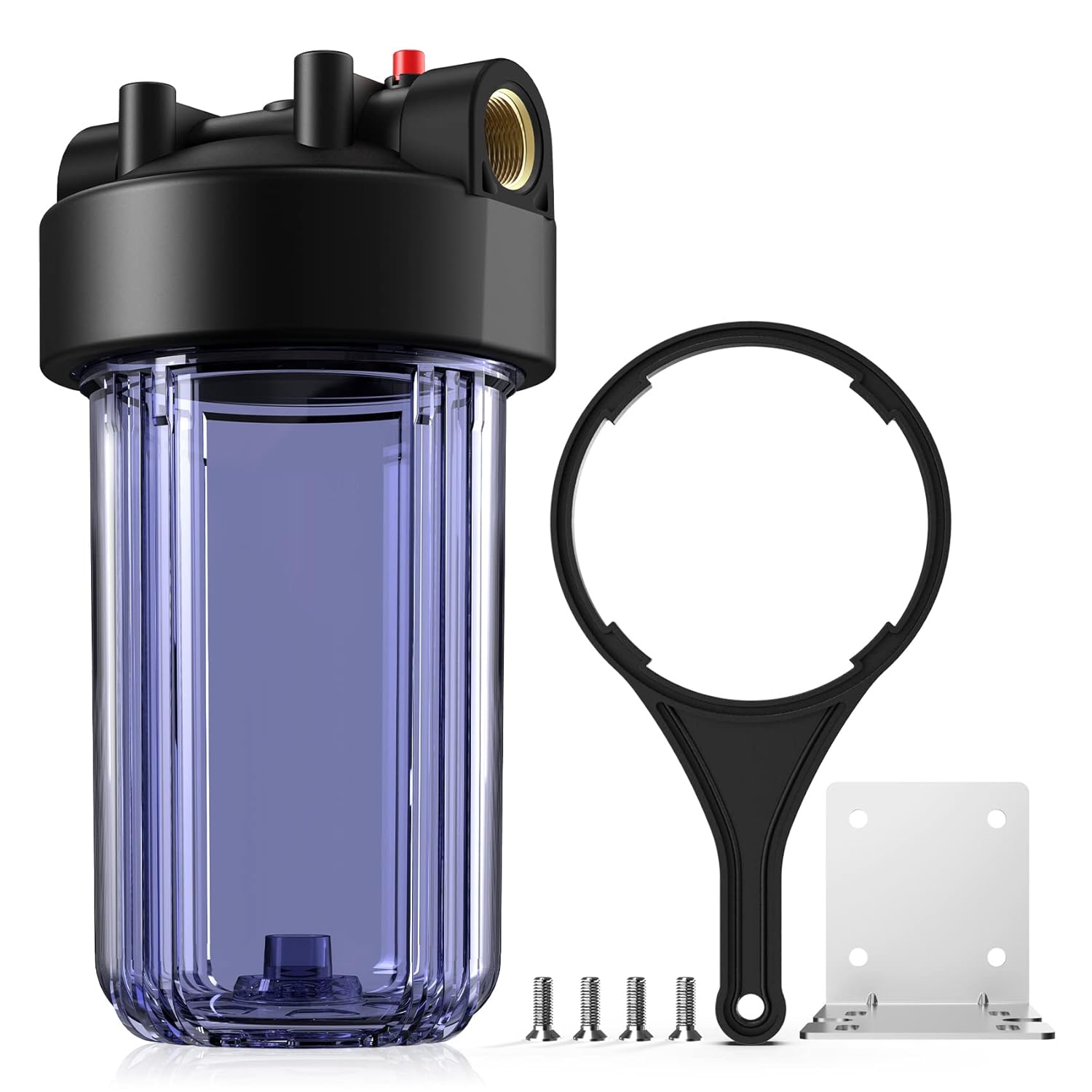
The SimPure DB10C is a single-stage whole-house filter housing intended as a pre-filter for municipal or well water. It accepts standard 10" x 4.5" cartridges such as sediment or granular activated carbon and installs in-line using 1" NPT brass inlet and outlet ports. The clear polypropylene housing makes cartridge condition visible, and the included wrench, heavy-duty mounting bracket, screws, and built-in red pressure-relief button simplify servicing. Brass ports and a double O-ring design reduce leak risk compared with cheaper plastic fittings, and the housing is rated for up to 20 gpm and typical household water temperatures. It does not include cartridges, fittings, or push connectors, so buyers must choose compatible filters for sediment removal or chlorine/taste reduction. The unit is a practical, low-complexity way to protect downstream appliances and provide pre-filtration for well water, but expect to size cartridges and plumbing adapters to your existing system during installation.
Best for: Homeowners who want a dependable, easy-to-service pre-filter for well or municipal water and prioritize leak-resistant hardware and visual cartridge monitoring.
Less Ideal for: People seeking a complete filtration system with cartridges, fittings, and multi-stage treatment already included or those with very tight installation spaces.
- Fits universal 10" x 4.5" cartridges so replacement filters are widely available
- 1" NPT brass inlet/outlet reduces risk of thread damage and improves sealing
- Clear reinforced polypropylene body allows quick visual inspection of cartridge
- Includes wrench, mounting bracket, screws, and built-in pressure-relief button for easier maintenance
- Filter cartridges and any push-fit adapters are not included
- Requires space clearance for a large 10" housing which can complicate some installations
Verdict: Choose the DB10C when you need a robust, easy-to-maintain single-stage housing to protect appliances and provide basic sediment or chlorine pre-filtration for well water.
Choosing the Right Whole-House Water Filter for Home Well Water: Key Factors to Consider
Contaminants Present and Test Results
Start with a certified water test before choosing any whole-house filter. Knowing concentrations of sediment, iron, manganese, hardness, hydrogen sulfide, and microbiological indicators determines which media and prefilters you need. A filter sized only for sediment will not address dissolved iron or coliform risks effectively.
Test results also guide whether you need staged treatment. For example, particulate and turbidity removal is often followed by oxidation and filtration steps for iron and sulfur. Relying on visual assessment alone can lead to undersized or mismatched systems that fail to protect plumbing and deliver the expected water quality.
Flow Rate and Household Demand
Whole-house filters must maintain adequate flow for simultaneous uses like showers and laundry. Calculate peak flow by adding fixture flow rates during busiest periods and choose a system rated above that peak to avoid pressure drops. A filter with excessive head loss will cause weak showers and slow-fill appliances.
Consider future changes such as adding fixtures or an in-law suite. Oversizing the filter housing or selecting a higher-capacity media reduces head loss and extends media life under fluctuating demand, keeping the system reliable over time.
Prefiltration and Sediment Handling
Well water often carries significant sediment and grit that will prematurely clog fine media. A robust prefilter stage protects downstream media, extends service intervals, and reduces maintenance time. Options include washable sediment screens, multi-gradient sediment cartridges, or spin-down strainers ahead of the main filter.
Assess how often prefilters will require cleaning or replacement based on your sediment load. Systems that integrate easy-access housings or automated backwash save effort for homes with heavy particulate loads.
Media Type and Targeted Treatment
Different media are effective for different contaminants. Granular activated carbon reduces organics and improves taste and odor. Manganese greensand or catalytic media can remove iron and hydrogen sulfide when paired with proper regeneration or oxidant dosing. KDF-style media assist with chlorine and some metal control but are not standalone solutions for heavy particulate.
Choose media that match your water test. Some systems allow mixed media beds or staged cartridges that can be tailored, providing flexibility as water quality or household needs change.
Installation, Compatibility With Well Systems, and Space
Whole-house systems vary in size, inlet/outlet orientation, and mounting requirements. Check physical dimensions and ensure pump and pressure tank interactions are accounted for. Certain configurations create additional backpressure that can affect pump cycling if not properly matched to the well system.
Think about access for servicing and cartridge changes. Systems installed in tight basements or crawlspaces require extra clearance for filter removal. Also verify inlet/outlet plumbing sizes to avoid costly rework.
Maintenance Cost and Serviceability
Regular maintenance includes media replacement, cartridge changes, and occasional valve servicing. Estimate annual running cost by adding media replacement frequency, typical cartridge costs, and any regeneration chemicals. Systems with common, readily available replacement parts and clear service instructions reduce long-term expense and downtime.
Prefer designs with straightforward access to replace media or cartridges and systems that support local service technicians if you are not doing DIY maintenance. Automated or backwashing systems often have higher upfront cost but lower ongoing manual maintenance.
Sizing Your System for Real Household Flow
Sizing a whole-house filter requires matching rated flow to your household peak demand. Start by listing fixture flow rates and estimating how many will run at once. Add a safety buffer to cover brief spikes and future family changes.
Choose housings and media volumes that offer lower head loss at your target flow. Larger housings and coarser media lower pressure drop and lengthen service intervals, which often results in a quieter, more reliable system in daily use.
- Measure peak flow in gallons per minute rather than relying on nominal fixture counts
- Select housings with service clearance for easy cartridge removal
- Factor in future expansion when deciding on capacity
Common Well-Water Problems and Treatment Approaches
Well water commonly presents a mix of physical and chemical issues: turbidity and sediment, iron and manganese, sulfur odors, hardness, and intermittent microbial concerns. Each problem has different treatment pathways, so layered solutions are common.
For particulate-heavy water, begin with a sediment stage. For dissolved iron or sulfur, oxidation followed by filtration or media beds designed for those contaminants is typically required. Taste and odor issues are often addressed with activated carbon after particulate and iron control.
- Sediment: mechanical filtration or spin-down strainers
- Iron/sulfur: oxidation plus media filtration
- Taste/odor: activated carbon polishing
Backwashing Vs Cartridge Systems
Backwashing systems periodically reverse flow to clean the media bed and are well-suited to larger homes or heavy particulate loads because they restore capacity without manual cartridge changes. They require proper drain access and slightly more complex controls.
Cartridge systems are simpler and often less expensive upfront. They are better for lighter sediment and homeowners who prefer straightforward cartridge swaps. Cartridge systems can be combined with prefilters to handle moderate sediment loads.
- Backwashing: lower manual maintenance, needs drain and controls
- Cartridge: simpler installation, easier DIY replacement
Dealing With Iron and Hydrogen Sulfide
Dissolved iron and hydrogen sulfide usually need oxidation to convert dissolved forms into filterable particulates, followed by specialized media to trap the oxidized particles. Some systems incorporate media that also reduce sulfur odors.
Correct oxidation method depends on concentration. Aeration, chemical oxidants, or catalytic media are common approaches. Ensure the system you choose is rated for the levels found in your well test and that it allows periodic media maintenance or regeneration.
- Confirm concentrations before selecting an oxidizing approach
- Pair oxidation with a media bed designed for iron/sulfur capture
Installation Tips and Space Considerations
Plan installation near the pressure tank and main water line shutoff. Allow enough vertical space to remove and replace cartridges or access media. Verify inlet and outlet plumbing sizes to avoid adapter headaches.
If the system requires a drain for backwashing, confirm local code for discharge and ensure reliable grade to the drain. Consider vibration isolation and support to reduce stress on fittings and to avoid leaks over time.
- Install upstream shutoff and bypass valve for easy service
- Leave clearance for filter removal and media access
- Confirm drainage route and local code compliance for backwash
How We Chose the Best Whole-House Water Filter for Home Well Water
We focused on systems and configurations designed specifically to address common well-water issues and practical household demands. Our selection filters favored whole-house units that demonstrate robust contaminant removal for well-specific problems such as sediment, iron, manganese, hardness interactions, and common organics. Key evaluation criteria included filtration effectiveness against sediment and common well contaminants, the system's impact on household flow rate and water pressure, maintenance complexity and replacement frequency, and build quality including corrosion-resistant components and serviceability. We also considered compatibility with typical well pumps and the availability of modular media options for tailored treatment. Excluded from consideration were point-of-use devices, countertop or under-sink filters, and systems intended solely for municipal chlorine treatment. We prioritized products that allow clear sizing by flow demand and contaminant load, use industry-standard media, and have accessible service procedures. The final list balances real-world durability, measurable contaminant reduction, and manageable upkeep for homeowners on private wells.
Our full evaluation process is outlined in our review methodology.
FAQ
How often should I test well water when using a whole-house filter?
Test at least once a year for baseline parameters and immediately after any system change or unexplained taste or odor. More frequent testing is wise if you notice visual changes, recurring sediment, or after heavy rains that can affect groundwater.
Can a whole-house filter protect my water heater and appliances?
Yes. Properly selected filtration and sediment removal reduce abrasive particles and scale-forming elements reaching appliances, which can extend service life. The degree of protection depends on filter media and maintenance schedule.
Will a whole-house filter remove bacteria from well water?
Some whole-house systems include disinfection or ultrafiltration stages that reduce bacterial load, but routine microbial contamination often requires dedicated disinfection like UV or chlorination. Match treatment to test results and consult a specialist for persistent microbial issues.
What kind of maintenance should I expect with a whole-house system?
Maintenance ranges from periodic cartridge swaps to scheduled backwash cycles and occasional media regeneration. Expect to clean prefilters more often with high sediment loads and to replace or regenerate media according to manufacturer guidance and observed performance.
How do I know if my filter is causing low water pressure?
Measure flow and pressure before and after the filter. Excessive head loss can occur if the system is undersized, media is clogged, or prefilters are fouled. Increasing housing size, cleaning prefilters, or selecting coarser media can restore pressure.
Final Verdict
Choosing a whole-house water filter for home well water requires balancing the contaminants you need to address with household flow demands and maintenance willingness. Prioritize systems sized for your peak flow, with appropriate prefiltration for sediment and media suited to your water chemistry. Expect some tradeoffs between lower manual maintenance and more complex backwashing equipment. The right choice protects plumbing and improves water quality across the house. Focus on measurable filtration capabilities, realistic maintenance planning, and proper installation to ensure dependable water performance for years to come.