
Note: This article contains affiliate links. If you click on these links and make a purchase, we may earn a small commission at no extra cost to you. This helps support our research and content. Read our full affiliate disclosure here.
If you want consistently better water at your kitchen faucet without swapping multiple under-sink cartridges, a whole-house water filter focused on kitchen faucet delivery can simplify maintenance and improve water quality for cooking and drinking. The right system removes sediment, chlorine taste and common contaminants while preserving faucet flow and minimizing pressure loss. This guide shortlists seven top options optimized for kitchen faucet use and evaluates each by flow performance, contaminant reduction, maintenance needs, and installation practicality. Read on for the criteria we used and the practical tradeoffs to expect when fitting a whole-house filter to your kitchen plumbing.
Top Picks at a Glance
| Best Overall The best all-around choice for most situations | WaterBoss Whole House Filter WB-WH-FILTER |  |
| Best Quality Built to a higher standard if you want something more solid | Express Water 3-Stage Whole House System |  |
| Best Value The sweet spot between price and what you get | DYLSDFQ 3-Stage Whole House Filter |  |
| Best Budget The cheapest option that still gets the job done reliably | A. O. Smith Whole House Sediment Filter AO-WH-PREV |  |
| Top Rated A top-rated pick with lots of positive feedback | iSpring WGB32B-KS Whole House Filter |  |
| Most Popular A crowd favorite that many people choose with confidence | Waterdrop WHF21-PG Whole House Filter |  |
| Best Seller A high-volume bestseller chosen again and again | Waterdrop WHF3T-PG Whole House Filter |  |
WaterBoss Whole House Filter WB-WH-FILTER

| Purification Method | Activated Carbon |
|---|---|
| Maximum Flow Rate | 7 gpm |
| Operating Pressure Range | 20-100 psi |
| Supported Water TDS Level Maximum (PPM) | 600 |
| Filter Life Cycle | 6 years |
The WaterBoss WB-WH-FILTER is a whole-house activated carbon tank that supplies filtered water to every tap without electricity. It is NSF/ANSI 42 certified to reduce up to 96.9% of chlorine taste and odor, and its rated flow of up to 7 gallons per minute keeps normal household water pressure intact for routine use. The unit is supplied as a fiberglass tank with a shut-off valve, nipple, and hose adapter for straightforward installation on standard 3/4" inlet/outlet plumbing. With a stated capacity of 600,000 gallons and a six-year filter life cycle, it is positioned as a low-maintenance option for buyers who want long run-time before media replacement. Practical limits include its targeted reduction of chlorine and organoleptic contaminants rather than broader contaminant removal, and its maximum supported TDS and operating temperature ranges that should be checked against local water conditions. For kitchens primarily seeking improved faucet taste and odor without complex maintenance, this provides a simple, durable solution.
Best for: Homeowners who want consistent, low-maintenance whole-house filtration to improve faucet water taste and odor across the kitchen and other taps.
Less Ideal for: Households that need removal of heavy metals, microbiological contaminants, or specific chemical contaminants should consider systems designed for those targets instead.
- NSF/ANSI 42 certification for chlorine, taste, and odor reduction
- High rated flow up to 7 gpm to maintain household water pressure
- Large service capacity of 600,000 gallons with a 6-year filter life cycle
- Manual operation with no power required and simple included plumbing fittings
- Designed for chlorine and taste/odor reduction only, not for comprehensive contaminant removal
- Operating limits for temperature, pressure, and TDS mean performance depends on local water chemistry
Verdict: Choose this unit if you want a simple, long-lasting whole-house filter that reliably removes chlorine taste and odor from your kitchen faucet and other taps.
Express Water 3-Stage Whole House System

| Purification Method | Activated Carbon, KDF, Polyphosphate |
|---|---|
| Maximum Flow Rate | 17 gpm |
| Operating Pressure Range | 20-80 psi |
| Filter Life Cycle | 6 months |
| Capacity | 100000 gallons |
This Express Water 3-stage system installs as a freestanding unit at your home water inlet to filter all water before it reaches faucets and appliances. It combines sediment and activated carbon stages with KDF and a polyphosphate anti-scale stage to cut chlorine, bad tastes and odors, remove heavy metals and limit scale buildup that damages pipes and fixtures. The package includes a stainless steel stand, pressure gauges and release buttons that make monitoring and cartridge changes straightforward, and the system is manual with no power required. With a rated maximum flow up to 17 gpm and support up to 100,000 gallons per set, it can handle typical household demand without noticeable pressure loss. Limitations to note: it does not reduce total dissolved solids (TDS) and filters are recommended every 6 to 12 months depending on use, so ongoing replacement cost and maintenance are part of ownership. For homeowners wanting point-of-entry protection and reduced chlorine and heavy metals throughout the kitchen and whole house, this system provides robust, practical performance.
Best for: Homeowners focused on protecting kitchen fixtures and household plumbing from chlorine, heavy metals and scale while maintaining strong flow at faucets.
Less Ideal for: Buyers whose primary goal is lowering TDS or producing reverse-osmosis level drinking water should consider an RO system instead.
- Three-stage filtration targeting sediment, chlorine, heavy metals and scale.
- Stainless steel freestanding frame with included pressure gauges for easy monitoring.
- High flow capacity (up to 17 gpm) suitable for whole-house supply without noticeable pressure drop.
- Covers up to 100,000 gallons per filter set and includes pressure relief for simpler cartridge changes.
- Does not reduce total dissolved solids (TDS).
- Requires periodic filter replacement every 6–12 months depending on water usage and quality.
Verdict: Choose this system if you want robust point-of-entry filtration that reduces chlorine, heavy metals and scale across every kitchen faucet while preserving household water flow.
DYLSDFQ 3-Stage Whole House Filter
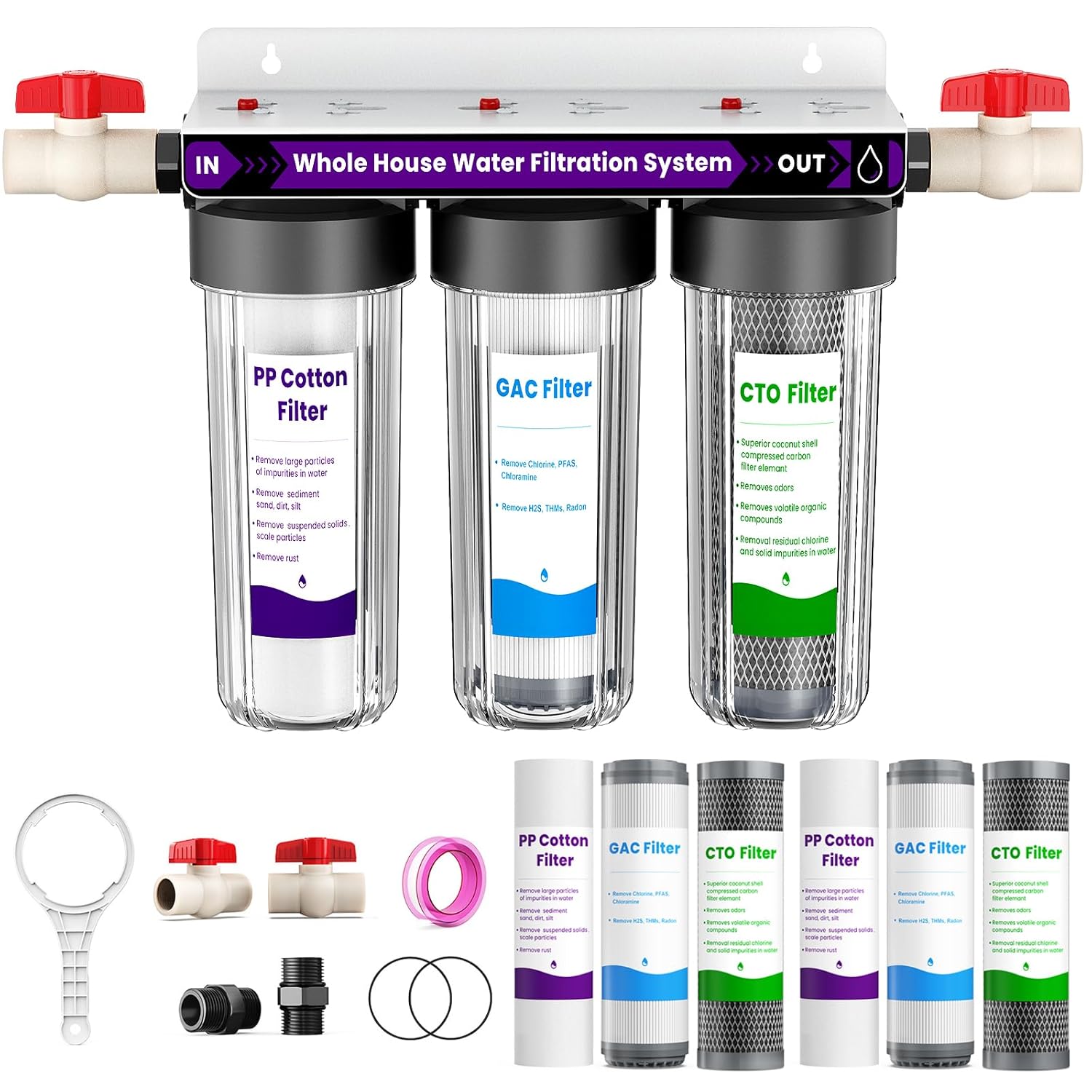
| Filtration rating | 0.5 micron |
|---|---|
| Maximum flow rate | 15 gpm |
| Purification method | Activated Carbon |
| Filter life cycle | 24 months |
| Capacity | 10000 gallons |
This DYLSDFQ three-stage whole-house filter uses PP, GAC, and CTO cartridges to remove sediment, chlorine, taste, and odors before water reaches faucets and appliances. It is designed for straight‑through installation on a main line and delivers up to 15 gallons per minute so showers, laundry, and kitchen faucets keep steady flow. The clear housings make visual inspection easy, and each port has its own shutoff plus double O-ring seals to simplify cartridge changes and reduce leak risk. The kit includes two extra filter sets so you can cover the first 12 to 24 months without buying replacements, and the manufacturer rates cartridges for roughly 4–6 months between changes depending on use. Limitations to note: this is an activated carbon based system and preserves dissolved minerals, so it will not lower TDS or remove dissolved salts, and very high‑contaminant situations may require specialized media or pretreatment. For routine city or well water conditioning it protects appliances and improves taste with straightforward maintenance.
Best for: Buyers wanting a practical, low-maintenance whole‑house filter to improve taste and protect appliances across a kitchen‑focused home setup, with easy visual maintenance and included spare cartridges.
Less Ideal for: Homes that need TDS reduction, water softening, or certified removal of specific contaminants like lead or bacteria should choose a system with targeted media or additional treatment steps.
- Three-stage PP+GAC+CTO filtration for sediment, chlorine, and odor reduction.
- Includes two extra full filter sets so initial replacement needs are covered.
- Clear housings allow quick visual checks of cartridge condition.
- 15 GPM maximum flow supports whole‑house use without noticeable pressure drop.
- Individual shutoff valves and double O-ring seals simplify cartridge changes and reduce leak risk.
- Does not reduce total dissolved solids so it will not soften water or remove dissolved salts.
- Not intended for removal of heavy metals or microbes without additional specialized media.
Verdict: A straightforward three‑stage whole‑house filter that delivers reliable chlorine and sediment reduction with included spare cartridges for low‑fuss, practical protection at the kitchen faucet.
A. O. Smith Whole House Sediment Filter AO-WH-PREV

| Maximum Flow Rate | 6 gpm |
|---|---|
| Operating Pressure Range | 25-100 psi |
| Upper Temperature Rating | 100 °F |
| Supported Water TDS Level Maximum (PPM) | 500 |
| Filter Life Cycle | 6 months |
The A. O. Smith AO-WH-PREV is a simple whole-house sediment filter packaged as a DIY-ready housing, cartridge, and wrench for point-of-entry installation. It is used to remove dirt, rust, silt, and other particulates before water reaches plumbing and appliances, protecting fixtures and downstream filters. Notable features include a clear housing for visual cartridge monitoring, a built-in valve and pressure-release button that let you change the cartridge without shutting off the water, and standard 3/4" inlet/outlet connections for straightforward plumbing. The system is NSF 42 certified for particulate reduction and is passive, using water pressure only so no power is required. Practical benefits include easy filter changes, visible filter condition, and compatibility with both city and well supplies. Limitations are its focus on sediment only—this unit does not reduce dissolved solids, chlorine, or scale—and the cartridge life is limited to about six months or 24,000 gallons depending on water quality. Buyers should expect a basic, cost-effective sediment prefilter rather than an all-in-one water treatment solution.
Best for: Homeowners who want an affordable, entry-level whole-house sediment prefilter to protect faucets and appliances and prefer a DIY install with visible cartridge monitoring.
Less Ideal for: Homes seeking comprehensive contaminants removal, chlorine taste reduction, or scale control should choose a multi-stage or chemical/adsorption system instead.
- Clear housing lets you visually check cartridge condition without disassembly
- Built-in shut-off bypass valve and pressure-release button for easier cartridge changes
- Includes housing, a sediment cartridge, and wrench for DIY installation
- NSF 42 certification for particulate reduction and passive operation requires no power
- Filters only sediment and particulates; does not reduce dissolved solids, chlorine, or hardness
- Cartridge life is limited and will vary by water quality, requiring regular replacements
Verdict: Pick this unit if you need a budget-friendly, easy-to-install whole-house sediment prefilter to protect faucets and appliances from visible particulates.
iSpring WGB32B-KS Whole House Filter

| Maximum Flow Rate | 15 gpm |
|---|---|
| Upper Temperature Rating | 100 °F |
| Filter Life Cycle | 1 years |
| Inlet / Outlet | 1 inch Female NPT |
| Purification Method | Mechanical / Chemical Absorption / Redox |
The iSpring WGB32B-KS is a tankless, three-stage whole-house filter built around a 20-inch Big Blue sediment cartridge, a KDF/adsorption mid-stage for heavy metals, and a coconut shell carbon block for chlorine, taste, and odor removal. It is installed on the main water line to protect plumbing, appliances, and all faucets including the kitchen, and it supports flow rates up to 15 gpm so household water pressure is preserved for normal use. The system is DIY-friendly with a clear manual and online videos and includes a housing wrench for cartridge changes; typical replacement guidance is up to 100k gallons or 12 months depending on water quality. Practical benefits include broad contaminant reduction that keeps cooking and drinking water cleaner without stripping beneficial minerals, and robust filter media that extend service life compared with single-stage units. Limitations are that it does not soften water or lower TDS, and because it is a whole-house assembly it requires space and basic plumbing skill to mount and plumb correctly.
Best for: Buyers seeking a reliable, low-maintenance whole-house filter to consistently reduce heavy metals, chlorine, and sediment across every faucet, prioritizing long filter life and proven contaminant removal.
Less Ideal for: Households that need water softening or TDS reduction as part of the same system should look at combined softener or RO solutions instead.
- Three-stage filtration targets sediment, heavy metals, chlorine, taste, and odor
- Rated for up to 15 gallons per minute so it maintains household flow
- Long filter life up to 100,000–150,000 gallons or about 12 months per cartridge
- Includes housing wrench and DIY installation resources for easier maintenance
- Does not reduce water hardness or lower total dissolved solids
- Requires indoor, protected installation space and basic plumbing for setup
Verdict: Choose the iSpring WGB32B-KS when you want a dependable, long-lasting whole-house filter that consistently removes heavy metals, chlorine, and sediment for clean kitchen faucet water everywhere in the home.
Waterdrop WHF21-PG Whole House Filter

| Purification Method | Granular Activated Carbon, Sedimentation |
|---|---|
| Maximum Flow Rate | 15 gpm |
| Operating Pressure Range | 25 psi |
| Upper Temperature Rating | 100 °F |
| Filter Life Cycle | 6 months |
The Waterdrop WHF21-PG is a 2-stage, 5-micron whole-house filtration system built around a PP sediment cartridge and a granular activated carbon (GAC) carbon stage. Install it on the main cold-water line to remove sand, rust, chlorine taste and smell, and reduce certain heavy metals before water reaches faucets and appliances. The system is designed for steady household flow up to 15 gallons per minute and uses food-grade, NSF/ANSI-approved components and a durable housing tested for common residential pressures. Filters are user-replaceable with the included wrench and the manufacturer recommends changing the GAC about every six months and the sediment cartridge every 3 to 6 months depending on water quality. Because it is a non-powered, inline unit it is low maintenance and will not affect water heating or require electricity, but it does not address very fine particulates below 5 microns, microbiological contaminants, or specialized contaminants like iron removal in some well water scenarios. For kitchen faucet protection and better tasting tap water, it provides reliable mechanical and carbon filtration at a household scale.
Best for: Buyers who want a proven, low-maintenance point-of-entry filter to improve tap taste and protect kitchen fixtures while relying on community-tested performance and social proof.
Less Ideal for: Homes needing removal of bacteria, viruses, or very fine particulates below 5 microns or properties with high iron/manganese where specialized media are required.
- Reduces sediment, chlorine, lead, and common tastes and odors with a 2-stage PP plus GAC setup
- Supports household flow rates up to 15 gpm so faucets and appliances keep usable pressure
- No electricity required so it runs continuously and reliably during power outages
- Includes installation wrench and replacement cartridges for DIY filter changes
- 5-micron rating does not remove very fine particulates or most microbes
- Recommended cartridge changes every 3–6 months create recurring maintenance needs
Verdict: A reliable, nonpowered whole-house 2-stage filter that improves faucet water taste and protects fixtures with straightforward DIY installation and proven household flow performance.
Waterdrop WHF3T-PG Whole House Filter

| Purification Method | Activated Carbon, Ion Exchange |
|---|---|
| Maximum Flow Rate | 15 gpm |
| Filter Life Cycle | 12 months |
| Supported Water TDS Level Maximum (PPM) | 1000 |
| Capacity | 100000 gallons |
The Waterdrop WHF3T-PG is a point-of-entry, three-stage whole-house filter designed to remove sediment, chlorine taste and odor, and some heavy metals using a combination of PP prefilter, KDF and granular activated carbon media. It installs on the main line with 1" ports and is intended to run at up to 15 gallons per minute, so it can supply a kitchen faucet and other fixtures without noticeable pressure loss in typical homes. The unit is built from NSF/ANSI 372 certified lead-free components and the filter cartridges are rated for up to 12 months or about 100,000 gallons under normal conditions, which keeps maintenance simple for cautious buyers. Practical limits: it is not an RO system, so it does not reduce TDS or soften hard water, and actual filter life and flow depend on household water quality and demand. The system is straightforward to install for someone comfortable with plumbing or can be fitted by a pro, and it helps protect downstream appliances and fixtures from sediment and chlorine-related issues.
Best for: Buyers who prioritize safer, clearer tap water for drinking and cooking and want a low-maintenance whole-house point-of-entry filter that reliably reduces chlorine and sediment.
Less Ideal for: Homes needing water softening or RO-level contaminant removal, or very high-demand households that require specialist high-flow or multi-stage treatment beyond basic whole-house filtration.
- Three-stage filtration combining sediment, KDF, and granular activated carbon for broad chlorine and particulate reduction
- NSF/ANSI 372 certified lead-free components for safer contact with potable water
- Rated 15 gpm maximum flow suitable for supplying a kitchen faucet and typical household fixtures
- Filter life up to 12 months or ~100,000 gallons reduces replacement frequency
- Includes three cartridges and basic installation hardware to get the system running
- Does not reduce total dissolved solids or act as a water softener
- Performance and lifespan depend on incoming water quality and household demand rather than fixed guarantees
Verdict: A simple, NSF-certified three-stage whole-house filter that gives risk-averse buyers clearer, lower-chlorine water to the kitchen faucet with minimal annual maintenance.
Choosing the Right Whole-House Water Filter for Kitchen Faucet: Key Factors to Consider
Flow Rate and Peak Demand
Flow rate matters because kitchen tasks often require strong, steady water pressure for filling pitchers, rinsing produce, or using a pull-down sprayer. A whole-house filter sized for faucet delivery should maintain adequate gallons per minute (GPM) at typical household pressures so you do not notice a slow trickle when running the tap.
Look for rated flow numbers that reflect realistic residential conditions. Consider peak simultaneous use in your home; if someone is using a shower while you need full faucet flow, a system with higher rated flow or a bypass option will prevent frustrating slowdowns.
Contaminant Reduction Targets
Different filters focus on different contaminants. For kitchen faucet use, you typically prioritize chlorine taste and odor, sediment, and any locally relevant chemical or heavy-metal concerns. Verify which substances a system reduces and whether those reductions are certified by an independent lab.
Know your water source and test results before choosing a system. Municipal water supplies often need chlorine and particulate removal, while private wells may require treatment for iron, manganese, or microbial hazards. Choose a filter media that addresses the issues most likely to affect taste, safety, and appliance longevity at the kitchen faucet.
Filter Lifespan, Replacement Frequency, and Running Cost
Replacement intervals and cartridge costs determine the long-term expense and hassle of owning a whole-house filter. Filters with longer rated lifespans reduce the frequency of service but may cost more up front. Low-cost cartridges that require monthly swapping can add significant annual expense and time.
Consider whether you can perform cartridge changes yourself or prefer a plumber. Check availability of replacements and whether the system uses common cartridge sizes or proprietary parts. Factor both parts cost and the expected hours of labor into your decision.
Installation Complexity and Space Requirements
Installation affects total cost and feasibility. Some whole-house systems are straightforward inline installations near the main shutoff, while others require additional fittings, mounting brackets, or pre-filters. The location relative to the kitchen and available clearance for filter housings will influence the ease of installation.
If you want a DIY-friendly solution, prioritize systems with simple plumbing connections and clear instructions. For tight mechanical rooms, compact housings or remote mounting options are useful. Also confirm whether the system needs a dedicated bypass valve to service the filter without interrupting water to the home.
Impact on Water Pressure and Plumbing
Any whole-house filter adds restriction to flow. Excessive pressure drop can damage appliances or cause poor faucet performance. Look for systems with low head loss specifications and options to adjust or bypass the filter during high-demand periods.
Be mindful of your home's existing pressure-regulating valves and whether the filter will require changes to maintain safe operating pressures. A pressure gauge upstream and downstream of the filter can help monitor real-world performance after installation.
Materials, Seals, and Maintenance Accessibility
Durability depends on housing materials, seal quality, and how easy it is to access internals for service. Metal housings offer extra protection in tight spaces, while quality polymer housings resist corrosion. Reliable O-rings and easily accessible drain ports simplify cartridge swaps and winterization.
Consider whether the manufacturer documents routine maintenance steps clearly and whether spare O-rings and wrench tools are provided. Good documentation reduces the risk of leaks due to improper reassembly and extends the effective life of the system.
Where to Install for Best Kitchen Faucet Performance
Placement matters for both performance and convenience. Install the whole-house filter as close to the main supply line as practical while preserving a short, dedicated run to the kitchen faucet to minimize pressure loss and particulate settling between the filter and tap.
If the mechanical room or basement is far from the kitchen, consider a parallel run or local point-of-entry arrangement that keeps the filtered line short. Ensure there is room for routine cartridge changes and space to use the housing wrench if required.
- Mount near the main shutoff for easy isolation
- Allow clearance below housings for cartridge removal
- Avoid long unfiltered runs between the filter and faucet
Balancing Filtration Media Types for Taste and Safety
Carbon filtration excels at improving taste and removing chlorine, while sediment pre-filters protect downstream media and faucets. Some systems layer media to address multiple concerns, but layered filters can increase pressure drop if not sized correctly.
Choose media combinations that match your water test results. For example, if discoloration or grinding sediment is present, include a robust sediment stage; if heavy metals are a local concern, select certified media designed for those contaminants.
- Carbon for taste and chlorine reduction
- Sediment stages protect faucets and extend media life
- Specialty media target specific contaminants when needed
Maintaining Consistent Flow Over Time
Clogging and media exhaustion gradually reduce flow. Look for systems with clear replacement indicators, easy bypass valves, or parallel housings that allow one cartridge to be serviced while the other remains online. Regular maintenance schedules based on household water usage prevent sudden slowdowns at the kitchen faucet.
If you expect variable water quality across seasons, choose larger-capacity housings or modular systems that let you add pre-filtration temporarily during high-sediment periods.
- Use pressure gauges to detect rising head loss
- Replace cartridges on a calendar or gallons-used schedule
- Consider dual-housing setups for uninterrupted service
DIY Vs Professional Installation Considerations
Some whole-house filters are designed for straightforward DIY installation with standard plumbing fittings and clear instructions. If your piping uses uncommon fittings or is in a tight space, professional installation ensures proper sealing and compliance with local codes.
Also consider warranty and service implications. Systems that are hard to access or require specialized tools are better left to a licensed plumber, while simple housings with clip-on brackets suit handy homeowners.
- Check local plumbing codes before DIY work
- Plan shutoff and bypass strategy in advance
- Reserve professional help for complex piping or pressure issues
Testing and Monitoring After Installation
After installing a whole-house filter for kitchen faucet use, run the faucet and test taste, clarity and pressure under normal conditions. Take baseline readings of flow and pressure to compare over time and confirm the filter is not introducing unacceptable head loss.
Regularly inspect housings for leaks and keep a replacement cartridge on hand. If you relied on third-party certifications for contaminant reduction, follow the recommended sampling schedule to ensure continued performance.
- Establish baseline flow and pressure numbers
- Inspect seals after first week of operation
- Keep spare cartridges and basic tools accessible
How We Chose the Best Whole-House Water Filter for Kitchen Faucet
We shortlisted systems that are appropriate for supplying a kitchen faucet from a whole-house filtration point without causing noticeable drops in flow or undue maintenance burden. Primary evaluation criteria focused on measured flow capacity at kitchen taps, certified contaminant reduction (sediment, chlorine, lead where applicable), filter life and maintenance frequency, and compatibility with typical residential water pressures and plumbing layouts. We also considered ease of installation for a homeowner or plumber, availability of replacement cartridges and clear maintenance instructions, and build quality of housings and seals. We excluded point-of-use only devices and systems that are too large or too slow for faucet delivery. Systems that require complex continuous regeneration or proprietary service contracts were deprioritized. Across all candidates we looked for clear specification data, third-party test or certification claims, realistic filter lifespans, and straightforward installation paths. The scoring emphasizes real-world faucet performance, long-term operating cost factors, and user-facing serviceability.
Our full evaluation process is outlined in our review methodology.
FAQ
Will a whole-house filter affect my kitchen faucet water pressure?
Often there will be a small pressure drop, but well-sized systems specify low head loss and should not noticeably reduce faucet performance. Pressure impact depends on the system's rated flow, inlet pressure, and cartridge condition.
How often will I need to change filters if I use it for the kitchen faucet?
It usually depends on household water usage and incoming water quality. Expect replacement intervals ranging from a few months for fine sediment cartridges to a year or more for larger carbon blocks; follow the manufacturer's gallons-used guidance.
Can I install a whole-house filter myself?
Sometimes. Systems with standard fittings and clear instructions are DIY-friendly, but complex piping, lack of shutoff valves, or local code requirements often make professional installation the safer choice.
Do whole-house filters remove chlorine taste at the kitchen faucet?
Many carbon-based whole-house filters reduce chlorine taste and odor effectively. Confirm the system includes an appropriate carbon stage and check any available third-party reduction data for chlorine.
How do I know which contaminants to prioritize for my kitchen faucet?
Start with a water test from your supply to identify common issues like chlorine, sediment, iron, or heavy metals. Prioritize filters that target contaminants affecting taste and safety for drinking and cooking.
Final Verdict
When choosing a whole-house water filter for kitchen faucet delivery, prioritize systems that preserve faucet flow while targeting the contaminants most relevant to your water supply. Balance upfront capacity and media type against long-term cartridge cost and maintenance access. Pay particular attention to rated flow, head loss, and clear installation instructions so you can maintain consistent water pressure and quality. Ultimately, pick a system that matches your kitchen routines and water test results: a modestly higher upfront capacity and easy serviceability often yield the best day-to-day experience at the faucet.