
Note: This article contains affiliate links. If you click on these links and make a purchase, we may earn a small commission at no extra cost to you. This helps support our research and content. Read our full affiliate disclosure here.
Picking the right whole-house water filter matters because it affects every tap and appliance in your home. The right system reduces contaminants, protects plumbing and fixtures, and keeps water taste and odor consistent across showers, kitchens, and laundry. This guide shortlists seven well-matched whole-house water filters and explains how they perform on the factors that matter for residential systems. Below we evaluate filtration effectiveness, flow capacity, maintenance needs, and installation considerations so you can match a system to your home's water quality and daily demand.
Top Picks at a Glance
| Best Overall The best all-around choice for most situations | iSpring WGB32BM 3-Stage Whole House Filter |  |
| Best Quality Built to a higher standard if you want something more solid | Aquasana Rhino WH-1000-CS-UVS-B |  |
| Best Value The sweet spot between price and what you get | Waterdrop Whole House Filter WD-WHF21-PG |  |
| Best Budget The cheapest option that still gets the job done reliably | iFilters LWH-D 2‑Stage Whole House Filter |  |
| Top Rated A top-rated pick with lots of positive feedback | iSpring WGB32B 3-Stage Whole House Filter |  |
| Most Popular A crowd favorite that many people choose with confidence | Culligan WH-HD200-C Whole House Filter |  |
| Best Seller A high-volume bestseller chosen again and again | SimPure DB10C 10" x 4.5" Housing |  |
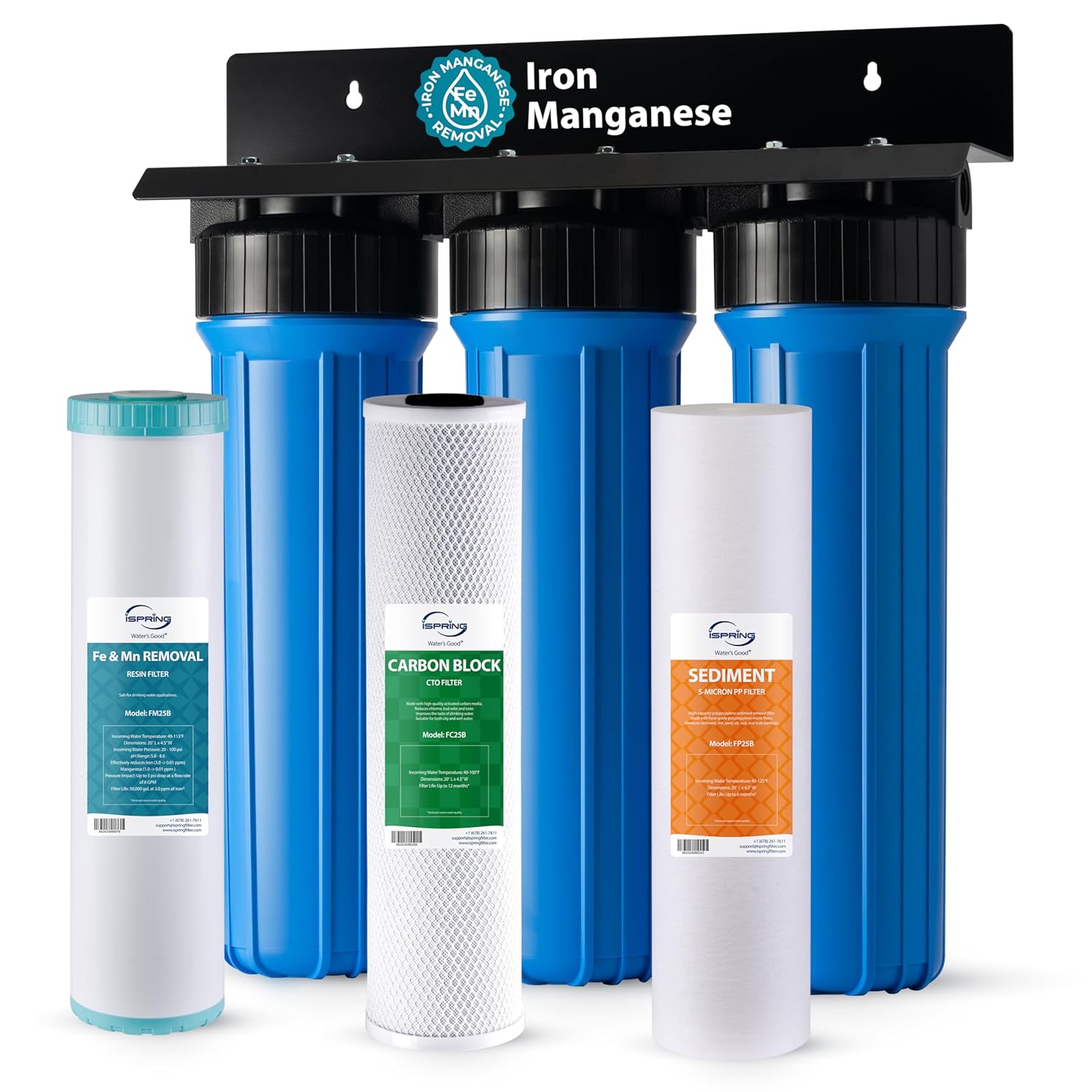
iSpring WGB32BM 3-Stage Whole House Filter
| Maximum Flow Rate | 15 gpm |
|---|---|
| Operating Pressure Range | 25 – 80 psi |
| Operating Temperature | 40 – 100 °F |
| Filter Life Cycle | 1 years |
| Inlet / Outlet | 1 inch NPT |
The iSpring WGB32BM is a tankless, permanent whole-house filtration system designed to sit on the main water line and treat water for an entire home. It uses a three-stage cartridge arrangement: a polypropylene big-blue sediment stage to capture sand, rust, and visible particulates, a coconut-shell carbon block to cut chlorine, taste and odor, and a catalytic iron/manganese stage that lowers iron and manganese to near 0.01 ppm within its rated inlet limits. The unit supports high flow (up to 15 gpm) with minimal pressure loss and accepts 1-inch NPT plumbing for straightforward installation in most setups. Filters are high-capacity and advertised to last up to 100,000 gallons or about 12 months under typical conditions, and replacement cartridges are available individually. Important limits are that the iron/manganese stage is rated for specific maximum inlet concentrations (iron up to 3.0 ppm, manganese up to 1.0 ppm) and the system does not soften water or remove dissolved solids, so a separate softener is recommended for very hard water. DIY installation is possible but indoor, protected mounting is advised to avoid weather exposure.
Best for: Buyers who want a high-capacity, whole-home filter that removes visible sediment, chlorine taste and odor, plus modest iron and manganese levels while preserving healthy minerals in tap water.
Less Ideal for: Homes with very high iron or manganese concentrations or those who need hardness reduction or TDS removal should choose a targeted iron-manganese system or add a water softener or RO system instead.
- Three-stage filtration that addresses sediment, chlorine/taste/odor, and iron/manganese.
- High flow capacity up to 15 gallons per minute with minimal pressure loss.
- High-capacity cartridges rated up to 100,000 gallons or about 12 months between changes.
- 1-inch NPT fittings and DIY-friendly design with included wrench and online install resources.
- Catalytic iron/manganese media reduces iron and manganese efficiently without frequent media replacement.
- Does not reduce water hardness or total dissolved solids, so a separate softener is needed for hard water.
- Iron/manganese removal is limited to inlet concentrations at or below the specified maxima.
- Manufacturer warranty is limited to one year.
Verdict: Choose the WGB32BM when you want a DIY-friendly, high-flow whole-house filter that removes sediment, chlorine, and moderate iron/manganese while leaving healthy minerals in your water.
Aquasana Rhino WH-1000-CS-UVS-B

| Maximum Flow Rate | 14.6 gpm |
|---|---|
| Operating Pressure Range | 20-100 psi |
| Supported Water TDS Level Maximum (PPM) | 500 |
| Filter Life Cycle | 10 years |
| Power Source | Corded Electric |
The Aquasana Rhino WH-1000-CS-UVS-B is a comprehensive whole-house system installed at the main water line to deliver filtered water throughout a home. It sequences a 20-inch sediment pre-filter, activated carbon and copper-zinc KDF media, a salt-free scale conditioner, post-filtration, and an NSF-tested UV unit to reduce chlorine, sediment, organic particles, scale, bacteria, and viruses. The system is sized for long-life performance — Aquasana rates it for up to 1,000,000 gallons or 10 years under rated conditions — which lowers ongoing maintenance frequency compared with shorter-life systems. The salt-free conditioner helps limit scale without salt or backwashing, while the UV stage provides an added barrier against microbial contamination certified to NSF/ANSI 55 Class B. Practical limits include operating conditions for best performance (recommended hardness and iron levels) and the physical footprint and plumbing work needed for a whole-house install, so professional installation is common. For buyers prioritizing long-term contaminant reduction and microbial protection across every tap, the Rhino delivers a robust, low-maintenance option.
Best for: Homeowners who want a high-performance, long-life whole-house system that reduces chlorine, particulates, scale, and microbes across every tap and are willing to invest in a permanent installed solution.
Less Ideal for: Renters or buyers who need a compact, portable, or no-plumbing filtration option or those with very hard or high-iron well water that exceeds the system's recommended operating ranges.
- Multi-stage filtration includes pre-filter, carbon, KDF media, salt-free conditioner, post-filter, and UV for broad contaminant reduction
- Long rated service life of up to 1,000,000 gallons or 10 years reduces replacement frequency
- UV treatment certified to NSF/ANSI Standard 55 Class B for bacteria and virus sterilization
- Salt-free scale control protects pipes and appliances without salt, backwashing, or drain lines
- Requires significant space and professional plumbing for whole-house installation
- Performance depends on input water chemistry and is optimized within specified hardness and iron ranges
Verdict: Choose the Rhino WH-1000-CS-UVS-B if you want a long-life, factory-quality whole-house system that combines broad contaminant reduction with UV microbial protection for every tap.
Waterdrop Whole House Filter WD-WHF21-PG

| Purification Method | Granular Activated Carbon, Sedimentation |
|---|---|
| Filtration Precision | 5 Micron |
| Maximum Flow Rate | 15 gpm |
| Filter Life Cycle | 6 months |
| Upper Temperature Rating | 100 °F |
The Waterdrop WHF21-PG is a two-stage, 10"x4.5" whole-house filtration system built around a PP sediment cartridge and a granular activated carbon (GAC) cartridge to capture particles down to 5 microns and reduce chlorine, lead, strange tastes and odors. It is installed on the main water line to protect plumbing and appliances and keep tap water tasting better throughout a home. The GAC uses coconut-shell carbon for improved taste, and the housing and components are rated for typical residential pressure and temperatures without needing power. Filter life is roughly 3–6 months for the sediment cartridge and about six months for the GAC under municipal water use, and the unit supports flows up to 15 gallons per minute so it should not noticeably restrict household supply. Setup is intended to be user-installable with the included wrench and hardware, though proper Teflon tape techniques and basic plumbing skills are required. Expect routine cartridge changes and occasional space and mounting considerations during installation; this is a practical, no-frills whole-house option rather than a multi-stage specialty system for hard well water or heavy iron removal.
Best for: Buyers who want a straightforward whole-house filter to improve tap water taste and protect plumbing without professional installation and who prioritize reliable everyday performance and low upfront complexity.
Less Ideal for: Homes with untreated well water, high iron or manganese levels, or buyers who need specialist heavy-metal removal beyond lead reduction should consider more advanced multi-stage systems.
- Reduces sediment, chlorine, lead and common tastes/odors with 5-micron filtration
- GAC cartridge made from coconut shell improves water taste
- Supports up to 15 gpm to maintain normal household flow
- DIY-friendly installation with included wrench and mounting hardware
- NSF/ANSI approved components listed for material quality
- Filters require regular replacement (sediment every 3–6 months, GAC about 6 months)
- Does not target heavy iron, manganese, or specialized well-water contaminants
Verdict: A practical, easy-to-install whole-house two-stage filter that reliably improves taste and protects plumbing for municipal water systems.
iFilters LWH-D 2‑Stage Whole House Filter

| Purification Method | Granular Activated Carbon, Sedimentation |
|---|---|
| Maximum Flow Rate | 3 gpm |
| Supported Water TDS Level Maximum (PPM) | 500 |
| Capacity | 11.4 liters |
The iFilters LWH-D is a straightforward point-of-entry two-stage filter that combines depth-graded polypropylene sediment filtration with coconut shell activated carbon to tackle dirt, rust, sand and common chlorine taste and odor. It installs inline or under-sink using standard 3/4" NPT ports and the clear housings let you visually inspect cartridge condition, while the integrated pressure-relief button makes replacements easier. Typical use is whole-home pre-filtration to protect fixtures, water heaters, washers and dishwashers and to improve drinking and bathing water quality without addressing dissolved solids. The system flows up to 3 gpm and is intended for small to medium homes; cartridges are designed to be changed roughly every six months depending on water quality. Limitations include no TDS reduction and compatibility notes around two filter gasket generations, so confirm replacement parts before ordering. For buyers focused on basic sediment and chlorine control who want a compact, serviceable unit, this delivers practical performance on a modest budget.
Best for: Buyers who want an affordable, easy-to-service whole-house pre-filter that improves water clarity and reduces chlorine taste and odor across a small to medium home.
Less Ideal for: Homes that need TDS reduction, heavy chemical contaminant removal, or high-flow commercial demand should consider more advanced multi-stage or RO systems instead.
- Two-stage design pairs depth sediment filtration with activated carbon for sediment and chlorine reduction
- Clear housings provide easy visual monitoring of filter condition
- Standard 3/4" NPT ports and pressure relief button simplify installation and cartridge changes
- Compact footprint suitable for point-of-entry or under-sink installations
- Designed replacement filter set available for consistent maintenance
- Does not reduce total dissolved solids (TDS) or provide RO-level purification
- Replacement compatibility varies by gasket generation, requiring care when ordering cartridges
Verdict: A cost-conscious, compact two-stage whole-house pre-filter that reliably reduces sediment and chlorine taste and odor for small to medium homes.
iSpring WGB32B 3-Stage Whole House Filter

| Maximum Flow Rate | 15 gpm |
|---|---|
| Inlet / Outlet | 1 inch Female NPT |
| Operating Pressure Range | 25 – 80 psi |
| Operating Temperature | 40 – 100 °F |
| Capacity | 100000 gallons |
The iSpring WGB32B is a tankless three-stage whole-house filter designed to deliver cleaner, chlorine-free water to every tap. It uses a 5-micron polypropylene sediment stage followed by two coconut-shell carbon block stages to cut chlorine, tastes, odors, and common chemical contaminants while preserving beneficial minerals. Built with industrial 20 x 4.5-inch cartridges and 1-inch NPT plumbing, the system supports up to 15 gpm flow and is intended for DIY installation with supplied wrench and online guides. Practical benefits include long filter life (up to 100,000 gallons or about 12 months under typical use), strong flow for simultaneous fixtures, and lab-tested chlorine removal that improves water taste and protects appliances. Limitations are that it does not soften water or reduce TDS, so homes with hard water should pair it with a softener, and the unit requires indoor, protected installation and occasional filter changes and disposal of used cartridges. For buyers prioritizing reliable whole-home chlorine and sediment control, this model is a straightforward, serviceable choice.
Best for: Buyers who want a dependable, low-maintenance whole-house filter that prioritizes chlorine, sediment, and taste removal while keeping strong household water flow.
Less Ideal for: Homes that need scale reduction or TDS removal as their primary concern should choose a dedicated water softener or reverse osmosis system instead.
- Three-stage filtration (sediment plus two carbon block stages) removes chlorine, tastes, odors, and particulates.
- Industrial 20×4.5-inch cartridges and 1-inch inlet/outlet support up to 15 gpm for whole-home flow without major pressure loss.
- Long rated capacity up to 100,000 gallons or about 12 months between filter changes under typical conditions.
- DIY-friendly installation with included wrench, manual, and online video guidance.
- Does not remove hardness or lower TDS, so it will not replace a water softener or RO system.
- Requires indoor, sheltered installation and occasional cartridge replacement and maintenance.
Verdict: Choose the iSpring WGB32B if you need a reliable, high-flow whole-house system that consistently removes chlorine, sediment, and odors for better-tasting water throughout your home.
Culligan WH-HD200-C Whole House Filter

| Maximum Flow Rate | 10 gpm |
|---|---|
| Supported Water TDS Level Maximum (PPM) | 600 |
| Capacity | 16000 gallons |
| Material Type | Stainless Steel |
The Culligan WH-HD200-C is a stainless-steel capped whole-house filter housing meant to protect plumbing and appliances from sediment and scale when paired with a compatible cartridge (cartridge sold separately). It installs inline at a 1-inch main and includes a mounting bracket, built-in shut-off and bypass valve, pressure relief, and a housing wrench for easier servicing. The clear sump makes it simple to inspect the cartridge and watch how the filter is performing, and the unit is rated for up to 10 gpm flow and up to 16,000 gallons capacity with the right cartridge. Its heavy-duty construction and WQA-tested cap help ensure a tight seal and long service life. The main limitation is that filtration performance depends entirely on the choice of cartridge, so you must buy the correct replacement filter for the contaminants you need to remove; also the unit requires a 1-inch main so it will not fit smaller service lines without adapters. For homeowners focused on robust sediment protection and appliance longevity, this is a straightforward, serviceable whole-house housing.
Best for: Homeowners who want a durable, easy-to-service whole-house housing to protect plumbing and appliances from sediment and who value visible cartridge inspection and integrated service valves.
Less Ideal for: Buyers seeking an all-in-one filtration solution with cartridges included or those with smaller-than-1-inch service lines should consider alternative systems or adapters.
- Durable stainless-steel cap and heavy-duty housing for long-term service
- Clear sump lets you visually inspect cartridge condition without disassembly
- Includes built-in shut-off, bypass valve, pressure relief, mounting bracket, and wrench for easier maintenance
- Rated for up to 10 gallons per minute flow to handle typical household demand
- Filter cartridge is sold separately so needed filtration media and cost vary by application
- Requires a 1-inch inlet/outlet, so plumbing adapters may be needed for other pipe sizes
Verdict: Choose the WH-HD200-C when you need a rugged, serviceable whole-house filter housing that makes cartridge inspection and maintenance simple.
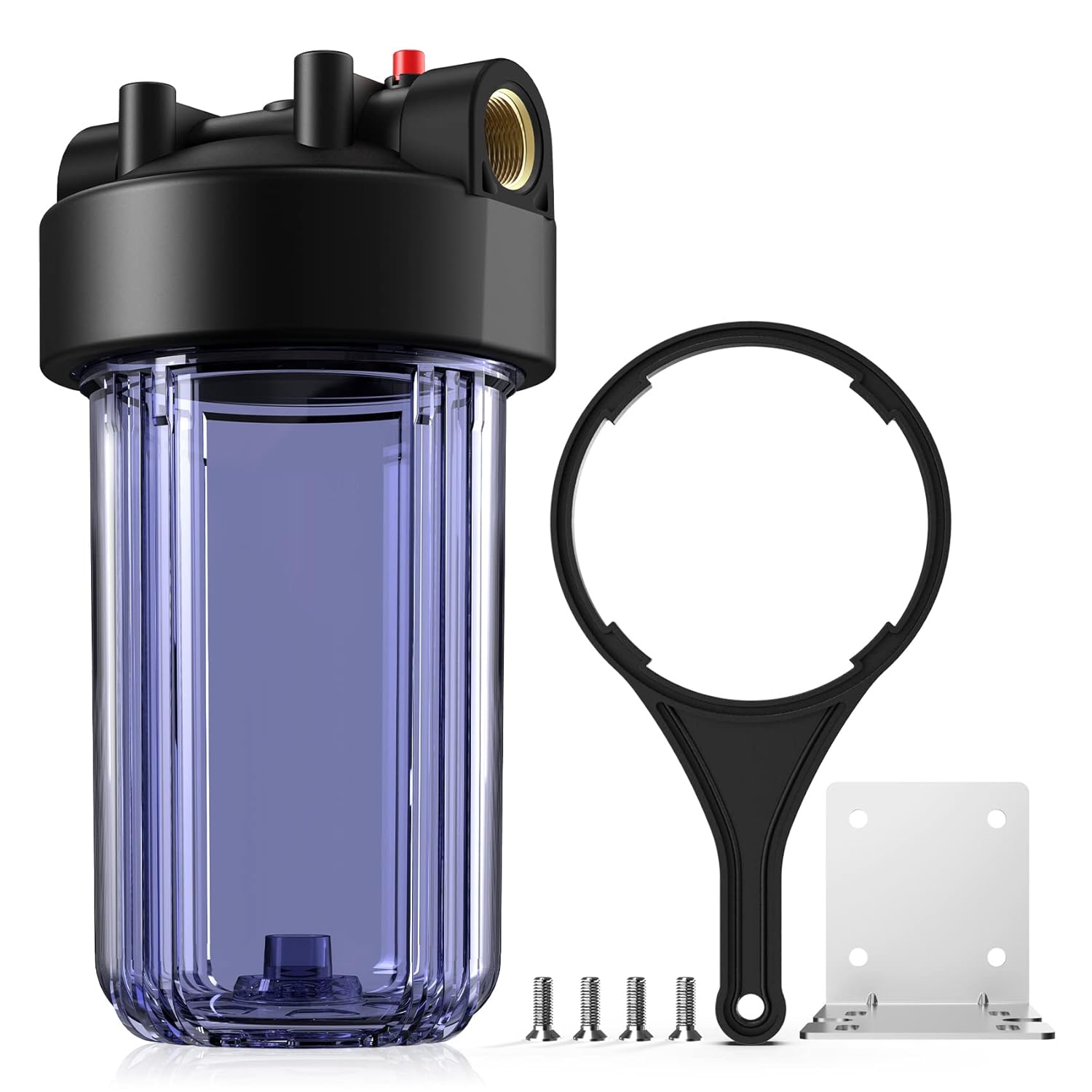
SimPure DB10C 10" x 4.5" Housing
| Inlet / Outlet | 1" NPT Brass Port |
|---|---|
| Compatible Filter Dimensions | 10" x 4.5" |
| Maximum Flow Rate | 20 gpm |
| Applicable Water Quality | Municipal Tap Water & Well Water |
| Working Water Pressure Range | 15-90 PSI |
The SimPure DB10C is a single-stage whole-house filter housing designed to hold standard 10" x 4.5" cartridges for sediment or carbon pre-filtration. It installs in-line using 1" NPT brass inlet and outlet ports and includes a heavy-duty mounting bracket, wrench, screws, and a built-in red pressure-relief button to make cartridge changes easier. The clear polypropylene bowl lets you visually check cartridge condition, and the brass ports plus double O-ring design aim to reduce the risk of leaks. Intended for municipal or well supply, it supports up to 20 gpm and is rated for typical household water temperatures and pressures. Limitations: the unit is a housing only and does not include filter cartridges, and you must allow space for installation and cartridge removal; it also requires choosing compatible cartridges for the contaminants you want to remove. For buyers who want a simple, visible pre-filter housing that fits common cartridges, the DB10C provides a straightforward option with robust fittings.
Best for: A cautious buyer who wants a durable, visible whole-house pre-filter housing that reduces plumbing risk and accepts common off-the-shelf cartridges.
Less Ideal for: People who want a complete filtration system ready to use out of the box or those who need multi-stage contaminant removal without adding separate cartridges and housings.
- Fits universal 10" x 4.5" filter cartridges so replacement options are widely available
- Clear polypropylene housing allows visual inspection of cartridge condition
- 1" NPT brass inlet/outlet and double O-ring construction reduce leak risk
- Includes installation hardware, mounting bracket, and wrench for easier setup
- Built-in pressure relief button speeds and simplifies cartridge replacement
- Filter cartridges are not included so additional purchase is required
- Requires adequate installation space to remove and replace cartridges comfortably
Verdict: Buy this if you need a sturdy, leak-resistant whole-house filter housing that accepts standard 10" x 4.5" cartridges for reliable pre-filtration.
Choosing the Right Whole-House Water Filter: Key Factors to Consider
Filtration Performance and Target Contaminants
Understand which contaminants the system is designed to reduce. Some whole-house filters focus on sediment and particulate removal, while others include activated carbon for chlorine, VOCs, and taste and odor reduction. Specialized media or multi-stage systems are required to address heavy metals, nitrates, or microbial concerns, so match the media type to the known issues in your water.
Testing your water or reviewing a recent municipal report helps you pick a system with the right reduction claims or certifications. A mismatch between the filter media and your water problems can leave important contaminants untreated or cause premature clogging.
Flow Rate and Household Demand
Whole-house filters are rated by flow capacity in gallons per minute. Choose a system whose flow rating meets or exceeds your household peak demand to avoid pressure drops during simultaneous use of showers, appliances, and faucets. Undersized systems cause reduced water pressure and an unpleasant user experience across fixtures.
Factor in future changes such as family growth or appliance upgrades. Some systems can be run in parallel to increase capacity, while others are intended for single-line service only. Verify the rated flow at realistic pressure conditions rather than idealized lab numbers.
Filter Longevity and Replacement Frequency
Filter lifespan affects both maintenance effort and operating cost. Sediment pre-filters usually require more frequent replacement than larger carbon or specialty cartridges. Understand manufacturer recommendations for service intervals and whether the system uses disposable cartridges or washable elements.
Also consider how easy it is to source replacements and whether changing filters requires tools or professional service. Longer life cartridges reduce the frequency of intervention but may cost more per unit.
Installation Complexity and Plumbing Compatibility
Whole-house installations connect to the main water line and may require cutting pipe, adding bypass valves, or altering drain lines. Some homeowners can install systems with basic plumbing skills, but larger or more complex units typically need a licensed plumber to meet code and maintain warranty coverage.
Confirm inlet and outlet sizes, recommended mounting orientation, and whether a bypass valve is included to allow service without shutting off the entire house. Planning for space and access in basements, garages, or utility closets is also important for future maintenance.
Materials, Build Quality, and Corrosion Resistance
Housings, seals, and valve materials determine long-term reliability. Look for corrosion-resistant materials and robust housings that can handle local water chemistry and pressure. Substandard materials can lead to leaks, premature failure, or contamination of treated water.
Pay attention to warranty terms and whether critical components like pressure relief valves or o-rings are replaceable. Durable construction reduces the risk of service interruptions and unplanned repairs.
Certifications and Verified Performance
Independent certifications or third-party test reports provide assurance that a system meets stated reduction targets. Certifications do not cover every contaminant, so confirm which standards are relevant to your needs. Where certifications are absent, look for detailed performance data and laboratory reports.
Verified performance helps set realistic expectations and assists in regulatory compliance for private wells in some jurisdictions. Treat certifications as one piece of the decision matrix rather than the sole factor.
Sizing Your System to Household Flow
Calculate peak simultaneous flow by adding the typical flow rates of fixtures and appliances used at once. Showers, washing machines, and dishwashers drive most peak loads. Compare that total to the system's rated gallons per minute to ensure you maintain acceptable pressure.
If your calculated peak approaches the system rating, consider a higher-capacity unit or dual parallel systems. Also check the manufacturer's rated flow at realistic pressure drops to avoid surprises when multiple fixtures are in use.
- Estimate flows: shower 1.5–2.5 GPM, dishwasher 1–2 GPM, washing machine 2–3 GPM
- Account for future household changes
- Consider parallel housings for very high demand
Pre-Filtration and Sediment Management
A sediment pre-filter protects downstream media and extends cartridge life, especially in homes with gritty or high-turbidity water. Look for systems that let you stage a coarse sediment filter ahead of finer media to avoid rapid clogging.
Options include washable screens, spin-down traps, and disposable sediment cartridges. Select a pre-filtration approach that balances maintenance frequency with protection for the primary filtration stages.
- Spin-down filters suit well water with heavy particulate
- Washable pre-filters reduce replacement costs but require more maintenance
- Staged sediment filtration yields longer life for expensive media
Carbon Media and Taste/Odor Control
Activated carbon is the go-to media for chlorine, volatile organic compounds, and taste or odor issues. Carbon comes in granular or block form, with block carbon offering better particulate filtration and contact time for chemical reduction.
Consider contact time and flow restrictions when evaluating carbon systems. Higher flow demands require larger carbon beds or multiple cartridges to achieve the same reduction performance.
- Carbon block reduces fine particulates and many chemicals
- Granular activated carbon can be less restrictive but may allow channeling
- Check documented reduction targets for specific contaminants
Maintenance Access and Ongoing Upkeep
Plan for where you will change filters and how often. Systems with front-access housings or quick-change cartridges make routine service less frustrating. Ensure there is enough clearance and lighting where the unit will be mounted.
Keep a maintenance log for replacement dates and pressure differentials. Regular monitoring prevents surprise performance drops and helps you optimize replacement intervals based on actual conditions.
- Allow clearance for cartridge removal and wrench use
- Install a pressure gauge to monitor filter loading
- Keep spare cartridges on hand to avoid service delays
Dealing with Specific Water Issues
If your water has a particular problem such as iron staining, sulfur odor, heavy sediment, or hard water, you will need media designed for that issue. Some whole-house filters incorporate specialty media or are designed as part of a staged treatment train that can include oxidizing filters, sequestrants, or softening components.
A clear diagnostic—either a municipal water quality report or lab tests for private wells—lets you target the right media and avoid unnecessary complexity or costs from misapplied treatments.
- Iron and manganese often need oxidation or catalytic carbon
- Sulfide odors typically require activated carbon or oxidation
- Hardness is generally addressed with softeners rather than filtration
How We Chose the Best Whole-House Water Filter
We focused on practical, measurable criteria that determine how well a whole-house water filter performs in everyday home use. Primary evaluation points included contaminant removal efficiency for common municipal and well water issues, certified filter media or documented reduction targets when available, and the system's flow capacity to preserve household water pressure during peak demand. We also weighed filter lifespan and replacement frequency, since ongoing maintenance affects total ownership effort, and assessed installation complexity to help owners determine whether professional assistance is needed. Durability and materials were considered to ensure housings and components resist corrosion and hold up under typical plumbing pressures. We excluded point-of-use and single-tap devices, softeners, and systems intended only for portable or camping use. Systems that only offered vague claims without specification of target contaminants, flow ratings, or replacement intervals were not considered. The shortlist favors systems with clear performance specs, realistic maintenance schedules, and installation profiles that suit a range of home sizes.
Our full evaluation process is outlined in our review methodology.
FAQ
How often should I replace whole-house filter cartridges?
Replacement frequency often depends on water quality and cartridge type. Sediment pre-filters may need changes every 1 to 3 months in dirty water, while carbon or specialty cartridges can last 6 to 12 months or longer. Monitor pressure drop and follow manufacturer intervals for best results.
Can I install a whole-house filter myself?
DIY installation is possible for owners comfortable with basic plumbing and shutoff procedures, especially for smaller, single-line systems. Larger units or installations that require cutting copper, adding bypass valves, or meeting local codes commonly require a licensed plumber.
Will a whole-house filter soften hard water?
Most whole-house filters do not remove hardness salts. Addressing hard water typically requires a dedicated water softener or a separate conditioning system. Some multi-stage setups pair filtration with softening, but they are distinct technologies.
How do I know what contaminants to target?
Start with a municipal water quality report or a certified laboratory test of your tap or well water. Those results identify concentrations of chlorine, lead, iron, bacteria, or other issues so you can select media that specifically reduces the detected contaminants.
Does a whole-house filter affect water pressure?
A properly sized system should not noticeably reduce water pressure. However, an undersized unit or a clogged filter will cause pressure drops. Check the rated flow at realistic pressure conditions and monitor pressure after installation to ensure adequate performance.
Final Verdict
Choosing a whole-house water filter comes down to matching filtration media, flow capacity, and maintenance profile to your home's specific water quality and daily demand. Prioritize verified contaminant reduction for issues you actually have, size the system for peak flow, and pick housings and components that simplify service. Balance long cartridge life against replacement cost and installation complexity. With those tradeoffs understood, you can select a system that reliably protects plumbing, improves water taste and odor, and fits your maintenance preferences.