
Note: This article contains affiliate links. If you click on these links and make a purchase, we may earn a small commission at no extra cost to you. This helps support our research and content. Read our full affiliate disclosure here.
A Wi‑Fi Ac Thermostat makes controlling your home climate easier, whether you want precise schedules, remote temperature adjustments, or better energy monitoring. Choosing the right thermostat affects daily comfort, HVAC runtime, and your household energy use. In this guide we narrowed the field to the top shortlisted options that suit a range of systems and user needs. Each pick is evaluated for connection stability, installation complexity, control features, and overall usability so you can match a thermostat to your setup and priorities. Read on for practical guidance and the criteria we used to pick these top choices.
Top Picks at a Glance
| Best Overall The best all-around choice for most situations | ecobee Smart Thermostat Essential |  |
| Best Quality Built to a higher standard if you want something more solid | ecobee Smart Thermostat Premium |  |
| Best Value The sweet spot between price and what you get | Sensi Smart Thermostat ST55 |  |
| Best Budget The cheapest option that still gets the job done reliably | Honeywell Home X2P Programmable Thermostat RTH20B |  |
| Top Rated A top-rated pick with lots of positive feedback | Sensi Touch ST75 Thermostat |  |
| Most Popular A crowd favorite that many people choose with confidence | Amazon Smart Thermostat |  |
| Best Seller A high-volume bestseller chosen again and again | Google Nest Thermostat |  |
ecobee Smart Thermostat Essential

| Connectivity Technology | Wi-Fi |
|---|---|
| Controller Type | Amazon Alexa, Android, Apple HomeKit, Google Assistant, iOS |
| Power Source | Battery Powered |
| Display Type | LCD |
The ecobee Smart Thermostat Essential is a straightforward smart thermostat that lets you control heating and cooling from its color touchscreen or the ecobee mobile app. It connects over Wi‑Fi and works with Siri, Alexa, Google Assistant, and Apple HomeKit so voice control and remote adjustments are easy. Built-in eco+ features and auto-scheduling adjust temperature to save energy when you are away, and the unit reports basic humidity and energy usage through the app. Installation is designed for typical 24 VAC HVAC systems and ecobee provides a compatibility checker and an optional Power Extender Kit for homes without a C wire. The Essential drops advanced extras found on higher-end models but keeps the core capabilities most people use: scheduling, remote control, and smart home integration. If you want multi-room sensor bundles or an air quality monitor, those are not included here and require separate purchases. For buyers seeking a reliable, energy-focused Wi‑Fi thermostat without premium frills, this model covers the essentials well.
Best for: Buyers who want a reliable, no-frills smart thermostat that saves energy and integrates with common voice assistants without paying for premium extras.
Less Ideal for: Shoppers who need bundled room sensors, built-in air quality features, or advanced HVAC diagnostics should consider higher-end models or sensor packs instead.
- Wi‑Fi connectivity with app control and voice assistant compatibility for remote operation
- Color touchscreen and simple on-device touch controls for local adjustments
- Built-in eco+ scheduling and auto-away features to reduce energy use
- Compatibility checker and optional Power Extender Kit to simplify installation without a C wire
- Does not include SmartSensor or built-in air quality monitoring found on higher-tier ecobee models
Verdict: A practical, energy-conscious Wi‑Fi thermostat that delivers essential smart control and voice integration without unnecessary premium features.
ecobee Smart Thermostat Premium

| Controller Type | Amazon Alexa, Android, Apple HomeKit, Google Assistant, iOS |
|---|---|
| Connectivity Protocol | Wi-Fi |
| Power Source | Battery Powered |
| Voltage | 24 volts |
| Included Components | Smart Thermostat Premium, SmartSensor, Backplate, Wire labels, Screws, PEK, trim plate, quick start guide |
The ecobee Smart Thermostat Premium is a high-end Wi‑Fi thermostat designed to optimize comfort and reduce heating and cooling costs. It pairs with the ecobee app and smart home platforms like Alexa, Siri (via HomeKit), and Google Assistant while also including a built-in speaker for voice control and media. The unit adds practical home-health features such as an integrated air quality monitor with alerts and filter reminders, radar-based occupancy sensing for presence detection, and a bundled SmartSensor to eliminate hot and cold spots. Installation is aimed at typical 24VAC HVAC systems and the included Power Extender Kit helps with homes lacking a C-wire. The metal chassis and large LCD deliver a premium look and readable interface. Expect solid energy-saving automation and remote control, though some advanced features require an ecobee account and occasional cloud connectivity for full functionality. The product is best for users who want a factory-quality, feature-rich smart thermostat and are comfortable with cloud-linked smart-home integration.
Best for: Buyers focused on high performance and energy savings who want a premium, fully featured Wi‑Fi thermostat with advanced sensing and built-in voice control for tight comfort management.
Less Ideal for: Those who prefer a completely local/offline thermostat, have a line‑voltage heating system, or need the simplest possible programmable thermostat with minimal smart features.
- Built-in voice assistant and speaker for hands-free control and media playback
- Integrated air quality monitor with alerts and filter reminders
- Includes SmartSensor to manage hot and cold spots and improve room-level comfort
- Radar occupancy sensing for improved presence detection and automation
- Power Extender Kit and trim kit included to simplify DIY installation
- Some advanced features rely on cloud services and an ecobee account
- Designed for 24VAC HVAC systems so incompatible with line-voltage setups
Verdict: If you want a performance-oriented Wi‑Fi thermostat with advanced occupancy sensing, air quality monitoring, and built-in voice control, the ecobee Smart Thermostat Premium is the top pick.
Sensi Smart Thermostat ST55

| Connectivity Technology | Wi-Fi |
|---|---|
| Controller Type | Amazon Alexa, Apple HomeKit, Google Assistant, SmartThings, Vera |
| Power Source | Corded Electric |
| Display Type | LED |
| Number of Batteries | 2 AA batteries required (included) |
The Sensi Smart Thermostat ST55 is a DIY Wi‑Fi thermostat aimed at replacing a traditional wall thermostat with minimal fuss. It connects to 2.4 GHz Wi‑Fi and pairs with Alexa, Google Assistant, Apple HomeKit, SmartThings, and Vera so you can change settings by app or voice and check schedules remotely. Installation is designed for homeowners with its built‑in level, wire labels, and step‑by‑step app guidance, and it can run without a common wire in many setups while including two AA batteries for backup. The app provides usage reports, smart alerts, and filter reminders to help reduce HVAC energy use, and the unit is ENERGY STAR certified for verified savings. The display is a simple LED touch/button interface rather than a large color touchscreen, which keeps operation straightforward but offers less visual polish than premium models. Overall, it is practical, privacy‑focused, and reliable for steady, everyday control of heating and cooling systems.
Best for: A homeowner who wants a straightforward, privacy-conscious Wi‑Fi thermostat that is easy to install and helps cut HVAC energy through schedules and usage reports.
Less Ideal for: Buyers seeking a premium touchscreen interface or advanced on‑device controls for frequent in-person interaction should consider higher-end models instead.
- Works with major smart home platforms and voice assistants for flexible remote control
- ENERGY STAR certified with app usage reports and smart alerts to help reduce HVAC energy
- Easy DIY installation with built‑in level, wire stickers, and guided mobile app
- Includes batteries and mounting hardware so it is ready to install out of the box
- Simple LED display and button controls lack the larger color touchscreen and advanced interface found on some competitors
Verdict: Choose the Sensi ST55 if you want an easy DIY Wi‑Fi thermostat that integrates with major smart platforms and focuses on energy savings and data privacy.
Honeywell Home X2P Programmable Thermostat RTH20B

| Compatibility | Single‑Stage, 1 Heat/1 Cool |
|---|---|
| Scheduling | 5‑2 day (and other options) or non‑programmable |
| Power | 2 AA batteries (C‑wire supported) |
| Connectivity | WiFi 2.4/5 GHz (802.11 b/g/n) |
The Honeywell Home X2P (RTH20B) is a straightforward programmable thermostat built for single‑stage 1 heat/1 cool systems and everyday home use. It provides 5‑2 day scheduling (with additional scheduling options or a non‑programmable mode), a large backlit LCD for easy reading, and basic features like change‑filter reminders and humidity monitoring. Installation is typical for a wall thermostat and it runs on two AA batteries while supporting 24 VAC C‑wire setups where available. Practical benefits include clear daily control, simple programming for weekday/weekend schedules, and energy‑aware settings such as an extended low‑heat setpoint. Limitations are its focus on single‑stage systems and lack of advanced smart features found in higher‑end Wi‑Fi thermostats, so it does not offer extensive learning algorithms, deep third‑party integrations, or multi‑stage HVAC control. For buyers who want a reliable, no‑frills programmable Wi‑Fi thermostat, it covers the essentials without extra complexity.
Best for: Buyers on a budget who need a reliable, easy‑to‑program Wi‑Fi thermostat for a simple single‑stage heating and cooling system and prefer straightforward controls over advanced smart features.
Less Ideal for: Users with multi‑stage HVAC equipment, heavy smart‑home integration needs, or those who want self‑learning thermostats and advanced automation capabilities.
- Clear, large backlit LCD for easy daily use
- 5‑2 day scheduling with alternate scheduling and non‑programmable option
- Change‑filter reminders and basic humidity monitoring
- Compatible with common single‑stage HVAC systems and standard wall mounting
- Not designed for multi‑stage systems or advanced smart home automation
- Lacks learning features and deep third‑party integrations
Verdict: A budget‑friendly, no‑frills programmable Wi‑Fi thermostat that delivers dependable weekday/weekend scheduling and clear controls for single‑stage systems.
Sensi Touch ST75 Thermostat

| Connectivity Technology | Wi‑Fi |
|---|---|
| Controller Type | Amazon Alexa, Apple HomeKit, Google Assistant, SmartThings, Vera |
| Screen Size | 4.3 inches |
| Power Source | AC/DC |
The Sensi Touch ST75 is a wall‑mounted programmable thermostat that brings Wi‑Fi control, a color touchscreen, and Energy Star certified efficiency to a home HVAC setup. It is typically installed in place of a legacy thermostat using a common wire and the package includes mounting hardware and an installation guide to support a DIY install. The touchscreen and mobile app let you change schedules and temperatures from anywhere, and the Sensi app provides usage reports, smart alerts, and filter reminders to help with routine maintenance and energy tracking. It integrates with major smart platforms for voice control and automation. Practical benefits include straightforward guided setup, clear on‑screen controls for everyday use, and the ability to monitor system performance remotely. Important limitations are the requirement for a C‑wire power connection and dependence on 2.4 GHz Wi‑Fi for remote features, which could complicate installs in homes without a C‑wire or on 5 GHz‑only networks.
Best for: Buyers who prioritize a dependable, easy‑to‑manage smart thermostat and want clear remote control plus energy reporting to monitor system performance and savings.
Less Ideal for: Homes without an available C‑wire or users who only have 5 GHz Wi‑Fi and cannot add or convert wiring or network support.
- Color touchscreen with intuitive menus for in‑home tuning
- Remote control and scheduling via Sensi mobile app
- Energy Star certification and usage reports to help reduce HVAC energy
- Integrates with major voice and smart home platforms
- Includes installation guide and mounting hardware for DIY setup
- Requires a common (C) wire for installation
- Only supports 2.4 GHz Wi‑Fi networks
Verdict: A reliable, Energy Star certified smart thermostat that delivers easy DIY installation, remote control, and useful usage reports for homeowners focused on dependable HVAC control.
Amazon Smart Thermostat
| Model ASIN | B08J4C8871 |
|---|---|
| Works with | Alexa and Ring |
| C‑wire | Required |
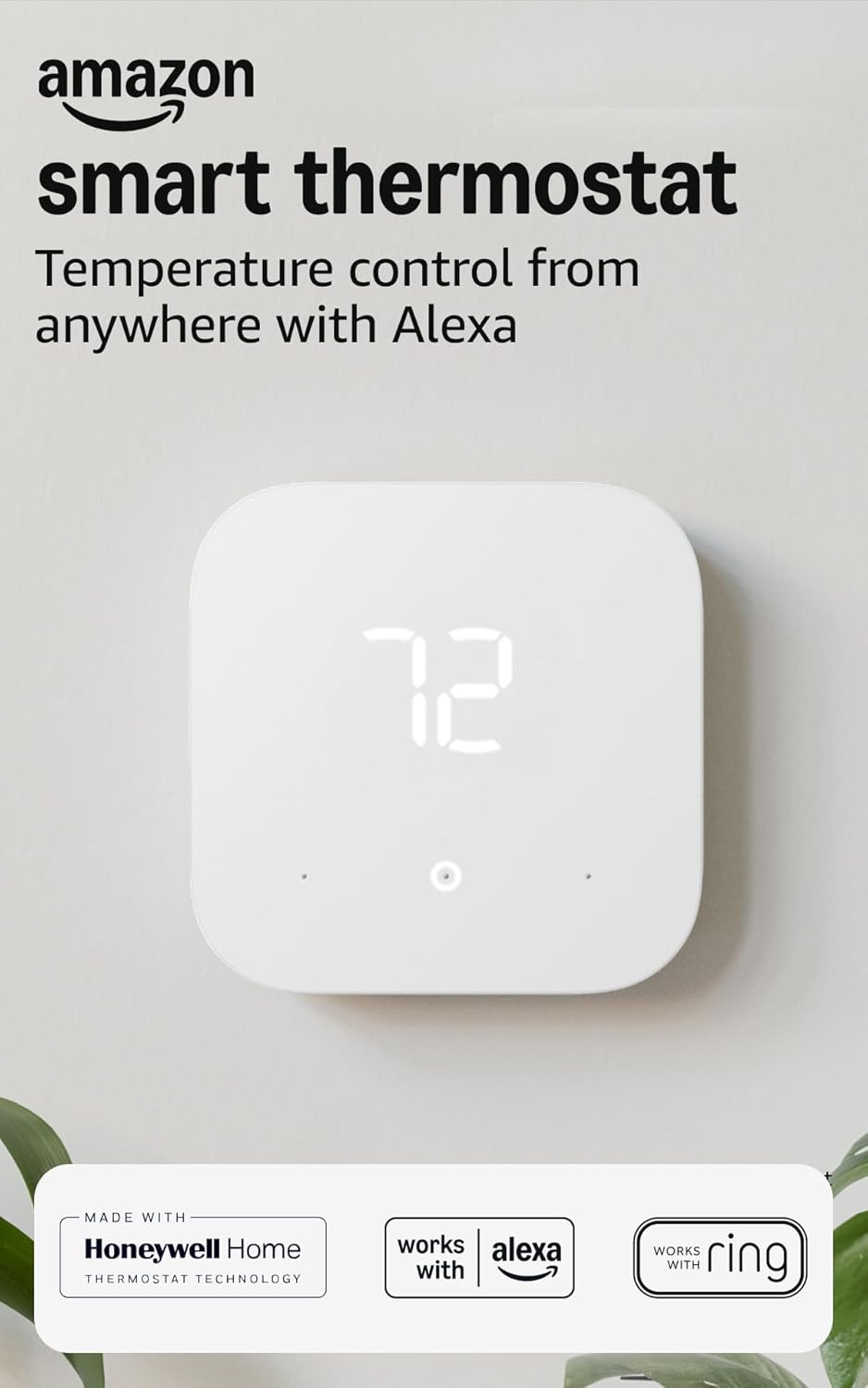
The Amazon Smart Thermostat is a straightforward Wi‑Fi thermostat designed to replace a traditional wall unit and let you control heating and cooling from the Alexa app or voice commands. It supports scheduled modes like home, away, and sleep and can use Alexa presence detection and compatible Alexa devices to adjust temperature automatically. Installation is intended as a DIY process using the Alexa app installer, but it does require a C‑wire. The product leverages Honeywell Home thermostat technology for core temperature sensing and control, and Amazon highlights potential energy savings and regional rebate information after purchase. Practical benefits include easy remote control, Alexa voice routines and automation, and basic energy‑saving scheduling; limitations are the C‑wire requirement and reliance on the Alexa ecosystem for advanced features, which may not suit users who prefer other smart platforms or need more granular HVAC diagnostics.
Best for: Buyers who want a simple, Alexa‑centric smart thermostat that provides remote control, voice automation, and basic energy‑saving schedules with easy app guidance.
Less Ideal for: Users who need a thermostat that works primarily with non‑Alexa smart platforms or who want deep HVAC diagnostics and advanced professional controls.
- Wi‑Fi connectivity for remote control via the Alexa app
- Works with Alexa voice commands and Alexa routines for hands‑free control
- Built on Honeywell Home thermostat technology for reliable temperature control
- Supports scheduling and automatic adjustments using presence detection
- Email support for local energy rebate information to help reduce running costs
- Requires a C‑wire for installation
- Advanced features are tied to the Alexa ecosystem
Verdict: Choose this thermostat if you want an affordable, Alexa‑first Wi‑Fi thermostat that adds voice control and basic energy‑saving schedules to a conventional HVAC system.
Google Nest Thermostat
| Connectivity Technology | Bluetooth, Wi-Fi |
|---|---|
| Power Source | Battery Powered |
| Control Type | Remote Control, Voice Control |
| Display Type | LCD |
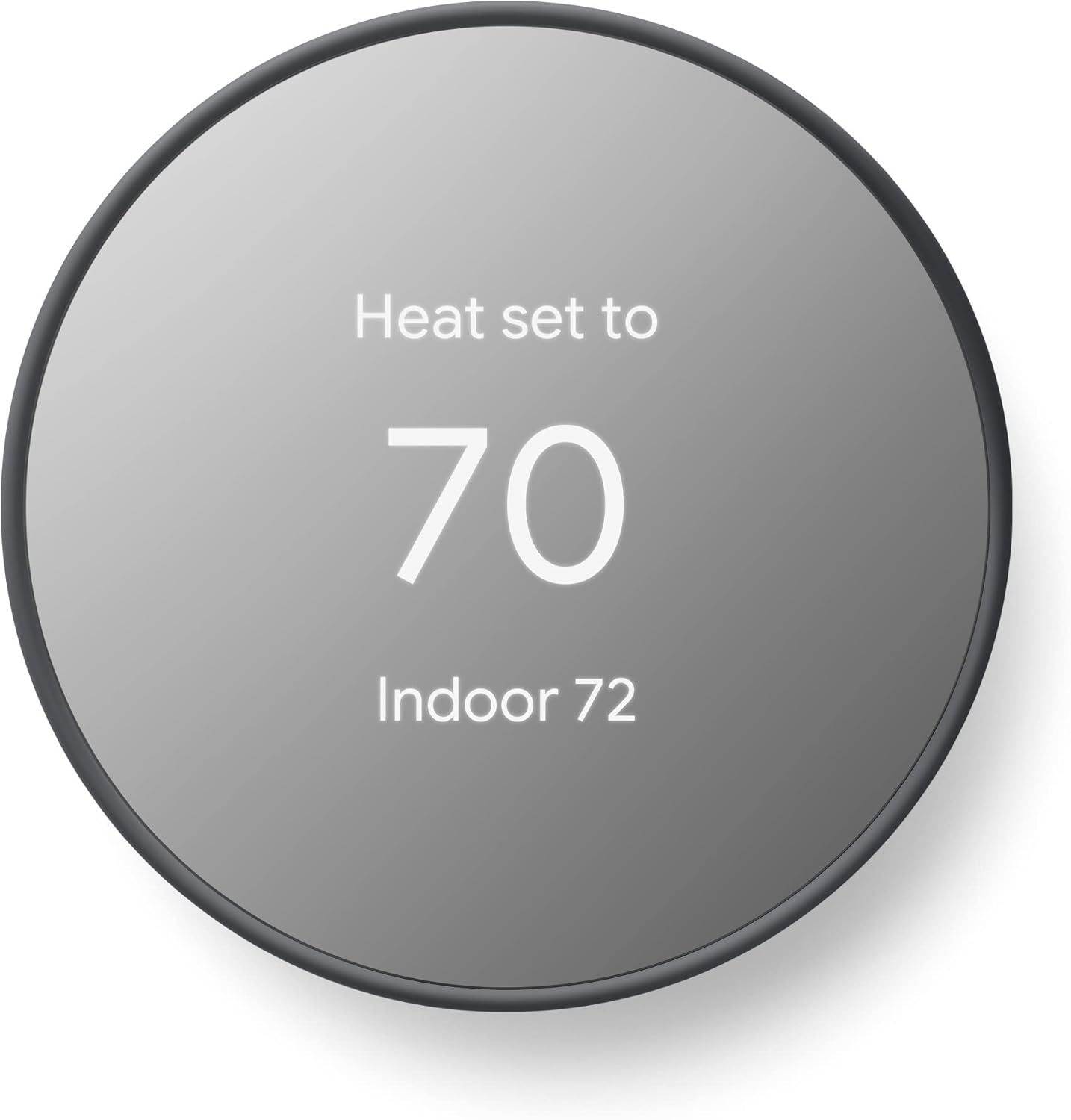
The Google Nest Thermostat is an entry-level smart thermostat that provides app and voice control for heating and cooling systems and simple energy-saving features. It connects to 2.4 and 5 GHz Wi‑Fi and Bluetooth Low Energy so you can adjust temperature from the Google Home app or with a compatible voice assistant, and the device can automatically set Eco Temperatures when it senses the home is empty. Installation is intended to be DIY-friendly and usually completes in about 30 minutes, and the unit works without a C wire in most homes though some systems require one or a power accessory. The thermostat includes basic HVAC monitoring that can alert you to potential issues and a Savings Finder feature that suggests schedule tweaks to reduce energy use. Practical limits: it is a compact, plastic unit with a simple 2-inch LCD and runs on two A batteries, so it lacks the larger display and advanced learning behavior of higher-tier models and may need professional help for some HVAC configurations.
Best for: Buyers who want a straightforward, energy-minded smart thermostat that is easy to install and controlled from a phone or voice assistant without a steep learning curve.
Less Ideal for: Homes that need advanced learning features, a large touchscreen display, or those with complex HVAC wiring where a factory-quality hardwired thermostat is preferred.
- Wi‑Fi and Bluetooth connectivity for remote and voice control
- Designed for simple DIY installation in most homes
- Energy-saving features like Eco Temperatures and Savings Finder
- Includes basic HVAC monitoring and alert notifications
- Works without a C wire in most common systems
- Requires two A batteries for power instead of hardwired power
- Limited 2-inch LCD provides less detail than larger thermostats
- May need a C wire or power accessory for some HVAC setups
Verdict: A simple, easy-to-install Wi‑Fi thermostat that brings remote and voice control plus basic energy-saving tools to mainstream buyers.
Choosing the Right Wi-Fi Ac Thermostat: Key Factors to Consider
Compatibility With Your HVAC System
Not all Wi‑Fi thermostats work with every heating and cooling configuration. Confirm whether the thermostat supports single‑stage or multi‑stage cooling, heat pump systems, and whether it requires a common wire. Compatibility affects not only whether the device will function but also whether it can control advanced features like multi‑stage compressors or auxiliary heat.
Choosing a thermostat that matches your system prevents unexpected trips by installers or the need to add wiring. If your system is older or uses nonstandard controls, look for models that explicitly list broad system support and clear documentation on wiring.
Wi‑Fi Performance and Network Requirements
A thermostat that loses connectivity frequently defeats the purpose of remote control. Check the product's supported Wi‑Fi bands, recommended router distance, and whether it needs a 2.4 GHz or 5 GHz network. Strong local Wi‑Fi and a reliable router help maintain consistent remote access and push notifications.
Consider placement near your HVAC control panel or where the router signal is strong. Some thermostats handle weak Wi‑Fi better than others, and a model with robust reconnection logic will reduce headaches if your network drops occasionally.
Installation Complexity and Wiring Needs
Installation ranges from simple battery‑powered swaps to setups that require a common wire or professional attention. Confirm what wiring the thermostat requires and whether your current wall plate provides those terminals. The easier the installation, the lower the upfront effort for DIYers.
Also consider whether the thermostat offers helpful install guides or an app‑assisted wiring check. Some products include adapter kits or clear troubleshooting steps for common wiring gaps, which can save time and the cost of a service call.
Mobile App Experience
The mobile app is often how you interact with a Wi‑Fi thermostat daily. A well‑designed app makes scheduling, temperature adjustments, and monitoring quick and intuitive. Look for apps that present clear schedules, support geofencing or location‑based routines, and provide reliable push notifications for alerts like extreme temps or connectivity problems.
Apps that integrate with voice assistants and other smart‑home systems can streamline control across devices. App quality also affects initial setup, with better apps guiding users through wiring and calibration steps.
Programmability and Automation Options
Different users value different automation features. Basic scheduling covers most needs, but adaptive scheduling, learning modes, and geofencing can reduce hands‑on adjustments. Consider whether the thermostat supports multiple schedules, weekend/weekday variations, and vacation modes.
Automation that learns occupancy patterns or links to local weather data can improve comfort and efficiency. Confirm whether advanced features are cloud‑based and whether they require ongoing account creation or subscriptions.
Energy Reporting and Efficiency Tools
If reducing energy use is a priority, choose a thermostat that offers clear usage reports and runtime summaries. Good reporting shows when heating or cooling runs most and helps identify opportunities to tweak schedules. Look for models that estimate energy impact based on runtime or provide historical charts.
Energy tools that include cost estimates or comparisons to previous periods make it easier to gauge whether changes reduce consumption. Keep in mind that reporting accuracy depends on proper system configuration and consistent data from the thermostat.
Installation Checklist Before You Start
Gather the necessary tools and verify your wiring at the existing thermostat before buying. Turn off power to the HVAC at the breaker, remove the old thermostat, and photograph the wiring configuration so you can match terminals during installation.
Confirm whether a common wire is present and note which terminals are used for heat, cool, fan, and accessories. If your setup uses proprietary control boards or uncommon terminal names, consult the furnace or air handler documentation.
- Turn off HVAC power at the breaker
- Photograph the current wiring and wall plate
- Check for a common wire or adapter need
- Measure wall cavity depth for the new thermostat
Network Tips to Keep Your Thermostat Connected
Place routers or range extenders to minimize signal obstacles between the thermostat and the Wi‑Fi source. Consider using the 2.4 GHz band if the thermostat lists that as a requirement because it often travels better through walls.
If your home network uses strict access controls, whitelist the thermostat's MAC address or enable device onboarding modes temporarily during setup. Firmware updates and cloud features rely on stable connectivity, so schedule updates during low‑use hours.
- Prefer 2.4 GHz for range when supported
- Temporarily disable guest networks or device isolation
- Check for firmware updates after installation
Making Schedules That Balance Comfort and Savings
Start with a simple weekday and weekend schedule, then refine based on actual occupancy and comfort. Keep setpoint banding modest; large swings can increase runtime and stress the HVAC system.
Use setback periods during predictable absences and enable preconditioning so the system brings the house to your desired temperature shortly before occupancy. For energy savings, favor modest setbacks and let automation fine‑tune timing based on past performance.
- Use small setpoint differences for efficiency
- Enable preconditioning where available
- Create separate schedules for weekday and weekend
Integrating With Smart Home Systems
Many Wi‑Fi thermostats connect to voice assistants and automation hubs. Decide whether you need deep integration or simple voice control, since some users prefer a lightweight experience while others want complex routines that tie lighting and occupancy sensors to climate.
Consider privacy and data sharing when linking accounts. Review what data the thermostat shares with external services and whether you can limit cloud features if privacy is a concern.
- Check supported voice assistants and hubs
- Decide on the level of integration you need
- Review privacy and data-sharing options
Maintenance and Long-Term Care
Keep firmware current and revisit app settings seasonally. Replacing batteries on models that use them and checking thermostat level and contact cleanliness helps maintain accurate sensing.
Periodically check reported runtime and temperature logs to spot anomalies that could indicate sensor drift or HVAC issues. Early detection of irregular cycles can prevent larger repairs.
- Update firmware when available
- Replace batteries if applicable
- Review runtime reports seasonally
How We Chose the Best Wi-Fi Ac Thermostat
We focused on real-world usability and system compatibility when selecting these Wi‑Fi Ac Thermostats. Key evaluation criteria included connectivity reliability, since a stable network connection is essential for remote access and schedules; installation and wiring flexibility to account for common household HVAC setups; control features and programmability, covering schedules, geofencing, and intelligent temperature adjustments; user interface and app quality, because easy setup and daily control reduce frustration; and energy reporting and integration with smart-home platforms for longer-term efficiency tracking. We excluded thermostats that required specialized professional-only installation or that lacked basic Wi‑Fi remote control. We also filtered out models with consistently poor connectivity or minimal scheduling options. Our short list favors products that balance straightforward DIY installation with robust remote-control features, and that provide clear energy-use feedback so you can make informed adjustments over time.
Our full evaluation process is outlined in our review methodology.
FAQ
Do I need a common wire for a Wi‑Fi Ac Thermostat?
Often a common wire is required to provide continuous power to Wi‑Fi thermostats. Some models include power‑stealing technology or adapter kits that remove this requirement, but compatibility depends on your HVAC control board and model.
Will a Wi‑Fi thermostat work with a heat pump?
Many Wi‑Fi thermostats support heat pump systems, but functionality varies with multi‑stage compressors and auxiliary heat. Verify that the thermostat supports heat pump configurations and provides correct staging controls.
How secure are these smart thermostats on my home network?
Security varies by vendor and firmware practices. Use strong Wi‑Fi passwords, keep firmware updated, and enable account protections such as two‑factor authentication when available. Limiting third‑party integrations reduces potential data exposure.
Can the thermostat learn and automate schedules for me?
Some thermostats offer learning or adaptive scheduling that creates routines from occupancy patterns. Others require manual schedules or geofencing. The accuracy of learned routines depends on consistent occupancy patterns and the thermostat's algorithms.
What happens if the Wi‑Fi goes down?
Most thermostats retain core local scheduling and temperature control even without Wi‑Fi, but remote access and cloud‑based features will be unavailable until the connection is restored. Some models provide local notifications or fallback modes.
Final Verdict
A Wi‑Fi Ac Thermostat can simplify everyday comfort while giving you better visibility into HVAC runtime and energy use. Prioritize models that match your system wiring, offer reliable network performance, and provide an app experience that you find intuitive. Decide which automation features matter most, such as geofencing or learning modes, and balance convenience against any required account or cloud dependencies. With attention to compatibility and connectivity, you can pick a thermostat that improves comfort and helps manage energy over the long term.