
Note: This article contains affiliate links. If you click on these links and make a purchase, we may earn a small commission at no extra cost to you. This helps support our research and content. Read our full affiliate disclosure here.
A touchscreen thermostat can make everyday comfort easier while trimming energy waste. If you want clearer controls, faster scheduling, and a modern interface that family members actually use, choosing the right touchscreen thermostat matters. This guide highlights seven shortlisted touchscreen thermostats that stand out for usability, compatibility, and energy features. We evaluated each option for setup simplicity, daily control clarity, and the features that drive convenience and savings. Read on to find the touchscreen thermostat style and feature set that fits your home and thermostat wiring.
Top Picks at a Glance
| Best Overall The best all-around choice for most situations | Google Nest Learning Thermostat (4th Gen) |  |
| Best Quality Built to a higher standard if you want something more solid | ecobee Smart Thermostat Premium |  |
| Best Value The sweet spot between price and what you get | Sensi Touch ST75 Thermostat |  |
| Best Budget The cheapest option that still gets the job done reliably | LUX P721UT Touchscreen Thermostat |  |
| Top Rated A top-rated pick with lots of positive feedback | Honeywell Home Smart Color Thermostat |  |
| Most Popular A crowd favorite that many people choose with confidence | Sensi Smart Thermostat ST55 |  |
| Best Seller A high-volume bestseller chosen again and again | Google Nest Thermostat |  |
Google Nest Learning Thermostat (4th Gen)

| Connectivity Technology | Wi-Fi |
|---|---|
| Power Source | Battery Powered |
| Voltage | 24 volts |
| Display Type | Touchscreen |
| Included Components | Nest Temperature Sensor (2nd gen) |
The Nest Learning Thermostat (4th gen) is a touchscreen smart thermostat that learns your schedule and suggests energy-saving adjustments while giving remote control through the Google Home app and voice assistants. It pairs with the included Nest Temperature Sensor to target specific rooms, and Dynamic Farsight plus a larger display make status visible from across the room. The unit supports most 24V HVAC systems and installs with or without a C wire in many homes, and it reports system health alerts to help catch issues early. Smart features include adaptive Eco, natural heating and cooling that factors in outdoor conditions, Smart Schedule suggestions you can accept or decline, and Matter compatibility for easier smart-home integration. Trade-offs are that advanced features rely on app connectivity and cloud services, and some users may need to consult compatibility resources for less common HVAC setups. For buyers wanting a blend of polished hardware and automated energy savings, the Nest strikes a strong balance between style and capability.
Best for: Buyers who want an attractive, easy-to-use smart thermostat that automates energy savings and integrates with a modern smart home ecosystem.
Less Ideal for: If you need a simple non-connected thermostat or have a highly unusual or proprietary HVAC control system, this smart learning thermostat may be more than necessary or require additional compatibility checks.
- Learns your preferences and suggests energy-saving schedule changes
- Includes Nest Temperature Sensor to manage hot and cold spots remotely
- Large, readable touchscreen with Dynamic Farsight for at-a-glance info
- Works with Google Home app and voice assistants and supports Matter for smart-home integration
- System Health Monitor sends alerts if heating or cooling needs attention
- Some advanced functions depend on app/cloud connectivity and account integration
- May require checking compatibility for uncommon HVAC configurations
Verdict: A polished, learning touchscreen thermostat that combines smart scheduling, room sensing, and wide smart‑home integration for buyers who want automated comfort and energy savings.
ecobee Smart Thermostat Premium

| Connectivity Protocol | Wi-Fi |
|---|---|
| Connectivity Technology | Bluetooth |
| Power Source | Battery Powered |
| Voltage | 24 volts |
| Display Type | LCD |
The ecobee Smart Thermostat Premium is a touchscreen thermostat that combines temperature control, air quality monitoring, and occupancy sensing with built-in voice assistants for hands-free control. It is typically wall-mounted and used to manage heating and cooling via the ecobee app, voice commands, or the bright LCD interface, and it includes a SmartSensor to reduce hot and cold spots. Notable features include dual-band Wi-Fi, a built-in air quality monitor that alerts and offers filter reminders, radar occupancy sensing for more accurate presence detection, and compatibility with major smart home platforms including Siri, Alexa, Google Assistant, and HomeKit. The package includes a power extender kit to aid installation in homes without a C-wire and a trim plate for a finished look. In practice this delivers precise room-level comfort and energy-saving schedules, plus the convenience of streaming audio and voice control from the thermostat itself. The main limitations are that full Siri use requires an Apple home hub and compatibility should be checked against specific HVAC wiring, but for homes that match the supported systems this is a capable, feature-rich touchscreen thermostat for performance-focused users.
Best for: Buyers who want a top-tier touchscreen thermostat that prioritizes precise comfort control, integrated air-quality insights, and advanced occupancy sensing for measurable energy savings.
Less Ideal for: People with noncompatible HVAC systems such as line-voltage or millivolt setups or those who want a simpler, no-frills thermostat without smart-home integrations.
- Built-in Alexa and Siri for voice control and a speaker for audio playback
- Included SmartSensor helps manage hot and cold spots for room-level comfort
- Built-in air quality monitor with alerts and filter reminders
- Radar occupancy sensing improves presence detection compared with motion-only sensors
- Power Extender Kit and trim plate included to simplify DIY installation
- Siri voice features require an Apple home hub to enable
- Requires checking HVAC wiring compatibility; not compatible with line-voltage or millivolt systems
Verdict: Choose this thermostat if you want a performance-focused touchscreen unit that combines precise room comfort control with built-in voice assistants and air-quality monitoring.
Sensi Touch ST75 Thermostat

| Connectivity Technology | Wi‑Fi (2.4 GHz) |
|---|---|
| Control Method | App, Touch, Voice |
| Display Type | LCD color touchscreen |
| Specific Uses For Product | Air Conditioner, Boiler, Furnace, Heat Pump |
| Temperature Control Type | Programmable |
The Sensi Touch ST75 is a wall‑mounted smart thermostat that replaces a standard programmable thermostat and puts a 4.3‑inch color touchscreen and mobile control on your wall. It connects to 2.4 GHz Wi‑Fi and pairs with the Sensi mobile app for remote scheduling, usage reports, and equipment alerts, while supporting common HVAC types including furnaces, heat pumps, boilers and air conditioners. Installation is DIY friendly if you have a C‑wire, with illuminated easy‑click terminals and an in‑app step‑by‑step guide and built‑in level. The touchscreen, backlight and voice/app control make daily adjustments straightforward, and Energy Star certification plus scheduling and geofencing features help reduce HVAC runtime. Expect solid basic smart features rather than advanced home automation depth; it needs a C‑wire for primary power and does not advertise 5 GHz Wi‑Fi support. The Sensi app delivers useful maintenance reminders and system alerts, which is handy for keeping HVAC running efficiently without heavy setup.
Best for: Buyers who prioritize straightforward energy savings and reliable remote control with an easy DIY install and clear touchscreen controls.
Less Ideal for: Users who lack a C‑wire or need advanced multi‑band Wi‑Fi and deep third‑party automation integrations should consider different options.
- Easy DIY installation with illuminated terminals and built‑in level
- 4.3‑inch color touchscreen with touch, app and voice control
- Remote access, scheduling, geofence and usage reports for energy savings
- Energy Star certified and provides equipment alerts and maintenance reminders
- Requires a common wire (C‑wire) for primary power
- Only supports 2.4 GHz Wi‑Fi, not 5 GHz
Verdict: A practical touchscreen smart thermostat that makes DIY installation and everyday remote control simple while helping reduce HVAC energy use.
LUX P721UT Touchscreen Thermostat

| Temperature Control Type | programmable |
|---|---|
| Connectivity Technology | Wi-Fi |
| Power Source | Battery Powered |
| Display Type | LCD |
| Mounting Type | Wall Mount |
The LUX P721UT is a basic touchscreen programmable thermostat aimed at homeowners who want schedule control without a steep price. It supports 7-day, 5/2-day or non-programmable modes and works with universal heat pump and conventional 2-heat/1-cool systems, so it fits common ductless and conventional HVAC setups. The large LCD touchscreen and selectable 2- or 4-period daily schedules make programming straightforward, and a keypad lock prevents accidental changes. Dual power capability with 2 AA batteries and 24 VAC compatibility provides flexibility during installation and power interruptions. It also includes Wi-Fi connectivity for remote access. Expect a straightforward control experience rather than advanced smart-home automation or energy-reporting features found on higher-end models. The plastic housing and simple feature set keep things affordable, but you may miss deeper integration or learning thermostats if you want aggressive energy optimization.
Best for: Buyers wanting an affordable touchscreen thermostat that adds programmable schedules and simple remote access for standard 2H/1C systems.
Less Ideal for: People who want advanced energy optimization, broad smart-home ecosystem integration, or a premium metal finish.
- 7-day and 5/2-day programmable schedules with selectable 2 or 4 periods per day
- Large touchscreen LCD for easy viewing and simple touch programming
- Universal compatibility with 2-heat/1-cool and heat pump systems
- Dual power options (2 AA batteries or 24 VAC) for installation flexibility
- Basic feature set without advanced learning or deep smart-home integrations
Verdict: A budget-friendly touchscreen programmable thermostat that delivers straightforward scheduling and universal 2H/1C compatibility without premium smart features.
Honeywell Home Smart Color Thermostat

| Connectivity Technology | Wi-Fi |
|---|---|
| Controller Type | Touch Screen, Voice |
| Power Source | AC Power Supply |
| Temperature Control Type | Heating and Cooling |
| Specification Met | Energy Star |
The Honeywell Home Smart Color Thermostat is a wall‑mounted, Wi‑Fi programmable thermostat that combines a customizable color touch display with smart scheduling and remote control through the Honeywell app and voice assistants. It is typically used to manage heating and cooling schedules for homes with low‑voltage HVAC systems and requires a C‑wire for power. Notable features include Energy Star certification, Smart Response technology that adapts to your heating and cooling patterns, on‑screen local weather and humidity readouts, and alerts for filter and humidifier pad changes. The touchscreen is bright and easy to read and lets you change the background color to match your décor, while app and voice control let you adjust settings remotely. Installation is intended for DIY with step‑by‑step guidance, but homeowners should confirm system compatibility beforehand since it will not work with line‑voltage electric baseboard heat and needs low‑voltage systems. The thermostat delivers reliable scheduling, useful equipment alerts, and clear remote control, making it a strong choice when you want a modern touchscreen interface and energy reporting for typical forced‑air and heat pump systems.
Best for: Buyers who prioritize a dependable, feature‑rich touchscreen thermostat that provides clear remote control, scheduling, and equipment alerts for conventional low‑voltage HVAC systems.
Less Ideal for: Homes that use line‑voltage electric baseboard heating or owners without an available C‑wire should choose a different thermostat or add the required power adapter.
- Customizable full‑color touchscreen that is bright and easy to read
- Wi‑Fi connectivity with app and voice assistant control for remote adjustments
- Energy Star certified with energy reports and eligibility for utility rebate programs
- Smart Response technology and equipment alerts for filter and humidifier pad changes
- Requires a C‑wire and does not support line‑voltage electric baseboard heating
Verdict: A reliable, Energy Star certified touchscreen thermostat that gives homeowners smart scheduling, remote control, and helpful equipment alerts for low‑voltage HVAC systems.
Sensi Smart Thermostat ST55

| Connectivity Technology | Wi‑Fi |
|---|---|
| Controller Type | Amazon Alexa, Apple HomeKit, Google Assistant, SmartThings, Vera |
| Power Source | Corded Electric |
| Display Type | LED |
| Number of Batteries | 2 AA (included) |
The Sensi ST55 is a Wi‑Fi smart thermostat designed to replace a conventional wall thermostat and add remote control, scheduling, and energy reporting. It connects to 2.4 GHz Wi‑Fi and pairs with Alexa, Apple HomeKit, Google Assistant, SmartThings, and other controllers so you can control temperature from the Sensi app or with voice. The unit mounts to the wall, includes simple DIY installation aids and most necessary hardware, and can operate without a common wire in many setups while still supporting a C‑wire when available. Its LED display, button controls, and built-in scheduling make everyday use straightforward, and usage reports and smart alerts help track HVAC performance and filter changes. As a touchscreen thermostat roundup entry, note that the ST55 uses button controls and an LED screen rather than a full color touchscreen, so it favors straightforward operation over a more graphical touch interface. Energy Star certification and manufacturer HVAC experience back its energy-saving and reliability claims, but users expecting a large color touch display will find a simpler interface here.
Best for: Buyers who want a reliable, Energy Star certified smart thermostat that prioritizes easy DIY installation, broad smart home compatibility, and clear energy reporting over a flashy touchscreen interface.
Less Ideal for: Shoppers seeking a thermostat with a large, full‑color touchscreen or a highly graphical on‑device interface should consider other models that emphasize display and touch controls.
- Works with major voice assistants and smart home platforms for flexible control.
- Energy Star certification and usage reports help identify savings and system issues.
- Easy DIY installation with included hardware and step‑by‑step app guidance.
- Includes batteries and basic accessories so it is ready to install out of the box.
- Does not include a large color touchscreen; interface is LED and button based.
- Requires 2.4 GHz Wi‑Fi and may need a C‑wire for some HVAC systems.
Verdict: Choose the Sensi ST55 if you want a straightforward, Energy Star certified smart thermostat with wide smart home support and easy DIY installation rather than a large touchscreen display.
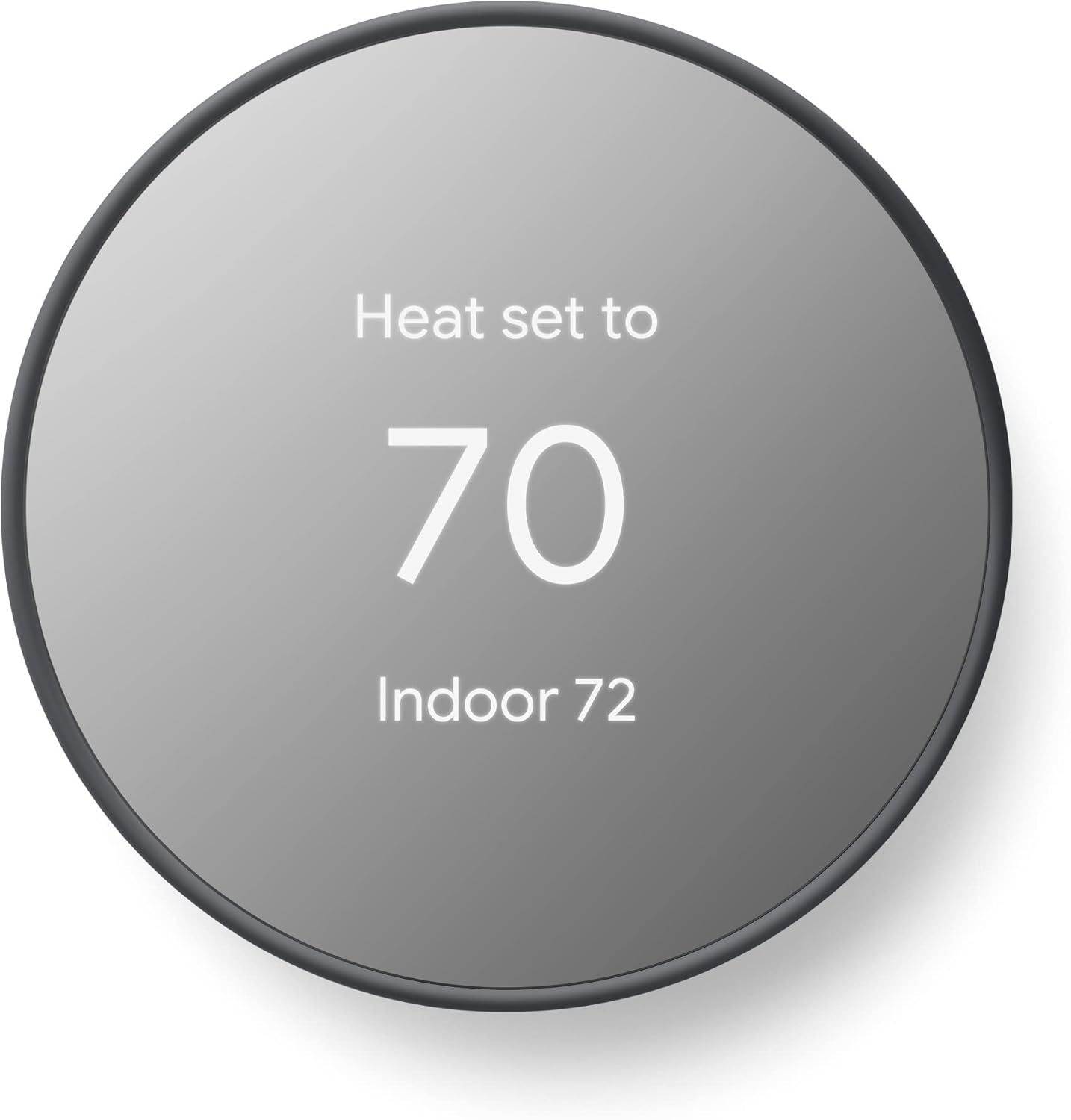
Google Nest Thermostat
| Connectivity Technology | Bluetooth, Wi-Fi |
|---|---|
| Power Source | Battery Powered |
| Display Type | LCD |
| Control Type | Remote Control, Voice Control |
| Number of Batteries | 2 A batteries required. (included) |
The Google Nest Thermostat is an entry-level smart thermostat that brings remote control, basic automation, and HVAC monitoring to an affordable package. It pairs with the Google Home app for scheduling, remote temperature control, and suggestions from Savings Finder, and supports voice commands via compatible assistants. The device is battery powered and designed for a straightforward wall-mounted self-install that usually takes under 30 minutes, and it can operate without a C wire in most homes. In daily use it will automatically set Eco Temperatures when it senses nobody is home, send alerts if it detects potential HVAC issues, and let you tweak schedules from your phone. Trade-offs are its simpler LCD touchscreen and limited advanced features compared with higher-end Nest models, and some systems may still require a C wire or professional power accessory to work properly. For buyers who prioritize easy setup, remote access, and energy-saving basics in a touchscreen thermostat, this model covers the essentials without complexity.
Best for: Buyers who want a straightforward, budget smart thermostat with remote app and voice control and who value easy installation and simple energy-saving features.
Less Ideal for: Tech enthusiasts or installers who need advanced learning algorithms, a larger full-color touchscreen, or extensive professional HVAC integrations.
- App and voice control through Google Home and compatible assistants for remote temperature changes
- Simple, usually DIY installation with included mounting hardware
- Energy-saving features like Eco Temperature and Savings Finder that suggest schedule tweaks
- Battery powered design that can work without a C wire in many homes
- HVAC monitoring that can send alerts if the system shows signs of problems
- Basic 2-inch LCD touchscreen and fewer advanced scheduling or learning features than premium Nest models
- May require a C wire or power accessory for some HVAC setups
Verdict: A simple, affordable touchscreen smart thermostat that delivers remote control and energy-saving basics with easy DIY setup.
Choosing the Right Touchscreen Thermostat: Key Factors to Consider
Installation and Wiring Compatibility
Confirm whether the thermostat works with your HVAC control system and wiring. Many modern touchscreens assume the presence of a common wire for power; missing that wire can complicate installation or require an adapter. Check for compatibility with single-stage and multi-stage heating and cooling, heat pumps, and any auxiliary heat or fan control your system uses.
Installation difficulty affects cost and the likelihood you will DIY the swap. If you are replacing an old mechanical or basic digital thermostat, look for models that include clear wiring diagrams and support for common legacy terminals.
Touchscreen Usability and Display
A responsive, well-lit touchscreen reduces friction in daily use. Look for displays with good contrast that remain readable in bright hallways and dim bedrooms. Touch sensitivity and the size of on-screen targets matter, especially for homeowners who prefer quick adjustments without navigating deep menus.
Interface design affects how easily everyone in the household can change settings. Thermostats with straightforward home screens for temperature and mode, plus quick-access presets or shortcuts, make routine adjustments less frustrating.
Scheduling Flexibility
Scheduling capability determines how hands-off your temperature control can be. Basic week-based schedules are fine for predictable routines, but more flexible schedules with per-day programming or adaptive learning can better handle irregular habits. Consider whether schedules are editable from the device and via an app, and how many program periods per day are supported.
The easier it is to set and edit schedules, the more likely you are to keep energy-saving routines in place. Also check for vacation or away modes that temporarily suspend normal schedules with minimal effort.
Energy-Saving and Reporting Features
Energy features help you understand and reduce runtime. Look for clear eco modes, setpoint recommendations, or usage reports that show trends over days and weeks. Some thermostats include learning algorithms that adjust settings based on occupancy patterns; others rely on manual schedules paired with sensor inputs.
Reporting and straightforward eco feedback make it easier to translate daily thermostat use into long-term savings. If reducing utility bills is a priority, prioritize models that provide actionable data rather than only raw temperature logs.
Connectivity and Remote Access
Remote control through a mobile app or web portal expands how you interact with the thermostat. Strong, stable connectivity lets you adjust temperature away from home, receive alerts, and sync schedules across household members. Check for compatibility with common smart-home ecosystems if you plan to integrate voice assistants or automation routines.
Reliable cloud services and clear app interfaces reduce frustration. Also consider whether the thermostat supports multiple users and has permission settings if several household members will manage settings.
Sensors and Zoning Options
Built-in and external sensors affect comfort and accuracy. Internal sensors provide a basic measure of ambient temperature, while remote or wireless sensors can better represent frequently used rooms. Multi-sensor support helps limit hot or cold spots without rewiring your HVAC.
If your home requires zoned control, check whether the thermostat supports multiple sensors or integrates with zoning panels. Sensor placement and the ability to prioritize rooms influence both comfort and energy use.
Common Wiring Questions Answered
Most touchscreen thermostats need a stable 24V power source, often supplied via a common wire. If your existing thermostat lacks that wire you may be able to use an adapter or choose a model designed for low-power installations. Always shut off HVAC power before wiring and confirm terminal labels before making connections.
If your system is a heat pump, multi-stage, or uses separate controls for humidification or ventilation, check the thermostat's compatibility list and wiring diagram. Some advanced features, like auxiliary heat control or dual fuel switching, require explicit support from the thermostat.
- Identify existing terminal labels before buying
- Turn off power at the breaker before wiring
- Confirm support for heat pump or multi-stage systems if applicable
Making the Most of Scheduling and Routines
Set up a baseline schedule that matches your regular occupancy patterns, then refine with shorter hold or temporary overrides for irregular days. Use vacation or away modes to suspend normal schedules while you are gone and restore them automatically on return.
If a thermostat includes adaptive learning, monitor the first few weeks and tweak preferred temperatures so the algorithm optimizes toward your comfort rather than assumptions. Take advantage of time-of-day setpoints to reduce heating or cooling during low-use hours.
- Create simple weekday/weekend templates first
- Use temporary holds for one-off events
- Adjust learning-based systems early to teach preferences
Using Remote Sensors Effectively
Place remote sensors in rooms where occupants spend the most time rather than near doors or windows that see temperature swings. For bedrooms, mounting a sensor at occupant height yields more representative readings than high-wall placement. Rotate sensor priority if different rooms have shifting occupancy during the day.
If your thermostat supports multiple sensors, experiment with averaging versus priority modes. Averaging helps stabilize whole-house comfort, while priority modes keep a chosen room at the exact target temperature.
- Avoid placing sensors in direct sunlight or above heat sources
- Use wireless sensors to improve comfort in frequently used rooms
- Test different priority settings to match household routines
Display and Accessibility Tips
Adjust display brightness and sleep settings to balance visibility and energy use. High-brightness settings help in hallways with lots of ambient light, while dimming at night prevents glare. Many units let you customize the home screen with favorite shortcuts and temperature presets.
Enable larger fonts or simplified screen layouts if household members prefer fewer on-screen options. Clear labeling of modes and temperature setpoints reduces accidental changes and keeps everyone comfortable.
- Customize brightness for daytime and nighttime
- Use shortcuts for common setpoints
- Enable simplified layouts for ease of use
Integration With Smart Home Systems
If you plan to add voice control or automation, confirm the thermostat's ecosystem compatibility and the level of integration provided. Some thermostats expose full scheduling and setpoint control to external systems, while others only offer basic status updates.
Consider privacy and account requirements when connecting cloud services. Decide whether you want full remote access via an app or a local-only integration, and check whether the device allows multiple user accounts with different permission levels.
- Verify voice assistant and automation compatibility
- Check cloud account requirements and privacy settings
- Decide between local-only and cloud-enabled control
How We Chose the Best Touchscreen Thermostat
We focused on practical, user-facing criteria that determine whether a touchscreen thermostat will work well in real homes. Evaluation emphasized installation and wiring compatibility, because a smart display is only useful if the unit integrates cleanly with a home's HVAC system. We tested interface clarity by judging touch responsiveness, menu layout, and how many steps common actions require. Scheduling and automation capabilities were weighed next; thermostats that offer flexible, easy-to-edit schedules or adaptive routines scored higher. Energy-focused features were another major filter, including reported savings modes, eco setpoints, and support for occupancy or learning modes. Connectivity and remote control were evaluated for reliability and the breadth of control options available through apps or integrations. Finally, build quality and display readability—day and night—were considered so selected models would be durable and usable in a range of lighting conditions. We excluded units that require uncommon wiring changes, lack essential HVAC compatibility, or have interfaces that regularly force deep menu dives for simple tasks. The criteria described here guided the shortlist and align with the scoring metrics used in the product scorecards.
Our full evaluation process is outlined in our review methodology.
FAQ
Do touchscreen thermostats need a common wire?
Often, yes. Many touchscreen models expect a 24V common wire for consistent power. If your wall thermostat lacks one, you may need an adapter or a model specifically designed to operate without a common wire.
Can I install a touchscreen thermostat myself?
Many homeowners can install a touchscreen thermostat if they are comfortable turning off power and following wiring diagrams. However, systems with complex wiring or hydronic and multi-stage setups may require professional installation.
Will a touchscreen thermostat save energy?
It can. Energy savings come from better scheduling, smarter automation, and reduced runtime through efficient setpoints. The thermostat itself is a tool; savings depend on how consistently schedules and eco modes are used.
How do remote sensors improve comfort?
Remote sensors measure temperature in occupied rooms and allow the thermostat to base control on more representative conditions. This reduces hot and cold spots and can prevent over-conditioning rooms that are seldom used.
Are touchscreen thermostats compatible with smart-home systems?
Many are, but integration levels vary. Some offer broad automation and voice control support while others limit third-party access. Check compatibility with the smart-home ecosystem you use and whether features like scheduling and geofencing are exposed.
Final Verdict
When choosing a touchscreen thermostat, prioritize compatibility with your HVAC wiring and the display and interface design that your household will actually use. Balance scheduling flexibility and energy-management features against the installation requirements and connectivity you want. Focus on models that make daily adjustments simple and provide clear energy feedback. That tradeoff—between ease of use, reliable compatibility, and useful reporting—will guide you to a touchscreen thermostat that improves comfort without adding complexity.