
Note: This article contains affiliate links. If you click on these links and make a purchase, we may earn a small commission at no extra cost to you. This helps support our research and content. Read our full affiliate disclosure here.
Picking the right Wi-Fi controlled thermostat makes daily comfort seamless and can trim energy use through smarter schedules and remote control. If you want reliable remote temperature management, straightforward installation, and clear app controls, the right thermostat reduces hassle and keeps your home comfortable on your terms. This guide shortlists the top Wi-Fi controlled thermostats for typical homes and apartments. Each pick was chosen for factors that matter in real-world use: wireless reliability, setup complexity, compatibility with common HVAC systems, and the usability of mobile and in-unit controls. Read on for the evaluation criteria and practical notes to help you choose the best fit.
Top Picks at a Glance
| Best Overall The best all-around choice for most situations | ecobee Smart Thermostat Essential |  |
| Best Quality Built to a higher standard if you want something more solid | ecobee Smart Thermostat Premium |  |
| Best Value The sweet spot between price and what you get | Honeywell Home X2S Smart Thermostat |  |
| Best Budget The cheapest option that still gets the job done reliably | Amazon Smart Thermostat |  |
| Top Rated A top-rated pick with lots of positive feedback | Sensi Touch ST75 |  |
| Most Popular A crowd favorite that many people choose with confidence | Google Nest Thermostat |  |
| Best Seller A high-volume bestseller chosen again and again | Sensi Smart Thermostat ST55 |  |
ecobee Smart Thermostat Essential

| Connectivity Technology | Wi-Fi |
|---|---|
| Controller Type | Amazon Alexa, Android, Apple HomeKit, Google Assistant, iOS |
| Power Source | Battery Powered |
| Display Type | LCD |
| Specification Met | Energy Star |
The ecobee Smart Thermostat Essential is a budget-focused smart thermostat that gives you remote control via the ecobee app plus voice control through Siri, Alexa, and Google Assistant. It mounts to the wall and uses a color touchscreen for local adjustments while automated features like auto-scheduling and eco+ help shift runtime to save energy. The Essential supports common 24 VAC systems and can work without a C wire when used with the optional Power Extender Kit, making it a straightforward DIY install for many homes. Practical additions include fan control, filter and maintenance reminders, and integration with ecobee SmartSensor accessories for room-level sensing (sold separately). The unit is battery powered and Energy Star certified, but it lacks some premium sensors and built-in air quality monitoring found on higher-end ecobee models, and advanced HVAC diagnostics are more limited. For someone who wants reliable remote temperature control and basic energy savings without a lot of extra bells and whistles, this model covers the essentials well.
Best for: Buyers who want a reliable, budget-friendly smart thermostat that gives remote control, voice integration, and basic energy-saving features without the complexity of premium models.
Less Ideal for: Users who need advanced multi-room sensing, built-in air quality monitoring, or the most feature-rich HVAC diagnostics should look at higher-tier smart thermostats.
- Wi‑Fi and voice assistant support for remote and hands-free control
- Eco+ features and auto-scheduling to reduce heating and cooling energy use
- Works with most 24 VAC HVAC systems and offers a Power Extender Kit option for homes without a C wire
- Simple touchscreen and app interface for easy daily adjustments
- Does not include the higher-end sensors or built-in air quality monitoring found on premium ecobee models
- Battery powered design may require occasional battery changes
Verdict: A straightforward, cost-conscious smart thermostat that delivers remote app control, voice assistant compatibility, and basic energy-saving features for most 24 VAC homes.
ecobee Smart Thermostat Premium

| Controller Type | Amazon Alexa, Android, Apple HomeKit, Google Assistant, iOS |
|---|---|
| Connectivity Protocol | Wi-Fi |
| Power Source | Battery Powered |
| Voltage | 24 volts |
| Included Components | Smart Thermostat Premium, SmartSensor, Backplate, Power Extender Kit, trim plate |
The ecobee Smart Thermostat Premium is a full-featured Wi‑Fi thermostat designed to optimize comfort and energy use across a home. It mounts on the wall and pairs with an included SmartSensor to detect room-level temperatures and reduce hot or cold spots, while radar occupancy sensing and geofencing adjust behavior based on presence. The device has a large LCD display, built-in Alexa or Siri voice control with a speaker for music and voice commands, and an air quality monitor that issues alerts and filter reminders. Installation is DIY-friendly for most 24VAC systems and the box includes a Power Extender Kit for homes without a C-wire. In practice the thermostat gives precise, room-focused control that can cut heating and cooling waste and integrates with HomeKit, Google Assistant, SmartThings, and IFTTT for automation. Trade-offs are its reliance on an app and account for advanced features and the premium metal design and extras make it larger and more feature-rich than basic Wi‑Fi thermostats, which may be more than some buyers need.
Best for: Buyers focused on performance and energy savings who want room-level temperature control, advanced occupancy detection, and integrated voice and air quality features for a smarter, more efficient HVAC setup.
Less Ideal for: People who only need a basic Wi‑Fi or programmable thermostat for simple schedule control or who prefer a minimal, no-cloud local device.
- Includes SmartSensor to balance temperatures in specific rooms and reduce hot/cold spots
- Built-in voice assistant (Alexa or Siri) and speaker for hands-free control and audio
- Integrated air quality monitor with alerts and filter reminders
- Radar occupancy sensing and geofencing for presence-aware automation
- Power Extender Kit and trim kit included to simplify DIY installation on most 24VAC systems
- Advanced features require app account and cloud connectivity for full functionality
- Larger, premium design may be overkill for buyers who want a simple programmable thermostat
Verdict: Choose this thermostat if you want a high-performance, Wi‑Fi smart thermostat that uses sensors, radar occupancy, and built-in voice to maximize comfort and energy savings.
Honeywell Home X2S Smart Thermostat

| Compatibility | Up to 2H/2C conventional or Up to 2H/1C heat pump |
|---|---|
| Connectivity | WiFi (2.4 or 5 GHz), Matter |
| Power Requirement | C‑wire required (24 VAC) |
| Scheduling Options | 7 day, 5‑1‑1 day, 5‑2 day, 1 week or non‑programmable option |
| ENERGY STAR | Yes |
The Honeywell Home X2S is a wall‑mounted smart thermostat designed to replace basic programmable units and provide remote control plus energy‑saving features. It connects to 2.4 or 5 GHz Wi‑Fi and works with Matter, Alexa, Google Assistant, and Apple HomeKit so you can adjust temperature from the app or voice assistant. The interface combines push‑button controls and an LCD screen, while the app offers flexible scheduling (7‑day, 5‑1‑1, 5‑2 or 1‑week), auto‑away, filter reminders, and indoor humidity monitoring. The unit is ENERGY STAR certified and supports conventional and heat pump systems up to the stated staging limits, but it requires a C‑wire for full power so some homes may need an adapter or wiring check. Interchangeable accent pieces help it blend into different decors, and the Matter certification improves smart home reliability compared with older Wi‑Fi thermostats. If you value clear scheduling, platform compatibility, and energy program participation this thermostat delivers those practical benefits, though installation may be slightly more involved in homes lacking a common wire.
Best for: Buyers who prioritize reliable smart home integration, flexible scheduling, and measurable energy savings and are comfortable checking wiring or arranging a simple install.
Less Ideal for: People seeking a battery‑only or completely wireless retrofit solution or those who want a touchscreen interface for on‑device control.
- Matter certified for broader smart home compatibility with Alexa, Google Assistant, and Apple HomeKit
- Flexible scheduling options plus auto‑away and filter reminders for hands‑off energy savings
- ENERGY STAR certified to support energy program participation and potential rebates
- Humidity display and indoor monitoring add useful climate feedback beyond temperature
- Interchangeable decorative accents let the thermostat match different decors
- Requires C‑wire power which can complicate installation in some older homes
- No touchscreen; uses push buttons and an LCD which limits advanced on‑device navigation
Verdict: Choose the X2S if you want a practical, ENERGY STAR certified Wi‑Fi thermostat with Matter support and flexible scheduling to cut energy use while integrating cleanly into a smart home.
Amazon Smart Thermostat
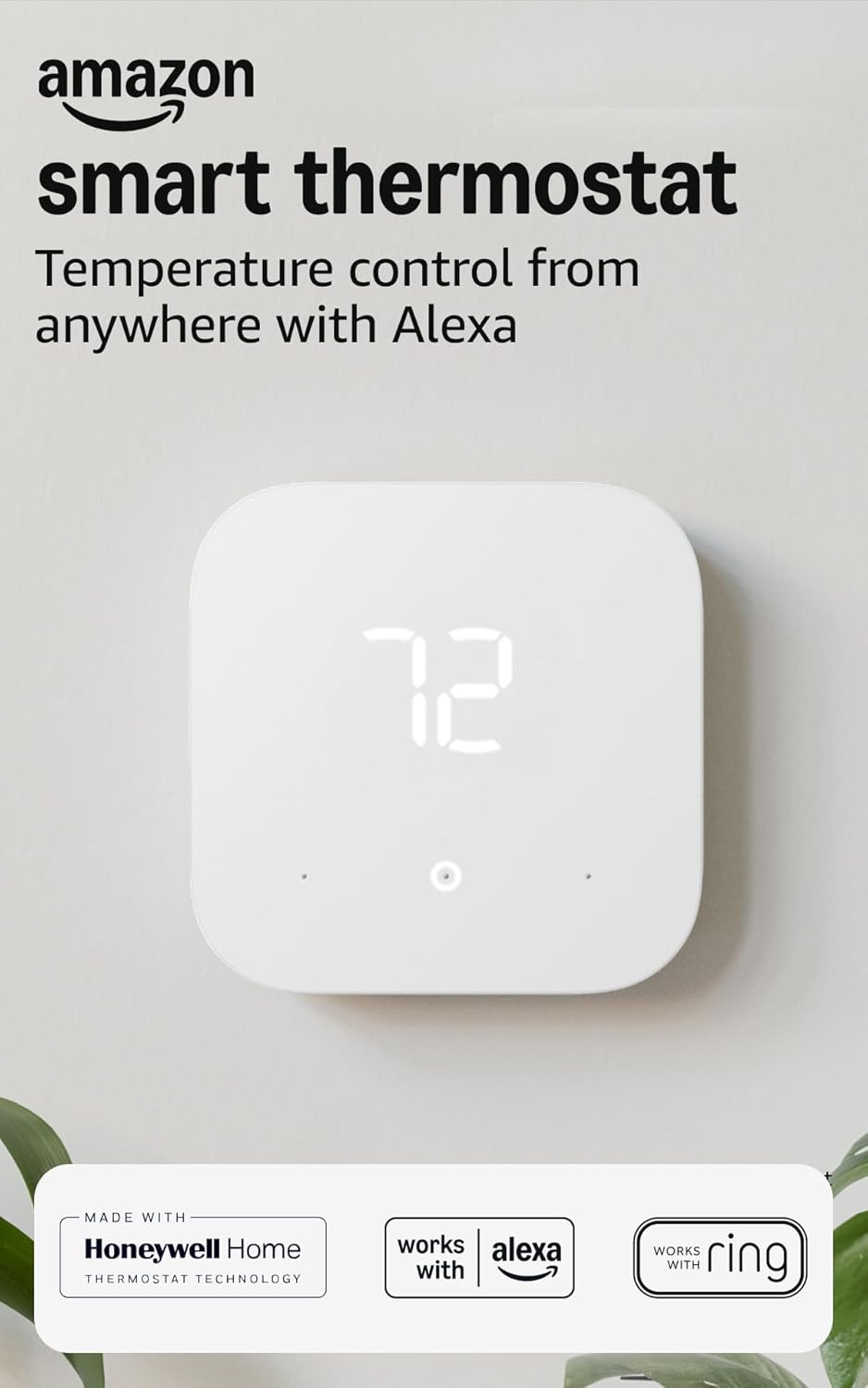
| Works with | Alexa, Ring |
|---|---|
| C-wire | Required |
| Remote control | Alexa app |
The Amazon Smart Thermostat provides basic smart thermostat functionality with tight Alexa integration and a DIY installation flow guided by the Alexa app. It uses Honeywell Home thermostat technology for temperature control and connects to your Wi‑Fi so you can set schedules, switch modes, and adjust temperature from the Alexa app or voice commands. Notable features include presence-based adjustments when paired with select Alexa devices, predefined home, away, and sleep schedules, and email guidance on possible utility rebates to reduce upfront cost. Practical benefits are simple setup for users already in the Alexa ecosystem, remote control when away from home, and energy-saving schedules aimed at lowering bills. Limitations are that it requires a common wire C-wire, lacks advanced learning algorithms found in higher-end competitors, and its smart features are centered on Alexa rather than broader smart home platforms.
Best for: Buyers looking for an affordable Wi‑Fi thermostat that integrates tightly with Alexa and wants straightforward, app-guided setup and basic energy-saving schedules.
Less Ideal for: Users who want platform-agnostic smart home integration, advanced learning thermostats, or a model that runs without a C-wire.
- Works natively with Alexa and Ring for voice and presence-based control
- Guided DIY installation through the Alexa app
- Remote scheduling and control via the Alexa app
- Built on Honeywell Home thermostat technology for reliable temperature control
- Requires a C-wire which may need additional wiring for some homes
- Smart capabilities are focused on Alexa and may be limited for non-Alexa users
- Does not offer advanced self-learning algorithms
Verdict: A budget-friendly Wi‑Fi thermostat ideal for Alexa users who want simple installation and straightforward remote scheduling to cut energy use.
Sensi Touch ST75

| Connectivity Technology | Wi-Fi (2.4 GHz) |
|---|---|
| Control Method | App, Touch, Voice |
| Screen Size | 4.3 inches |
| Temperature Control Type | Programmable |
| Specific Uses For Product | Air Conditioner, Boiler, Furnace, Heat Pump |
The Sensi Touch ST75 is a wall‑mounted smart thermostat that replaces a conventional thermostat to give remote control, scheduling, and usage reporting via the Sensi mobile app. It connects to 2.4 GHz Wi‑Fi and integrates with Alexa, Google Assistant, Apple HomeKit, SmartThings and Vera so you can use voice or app controls and include the thermostat in automations. The 4.3‑inch color touchscreen and illuminated terminals simplify DIY installation when a common c‑wire is present, and the app provides energy reports, smart alerts and filter reminders to help with routine maintenance. The unit is Energy Star certified and supports geofencing and programmable schedules to reduce HVAC runtime. Limitations to note are the C‑wire requirement for reliable power and dependence on a 2.4 GHz network, which may require network adjustments in homes using only 5 GHz Wi‑Fi or lacking a c‑wire.
Best for: Buyers who prioritize a reliable, factory‑backed smart thermostat that integrates with major smart‑home platforms and provides clear energy reports and maintenance alerts.
Less Ideal for: People without an available common wire or homes that only run 5 GHz Wi‑Fi should consider alternate models or wiring options before choosing this unit.
- Works with major smart assistants and HomeKit for broad voice and automation options
- Energy Star certified and provides usage reports and smart alerts to help reduce HVAC energy use
- Large color touchscreen and app make daily control and scheduling straightforward
- Designed for DIY installation with illuminated easy‑click terminals and built‑in level
- Requires a common c‑wire for reliable installation and operation
- Only compatible with 2.4 GHz Wi‑Fi networks, not 5 GHz
Verdict: Choose the Sensi Touch ST75 if you want a proven, Energy Star smart thermostat with solid app control and wide smart‑home compatibility for dependable HVAC management.
Google Nest Thermostat
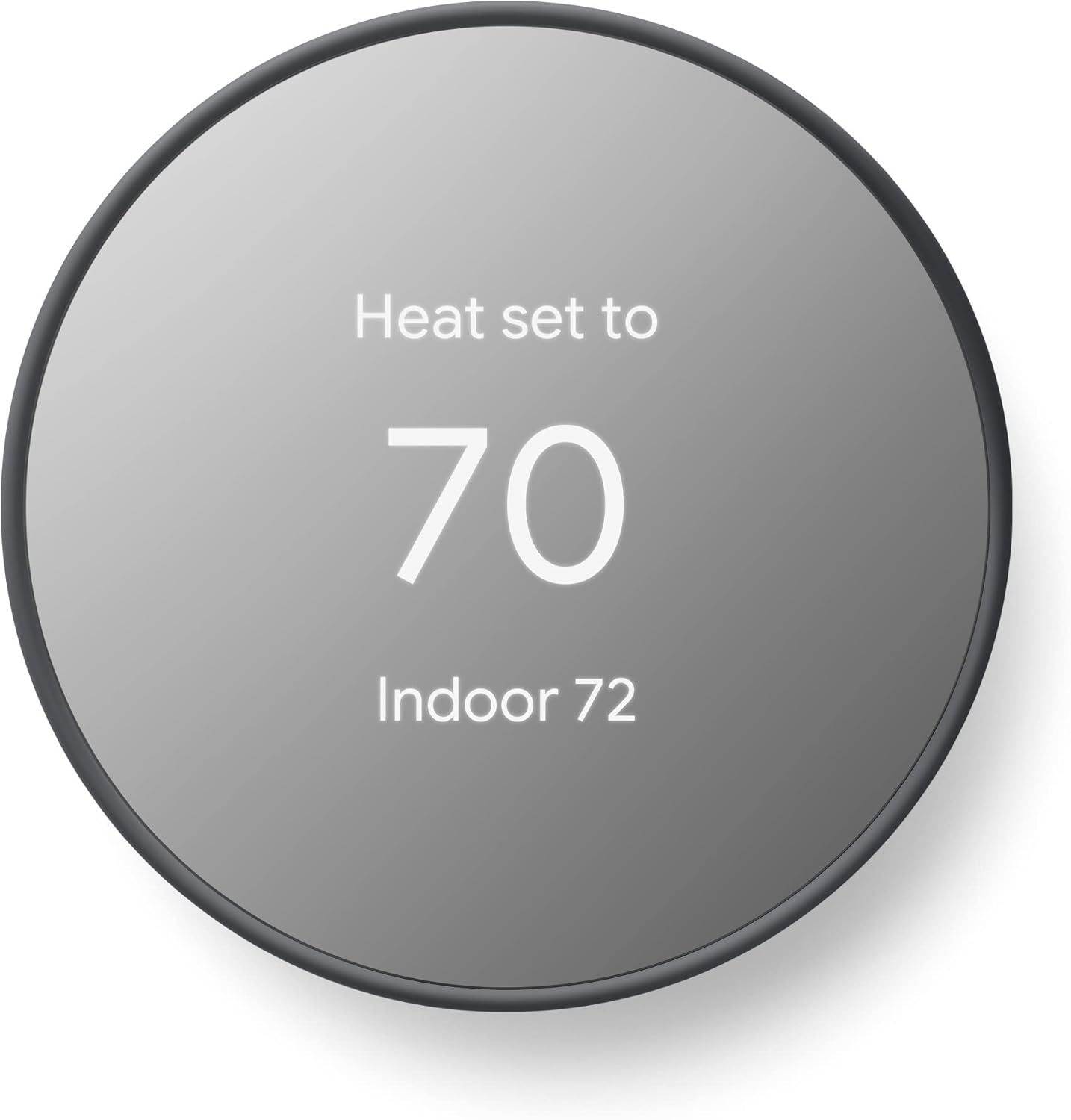
| Connectivity Technology | Bluetooth, Wi-Fi |
|---|---|
| Display Type | LCD |
| Screen Size | 2 inches |
| Power Source | Battery Powered |
| Number of Batteries | 2 A batteries required. (included) |
The Google Nest Thermostat is a compact, app-driven smart thermostat that replaces a basic wall thermostat to give remote temperature control, simple scheduling, and energy-saving automation. It connects over 2.4/5 GHz Wi‑Fi and Bluetooth and is controlled from the Google Home app or with voice assistants, so you can change settings from a phone or with compatible smart speakers. Installation is designed for DIY in about 30 minutes and the unit usually works without a C wire; where needed you can add a power accessory. Features like Savings Finder, Eco Temperatures when you leave, and HVAC monitoring provide practical energy savings and alerts that can flag potential system issues. The display is a 2-inch LCD and two A batteries power the unit, which keeps wiring simple but means occasional battery replacement. While it covers the common heating and cooling setups and offers solid integration with Google services, it lacks the advanced learning routines and larger screen of higher-end Nest models and depends on reliable Wi‑Fi for remote and voice features.
Best for: Buyers who want a budget-friendly, Wi‑Fi smart thermostat that is easy to install and integrates with Google Home for remote and voice control, with energy-saving features prioritized over advanced learning behavior.
Less Ideal for: Those who want the most feature-rich Nest model with advanced self-learning schedules, a larger display, or built-in professional-level diagnostics should consider higher-end options.
- Easy DIY installation with Google Home app guidance
- Works without a C wire in most homes, simplifying retrofit installs
- Remote control and voice control via Wi‑Fi and Google Assistant
- Energy-saving features like Savings Finder and automatic Eco Temperatures
- HVAC monitoring that can send alerts for potential issues
- Requires batteries for power which need periodic replacement
- Does not include the advanced learning features found on higher-end Nest models
Verdict: A simple, app-first Wi‑Fi thermostat that gives reliable remote control and practical energy-saving features for buyers who prioritize ease of install and Google Home integration.
Sensi Smart Thermostat ST55

| Connectivity Technology | Wi-Fi |
|---|---|
| Control Method | App, Touch, Voice |
| Power Source | Corded Electric |
| Display Type | LED |
| Number of Batteries | 2 AA (included) |
The Sensi Smart Thermostat ST55 replaces a traditional wall thermostat with a Wi‑Fi connected, programmable controller designed for straightforward DIY installs. It connects to 2.4 GHz Wi‑Fi and pairs with the Sensi mobile app to provide remote access, scheduling, usage reports, and smart alerts, while also supporting voice control through Alexa, Google Assistant, Apple HomeKit, SmartThings, and Vera. The physical unit is a simple LED display with button controls and a compact, familiar shape that fits typical thermostat cutouts so you rarely need wall repair. Notable practical benefits include Energy Star certification for energy savings, filter reminders and maintenance alerts, and included mounting hardware and batteries to get started. Limitations to consider are the modest 5 inch screen and button-based interface that is less visually rich than touchscreen competitors, and 2.4 GHz Wi‑Fi only which could be restrictive on congested networks. The ST55 is a solid, privacy-focused choice for buyers who want reliable remote control and energy reports without a steep learning curve or complex setup.
Best for: Buyers who want a dependable, privacy-minded smart thermostat they can install themselves and control remotely with a simple app and voice assistants.
Less Ideal for: People who prioritize a large touchscreen interface or need dual‑band Wi‑Fi support and advanced visual controls.
- Easy DIY installation with included mounting hardware and step‑by‑step app guidance
- Remote control and scheduling via the Sensi mobile app with usage reports and smart alerts
- Works with major voice assistants and home platforms for flexible control
- ENERGY STAR certification and features aimed at reducing HVAC energy use
- Includes batteries and filter/maintenance reminders for ongoing system care
- 5‑inch LED and button controls are less intuitive than modern color touchscreens
- Supports only 2.4 GHz Wi‑Fi which may limit network placement options
Verdict: Choose the Sensi ST55 if you want a straightforward, Energy Star certified smart thermostat that offers reliable remote control and easy DIY installation.
Choosing the Right Wi-Fi Controlled Thermostat: Key Factors to Consider
Connectivity Reliability
A Wi-Fi controlled thermostat is only as useful as its connection. Reliable connectivity ensures remote temperature adjustments, accurate reporting, and timely software updates. Look for thermostats that support common Wi-Fi bands and have a history of stable cloud services.
Unreliable connectivity can create frustrating gaps between the app and the thermostat, cause missed schedules, or delay critical alerts. If your home has weak Wi-Fi in the thermostat location, plan for a stronger access point or choose devices known for robust reconnection behavior.
Installation and Wiring Compatibility
Thermostat installation varies from simple battery swaps to wiring into multi-stage HVAC systems. Verify whether the thermostat requires a common wire or supports battery-only operation. Check compatibility with single-stage, multi-stage, heat pump, or millivolt systems as relevant to your HVAC.
Ease of installation saves time and reduces the need for professional help. Clear wiring diagrams, labeled terminals, and helpful setup assistants in the app are beneficial for DIYers. If your system has nonstandard wiring or advanced controls, prioritize models with explicit compatibility or professional installation support.
App and On-Unit Usability
Daily interaction happens through the mobile app and the thermostat display. A well-designed app makes scheduling, temperature adjustments, and mode changes simple. Look for responsive controls, clear status information, and useful notifications.
The on-unit interface should remain usable even without the app. A readable display, tactile buttons or a sensible touchscreen, and straightforward menus are important for household members who prefer local control. Consider whether the app or on-unit options support multiple users and permission levels.
Scheduling and Energy Management
Advanced scheduling and energy features determine how much a thermostat can reduce consumption without sacrificing comfort. Useful features include weekday/weekend schedules, adaptive learning schedules, eco or away modes, and integration with occupancy sensors.
Meaningful energy management depends on how easily you can set and modify schedules, whether the thermostat can adjust behavior based on real-time conditions, and how it reports usage. Clear energy reports or trend graphs help you track savings and refine settings over time.
Sensor and Integration Support
Supplemental sensors and integration with other smart home devices can improve comfort and zoning. Remote temperature or occupancy sensors help the thermostat avoid hot or cold spots and respond to where people actually are.
Integration with voice assistants, home automation platforms, or climate controls allows more flexible automation rules. Check whether the thermostat supports additional sensors, whether those sensors are wired or wireless, and how easily they pair and report data.
Reliability of Firmware and Security
Firmware updates fix bugs and add features, while good security practices protect networked devices. Choose thermostats with a track record of regular software support and clear security measures like encrypted communications and secure account access.
Neglecting firmware reliability can lead to stability problems or missed feature improvements. Strong security reduces the risk of unauthorized access to your home controls and personal data.
Wiring Scenarios and What to Expect
Different homes present different wiring setups. Most supply common wires for power and simple control, but older systems might only provide two wires. Understand which terminals your HVAC uses before choosing a thermostat.
If your system lacks a common wire, options include selecting a battery-powered thermostat, using a power extender kit when supported, or having an electrician add a wire. For multi-stage heating or heat pump systems, ensure the thermostat explicitly documents compatibility and wiring diagrams.
- Two-wire systems often only support basic on/off thermostats.
- A common wire simplifies power and reduces battery dependence.
- Multi-stage systems need thermostats that expose and map extra terminals.
Using Sensors to Improve Comfort
Remote or room sensors help balance temperature across different areas. Place sensors where occupants spend time rather than in drafty or direct-sun locations to get useful readings.
Some thermostats average sensor readings automatically, while others let you prioritize locations or set sensor-based schedules. Consider whether you want sensors for temperature, motion, or humidity, and how those readings will be used by the thermostat.
- Temperature sensors reduce hot or cold spots.
- Occupancy sensors enable automatic eco modes.
- Humidity sensing improves comfort in damp climates.
Scheduling Strategies for Better Efficiency
Effective schedules match temperature setpoints to typical occupancy patterns. Create setback periods during work or sleep hours and boost comfort shortly before people return home. Avoid overly complex schedules that are hard to maintain.
Take advantage of adaptive or learning schedules if you prefer a hands-off approach. Use vacation or away modes to prevent energy waste during longer absences, and periodically review energy reports to refine your program.
- Simple weekday/weekend schedules cover most needs.
- Adaptive learning can reduce setup time but may require initial adjustments.
- Combine scheduling with geofencing or occupancy sensors for automatic changes.
Troubleshooting Common Setup and Connectivity Issues
Connectivity problems often stem from weak Wi-Fi signal at the thermostat location. Test signal strength before purchase and consider network improvements like a mesh node or relocated access point.
If the thermostat fails to connect during setup, check that your router uses a supported frequency band and that any firewall settings are not blocking device registration. Many apps include diagnostics to guide reconnection attempts.
- Restart the thermostat and router if pairing fails.
- Confirm Wi-Fi credentials and band compatibility.
- Use app diagnostics and guided setup features when available.
Privacy and Account Management
Account security and data handling are important for networked thermostats. Use strong, unique passwords and enable multi-factor authentication if available. Review account sharing and guest access settings for household members.
Consider what data the thermostat collects and how long usage logs are retained. If privacy is a priority, choose thermostats that document their data practices and offer local control modes when offline.
- Enable secure passwords and two-factor authentication.
- Limit third-party integrations if you want tighter privacy control.
- Check data retention and export options in the app.
How We Chose the Best Wi-Fi Controlled Thermostat
We evaluated Wi-Fi controlled thermostats using concrete, homeowner-focused criteria that affect everyday performance and long-term satisfaction. Primary filters included wireless connectivity and app stability, since consistent remote control and accurate reporting depend on a strong, reliable connection. Installation complexity and wiring compatibility were key, because many buyers swap thermostats themselves or need clear guidance for professional install. We also prioritized control interface quality, covering both the mobile app and the on-device display and buttons, as intuitive controls reduce daily friction. Energy and scheduling features were assessed for meaningful savings potential and ease of programming. Finally, sensor support and integration options matter for whole-home comfort and automation. We excluded products that lack essential HVAC compatibility information, have no Wi-Fi capability, or offer only minimal remote control features. Our selections emphasize real-world reliability and usability rather than niche or experimental features.
Our full evaluation process is outlined in our review methodology.
FAQ
Do Wi-Fi controlled thermostats need a common wire?
Many models perform best with a common wire to provide continuous power, but some support battery-only operation or include a power adapter. Check your HVAC wiring and the thermostat's stated requirements before purchasing.
Can I install a Wi-Fi thermostat myself?
Often yes for homeowners comfortable with basic wiring, provided your system compatibility is confirmed. If your HVAC has complex wiring or you are unsure, professional installation is a safer option.
Will a Wi-Fi thermostat work with my heat pump or multi-stage system?
Support depends on the thermostat's documented compatibility. Look for models that explicitly list heat pump and multi-stage configurations and provide wiring guides for those systems.
How reliable are mobile apps for controlling thermostats remotely?
App reliability varies by provider and home network conditions. Many apps offer stable remote control and push notifications, but performance can depend on the thermostat's cloud service and your Wi-Fi stability.
Can sensors help reduce energy use?
Yes. Remote temperature and occupancy sensors let the thermostat focus conditioning where people are, reducing wasted heating or cooling. The savings depend on how you schedule and prioritize sensor inputs.
Final Verdict
When choosing a Wi-Fi controlled thermostat, prioritize connectivity reliability, wiring compatibility, and the quality of the control interface. Tradeoffs are common: the most feature-rich models may require more complex wiring or depend more heavily on cloud services, while simpler units can offer reliable local control with fewer features. Decide which features you need most, such as sensor support, advanced scheduling, or simplified setup, and match those priorities to the thermostat's documented compatibility and app capabilities. With the right balance of reliability and features, you can gain convenient, efficient temperature control that fits your home and routine.