
Note: This article contains affiliate links. If you click on these links and make a purchase, we may earn a small commission at no extra cost to you. This helps support our research and content. Read our full affiliate disclosure here.
If you enjoy collecting and serving wine, a high-end wine cooler can protect your bottles and improve every pour. The right cooler keeps bottles at stable, precise temperatures, minimizes vibration and light exposure, and offers flexible shelving so you can store different bottle shapes and sizes. This guide covers our shortlisted high-end wine coolers, chosen for accuracy, capacity, and user convenience. We evaluate temperature control, vibration suppression, storage options, noise, and build quality to help you find a unit that fits your room and routine. Read on for a focused look at the features that matter most and which designs fit common use cases.
Top Picks at a Glance
| Best Overall The best all-around choice for most situations | FoMup 24" Wine Cooler FM24WL-2 |  |
| Best Quality Built to a higher standard if you want something more solid | Zephyr Presrv 24" Wine Fridge |  |
| Best Value The sweet spot between price and what you get | Yeego 24 Inch Wine Fridge YG-WD24-A |  |
| Best Budget The cheapest option that still gets the job done reliably | BLACK+DECKER 12-Bottle Wine Fridge BD60336 |  |
| Top Rated A top-rated pick with lots of positive feedback | BODEGA 30-Inch Wine & Beverage Cooler |  |
| Most Popular A crowd favorite that many people choose with confidence | Velieta 24-Inch Wine Cooler KMHJ510 |  |
| Best Seller A high-volume bestseller chosen again and again | Icyglee 25-Bottle Wine Cooler |  |
FoMup 24" Wine Cooler FM24WL-2

| Capacity | 15.8 cubic feet |
|---|---|
| Number Of Shelves | 16 |
| Cooling Method | Compressor |
| Temperature Range | 40-65 F |
| Annual Energy Consumption | 250 kilowatt hours per year |
This FoMup 24" wine cooler is a compressor-cooled, freestanding unit built to store a large collection while fitting into a kitchen or cellar. It uses a digital touch panel with memory to set temperatures between 40 and 65 F, and its wind-cooling system plus activated carbon filter help keep air stable and odor free. The unit offers smooth sliding wood-and-wire shelves for easier bottle access, a double-layer tempered glass door for light protection, and a reversible stainless steel door for flexible placement. In real-world use it operates like a dedicated wine cellar rather than a simple beverage fridge, with capacity for many bottles and a frost-free defrost system that reduces maintenance. Trade-offs include its large footprint and the typical compressor noise compared with thermoelectric units, and buyers should leave the unit standing for 24 hours after delivery before powering it on. For collectors who need a tall, energy-consuming cooler with practical shelving and temperature memory, this model delivers a lot of storage and useful features.
Best for: Collectors or serious home hosts who need a high-capacity, upright wine cooler that behaves like a dedicated cellar and prioritizes storage, stable temperatures, and flexible installation.
Less Ideal for: Small-space renters or casual users who need a compact, quiet countertop or undercounter fridge should consider smaller or quieter models instead.
- Very high storage capacity claimed (up to 190 Bordeaux bottles)
- Digital touch temperature control with memory for consistent setpoints
- Smooth sliding wood and wire shelves for easier bottle access
- Reversible stainless steel door and keyed lock for placement flexibility and security
- Large footprint and tall form factor may not fit smaller kitchens
- Compressor-based cooling can be noisier and uses more energy than thermoelectric alternatives
Verdict: Buy this if you want a tall, high-capacity wine cooler with precise digital controls and flexible installation for a serious at-home collection.
Zephyr Presrv 24" Wine Fridge

| Capacity | 5.2 cubic feet |
|---|---|
| Bottle capacity | 21 bottles |
| Can capacity | 64 12oz cans |
| Temperature range (beverage) | 38° – 65° F |
| Temperature range (wine) | 40° – 65° F |
The Zephyr Presrv 24" is a high-end dual-zone wine and beverage fridge designed for under-counter or freestanding installation. It splits storage into dedicated wine and beverage zones, uses a compressor with inverter technology for stable cooling, and offers a wide temperature range suitable for both wines and chilled drinks. Notable touches for cellar-minded buyers include vibration dampening, full-extension wood racks for bottles, slide-out glass shelves for cans, and a carbon filter with LED lighting in three colors. Electronic capacitive touch controls, a door-open alarm, and dual-pane argon-filled glass help protect inventory and maintain setpoints. Practical limitations are its size and weight, which require planning for built-in installs, and the premium price tier relative to simpler single-zone units. For enthusiasts who prioritize stable, display-ready storage and flexible beverage cooling, the Presrv delivers a refined feature set and thoughtful preservation features.
Best for: Buyers who want a performance-focused wine cooler that maintains precise temperatures and protects bottles while providing flexible beverage storage and a display-grade finish.
Less Ideal for: Casual users who need a compact, budget beverage fridge or who plan frequent relocations and need a lightweight unit.
- Dual-zone cooling with inverter compressor for stable, adjustable temperatures
- Vibration dampening and argon-filled dual-pane glass to protect wine quality
- Full-extension wood racks and slide-out glass shelves for organized bottle and can storage
- Carbon air filter and selectable 3-color LED lighting for display and odor control
- Large, heavy cabinet limits placement flexibility and makes installation more involved
- Premium features place it in a higher price bracket than basic beverage fridges
Verdict: Choose the Zephyr Presrv 24" if you want a high-end, dual-zone cooler that protects wine with precise, low-vibration cooling while offering flexible beverage storage and showroom styling.
Yeego 24 Inch Wine Fridge YG-WD24-A

| Capacity | 5.12 cubic feet |
|---|---|
| Size | 52 Bottles |
| Temperature range | 40-65°F (5-18°C) |
| Cooling Method | Compressor |
| Annual Energy Consumption | 194 kilowatt hours per year |
The Yeego 24 Inch Wine Fridge is a compressor-cooled cabinet designed to store and display a medium-sized wine collection. It uses five adjustable wooden shelves and dual-layer tempered glass to protect bottles from vibration and UV light while a digital control panel manages temperatures in a 40 to 65°F range. The unit is configurable for built-in, under-counter, or freestanding installation and includes front ventilation and leveling feet to simplify placement. Practical touches like soft blue LED interior lighting, a stainless steel handle, and automatic defrost make daily use straightforward. The compressor design and 360° air circulation promise steady cooling and relatively low noise around 41 to 43 dB, which helps when the fridge sits near living spaces. Trade-offs are typical for a 24-inch cooler: it requires proper clearance for ventilation when built in and consumes energy consistent with compressor models, but it offers better temperature control and capacity than small thermoelectric units.
Best for: Buyers who want a practical, higher-capacity wine cooler that prioritizes steady temperature control and low vibration for long-term storage and display.
Less Ideal for: People who need a very compact, ultra-low-energy countertop cooler or only occasional short-term chilling should consider smaller thermoelectric models instead.
- Compressor cooling with 360° air circulation for even, reliable temperatures
- Holds up to 52 standard bottles on five adjustable wooden shelves
- Dual-layer tempered glass and stainless steel frame reduce UV exposure and look upscale
- Built-in or freestanding installation with front ventilation and adjustable leveling feet
- Quiet operation around 41–43 dB and automatic defrost for low maintenance
- Requires adequate ventilation and clearance for built-in installation
- Larger footprint and higher energy use than small thermoelectric coolers
Verdict: A roomy, compressor-based 24-inch cooler that delivers reliable, low-vibration temperature control for collectors who want a practical, display-ready wine fridge.
BLACK+DECKER 12-Bottle Wine Fridge BD60336

| Capacity | 12 Bottles |
|---|---|
| Temperature Range | 46°F – 66°F |
| Cooling Method | Thermoelectric |
| Shelves | 5 removable chrome racks |
| Power | 115 volts |
The BLACK+DECKER 12-bottle wine fridge is a small freestanding cooler that uses thermoelectric cooling to keep bottles between 46 and 66°F. It is set up with five removable chrome racks and an LED temperature display for simple electronic control, plus an interior light and a recessed handle for a tidy look. Thermoelectric technology means quieter operation and low vibration, which helps short- to medium-term storage and entertaining use in living rooms, home bars, or offices. The mirrored glass door blocks UV light and gives the unit a sleek, space-conscious presence on a countertop or floor. Because it is thermoelectric rather than compressor-based, it is more energy efficient and avoids refrigerants, but it will struggle to maintain very low temperatures in hot ambient rooms and is not intended for long-term cellar aging. Its 12-bottle capacity and compact footprint make it a practical, affordable option for buyers who want a stylish secondary cooler rather than a high-end cellar-grade appliance.
Best for: Buyers on a tight budget who want a tidy, low-noise secondary cooler for entertaining or short-term bottle storage and who prioritize style and compact footprint over professional-grade performance.
Less Ideal for: Collectors who need long-term, cellar-grade temperature stability or anyone placing the unit in very warm rooms where compressor cooling is required.
- Compact 12-bottle capacity fits small spaces and counters
- Thermoelectric cooling provides quiet, low-vibration operation
- Electronic temperature control with LED display for easy set-up
- Mirrored glass door blocks UV light and adds a modern look
- Five removable chrome racks and interior light improve access and presentation
- Thermoelectric system cannot cool as aggressively as compressor units in hot rooms
- Not designed for long-term cellar aging or strict temperature stability
Verdict: A budget-friendly, compact wine cooler that delivers quiet, low-vibration chilling and a stylish mirrored door for short-term storage and entertaining.
BODEGA 30-Inch Wine & Beverage Cooler
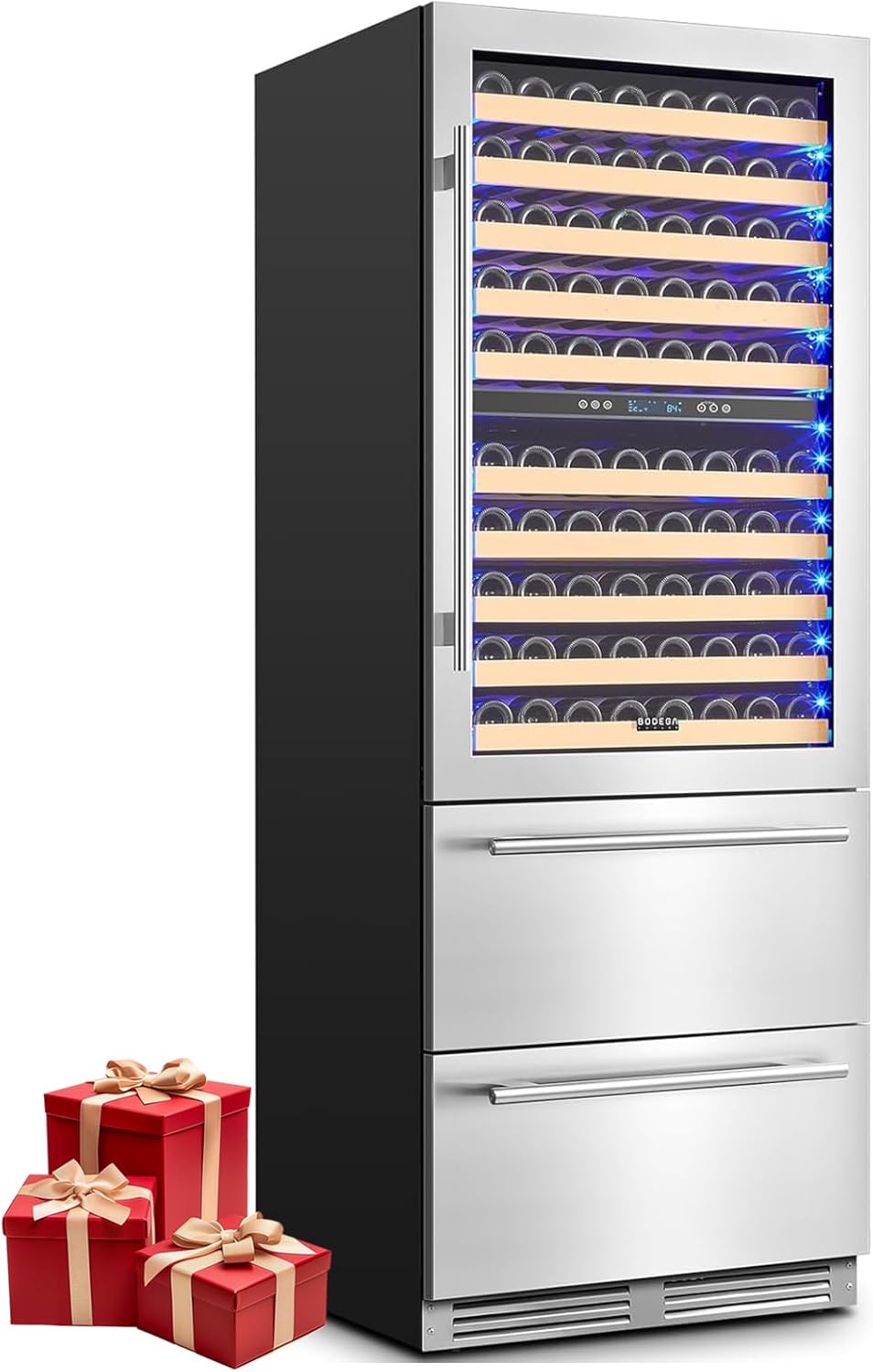
| Configuration | Dual zone wine cooler & two beverage drawers |
|---|---|
| Cooling Method | Compressor |
| Number Of Shelves | 10 |
| Defrost System Type | Automatic |
| Refrigerant | R-600A |
This BODEGA 30-inch wine and beverage cooler combines a dual temperature design with two pull-out beverage drawers to store both wine and cans in a single built-in or freestanding cabinet. Use the upper and lower wine zones to hold traditional Bordeaux bottles at serving temperatures while the drawer section handles sodas or chilled mixers; a touch LCD lets you set temperatures within the published ranges. The unit uses a compressor with fan circulation for steady, even cooling and automatic defrost, and double-pane tempered glass plus LED interior lighting help protect and display the collection. Practical details include ten wooden and wire shelves with partial slide-out capability and a front-vented design that allows under-counter installation. Expect quiet operation and energy-efficient performance, but note this is a large, heavy-capacity appliance intended for permanent placement rather than casual relocation. Installation and clearances for built-in use should be planned ahead to get the factory-quality fit and reliable long-term performance the cooler is built for.
Best for: Buyers who prioritize long-term, dependable refrigeration for a large wine and beverage collection and need a robust built-in-capable cooler that maintains steady temperatures.
Less Ideal for: If you need a small, portable, or budget compact cooler for occasional use, this high-capacity built-in-capable unit is not a good fit.
- Very large combined capacity for wine and cans allowing mixed storage in one unit
- Dual temperature zones plus a dedicated drawer give flexible, proper storage for wines and beverages
- Compressor cooling with fan circulation and automatic defrost for stable, even temperatures
- Front-vented design supports built-in installation and saves floor space
- Wood and wire shelving with partial slide-out racks simplifies bottle access and protects finishes
- Size and capacity require planning for installation and are not suited to temporary or mobile use
- High-capacity unit is heavy and intended for permanent placement rather than frequent moves
Verdict: Choose this BODEGA 30-inch cooler when you need a high-capacity, built-in-capable refrigerator that reliably stores large mixed collections at correct serving temperatures.
Velieta 24-Inch Wine Cooler KMHJ510

| Configuration | Freezerless |
|---|---|
| Cooling Method | Compressor |
| Defrost System Type | Automatic |
| Installation Type | Built-in/Freestanding |
| Lock Type | Key |
The Velieta 24-inch wine cooler is a compressor-based refrigerator designed to store a large collection with professional-style temperature control and a front-vent that allows either freestanding or built-in installation. It offers an upgraded large-capacity interior with two roomy shelves that can accommodate larger bottles such as Pinot or Champagne, a digital LED display for setting the temperature, and a keyed lock plus a carbon purification system to reduce odors. The unit emphasizes quiet operation with energy-efficient, low-vibration compressors and a sturdy door seal to help maintain consistent internal temperature. Practical benefits include flexible installation, simple digital controls, and features aimed at protecting and preserving bottles for long-term storage. Important limitations are that the listing mixes overall capacity figures (15.8 cu ft) with a much smaller stated refrigerator net capacity, so buyers should confirm exact bottle count for their needs, and the product does not list an energy efficiency rating or detailed vibration specs common on higher-end cellar units.
Best for: Buyers who value a quiet, professionally controlled cooler for a sizable wine collection and want built-in or freestanding flexibility while relying on multiple product features and reviews to confirm performance.
Less Ideal for: Collectors who need factory-rated energy efficiency, precise vibration specs, or guaranteed cellar-grade performance without independently verifying capacity and specs.
- Large internal capacity with removable shelves to fit larger bottles
- Compressor cooling with low-vibration, whisper-quiet operation
- Front-vent design supports built-in or freestanding installation
- Digital LED temperature display and professional temperature control
- Security lock and carbon purification system to protect and freshen stored bottles
- Listing provides inconsistent capacity numbers, requiring buyers to verify actual bottle capacity
- No official energy efficiency rating provided
Verdict: Choose this cooler if you want a large-capacity, quiet compressor wine refrigerator with flexible installation and protective features for an expanding collection.
Icyglee 25-Bottle Wine Cooler

| Capacity | 25 bottles |
|---|---|
| Temperature Range | 41–64°F |
| Cooling Method | Compressor |
| Number Of Shelves | 5 |
| Voltage | 115 volts |
The Icyglee 25-bottle wine cooler is a compact freestanding unit that uses a compressor to hold wine at set temperatures between 41°F and 64°F. You control temperature with a digital panel and the five adjustable horizontal shelves let you fit different bottle sizes or mix red and white storage in one cabinet. The double-layer tempered glass door offers UV protection and a reversible hinge so you can install the cooler where it fits best, and the interior LED light makes it easy to see labels without opening the door. The compressor and low-vibration design aim for quiet operation and stable aging, while manual defrost keeps the mechanics simple. Practical limits are its 25-bottle capacity and single-zone cooling, which mean it is better for an everyday collection or short-term storage than for a large, long-term, dual-zone cellar. Energy consumption is moderate and the unit carries a one-year manufacturer support plan.
Best for: Priced and designed for cautious buyers seeking a compact, reliable cellar for everyday wine storage who value stable compressor cooling and low vibration for preserving bottles.
Less Ideal for: Not a great choice for collectors needing large capacity, strict dual-zone aging, or a premium high-end showroom unit for long-term cellar storage.
- Compressor cooling with low-vibration design supports stable aging and quiet operation.
- Digital temperature control with 41–64°F range lets you set storage for reds, whites, or sparkling wines.
- Double-layer tempered glass door provides UV protection and reversible installation.
- Adjustable horizontal shelves allow flexible bottle arrangements and easy access.
- Single-zone cooling limits ability to store reds and whites at their optimal separate temperatures.
- Manual defrost requires occasional maintenance compared with auto-defrost models.
- Capacity maxes out at 25 bottles, which may be small for serious collectors.
Verdict: A practical, quiet compressor wine cooler that gives risk-averse buyers simple digital control and UV-protected storage for a modest 25-bottle collection.
Choosing the Right High-End Wine Cooler: Key Factors to Consider
Temperature Control and Stability
Precise temperature control matters because different wines require different storage setpoints and small fluctuations accelerate aging. Look for systems that maintain steady degrees over time with minimal overshoot after the door opens.
Digital thermostats with clear readouts and a tight tolerance are easier to monitor and adjust. If you plan to store both reds and whites, dual-zone units let you set separate temperatures for each compartment without compromise.
Vibration and Noise Levels
Vibration can disturb sediment in older bottles and noisier compressors can be intrusive in living spaces. Low-vibration compressor mounts or well-designed thermoelectric systems reduce agitation, while sound-damping insulation and quiet fans keep operational noise down.
Consider where the cooler will sit. Models intended for kitchens or open-plan rooms should prioritize quiet operation. If the unit will be in a finished basement or dedicated cellar, noise is less critical but vibration control still matters for long-term storage.
Shelving and Storage Flexibility
Shelving design influences how many bottles you can store and how easily you can access them. Removable or sliding wooden shelves help protect labels and make organization simpler. Adjustable shelf heights accommodate magnums and taller bottles.
Think about the mix of wines you own. If you often host and need ready-to-serve bottles on the bottom and longer-term storage above, look for layouts that support this workflow. A unit that maximizes usable space is more valuable than one that lists a high total capacity but uses it inefficiently.
Door Construction and Light Protection
UV and visible light exposure can degrade wine over time. Tinted, UV-resistant glass doors or solid-panel options protect contents while still allowing monitoring. Tight door seals prevent warm air infiltration and reduce compressor cycling.
If the cooler will sit where it gets natural or artificial light, choose glass with proven UV filtering and a solid latch mechanism. Doors that open smoothly and have reversible hinging add installation flexibility.
Controls, Monitoring, and Alarms
User controls determine how easily you set and maintain ideal conditions. Clear digital displays, separate controls for multiple zones, and intuitive menus reduce the chance of user error. Built-in alarms for temperature excursions and door ajar conditions are helpful protections.
Remote monitoring or smartphone connectivity can be a convenience for people who travel or manage wine collections remotely. However, core reliability of the thermostat and local readouts should take precedence over optional connectivity features.
Energy Use and Ventilation Considerations
High-end coolers can consume significant energy, especially compressor-based units working to maintain low temperatures in warm rooms. Look for efficient compressors, good insulation, and models designed for built-in or freestanding installation depending on placement.
Ventilation requirements vary. Built-in units often need front or top ventilation to avoid heat buildup, while freestanding units may require clearance around the sides and rear. Consider the installation location before selecting capacity and cooling type to avoid performance problems.
Single-Zone Vs Dual-Zone Units
Single-zone wine coolers maintain one temperature across the whole cavity and are suitable when you plan to store primarily one style of wine or dedicate the unit to long-term aging. They are simpler to operate and often provide slightly better uniformity within that single range.
Dual-zone units give separate compartments set at different temperatures so you can keep whites and reds ready to serve simultaneously. If you regularly rotate bottles from long-term storage to short-term serving, dual-zone flexibility eliminates the compromise of a single setpoint.
- Single-zone: simpler controls, slightly better uniformity in one range
- Dual-zone: flexible serving options, more complex installation and sealing needs
Built-In Vs Freestanding Installation
Decide whether the cooler will be integrated into cabinetry or sit freestanding. Built-in models are designed for tighter clearances and can match kitchen lines, but they often need front-venting to expel heat. Freestanding units allow more placement options but require side and rear clearance for airflow.
Measure the intended space and verify ventilation requirements before purchase. Improper clearance can increase compressor run time, reduce temperature stability, and shorten equipment life.
- Built-in: fits cabinetry, usually front-vented
- Freestanding: flexible placement, needs side/rear clearance
Noise Management for Living Spaces
Noise matters if the cooler is near seating areas, bedrooms, or open-plan living spaces. Look for published sound ratings if available and assess whether the unit uses compressor or thermoelectric cooling. Compressor systems tend to be more capable at lower temperatures but can be noisier unless engineered for quiet operation.
Mounting and leveling the cooler properly reduces rattles and amplifies sound-damping benefits. Anti-vibration feet and tight internal shelving contact points also help minimize operational noise.
- Thermoelectric: quieter, less effective for large capacities or warm rooms
- Compressor: more powerful cooling, often louder without sound-damping design
Maintaining Optimal Humidity
Humidity affects cork integrity and label condition. Most dedicated wine coolers maintain higher humidity than standard refrigerators, which helps keep corks moist and prevents seepage. However, some units run quite dry, especially those with strong airflow.
If you store wines for many years, consider supplemental solutions like humidity pans or built-in humidity control features. Avoid placing the unit in very dry or very damp rooms, as extreme ambient conditions make internal regulation harder.
- Ideal internal humidity supports cork longevity
- Supplemental humidity control can protect long-term collections
Placement, Ventilation, and Proximity to Heat Sources
Keep the cooler away from direct sunlight, ovens, or other heat sources that force the compressor to work harder. Proper ventilation ensures consistent cooling performance and reduces energy use. Check whether the model is rated for built-in installation and what clearances are required.
Allow space for door swing and bottle access. If the unit is installed under counters, confirm the door can open fully without obstruction and that front ventilation is unobstructed.
- Avoid heat sources and direct sun
- Follow manufacturer clearance guidelines for ventilation
How We Chose the Best High-End Wine Cooler
We focused on the capabilities that matter most for high-end wine preservation and everyday service. Temperature control and stability were primary filters because fine wines need narrow setpoints and minimal fluctuation. Vibration isolation and low-noise operation were weighted heavily to prevent sediment disruption and keep living areas comfortable. Storage flexibility and shelf design were examined to ensure the units can handle a mix of standard and larger bottles as well as partial loads. Build quality, materials, and door glazing were considered for light protection and long-term durability. Energy efficiency and cooling system type were evaluated to balance performance with operating cost and heat output. We excluded entry-level and portable models that lack precise control or adequate insulation. Units that did not offer adjustable shelving, dual-zone options where advertised, or clear temperature readouts were removed from consideration. Our selection emphasizes measurable preservation features and real-world usability rather than ornamental extras.
Our full evaluation process is outlined in our review methodology.
FAQ
How cold should I set a high-end wine cooler for long-term red storage?
For long-term red wine storage, many collectors set the cooler between 55 and 58 degrees Fahrenheit. The exact setpoint depends on the wine style and cellar maturity, but the priority is steady temperature rather than an absolute number.
Is a dual-zone high-end wine cooler worth it if I mostly drink one type of wine?
If you primarily store and drink one type of wine, a single-zone unit is usually sufficient and simpler to manage. A dual-zone is most useful when you frequently keep both whites and reds at ready-to-serve temperatures in the same cabinet.
Can I install a high-end wine cooler under my kitchen counter?
Many high-end coolers are available in built-in configurations suitable for under-counter installation, but you must verify front-venting requirements and clearance. Improper ventilation can reduce performance and reliability.
How important is UV protection in the door glass?
UV protection prevents sunlight from degrading wine and fading labels. If the cooler will be placed where it gets ambient or direct light, choosing tinted, UV-resistant glass helps preserve wine quality over time.
What maintenance does a high-end wine cooler need?
Regular maintenance includes cleaning interior surfaces, checking door seals, and occasionally vacuuming vents to remove dust. If the unit has a condensate drain or drip pan, keep it clear. Periodic temperature verification with a calibrated thermometer is also good practice.
Final Verdict
Prioritize temperature accuracy, vibration control, and flexible shelving when choosing a high-end wine cooler. Those features have the most impact on long-term preservation and daily service. Consider installation constraints like ventilation and noise to ensure the unit performs well in its intended spot. Focus on the tradeoffs between single- and dual-zone designs, and choose a model whose capacity and shelving layout match how you store and serve bottles.