
Note: This article contains affiliate links. If you click on these links and make a purchase, we may earn a small commission at no extra cost to you. This helps support our research and content. Read our full affiliate disclosure here.
Installing a 3-Way smart switch can transform how you control lighting in multi‑switch circuits, letting you use apps, voice assistants, and schedules while keeping existing wall switches functional. Picking the right switch matters because these devices must match your home wiring and the second switch type or companion unit to work correctly. This guide covers the top shortlisted 3‑Way smart switches for typical household installations and explains the practical tradeoffs you should expect. We evaluated options for wiring compatibility, installation complexity, wireless features, and reliability. Read on to see the selection and the evaluation criteria that helped narrow the list to the most versatile and installable choices.
Top Picks at a Glance
| Best Overall The best all-around choice for most situations | Tapo S515 Smart Switch |  |
| Best Quality Built to a higher standard if you want something more solid | Lutron Caseta Smart Switch Kit |  |
| Best Value The sweet spot between price and what you get | meross Smart 3-Way Switch MSS550 |  |
| Best Budget The cheapest option that still gets the job done reliably | TOPGREENER Smart Wi‑Fi Switch TGWF15S |  |
| Top Rated A top-rated pick with lots of positive feedback | Lutron Claro 3-Way Smart Switch Kit |  |
| Most Popular A crowd favorite that many people choose with confidence | Kasa Smart HS210 3‑Way Kit |  |
| Best Seller A high-volume bestseller chosen again and again | Leviton Decora Smart Switch D315S |  |
Tapo S515 Smart Switch

| Operation Mode | ON-OFF-ON |
|---|---|
| Current Rating | 15 A |
| Operating Voltage | 120 volts |
| Connectivity Protocol | Matter, Wi-Fi |
| Controller Type | Amazon Alexa, Apple HomeKit, Google Assistant, IFTTT, SmartThings |
The Tapo S515 replaces traditional wall switches to add remote and voice control to single-pole, 3-way, and 4-way lighting circuits. Installation requires a neutral and 2.4 GHz Wi‑Fi and the package includes wall plates, wire nuts, screws, and a quick start guide; the Tapo app walks you through wiring and setup. Once installed you get Matter and Wi‑Fi connectivity for broad platform compatibility with Alexa, HomeKit, Google Home, and SmartThings, plus scheduling, away-mode automation, and energy monitoring that shows usage and estimated costs. The switch supports multi-admin access and two-factor authentication for added security, and its UL and RoHS certifications address safety concerns. Limitations to note are the 15 A / 600 W per-load rating for some lamp types and the need to place the S515 on the line/hot side in multi-way swaps, which can complicate replacement in existing multi-switch runs; professional installation is recommended if you are not comfortable with household wiring.
Best for: Buyers who want a versatile, standards-based smart switch that works across multiple platforms and locations in the home and value built-in energy monitoring and secure remote control.
Less Ideal for: If you lack a neutral wire, have only 5 GHz Wi‑Fi, or prefer a plug-and-play swap without any wiring changes, this switch is not the best fit.
- Works in single-pole, 3-way, and 4-way circuits for flexible placement
- Matter and Wi‑Fi support broad compatibility with major smart home platforms
- Built-in energy monitoring gives usage graphs and bill estimates
- App-guided setup and scheduling with remote and voice control
- Includes necessary installation hardware and supports multi-admin access
- Requires neutral wiring and 2.4 GHz Wi‑Fi so older homes may need rewiring
- Must be installed on the line/hot side in multi-way setups which can complicate swaps
Verdict: Choose the Tapo S515 when you need a Matter-certified, multi-location smart switch with energy monitoring and wide platform compatibility.
Lutron Caseta Smart Switch Kit

| Operating Voltage | 120 volts |
|---|---|
| Current Rating | 5 A |
| Wattage | 600 watts |
| Circuit Type | 3-way |
| Connectivity Protocol | Wi-Fi |
The Lutron Caseta 3-way smart switch kit provides reliable, real-world smart control for lighting and fans with both a hard wall switch and a wireless Pico remote so you can add a second control point without running new wiring. It is typically installed where you want an on/off smart switch in a 3-way circuit; the included Pico mounts to any surface and pairs to the Caseta switch for multi-location control. Notable features include wide smart-home compatibility with Alexa, Google Assistant, and Apple HomeKit, Wi-Fi connectivity when paired with the Caseta Smart Hub, and support for incandescent, halogen, LED and CFL loads up to the listed watt/amp limits. Practical benefits are exacting control of grouped lights, scheduling and geofencing (with the hub), and the ability to make existing fixtures smart while keeping existing bulbs. Important limitations are the requirement for a neutral wire at the switch location and that advanced smart features such as scenes, schedules, and app/voice control require the Caseta Smart Hub sold separately.
Best for: Buyers who want a high-performing, reliable smart 3-way switch solution that integrates with major smart-home platforms and adds remote control points without rewiring.
Less Ideal for: People who cannot provide a neutral wire at the switch or who want built-in hub-free advanced scheduling and automation out of the box.
- Wireless Pico remote lets you add a second switch location without running new wires
- Works with Alexa, Google Assistant, and Apple HomeKit for voice control
- Supports a variety of bulb types and grouped loads so one switch can control multiple fixtures
- Pairs with Caseta Smart Hub to unlock scheduling, geofencing, and scenes
- Neutral wire required at the switch location
- Full smart features require purchasing the Caseta Smart Hub separately
Verdict: A performance-focused 3-way smart switch kit that adds a wireless second control point and integrates with major voice platforms when paired with the Caseta Smart Hub.
meross Smart 3-Way Switch MSS550

| Operation Mode | ON-OFF |
|---|---|
| Current Rating | 2 A |
| Operating Voltage | 120 volts |
| Connectivity Protocol | Wi-Fi |
| Compatible Devices | Apple HomeKit, Amazon Alexa, Google Assistant, SmartThings |
The meross MSS550 is a neutral‑wire smart wall switch designed to replace one device in a 3‑way circuit or function as a single‑pole switch while connecting directly to 2.4 GHz Wi‑Fi. You control it with the Meross app, voice assistants (HomeKit, Alexa, Google Assistant), or on‑device push button, and it supports scheduling, sunrise/sunset timers and local LAN control when your internet is down. Installation is aimed at DIYers: the switch fits standard Decora openings and the manufacturer highlights a simplified single‑switch replacement for 3‑way setups to cut time and cost, but you must have a neutral wire. The unit is FCC/IC/ETL listed and rated for modest loads (2 A, 200 W), so it is best for lighting circuits and not heavy loads. Practical benefits include remote access, voice control, and millisecond local response for faster switching when on the home network. Limitations are the neutral‑wire requirement and 2.4 GHz‑only Wi‑Fi support, which may complicate installs in homes with 5 GHz‑only routers or without accessible neutrals.
Best for: Buyers who want a budget‑minded, HomeKit‑compatible smart switch that adds voice, remote control, and schedules to existing lighting circuits while minimizing installation time and expense.
Less Ideal for: Homes lacking a neutral wire or those needing to control high‑wattage fixtures or devices should look for a different switch or a relay rated for heavier loads.
- Works with Apple HomeKit, Alexa, Google Assistant and SmartThings for voice and ecosystem control.
- Direct 2.4 GHz Wi‑Fi connection requires no separate hub for remote and app control.
- Supports 3‑way and single‑pole wiring while replacing only one switch in many 3‑way setups to save time and cost.
- Scheduling, sunrise/sunset timers and local LAN control provide useful automation and offline responsiveness.
- Low current rating (2 A / 200 W) limits use to lighting and small loads, not high‑wattage fixtures or appliances.
- Requires a neutral wire and 2.4 GHz Wi‑Fi, so some homes will need wiring or network changes before install.
Verdict: A practical, budget‑friendly HomeKit‑ready 3‑way smart switch that adds voice, scheduling and remote control while keeping installation simple for neutral‑wired lighting circuits.
TOPGREENER Smart Wi‑Fi Switch TGWF15S
| Operating Voltage | 120 volts |
|---|---|
| Current Rating | 15 A |
| Wattage | 1800 watts |
| Connectivity Protocol | Wi-Fi (2.4 GHz) |
| Circuit Type | 3-way |
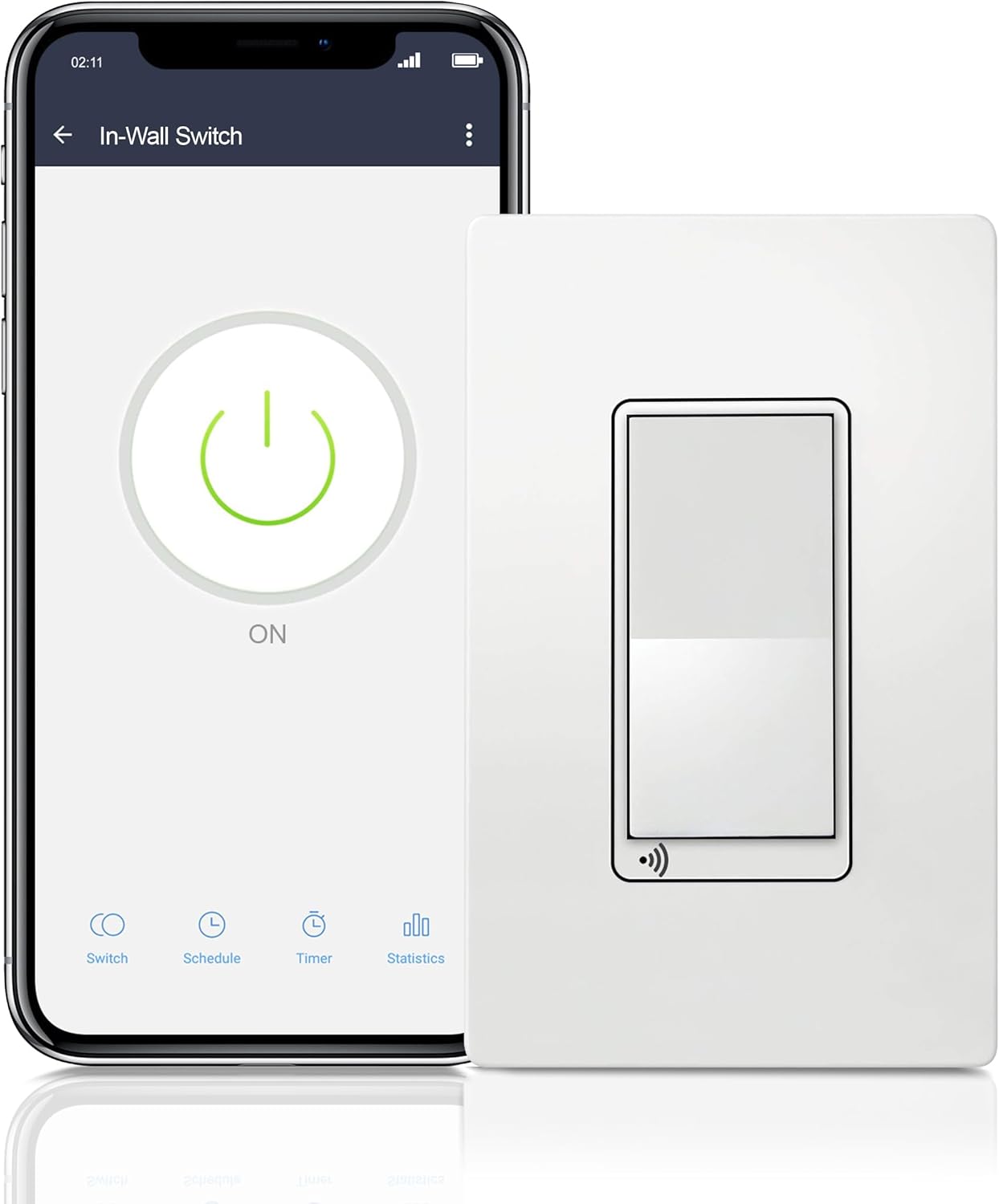
The TOPGREENER TGWF15S is an affordable in-wall Wi‑Fi switch for adding basic smart control to standard lighting circuits. It replaces a rocker switch and can be wired as a single-pole or a 3-way when the neutral is available, then joins your 2.4 GHz network without a hub so you can turn lights on/off from the TOPGREENER, Tuya, or Smart Life apps and with Alexa or Google voice commands. The app supports schedules, timers, scenes, and real-time on/off status which is handy for energy savings and security while away. The switch is rated for 15 A (about 1800 W resistive) and includes quick-connect terminals for common wiring. Practical downsides are the neutral-wire requirement and the need for a secure 2.4 GHz network, which limits installs in old homes without a neutral or in homes that run only 5 GHz Wi‑Fi. Installation and app setup are straightforward for DIYers comfortable with household wiring, and the switch meets UL and FCC specs and has IP54 protection for durability.
Best for: Buyers who want a low-cost, no-hub smart switch to add app and voice control to standard or 3-way lighting circuits and who are comfortable doing a neutral-wire installation.
Less Ideal for: Homes without a neutral in the switch box or users who require 5 GHz Wi‑Fi support or advanced energy metering features.
- No hub required — connects directly to 2.4 GHz Wi‑Fi for remote control
- Works in single-pole or 3‑way circuits for flexible installation
- Supports schedules, timers and scenes via TOPGREENER, Tuya, or Smart Life apps
- Voice control compatible with Amazon Alexa and Google Assistant
- 15 A rating (up to 1800 W resistive) suitable for typical household lighting
- Requires a neutral wire, so it is not compatible with some older switch boxes
- Only supports 2.4 GHz Wi‑Fi and will not connect to 5 GHz networks
Verdict: A budget-friendly in-wall smart switch that adds app scheduling and voice control to single-pole or 3-way lights without needing a hub.
Lutron Claro 3-Way Smart Switch Kit

| Operation Mode | ON-OFF |
|---|---|
| Current Rating | 5 A |
| Operating Voltage | 120 volts |
| Circuit Type | 3-way |
| Connectivity Protocol | ClearConnect |
The Lutron Claro 3-Way Smart Switch Kit provides a straightforward way to add a reliable, wireless second control point without running new wiring. It pairs a factory-style Claro smart rocker switch with a Pico paddle remote and wall bracket so you can mount a wireless controller anywhere to act like a second switch. The switch uses Lutron ClearConnect wireless protocol and integrates with major smart platforms when paired with a Caséta hub, while basic remote control works without a hub. Practical touches include a soft-glow LED indicator, compatibility with LED loads and fans (5 A for LEDs, 3 A for fans), UL listing, and included wire labels to simplify installation; a neutral wire is required. The main limitations are the modest current rating that rules out high-load circuits and the need for the optional Caséta hub to unlock advanced scheduling and voice control features. For homeowners seeking a durable, well-supported 3-way smart switch that matches existing paddle-style decor, this kit is an effective, low-friction solution.
Best for: Buyers who prioritize dependable, professionally supported smart lighting and want a simple wireless 3-way solution that blends with existing paddle switches and minimizes installation complexity.
Less Ideal for: People needing to control high-current fixtures, or those who want full voice and scheduling features without adding the Caséta smart hub.
- Adds a wireless second control point without running wire using the included Pico remote and bracket
- Matches existing Claro paddle aesthetic for seamless replacement
- ClearConnect protocol with wide smart-platform compatibility when used with a Caséta hub
- Included wallplate, wire labels, and UL listing simplify installation and provide safety reassurance
- Soft-glow LED indicator provides easy status feedback in low light
- Requires neutral wire for the switch to operate
- 5 A LED / 3 A fan rating limits use on high-load fixtures
Verdict: A durable, easy-to-install wireless 3-way kit that delivers reliable factory-quality control and matches classic paddle switches for homeowners wanting dependable smart lighting.
Kasa Smart HS210 3‑Way Kit

| Circuit Type | 1-way, 3-way |
|---|---|
| Current Rating | 15 A |
| Operating Voltage | 120 volts |
| Connectivity Protocol | Wi-Fi |
| Wattage | 1800 watts |
The Kasa HS210 KIT includes two smart switches designed to replace a standard 3‑way circuit so you can control the same light from two locations like stairways or hallways. Installation is guided in the Kasa or Tapo app and the kit handles the master/auxiliary wiring logic so you do not need to configure complex roles manually, though a neutral wire and basic wiring familiarity or an electrician are required. Once installed the switches connect to 2.4 GHz Wi‑Fi and offer remote on/off, schedules, away mode, grouping with other Kasa devices, and voice control through Alexa or Google Assistant. The switches are UL certified and rated for 15 A and 1800 watts, with IP54 ingress protection for added durability. Limitations include the requirement for a neutral wire, 2.4 GHz networks only, and no hub support, so users on 5 GHz‑only networks or without neutral wiring must choose alternatives. For typical home use the HS210 KIT simplifies replacing a 3‑way pair and adds dependable app and voice control without extra hubs.
Best for: Buyers who want a proven, straightforward upgrade from traditional 3‑way switches and prioritize easy app guidance, voice control, and reputable brand reliability when making a smart home decision.
Less Ideal for: Homes without a neutral wire or users who only run 5 GHz Wi‑Fi should consider other switch types or consult an electrician before purchasing.
- Kit includes two switches tailored for 3‑way wiring so they work together out of the box
- App‑guided setup walks through wiring and Wi‑Fi connection to simplify installation
- Works with Alexa and Google Assistant for hands‑free voice control
- Supports remote control, scheduling, away mode, and grouping in the Kasa/Tapo apps
- UL certified and rated for 15 A / 1800 W with IP54 protection for durability
- Requires a neutral wire and 2.4 GHz Wi‑Fi, so not compatible with all homes
- No hub or 5 GHz support which limits connectivity options
Verdict: If you need a reliable, app‑guided replacement for a traditional 3‑way switch pair that adds remote and voice control without a hub, the Kasa HS210 KIT is a dependable choice.
Leviton Decora Smart Switch D315S

| Connectivity | 2.4 GHz Wi‑Fi, Matter |
|---|---|
| Voice assistants | Alexa, Google Assistant, Apple Siri |
| Load rating | 15A, 1/3 HP |
| Companion support | Wire‑free Anywhere Switch or wired DD0SR for 3‑way |
The Leviton Decora Smart Switch D315S is a hub‑free smart on/off switch that connects to 2.4 GHz Wi‑Fi and integrates with Matter, Alexa, Google Assistant and Apple Siri for local and remote control. It is typically used to replace a standard wall switch to make lights, fans, pumps or other loads smart; setup is handled through the My Leviton app and the switch includes an LED locator light and a screwless Decora faceplate. Practical benefits include reliable direct Wi‑Fi control without a separate hub, multi‑location capability via a wire‑free Anywhere Switch or a wired companion for traditional 3‑way setups, and broad load support including LED, CFL, incandescent and motor loads rated up to 15A and 1/3 HP. The reduced product depth and included wallplate simplify installation for most households, but a neutral wire is required so older two‑wire boxes without neutral will need rewiring or a different solution. The switch is focused on straightforward on/off control rather than dimming, so buyers needing variable light levels should choose a dimmer model instead.
Best for: Buyers who want a reliable, widely compatible smart switch that works without a hub and integrates with major voice assistants and Matter for simple remote and local control.
Less Ideal for: Homes without a neutral in the switch box or buyers who need dimming capability or advanced scene-based lighting control.
- Works directly on 2.4 GHz Wi‑Fi—no hub required
- Matter certified for local integration with major smart home platforms
- Rated for a wide range of loads up to 15A and 1/3 HP
- Supports wire‑free and wired companions for multi‑location 3‑way control
- Includes screwless Decora wallplate and LED locator light for easy install and use
- Requires a neutral wire, so not compatible with some older switch boxes
- Provides on/off control only and does not dim lights
Verdict: Choose the D315S if you want a straightforward, hub‑free smart on/off switch that integrates broadly via Matter and major voice assistants.
Choosing the Right 3-Way Smart Switch: Key Factors to Consider
Wiring Compatibility
Confirming wiring compatibility is the first practical step because 3‑way circuits come in several common configurations. Some smart switches require a neutral wire at the primary location, while others support no‑neutral installs or use a companion at the remote location. Knowing whether your circuit uses line and load at the same box, or if power passes through the light fixture, determines which switch types will work without rewiring.
Ignoring wiring details can lead to an incompatible purchase or extra electrician hours. Check for clear wiring diagrams and whether the switch supports the same grounding and traveler wiring your home uses.
Need for a Companion or Auxiliary Switch
Many 3‑way smart switch solutions rely on a companion or auxiliary device at the remote switch location rather than converting an existing mechanical switch into a fully featured smart unit. Companions vary from simple momentary buttons to full electronic modules and affect cost and installation steps.
Understand whether the smart switch you choose requires swapping the remote switch and whether the companion needs a neutral or separate power. Some designs preserve the original switch's look by using a small auxiliary module behind the wall plate, while others replace both switches outright.
Installation Complexity and Tools Needed
Installation difficulty varies widely. Some smart switches are designed for DIYers with standard tools and clear wiring labels, while others assume experience with line voltage work or call for an electrician. Factors that increase complexity include tight backboxes, hidden neutrals, or multi‑circuit wall boxes.
Assess the documentation, whether the manufacturer provides wiring diagrams for common 3‑way permutations, and whether the switch supports easy pairing or requires advanced hub setup. If you are uncertain about live wiring, plan for a professional install.
Compatibility With Home Automation Ecosystems
Decide which ecosystem or control method matters most: voice assistants, direct local control via Zigbee/Z‑Wave, or cloud‑based Wi‑Fi apps. Some 3‑way smart switches integrate natively with popular ecosystems via standard protocols, enabling local automations and faster response. Others depend on cloud services, which can add latency or dependency on an internet connection.
Choosing the right connectivity affects future expandability and how the switch participates in scenes, timers, and presence‑based automations.
Load and Bulb Type Support
Different switches handle different loads and bulb technologies. LED lighting often presents lower minimum loads than incandescent bulbs, and some smart switches require a neutral or a minimum current to detect the load. Dimmable circuits introduce another variable; not every smart switch supports dimming for all LED driver types.
Verify the switch's supported load range, whether it explicitly supports LED dimming, and if it requires a bypass or dedicated dimmer companion for low‑load fixtures.
Reliability and Firmware Support
Long‑term reliability depends on solid hardware and firmware maintenance. Look for devices from manufacturers that issue firmware updates to fix bugs and improve compatibility. Also consider how the device behaves during power cycles and how it restores state after outages.
Good documentation and a responsive support channel reduce headaches if you encounter setup quirks or need to update the device after major ecosystem changes.
Common 3‑Way Wiring Scenarios and How They Affect Your Choice
Three‑way circuits are wired in several ways, and the physical location of the line and load conductors changes which smart switch approach will work best. If both line and load are present at the switch box, standard smart switches that expect a neutral are often the simplest choice. If power runs to the fixture first or travelers carry switched hot, you may need a companion module or a different wiring strategy.
Before buying, open the switch box with power off and identify the traveler wires, neutrals, and where the hot feed enters. If you are unsure, take a photo and consult an electrician. Knowing the scenario in advance prevents returns and extra labor.
- Line and load in the same box: simplest installs
- Line at fixture: often requires companion at the switch
- Traveler‑only boxes: need solutions that work with traveler signaling
Neutral Vs No‑Neutral Options
Neutral availability is a common constraint in older homes. Many modern smart switches require a neutral to power the switch electronics. If your box lacks a neutral, look for no‑neutral compatible models that either draw a small current through the load or use a companion module to supply power.
No‑neutral devices are convenient but can have compatibility limits with certain LED fixtures. When a neutral is present, you get broader device choices and often simpler dimmer performance.
- Confirm presence of bundled neutrals in the box
- No‑neutral solutions may need a bypass or companion
Dimming, LEDs, and Load Considerations
If you need dimming in a 3‑way circuit, choose switches that explicitly list compatibility with LED drivers and minimum load requirements. Some smart dimmers struggle with low wattage LED arrays and may flicker or fail to reach the full dimming range without a load capacitor or bypass device.
For mixed loads or multiple fixtures on one circuit, add up the total wattage to ensure the switch can handle the combined load. Dimmers and on/off switches may have different rating thresholds.
- Look for LED‑friendly dimmers if using modern bulbs
- Check maximum and minimum load ratings
Local Control Versus Cloud Dependency
Decide whether you want local control that keeps automations working without the internet or cloud‑dependent switches that often provide easier remote access and onboarding. Local control via Zigbee, Z‑Wave, or local Wi‑Fi can yield faster response and less reliance on manufacturer servers. Cloud solutions sometimes offer simpler setup and ecosystem integrations but may have outage-related limitations.
If uninterrupted local control is important, choose devices that support local automations or that integrate with your existing home automation hub.
- Local protocols reduce latency and outage dependency
- Cloud services may offer richer mobile features but add risk
Physical Fit and Wall Plate Compatibility
Check the depth of your electrical box and the physical size of the smart switch. Some electronic modules are thicker than mechanical switches and can make crowded boxes difficult to close safely. Also consider whether you want to preserve the look of the original switch or replace both wall plates for a uniform appearance.
If you plan to use decorative plates or large rocker switches, confirm that the device and any companion modules will fit behind the trim and allow the wall plate to sit flush.
- Measure backbox depth before purchasing
- Consider low‑profile or auxiliary modules for tight spaces
Security and Privacy Considerations
Smart switches can be entry points into a home network. Prefer devices that support secure setup methods and that do not require overly permissive network access. Firmware update practices and clear privacy policies matter when a switch connects to cloud services.
If privacy is a priority, prioritize devices that allow local control and that support strong, updatable firmware without mandatory cloud reliance.
- Look for documented firmware update processes
- Prefer local control to minimize cloud data exposure
How We Chose the Best 3-Way Smart Switch
We prioritized products that solve the real-world challenges homeowners face with 3‑way lighting circuits. Key evaluation criteria included wiring compatibility, meaning whether the switch supports common 3‑way configurations such as line/load separation and neutral requirements. Installation complexity was assessed by the typical steps an electrician or competent DIYer must take, the clarity of instructions, and whether a companion or auxiliary device is needed at the remote location. Connectivity and smart features were evaluated for their support of popular ecosystems, local control options, and the stability of the wireless link. Reliability and firmware support focused on how consistent the device behaves under normal home conditions and the vendor track record for updates. Safety and certifications were also considered to ensure compliance with electrical standards. We excluded devices that only work in proprietary two‑wire hacks or that require unusual rewiring not suitable for most homes. Low-quality modules without clear wiring diagrams or missing essential certifications were not considered. The resulting shortlist favors solutions that balance broad household compatibility, reasonable installation effort, and dependable smart features.
Our full evaluation process is outlined in our review methodology.
FAQ
Can I replace a 3‑way mechanical switch with a smart switch myself?
Often you can if you are comfortable working with live electrical wiring and turn power off at the breaker first. Many installs require identifying travelers and neutrals. If the wiring configuration is unclear or the box is cramped, hiring an electrician is the safer choice.
Do all 3‑way smart switches need a neutral wire?
No. Some models require a neutral while others are designed for no‑neutral installations using a companion or drawing a small current through the load. Check the product documentation for exact requirements and compatibility with LED fixtures.
Will a smart 3‑way switch work with LED bulbs and dimmers?
Many smart switches support LED bulbs, but dimming behavior varies by driver type and load. Look for switches that explicitly state LED dimming compatibility and observe minimum load requirements to avoid flicker or limited dimming range.
What happens to my lights during a Wi‑Fi or internet outage?
Behavior depends on the switch. Devices with local control or protocol‑based integrations typically continue to operate normally via the physical switch or local automation. Cloud‑dependent models may lose remote app control but usually still allow direct wall control.
Do I need a hub to use a 3‑way smart switch?
Not always. Some switches use Wi‑Fi and connect directly to your router, while others use Zigbee or Z‑Wave and require a compatible hub for local control. Choosing a hubless option simplifies setup but may limit advanced local automations.
Final Verdict
Prioritize wiring compatibility and installation complexity when choosing a 3‑way smart switch because these factors determine whether the device will fit your home without extra rewiring. Balance that with connectivity needs: pick local protocol support for reliability or cloud features for convenience. Also verify load and dimmer compatibility for your bulbs and confirm the physical fit in the wall box. Assess tradeoffs between ease of installation and long‑term flexibility. With the right focus on wiring, load handling, and control method, you can confidently select a 3‑way smart switch that delivers reliable, convenient lighting control in multi‑switch circuits.