
Note: This article contains affiliate links. If you click on these links and make a purchase, we may earn a small commission at no extra cost to you. This helps support our research and content. Read our full affiliate disclosure here.
If you paint, collect, or design miniatures, the right 3D printer for figurines can make the difference between crisp, display-worthy models and disappointed cleanups. You need a machine that reproduces fine detail, manages small tolerances, and fits the workflow you prefer—whether that is fast prototyping or ultra-detailed resin casts. This guide shortlists top options across common home and hobby setups and explains why each made the list. We evaluated machines for output detail, surface finish, usability, and maintenance demands. Read on for the criteria we used, practical buying factors, and user-focused guidance to help you pick the 3D printer that best matches your figurine workflow.
Top Picks at a Glance
| Best Overall The best all-around choice for most situations | ELEGOO Centauri Carbon |  |
| Best Quality Built to a higher standard if you want something more solid | ANYCUBIC Photon Mono M7 Pro |  |
| Best Value The sweet spot between price and what you get | ELEGOO Neptune 3 Pro |  |
| Best Budget The cheapest option that still gets the job done reliably | phrozen Sonic Mighty 4K |  |
| Top Rated A top-rated pick with lots of positive feedback | ANYCUBIC Photon Mono 4 |  |
| Most Popular A crowd favorite that many people choose with confidence | FLASHFORGE Adventurer 5M |  |
| Best Seller A high-volume bestseller chosen again and again | Bambu Lab P1S 3D Printer |  |
ELEGOO Centauri Carbon

| Build Volume | 256 × 256 × 256 mm |
|---|---|
| Max Printing Speed | 500 mm/s |
| Max Hot End Temp. | 320 °C |
| Supported Filament | PLA/PETG/ABS/ASA/TPU/PC/PA/Carbon/Glass fiber reinforced |
| Connectivity | USB & Wi-Fi |
The ELEGOO Centauri Carbon is a ready-to-run, enclosed CoreXY FDM printer built for speed and material versatility. It ships preassembled with auto bed leveling, an intuitive touchscreen, and a dual-gear hardened steel direct extruder, so users can start printing without lengthy setup. The CoreXY motion system, high-flow hotend and all-metal hotend rated to 320°C let the machine push high speeds—up to 500 mm/s—and handle demanding filaments such as carbon- and glass-filled blends, ABS, PETG and TPU. A rigid die-cast frame plus auto vibration compensation and pressure advance help keep prints smooth at high acceleration, while a heated bed and a dual-sided textured PEI plate reduce warping. The built-in chamber camera and dual lighting make monitoring and time-lapses easy, which is helpful when dialing in small, detail-rich figurines. Trade-offs include the machine prioritizing speed and advanced filaments, so beginners chasing the absolute finest miniatures may still want to tune settings and slow prints for maximum detail and surface finish.
Best for: Buyers who want a fast, capable printer that handles advanced filaments and lets them produce strong, functional figurines and prototypes without a long assembly process.
Less Ideal for: Those who prioritize effortless ultra-fine surface finish straight from stock or absolute plug-and-play simplicity without any tuning should consider slower, detail-focused machines or resin printers instead.
- Arrives preassembled with auto-leveling and touchscreen for quick setup
- CoreXY architecture and high-flow hotend enable very fast printing speeds
- 320°C hotend and enclosed metal/glass chamber support high-performance and composite filaments
- Die-cast frame with vibration compensation improves stability at high acceleration
- Built-in chamber camera and dual lighting for real-time monitoring and time-lapse capture
- High top speeds may require dialing in slicer settings and slower passes for the finest miniature detail
- Hardened-steel components and high-temperature capability add complexity compared with simpler desktop hobby printers
Verdict: Choose the Centauri Carbon if you want a fast, factory-ready CoreXY printer that reliably handles high-temperature and composite filaments for durable, production-style figurines.
ANYCUBIC Photon Mono M7 Pro

| Screen resolution | 14K monochrome (13312×5120) |
|---|---|
| XY resolution | 16.8×24.8 μm |
| Top tested speed | 170 mm/h (0.1 mm layer, high-speed resin) |
| Build volume | 8.77×4.96×9.05 inches |
The Photon Mono M7 Pro is a resin LCD 3D printer built for speed and fine detail, aimed at users who need rapid, high-resolution figurine prints. It uses a 14K monochrome LCD with very high XY resolution to capture small features and holes down to about 0.3 mm, and an upgraded COB LighTurbo 3.0 light system with Fresnel lenses and reflectors to deliver uniform exposure across the build. The printer supports very fast layer rates—up to 170 mm/h in high-speed resin tests and roughly 130 mm/h with standard resins—so batch printing of miniatures is noticeably quicker than typical hobby resin machines. Practical conveniences include dynamic temperature control for the resin vat, automatic resin refill and one-key recycling, and multiple sensors for build plate installation, resin level, and failed-print detection that reduce setup headaches. Downsides are typical for resin workflows: post-processing, ventilation, and material handling remain necessary, and the machine's larger footprint and weight require a dedicated, ventilated workspace.
Best for: Hobbyists and small-studio creators who prioritize print fidelity and throughput for producing detailed figurines and small model runs.
Less Ideal for: Casual users wanting a low-maintenance, odor-free printer or those with limited, unventilated space should consider simpler or filament-based options instead.
- Very high 14K monochrome LCD resolution for fine detail on figurines
- Advanced COB LighTurbo 3.0 and optical design for >90% light uniformity and reliable layer exposure
- High practical print speeds (up to 170 mm/h with high-speed resin) for faster batch production
- Dynamic temperature control and auto-fill/resin recycle simplify prints in varying ambient conditions
- Multiple sensors and automated checks reduce setup errors and failed prints
- As a resin printer it requires standard post-processing and good ventilation
- Larger physical footprint and weight need a dedicated workspace
Verdict: If you need fast, ultra-detailed resin prints of figurines, the Photon Mono M7 Pro delivers class-leading resolution and speed for production-focused hobbyists and small studios.
ELEGOO Neptune 3 Pro

| Build volume | 225×225×280 mm (8.85×8.85×11 in) |
|---|---|
| Extruder type | Dual-gear direct drive |
| Auto bed leveling | 36-point |
| Noise level | ~47 dB |
| Supported filament diameter | 1.75 mm |
The ELEGOO Neptune 3 Pro is a user-friendly FDM printer aimed at hobbyists who want dependable, ready-to-print performance for small to medium models like figurines. It ships with large pre-assembled sections and a toolkit so you can be printing in minutes, and the 225×225×280 mm build area fits most single-figure prints and multi-part batches. The dual-gear direct drive extruder and titanium throat/brass nozzle combination improve filament feeding and reduce clog risk, which helps with flexible or detailed filaments for fine figurine features. Auto bed leveling (36 points), filament runout detection, and power-loss resume add reliability on longer prints, while dual Z lead screws and POM V-guide wheels maintain layer consistency. Noise is modest at about 47 dB for a home workshop. Limitations include an open-frame design that can make temperature-sensitive materials like ABS harder to print well without an enclosure, and the stock cooling and slicer tuning will still need attention for the finest miniature details. For buyers focused on printability and uptime, the Neptune 3 Pro balances convenience and capability for figurine work.
Best for: Buyers who prioritize straightforward, reliable printing for small batch figurines and want a machine that minimizes setup time and mid-print failures.
Less Ideal for: Those who need a fully enclosed, heated chamber for large ABS or high‑temperature engineering filaments or who demand out‑of‑the-box ultra-fine miniature detail without slicer adjustments.
- Ready-to-print setup with pre-assembled main parts and included toolkit for faster first prints
- Dual-gear direct drive extruder improves filament feeding and reduces clogs with flexible and detailed filaments
- 36-point auto bed leveling plus filament runout sensor and power-loss resume increase print reliability
- Dual Z lead screws and POM V-guide wheels provide stable, consistent layer motion
- Open-frame design makes printing temperature-sensitive materials more challenging without an enclosure
- Fine-detail results still require careful cooling and slicer tuning beyond stock settings
Verdict: A practical, reliable FDM printer that gets hobbyists printing figurines quickly while reducing common mid‑print failures.
phrozen Sonic Mighty 4K

| Printing volume | 7.9 x 4.9 x 8.7 inches |
|---|---|
| XY resolution | 52 µm |
| Screen | 9.3" monochrome LCD |
| Connectivity | USB |
The phrozen Sonic Mighty 4K is a tabletop resin printer built for detailed miniatures and small-scale models, combining a 9.3" monochrome LCD with 52µm XY resolution to deliver noticeably sharp detail for figurines and prototypes. Its 7.9 x 4.9 x 8.7 inch build volume is modest but well matched to tabletop subjects, and reinforced dual linear rails improve Z-axis stability for cleaner layer alignment on tall, narrow prints. Setup and use are straightforward, with USB connectivity and broad compatibility with common 405nm resins including standard and engineering formulations, which keeps material options flexible. Because the screen is monochrome print speeds are faster and the panel lasts longer than older color LCDs, helping hobbyists get more prints between replacements. The main limits are the small build area if you want to print larger busts or groups in one go, and as a resin system it requires post-processing like rinsing and curing, which adds time and workspace needs. For focused figurine work the Mighty 4K balances high resolution, reliability, and approachable workflow.
Best for: Hobbyists and miniature painters who prioritize high surface detail and reliable layer accuracy on single-figure prints while keeping costs reasonable.
Less Ideal for: Users who need to print large models or many pieces in one run, or those seeking an FDM-style printer with no resin post-processing.
- High 52µm XY resolution for fine detail on miniatures
- Monochrome 9.3" LCD enables faster exposures and longer screen life
- Reinforced dual linear rails improve Z-axis stability and layer accuracy
- Works with a wide range of 405nm resins including engineering and high-temp types
- Small build volume limits printing larger models or multiple figures at once
- Requires resin post-processing (washing and curing) and associated workspace
Verdict: For figurine-focused hobbyists on a budget, the Sonic Mighty 4K delivers high-detail resin prints and stable Z-axis performance in a compact, easy-to-use package.
ANYCUBIC Photon Mono 4

| LCD Type | 7'' Mono LCD |
|---|---|
| XY Resolution | 9024×5120 (10K) |
| Build Area | 6.04'' x 3.42'' x 6.49'' |
| Max Printing Speed | 70mm/h or 50mm/h |
The ANYCUBIC Photon Mono 4 is a resin LCD printer aimed at delivering very fine detail for small models and figurines. It uses a 7" 10K mono LCD and LighTurbo matrix light source to produce high XY resolution (9024×5120), which means crisp surface detail and smoother layers on miniatures. The machine includes a re-engineered laser-engraved build platform to improve adhesion and reduce lifting, a 4-point leveling procedure intended to simplify setup, and a power-resume feature that restarts prints after outages to reduce wasted resin. Typical use involves slicing in Photon Workshop and printing high-detail figures at modest speeds — the printer balances resolution with a recommended printing speed of up to 70mm/h. Practical benefits include excellent fine-detail capability for figurines, a user-friendly leveling workflow, and features that help avoid failed long prints. Limitations are the modest build volume suited for small models only and an estimated LCD lifespan around 2000 hours, meaning replacement parts will eventually be required for heavy users.
Best for: Buyers who prioritize print reliability and high surface detail for small models and figurines and want a straightforward, repeatable setup process.
Less Ideal for: Users who need large-format printing or who want a general-purpose FDM printer for big parts and functional prototypes.
- Very high XY resolution (10K) for fine surface detail on figurines
- Uniform LighTurbo matrix light source reduces layer artifacts and improves surface finish
- Laser-engraved build platform improves adhesion and eases part removal
- Power-resume after outages reduces wasted prints and resin
- Build volume is limited to small-to-medium figurines
- LCD screen rated for roughly 2000 hours, which may require eventual replacement
Verdict: Choose the Photon Mono 4 if you want a resin printer focused on reliable, high-resolution figurine prints with features that minimize failed jobs.
FLASHFORGE Adventurer 5M
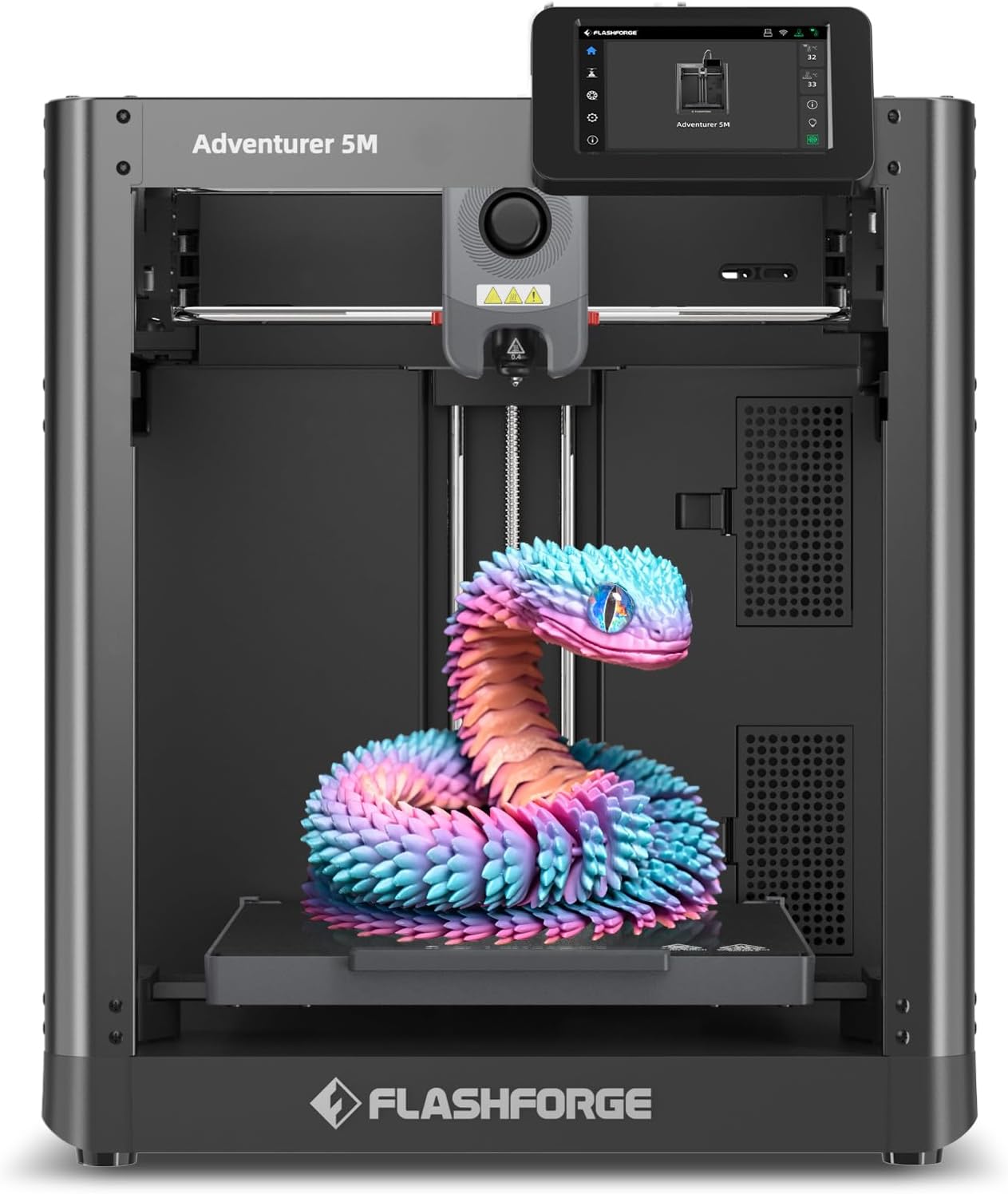
| Build Volume | 220 x 220 x 220 mm |
|---|---|
| Extruder Max Temp | 280°C Direct Drive |
| Travel Speed | 600 mm/s |
| Acceleration | 20,000 mm/s² |
| Platform | Double-sided PEI Platform |
The Adventurer 5M is a CoreXY desktop printer built for speed and repeatable results rather than casual tinkering. It combines one-click automatic bed leveling, a 280°C direct-drive extruder, and a double-sided PEI platform to make setup and part removal straightforward, and the CoreXY all-metal frame plus high travel acceleration (600 mm/s travel, 20,000 mm/s² acceleration) targets rapid prototyping and short production runs. Practical details like a quick, detachable nozzle system and multiple nozzle sizes (0.25–0.8 mm) let you prioritize fine detail or faster fills depending on the job, and the Flash Maker mobile app and optional camera support remote monitoring. For figurines the printer can deliver good surface quality when you use smaller nozzles and tuned slicer settings, but its emphasis on speed means dialing in slower prints and careful cooling is important for best detail. Also, multi-color printing and some intelligent filament features are only available on other series variants, so expect a straightforward single-material workflow here.
Best for: Buyers who prioritize consistent, repeatable prints and higher throughput for small production runs or frequent prototyping, and who value simple setup and remote monitoring over built-in multi-material convenience.
Less Ideal for: If you want out-of-the-box multi-color or multi-material printing or prefer a machine tuned solely for the finest miniature surface detail without additional tuning, consider other models geared to those needs.
- Automatic one-button bed leveling simplifies first-layer setup
- CoreXY structure with high travel speed and acceleration for fast prints
- Detachable high-flow nozzle and multiple nozzle sizes for flexible resolution vs speed
- Double-sided PEI platform makes part removal easier
- Mobile app and camera options enable remote monitoring and control
- Feature set prioritizes speed over built-in multi-material or advanced color printing
- High-speed settings require tuning to achieve best fine-detail results for small figurines
Verdict: Choose the Adventurer 5M when you need a fast, reliable CoreXY printer that simplifies setup and remote monitoring for frequent figurine prints while allowing nozzle-level control of resolution.
Bambu Lab P1S 3D Printer
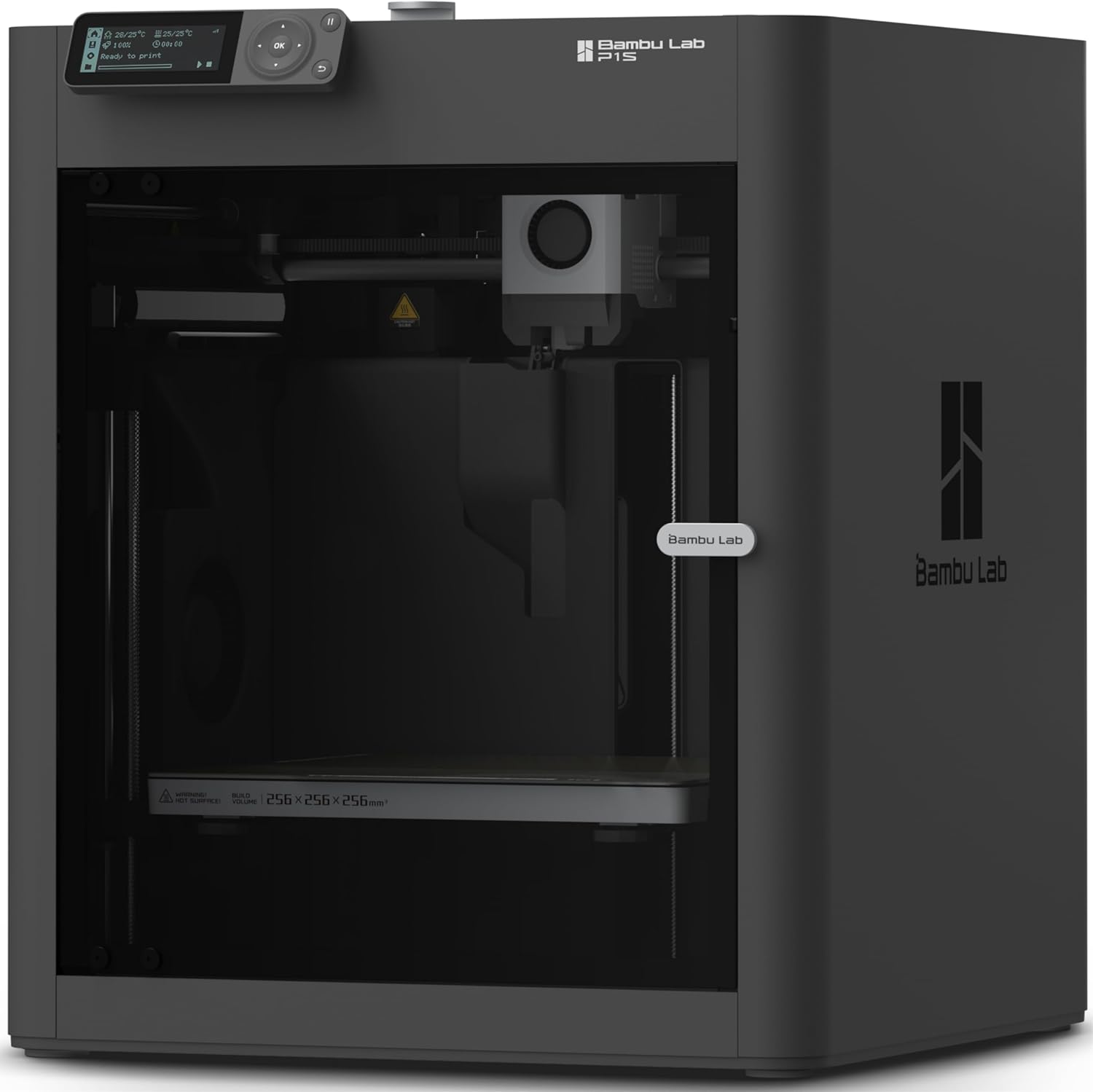
| Build Volume | 256×256×256 mm |
|---|---|
| Supported Filaments | PLA, PETG, TPU, PVA, PET, ABS, ASA; capable: PA, PC |
| Max Speed | 500 mm/s |
| Max Acceleration | 20 m/s² |
The P1S is a ready-to-use, enclosed CoreXY FDM printer that focuses on speed and usability for makers who want high-quality figurines without a steep setup curve. It offers automatic bed leveling, a direct-drive extruder that expands material choices, and an enclosed body that stabilizes temperature for better results with ABS and other advanced filaments. The printer supports a large 256×256×256 mm build volume, a camera for time-lapse capture, and integrates with Bambu Lab's MakerWorld model library to simplify finding and printing figurine models. Its specs advertise very high top speeds and accelerations, which translate to much faster print times when tuned, though getting the fastest settings reliable may require some calibration and filament tuning. Setup is designed to be quick and user-friendly, so risk-averse buyers should find initial use approachable, but those who need industrial-grade multi-material solutions should note that multi-color printing requires the AMS accessory and highly specialized filaments like carbon- or glass-fiber reinforced materials are not recommended.
Best for: Buyers who prioritize reliable, easy-to-start printing of detailed figurines and want a mostly plug-and-play machine with an enclosed build area and ecosystem support.
Less Ideal for: People who need out-of-the-box multi-color/multi-material printing without extra accessories or who must print with heavily reinforced filaments like carbon- or glass-filled materials.
- Enclosed CoreXY design stabilizes print environment for consistent figurine detail
- Automatic bed leveling and quick setup reduce initial user friction
- Direct-drive extruder supports flexible filaments like TPU and a wider range of materials
- Large 256×256×256 mm build volume accommodates most figurine sizes
- Integrated camera and MakerWorld library streamline monitoring and sourcing models
- Top advertised speeds require careful tuning to maintain fine figurine detail
- Multi-color printing needs the optional AMS accessory to achieve up to 16 colors
Verdict: A fast, enclosed, beginner-friendly FDM printer that lets cautious buyers produce detailed figurines quickly while minimizing setup headaches.
Choosing the Right 3D Printer for Figurines: Key Factors to Consider
Print Resolution and Layer Height
Fine layer height and precise XY resolution are critical when printing figurines because small features, facial details, and thin accessories look significantly better at higher resolutions. Lower layer heights reduce visible stepping and give smoother curves, which minimizes sanding and sculpting after printing.
Keep in mind that higher resolution increases print time. You should balance the level of detail you need against how long you are willing to wait for each piece. For many hobbyists, 50 to 100 micron resin prints or 100 to 200 micron filament prints are a practical compromise between detail and throughput.
Material Compatibility and Resin Choice
The materials you can use determine surface finish, strength, and ease of painting. Resin printers typically produce the highest detail and smoothest surfaces, ideal for small figurines and fine ornamentation. Filament printers can work for larger or less detailed models but often require more post-print smoothing.
Also consider material properties like brittleness, odor, and compatibility with primers and paints. Some resins cure to a very brittle state that complicates thin parts, while tougher resins or specialty formulations can give better durability for handling and assembly.
Build Volume and Batch Printing
Build volume matters if you plan to print multiple figurines or larger models in a single run. A larger build plate allows you to produce several miniatures at once, which can improve throughput and efficiency for batch painting or production.
However, larger volumes do not replace the need for stable XY accuracy and consistent Z steps. For many tabletop-scale figurines, a modest build area is sufficient if the printer delivers high fidelity and reliable repeatability.
Post-Processing Workflow
Post-processing can be the most time-consuming part of producing display-ready figurines. Consider how each printing process affects cleanup: resin prints require washing and UV curing and often use supports that need careful removal, while filament prints may need sanding, gap filling, and smoothing treatments.
Look for printers and ecosystems that simplify post-processing with good support structures, predictable support attachment points, and compatibility with common wash/cure solutions. Streamlining this stage saves hours of finishing work and improves final paint results.
Ease of Use and Calibration
A machine that is easy to calibrate and maintain will save you time and reduce failed prints. Important usability features include reliable bed leveling (automatic or assisted), clear instructions for first prints, and presliced sample files that match the machine's intended resolution.
Frequent calibration tasks like Z-offset adjustments or nozzle maintenance should be straightforward. If you are newer to 3D printing, prioritize machines with strong community support and simple routine maintenance procedures.
Long-Term Reliability and Parts Availability
Durability and access to replacement parts affect how long a printer remains useful. For hobbyists who print regularly, components such as FEP sheets, build plates, or hotend nozzles will wear and need replacement. Machines designed with easily sourced parts and clear service procedures reduce downtime.
Consider how common maintenance items are, whether the chassis and motion systems are robust, and how simple it is to swap consumables. Planning for ongoing upkeep prevents unexpected interruptions in your printing projects.
Resin Vs Filament for Figurines
Resin and filament workflows each have tradeoffs that affect final appearance, durability, and post-processing. Resin printers typically deliver finer surface detail and smoother results, which is why many hobbyists prefer them for small-scale figurines. Filament printers can be more forgiving on material handling and may be better for larger pieces or functional parts.
When deciding between the two, consider surface finish needs, the complexity of supports, and your tolerance for post-print tasks like washing, curing, sanding, and priming. Your choice should align with the level of detail you want and how much time you will spend finishing each piece.
- Resin: superior detail, smooth surfaces, requires wash and cure
- Filament: stronger parts for larger models, often needs more sanding
- Resin supports can be smaller but require careful removal
Preparing Models and Slicers for Best Results
Proper model orientation, support placement, and slice settings are crucial for preserving delicate features. Rotate parts to minimize overhangs on faces and ensure supports attach at low-visibility points. Use brims or rafts sparingly to improve adhesion for tricky bases.
Slicer profiles tuned for figurines often use slower speeds, smaller layer heights, and conservative retraction settings to avoid stringing and surface blemishes. Test and refine one variable at a time so you can learn which adjustments yield measurable improvements.
- Orient models to protect facial features and thin appendages
- Use lightweight supports where possible to reduce scarring
- Lower layer heights and slower speeds improve finish
Optimizing Post-Processing for Paint-Ready Parts
A consistent post-processing routine helps produce parts that accept primer and paint predictably. For resin prints, develop a wash-and-cure workflow that removes uncured resin without warping small parts. For filament prints, focus on filling layer lines and using heat or chemical smoothing when appropriate.
Sanding and primer are almost always part of the process for high-end tabletop minis. Start with coarser grits for major blemishes, then work down to fine grits before priming. If you plan to assemble multi-part models, test fit pieces before final sanding to avoid removing crucial alignment features.
- Establish a wash-and-cure station for resin parts
- Sand progressively and test primers on scrap prints
- Dry-fit assemblies before final finishing
Workspace and Safety Considerations
Printing figurines, especially with resin, requires a dedicated, well-ventilated workspace and proper protective gear. Use gloves and safety glasses when handling uncured resin, and store consumables in labeled containers. For filament printing, manage ultra-fine particles and occasional odors by locating the printer in a ventilated area.
Plan for post-processing zones: one area for removing supports, one for washing and curing, and one for painting. This separation reduces cross-contamination and keeps hazardous materials contained and away from common living spaces.
- Ventilate resin printing area and wear nitrile gloves
- Organize separate zones for printing, washing, and painting
- Keep spare consumables and tools organized for quick maintenance
Scaling Up: Batch Production Tips
If you plan to produce many figurines at once, optimize your slicer layout for spacing and orientation to minimize failed prints. Group similar models together to reuse identical support settings and reduce setup time. Additionally, stagger prints across multiple sessions to balance curing and finishing workloads.
Consider consumable burn rate and scheduling maintenance before long batch runs. Inspect FEP sheets, build surfaces, and critical motion components prior to high-volume jobs to reduce the chance of mid-run failures.
- Arrange multiple miniatures to maximize build plate usage
- Standardize support and exposure settings for repeatability
- Perform pre-run maintenance checks to avoid mid-batch issues
How We Chose the Best 3D Printer for Figurines
We focused on attributes that matter specifically for printing figurines and miniatures. Primary evaluation criteria included achievable layer resolution and surface detail, material compatibility for hobby-grade resins and filaments, and dimensional accuracy for small features. We also scored machines on workflow factors such as ease of post-processing, supported slicer software, and the repeatability of first-layer adhesion. Reliability and build quality were considered to reduce time spent on calibration and failed prints. We excluded industrial-scale machines and printers that prioritize speed over detail because those configurations rarely suit figurine work. Budget desktop models were included only if they met minimum detail and stability thresholds. In short, we filtered for printers that balance fine-detail capability, practical materials and workflow, and dependable day-to-day operation for hobbyists and small-scale creators.
Our full evaluation process is outlined in our review methodology.
FAQ
Is resin always better than filament for figurines?
Resin generally provides higher surface detail and smoother finishes, making it preferable for small figurines. However, filament can be better for larger pieces or parts that need more structural strength. The best choice depends on the desired finish and how much post-processing you are willing to do.
What layer height should I use for tabletop miniatures?
For resin prints, 25 to 50 microns is common for high-detail minis. For filament prints, 100 to 200 microns balances detail and print time. Start with manufacturer-recommended profiles and adjust down in small increments to refine surface quality.
How do I reduce support marks on faces and fine details?
Orient models so supports attach to low-visibility areas and use minimal contact supports. Many slicers let you place custom supports to avoid delicate regions. After removal, carefully sand and fill any small scars before priming.
How important is curing for resin prints?
Curing is essential for achieving full material properties and stable surfaces. Proper UV curing also reduces tackiness and improves paint adhesion. Under-curing can leave parts brittle or partially uncured, so follow recommended exposure times.
Can I paint directly on raw prints?
You should usually prime prints first to create a uniform surface that paint will adhere to. Some materials may require light sanding or a thin filler primer to erase layer lines and small surface blemishes before painting.
Final Verdict
Choosing the right 3D printer for figurines is a balance between resolution, materials, and how much time you will invest in post-processing. Prioritize machines that consistently deliver the level of surface detail you need and that fit your preferred materials and workspace constraints. Also factor in repeatability and ease of maintenance so you can produce multiple high-quality pieces without excessive rework. Focus on the tradeoffs described earlier: resin for fine detail and smooth finishes, filament for strength and larger parts, and a workflow that matches your painting and assembly habits. With that approach, you can confidently select a printer that supports your figurine-making goals.