
Note: This article contains affiliate links. If you click on these links and make a purchase, we may earn a small commission at no extra cost to you. This helps support our research and content. Read our full affiliate disclosure here.
If you paint or assemble scale figures and custom tabletop terrain, a dedicated 3D printer for miniatures and terrain can elevate the results by delivering finer details, cleaner supports, and repeatable tolerances. The wrong machine wastes filament, damages delicate sculpts, or forces heavy post-processing. This guide shortlists the top machines that hobbyists rely on for miniature-scale work and scenic bases, then explains the specs and workflow traits that matter for small-scale, high-detail projects. You will find machines suited to different budgets and workspace setups, plus the evaluation criteria we used to identify reliable picks.
Top Picks at a Glance
| Best Overall The best all-around choice for most situations | Bambu Lab A1 3D Printer |  |
| Best Quality Built to a higher standard if you want something more solid | Bambu Lab P1S 3D Printer |  |
| Best Value The sweet spot between price and what you get | Anycubic Kobra X 3D Printer |  |
| Best Budget The cheapest option that still gets the job done reliably | phrozen Sonic Mighty 4K |  |
| Top Rated A top-rated pick with lots of positive feedback | Creality Ender 3 V3 SE |  |
| Most Popular A crowd favorite that many people choose with confidence | FLASHFORGE Adventurer 5M |  |
| Best Seller A high-volume bestseller chosen again and again | FLASHFORGE AD5X 3D Printer | 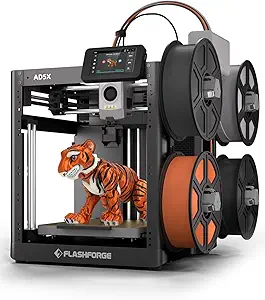 |
Bambu Lab A1 3D Printer

| Build volume | 256×256×256 mm |
|---|---|
| Max acceleration | 10m/s² |
| Ideal supported filaments | PLA, PETG, TPU, PVA |
| Full-auto calibration | Yes |
The Bambu Lab A1 is a ready-to-use FDM printer built to make 3D printing simpler for newcomers while still offering performance that hobbyists will appreciate. It handles full-auto calibration routines for Z-offset, bed leveling, vibration resonance, and nozzle pressure so you can start prints with minimal setup. The motion system, nozzle pressure sensor, and active flow-rate compensation combine to produce consistent, high-speed prints with good surface quality for basic miniatures and terrain. The open-frame build and 256×256×256 mm volume give you room for larger terrain pieces in one piece, and the A1 supports AMS lite for multi-color prints if you add that accessory. The printer is designed for quiet operation with active motor noise canceling and a simplified touchscreen for control. Important limits: it is an open-frame FDM unit rather than a resin printer, so ultra-fine miniature detail achievable with SLA will be limited, and multi-color requires the AMS accessory. Expect very good speed and reliability for PLA and common filaments, but not the ultra-high resolution surface finish of resin systems.
Best for: Buyers who want a low-friction, reliable FDM printer that prints faster than typical hobby machines and can handle larger terrain pieces while minimizing manual calibration work.
Less Ideal for: Artists or gamers seeking the highest possible miniature surface detail and ultra-fine features should consider a resin SLA printer instead.
- Automatic full calibration reduces setup and tuning time for repeatable prints
- Large 256×256×256 mm build volume suitable for one-piece terrain and bigger models
- Active flow-rate compensation and sensors that improve dimensional consistency
- Quiet operation with motor noise canceling and an easy touchscreen interface
- Open-frame FDM design cannot match the fine surface detail of resin SLA printers for tiny miniatures
- Multi-color printing requires purchase of the AMS lite accessory
Verdict: Choose the A1 if you want a beginner-friendly, high-speed FDM printer that reliably produces larger miniatures and terrain with minimal setup.
Bambu Lab P1S 3D Printer
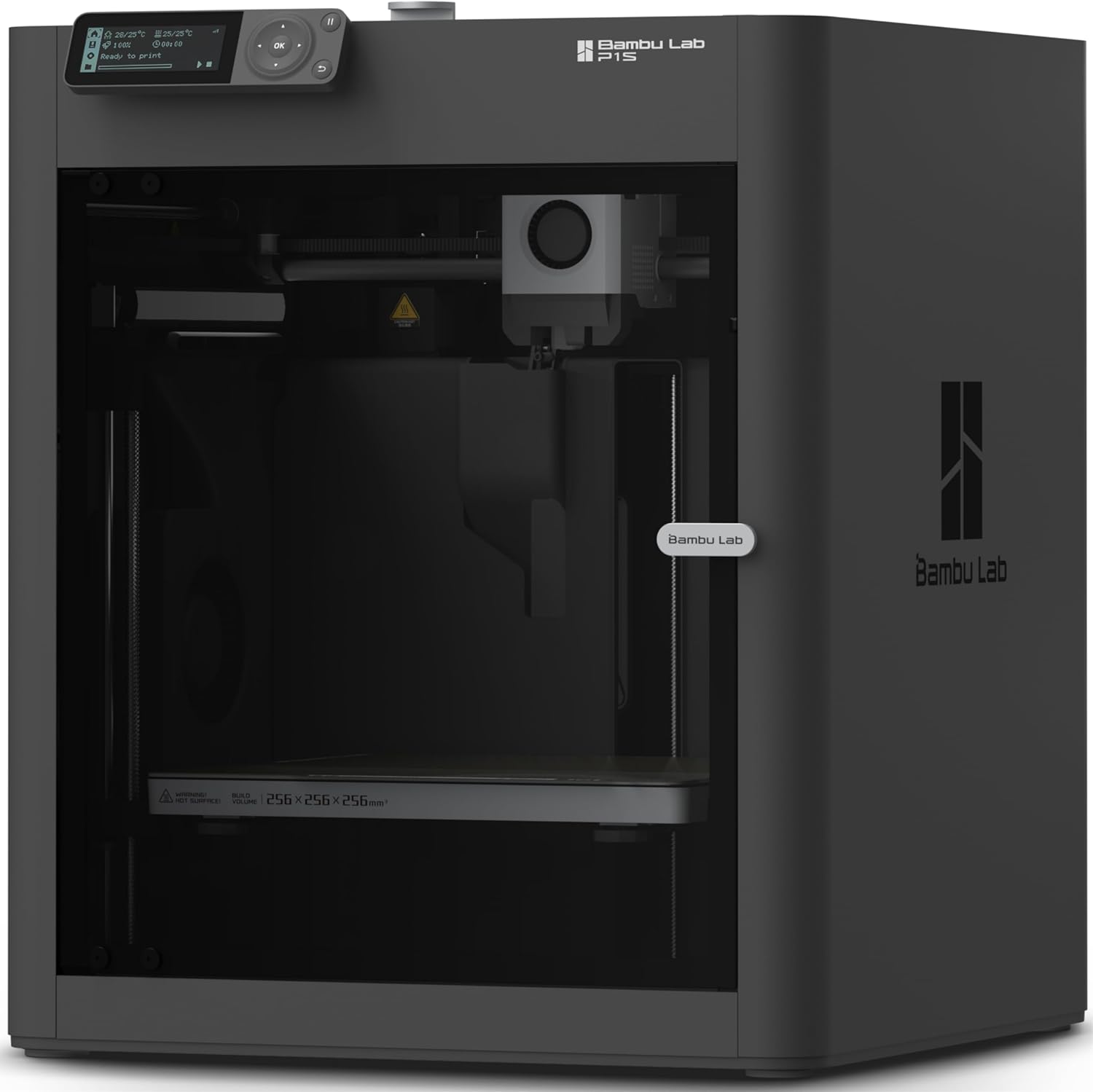
| Build Volume | 256×256×256 mm³ |
|---|---|
| Max Speed | 500 mm/s |
| Max Acceleration | 20 m/s² |
| Supported Filaments | PLA, PETG, TPU, PVA, PET, ABS, ASA; capable: PA, PC |
The Bambu Lab P1S is a ready-to-use enclosed CoreXY FDM printer designed for speed and precision in a compact footprint. It targets hobbyists and modelers who want fast turnarounds: the machine is rated up to 500 mm/s with very high acceleration, and it supports a wide range of filaments from PLA and PETG to TPU and ABS. The enclosed body and automatic bed leveling help stabilize prints with temperature-sensitive materials, and the direct-drive extruder broadens material choices and improves flexible filament performance. Setup is advertised as quick and the ecosystem includes MakerWorld model library and camera support for timelapses, which streamline workflow for miniature and terrain production. Important limitations are that extremely abrasive composite filaments are not recommended and achieving the top advertised speeds requires tuning and suitable slicer settings; noise and fine-detail fidelity at the absolute fastest settings may be inferior to slower, tuned prints. For enthusiasts prioritizing fast prototyping and high throughput of small parts, the P1S balances speed and real-world usability well.
Best for: Serious hobbyists and miniature painters who prioritize fast, repeatable production of small parts and want a mostly turnkey machine that supports a broad set of filaments.
Less Ideal for: Users whose primary goal is the absolute highest surface-finish detail at slow speeds or those who need to print highly abrasive, fiber-filled materials frequently.
- High maximum speed and acceleration for fast prints and rapid iteration
- Enclosed CoreXY design improves temperature stability for advanced filaments
- Direct-drive extruder increases compatibility with flexible and specialty filaments
- Automatic bed leveling and beginner-friendly ecosystem reduce setup friction
- Built-in camera support and MakerWorld library streamline workflow for modelers
- Extremely abrasive composite filaments are not recommended
- Top speeds require careful tuning and may reduce fine-detail quality
Verdict: Buy the P1S if you need a compact, mostly turnkey FDM printer that delivers exceptional speed and broad filament support for high-throughput miniature and terrain printing.
Anycubic Kobra X 3D Printer

| Print volume | 260×260×260mm³ |
|---|---|
| Max nozzle temp | 300C |
| Supported materials | PLA, PETG, TPU, PVA, ABS |
| Auto leveling | LeviQ 3.0 49-point |
| Camera | 720P AI monitoring |
The Anycubic Kobra X is a consumer-oriented FDM printer built for faster multicolor and single-material printing. It ships with LeviQ 3.0 auto-leveling, a hardened steel nozzle rated to 300C, and an ACE multicolor system that can handle native 4-color output and expand to many more with additional filament hubs. Typical use is plug-and-play: quick setup, app/PC control, and the 720p camera plus AI spaghetti and object detection help catch print failures early. Its claimed 600 mm/s top speed and vibration compensation let you run prints much faster than average while preserving detail, and sensors for power-loss recovery and filament run-out make long prints less risky. For miniatures and terrain the hardened nozzle, support for TPU/PETG/PLA/PVA, and 260 mm cubic build area cover most hobby projects, and the multicolor capability is useful for layered or accent pieces. Limits to consider are that real-world printing at very high speeds often needs tuning for best fine-detail results and true multicolor 19-color setups require extra ACE 2 Pro hubs and configuration, which adds complexity and cost.
Best for: Hobbyists and miniature painters who value a fast, mostly hands-off printer that can handle multicolor accents and a variety of filaments while minimizing setup fuss and failed prints.
Less Ideal for: Modelers who prioritize the absolute finest surface detail out of the box or who need full multicolor capability without buying and configuring extra hardware should consider other approaches.
- Native multicolor printing (4 colors) with expandability for complex color work
- LeviQ 3.0 49-point automatic bed leveling for reliable first layers
- Hardened steel nozzle and 300C support for a wide range of filaments
- AI camera with spaghetti and object detection for early error prevention
- Power-loss recovery and filament run-out sensor reduce failed long prints
- True 19-color printing requires additional ACE 2 Pro hubs and setup complexity
- Maximum advertised speeds are unlikely to produce optimal fine-detail results without tuning
Verdict: Choose the Kobra X if you want a fast, beginner-friendly FDM printer that brings practical multicolor capability and reliable automation to hobby-scale miniatures and terrain projects.
phrozen Sonic Mighty 4K

| XY Resolution | 52 µm |
|---|---|
| Printing Volume | 7.9 x 4.9 x 8.7 inch |
| LCD Size | 9.3 inch monochrome |
| Connectivity | USB, Wifi |
The phrozen Sonic Mighty 4K is a resin LCD printer aimed at hobbyists who want crisp miniatures and detailed terrain pieces without a large footprint. It uses a 9.3" monochrome LCD with 52µm XY resolution to produce fine surface detail, and a 7.9 x 4.9 x 8.7 inch build volume that fits multiple small models per run. Reinforced dual linear rails stabilize the Z axis for repeatable layer alignment and smoother tall prints, and the unit accepts standard 405nm resins including specialty engineering and high-temperature formulas. Typical use is desktop model production: prepare files, pour compatible resin, print, then wash and cure parts for painting. Practical benefits include faster layer exposure times from the monochrome screen and reliable detail for tabletop figures, while limitations are the relatively small build area if you need large terrain pieces and the usual resin workflow requirements such as ventilation, post-processing, and consumable resin and tank maintenance. Connectivity is USB and Wi‑Fi for file transfer and it ships with a suite of brand resources and compatible resin options to help beginners get started.
Best for: Hobbyists focused on producing highly detailed miniatures and small terrain who want a compact, reliable resin printer that balances print quality with a small desktop footprint.
Less Ideal for: Artists or makers who need to print large terrain sections or high-volume production runs should consider larger-format or SLA systems instead.
- High 4K-class detail with 52µm XY resolution for finely detailed miniatures
- Monochrome 9.3" LCD speeds exposures and extends screen life compared with color screens
- Dual linear rails give stable Z motion for cleaner layer alignment on tall prints
- Compatible with common 405nm resins including specialty and engineering formulas
- Compact tabletop footprint suitable for hobby desks and small workspaces
- Build volume is modest and limits very large terrain pieces or batch production of large models
- Requires standard resin post-processing and good ventilation which add time and setup needs
Verdict: Choose the Sonic Mighty 4K if you want a compact, high-detail resin printer that delivers crisp tabletop miniatures without taking over your workspace.
Creality Ender 3 V3 SE

| Max printing speed | 250 mm/s |
|---|---|
| Printing consumables | PLA/PETG/ABS/TPU 95A |
| Auto leveling | CR Touch |
| Extruder type | Full‑metal dual‑gear direct extruder |
| Assembly | 3 steps, ~20 minutes |
The Creality Ender 3 V3 SE is an FDM desktop printer that emphasizes speed and ease of use for hobbyists printing miniatures and small terrain pieces. It ships partially preassembled with a three‑step setup that can get you printing in about 20 minutes, and features a full‑metal Sprite dual‑gear direct extruder that handles PLA, PETG and flexible filaments more reliably than single‑gear bowden setups. Built‑in CR Touch auto leveling and a strain sensor handle bed leveling and Z offset automatically, reducing failed first layers. Dual Z lead screws and hardened Y‑axis linear shafts improve stability and reduce Z wobble for finer layer alignment, which helps with small detailed prints. The advertised top speed is 250 mm/s, useful for quick drafts though detail prints will still benefit from slower settings. The bundle includes four PLA spools so you can start right away, but buyers should plan to tune slicer settings for tiny miniatures and may want a finer nozzle or enclosure for premium resin‑level detail. Noise and vibration are described as lower, but very fine surface finish will not match high‑end resin machines.
Best for: Someone who values a dependable, easy‑to‑set‑up FDM printer that minimizes manual leveling and delivers repeatable results for hobby projects and terrain pieces.
Less Ideal for: Collectors or painters who need resin‑level surface smoothness and sub‑0.1 mm feature fidelity should consider a resin printer instead.
- Quick three‑step assembly that gets beginners printing fast
- Full‑metal Sprite dual‑gear direct extruder for more consistent filament feeding
- CR Touch auto leveling and strain sensor automate bed leveling and Z offset
- Dual Z‑axis and sturdy Y‑axis shafts improve stability and reduce Z wobble
- Includes four PLA filament spools so you can start printing immediately
- FDM surface detail and layer lines are still less fine than resin printers used for miniatures
- High advertised top speed benefits drafts more than ultra‑detailed small prints
Verdict: Buy this if you want a reliable, quick‑to‑set‑up FDM printer that automates leveling and delivers consistent, stable prints for miniatures and terrain.
FLASHFORGE Adventurer 5M
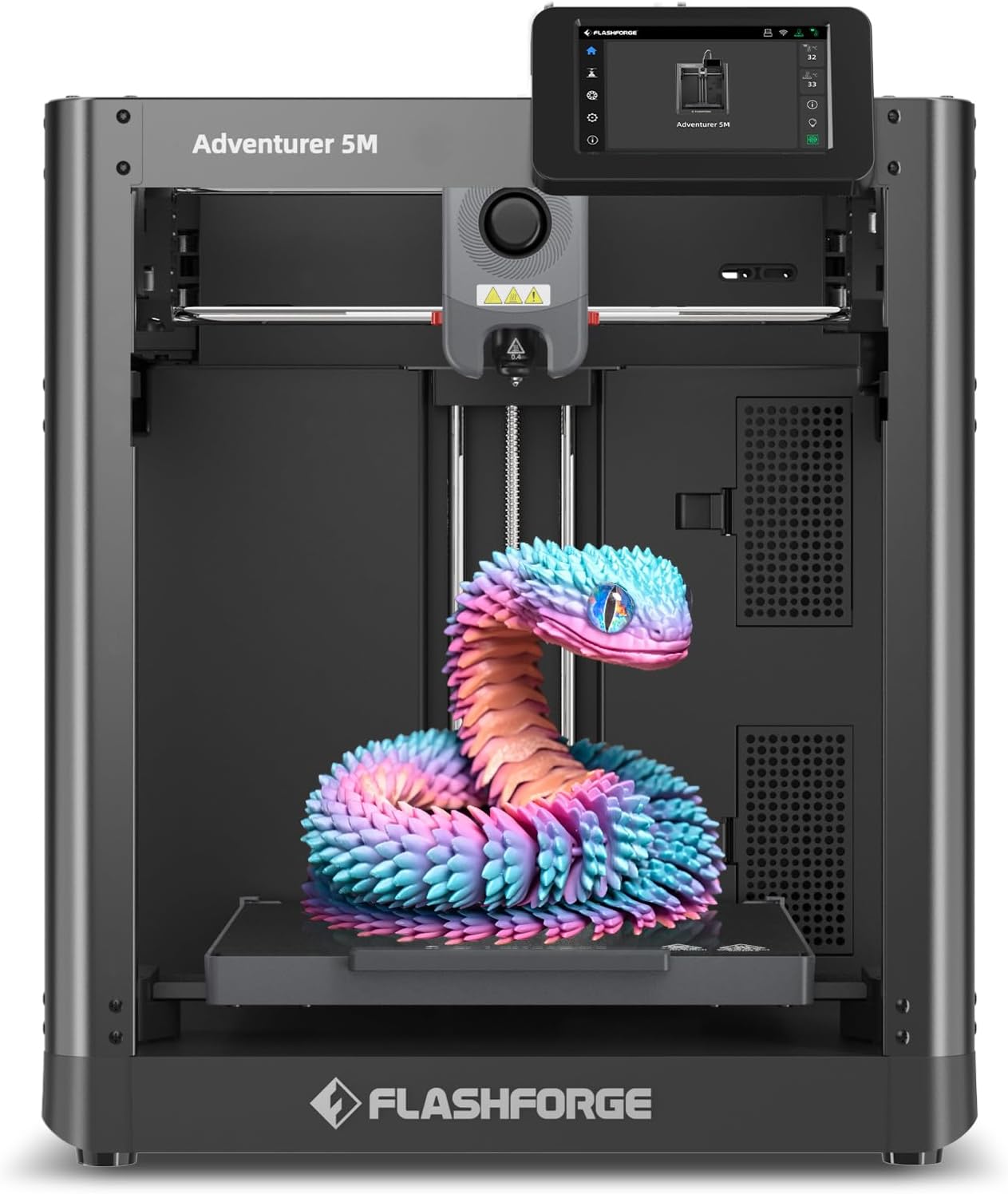
| Build Volume | 220 x 220 x 220 mm |
|---|---|
| Extruder Max Temp | 280°C Direct Drive |
| Travel Speed | 600 mm/s |
| Acceleration | 20,000 mm/s² |
| Platform Type | Double-Sided PEI Platform |
The Flashforge Adventurer 5M is a CoreXY desktop printer that emphasizes speed and convenience for iterative prototyping and hobby projects. It uses a 280°C direct extruder with quick 3-second detachable nozzles and a double-sided PEI platform, and the one-button auto leveling helps get consistent first layers without fiddly manual adjustments. Travel specs (600 mm/s, 20,000 mm/s² acceleration) and a high-flow nozzle are aimed at fast prints, while features like vibration compensation, multiple nozzle sizes, and dual-fan cooling help retain detail when you dial back speed. The integrated mobile app and optional camera support remote monitoring, which is handy for longer runs. Practical limits: the 220 mm cube build area is typical for miniatures but restricts larger terrain pieces unless you split models, and achieving the highest speeds requires tuning and appropriate filament to avoid quality loss. Regular nozzle and platform maintenance are necessary to keep reliability at higher throughput. For table-top model makers who value faster turnaround and easy setup, it balances convenience and quality effectively.
Best for: Modelers and hobbyists who prioritize faster print turnaround and easy, consistent setup for small-to-medium miniatures and terrain pieces and who prefer printers that minimize manual leveling work.
Less Ideal for: Users who need to print large single-piece terrain or who want a ready-to-print, ultra-high-detail solution without spending time tuning print speed and filament settings.
- Fast CoreXY motion with high travel speed and acceleration reduces print time for iterative runs.
- One-button automatic bed leveling saves setup time and improves first-layer consistency.
- Quick-change detachable nozzle and 280°C extruder support a range of engineering filaments and nozzle sizes.
- Double-sided PEI platform and dual-fan cooling make part removal and detail cooling easier.
- Mobile app and camera support remote monitoring and simpler workflow for multi-part batches.
- 220×220×220 mm build volume limits single-piece printing of larger terrain elements.
- Top speeds require careful tuning and suitable filament to avoid loss of fine detail.
Verdict: Buy this if you want a fast, easy-to-set-up CoreXY printer that speeds up miniature and small terrain production while still offering the filament and nozzle flexibility to tune for good detail.
FLASHFORGE AD5X 3D Printer

| Build volume | 220 x 220 x 220 mm |
|---|---|
| Extruder max temperature | 300°C |
| Structure | Open, Core XY |
| Travel speed | 600 mm/s |
| Nozzle sizes supported | 0.25 mm, 0.4 mm, 0.6 mm, 0.8 mm |
The FLASHFORGE AD5X is a CoreXY FDM printer built for faster prototyping and desktop makers who want more capability than a basic hobby machine. It prints with a direct-drive extruder rated to 300°C, supports a wide range of filaments including PLA, PETG, ABS and TPU, and has interchangeable nozzles from 0.25mm up to 0.8mm so you can choose fine detail or faster, chunky prints. Key convenience features include one-click auto bed leveling, automatic filament feed/retract, resume-on-power-loss and an intelligent filament system to reduce failed prints. The AD5X also advertises up to four-color printing and expandable camera and chamber lighting for easier monitoring. Where it shows its strengths is speed and throughput: the CoreXY layout with 600mm/s travel and high acceleration makes batch printing and quick iterations practical. For miniature-focused work the machine can use a 0.25mm nozzle for finer details, but users should expect some extra setup and slicer tuning to get the highest-resolution results compared with slower, purpose-built resin printers. The printer is best suited to users who want a versatile, relatively hands-off filament platform with higher throughput rather than an out-of-the-box ultra-fine-detail solution.
Best for: A cautious buyer who wants a capable, reliable filament printer that minimizes common failure modes while offering options for finer nozzles and faster output for tabletop miniatures and terrain.
Less Ideal for: Users seeking the absolute highest miniature detail with smooth resin-style finishes or those unwilling to spend time tuning slicer settings and hardware for ultra-fine FDM prints.
- CoreXY structure with high travel speed and acceleration for faster print times
- 300°C direct-drive extruder that handles a wide range of filaments
- One-click auto bed leveling and resume-on-power-loss reduce failed prints
- Interchangeable nozzles from 0.25mm to 0.8mm let you balance detail and speed
- Automatic filament feed/retract and intelligent filament system simplify operation
- Open-frame design and high-speed motion may require tuning to minimize vibration for extreme fine-detail prints
- Four-color printing adds complexity that can lengthen setup and calibration time
Verdict: Choose the AD5X if you want a faster, versatile filament printer that reduces common print failures while still allowing finer nozzles for detailed miniature and terrain work.
Choosing the Right 3D Printer for Miniatures and Terrain: Key Factors to Consider
Resolution and XY Detail
Miniatures and small terrain pieces rely on crisp tiny features that only show up when a printer can resolve fine details. Layer height is important, but XY resolution and optical or mechanical precision determine how well small sculpted details, thin filigree, and engraved textures reproduce. Lower layer heights reduce visible stepping, but without accurate XY positioning you still lose sharp edges.
When evaluating machines, look for specifications and real-world test prints that demonstrate thin-wall fidelity, clear facial features, and readable small text or glyphs. Keep in mind that achieving the best detail often requires tuning exposure or extrusion settings and using appropriate fine-detail materials.
Material and Resin Options
The choice between photopolymer resin and thermoplastic filament affects surface finish, detail, and post-processing. Resins designed for high-detail miniatures tend to capture finer textures and smoother surfaces straight off the printer. Filament printers can still produce excellent results with small nozzle sizes and fine layer heights, but the surface may need more finishing.
Also consider material durability for game pieces versus display models. Some resins are brittle but ultra-detailed; others are formulated to be tougher and more impact resistant. For terrain, heavier or reinforced materials may be preferable to avoid warping during handling. Check whether the printer supports a range of specialty resins or filaments you plan to use.
Build Volume Vs. Batch Printing
Miniature hobbyists often print multiple figures or modular terrain pieces in a single run. A printer with a modest build area can still be efficient if its print surface and workflow support batch layouts. Think about whether you prefer printing many small items simultaneously or larger terrain elements one at a time.
Bigger build plates let you print several pieces in one job, but they can increase risk of a single failed print ruining the entire batch. Smaller beds reduce wasted material per failed part and can simplify leveling and calibration. Choose a volume that matches how you intend to produce models and terrain efficiently.
Support Structures and Post-Processing
Supports are unavoidable for many miniatures and terrain shapes. The ease of generating, removing, and finishing supports affects final surface quality and your total time investment. Some systems produce finely placed, easy-to-trim supports that minimize scarring, while others require extensive sanding and touch-up.
Also factor in the post-processing steps your workflow needs, such as washing and curing for resin prints or sanding and priming for filament prints. The availability of affordable, space-efficient curing or cleaning tools can make a major difference in daily usability.
Calibration, Maintenance, and Community Support
Precision printing demands regular calibration and occasional maintenance. Machines that are easier to level, have reliable auto-calibration routines, and offer accessible replacement parts will save time. Clear manufacturer documentation and an active user community shorten troubleshooting and profile sharing.
For hobbyists, community-sourced slicing profiles, presets for miniature-specific settings, and step-by-step guides are valuable. Consider how easy it is to find and apply tested settings for the types of miniatures and terrain you plan to print.
Noise, Workspace, and Safety
Your printing environment affects machine choice. Resin systems require a ventilated space and careful handling during post-processing, while filament machines emit fewer volatile compounds but may need enclosures to control drafts and improve temperature stability. Noise levels matter if you print overnight in living spaces.
Think about ventilation, available bench space, and dust or solvent storage. Safety considerations include handling uncured resin, proper curing, and disposal of waste materials according to local regulations.
Resin Vs Filament for Miniatures
Photopolymer resin systems generally deliver the finest surface detail and smoothness, which reduces cleanup time and preserves sculpted texture. They are often the first choice for painters who need crisp facial features and thin appendages. However, resin handling requires washing and UV curing and often produces more brittle parts unless specific durable resins are chosen.
Filament printers can still produce tabletop-quality miniatures with careful tuning, smaller nozzles, and post-processing. They tend to be more forgiving with material strength and can be simpler and cleaner to operate. For terrain, filament offers versatility for larger, more durable pieces delivered with fewer constraints on size.
- Resin: best for ultra-fine detail and smooth surfaces
- Filament: better for durability and larger terrain pieces
- Consider workflow and safety when choosing between them
Optimizing Print Settings for Small Details
To get the best miniature prints, start with a conservative layer height and tune retraction, exposure, or extrusion rates to avoid stringing and surface artifacts. Slower print speeds and reduced acceleration reduce ringing and improve tiny detail fidelity. For resin printers, adjusting exposure times and lift speeds can prevent layer separation and speckling on thin parts.
Use high-quality slicing profiles or community-tested settings as a baseline, then perform small iterative test prints to dial in the final values. Small adjustments to support placement and orientation often yield large improvements in visible detail and reduce cleanup time.
- Print slower and reduce acceleration for sharper detail
- Use small test prints to iterate quickly
- Orient parts to minimize supports on detailed faces
Planning Batch Prints and Production Runs
When producing sets of miniatures or modular terrain, arrange models to balance bed adhesion and post-processing time. Packing many small models on the bed increases throughput but raises the impact of a single failure. Stagger test runs to confirm settings before committing to large batches.
Label parts and use consistent file naming to track revisions. If you paint many identical pieces, consider printing spares and planning cure schedules so you can wash and cure multiple batches efficiently without bottlenecks.
- Test settings on a few copies before large batches
- Leave space between parts to prevent fusing during prints
- Plan wash and cure cycles to keep a steady production pace
Finishing Techniques for Tabletop Quality
Sanding, priming, and fill-smoothing will often be necessary to achieve a paint-ready surface that looks professional at gaming scale. For resin prints, carefully trimming supports and a light sanding pass followed by a primer designed for miniatures usually does the job. For filament prints, more aggressive sanding and sometimes filler putty are necessary to remove layer lines.
Consider using a fine-grit sandpaper progression and detail files for small areas. A thin primer coat helps reveal lingering imperfections before painting. For terrain, texture paints and basing materials can conceal seams and join lines while improving durability.
- Trim supports carefully to avoid gouging details
- Use light primer coats to inspect and correct flaws
- Apply basing materials to hide seams and add realism
Workflow Tools That Speed Hobby Projects
Beyond the printer itself, several compact tools streamline miniature production. For resin workflows, a small ultrasonic cleaner or dedicated wash station and a safe, compact UV curing lamp speed post-processing. For filament users, a reliable fine nozzle, flush cutters, and quality adhesives make assembly and finishing faster.
Software and slicing tools also matter. Using curated community profiles, automated support generators, and batch-slicing features can save hours of repetitive setup. Keep a simple checklist for every print job to ensure consistent bed preparation, adhesion verification, and post-processing steps.
- Invest in a small wash and cure setup for resin work
- Keep spare nozzles and adhesives for filament assemblies
- Use slicing presets and batch tools to reduce repetitive work
How We Chose the Best 3D Printer for Miniatures and Terrain
We focused on attributes that directly affect small-scale detail, workflow speed, and predictable outcomes for miniature and terrain printing. Primary evaluation criteria included achievable layer height and XY resolution, resin or filament material compatibility for fine detail, and the stability of the build platform and motion system to prevent ringing and layer shifts. We also weighed ease of setup and calibration, common maintenance tasks, and the maturity of available slicing profiles and community support for miniature workflows. Print repeatability and part consistency across batches was another key filter since hobbyists often print dozens of pieces at once. We excluded machines that are marketed only for large-format printing or that lack the minimum resolution typically needed for miniature work. Also excluded were devices without accessible settings for exposure, retraction, or cooling that hobbyists rely on to dial in small details. The resulting shortlist prioritizes printers that combine the necessary hardware precision with software and community resources that shorten the learning curve.
Our full evaluation process is outlined in our review methodology.
FAQ
What resolution do I need to print tabletop miniatures?
You usually want a printer that can achieve very fine layer heights and good XY accuracy. Layer heights of 25 to 50 microns are common for detailed miniatures, but XY precision and stable motion are equally important to preserve sculpted details.
Are resin prints better than filament for painting?
Often resin prints show smoother surfaces and finer detail right off the printer, which reduces prep work before painting. Filament prints can be painted well but typically require more sanding and filling to hide layer lines.
How can I reduce failed prints when printing many miniatures at once?
Run small test batches first, leave space between models, and verify bed adhesion. Use conservative settings and stagger production so you can catch issues early rather than risking one failure to affect a large batch.
What post-processing is essential for resin miniatures?
Resin prints need washing to remove uncured resin and then UV curing to reach full strength. After that, light sanding and trimming of supports followed by a primer coat prepares the surface for painting.
Can I use standard filaments for terrain pieces?
Yes. Standard PLA and PETG are commonly used for terrain. Choose filaments with low warping for larger flat pieces and consider reinforced or higher-temperature materials if you need extra durability.
How important is community support and slicing profiles?
Very important. Community-shared profiles and troubleshooting tips can drastically shorten setup time and help you achieve reliable miniature prints without long trial-and-error periods.
Final Verdict
For miniature and terrain printing, prioritize a machine that delivers the necessary fine detail and stable motion rather than chasing raw build volume. Choose the material system that fits your workflow: resin for the finest detail and filament for larger, tougher terrain. Pay attention to batch strategies, support cleanup, and post-processing tools since these often determine how much time you spend to get a paint-ready piece. Balance resolution, material options, and ease of use against the kind of projects you print most often. With the right setup and tested settings, you can reliably produce tabletop-ready miniatures and terrain that meet hobbyist standards.