
Note: This article contains affiliate links. If you click on these links and make a purchase, we may earn a small commission at no extra cost to you. This helps support our research and content. Read our full affiliate disclosure here.
If you regularly need parts, prototypes, or fixtures larger than standard tabletop builds, choosing a 3D printer with a truly large build area changes how you work. A well-sized machine reduces the need to split models, lowers assembly time, and shortens development cycles. You want a printer that pairs a generous build volume with dependable dimensional accuracy, good temperature control, and a reliable workflow. This guide covers our shortlisted picks for 3D printers optimized for large prints. We evaluated machines on build volume, dimensional consistency, heated-bed performance, and long-print reliability to help you find an option suited to sustained large-format printing. Read on for the factors that matter and practical setup considerations before the product list.
Top Picks at a Glance
| Best Overall The best all-around choice for most situations | Sovol SV08 Max 3D Printer |  |
| Best Quality Built to a higher standard if you want something more solid | Original Prusa XL 1-Toolhead |  |
| Best Value The sweet spot between price and what you get | Anycubic Kobra 3 Max |  |
| Best Budget The cheapest option that still gets the job done reliably | LONGER LK5 Pro 3D Printer |  |
| Top Rated A top-rated pick with lots of positive feedback | QIDI Max4 Combo |  |
| Best Seller A high-volume bestseller chosen again and again | Creality Ender-5 Max |  |
Sovol SV08 Max 3D Printer

| Build volume | 500×500×500 mm |
|---|---|
| Max hotend temp | 300°C |
| Kinematics | CoreXY |
| Camera | 1280×720 HD |
| Included nozzles | 0.4 mm ×2 |
The Sovol SV08 Max is a large-format CoreXY FDM printer built for fast, high-volume parts and oversized prototypes. It packs a 500×500×500 mm build volume and CoreXY kinematics to reduce moving mass and vibration, which helps maintain dimensional accuracy at higher speeds. The machine is set up for high-flow printing with a 300°C-capable hotend and a 50 mm³/s flow rating, and it ships with two 0.4 mm nozzles while supporting larger optional nozzles for quicker, coarse fills. Bed leveling is handled by an eddy current scanning system with pressure-sensing touch points, simplifying first-layer setup for big prints. A 1280×720 HD camera and remote monitoring support let you keep an eye on long prints and capture time-lapses. Practical limits include the printer's large footprint and significant weight, which make it less workshop-friendly for cramped spaces, and high-speed, high-flow printing may require careful tuning and quality filament to avoid artifacts. For builders needing large, fast prints with upgrade paths for a heated chamber, the SV08 Max is a capable choice.
Best for: Makers and small workshop users who prioritize printing very large parts quickly and want a printer with modern motion hardware and easy bed leveling.
Less Ideal for: Hobbyists with limited workspace or beginners who prefer a small, lightweight printer that requires minimal tuning and setup time.
- True large 500×500×500 mm build volume suitable for full-scale prototypes and oversized parts
- CoreXY kinematics for faster acceleration and reduced vibration compared with Cartesian setups
- 300°C hotend and high-flow capability allow printing a wider range of engineering filaments
- Eddy current sensor with pressure-sensing points provides fast, contactless bed leveling
- Built-in 1280×720 camera and remote monitoring for long-run supervision and time-lapse capture
- Large footprint and heavy assembly make it difficult to move or fit into small workspaces
- High-speed, high-flow prints require careful tuning and premium filament to avoid print quality issues
Verdict: If you need a factory-capable large-format printer that prioritizes speed and high-flow printing for oversized parts, the Sovol SV08 Max is a strong pick.
Original Prusa XL 1-Toolhead

| Build volume | 360 × 360 × 360 mm |
|---|---|
| Filament diameter | 1.75 mm |
| Supported materials | PLA, PETG, ASA |
| Architecture | CoreXY |
The Original Prusa XL is a professional-grade large-format CoreXY printer built for fast, repeatable single-material production. It uses a next-generation Nextruder with a Loadcell sensor plus firmware features like Input Shaper and Pressure Advance to improve dimensional accuracy and mitigate ringing at higher speeds. The segmented heated bed provides zoned warming to cut power use and reduce warping on big parts, and the machine ships nearly assembled with a Satin print sheet and 1 kg Prusament PLA so you can start prints quickly. Its modular, serviceable design makes maintenance and future upgrades straightforward, and it supports offline use as well as integration with Prusa Connect for networked workflows. Trade-offs are that this is a large, heavy unit that requires a dedicated workspace and that the listing is for a single toolhead configuration, so makers needing multi-material or multi-head production will need different setups or upgrades.
Best for: Engineers, prototypers, and small production shops that prioritize large-format, high-speed single-material prints with strong dimensional accuracy and serviceability.
Less Ideal for: Hobbyists with limited workspace or users who need native multi-material or multi-head printing without aftermarket upgrades.
- Large 360×360×360 mm build volume for big prototypes and parts
- CoreXY motion and Input Shaper/Pressure Advance support for faster, cleaner prints
- Segmented heated bed reduces warping and improves first-layer consistency across large surfaces
- Modular, serviceable design with quick final assembly and included spool and print sheet
- Single toolhead configuration limits out-of-the-box multi-material or multi-color printing
- Size and weight require a dedicated, sturdy workspace and may complicate transport
Verdict: Buy this if you need a large, fast CoreXY printer that delivers professional-quality single-material prints with excellent dimensional stability.
Anycubic Kobra 3 Max

| Build Volume | 420 × 420 × 500 mm |
|---|---|
| Printing Speed | <600 mm/s (recommended 300) |
| Leveling Type | Auto Leveling Smart Z-offset |
| Materials | PLA, PETG, TPU, ABS, PVA, ASA |
The Anycubic Kobra 3 Max is built for big, fast FDM prints: its 420×420×500mm build area lets you produce large single-piece parts while an upgraded print head, dual Y-axis and SG15 bearings aim to keep motion smooth at higher speeds. Pairing with Anycubic ACE Pro add-ons enables multicolor workflows, and the Kobra OS includes AI print monitoring that pauses on common failures to protect long runs. For practical use it supports common filaments like PLA, PETG and TPU and offers an auto-leveling Smart Z offset to simplify bed prep. The real strength is in batch or single large-part printing where reduced setup and shorter print times matter. Expect trade-offs common to large open-frame printers: you will need room for the footprint and some tuning for consistent top-to-bottom accuracy on very tall prints, and multicolor requires purchasing the ACE Pro accessory. If you need large-volume output and faster throughput rather than a fully enclosed, temperature-controlled chamber, this model is a strong option.
Best for: Buyers who prioritize making large single-piece parts or faster batch prints and want a practical, production-oriented machine they can tune and extend with accessories.
Less Ideal for: Those who need a fully enclosed, temperature-controlled printer for demanding ABS/ASA work or users seeking out-of-the-box multicolor printing without buying extra hardware.
- Very large 420×420×500mm build volume for single-piece large prints
- High-speed motion design with SG15 bearings and dual-axis upgrades for faster layer times
- AI print monitoring that can pause prints on detected failures to save filament and time
- Auto-leveling Smart Z-offset reduces manual bed leveling effort
- Supports common materials including PLA, PETG and TPU for versatile projects
- Requires additional ACE Pro hardware for true multicolor printing
- Open-frame design may need environmental control or tuning for high-accuracy tall prints
Verdict: Choose the Kobra 3 Max when you need a large-format, high-speed FDM printer that delivers practical big-print capacity and faster throughput for production-style projects.
LONGER LK5 Pro 3D Printer
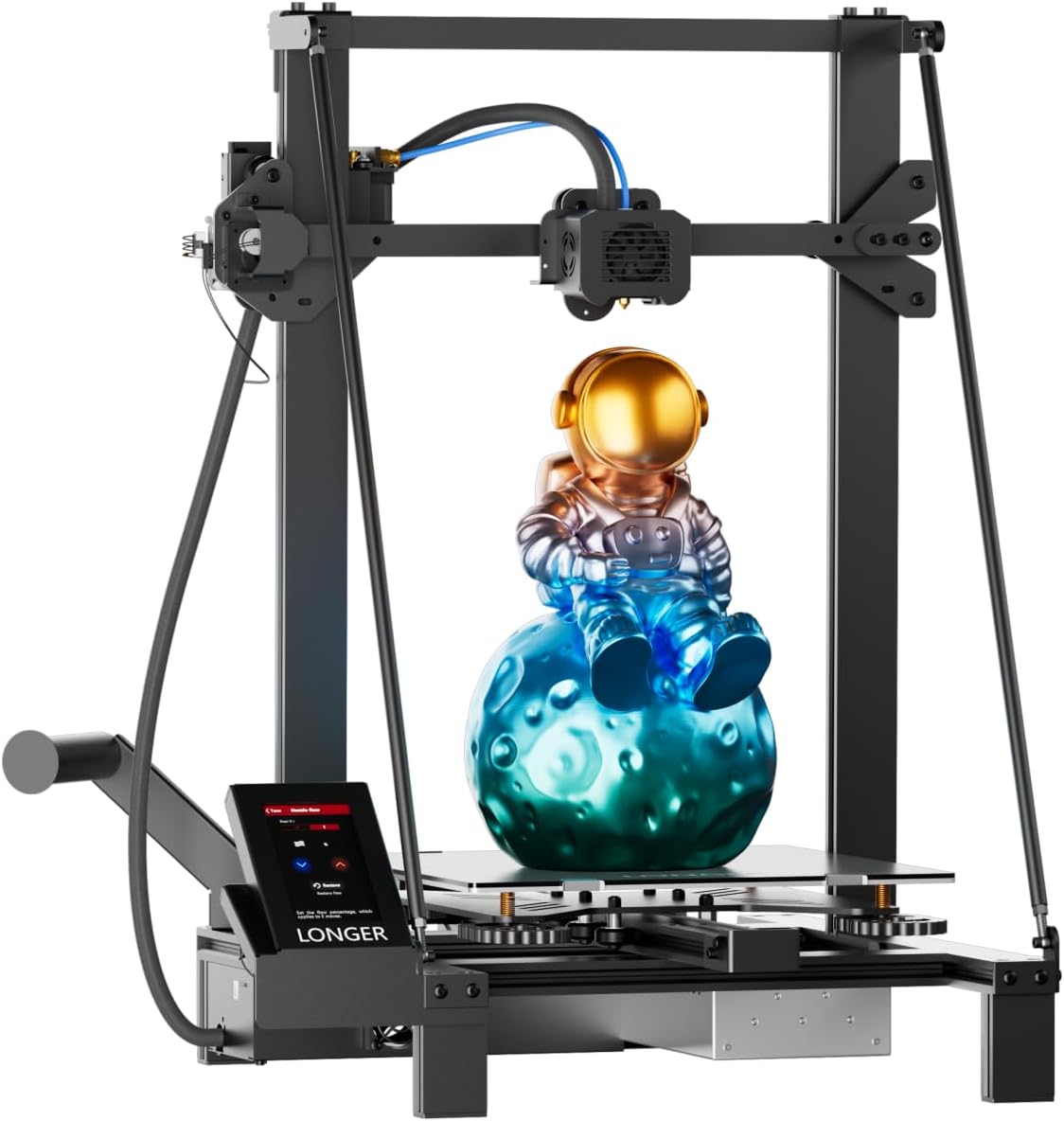
| Build volume | 300×300×400 mm |
|---|---|
| Printing speed | 180 mm/s |
| Driver type | TMC2209 silent drivers |
| Pre-assembled | 95% pre-assembled |
| Special features | Filament detection and resume printing |
The LONGER LK5 Pro is a 95% pre-assembled FDM printer aimed at makers who need a larger build area without a steep learning curve. It delivers a 300×300×400mm print volume and a claimed top speed of 180 mm/s while using a reinforced triangular frame and lattice glass bed to improve stability and bed flatness for better surface quality. Practical features include TMC2209 silent stepper drivers for quiet operation, filament runout and power-loss detection that pause and resume prints, and an open-source motherboard for firmware tweaks. The printer is suited to straightforward home, school, or small workshop projects where printing larger parts or multiple smaller parts in one job matters. Limits to consider: the advertised 180 mm/s and 0.1 mm precision are optimistic—real-world quality depends on tuning and filament choice—and a 95% build means some assembly and calibration is still required. Customer support and the openness to modify firmware are helpful for hobbyists who want to improve performance over time.
Best for: Buyers who need a roomy printer for large models or multi-part jobs on a budget and prefer a machine that comes mostly assembled but can be tuned over time.
Less Ideal for: Users seeking a plug-and-play, guaranteed high-speed professional printer with no setup or tuning, or those who need certified industrial reliability and support.
- Large 300×300×400mm build volume for big parts or batch printing
- 95% pre-assembled design reduces setup time for beginners
- Filament runout and power-loss detection that pause and resume prints
- Quiet TMC2209 stepper drivers for lower operating noise
- Open-source motherboard allows firmware customization and upgrades
- Top speed and 0.1 mm precision require careful tuning and may not be achieved out of the box
- Some assembly and calibration still required despite heavy preassembly
Verdict: If you want a large-volume, budget-friendly 3D printer that is mostly assembled and easy to tweak, the LONGER LK5 Pro is a strong choice.
QIDI Max4 Combo

| Build volume | 390×390×340 mm |
|---|---|
| Chamber temperature | ≤65℃ |
| Hotend max temperature | ≤370°C |
| Max tool head speed | ≤800 mm/s |
The QIDI Max4 Combo is a large-format enclosed 3D printer built for demanding parts and engineering materials. It offers a 390×390×340mm build area and an actively heated chamber up to 65°C, which helps reduce warping on long prints and keeps dimensional stability for ABS, PC, nylon, and carbon-fiber composites. A 370°C hotend and hardened steel nozzle expand material choices to abrasive and high-temperature filaments, while a full-surface silicone heated bed promotes uniform first-layer adhesion. Performance features include closed-loop X/Y motors, dual Z lead screws and anti-backlash nuts for steadier layers, and a tool head capable of very high speeds and acceleration for faster throughput where the model and material allow. The built-in AI camera and large touch screen simplify monitoring and basic controls, and network options include Wi-Fi, Ethernet, and cloud access. The printer is aimed at professional prototyping and large functional parts, but the Polar Cooler for cleaner airflow is sold separately and the machine's size and power mean setup and space planning are important considerations.
Best for: Engineers, small manufacturers, and advanced hobbyists who need a reliable large-format printer that can handle engineering plastics and long production prints with consistent dimensional accuracy.
Less Ideal for: Casual hobbyists or occasional users who lack workshop space or do not intend to print high-temperature or abrasive materials.
- Very large 390×390×340mm build volume for single-piece large parts
- 65°C heated chamber and silicone bed reduce warping with engineering materials
- 370°C hotend and hardened steel nozzle support high-temp and abrasive filaments
- Closed-loop X/Y motors and dual Z lead screws for improved precision and layer consistency
- Built-in AI camera and network options for remote monitoring and control
- Polar Cooler not included and must be purchased separately for advanced airflow control
- Large footprint and weight require dedicated space and careful setup
- High-speed capability may be limited by specific material flow and nozzle options
Verdict: Choose the Max4 Combo when you need a large, factory-capable enclosed printer that reliably handles engineering and abrasive materials for big, single-piece parts.
Creality Ender-5 Max

| Build volume | 400×400×400mm |
|---|---|
| Heating bed power | 1000W |
| Auto-leveling | 36-point |
| Max XY speed (peak) | 700mm/s |
The Creality Ender-5 Max is a large-format FDM printer built for big parts and higher-throughput workflows. It provides a true 400×400×400mm build volume so you can print large prototypes or run small batches without splitting models, and a heated 1000W bed helps with adhesion for bigger prints. Creality claims peak XY speeds up to 700mm/s and high acceleration for faster cycle times, while a 36-point auto-leveling routine reduces manual bed tuning. The metal dual-gear extruder improves filament grip and durability during extended runs, and LAN-based multi-device control plus Creality Print make it easier to manage several machines or queue jobs remotely. Expect the machine to need basic setup and occasional calibration despite the auto-leveling, and very high speeds will still require tuning to avoid ringing on tall, detailed parts. The Ender-5 Max is best when you need large build capacity and networked workflow rather than compact desktop convenience.
Best for: Buyers who prioritize reliably producing single-piece large prints or running multiple jobs on a networked setup and who prefer a machine with professional features over compact convenience.
Less Ideal for: Hobbyists with limited bench space or casual users who only print small models and want a plug-and-play desktop printer.
- Massive 400×400×400mm build volume for single-piece large prints
- High-speed XY motors and strong acceleration for shorter print times
- 36-point auto-leveling reduces manual bed adjustment
- All-metal dual-gear extruder for consistent filament feeding and durability
- LAN multi-device control simplifies managing multiple printers
- Very high claimed speeds require tuning to maintain print quality
- Large footprint and weight make it less suitable for small workspaces
Verdict: Choose the Ender-5 Max when you need a factory-quality large-format printer that speeds up big-part and multi-device workflows.
Choosing the Right 3D Printer for Large Prints: Key Factors to Consider
Build Volume Vs Usable Area
Large advertised build volumes are only valuable if the entire area and height are practically usable. Consider the usable build area after accounting for toolhead clearance, bed clips, and enclosure interior. A wide bed with several millimeters lost to a bezel or carriage can force part splitting and post-assembly.
Also think about the maximum printable height versus real-world constraints like heated enclosure access and Z-axis stability. Taller prints amplify small layer shifts and wobble, so a printer with a high, stiff Z-axis and secure lead screws or linear rails will produce more reliable tall parts.
Thermal Management and Heated Bed
Maintaining a consistent bed and chamber temperature across a large surface is harder than on small printers. Uneven bed heat causes warping along edges and corners of large prints. Look for printers with either a high-quality, evenly distributed heated bed or an insulated, heated chamber that reduces thermal gradients.
Heated beds should reach and hold temperatures appropriate for the materials you plan to use. For flexible or engineering filaments, ability to maintain elevated chamber temperatures is crucial to prevent delamination on large cross sections.
Frame Stiffness and Motion Accuracy
Mechanical rigidity becomes increasingly important as print size grows. A flimsy frame or loose motion components translate into visible ringing, layer misalignment, or dimensional error over long travel distances. Evaluate the frame design, fastener quality, and the type of linear motion system (linear rails, rods with bearings, or lead screws).
Better motion systems reduce vibration and maintain accuracy during long moves. For large-format work, prioritize printers with reinforced frames and quality linear motion components even if they add upfront complexity.
Print Resume and Filament Management
Long prints are vulnerable to interruptions. Power outages, filament jams, or depleted spools can ruin hours of work. Features such as resume-on-power-loss, filament runout detection, and reliable extruder mechanics reduce waste and reprints. Consider the logistics of feeding large spools or running filament through enclosures when planning long-duration jobs.
Some workflows also benefit from dual-drive extruders or improved filament path design to reduce slippage during long continuous prints.
Bed Leveling and First-Layer Consistency
A perfect first layer prevents many issues on large prints because small adhesion problems can magnify over tall or wide parts. Automatic bed leveling systems that compensate for slight frame twist or bed surface irregularities save setup time and increase first-layer consistency. Also verify the method used for bed leveling: mesh probing across the full bed is more useful for large areas than a single-point probe.
Surface preparation options matter too. A large print may need stronger adhesion aids or a specific print surface to keep edges from lifting during long cool-down periods.
Material Compatibility and Enclosure Options
Large-format projects often push into materials beyond PLA, such as ABS, PETG, or nylons, which need elevated chamber temperatures and controlled cooling. Check whether the printer can support an enclosed build environment and heated bed temperatures required by your chosen materials.
If you plan to use high-temperature filaments, verify extruder and hotend capabilities, plus the availability of an enclosure that maintains thermal stability across the full print volume.
Preparing Your Workspace for Large Builds
Large printers need more than floor space. Plan for access around the machine for loading filament, removing prints, and maintenance. Ensure the floor is level and can support the printer plus any vibration isolation you may add for better print quality.
Also consider ventilation and filtration. Larger parts made from engineering materials can off-gas or release fine particles during long prints, so proper ventilation or an enclosed machine with filtration is helpful for indoor use.
- Leave clearance on all sides for bed removal and part handling
- Assess electrical capacity for prolonged high-power draws
- Use a sturdy, level surface to avoid micro-movements during long prints
Slicing Strategies for Big Parts
Slicing large models calls for different habits than small prints. Use conservative layer heights and slower outer wall speeds to improve surface finish and reduce artifacts that become obvious on large surfaces. Increasing infill only where structural support is needed saves time and filament.
Enable features that help with long prints, such as gradual cooling profiles, brim or skirt for better adhesion, and adaptive print speeds for long perimeters. When possible, orient the model to minimize overhangs and long unsupported spans that require heavy bridging or supports.
- Use brims or rafts for larger contact areas
- Lower outer wall speed to reduce ringing on long moves
- Consider splitting very tall parts into boltable sections to reduce print time and failure risk
Maintenance Routines to Keep Long Prints Reliable
Preventive maintenance becomes more important on machines that run long jobs. Regularly check and tighten motion hardware, lubricate rails if applicable, and inspect belts or lead screws for wear. Small issues multiply over long-hour runs, so a short pre-print checklist can save hours of reprints.
Also monitor wear items like nozzles and drive gears. Replace or clean these parts on a schedule based on hours printed and filament types used to avoid clogs during multi-hour prints.
- Create a pre-print checklist for bed adhesion, filament path, and toolhead clearance
- Keep replacement nozzles and a basic tool kit on hand
- Log long-print jobs to spot recurring issues and refine settings
Finishing and Joining Large Printed Parts
Even with a large printer, some builds are better printed in sections and joined afterward. Mechanical joining, adhesives, and solvent welding are common approaches depending on material. Design joining features into the model such as alignment pins or dovetail edges to speed assembly and improve tolerances.
Post-processing for large surfaces can be time-consuming. Sanding, filler, and coating are often required to achieve a uniform finish on visible faces. Consider access for post-processing when selecting a build orientation.
- Design seams and fastener locations into parts to simplify assembly
- Plan for clamping and fixturing during post-processing
- Test-fit mating parts before final bonding or finishing
How We Chose the Best 3D Printer for Large Prints
We focused on machines that make large-format printing practical for makers, engineers, and small shops. Key evaluation criteria included usable build volume, consistent dimensional accuracy across the whole bed, and thermal control for large prints. We also prioritized firmware and controls that support long jobs, such as resumed prints after power interruptions, filament runout detection, and stable bed leveling systems. Mechanical stiffness and motion system design were considered because structural rigidity directly affects surface finish and dimensional repeatability on big parts. Finally, we looked at safety and enclosure options that help when printing high-temperature materials or long-duration parts. We excluded printers that only advertise large nominal envelopes but lack the mechanical or thermal systems to produce repeatable large parts. We also excluded machines without basic long-print reliability features such as resume-on-power-loss or filament sensors. The shortlist reflects products that balance raw build area with engineering that supports consistent, usable large-format printing.
Our full evaluation process is outlined in our review methodology.
FAQ
How big is 'large' for a 3D printer build volume?
Large is relative, but in practical terms it means a bed and height that let you print parts larger than common desktop projects without splitting. For many users, this starts around a footprint of 300 x 300 mm and taller Z heights, though true large-format work may require 500 mm or more in at least one axis.
Will larger prints take more maintenance than smaller ones?
Yes. Longer print times and greater mechanical travel increase wear on motion components and nozzles. Regular checks on belts, bearings, and bed flatness help prevent mid-print failures that are more costly on long jobs.
Can I print engineering plastics at large scale on these machines?
Often you can, but success depends on chamber temperature control, hotend capability, and an enclosure to reduce warping. Machines designed for large-format engineering prints should support higher bed and chamber temperatures and robust extrusion systems.
Is it better to print one huge part or break it into sections?
It depends on the geometry, required strength, and printer reliability. Splitting can reduce failure risk and simplify post-processing, but it adds assembly steps and potential alignment challenges. Consider splitting strategically along low-stress planes and adding alignment features.
How do I handle filament for long continuous prints?
Use larger spools or a filament feeder that supports extended runs, and check for smooth filament path through any enclosure. Filament runout sensors and reliable spool mounts reduce the chance of mid-print interruptions.
Final Verdict
When you need to produce bigger parts without constant joining, prioritize usable build volume paired with the mechanical and thermal systems that keep prints consistent over long runs. Focus on printers with robust frames, even heating across the bed or a heated chamber, and features that protect long jobs from interruptions. Balance the desire for maximum size with the realities of maintenance, workspace, and material needs. Choose a machine that matches the tallest or widest parts you plan to print while offering the reliability features required for multi-hour or multi-day prints.