
Note: This article contains affiliate links. If you click on these links and make a purchase, we may earn a small commission at no extra cost to you. This helps support our research and content. Read our full affiliate disclosure here.
If you need a 3D printer that can handle bigger parts, faster cycles, and more demanding materials without stepping into industrial pricing, choosing the right midrange machine matters. A well-matched 3D Printer under $15,000 will affect part accuracy, production throughput, and material flexibility for prototyping or low-volume production. This guide shortlists top-performing options that balance build volume, reliability, and material support. We evaluated machines on print accuracy, uptime, and operating cost to help you find a practical fit. Read on to see the top picks and what each type of buyer should prioritize.
Top Picks at a Glance
| Best Overall The best all-around choice for most situations | Bambu Lab P2S Combo |  |
| Best Quality Built to a higher standard if you want something more solid | Raise3D Pro3 Plus HS |  |
| Best Value The sweet spot between price and what you get | Creality K1C 3D Printer K1C |  |
| Best Budget The cheapest option that still gets the job done reliably | FLASHFORGE Adventurer 5M |  |
| Top Rated A top-rated pick with lots of positive feedback | QIDI Max4 Combo |  |
| Most Popular A crowd favorite that many people choose with confidence | Creality Ender 3 V3 SE |  |
| Best Seller A high-volume bestseller chosen again and again | Bambu Lab P1S |  |
Bambu Lab P2S Combo

| Print speed | Up to 600 mm/s |
|---|---|
| Filament drying | AMS 2 Pro drying up to 65 °C |
| Chamber control | Adaptive Airflow System with 50 °C chamber capability |
The Bambu Lab P2S Combo pairs a high-speed CoreXY P2S printer with the AMS 2 Pro multi-spool system to deliver fast, accurate FDM printing and straightforward multi-color workflows. The P2S itself is built for speed and precision, claiming up to 600 mm/s supported by a PMSM servo extruder and active flowrate compensation to keep layers consistent and corners clean. It also offers quick-swap nozzles, automatic calibration, and AI failure detection that let you get a printer set up and printing in minutes rather than hours. The AMS 2 Pro adds automatic filament drying and multi-spool handling so multi-color or multi-material jobs run with fewer interruptions. The adaptive airflow system and a carbon filter help manage part cooling and a stable chamber environment for engineering filaments. Practical downsides include the space and workflow overhead of a high-performance combo unit and the fact that the base P2S requires the AMS combo to do true multi-color printing, so multi-color capability is not native to the printer alone. For hobbyists and small shops that value speed, automation, and an integrated ecosystem, this combo accelerates turnaround and reduces fiddling with settings.
Best for: Buyers who want a fast, automated 3D printing setup for rapid prototyping or small-run production and who value reduced setup time and integrated multi-color workflows.
Less Ideal for: Casual makers who only need occasional single-color prints or those who prefer a compact, simple printer with minimal accessories.
- Extremely fast print speeds (up to 600 mm/s) for rapid prototyping
- PMSM servo extruder with active flowrate compensation for consistent layer quality
- AMS 2 Pro provides seamless multi-color/multi-material printing with active filament drying
- Automatic calibration, quick-swap nozzles, and AI failure detection reduce setup time and failed prints
- Adaptive airflow and carbon filter help manage cooling and maintain a stable printing environment
- Multi-color printing requires the AMS 2 Pro combo rather than working on the base printer alone
- High-performance combo increases footprint and setup complexity compared with standalone hobby printers
Verdict: Choose the P2S Combo if you need blistering print speeds plus an integrated, automated multi-spool system to speed up prototyping and small-batch multi-color prints.
Raise3D Pro3 Plus HS

| Maximum nozzle temperature | 320ºC |
|---|---|
| Maximum build plate temperature | 120ºC |
| Maximum speed | 500 mm/s |
| Standard print speed | 300 mm/s |
The Raise3D Pro3 Plus HS is built for high-throughput, end-use part production by combining a large build volume with Hyper FFF high-flow extrusion and a closed-loop stepper motion system. It prints a wide range of materials, including high-performance composites and fiber-filled filaments, at standard speeds around 300 mm/s and peak speeds up to 500 mm/s while supporting nozzle temperatures up to 320°C and a heated bed to 120°C. Practical features like a flexible steel build plate with uniform magnetic adhesion, auto mesh leveling with flatness detection, enclosed airflow management, dual-gear extruders, and a 7-inch touchscreen with Wi-Fi and live camera make it straightforward to run long jobs and monitor prints remotely. The strengthened hot end, all-metal nozzle, and robust frame are aimed at reliability during long production runs, but the printer's industrial focus means it requires setup space and some operator familiarity to tune high-speed prints and composite materials. For performance-focused users needing large, factory-quality prints, this printer delivers industrial-grade throughput and material capability.
Best for: Buyers who prioritize production speed and material capability for end-use or short-run industrial parts and need a reliable printer that can handle advanced composites and long print cycles.
Less Ideal for: Hobbyists, casual makers, or buyers who need a compact desktop printer or simple plug-and-play operation should consider smaller, less complex models instead.
- High-speed Hyper FFF system with closed-loop stepper motors for precise high-rate extrusion
- Large build volume for single and dual-extruder configurations suited to big parts
- Supports a wide range of materials including high-temp and fiber-filled composites to 320°C
- Industrial-grade hardware: all-metal frame, strengthened hot end, and dual-gear extruders for long continuous runs
- Convenience features like auto mesh-leveling, flexible magnetic build plate, live camera, and network connectivity
- 200-pound machine that requires significant floor space and handling for installation
- Steep learning curve and tuning needed to optimize high-speed prints and composite materials
Verdict: If you need industrial-level speed and the ability to print high-performance composite materials at scale, the Pro3 Plus HS delivers the throughput and reliability to run production-grade parts under $15,000.
Creality K1C 3D Printer K1C

| Max nozzle temp | 300 ℃ |
|---|---|
| Supported materials | PLA, ASA, ABS, TPU, PLA-CF, PET-CF |
| Build volume | 8.66 x 8.66 x 9.84 inch |
| Print acceleration | 20000 mm/s² |
| Max advertised speed | 600 mm/s |
The Creality K1C is a compact, plug-and-play FDM printer aimed at making fast, capable prints accessible without a lengthy setup. It ships largely assembled so you can power up and start printing in minutes, and its auto calibration (Z offset and leveling) plus auto input-shaping reduce manual tuning. The machine features a clog-free direct extruder with a durable steel-tipped copper nozzle and a titanium-alloy heat break that supports up to 300 C, letting you run PLA, PET-CF/PLA-CF and other higher-temperature filaments for stronger jigs and functional parts. An onboard AI camera enables basic failure detection and timelapse monitoring, while an upgraded multi-fan cooling system improves bridging and overhang quality. The build volume is modest but suits small prototypes or production jigs, and the high-speed motion system (advertised 600 mm/s) is geared toward faster turnaround, though real-world speeds for quality prints will be lower. Expect the usual consumer-level limits on enclosure thermal control and fine-tuning compared with larger industrial systems, but for small shops or makers wanting quick setup and robust material support, this is a practical choice.
Best for: Buyers who want a fast-to-start desktop printer that handles tougher filaments for functional prototypes and production jigs without spending time on complex setup.
Less Ideal for: Those who need very large-format printing, tight industrial thermal control, or the absolute highest fine-detail output from an industrial-grade machine.
- Mostly preassembled and ready to print quickly after unboxing
- Clog-free direct extruder with steel-tipped nozzle and titanium heat break supports up to 300 C
- Auto calibration and input shaping reduce manual leveling and tuning
- Onboard AI camera for basic print-failure detection and timelapse monitoring
- Upgraded multi-fan cooling improves bridging and reduces stringing
- Modest build volume limits larger prints
- Advertised top speeds are much higher than practical quality printing speeds
Verdict: A quick-to-deploy desktop printer that lets practical builders print stronger, higher-temperature parts with minimal setup.
FLASHFORGE Adventurer 5M
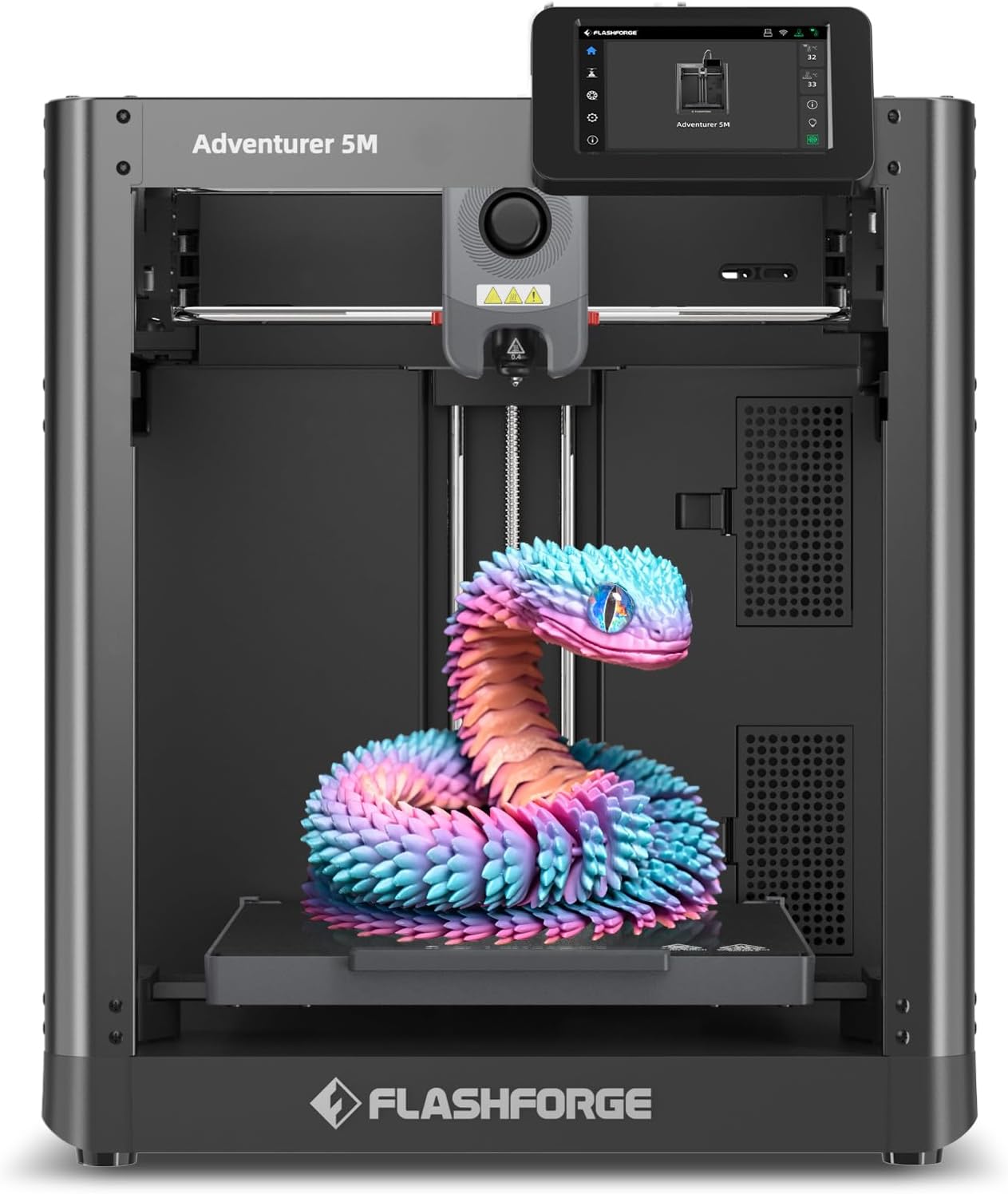
| Build Volume | 220 x 220 x 220 mm |
|---|---|
| Max Nozzle Temp | 280°C |
| Travel Speed | 600 mm/s |
| Acceleration | 20,000 mm/s² |
| Platform Type | Double-sided PEI Platform |
The FLASHFORGE Adventurer 5M is a CoreXY desktop printer built for speed and straightforward operation. It uses one-button automatic bed leveling and a 280°C direct-drive extruder with quick, tool-free nozzle swaps for fast setup and minimal fiddling. The machine targets high-throughput workflows with a claimed 600 mm/s travel speed and aggressive acceleration, a dual-sided PEI platform for easier part removal, and multiple nozzle sizes to tune layer resolution versus speed. Practical advantages include the fast warm-up and a mobile app for remote monitoring, which helps when running multiple prints back to back. The all-metal structure and vibration compensation aim to keep prints consistent during high-speed moves, but pushing the top speeds will still require careful tuning and good filament to avoid ringing or layer issues. The printer supports common engineering filaments but does not appear to include an enclosed heated chamber by default, so higher-temperature or warp-prone materials may need an enclosure accessory. For buyers who value quicker prototyping cycles over plug-and-play perfection, this model delivers a lot of performance for a desktop unit.
Best for: Buyers who need a fast, desktop prototyping printer that reduces setup time and prioritizes throughput over fully enclosed industrial workflows.
Less Ideal for: Users who require ready-to-print high-temperature enclosure performance out of the box or those seeking a completely noise-free plug-and-play experience.
- One-button automatic bed leveling for reliable first layers
- CoreXY all-metal structure designed for high travel speeds and stable motion
- 280°C direct-drive extruder with quick 3-second nozzle changes
- Dual-sided PEI platform for easier part removal
- Mobile app for remote monitoring and job management
- No built-in enclosed heated chamber included, limiting high-temperature material performance
- Top advertised speeds require tuning and high-quality filament to maintain print quality
Verdict: A speed-focused CoreXY desktop printer that delivers fast prototyping and easy setup for budget-minded users who prioritize throughput.
QIDI Max4 Combo

| Build volume | 390×390×340 mm |
|---|---|
| Hotend max temperature | 370°C |
| Chamber max temperature | 65°C |
| Max toolhead speed | ≤800 mm/s |
The QIDI Max4 Combo is a heavy-duty enclosed 3D printer built for large parts and engineering materials. It delivers a 390×390×340mm build volume and a full-surface silicone heated bed that helps first-layer adhesion and reduces warping for long prints. Key hardware includes a 370°C high-temperature hotend and an actively heated chamber up to 65°C, which together allow printing PC, Nylon, carbon-fiber composites and other high-temp filaments more reliably than typical hobby machines. Mechanical improvements such as dual Z lead screws, closed-loop X/Y motors, and an anti-backlash Z nut improve dimensional accuracy and reduce layer shifts during long or fast prints. The unit also includes an HD AI camera for automatic failure detection and a 5-inch touchscreen plus multiple network options for remote control. The printer is designed for reliability and repeatable results, though it is large and heavy and the optional Polar Cooler for air management is sold separately, so expect additional setup and accessory cost for some workflows.
Best for: Buyers who need a reliable, repeatable printer for large prototypes and engineering-grade materials and who prioritize consistent results over compact size.
Less Ideal for: Casual hobbyists with limited space or users looking for a compact, plug-and-play desktop printer for simple PLA projects.
- Very large 390×390×340mm build volume for single-piece industrial-size prints
- 370°C hotend and 65°C heated chamber support engineering materials like PC, Nylon, and carbon-fiber composites
- Closed-loop X/Y motors and dual Z lead screws reduce missed steps and improve print stability
- Full-surface silicone heated bed promotes uniform temperature and strong first-layer adhesion
- Built-in AI camera and multiple network options (Wi‑Fi, Ethernet, cloud) enable monitoring and remote control
- Physically large and heavy, requiring substantial workspace and care during installation
- Polar Cooler air management accessory is not included and must be purchased separately
- High-end capability may require tuning and material-specific settings for optimal results
Verdict: Choose the QIDI Max4 Combo when you need a robust, large-format printer that reliably handles high-temperature and composite materials for professional prototyping.
Creality Ender 3 V3 SE

| Printing speed | 250 mm/s |
|---|---|
| Acceleration | 2500 mm/s² |
| Mainboard | 32-bit silent mainboard |
| Extruder | Sprite direct extruder |
The Ender 3 V3 SE is a consumer-focused FDM 3D printer that targets quick setup and reliable everyday printing. It ships as a mostly assembled kit that can be put together in roughly 20 minutes and uses CR Touch auto leveling and a strain sensor to simplify first-layer calibration. The Sprite direct extruder handles PLA, PETG, and flexible filaments and the machine supports one-tap filament load and unload, which speeds routine print prep. Creality beefed up motion stability with a dual Z-axis synchronized system and twin Y linear shafts to reduce wobble, while a 32-bit silent mainboard and advanced stepper drivers keep noise and vibration down. The spring steel build plate makes part removal straightforward. Limitations include a modest build volume compared with larger prosumer machines and the typical need for occasional tinkering and tuning to get optimal prints, especially for advanced materials or very large models.
Best for: Buyers who want an affordable, easy-to-start 3D printer with modern conveniences like auto leveling and a direct drive extruder and who value a low-noise, stable machine for regular hobby or light prototyping use.
Less Ideal for: People who need a large build volume, industrial throughput, or hands-off plug-and-play performance for complex materials should consider higher-end or larger-format machines.
- CR Touch auto leveling and strain sensor simplify first-layer setup
- Sprite direct extruder reliably feeds PLA, PETG, and TPU
- 32-bit silent mainboard reduces operating noise and improves motor control
- Dual Z-axis and dual Y linear shafts improve print stability and reduce Z wobble
- One-tap filament load/unload and flexible spring steel build plate speed routine use
- Smaller build volume than many prosumer printers limits large prints
- May require periodic tuning and user adjustments for best results
Verdict: A budget-friendly desktop 3D printer that makes getting started and routine printing easier thanks to auto leveling, a direct extruder, and quiet, stable mechanics.
Bambu Lab P1S
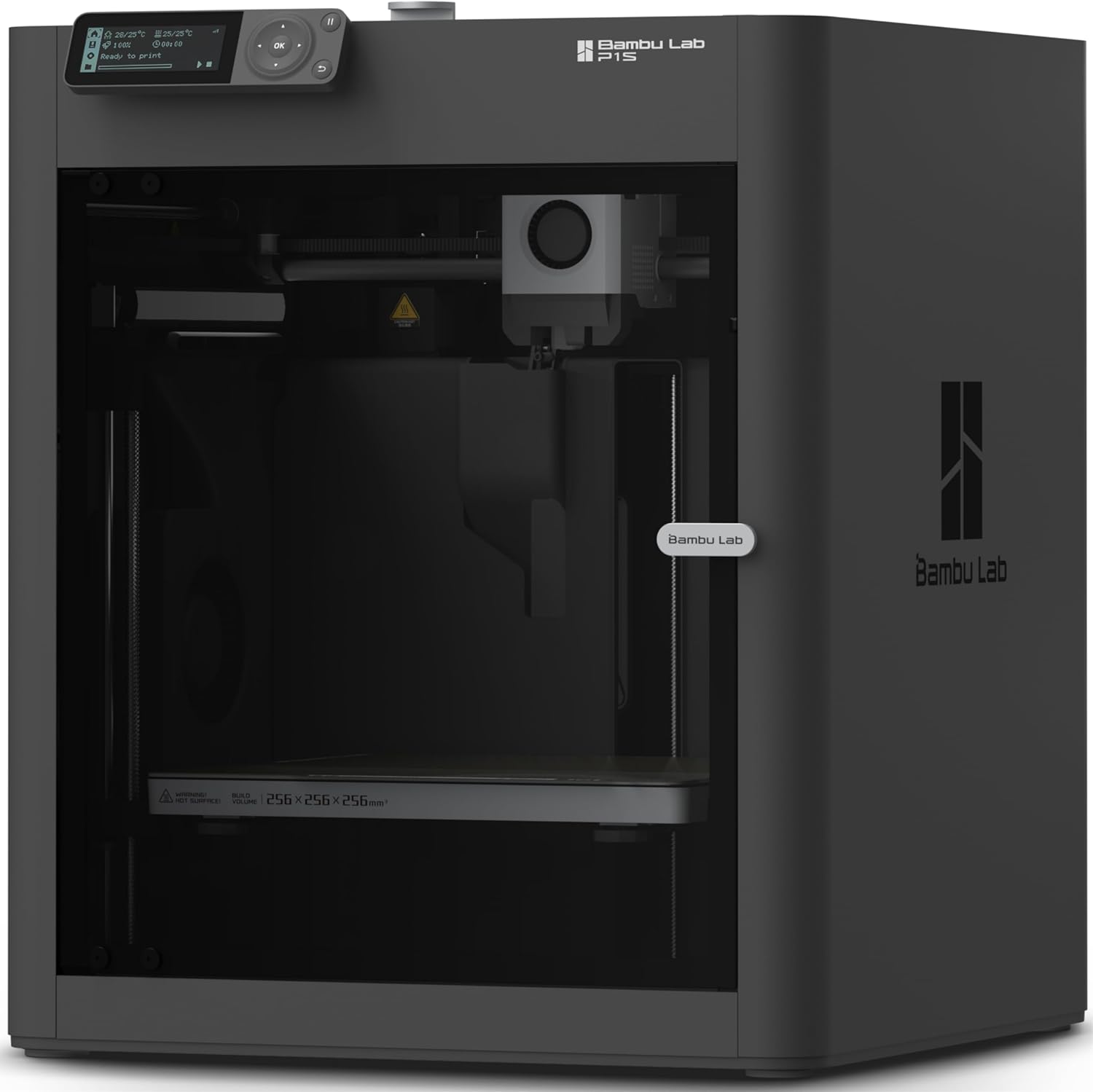
| Build Volume | 256×256×256 mm³ |
|---|---|
| Supported Filaments | PLA, PETG, TPU, PVA, PET, ABS, ASA (capable: PA, PC) |
| Max Speed | 500 mm/s |
| Max Acceleration | 20 m/s² |
The Bambu Lab P1S is a ready-to-use, enclosed CoreXY FDM printer aimed at making reliable, high-speed prints accessible to mainstream users. It ships with automatic bed leveling, a direct-drive extruder for broader filament compatibility, and an ecosystem that includes a MakerWorld model library and an on-board camera for time-lapse capture. The printer supports many common materials such as PLA, PETG, TPU, PVA, ABS and ASA and is built to print quickly with claimed top speeds and high acceleration for shorter print times. Practical benefits include the enclosed frame that stabilizes temperature for better results with advanced filaments, straightforward setup that the brand says can be done in about 15 minutes, and integrated software/online model access that reduces the learning curve. Limitations to note are that very abrasive fiber-filled filaments are not recommended and multi-color printing requires connecting Bambu Lab's AMS accessory, which is sold separately. For buyers who want fast, reliable prints without deep tuning, the P1S balances performance and ease of use well.
Best for: Buyers who prioritize reliable, fast prints with minimal setup and want a mostly turn-key desktop 3D printer backed by an approachable software and model ecosystem.
Less Ideal for: Users who require built-in multi-color/multi-material output without buying accessories or those who plan to print highly abrasive, fiber-reinforced filaments frequently.
- Enclosed CoreXY design improves thermal stability and print consistency
- Direct-drive extruder increases material compatibility including flexible filaments
- Automatic bed leveling simplifies setup and reduces failed prints
- On-board camera and MakerWorld library make monitoring and finding models easier
- Multi-color printing requires the optional AMS accessory sold separately
- Manufacturer advises against abrasive fiber-filled filaments
Verdict: Choose the P1S if you want a fast, enclosed, easy-to-use desktop 3D printer that delivers reliable results with common materials and minimal setup.
Choosing the Right 3D Printer: Key Factors to Consider
Print Accuracy and Resolution
Higher accuracy reduces post-processing and allows rapid validation of designs. Layer height, XY precision, and repeatability determine how closely a printed part matches CAD dimensions. For functional prototypes you will often inspect tolerances and mating features, so machines with finer resolution or proven calibration workflows cut rework and fit issues.
Accuracy also interacts with material choice. Some filaments and resins print more precisely than others, so choose a machine whose mechanical precision matches the materials you plan to use. Calibration tools, bed leveling, and motion-system stiffness all influence real-world accuracy.
Build Volume and Scalability
Build volume defines the maximum single-part size and how many parts you can nest per run. A larger build chamber lets you print bigger prototypes or multiple components in one job, improving throughput for small production runs.
Consider the physical footprint and whether the machine can be scaled with modular add-ons or multiple units. If your workflow demands larger parts only occasionally, flexible packing strategies and part segmentation are also relevant.
Material Compatibility
Material support affects part strength, thermal resistance, and surface finish. The under $15,000 category can include machines capable of printing engineering plastics and specialty resins, which are necessary for functional testing or end-use prototypes.
Check whether the machine supports the specific filaments or resins you need, including high-temp thermoplastics, composite-filled filaments, or UV-cure resins. Consider heated build chambers, extrusion temperatures, and post-curing requirements when evaluating real-world material flexibility.
Reliability and Uptime
Uptime is critical when printers are used for iterative prototyping or low-volume manufacturing. A reliable machine minimizes failed prints, reduces supervision time, and keeps development schedules on track. Look for robust mechanical components, proven duty cycles, and stable motion systems.
Also evaluate common failure modes and how easy it is to recover a failed job. Features like power-loss recovery, filament runout detection, and remote monitoring can materially increase effective uptime in busy work environments.
Ease of Maintenance and Serviceability
Routine maintenance frequency and the simplicity of service procedures affect long-term operating cost. Accessible hot ends, modular extruders, and user-replaceable wear parts reduce downtime and the need for specialized technicians.
Availability of replacement parts, clear documentation, and straightforward calibration procedures help keep a machine productive. Consider whether routine tasks such as nozzle changes, belt tensioning, or resin vat swaps are manageable for your team.
Workflow and Software Integration
A 3D Printer must fit into your existing design and production workflow. Slicing software quality, file format support, print farm management, and network connectivity determine how smoothly jobs move from CAD to finished part.
Good software saves time by simplifying part orientation, support generation, and print parameter management. Compatibility with common file formats and ease of integrating multiple machines into a queue are important when you scale beyond a single unit.
Choosing Between FDM and Resin Technologies
FDM and resin-based technologies have distinct strengths. FDM is often preferred for durable thermoplastic prototypes and larger parts, while resin printers excel at surface detail and small features. Match the process to the end-use: functional, load-bearing parts tend to favor filament-based machines, whereas high-detail visual models usually print better in resin.
Also consider post-processing. Resin parts typically require washing and curing steps, which add bench time and require additional equipment. Larger FDM parts may need support removal and surface finishing. Factor in the full workflow when deciding which technology will be most efficient for your shop.
- FDM: good for strength, larger volumes, and engineering filaments
- Resin: better for fine detail, small features, and smooth surfaces
- Post-processing needs differ substantially between technologies
Setting Up for Consistent Results
A consistent setup reduces variation between runs. Invest time in proper leveling, tensioning, and calibration during initial installation. Verify temperature stability and environmental controls, especially for sensitive materials that react to humidity or drafts.
Establish standard operating procedures for slicing profiles, support strategies, and part orientation. Consistent file preparation often yields bigger gains in repeatability than incremental hardware changes.
- Create and store proven slicing profiles for common materials
- Document calibration steps and maintenance schedules
- Control ambient temperature and humidity where possible
Scaling Production with Multiple Units
When single-machine throughput is insufficient, adding identical units can be more predictable than relying on one large machine. Multiple smaller printers allow parallel jobs and reduce the impact of a single unit failure on total output.
Ensure networked management or print-farm software to coordinate jobs, distribute files, and monitor status. Consider floor space, power, and tooling needs as you plan to scale.
- Parallelization reduces single-point failure risk
- Uniform machines simplify maintenance and spare parts inventory
- Print-farm software streamlines job distribution and monitoring
Material Handling and Safety
Higher-temperature filaments and photopolymer resins require specific handling and safety practices. For thermoplastics, ensure proper ventilation and safe storage for dry conditions. For resins, provide PPE, containment for spills, and designated curing stations.
Plan for consumable storage, waste disposal, and any post-processing chemicals. Safe, repeatable material handling protects parts quality and reduces risk to staff.
- Store filaments in dry, sealed containers with desiccant
- Use gloves and eye protection when handling resins
- Provide proper ventilation for higher-temp or odorous materials
Optimizing for Time-to-Part
Time-to-part depends on print speed, the number of nested parts per build, and post-processing. Choose machines whose mechanical design and extrusion systems deliver reliable higher-speed performance for the materials you will use most often.
Also examine how easily parts can be removed and finished. Faster machines that produce prints requiring extensive cleanup may not actually reduce end-to-end lead time.
- Balance print speed with required surface quality
- Optimize nesting to maximize build volume usage
- Factor post-processing time into total lead-time estimates
How We Chose the Best 3D Printer
We focused on practical, measurable factors buyers use when selecting a 3D Printer in the under $15,000 segment. Primary filters were build volume and dimensional accuracy, because buyers in this price bracket need machines that produce usable, repeatable parts. We also prioritized reliability and uptime data, selecting machines with proven duty cycles or professional-grade components to limit downtime. Material compatibility was another key criterion, emphasizing machines able to process engineering filaments or resins suited to functional prototypes. Ease of maintenance and parts availability were evaluated to estimate lifecycle cost and minimize service interruptions. Finally, we considered workflow features such as slicing/software ecosystem and connectivity because they materially affect day-to-day productivity. We excluded entry-level hobby printers and fully industrial systems outside the budget cap. Machines lacking basic documentation or service support were not considered. The shortlist reflects platforms that meet minimum standards across the measurable dimensions above rather than marketing claims.
Our full evaluation process is outlined in our review methodology.
FAQ
What build volume do I need for prototyping?
It depends on the largest single part you expect to print. If you commonly print full-size prototypes, choose a printer with a chamber slightly larger than your biggest part. For small batches, multiple smaller printers can be more efficient than one very large machine.
Can machines under $15,000 print engineering-grade materials?
Often they can. Many midrange machines support higher-temperature extruders and heated chambers suitable for engineering plastics. Verify the specific temperature limits and chamber requirements for the materials you intend to use.
How much maintenance should I expect?
Routine tasks like nozzle changes, bed leveling, and lubrication are common. Frequency depends on usage intensity and material abrasiveness. Machines designed with modular components reduce downtime by making these tasks faster and easier.
Is post-processing time included in print estimates?
No, printing time is just one part of the workflow. Washing, curing, support removal, sanding, or annealing can add significant time to each part. Plan for post-processing when estimating total lead times.
How do I improve first-layer adhesion?
Start with a clean build surface, correct bed leveling, and an appropriate nozzle-to-bed gap. Use recommended bed temperatures and adhesion aids when necessary. Material-specific surface prep and slow initial layers also help ensure consistent adhesion.
Final Verdict
When shopping for a 3D Printer under $15,000, prioritize the dimensions that will impact your workflow most: print accuracy, usable build volume, and reliable material support. Decide whether detail or strength matters more to your parts and match technology accordingly. Expect tradeoffs between speed, surface finish, and maintenance needs. Focus on machines with documented uptime, accessible serviceability, and software that fits your workflow. With those priorities in mind you can pick a midrange printer that delivers consistent parts and predictable operating costs for prototyping or low-volume production.