
Note: This article contains affiliate links. If you click on these links and make a purchase, we may earn a small commission at no extra cost to you. This helps support our research and content. Read our full affiliate disclosure here.
Picking the right 3D printer under $4,000 matters because at this price range you expect industrial-grade tolerances, broader material support, and lower maintenance overhead. Whether you build functional prototypes, small production runs, or high-detail design pieces, a well-chosen machine changes how fast and accurately you can move from concept to finished part. This guide shortlists the top options in this budget tier and explains the practical tradeoffs buyers face. We evaluated machines for accuracy, material flexibility, reliability, and operating costs so you can focus on the capabilities that map to your projects. Read on for the highlights and the criteria we used to pick these top contenders.
Top Picks at a Glance
| Best Overall The best all-around choice for most situations | Original Prusa MK4S |  |
| Best Quality Built to a higher standard if you want something more solid | Snapmaker U1 3D Printer |  |
| Best Value The sweet spot between price and what you get | Bambu Lab A1 Combo |  |
| Best Budget The cheapest option that still gets the job done reliably | TANGXI Mini FDM 3D Printer |  |
| Top Rated A top-rated pick with lots of positive feedback | QIDI Max4 Combo |  |
| Most Popular A crowd favorite that many people choose with confidence | Creality Ender 3 V3 SE |  |
| Best Seller A high-volume bestseller chosen again and again | Bambu Lab P1S 3D Printer |  |
Original Prusa MK4S

| Print volume | 9.84 x 8.3 x 8.6 in |
|---|---|
| Included filament | 1 kg Prusament PLA |
| Print technology | FDM |
| Features | Input shaping, open-source upgradeable |
The Prusa MK4S is a ready-to-run desktop FDM printer aimed at makers and small shops that need dependable, high-quality prints without a long setup. It prints at relatively high speed while using input shaping to cut ringing and vibration, which improves edge sharpness on detailed parts. The unit ships fully assembled and includes a 1 kg spool of Prusament PLA so you can start printing immediately, and Prusa's ecosystem and firmware support make future upgrades straightforward. Its build volume suits small production runs and prototyping, and the machine is engineered for day-to-day reliability in studios or workshops. Expect excellent surface finish and dimensional accuracy for typical engineering plastics, but note the platform is a single-machine desktop system so very large parts or high-throughput manufacturing will still need multiple units or larger-format equipment. The MK4S balances speed, print quality, and practical usability for buyers wanting a long-lived, serviceable printer.
Best for: Buyers who want a dependable, ready-to-run desktop printer that delivers a balance of speed, surface quality, and upgradeable firmware for hobbyist pros and small-scale production.
Less Ideal for: Teams needing a large-format printer for single-piece production or manufacturers requiring industrial-scale throughput should consider larger or multi-machine solutions.
- Fully assembled out of the box with included 1 kg Prusament PLA for quick start
- Input shaping reduces ringing for cleaner edges at higher print speeds
- Designed for reliable day-to-day operation suitable for studio and light production use
- Open-source firmware and upgrade paths support long-term improvements and community mods
- Build volume is limited to desktop-sized parts, not suited for very large prints
- Higher-end production environments may require multiple machines for true throughput scaling
Verdict: The MK4S is the go-to choice for buyers seeking a dependable, high-quality desktop 3D printer that balances speed and finish with long-term upgradeability.
Snapmaker U1 3D Printer

| Build volume | 270 x 270 x 270 mm |
|---|---|
| Max speed | 500 mm/s |
| Toolheads | 4 independent heads with SnapSwap |
| Compatible materials | PLA, PVA, TPU, PETG, ABS, ASA, PA, PC |
The Snapmaker U1 is built around its SnapSwap four-toolhead system, which holds four preloaded, preheated extruders that the machine swaps in about five seconds to print multiple colors and materials with minimal purging. It uses a rigid CoreXY motion system and carbon-fiber X-axis rails to reach high speeds—up to 500 mm/s—while the automatic toolhead offset calibration, vibration compensation, and tuned extrusion aim to preserve dimensional accuracy. In practice the U1 shines on complex multi-color or mixed-material jobs where you would otherwise spend time and filament purging between filaments; the firm kinematic locks simplify head changes and are rated for heavy use. The printer is also friendlier to beginners than many pro machines thanks to a model library, Orca slicer integration, a touchscreen, automatic filament management, and remote app monitoring. Expect strong material flexibility—PLA, PETG, TPU, PVA, ABS and engineering filaments—but note the system is a larger, heavier desktop machine and its advanced features add complexity compared with single-extruder printers. The U1 is aimed at users who need speed, multi-material capability, and reliable tool changes rather than the simplest possible setup.
Best for: Buyers who prioritize high-speed, production-capable multi-color or mixed-material printing and want a machine that reduces scrap and downtime during complex jobs.
Less Ideal for: Casual hobbyists who need a very small, lightweight, or ultra-simple single-extruder printer for occasional use should consider simpler alternatives.
- True multi-color/multi-material printing with four preheated toolheads that switch in about five seconds
- Significant reduction in filament purge waste compared with filament-change systems
- High-speed CoreXY motion (up to 500 mm/s) for faster print throughput
- Automatic calibration and vibration compensation that reduce manual tuning and improve first-layer reliability
- Large and relatively heavy desktop footprint compared with compact hobby printers
- Advanced toolchanger and motion hardware add system complexity that may require learning time
Verdict: Choose the U1 when you need fast, production-style multi-color and mixed-material prints with minimal waste and reliable automatic tool changes.
Bambu Lab A1 Combo

| Build volume | 256×256×256 mm |
|---|---|
| Supported filaments | PLA, PETG, TPU, PVA |
| Max speed | 500 mm/s |
| Max acceleration | 10 m/s² |
The Bambu Lab A1 Combo is a fast, user-friendly FDM printer aimed at makers who want high throughput without constant tweaking. It supports multi-color printing via the AMS lite module, and the bundle here includes an LED lamp kit for printable light projects. The printer automates common setup tasks with full-auto calibration for Z-offset, bed-level, resonance, and nozzle pressure, while sensors and an active flow-rate compensation system help deliver consistent layers at high speeds. A 256×256×256 mm build volume gives room for larger parts and the touchscreen plus Bambu Cloud or LAN-only control makes job management straightforward. Practical benefits include rapid printing, quieter operation thanks to motor noise canceling, and a one-clip quick-swap nozzle that simplifies maintenance. Limitations to note are that multi-color capability requires the AMS lite module and advanced multi-material workflows may need some experimentation; also the open-frame design offers less thermal isolation than enclosed printers for high-temperature materials. Expect a polished, speed-focused desktop printer that favors PLA/PETG-style workflows.
Best for: Buyers who prioritize fast, reliable desktop production and want a printer that minimizes manual tuning while supporting color prints and larger single-part builds.
Less Ideal for: Users who need an enclosed, high-temperature-capable printer for ABS/engineering materials or those who plan complex multi-material engineering workflows out of the box.
- Full-auto calibration for hands-off setup and consistent first layers
- Supports reliable multi-color printing with AMS lite and RFID-synced filament profiles
- High-speed motion system with sensors and flow compensation for accurate, fast prints
- Generous 256×256×256 mm build volume for single-part prints and functional prototypes
- Quiet operation and a quick-swap nozzle that reduce maintenance hassle
- Multi-color printing requires purchasing or including the AMS lite module
- Open-frame design limits thermal control for high-temperature materials
Verdict: Choose the A1 Combo if you want a fast, low-maintenance desktop 3D printer that reliably delivers large, multicolor PLA/PETG prints.
TANGXI Mini FDM 3D Printer

| Build volume | 100 x 100 x 100 mm |
|---|---|
| Filament diameter | 1.75 mm |
| Supported materials | PLA, TPU |
| Nozzle | All-metal nozzle |
| Layer resolution | Up to 0.05 mm |
This compact TANGXI Mini FDM 3D printer is a beginner-oriented, fully assembled machine with a 100 x 100 x 100 mm build area that prints 1.75 mm PLA and TPU. It uses an all-metal nozzle and claims layer resolution down to 0.05 mm, which helps produce relatively detailed small models for its size. Setup is simple: copy G-code to the included memory card, insert it, and control printing with basic + and – keys, so no slicing experience is strictly required to start. The nozzle heats quickly, reaching about 180°C in roughly five minutes, reducing wait time between prints. Its ABS shell feels sturdy for desktop use and the unit is compact enough for a desk, classroom, or hobby bench. Expect limitations typical of tiny printers: small build volume restricts larger projects, and advanced features like touchscreen slicing, heated bed leveling, or network printing are not present. For first-time users or anyone who wants a low-cost, plug-and-play way to learn 3D printing basics and print small prototypes, it is a practical entry-level choice.
Best for: Buyers on a tight budget who want a low-friction, entry-level machine to learn 3D printing and produce small PLA or TPU models for education or hobby projects.
Less Ideal for: Users who need to print larger parts, require advanced workflow features, or expect professional throughput for production use should consider a larger, more feature-rich printer.
- Fully assembled and simple card-based operation for quick out-of-box use
- All-metal nozzle with reported 0.05 mm layer resolution for fine detail on small prints
- Fast nozzle warm-up (about 5 minutes to 180°C) to reduce downtime
- Compact, rugged ABS construction suitable for desktop, classroom, or makerspace
- Very small 100 x 100 x 100 mm build volume limits part size
- Lacks advanced features like network printing, touchscreen controls, or automated bed leveling
Verdict: A budget-friendly, fully assembled mini FDM printer that makes starting with PLA and TPU printing fast and easy for beginners.
QIDI Max4 Combo

| Build volume | 390×390×340 mm |
|---|---|
| Max hotend temperature | 370°C |
| Chamber temperature | ≤65℃ |
| Max toolhead speed | ≤800 mm/s |
| Supported materials | PLA, PETG, ABS, ASA, TPU, PA, PC, PPS-CF, carbon fiber composites |
The QIDI Max4 Combo is a professional-grade enclosed 3D printer built for large parts and demanding materials. It offers a 390×390×340 mm build volume and a full-surface silicone heated bed to improve first-layer adhesion and reduce warping when printing big models. The printer supports a 370°C hotend and a chamber heated up to 65°C, which together enable stable printing of engineering filaments like PC, Nylon, and carbon-fiber composites; a hardened steel nozzle and high-flow hotend also help with abrasive and high-viscosity materials. Motion hardware includes closed-loop motors on X/Y, dual Z lead screws, and CoreXY-style mechanics for stiffness and repeatable positioning, and the tool head is rated to move up to 800 mm/s for high-speed jobs when settings and materials allow. Practical touches such as an AI camera for print-failure detection, a large touch screen, and multiple networking options (Wi-Fi, Ethernet, cloud, USB) make monitoring and control straightforward. The Polar Cooler accessory is sold separately, and real-world top speeds and throughput will depend on material, nozzle size, and tuning, so expect slower throughput for high-temperature composites despite the hardware headroom.
Best for: Buyers who prioritize a reliable, industrial-capable machine for large-format prints and want hardware designed to handle engineering filaments with stable chamber temperature control and robust motion components.
Less Ideal for: Casual makers or first-time buyers who only print small PLA parts and prefer a simpler, lower-cost desktop printer without advanced high-temperature or large-format features.
- Very large 390×390×340 mm build volume suitable for big parts and single-piece prototypes
- 370°C hotend plus 65°C heated chamber allow printing engineering and carbon-fiber reinforced materials
- Closed-loop X/Y motors and dual Z lead screws provide stable, repeatable motion for higher precision
- AI camera and large touchscreen simplify monitoring and intervention during long prints
- Multiple connectivity options including 2.4/5GHz Wi‑Fi, Ethernet, cloud, and USB for flexible workflow
- Polar Cooler is not included and must be purchased separately for the advertised cleaner-air cooling system
- Maximum toolhead speed ratings are optimistic; actual high-speed printing depends heavily on material, nozzle, and tuning
Verdict: Choose the QIDI Max4 Combo if you need a large, reliable enclosed printer that can consistently handle engineering filaments and long production prints.
Creality Ender 3 V3 SE

| Printing speed | Up to 250 mm/s |
|---|---|
| Extruder type | Sprite direct extruder |
| Electronics | 32-bit silent mainboard |
| Bed surface | PC spring steel build plate |
The Creality Ender 3 V3 SE is an entry-to-mid-level FDM printer built for fast, straightforward printing. It can reach up to 250 mm/s with high acceleration, and its Sprite direct extruder handles common materials like PLA, PETG, and TPU with smooth feeding. Assembly is simple — advertised as a three-step setup — and CR Touch plus a strain sensor provide auto-leveling and Z-offset so getting a good first layer is easier for newcomers. The machine uses a dual Z-axis with synchronized belts and a reinforced Y-axis for steadier motion, while a 32-bit silent mainboard reduces noise during prints. Practical conveniences include one-tap filament load/unload and a flexible spring steel build plate for easier part removal. Limitations to note are that very high-speed settings may still require tuning to preserve fine detail, and its build volume is modest compared with larger desktop models, so it is best for small- to medium-sized parts rather than large-format prints.
Best for: Buyers who want a fast, easy-to-start desktop 3D printer with reliable filament handling and helpful automated leveling, and who value social proof from a widely used Creality platform.
Less Ideal for: Those needing large-format printing or professional-grade dimensional accuracy for industrial parts should consider larger or more specialized machines.
- Fast maximum print speed and high acceleration for quicker job turnaround
- Sprite direct extruder supports flexible and common filaments reliably
- Auto-leveling with CR Touch and strain sensor simplifies first-layer setup
- Dual Z-axis and reinforced Y-axis improve vertical stability and print quality
- 32-bit silent mainboard reduces operating noise and provides smoother motion control
- Modest build volume limits larger prints
- High-speed printing may require calibration to maintain fine detail
Verdict: A speedy, user-friendly desktop printer with a proven direct extruder and auto-leveling that is ideal for faster small-to-medium prints under $4,000.
Bambu Lab P1S 3D Printer
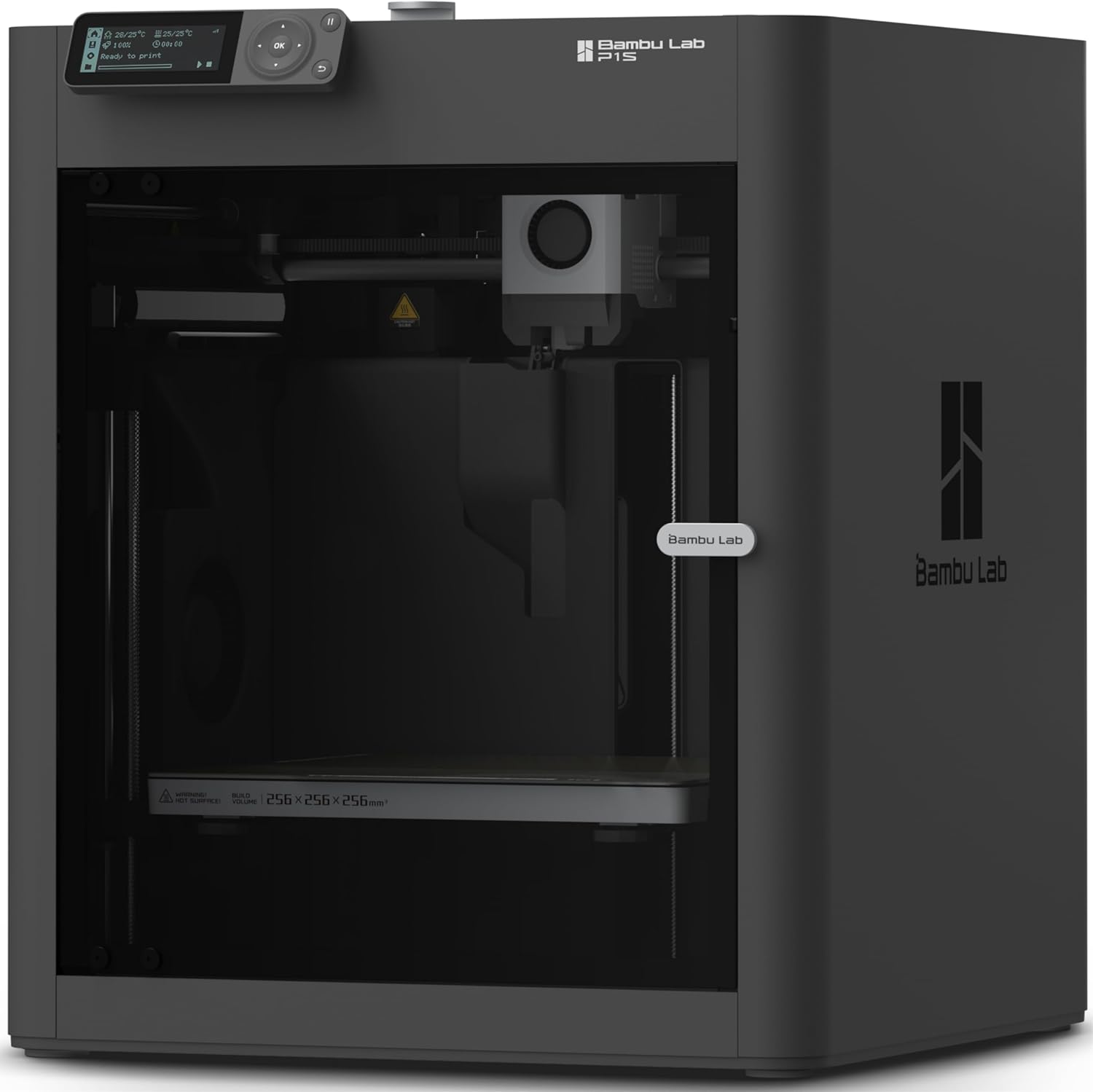
| Build Volume | 256×256×256 mm³ |
|---|---|
| Max Speed | 500 mm/s |
| Max Acceleration | 20 m/s² |
| Supported Filaments | PLA, PETG, TPU, PVA, PET, ABS, ASA |
The Bambu Lab P1S is an enclosed CoreXY FDM printer designed to get reliable prints quickly with minimal setup. It ships ready-to-use and advertises a 15-minute setup, automatic bed leveling, and a factory-friendly interface tied to Bambu Lab's MakerWorld model library, which helps risk-averse users avoid common first-print problems. The P1S supports a wide range of filaments including PLA, PETG, TPU, PVA, ABS and ASA and uses a direct-drive extruder for better handling of flexible materials. Performance specs claim very high speeds (up to 500 mm/s) and high acceleration, so typical use ranges from fast prototyping to detailed hobby parts; the enclosed body also improves consistent results with heat-sensitive filaments. Notable extras include a camera for time-lapse captures and compatibility with the AMS multi-color feeder for up to 16-color workflows. The trade-offs are that extreme speeds may require tuning for best surface finish and advanced composites like carbon- or glass-filled filaments are not recommended, so users targeting industrial composite prints should look elsewhere.
Best for: A buyer who wants a low-friction entry into reliable, fast desktop 3D printing with easy setup and strong ecosystem support for everyday prototyping and hobby projects.
Less Ideal for: Professionals needing a dedicated composite or industrial materials workflow or users who prioritize maximum surface finish without any tuning.
- Enclosed CoreXY design for more stable temperature control and improved print consistency
- Fast motion specs (up to 500 mm/s and high acceleration) for rapid prototyping
- Automatic bed leveling and quick setup reduce initial calibration time
- Direct-drive extruder expands material compatibility, including flexible filaments
- Access to MakerWorld model library simplifies finding and starting prints
- Not recommended for carbon or glass fiber reinforced filaments
- Achieving the best surface finish at top speeds may require extra tuning
Verdict: Pick the P1S if you want a fast, enclosed, beginner-friendly desktop 3D printer that delivers reliable results with minimal setup.
Choosing the Right 3D Printer: Key Factors to Consider
Print Accuracy and Repeatability
Accuracy determines how closely printed parts match CAD dimensions, which matters for fit, function, and post-processing. At this price point you should expect consistent layer registration, minimal Z wobble, and reliable extrusion control across long runs.
Repeatability is equally important when you produce multiple copies. Small deviations between prints add up in assemblies, so look for machines with rigid frames, quality linear motion systems, and proven calibration workflows to ensure outgoing parts meet tolerance needs.
Material Support and Extrusion Options
Different projects require different materials. Consider what filaments or resins the machine handles and whether it supports engineering materials such as nylon, polycarbonate, high-temperature resins, or composites reinforced with fibers.
Also evaluate hot end and extrusion technology, including direct drive versus Bowden systems, high-temp hot ends, and hardened nozzles. These influence how reliably the printer can process abrasive or high-temperature filaments and determine the finishing steps needed after printing.
Build Volume and Production Speed
Build volume affects part size and batch throughput. A larger envelope lets you print bigger prototypes or nest multiple parts for small production runs, but bigger volumes also increase material use and thermal-management demands.
Speed is a balance between mechanical capability and acceptable surface quality. Faster machines reduce turnaround but may produce more visible artifacts unless the motion system and slicing settings are tuned for high-speed precision.
Reliability, Maintenance, and Parts Availability
A machine that requires frequent adjustment or has scarce replacement parts will cost more over its lifetime. Consider how easy routine tasks are, such as leveling, nozzle changes, and belt replacement, plus whether spare parts and consumables are readily available.
Serviceability also includes access to documentation and community or vendor support channels. Machines designed with modular components often let you swap problem parts quickly and keep downtime low.
Software, Slicing, and Workflow Integration
Good software reduces prep time and avoids frustration. Assess whether the printer works with mainstream slicers and if vendor software provides reliable profiles, accurate previews, and advanced features like adaptive infill or variable layer heights.
Workflow integration covers connectivity options, print queuing, and support for networked or remote operation. Seamless file transfer and monitoring tools save time when running multiple prints or operating a small production setup.
Operating Cost and Consumables
Beyond the purchase price, factor in filament or resin cost, expected nozzle and bed replacement frequency, and any expendable accessories. Machines with higher deposition rates or larger build volumes will use more material and may raise per-part costs.
Consider energy use for heated beds or chambers and whether specialized consumables add significant recurring expense. Lower operating costs help justify a higher upfront investment when you plan frequent use.
Choosing the Right Print Technology
Layering methods vary by output needs. Fused deposition modeling is common for strong thermoplastic parts and offers a wide material palette. Vat photopolymerization typically produces higher detail and smoother surfaces, which is useful for fine jewelry prototypes and dental models.
When selecting technology, match the method to your end use. Functional parts that need toughness and temperature resistance generally favor extrusion-based machines, while detailed visual models often benefit from resin processes.
- Extrusion: better for durable mechanical parts and larger models
- Resin: best for high-detail and smooth surface finishes
- Consider post-processing needs like curing, support removal, or annealing
Thermal Management and Enclosure Importance
Stable thermal conditions reduce warping and layer delamination, especially with engineering plastics. Enclosures help maintain an even ambient temperature around the part and can be essential for high-temperature materials.
Look for machines with controlled chambers or add-on enclosures and heated beds that reach temperatures compatible with your chosen materials. Proper ventilation and filtration are also important when printing materials that emit fumes.
- Enclosures improve dimensional stability for large or high-temp prints
- Heated beds and chambers expand material options
- Filtration helps when printing resins or high-temp filaments
Calibration, Sensors, and Automation Features
Automated bed leveling, filament runout detection, and nozzle crash protection reduce failed prints and the need for constant supervision. Sensors that detect first-layer adhesion issues or flow problems can save hours of rework.
While manual calibration can work, automation improves throughput and reduces the skill needed to get reliable results. Consider which automated features are essential for your workflow and which are nice-to-have.
- Auto bed leveling improves first-layer success rates
- Filament sensors prevent mid-print failures
- Power-loss recovery protects long prints from interruption
Post-Processing and Finishing Workflow
Post-processing needs vary with material and technology. Resin parts require curing and often light sanding, while FDM parts may benefit from vapor smoothing, sanding, or annealing for improved mechanical properties.
Plan for the space, tools, and consumables required for finishing. Efficient post-processing workflows often determine how quickly a printed part becomes a usable prototype or end-use item.
- Resin curing stations and wash systems streamline SLA workflows
- Sanding, priming, and painting improve visual prototypes
- Annealing ovens can increase strength for certain thermoplastics
Safety and Workspace Considerations
Printing can introduce fumes, fine particles, and flammable materials. Ensure your workspace has appropriate ventilation, fire safety measures, and storage for consumables. Enclosures with filtration reduce airborne particulates and odors.
Also think about noise, power requirements, and physical footprint. Machines with high-temperature chambers may need dedicated circuits. Proper planning prevents surprises when integrating a printer into a shared workshop.
- Provide ventilation or air filtration for enclosed printing spaces
- Verify electrical requirements before installation
- Store materials safely to avoid contamination or degradation
How We Chose the Best 3D Printer
We started by filtering machines built for frequent, dependable use rather than hobbyist curiosities. Primary evaluation criteria were print accuracy and consistency, material compatibility, and build volume since those define whether a printer can handle professional prototypes or short-run parts. We also considered reliability and serviceability, measuring how easily routine maintenance and common repairs are performed, plus available documentation and user-accessible parts. Operating cost was assessed from expected consumable usage and common replacement items. Finally, software and workflow mattered: we looked for printers with stable slicing support and features that reduce manual print prep. Excluded from consideration were machines clearly intended only for occasional hobby use, lone experimental rigs without community or vendor support, and units lacking basic safety or enclosure options expected at this price tier. The result is a curated list emphasizing machines that balance precision, material range, and predictable running costs for professional or serious maker workflows. The scoring criteria reflect these priorities and guided our editorial choices.
Our full evaluation process is outlined in our review methodology.
FAQ
Which 3D printing technology is best for functional prototypes?
It depends on the mechanical properties required. Extrusion-based printers generally produce tougher, more heat-resistant parts suitable for functional prototypes, while resin processes deliver finer detail but may have different strength and heat characteristics.
How important is enclosure for printing engineering plastics?
Enclosures are often essential for high-temperature materials because they keep ambient temperature stable and reduce warping. For many engineering thermoplastics, a heated chamber greatly improves print success.
Can I use composite or abrasive filaments in a midrange machine?
Some machines in this price tier support abrasive or fiber-filled filaments if they offer hardened nozzles and robust extrusion systems. Check for hardened toolheads and vendor guidance on nozzle types before running abrasive materials.
What maintenance should I plan for regular prints?
Expect routine tasks like nozzle cleaning, periodic belt tension checks, replacement of wear items such as nozzle tips and build-surface materials, and occasional calibration. The frequency depends on print volume and material abrasiveness.
How do I estimate operating costs per part?
Estimate material weight for the part, multiply by filament or resin cost per unit weight, and add proportional costs for expendables like nozzles and build surfaces. Energy use and post-processing consumables should also be included for a fuller picture.
Is software compatibility a major constraint?
Software matters because reliable slicer profiles and easy workflow reduce setup time and failed prints. Many machines work with common slicers, but verify that vendor profiles exist or that the machine accepts open profiles for better control.
Final Verdict
When shopping for a 3D printer under $4,000, prioritize the capabilities that match your most common projects. If you need repeatable, load-bearing parts, emphasize dimensional accuracy, chamber temperature control, and robust extrusion hardware. If detail and surface finish are primary, look for technologies and workflows that minimize post-processing. Balance build volume, material options, and expected operating costs against the automation and serviceability you will need. Choosing a machine aligned with these tradeoffs makes it easier to deliver reliable prototypes and short production runs without unexpected downtime.