
Note: This article contains affiliate links. If you click on these links and make a purchase, we may earn a small commission at no extra cost to you. This helps support our research and content. Read our full affiliate disclosure here.
Picking the right 3D printer for home use matters because desktop printers vary widely in reliability, ease of setup, and the quality of finished parts. For hobbyists, makers, and small-project users, a good sub-$500 machine can produce functional prototypes, replacement parts, and creative objects without consuming your entire weekend in troubleshooting. This guide shortlists the best options in that budget range and focuses on factors that affect everyday use like print quality, reliability, and user experience. Below you will find concise evaluations of top picks and an explanation of the criteria used to select them, so you can match a machine to your typical projects and skill level.
Top Picks at a Glance
| Best Overall The best all-around choice for most situations | ELEGOO Neptune 3 Pro |  |
| Best Quality Built to a higher standard if you want something more solid | Bambu Lab P1S 3D Printer |  |
| Best Value The sweet spot between price and what you get | Creality K1C 3D Printer K1C |  |
| Best Budget The cheapest option that still gets the job done reliably | XZN Mini 3D Printer |  |
| Top Rated A top-rated pick with lots of positive feedback | Creality Ender 3 V3 SE |  |
| Most Popular A crowd favorite that many people choose with confidence | FLASHFORGE Adventurer 5M |  |
| Best Seller A high-volume bestseller chosen again and again | Bambu Lab A1 Combo |  |
ELEGOO Neptune 3 Pro

| Build volume | 225×225×280 mm |
|---|---|
| Noise level | 47 dB |
| Supported filament diameter | 1.75 mm |
| Extruder type | Dual-gear direct drive |
The ELEGOO Neptune 3 Pro is a ready-to-print desktop FDM machine aimed at home users who want reliable, everyday printing without a steep learning curve. It ships with partially preassembled main parts and a toolkit so you can start prints quickly, and the 225 × 225 × 280 mm build volume handles typical hobby projects, miniatures, and functional prototypes. Notable hardware includes a dual-gear direct drive extruder for consistent filament feeding, a titanium throat with brass nozzle and widened heat sink to reduce clogs, and a front cooling fan to improve layer cooling. The 36-point one-click auto bed leveling, filament runout sensor, and power-loss resume make longer prints less nerve-wracking, while the PEI flexible magnetic build plate eases part removal. Motion is driven by an STM32 board, silent stepper motors, and dual Z lead screws for steady, accurate layers at low noise. Downsides are that advanced users may want a larger build volume or fully enclosed chamber for high-temperature materials, and occasional tuning is still required to dial in quality for tricky filaments.
Best for: A balanced home hobbyist who wants a near-out-of-the-box printer that handles common filaments reliably and minimizes failed prints without needing extensive upgrades.
Less Ideal for: Users who need very large build capacity, frequent high-temperature or industrial materials, or a fully enclosed printer for strict temperature control should look elsewhere.
- Quick setup with preassembled main parts and included toolkit
- Dual-gear direct drive extruder for consistent filament feeding and fewer clogs
- 36-point auto bed leveling, filament detection, and resume-after-power-loss reduce failed prints
- PEI magnetic flexible build plate makes part removal easier
- Quiet stepper motors and dual Z lead screws deliver stable, low-noise prints
- Not fully enclosed so printing high-temperature filaments may be challenging
- Build volume is mid-size and may limit very large projects
Verdict: A feature-rich, easy-to-start desktop FDM printer that reliably handles everyday home projects while minimizing print failures.
Bambu Lab P1S 3D Printer
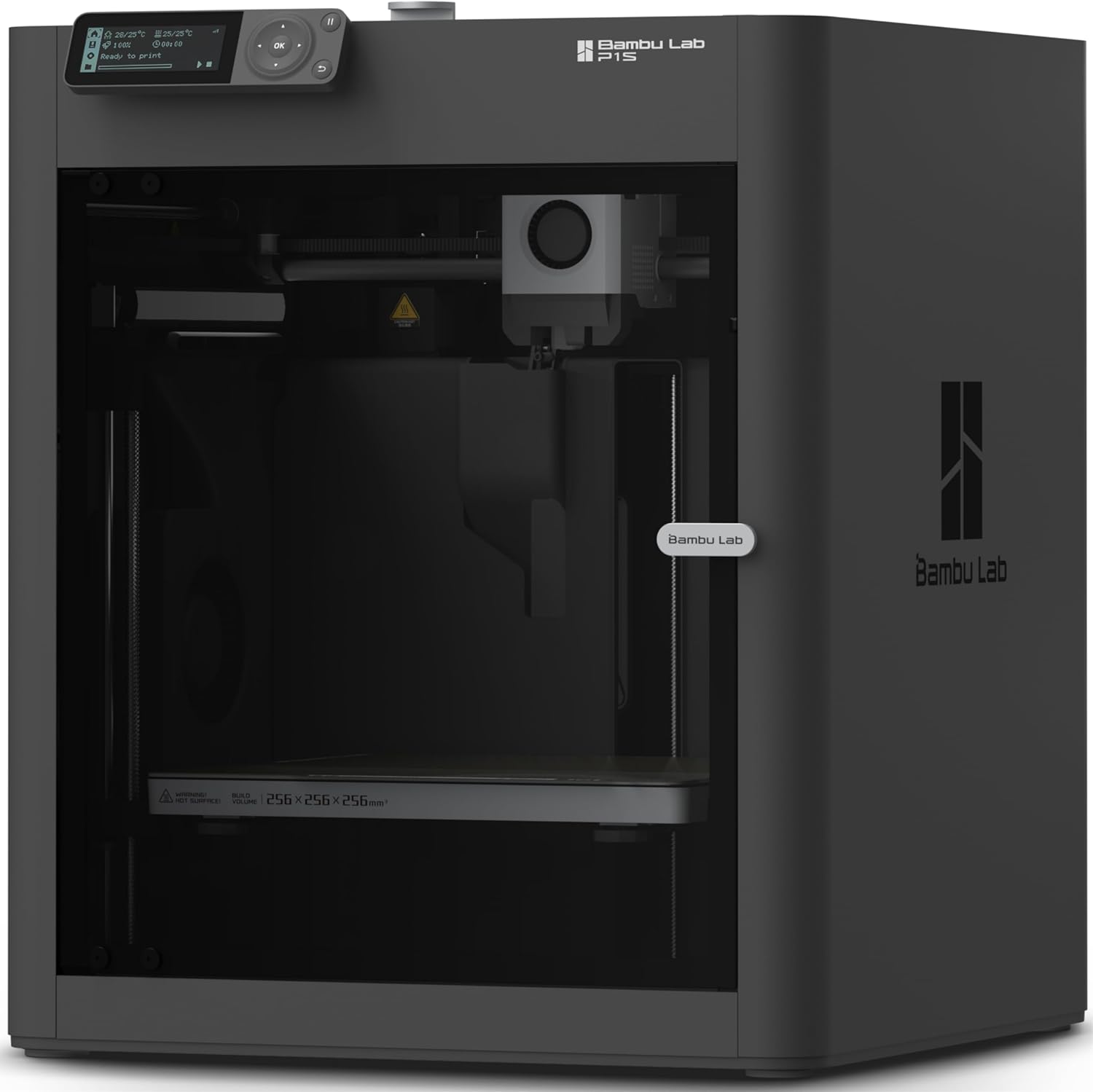
| Build Volume | 256×256×256 mm³ |
|---|---|
| Max Speed | 500 mm/s |
| Max Acceleration | 20 m/s² |
| Supported Filaments | PLA, PETG, TPU, PVA, PET, ABS, ASA (capable: PA, PC) |
The Bambu Lab P1S is a ready-to-use enclosed CoreXY FDM printer that targets users who want high-speed, accurate prints without a long setup process. It ships with automatic bed leveling, a direct-drive extruder that widens compatible filament options, and a built-in camera for time-lapses, all wrapped in an enclosed chassis that helps when printing more temperature-sensitive materials. The P1S claims true high speeds with up to 500 mm/s travel and very high acceleration, which noticeably reduces print times on medium-sized parts while retaining fine detail when tuned. Setup is straightforward and makers can pull models from the MakerWorld library, so novices can start printing quickly and experienced users can push speed settings. Limitations include a build volume suited to small to medium prints and the manufacturer advising against carbon or glass-filled materials, so heavy engineering composites are not a fit. For the intended home and hobby use, the P1S balances fast throughput and good print quality in an accessible package.
Best for: Someone who prioritizes print speed and precision at home and wants a mostly plug-and-play machine that can handle a wide range of common filaments while minimizing setup time.
Less Ideal for: Users who need large-format printing capacity or who plan to regularly print with abrasive, fiber-reinforced engineering filaments should look at larger or more specialized machines.
- Very high travel speed and acceleration for much faster print times
- Enclosed CoreXY design improves stability and helps print temperature-sensitive filaments
- Automatic bed leveling simplifies setup and reduces failed prints
- Direct-drive extruder increases reliable printing with flexible and varied filaments
- Built-in camera and access to MakerWorld model library for easy printing and time-lapse capture
- Build volume is limited to small-to-medium parts compared with larger-format printers
- Not recommended for carbon or glass fiber reinforced filaments
Verdict: Choose the P1S if you want a fast, enclosed CoreXY printer that delivers high-speed, high-precision prints with minimal setup for home use.
Creality K1C 3D Printer K1C

| Printing speed | 600 mm/s (max) |
|---|---|
| Supported filaments | PLA, ASA, ABS, TPU, PLA-CF, PET-CF |
| Max nozzle temperature | 300 ℃ |
| Build volume | 8.66 x 8.66 x 9.84 inch |
The Creality K1C is a ready-to-run desktop 3D printer aimed at speed and convenience for home users. It arrives mostly assembled and boots with a smartphone-style guide so you can be printing within minutes; auto Z-offset, auto bed leveling and input-shaping reduce fiddling. The machine emphasizes high throughput with up to 600 mm/s rated speed and high acceleration for rapid prints, while an upgraded direct extruder (steel-tipped copper nozzle and titanium-alloy heat break) supports higher-temperature filaments including carbon-fiber blends. Cooling is handled by dedicated hotend, part-cooling, and auxiliary fans to improve layer bonding and reduce stringing, and an onboard AI camera offers real-time monitoring and failure detection. Practical benefits include quick setup, compatibility with common filaments (PLA/ABS/TPU/ASA and PLA-CF/PET-CF), and features that reduce failed prints. Limitations to expect are the smaller build volume relative to larger hobby printers and that advertised top speeds are situational—high-quality detail prints still require slower settings and tuning.
Best for: Buyers who value a low-friction, fast-start 3D printer for prototyping, mods, and small to medium home projects and who prefer features that cut setup and troubleshooting time.
Less Ideal for: Users who need large-format printing capacity or who prioritize maximum fine-detail quality at top speed over fast turnarounds should consider other options.
- Mostly preassembled with guided setup for quick first prints
- Auto calibration (Z-offset and leveling) and input shaping reduce manual tuning
- Clog-free direct extruder and high-temp capable nozzle support carbon-fiber and common filaments
- Built-in AI camera enables real-time monitoring and time-lapse capture
- Multi-fan cooling architecture improves layer quality and reduces stringing
- Rated top speed is higher than typical practical print speeds for detailed parts
- Smaller build volume limits large projects
Verdict: Choose the K1C if you want a plug-and-play desktop printer that minimizes setup and failed prints while supporting fast, higher-temperature filament work.
XZN Mini 3D Printer

| Top speed | 250 mm/s |
|---|---|
| Precision | 0.01 mm |
| Includes | PLA filament and SD card |
| Bed | PEI heated bed |
This compact XZN mini 3D printer is a ready-to-run starter kit aimed at kids and first-time users, arriving fully assembled with a roll of PLA filament and an SD card. It prints at high speed up to 250 mm/s and claims fine precision to 0.01 mm, which shortens print times while keeping detail for small hobby parts and classroom projects. The machine emphasizes ease of use with one-button auto-leveling, one-touch filament loading, an automated nozzle cleaning routine, and a PEI heated bed that helps parts release cleanly. Practical benefits include minimal setup, a small footprint for a desk or classroom, and included accessories to get beginners printing quickly. Important limitations are the mini form factor, which restricts build volume compared with larger home printers, and the promotional precision figure may not match every filament or advanced print geometry. The maker also bundles basic support and a 12-month repair policy, which is helpful for first-time owners.
Best for: Buyers looking for an inexpensive, plug-and-play 3D printer for learning, classroom activities, or casual hobby printing who value ease of setup and quick results over large build capacity.
Less Ideal for: Enthusiasts who need large build volume, advanced tuning, or guaranteed industrial-grade tolerances should choose a larger, more configurable printer instead.
- Fully assembled kit with filament and SD card so beginners can start printing right away
- One-button auto-leveling and one-touch filament loading simplify setup and operation
- PEI heated bed and automatic nozzle cleaning improve first-layer adhesion and consistency
- High top speed (250 mm/s) reduces print times for small models
- Mini form factor limits maximum build volume for larger projects
- Manufacturer precision and top speed are ideal conditions and may vary by material and model complexity
Verdict: A budget-friendly, fully assembled starter 3D printer that gets kids and beginners printing quickly with minimal setup.
Creality Ender 3 V3 SE

| Item model number | Ender 3 V3 SE |
|---|---|
| Printing speed | Up to 250 mm/s |
| Extruder | Sprite direct extruder |
| Mainboard | 32-bit silent mainboard |
The Creality Ender 3 V3 SE is a user-friendly desktop FDM printer aimed at fast, consistent home prints. It ships as a mostly DIY kit that assembles in roughly 20 minutes and uses a CR Touch auto-leveling sensor and strain sensor for automatic Z offset, which simplifies first-layer setup for beginners and reduces time spent troubleshooting bed leveling. Print speed is advertised up to 250 mm/s with high acceleration while retaining acceptable quality for hobby projects and functional parts. The Sprite direct extruder handles PLA, PETG, and flexible filaments reliably, and the dual Z-axis plus dual Y linear shafts give the gantry extra stability for taller or detailed prints. Practical touches include a PC spring steel build plate for easy part removal and one-touch filament load/unload. The 32-bit silent mainboard cuts operational noise and improves motion precision. Expect good reliability for routine home use, though extreme high-speed printing will still require tuning and some users may prefer larger build volumes or fully enclosed printers for ABS or very large parts.
Best for: Home makers and hobbyists who prioritize a reliable, easy-to-start printer that minimizes bed-leveling hassle and handles common filaments for everyday projects.
Less Ideal for: Users who need a very large build volume, full enclosure for high-temperature materials, or plug-and-play industrial throughput.
- CR Touch auto-leveling and strain sensor simplify first-layer setup and reduce manual calibration
- Sprite direct extruder supports PLA, PETG, and TPU for versatile material use
- Dual Z-axis and reinforced Y linear shafts improve stability and reduce Z-wobble
- 32-bit silent mainboard lowers operating noise and improves stepper control
- PC spring steel build plate makes finished parts easy to remove
- Print speed claims require tuning to balance quality and may not match advertised top speeds out of the box
- Build volume is modest compared with larger hobby printers for big projects
Verdict: A dependable, beginner-friendly home 3D printer that cuts setup time with auto-leveling and delivers versatile, quiet printing for everyday projects.
FLASHFORGE Adventurer 5M
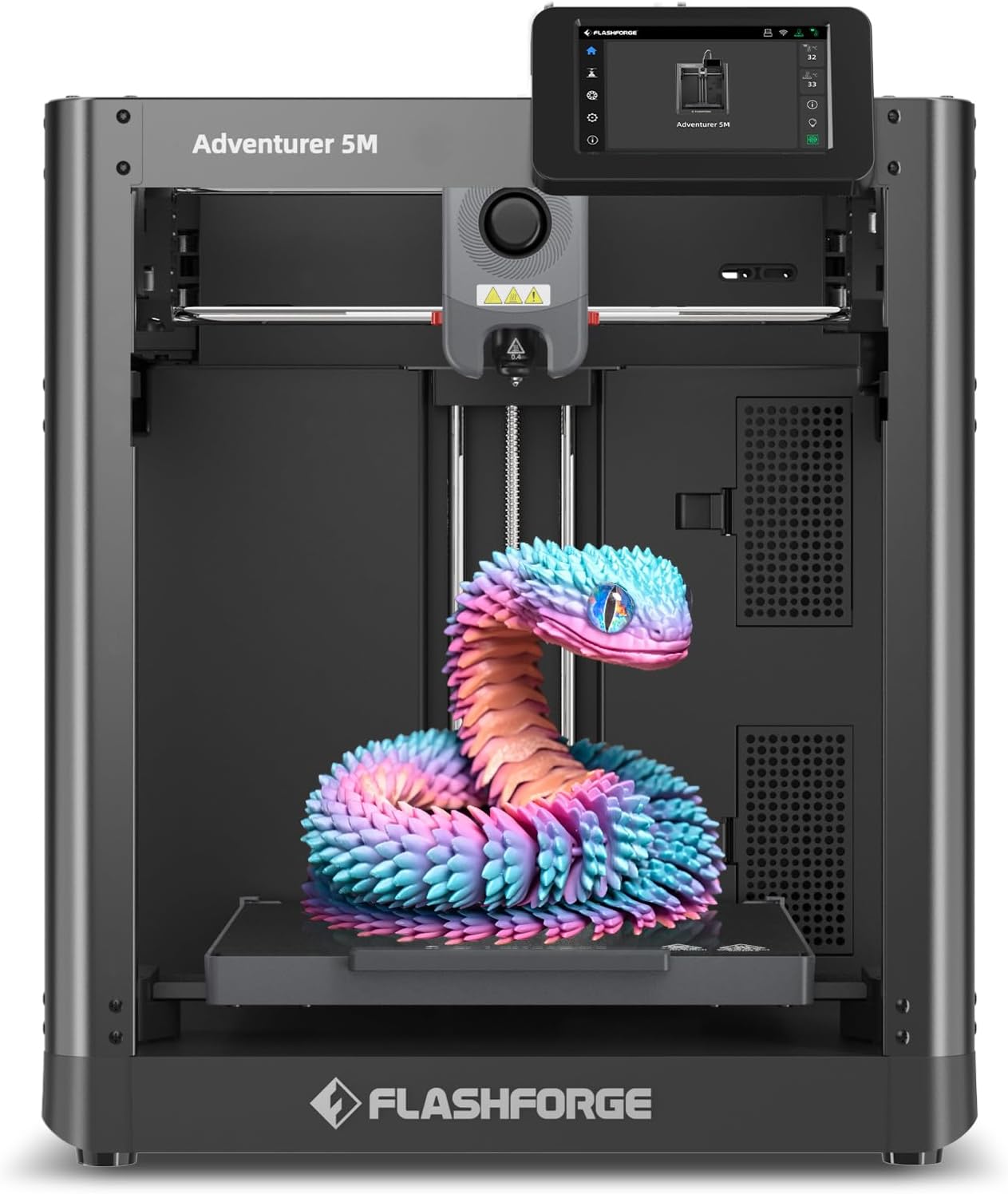
| Build Volume | 220 x 220 x 220 mm |
|---|---|
| Extruder Max Temp | 280°C |
| Structure | All-metal Core XY Structure |
| Travel Speed | 600 mm/s and 20,000 mm/s² |
| Platform Type | Double-Sided PEI Platform |
The FLASHFORGE Adventurer 5M is a CoreXY desktop printer built around speed and convenience for hobbyists and small-scale prototyping. It uses one-button automatic bed leveling and a double-sided PEI platform to simplify first-layer adhesion and part removal, while the 280°C direct extruder and multiple nozzle sizes let you run common engineering filaments such as PLA, PETG, ABS, TPU, and carbon-fiber blends. The printer's CoreXY all-metal structure, 600 mm/s travel speed and high acceleration are optimised for rapid printing, and features like a quick-change 3-second detachable nozzle, dual-fan nozzle cooling, and vibration compensation aim to preserve print quality at higher speeds. FlashPrint slicing and mobile monitoring through the Flash Maker app make remote job control straightforward. Expect solid results for rapid prototyping and general-purpose home projects, but be prepared to manage nozzle and platform maintenance and to tune profiles when printing higher-temperature or specialty materials to get consistent results at the claimed speeds.
Best for: Buyers who prioritize fast, automated desktop printing for prototyping or hobby projects and value easy setup plus remote monitoring to reduce hands-on time.
Less Ideal for: People who need out-of-the-box multi-color printing or who prefer a simpler, lower-speed machine with minimal tuning and maintenance.
- Automatic one-button bed leveling for easier first-layer setup
- CoreXY all-metal frame with high travel speed for faster prints
- 280°C direct extruder and multiple nozzle sizes support a range of filaments
- Double-sided PEI platform for easier part adhesion and tool-free removal
- Mobile app monitoring and FlashPrint slicing for remote control and workflow
- High advertised speeds require tuning and careful maintenance to avoid quality loss
- No built-in multi-color capability on this base model
Verdict: Choose the Adventurer 5M if you want a fast, CoreXY desktop printer that combines one-click leveling and remote monitoring for efficient home prototyping under $500.
Bambu Lab A1 Combo

| Build volume | 256×256×256 mm |
|---|---|
| Acceleration | 10,000 mm/s² |
| Included module | AMS lite (multi-color support in combo) |
| Filament support | PLA, PETG, TPU, PVA |
The Bambu Lab A1 Combo is a ready-to-use desktop FDM printer aimed at makers who want fast, reliable prints without a lot of manual tuning. It handles full-auto calibration for Z-offset, bed leveling, resonance and nozzle pressure, so initial setup and per-print prep are minimal. With its AMS lite multi-color feeder, RFID-synced filament profiles, and active flow-rate compensation the A1 makes multi-color and single-material prints more consistent. The 256 mm cube build volume gives you room for larger home projects, and the motion system with linear rails, accelerometers and a nozzle pressure sensor supports high-speed printing while retaining detail. Practical benefits include a simplified touchscreen interface, quiet operation thanks to motor noise canceling, and a 1-clip quick-swap nozzle for easier maintenance. Limitations to note are that advanced users seeking enclosure or high-temperature materials have fewer options with this open-frame desktop unit, and multi-color capability requires the AMS lite module if not included in the bundle.
Best for: Home users who want a low-hassle, reliable 3D printer that simplifies setup and produces fast, accurate prints with easy multi-color options.
Less Ideal for: Users who need a fully enclosed printer for high-temperature engineering filaments or those who want a highly modifiable, workshop-grade machine.
- Full-auto calibration reduces setup time and per-print adjustments
- AMS lite support and RFID-synced filament profiles simplify multi-color printing
- High-speed motion control with sensors delivers fast prints while maintaining precision
- Generous 256×256×256 mm build volume for larger home projects
- Quiet operation and a user-friendly touchscreen for an approachable desktop experience
- Open-frame design limits use with high-temperature or fully enclosed material workflows
- Multi-color printing requires the AMS lite module if not included in the purchased kit
Verdict: If you want a fast, easy-to-use home 3D printer that minimizes setup fuss and makes multi-color printing approachable, the A1 Combo is a strong choice.
Choosing the Right 3D Printer: Key Factors to Consider
Print Quality & Accuracy
Print quality determines whether parts come out dimensionally useful or just decorative. Layer resolution, frame rigidity, and the precision of the motion system all influence surface finish and tolerance. For home-use printers under $500, expect tradeoffs: very fine layer heights are possible but require slower speeds and careful calibration. Consider how precise your projects need to be and whether you are willing to spend time dialling in slicer settings to improve results.
Consistent first layers and accurate XY motion are more important than absolute minimum layer thickness for many functional prints. If you plan to print mechanical parts that must fit together, prioritize machines with stable motion systems and reliable extrusion over those that merely advertise ultra-fine layer numbers.
Ease Of Setup And Use
Ease of setup affects how quickly you can move from unboxing to your first successful print. Features that help include clear assembly instructions, pre-calibrated or auto-leveling beds, guided touchscreen menus, and bundled slicer profiles. At this price range, some machines offer near plug-and-play operation while others require manual bed tramming and firmware tweaks.
If you are new to 3D printing or want to minimize weekend tinkering, choose a printer with documented beginner-friendly workflows and active user communities. Look for included sample filament and test models that help validate the machine right away.
Reliability And Maintenance
Long-term usability depends on reliability and how easy the printer is to maintain. Check whether common wear items like nozzles, belts, and build surfaces are standard sizes and easy to replace. A rigid frame, robust belt tensioners, and a well-secured extruder reduce failures and keep calibration stable between prints.
Maintenance also includes firmware updates and availability of replacement parts. For home users, lower ongoing maintenance effort means more prints and less downtime, so factor serviceability and community support into your decision.
Material Compatibility
The range of filaments a printer can handle affects the types of projects you can complete. PLA is the easiest and most common filament for home printers, but PETG and TPU expand usefulness for functional parts and flexible components. Heated beds, reliable filament feeding, and a compatible nozzle temperature range are key for handling materials beyond PLA.
Consider whether you need an enclosed build area or a removable heated bed for certain materials. Filament diameter support and whether the machine uses an accessible spool mount also influence daily convenience.
Build Volume And Workspace Fit
Build volume sets the maximum size of single-piece prints and affects how you plan multi-part assemblies. Larger build areas are appealing but also increase print times and the chance of warping on longer jobs. For home environments, balance the physical footprint of the printer with the usable build volume; a compact machine can still produce many useful parts if you plan modest-sized prints or split larger models.
Also consider how the printer will fit in your workspace with regard to noise, ventilation needs, and access for filament changes. If you plan to keep the printer in a living area, quieter operation and a small footprint may be more valuable than a large bed.
Which Features Matter Most For Home Projects
Home 3D printing is about predictable output and manageable maintenance. Key features that impact everyday use include a stable heated bed, user-friendly filament feed, and a motion system that resists play or wobble. Those elements have a larger effect on successful prints than flashy extras.
For many makers, the ability to quickly get the first layer right and resume prints after interruptions will determine whether a printer is useful or a weekend project in frustration. Look for features that make these tasks simpler and less frequent.
- Guided bed leveling or assisted manual leveling
- Accessible filament path and reliable extruder gearing
- Solid frame and good bed adhesion options
- Removable build plates or textured surfaces for easy part removal
Managing Filament And Materials At Home
Storing and handling filament properly reduces failed prints and material waste. Use dry storage or desiccant packs for hygroscopic filaments like PETG or nylon. For flexible filaments, a direct-drive or short Bowden path typically results in better feeding behavior.
Pay attention to spool mounting and whether the printer accommodates standard spool sizes. A consistent filament diameter and quality filament make a bigger difference than chasing premium extruders when starting out.
- Keep spare nozzles and a small toolkit on hand
- Label spools with material type and print temperature
- Use enclosure or local ventilation for higher-temperature materials
Common Maintenance Tasks And How To Plan For Them
Routine maintenance keeps a home printer reliable. Tasks include cleaning the build surface, checking belt tension, lubricating linear rails or rods if applicable, and replacing worn nozzles. Establish a simple checklist to run after every 20 to 50 hours of printing to avoid surprises.
Having a small stock of consumables such as spare nozzles, a replacement build surface, and common fasteners reduces downtime. Learn basic troubleshooting steps for filament jams and adhesion issues so you can address problems quickly without long repair cycles.
- Inspect belts and pulleys for looseness every few weeks
- Keep an extra build plate or masking materials for quick swaps
- Document bed leveling settings after a successful calibration
Improving Print Results With Slicer Settings
Slicer adjustments often yield greater improvements than hardware changes. Layer height, print speed, retraction distance, and cooling all influence surface finish and stringing. Start with default profiles provided by the manufacturer and adjust one setting at a time to learn its effect.
For dimensional accuracy, tune extrusion multiplier and measure simple test cubes. For bridging and overhangs, experiment with print cooling and slower speeds. Good filament and consistent nozzle temperature simplify tweak cycles.
- Use calibration prints like cubes and temperature towers
- Adjust retraction for the filament and extruder configuration
- Slow down for fine layers and increase cooling for PLA
Safety And Noise Considerations For Home Use
Noise level and thermal safety matter when a printer shares living space. Look for machines with quieter stepper drivers or the ability to change firmware-driven motor profiles to lower noise. Ensure the printer has proper thermal protection and secure wiring to reduce fire risk.
If printing for long sessions, place the printer on a stable, non-flammable surface and keep the area ventilated, especially when using materials that can emit fumes. Consider enclosures not only for temperature control but also to limit accidental contact with hot components.
- Place printer away from high-traffic areas during long prints
- Use smoke or heat detectors in workshop spaces
- Check that power connectors and heated bed wiring are secure
How We Chose the Best 3D Printer
We evaluated machines that target home users and fall within the under-$500 budget to reflect realistic choices for hobbyists and casual makers. Our selection emphasized practical performance over feature lists, prioritizing printers that deliver consistent first-layer adhesion, repeatable dimensional accuracy, and hardware that minimizes common failure modes. We inspected product specifications and user-focused design choices that reduce setup time such as guided bed leveling, enclosed or semi-enclosed build areas where applicable, and straightforward firmware or touchscreen menus. Reliability metrics included build platform stability, common failure points like loose belts or weak extruders, and availability of replacement parts or community support. Usability criteria covered out-of-box setup, slicer compatibility, and filament handling including whether the printer supports common materials like PLA and PETG. Safety and noise levels were considered for home environments. We excluded experimental kits and printers that require extensive modification to achieve basic printing results. The resulting shortlist reflects machines that are practical for real-world home projects while keeping maintenance and tuning demands reasonable.
Our full evaluation process is outlined in our review methodology.
FAQ
Can a sub-$500 3D printer produce functional parts?
Yes, many inexpensive printers can produce functional parts suitable for prototypes and household fixes. Success depends on proper calibration, suitable filament choice, and realistic expectations about tolerances and finish.
How important is bed leveling for successful prints?
Very important. A level and properly set first layer is the foundation of a good print. Automated or guided leveling systems reduce user error, but manual leveling can work well if you follow a consistent process.
What maintenance should I expect with a home 3D printer?
Expect light, regular maintenance such as cleaning the build surface, checking belt tension, and replacing nozzles. Occasional deeper maintenance might include realigning frame components and updating firmware.
Which filaments are easiest for beginners?
PLA is the easiest filament to start with because it prints at lower temperatures and has minimal warping. PETG is a good next step for stronger, more functional parts but requires a heated bed and slightly different settings.
Do I need an enclosure to print useful parts at home?
Not always. Enclosures help with temperature-sensitive materials and reduce warping, but many useful prints can be made open-frame with the right filament and bed preparation.
Final Verdict
When choosing a 3D printer for home use under $500, prioritize machines that offer reliable first layers, straightforward setup, and easy maintenance. Tradeoffs are inevitable: larger build volumes and advanced features often come with more calibration work. Focus on the combination of print quality, usability, and material compatibility that matches the types of projects you plan to do. With reasonable expectations and basic upkeep, a budget-friendly desktop 3D printer can be a productive tool for hobbyist projects and household repairs.