
Note: This article contains affiliate links. If you click on these links and make a purchase, we may earn a small commission at no extra cost to you. This helps support our research and content. Read our full affiliate disclosure here.
If you need industrial-capable desktop or shop-floor 3D printing without stepping into six-figure equipment, a well-chosen 3D printer under $30,000 can deliver. You will use this class of machines for repeatable prototyping, small-batch production, or tooling parts where build volume, material options, and dimensional accuracy make the difference between wasted cycles and production-ready parts. This guide spotlights the top shortlisted 3D printers in this price band and explains the practical tradeoffs relevant to workshop and small-factory use. We evaluate machines on the specs and real-world factors that matter most in daily use, then summarize what to prioritize for your workflow.
Top Picks at a Glance
| Best Overall The best all-around choice for most situations | Bambu Lab P2S Combo |  |
| Best Quality Built to a higher standard if you want something more solid | Original Prusa XL 5-Toolhead |  |
| Best Value The sweet spot between price and what you get | Anycubic Kobra X |  |
| Best Budget The cheapest option that still gets the job done reliably | ELEGOO Neptune 3 Pro |  |
| Top Rated A top-rated pick with lots of positive feedback | Creality K2 Combo 3D Printer |  |
| Most Popular A crowd favorite that many people choose with confidence | Creality Ender 3 V3 SE |  |
| Best Seller A high-volume bestseller chosen again and again | Bambu Lab P1S 3D Printer |  |
Bambu Lab P2S Combo

| Print speed | Up to 600 mm/s |
|---|---|
| Filament drying | Up to 65°C (AMS 2 Pro) |
| Extruder | PMSM servo extruder |
| Air management | Adaptive Airflow with carbon filter |
The Bambu Lab P2S Combo combines a very fast CoreXY P2S printer with the AMS 2 Pro multi-spool accessory to deliver fast, reliable single- and multi-color FDM printing. The P2S prioritizes speed and precision with a PMSM servo extruder and active flowrate compensation that keep layer lines sharp even at high travel speeds up to 600 mm/s, while automatic calibration and quick-swap nozzles cut setup time so you can be printing in minutes. The AMS 2 Pro adds automated filament management and a heated drying chamber up to 65°C, which helps avoid moisture-related print failures when running multi-spool jobs. Adaptive Airflow and a carbon filter help manage cooling and chamber temperature for a wider range of engineering filaments. The practical result is a streamlined workflow through Bambu Studio and MakerWorld model access, but buyers should note this is a high-performance desktop system that assumes some familiarity with 3D printing for tuning and maintenance and that the base P2S requires the AMS combo for multi-color prints.
Best for: Buyers who want a fast, production-capable desktop 3D printer with integrated workflow and multi-spool support for prototyping or short-run parts and who value speed and automated filament handling.
Less Ideal for: Casual hobbyists seeking a very simple, low-maintenance machine or buyers who only need single-color toy-level prints and do not require high throughput.
- Very high print speeds up to 600 mm/s while maintaining precision
- PMSM servo extruder with active flowrate compensation for consistent extrusion
- AMS 2 Pro provides multi-spool management and filament drying up to 65°C
- Adaptive Airflow and carbon filter help control cooling and maintain chamber temperature
- Quick setup and automatic calibration get you printing in about 15 minutes
- Multi-color printing requires the AMS 2 Pro combo rather than the base printer
- High-speed hardware increases complexity for users who prefer a simple, hobbyist setup
Verdict: Choose the P2S Combo if you need a very fast, workflow-oriented desktop 3D printer with automated multi-spool filament handling and drying for reliable prototyping and short production runs.
Original Prusa XL 5-Toolhead

| Build volume | 14.17 × 14.17 × 14.17 inches |
|---|---|
| Toolheads | Up to 5 tools |
| Controller | 32-bit with Input Shaper and Pressure Advance |
| Included material | 1 kg Prusament PLA |
The Original Prusa XL 5-Toolhead is a professional CoreXY system built for multi-material and full-color printing workflows. It combines a next-generation Nextruder with a load cell sensor, native Input Shaper and Pressure Advance on a 32-bit controller to keep prints fast and accurate even when switching between up to five tools. The printer is targeted at shop and prototyping use, offering a 14.17 × 14.17 × 14.17 inch build volume, segmented heated bed zones to reduce warping and an included satin print sheet plus a 1 kg spool of PLA to get started. Integration with Prusa software and Printables.com streamlines file management and job submission, and Prusa's support offering is pitched at professional users. Trade-offs are its size and complexity: the unit ships with several fragile components packed separately that require assembly and setup knowledge, and larger multi-tool systems need careful calibration and material management to avoid downtime. For teams that need versatile multi-material capability and factory-quality extrusion control, the XL delivers a capable, production-oriented platform.
Best for: Engineers, small production shops, and serious hobbyists who prioritize high-throughput, multi-material prototyping and need a robust platform for functional and full-color models.
Less Ideal for: Casual users or classrooms looking for a plug-and-play desktop printer or anyone with limited shop space or minimal experience servicing complex 3D printers.
- Five-tool multi-material/color capability for complex prototypes and visual models
- 32-bit control with Input Shaper and Pressure Advance for improved speed and print quality
- Segmented heated bed that reduces warping and improves first-layer consistency
- Includes a Satin print sheet and 1 kg spool of Prusament PLA to start printing
- Integrates with Prusa software ecosystem for job management and support
- Large footprint and weight require dedicated workspace and handling
- Requires assembly of several fragile parts after transport which adds setup time
- Multi-tool operation increases complexity for calibration and material switching
Verdict: Choose the Prusa XL 5-Toolhead when you need a professional multi-material, high-precision platform for advanced prototyping and small-scale production.
Anycubic Kobra X

| Build volume | 260 x 260 x 260 mm |
|---|---|
| Max nozzle temperature | 300℃ |
| Connectivity | Dual-band Wi‑Fi (2.4G/5G) and LAN |
| Auto leveling | LeviQ 3.0 49-point |
The Anycubic Kobra X is a fast, feature-rich FDM printer aimed at hobbyists, families, and small makerspaces that want multicolor prints without a complicated setup. It ships with four ACE 2 Pro color modules built in and can expand the palette to many more colors, letting you mix hues in a single job while cutting purge waste and travel with the company's optimized color workflow. Key practical features include a hardened steel nozzle rated to 300℃ for printing PLA, PETG, TPU and other filaments, LeviQ 3.0 49-point auto bed leveling for reliable first layers, and AI camera monitoring with spaghetti and foreign object detection for remote oversight. The machine targets speed with claimed peak movements up to 600 mm/s and includes power and filament recovery to protect long prints. Downsides to expect are the learning curve for reliable multicolor setups and that pushing top speeds may require calibration to maintain print quality; advanced users will want to tune acceleration and vibration compensation. For buyers who prioritize getting a lot of capability for the budget, the Kobra X packs a strong set of practical features.
Best for: Buyers who want a highly capable, practical 3D printer that delivers multicolor capability and fast throughput without stepping into industrial-priced machines.
Less Ideal for: People who need plug-and-play single-color desktop printing with zero tuning or professional users who require fully enclosed industrial systems for critical production environments.
- Native multicolor printing with four built-in ACE 2 Pro modules and expandability for more colors
- LeviQ 3.0 49-point auto bed leveling for consistent first-layer adhesion
- Hardened steel nozzle and up to 300℃ nozzle temperature for a wide range of filaments
- AI camera monitoring with spaghetti and foreign object detection plus remote app control
- Multicolor printing increases setup complexity and may need tuning to avoid quality issues
- High claimed speeds require careful calibration to prevent ringing and loss of fine detail
Verdict: The Kobra X delivers multicolor printing, robust filament support, and practical smart monitoring at a value-focused price, making it a top pick for buyers who want capability and speed without industrial cost.
ELEGOO Neptune 3 Pro

| Build volume | 225×225×280 mm |
|---|---|
| Extruder | Dual-gear direct drive |
| Bed leveling | 36-point auto leveling |
| Filament diameter | 1.75 mm |
| Noise level | 47 dB |
The ELEGOO Neptune 3 Pro is a ready-to-use desktop FDM printer targeted at hobbyists and makers. It ships with partially preassembled main parts and a toolkit so you can get printing quickly, and its 225×225×280 mm build volume handles typical small-to-medium projects. Notable hardware includes a dual-gear direct drive extruder for more reliable feeding of flexible and common filaments, a titanium throat with brass nozzle and improved heatsink to reduce clogs, and a PEI magnetic platform for easier part removal. Convenience features such as 36-point auto bed leveling, filament runout detection, and power-loss resume reduce failed prints and setup fiddling. Motion is driven by an STM32 board, silent stepper motors, and dual Z lead screws for stable layer alignment. At the same time, it is a consumer-level machine: it is not enclosed so temperature-sensitive materials may need enclosure or dialed settings, and advanced industrial features like multi-material heads or high-temp all-metal hotends are not present. For its price and feature set it delivers dependable, practical performance for everyday printing tasks.
Best for: Buyers looking for an affordable, feature-rich desktop printer that gets reliable everyday prints with minimal setup and maintenance.
Less Ideal for: Professionals who need an enclosed, high-temperature industrial printer or users wanting built-in multi-material manufacturing should consider other options.
- Dual-gear direct drive extruder improves filament feeding and reduces clogging with flexible materials
- 36-point auto bed leveling simplifies first-layer setup
- Filament runout sensor and power-loss resume reduce failed long prints
- PEI magnetic platform makes part removal and surface prep easier
- Dual lead screws and silent stepper motors provide steady, relatively quiet motion (~47 dB)
- Open-frame design limits out-of-the-box printing with high-temperature or hygroscopic materials
- Not suited for advanced multi-material printing or factory-grade high-temp applications
Verdict: A budget-friendly desktop 3D printer that balances easy setup and practical reliability for everyday hobbyist and maker projects.
Creality K2 Combo 3D Printer

| Maximum nozzle temperature | 300°C |
|---|---|
| Maximum print speed | 600 mm/s |
| Build volume | 10.24 × 10.24 × 10.24 inch |
| Heater power | 80W |
| Filament colors supported | Up to 16 colors |
The Creality K2 Combo pairs a K2 FDM printer with Creality's CFS multi-filament system to handle up to 16 colors in a single build while keeping single-color prints simple. It is built around a rigid exoskeleton, steel X-axis rail, dual Z support, and step-servo motion components that enable very fast moves and acceleration — the spec sheet lists up to 600 mm/s and aggressive acceleration for short print times. The machine uses a durable direct-drive extruder with hardened-steel gears, a quick-swap hotend that reaches 300°C, and a high-flow 80W heater for better extrusion of engineering filaments. Practical additions include auto mesh leveling that probes only the print area, an internal camera for print monitoring and failure alerts, and auxiliary part-cooling fans. Trade-offs are its focus on speed and a larger, more complex multi-filament system, which increases setup tuning and maintenance compared with simpler single-extruder printers. Expect a learning curve to dial in multicolor profiles and high-speed slicer settings, but the K2 Combo is designed to deliver reliable, factory-quality hardware for sustained use once tuned.
Best for: Buyers who prioritize sustained reliability and factory-grade hardware for demanding prints and who are willing to invest time tuning a high-speed, multi-filament machine.
Less Ideal for: Casual hobbyists who want a plug-and-play single-color printer or users who prefer minimal setup and low maintenance over advanced multi-color capabilities.
- Multi-color printing support up to 16 colors with Creality CFS system
- Sturdy aerospace-aluminum exoskeleton and reinforced motion rails for stable high-speed printing
- Durable direct-drive extruder with hardened-steel gears and 300°C-capable hotend for abrasive and engineering filaments
- High-flow 80W heater and quick-swap hotend improve extrusion rates and maintenance
- Built-in camera and adaptive mesh auto-leveling streamline monitoring and first-layer reliability
- High-speed operation and multi-filament hardware require more tuning and maintenance than basic printers
- Large and complex system may be overkill for users who only need occasional single-color prints
Verdict: Choose the K2 Combo when you need a robust, factory-quality high-speed printer that reliably handles multi-color and engineering filament work once properly tuned.
Creality Ender 3 V3 SE

| Item model number | Ender 3 V3 SE |
|---|---|
| Printing speed | Up to 250 mm/s |
| Extruder type | Sprite direct extruder |
| Mainboard | 32-bit silent mainboard |
The Creality Ender 3 V3 SE is an entry-to-mid-level FDM printer that prioritizes speed and ease of use. It uses a Sprite direct extruder for reliable feeding of PLA, PETG, and TPU, plus CR Touch and a strain sensor to automate bed leveling and Z-offset so beginners can get a good first layer quickly. Creality rates the machine for up to 250 mm/s printing with high acceleration, supported by a dual Z-axis and dual Y linear shafts for steadier motion and reduced Z wobble. A 32-bit silent mainboard and upgraded stepper drivers keep noise down during prints, while the PC spring steel build plate makes parts removal straightforward. The printer also offers one-touch filament load and unload and an intuitive motion-graphics UI for status feedback. Limitations to note are its small build footprint compared with larger professional machines and that achieving the fastest print speeds still requires tuning and quality filament; advanced users may want a larger heated chamber or enclosure for certain materials. For its price and feature set, it is a practical all-rounder for hobbyists and small workshops.
Best for: Buyers who want a fast, user-friendly FDM machine that balances modern features and quiet operation for desktop prototyping or hobby projects and who value proven community support.
Less Ideal for: Those needing large-format printing, an enclosed heated chamber for advanced high-temp materials, or production-level throughput should consider bigger industrial models instead.
- Sprite direct extruder supports flexible and standard filaments with reliable feeding
- CR Touch auto leveling and strain sensor simplify first-layer setup for beginners
- Capable motion hardware including dual Z-axis and dual Y linear shafts for stable prints
- 32-bit silent mainboard reduces operational noise and improves motor control
- One-tap filament load/unload and a motion-graphics UI make day-to-day use smoother
- Relatively small build volume compared with larger prosumer or industrial printers
- Top speeds require careful tuning and quality filament to maintain good surface finish
Verdict: A fast, beginner-friendly desktop FDM printer that packs direct extrusion, auto-leveling, and quiet operation into a compact, practical package.
Bambu Lab P1S 3D Printer
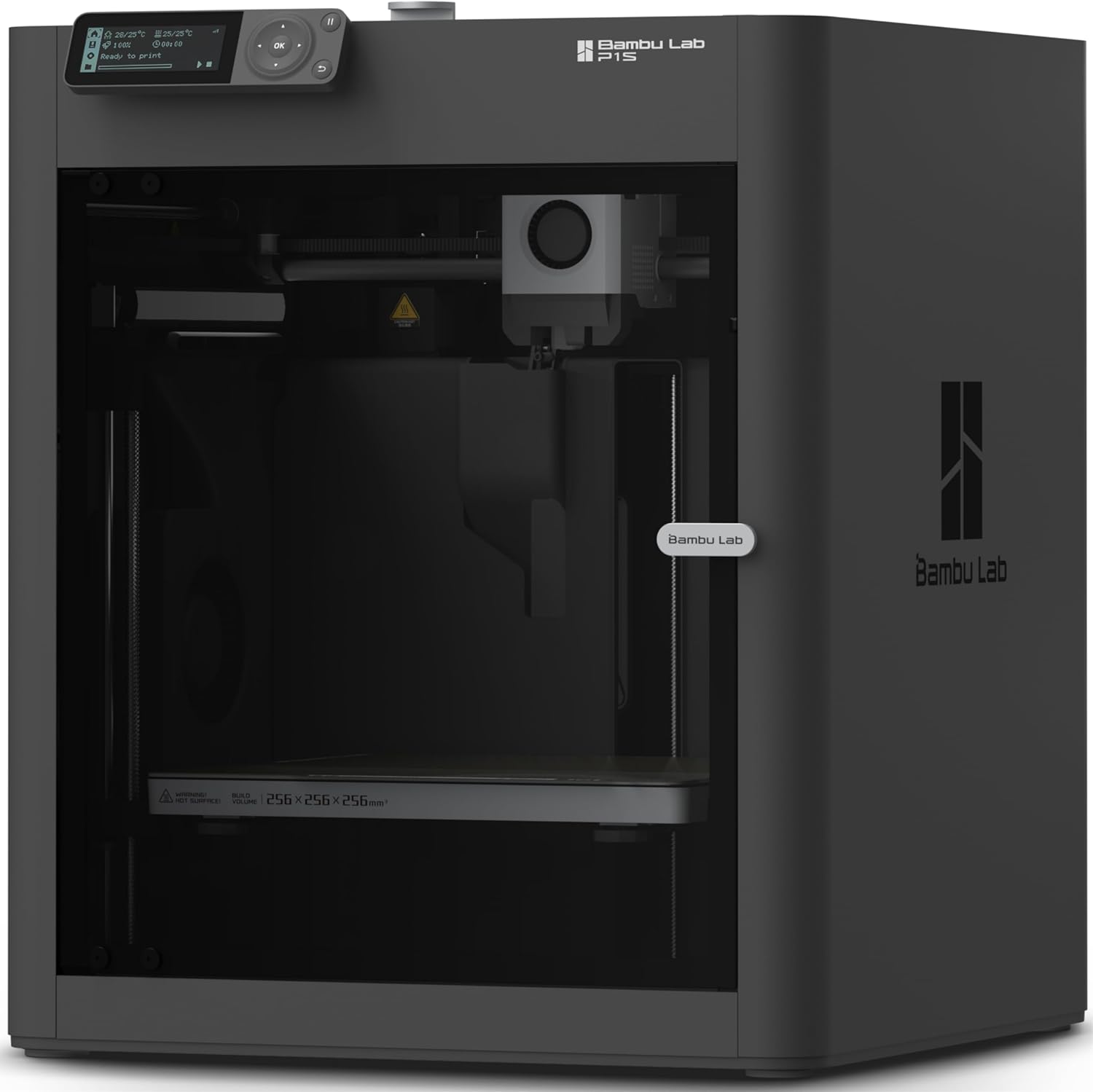
| Build Volume | 256×256×256 mm³ |
|---|---|
| Max Speed | 500 mm/s |
| Max Acceleration | 20 m/s² |
| Supported Filaments | PLA, PETG, TPU, PVA, PET, ABS, ASA |
The Bambu Lab P1S is an enclosed CoreXY FDM printer aimed at users who want fast, reliable prints without a long setup process. It ships ready to use with automatic bed leveling and a guided, short assembly so you can start printing quickly, and the enclosed body helps with temperature stability for tricky filaments. The printer supports a wide range of common materials including PLA, PETG, TPU and ABS and features a direct-drive extruder for better handling of flexible filaments and multi-material work when paired with Bambu Lab AMS. Performance claims include very high travel speeds and acceleration for shorter print times, and the built-in camera can capture timelapses. Practical benefits are fast throughput for prototyping, a controlled build environment for consistent results, and a beginner-friendly software and model library to lower the learning curve. Limitations to note are that advanced engineering materials like carbon- or glass-filled polymers are not recommended, and multi-color/multi-material capability requires the optional AMS accessory.
Best for: Buyers who prioritize reliable, fast prints with minimal setup and prefer a guided, beginner-friendly printing ecosystem for prototyping and hobby projects.
Less Ideal for: Users who need factory-grade composite printing with carbon or glass fiber reinforcement or who require multi-material output without buying additional accessories.
- Enclosed CoreXY design improves thermal stability and print quality with advanced filaments
- Automatic bed leveling simplifies setup and reduces failed prints
- Direct-drive extruder handles flexible filaments and a broader material set
- Very high claimed speed and acceleration reduce print turnaround time
- Integrated camera and MakerWorld model library help beginners get started quickly
- Multi-color or multi-material printing requires purchasing the optional AMS accessory
- Not recommended for carbon- or glass-fiber reinforced filaments
Verdict: Choose the P1S if you want a fast, enclosed, beginner-friendly CoreXY printer that delivers reliable, high-throughput prints with easy setup.
Choosing the Right 3D Printer: Key Factors to Consider
Build Volume and Workspace
Larger build volume determines the maximum part size you can produce in a single print. If your workflow includes full-size prototypes, tooling molds, or assembly-fit checks, a single-build solution reduces assembly and finishing work.
Volume also affects printer footprint and enclosure needs. Bigger chambers require more robust thermal management to avoid warping when printing engineering-grade plastics. Consider whether your shop layout and ventilation can accommodate the machine and any required post-processing areas.
Dimensional Accuracy and Repeatability
Accuracy affects whether printed parts meet tolerances without extensive machining. Look for mechanical stiffness, bed and gantry design, and the stated XY and Z resolution metrics. Repeatability matters more than single-part resolution because production workflows rely on consistent output across many builds.
Calibration workflows and available sensors (for bed leveling or toolhead compensation) reduce setup time and variance between builds. Machines that simplify calibration save shop hours and minimize scrap.
Material Compatibility
Material choice directly influences part function. Some projects require engineering plastics, high-temperature resins, or reinforced composites. Check the printer's rated temperature range, extruder and hot end capabilities, and whether it supports pellet, filament, or resin feedstocks.
Beyond peak temperatures, consider enclosure heating, inert atmosphere options, and filtration for materials that off-gas. Material ecosystem and vendor support matter for sourcing consistent batches of engineering-grade feedstock.
Reliability and Serviceability
A printer that spends more time down for repairs erodes the productivity gains of rapid prototyping. Favor machines with robust mechanical designs, proven components, and accessible service parts. Consider the availability of modular assemblies for quick swaps and how easy routine maintenance tasks are, such as nozzle changes and bed replacements.
Also evaluate diagnostics and remote-monitoring features that can alert you to failed prints or maintenance windows before they cause extensive downtime.
Post-Processing and Workflow Integration
Printing is only part of the production cycle. Post-processing needs can add significant time and labor. Some machines produce parts that require minimal cleanup, while others need extensive support removal, curing, or machining.
Assess the compatibility with your existing slicing software, file formats, and any automation or conveyor options for high-throughput shops. Consider whether the machine supports batch scheduling, networked job queues, or direct integration with CAD/CAM toolchains.
Operational Costs and Consumables
Consumable costs, including filament, resin, support materials, and maintenance parts, add up over multiple builds. Calculate running cost per part by including expected material use, wear components like nozzles and belts, and necessary environmental controls such as heated chambers.
Also factor in energy consumption for heated enclosures and post-curing stations. Machines with clearer service intervals and predictable consumable lifecycles are easier to budget for in production settings.
Which Technologies Fit This Price Band
Within the under $30,000 range you will find multiple additive technologies that serve different applications. Fused deposition and fused filament fabrication variants offer broad material choice and straightforward part finishing. Stereolithography and digital light processing systems deliver higher surface detail for small features, while some selective thermoplastic extrusion systems scale to much larger volumes.
Choose the technology that matches end-use requirements. If you need functional mechanical parts exposed to heat or chemicals, prioritize systems that can handle engineering-grade thermoplastics. For highly detailed visual prototypes, resin-based processes are often a better fit.
- Fused filament systems: versatile materials, easier scaling to larger volumes
- Vat photopolymer systems: fine detail and smooth surfaces for small to medium parts
- Pellet extrusion and high-temperature extrusion: cost-effective for large volumes and engineering plastics
Site Preparation and Safety Considerations
Plan for the physical and environmental needs of a professional 3D printer. Larger machines require sturdy, level flooring and secure electrical supply. Verify clearance around the machine for loading and maintenance.
Safety considerations include ventilation for VOCs, enclosure interlocks for high-temperature processes, and proper storage for reactive or hygroscopic materials. Implement workspace procedures for handling hot components and for safe disposal of support or resin waste.
- Ensure dedicated power circuits for high-draw heaters and enclosures
- Provide local exhaust ventilation or filtration when printing resins or high-temperature polymers
- Designate post-processing stations separated from the main print area
Maximizing Throughput Without Sacrificing Quality
Throughput is a balance of print speed, part orientation, and batch organization. Optimize nesting and part orientation to reduce print time while minimizing the need for supports that increase finishing time. Use layer height and infill strategies that meet functional needs without overbuilding parts.
Consider software features that enable queuing and remote monitoring so you can run builds overnight or across multiple shifts. Automated bed leveling, filament runout detection, and fail-safe routines reduce wasted builds and free operator time for higher-value tasks.
- Use coarser layers for non-critical surfaces to speed prints
- Group similar parts to minimize machine warm-up and changeover
- Leverage remote monitoring to schedule maintenance during low-use windows
Material Handling and Storage Best Practices
Proper storage preserves material performance. Many engineering polymers and resins are hygroscopic and lose printability when exposed to moisture. Use desiccant cabinets or vacuum-sealed storage for filaments and sealed containers for resins.
Label batches with purchase date and material lot information to track variance between runs. Establish a small inventory policy so you can rotate stock before it degrades.
- Store filaments in dry boxes with humidity indicators
- Keep resins in opaque, sealed containers away from heat and direct light
- Track material lot numbers for quality control and troubleshooting
Maintenance Routine and Preventive Care
A predictable maintenance schedule extends uptime and ensures consistent part quality. Establish daily checks such as nozzle condition, bed adhesion, and basic movement smoothness. Weekly tasks may include deeper calibration and lubrication of mechanical components.
Keep a small inventory of common wear parts like nozzles, belts, and bed surfaces so you can perform quick swaps. Document maintenance actions and any part-geometry drift to build a history that helps diagnose recurring issues.
- Create a check sheet for pre-print and post-print inspections
- Schedule periodic calibration and more in-depth inspections during low-use periods
- Log material batches and maintenance to pinpoint sources of variance
How We Chose the Best 3D Printer
We prioritized machines that deliver measurable capability for professional prototyping and short-run production while fitting the under $30,000 budget constraint. Key evaluation criteria included build volume and dimensional accuracy, material compatibility and processing, reliability and uptime for continuous jobs, and operational cost factors such as consumables and maintenance. We also considered workflow features that affect throughput: part preparation and slicing integration, post-processing requirements, and available safety or enclosure options for higher-temperature materials. To keep the list useful for practical buyers we excluded pure hobby-level hobbyist hobby printers that lack industrial materials support or robust enclosures. We also filtered out machines requiring extensive aftermarket modification to be usable for professional parts. The resulting picks are machines that pair usable build space with proven material versatility, predictable repeatability, and manageable operating costs. These are the dimensions that guided inclusion and are reflected in the scoring criteria used on each product card.
Our full evaluation process is outlined in our review methodology.
FAQ
Can machines under $30,000 handle engineering-grade thermoplastics?
Often they can, but it depends on the printer's maximum nozzle and chamber temperatures and whether it offers a heated enclosure. Many printers in this band support a range of engineering filaments when configured with appropriate hot ends and enclosures.
How do I estimate the running cost per part?
Estimate material usage, expected support material, and the lifespan of wearable parts like nozzles. Add energy consumption for heated build chambers and post-processing steps. Tracking these costs over several builds gives a realistic per-part figure.
Are larger build volumes worth the tradeoffs?
Larger build volumes let you print single-piece large parts and increase batch capacity, but they require better thermal control and more floor space. Choose volume based on the size of parts you need and whether your workflow benefits from single-piece builds.
What should I plan for post-processing?
Post-processing varies by technology and material. Expect support removal, sanding, heat treatment, or UV curing for resins. Plan dedicated stations, appropriate tools, and safety equipment for dust and chemical handling.
How important is customer support and spare parts availability?
Support and spare parts availability are crucial for production continuity. Machines that offer clear service channels and accessible replacement components reduce downtime and shorten repair cycles.
Final Verdict
When selecting a 3D printer under $30,000 focus on the combination of build volume, material support, and predictable accuracy that matches your intended parts. Prioritize machines with proven reliability and easy serviceability if you plan to run regular production or long print cycles. Balance throughput against post-processing demands and operating costs to choose a machine that fits both your technical requirements and your workflow.