
Note: This article contains affiliate links. If you click on these links and make a purchase, we may earn a small commission at no extra cost to you. This helps support our research and content. Read our full affiliate disclosure here.
If you need a professional 3D printer on a sub-$50,000 budget, picking the right machine changes how fast and reliably you turn CAD into useable parts. You will care about repeatable dimensional accuracy, the materials the machine accepts, and how easily it integrates with your workflow. This guide presents seven shortlisted 3D printers that suit workshop and light-production environments under $50,000. We evaluate each for build volume, material compatibility, print consistency, and serviceability so you can match a printer to your part sizes and production tempo. Read on for the decision criteria and practical buying advice before the product list.
Top Picks at a Glance
| Best Overall The best all-around choice for most situations | Bambu Lab P2S Combo 3D Printer |  |
| Best Quality Built to a higher standard if you want something more solid | Original Prusa XL 5-Toolhead |  |
| Best Value The sweet spot between price and what you get | Creality K1C 3D Printer |  |
| Best Budget The cheapest option that still gets the job done reliably | ELEGOO Neptune 3 Pro |  |
| Top Rated A top-rated pick with lots of positive feedback | Original Prusa CORE One+ kit |  |
| Most Popular A crowd favorite that many people choose with confidence | Creality Ender 3 V3 SE |  |
| Best Seller A high-volume bestseller chosen again and again | Bambu Lab P1S 3D Printer |  |
Bambu Lab P2S Combo 3D Printer

| Print speed | Up to 600 mm/s |
|---|---|
| Filament drying temp | Up to 65 °C |
| Extruder | PMSM servo extruder |
| Chamber temp | Maintains 50 °C target for engineering materials |
The Bambu Lab P2S Combo pairs a high‑speed CoreXY P2S 3D printer with the AMS 2 Pro feeder to deliver fast, accurate FDM prints and streamlined multi‑color or multi‑material jobs. It is designed for rapid production and prototyping, offering top speeds up to 600 mm/s, a PMSM servo extruder with active flowrate compensation for steadier extrusion, quick‑swap nozzles, and automatic calibration to reduce setup time. The AMS 2 Pro adds spool drying up to 65 °C and automated filament handling so multi‑color prints run with fewer pauses and jams. The printer's adaptive airflow and a carbon filter help control cooling and maintain a warm chamber for engineering materials. Practical benefits include short time-to-first-print, strong ecosystem support via Bambu Studio and MakerWorld model library, and AI failure detection that can catch print issues early. Important limitations are that the multi‑color capability requires the Combo with AMS 2 Pro (the base P2S alone is single‑filament), and the focus on speed means buyers should expect to tune profiles for the best surface finish on delicate parts.
Best for: Buyers who want a fast, capable desktop FDM system that shortens time to finished parts and supports multi‑color workflows when paired with the AMS 2 Pro.
Less Ideal for: Those seeking the absolute highest fine surface quality out of the box for delicate models without spending time on profile tuning or users who do not need multi‑filament capability.
- Very high maximum print speed (up to 600 mm/s) for rapid prototyping and short cycle times.
- PMSM servo extruder with active flowrate compensation improves extrusion consistency and corner quality.
- AMS 2 Pro enables seamless multi‑color/multi‑material printing with built‑in filament drying.
- Automatic calibration, quick‑swap nozzles, and AI error detection reduce setup time and failed prints.
- Adaptive airflow and a carbon filter support both fine cooling for overhangs and a warm chamber for engineering filaments.
- Multi‑color/multi‑material printing requires the AMS 2 Pro Combo; base P2S is single‑filament.
- High speeds may require tuning to achieve the best fine surface finish on detailed parts.
Verdict: Choose the P2S Combo if you need one of the fastest, workflow‑focused desktop FDM systems with reliable multi‑color printing when paired with the AMS 2 Pro.
Original Prusa XL 5-Toolhead

| Build volume | 14.17 × 14.17 × 14.17 inches |
|---|---|
| Toolheads | Up to 5 |
| Control platform | 32-bit with Input Shaper and Pressure Advance |
| Included materials | 1 kg Prusament PLA spool |
The Original Prusa XL 5-Toolhead is a large-format CoreXY system built for professional prototyping and advanced multi-material jobs. It supports five independent toolheads so you can print multiple colors or materials in a single run, and the machine runs on a 32-bit embedded platform with native Input Shaper and Pressure Advance for faster, more accurate motion. Practical features for workshop use include the Nextruder with Loadcell sensing for consistent first-layer adhesion, a segmented heated bed to reduce warping and save energy, and compatibility with Prusa software and Printables workflows. The printer ships with a Satin print sheet and a 1 kg spool of PLA and can be operated offline or through Prusa Connect. Limits to consider are the large footprint and substantial weight that demand a dedicated workspace and the complexity of multi-tool setups, which adds setup and tuning time compared with single-extruder machines. For teams needing industrial-style material flexibility and reliable first layers across a 14.17-inch cube build volume, the XL delivers a capable, production-oriented platform.
Best for: Buyers who prioritize high-throughput prototyping and need flexible multi-material or multi-color capability for professional model making and functional parts.
Less Ideal for: Hobbyists or casual users who need a compact, low-maintenance desktop printer or those with limited shop space and time for advanced calibration.
- Five independent toolheads for multi-material or multi-color prints
- 32-bit control with Input Shaper and Pressure Advance for improved speed and print quality
- Nextruder with Loadcell sensor ensures consistent first-layer adhesion
- Segmented heated bed reduces warping and improves energy efficiency
- Includes Satin print sheet and 1 kg spool so you can start printing quickly
- Large footprint and heavy chassis require a dedicated workspace and stable surface
- Multi-tool configuration adds setup and calibration complexity compared with single-extruder printers
Verdict: If you need a robust, multi-material production platform for professional prototyping, the Prusa XL 5-Toolhead delivers industrial-grade flexibility and precise motion control.
Creality K1C 3D Printer

| Item model number | K1C |
|---|---|
| Printing temperature | Up to 300°C |
| Supported filaments | PLA, PLA-CF, PET-CF, ASA, ABS, TPU |
| Max print speed | 600 mm/s |
The Creality K1C is a ready‑to‑use desktop FDM printer aimed at quick prototyping and hobbyist production runs. It ships largely assembled and boots with a smartphone‑style guide so you can go from box to first print in minutes, with auto Z offset and auto leveling removing much of the usual setup fuss. The unit emphasizes speed and throughput with a 600 mm/s top print speed and aggressive acceleration while a clog‑free direct extruder, steel‑tipped copper nozzle and titanium heat break let it handle higher‑temperature filaments including carbon fiber blends. An onboard AI camera provides basic monitoring and failure detection plus time‑lapse capture, and an upgraded multi‑fan cooling path improves overhangs and reduces stringing. Practical buyers will appreciate the convenience of plug‑and‑play operation and broad filament compatibility, but expect that extreme high speeds require tuned profiles to keep quality consistent and that the build volume is modest at about 8.66 x 8.66 x 9.84 inches, which limits large parts without splitting. For everyday prototyping, jigs and small production runs it balances speed and convenience well.
Best for: Buyers who prioritize fast, hassle‑free prototyping and want a mostly plug‑and‑play printer that handles a range of filaments including carbon fiber blends.
Less Ideal for: Users who need to produce large one‑piece prints or who prefer a larger industrial build area for big prototypes and furniture‑scale parts.
- Fast top printing speed (600 mm/s) and high acceleration for quicker turnaround on small parts
- Ready‑to‑print out of the box with auto Z offset and auto leveling to reduce setup time
- Clog‑free direct extruder with high‑temp capability and durable steel‑tipped nozzle for abrasive and high‑temperature filaments
- Built‑in AI camera for real‑time monitoring, failure detection, and time‑lapse recording
- Upgraded multi‑fan cooling improves layer bonding and reduces stringing on bridges and overhangs
- Modest build volume limits printing larger single pieces
- Very high advertised speeds require careful tuning to maintain consistent print quality
Verdict: Choose the Creality K1C if you want a compact, high‑speed desktop printer that minimizes setup time and handles a wide range of filaments for fast prototyping.
ELEGOO Neptune 3 Pro

| Build volume | 225 × 225 × 280 mm |
|---|---|
| Noise level | 47 dB |
| Supported filament diameter | 1.75 mm |
| Motherboard | STM32 |
The ELEGOO Neptune 3 Pro is a compact FDM printer designed for hobbyists and makers who want dependable, ready‑to‑use printing without extensive setup. It ships with main parts preassembled and a toolkit so you can start printing quickly, and the 225 × 225 × 280 mm build area suits most everyday projects. The dual‑gear direct drive extruder and upgraded nozzle assembly (titanium throat, brass nozzle, widened heat sink) improve filament feeding and reduce clog risk, and the printer supports PLA, TPU, PETG and ABS. Smart features like 36‑point auto bed leveling, a filament runout sensor, and power‑loss resume reduce failed prints and make longer jobs less stressful. Motion is handled by an STM32 board, silent stepper motors, and dual lead screws on the Z axis for steadier layers, while a PEI magnetic platform and removable build surface simplify part removal. Noise is relatively low at around 47 dB. Limitations include a modest build volume compared with larger prosumer machines and a primarily open frame that may not be ideal for temperature‑sensitive filaments without enclosure upgrades.
Best for: Buyers looking for an affordable, mostly plug‑and‑play FDM printer that balances ease of use and reliable everyday performance for hobby projects and prototyping.
Less Ideal for: Professionals who need large build volumes, fully enclosed heated chambers for advanced engineering plastics, or a factory turnkey solution for high‑volume production.
- Direct‑drive dual‑gear extruder for consistent filament feeding and fewer clogs
- 36‑point auto bed leveling and filament runout sensor reduce failed prints
- PEI magnetic removable build plate for easier part removal
- Quiet operation with silent stepper motors and a reported 47 dB noise level
- Open frame design and modest build volume limit use with highly temperature‑sensitive or very large prints
- Not fully enclosed so printing ABS or nylon may require an external enclosure for best results
Verdict: A budget‑minded, ready‑to‑print FDM machine that delivers reliable everyday results with helpful auto‑leveling and anti‑fail features.
Original Prusa CORE One+ kit

| Build Volume | 250 x 220 x 270 mm |
|---|---|
| Filament diameter | 1.75 mm |
| Layer height | 0.05-0.30 mm |
| Max nozzle temperature | 290 °C / 554 °F |
| Max chamber temperature | 55 °C / 131 °F |
The Prusa CORE One+ is a DIY kit that builds into a compact, fully enclosed CoreXY printer with a steel exoskeleton aimed at reliability and speed. Assembly is photographic and mostly solder-free, taking most builders 15–20 hours and teaching you the machine as you go. Once built it uses the Nextruder direct-drive system with 360° cooling, a high-flow 0.4 mm Prusa nozzle, and factory-tuned PrusaSlicer profiles to deliver consistent dimensional accuracy across PLA, PETG and advanced materials like ASA, ABS, PC and nylons. The closed chamber and active temperature control (up to 55°C) plus automatic ventilation make printing warpage-prone materials far easier, and the machine supports high nozzle and bed temperatures for tougher filaments. Practical benefits include a small footprint with increased build volume over previous models, two filament sensors, offline operation for privacy, and a design intended for easy maintenance. Limitations are the required time and skill to assemble the kit and the need to accept a DIY build process rather than a plug-and-play boxed printer.
Best for: Buyers who prioritize long-term reliability and material flexibility and who are willing to assemble and learn their machine to get factory-quality results for demanding prints.
Less Ideal for: Users who need a ready-to-run printer out of the box or who want minimal setup time and no hands-on assembly experience.
- Fully enclosed CoreXY with active thermal control for stable printing of advanced materials
- Robust all-steel exoskeleton designed for long-term reliability and easy maintenance
- Factory-tuned PrusaSlicer profiles and Nextruder with 360° cooling for consistent, high-quality prints
- Supports high nozzle and bed temperatures and two filament sensors for robust material compatibility
- Offline-capable operation and removable Wi-Fi for secure, private workflows
- Requires substantial DIY assembly time and some mechanical familiarity to build and tune
- Not a plug-and-play consumer printer—initial setup is more involved than preassembled machines
Verdict: Buy the CORE One+ if you want a durable, high-speed enclosed CoreXY kit that delivers factory-tuned reliability and broad material capability after a one-time DIY build.
Creality Ender 3 V3 SE

| Printing speed | up to 250 mm/s |
|---|---|
| Acceleration | 2500 mm/s² |
| Extruder type | Sprite direct extruder |
| Mainboard | 32-bit silent mainboard |
The Creality Ender 3 V3 SE is an entry-to-mid-level FDM printer focused on faster prints and easier startup. It uses the Sprite direct extruder to handle PLA, PETG and flexible filaments more reliably than typical Bowden setups and adds one-tap auto filament load/unload to simplify material changes. The built-in CR Touch and strain sensor automate bed leveling and Z offset so new users spend less time tuning first layers, and the UI includes motion-graphic feedback to make status and leveling visible. Structurally it employs a dual Z-axis with a timing belt and reinforced Y-axis shafts for steadier motion, while a 32-bit silent mainboard reduces motor noise during printing. The spring steel build plate is convenient for part removal. Limits include a relatively small build volume compared with larger prosumer machines and no enclosed heated chamber for demanding high-temperature filaments, so users should expect the best results with standard materials and medium-detail parts. For buyers who value quick setup and filament versatility, the Ender 3 V3 SE is a practical, well-rounded choice.
Best for: Buyers who want a fast-to-start, reliable desktop printer with good filament compatibility and quiet operation backed by many user reviews.
Less Ideal for: Professionals who need large-format printing, a heated enclosure for high-temp materials, or factory-level throughput should look at larger industrial models.
- Sprite direct extruder supports PLA, PETG and TPU with smoother feeding
- CR Touch and strain sensor provide automated bed leveling and Z offset
- 32-bit silent mainboard for quieter operation and precise axis control
- One-tap filament load/unload and flexible spring steel build plate speed setup and part removal
- Modest build volume and open-frame design limit printing of very large or high-temperature parts
- Not a fully enclosed heated chamber, so ABS and other heat-sensitive filaments may need an enclosure
Verdict: A user-friendly desktop FDM printer that delivers fast prints, quiet operation, and easier startup for hobbyists and makers seeking reliable everyday performance.
Bambu Lab P1S 3D Printer
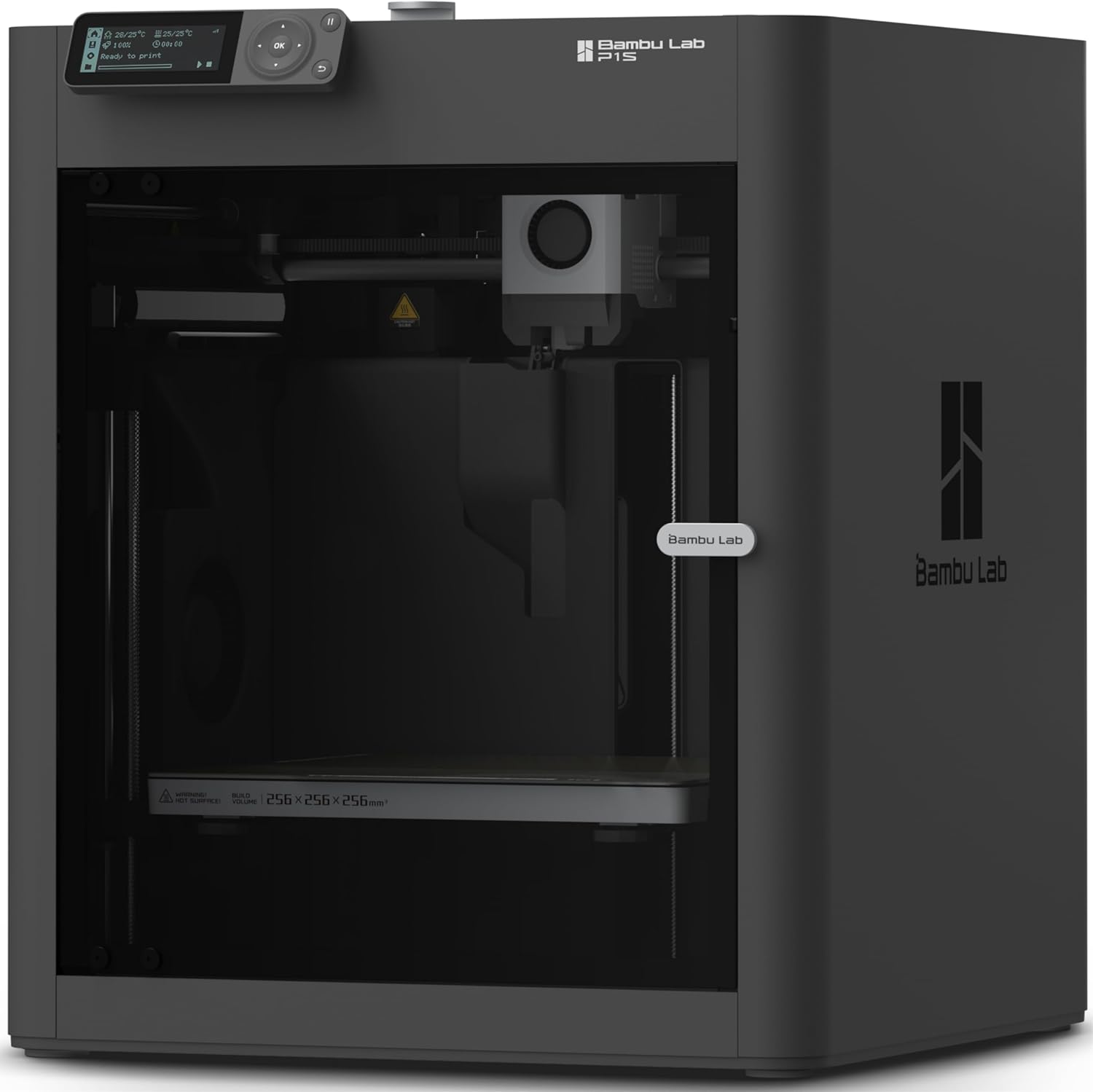
| Build Volume | 256×256×256 mm³ |
|---|---|
| Max Speed | 500 mm/s |
| Max Acceleration | 20 m/s² |
| Supported Filaments | PLA, PETG, TPU, PVA, PET, ABS, ASA |
The Bambu Lab P1S is an enclosed CoreXY FDM printer aimed at users who want high speed and reliable prints with minimal fuss. It prints at up to 500 mm/s and offers automatic bed leveling, a direct-drive extruder that broadens filament compatibility, and an enclosed build to better handle temperature-sensitive materials. The P1S supports a wide range of common filaments including PLA, PETG, TPU, PVA, ABS and ASA and can be paired with Bambu Lab AMS for multi-color or multi-material work. Setup is straightforward and the MakerWorld model library plus a built-in camera for timelapses make it approachable for beginners while still appealing to experienced hobbyists who value speed. The practical payoff is faster turnaround and fewer failed prints versus many hobby printers, though extreme engineering filaments like carbon or glass-filled composites are not recommended. The printer's 256×256×256 mm build volume and factory-oriented features make it a strong option for creators who want dependable, fast results without a steep learning curve.
Best for: Buyers who want a low-friction, reliable 3D printer that delivers fast, high-quality prints with minimal setup and guided resources for learning and production.
Less Ideal for: Users who need to print specialized composite filaments or who want a larger industrial build volume should consider different machines tailored to those needs.
- High top speed (up to 500 mm/s) for much faster prints than typical hobby printers
- Enclosed CoreXY design improves temperature stability for better results with advanced filaments
- Automatic bed leveling reduces setup time and failed first layers
- Direct-drive extruder expands the range of usable materials including flexible filaments
- Beginner-friendly ecosystem with MakerWorld library and built-in camera for timelapse capture
- Multi-color printing requires purchase and connection of the optional AMS accessory
- Not recommended for carbon or glass fiber reinforced filaments
Verdict: The P1S is a fast, enclosed, beginner-friendly printer that delivers reliable, high-quality FDM prints for makers who prioritize speed and ease of use.
Choosing the Right 3D Printer: Key Factors to Consider
Build Volume and Part Size
Build volume determines the maximum single-part dimensions you can print and how many parts fit per build. Larger build envelopes let you print full-size prototypes or batch multiple smaller parts in one run, which reduces per-part cycle time.
When evaluating build volume, consider usable print area rather than quoted envelope sizes. Chamber design, required support structures, and staging for post-processing can reduce effective capacity. If you plan to scale, a slightly larger bed often yields better throughput without greatly increasing complexity.
Material Compatibility and Processing
Different printers support different materials and preparation workflows, from standard thermoplastics to high-performance engineering resins and composites. Material compatibility impacts final part properties like heat resistance, chemical resistance, and mechanical strength.
Also check material handling requirements such as dry-box systems for hygroscopic filaments or heated build chambers for high-temperature polymers. The availability of certified materials and clear processing parameters reduces trial-and-error and shortens time to consistent parts.
Dimensional Accuracy and Repeatability
Accuracy and repeatability determine whether printed parts meet tolerance requirements without excessive post-processing. For functional prototypes and end-use components, consistent dimensions across multiple builds are often more valuable than visually fine surface finish.
Examine published tolerance data, recommended build orientations, and any calibration routines. Machines with automated calibration or easy-to-access adjustment points will help maintain accuracy as belts, rails, and nozzles wear.
Throughput and Uptime
Throughput is a function of print speed, allowable layer heights, and how often the machine needs intervention. Uptime depends on robust mechanical design, accessible maintenance points, and reliable consumables.
Consider how much operator time a machine requires. Systems that enable longer unattended runs and straightforward job queuing increase effective daily output and lower labor cost per part.
Maintenance, Support, and Consumables
Serviceability affects long-term ownership cost and machine availability. Look for machines with straightforward part replacement procedures, widely available wear items, and documented maintenance intervals.
Also consider the vendor or channel support network, spare-part lead times, and whether preventative maintenance kits are available. Clear service documentation shortens downtime and helps internal technicians manage routine upkeep.
Workshop and Facility Requirements
Professional 3D printers vary widely in power, ventilation, and space needs. Confirm electrical requirements, whether a dedicated circuit or three-phase power is necessary, and the printer's thermal output. Ventilation or filtration may be required for some material families to manage fumes or particulates.
- Confirm electrical service and outlet placement before purchase
- Plan for ventilation, fume extraction, or filtration when printing resins or high-temperature polymers
- Leave access room around the machine for filament/material loading and maintenance
Software, Workflow Integration, and Automation
A printer's software ecosystem affects how easily it fits into product-development or light-production workflows. Look for slicers or print managers that support job queuing, remote monitoring, and standardized profiles for the materials you plan to use. If you run multiple machines, networked management reduces manual oversight.
- Check for cloud or local job management and remote status notifications
- Look for API access or file-format compatibility with your CAD and PLM tools
- Consider whether the vendor offers pre-built profiles for the specific materials you will use
Post-Processing Needs and Space Planning
Post-processing often requires as much planning as the printer itself. Depending on material and support strategy, you may need wash stations, curing ovens, sanding and finishing areas, or secondary machining. Factor this equipment and its footprint into overall space and budget planning.
- Identify all required post-processing steps for your chosen materials
- Allocate space for curing, washing, or thermal treatment near the printer to reduce handling time
- Plan for consumables storage and waste handling
Scaling From Prototype To Light Production
If you expect to move from prototyping to small-batch production, think about part repeatability, spare-part inventory, and operator training. Machines that simplify setup and offer consistent output will scale more smoothly. Also evaluate whether small procedural changes allow faster builds without compromising tolerances.
- Develop standard operating procedures for common part families
- Keep critical wear parts on hand to minimize downtime during production runs
- Benchmark cycle times for representative parts to estimate daily capacity
How We Chose the Best 3D Printer
We focused on capabilities that matter for buyers investing at the professional end but staying under a $50,000 cap. Selection began with machines offering clear specifications for build volume, material systems, and repeatable dimensional accuracy. We prioritized printers with proven workflows for common engineering materials, robust motion systems, and firmware or software that supports job queuing and remote monitoring. Evaluation criteria included maximum usable build volume, supported material families and processing requirements, dimensional accuracy and repeatability, production throughput and reliability, and serviceability including parts access and maintainability. We excluded machines lacking published technical specs or those oriented purely at hobbyists rather than professional workflows. Also filtered out equipment that required third-party modifications to reach basic industrial usability. The list favors systems that balance print quality with uptime and predictable operating costs. We considered footprint and facility needs because installation constraints often influence whether a purchase succeeds. Finally, we screened for manufacturers that document maintenance schedules and supply chains for replaceable wear parts, since ongoing support is critical for professional use.
Our full evaluation process is outlined in our review methodology.
FAQ
How do I choose the right build volume for my needs?
Start by measuring the largest parts you will print and add clearance for fixturing and supports. If you will batch multiple parts, estimate how many need to fit on a single build plate and choose a volume that minimizes wasted space and reduces total cycle time.
Are professional 3D printers hard to maintain?
Maintenance complexity varies, but most professional machines follow predictable schedules for items like belts, bearings, and nozzle wear. Machines with clear documentation and modular parts are easier to service, and routine upkeep is usually straightforward for trained technicians.
Can I use industrial filaments with any machine under $50,000?
Material use depends on the printer's thermal capabilities, extrusion system, and chamber design. Some high-performance filaments need heated chambers, hardened nozzles, or dry material handling, so check the machine's stated compatibility and requirements before planning production parts.
How important is software compatibility with existing CAD workflows?
Software compatibility is important for minimizing manual file prep and avoiding errors. Printers that accept common file formats and offer reliable slicing profiles or API integration will reduce setup time and support a smoother production workflow.
What roughly determines operating costs over time?
Operating costs come from consumables, maintenance parts, energy usage, and labor for setup and post-processing. Machines that enable larger batch builds and reduce operator intervention typically lower per-part operating costs.
Final Verdict
Prioritize the factors that most directly affect your projects: build volume if you need large parts or high batch counts, material compatibility if the parts require specific mechanical or thermal properties, and uptime if you plan continuous production runs. Expect tradeoffs between raw speed and achievable accuracy, and plan facility and post-processing resources alongside the printer purchase. Choose a system with clear service documentation and accessible consumables to keep downtime low and production predictable.