
Note: This article contains affiliate links. If you click on these links and make a purchase, we may earn a small commission at no extra cost to you. This helps support our research and content. Read our full affiliate disclosure here.
Picking the right air purifier for a 300 sq ft room matters because filter capacity, airflow, and noise determine whether the unit actually improves daily indoor air. In a mid-size bedroom, living room, or home office you want equipment that clears allergens, dust, and odors without running loudly or consuming excessive power. This guide shortlists the top picks for that room size and explains how we evaluated them across real-use factors like clean-air delivery and operating sound. Read on for focused buying guidance and the practical tradeoffs to expect.
Top Picks at a Glance
| Best Quality Built to a higher standard if you want something more solid | BLUEAIR Blue Pure 511 |  |
| Best Value The sweet spot between price and what you get | Wozoyo Pure Air PA1 |  |
| Top Rated A top-rated pick with lots of positive feedback | Jafanda JF260 Air Purifier |  |
| Most Popular A crowd favorite that many people choose with confidence | Levoit Core 300-P Air Purifier |  |
| Best Seller A high-volume bestseller chosen again and again | Levoit Core Mini-P |  |
BLUEAIR Blue Pure 511

| Floor Area | 432 square_feet |
|---|---|
| Noise Level | 24 db |
| Particle Retention Size | 0.1 micron |
| Filter Type | Activated Carbon |
| Power Source | Corded Electric |
The Blueair Blue Pure 511 is a compact plug-and-play air purifier built to deliver strong particle removal in small to medium rooms. It uses Blueair's HEPASilent dual filtration combining a washable pre-filter and HEPA-class filter with activated carbon to capture particles down to 0.1 micron and reduce odors. The unit is easy to use with a single-button touch control, a compact footprint that fits on a desk or nightstand, and washable pre-filters for simple upkeep. Measured noise is very low on its quiet setting and rises predictably on higher fan speeds, so it works well in bedrooms and home offices where low sound matters. Performance claims include cleaning up to 432 sq ft on high speed within 30 minutes and recommended AHAM-style air changes for rooms around 192 sq ft for best results. Limitations are the basic control set with no timers or smart connectivity and the need to replace the main filter about every six months under regular use, so ongoing filter cost and manual replacement reminders are factors to plan for.
Best for: Buyers who prioritize measurable particle-removal performance and quiet operation in a compact unit for bedrooms or 300 sq ft living spaces.
Less Ideal for: People who want smart-connected features, advanced scheduling, or a purifier sized for much larger open-plan areas should look elsewhere.
- HEPASilent dual filtration captures particles down to 0.1 micron and reduces odors with activated carbon
- Quiet operation rated as low as 24 dB for bedroom or office use
- Compact footprint fits small spaces and is easy to place
- Washable pre-filter allows simple cleaning and cosmetic customization
- Controls are basic with no app, timer, or advanced automation
- Replacement HEPA filter needs swapping roughly every six months under typical use
Verdict: Choose the Blue Pure 511 when you want a compact, whisper-quiet purifier that delivers proven HEPA-class particle removal for small to mid-size rooms.
Wozoyo Pure Air PA1

| Coverage | Up to 300 ft² (1 ACH) |
|---|---|
| CADR / Airflow | 40 CFM |
| Filtration | Pre-filter, True HEPA, Activated Carbon |
| Noise level | ≥ 22 dB |
The Wozoyo Pure Air PA1 is a small, desk-friendly air purifier designed to clean air in bedrooms, home offices, and other rooms up to roughly 300 square feet. It uses a three-stage filter stack — pre-filter, True HEPA, and activated carbon — to capture PM2.5/PM10 particles, pet dander, smoke, and odors, while delivering about 40 CFM airflow. The unit offers three fan speeds, low-noise operation down to about 22 dB, and a compact footprint that fits on a nightstand or desk. AHAM verification means its performance has been independently tested for CADR and efficiency, which helps in choosing the right purifier for a single-room setup. Practical benefits include straightforward filter-based filtration and quiet overnight use, but buyers should note its modest airflow and 1 ACH rating at the maximum advertised coverage, so larger or open-plan rooms will need a larger unit or multiple purifiers. Replacement filters and ongoing filter changes are a recurring cost to maintain performance.
Best for: Buyers who want a verified, low-noise purifier to keep air cleaner in a single bedroom or home office and who prioritize compact size and proven filtration.
Less Ideal for: People needing to clean air in large, open-plan living areas or multiple connected rooms should choose a higher-CADR unit or multiple purifiers instead.
- True HEPA plus activated carbon captures fine particles and common odors
- AHAM verified performance gives an independent check on room coverage
- Compact, lightweight design fits on desks or bedside tables
- Low-noise operation suitable for sleep or focused work
- Airflow (40 CFM) and 1 ACH rating limit effectiveness in larger or open-plan spaces
- Small unit means frequent filter replacements relative to larger purifiers
Verdict: A compact, AHAM-verified HEPA purifier that quietly and effectively protects a single bedroom or home office up to about 300 sq ft.
Jafanda JF260 Air Purifier

| CADR | 153 CFM / 260 m³/h |
|---|---|
| Filtration | True HEPA & 300 g Activated Carbon |
| Coverage | Up to 1190 ft² (spec sheet rates cycles at multiple room sizes) |
| Noise level | As low as 23 dB (Sleep Mode) |
The Jafanda JF260 is a compact tower air purifier built to clean large rooms with a 3-in-1 system combining a True HEPA filter and a heavy activated carbon layer. It is typically placed on the floor in living rooms or bedrooms and runs on five fan speeds, including an auto mode that adjusts airflow based on the built-in PM2.5 sensor. The unit's CADR and stated coverage mean it can cycle air frequently in spaces up to the advertised area, and the sleep mode drops noise to the low 20s dB for minimal disruption at night. Practical benefits include strong particle and odor removal from the HEPA plus 300 g carbon stage, an easy-to-read air quality display, and multiple speed levels for tuning between quiet and faster cleaning. Limitations are standard for this class: filters will require periodic replacement and effectiveness depends on keeping doors closed and correct placement, and the unit lacks advanced smart-home integration on this SKU. For someone who values straightforward, reliable filtration and a quiet night mode, it performs well in real rooms around the 300 sq ft size.
Best for: Buyers who prioritize a dependable, no-frills purifier that reliably reduces particles and odors in everyday rooms and values quiet nighttime operation.
Less Ideal for: Those who need integrated smart-home features, app control, or multi-room networked purification should consider alternatives with built-in Wi-Fi and voice assistants.
- True HEPA filtration combined with 300 g activated carbon for particles and odors
- Built-in PM2.5 sensor with auto mode to adjust fan speed to air quality
- Very quiet sleep mode (around 23 dB) suitable for bedrooms
- Multiple fan speeds for balancing noise and cleaning speed
- Filter elements require regular replacement to maintain performance
- No built-in smart app or voice control on this model
Verdict: A solid, quiet HEPA-and-carbon purifier that reliably cleans a ~300 sq ft room without unnecessary smart features.
Levoit Core 300-P Air Purifier

| Power Source | Corded Electric |
|---|---|
| Filter Type | 3 in 1 Filtration |
| Floor Area | 1073 square_feet |
| Noise Level | 24 db |
| Wattage | 56 watts |
The Levoit Core 300-P is a small, efficient air purifier built around a 3-stage original filter and a HEPA-grade filtration that captures 99.97% of particles down to 0.1–0.3 microns. It is intended for bedroom or home use and can refresh air in a 222 ft² room nearly five times per hour and handle up to a 1,073 ft² area at a slower rate, making it well suited for single rooms. The unit uses a 56W motor with a CADR in the 140–167 CFM range, has touch controls, a timer, and a near-silent Sleep Mode at about 24 dB for overnight use. Practical strengths include proven filtration performance for smoke, pollen, pet dander, and VOCs and certifications such as AHAM and CARB for verified cleaning capability and safety. Expect routine filter replacements every 6–8 months for best results and manual speed control on this model since it lacks Auto Mode and smart connectivity found on some variants. The compact footprint and quiet operation make it easy to place in bedrooms or offices, though buyers should plan for ongoing filter costs and manual operation adjustments.
Best for: A buyer who values independently verified performance and quiet overnight operation for a single room will appreciate this purifier for bedrooms, home offices, and spaces with pets or smoke concerns.
Less Ideal for: People who want smart features, automatic air-quality adjustments, or fast whole-house cleaning should consider other models with Auto Mode or higher CADR ratings.
- HEPA-grade 3-stage filter captures 99.97% of 0.1–0.3 μm particles
- Certified performance with AHAM, CARB, and ETL listings
- Quiet Sleep Mode reduces noise to about 24 dB for bedroom use
- Compact, portable design that fits small rooms and desks
- Touch controls, timer, and a check-filter indicator for simple operation
- No built-in Auto Mode or smart connectivity on this specific model
- Requires filter replacement every 6–8 months, adding ongoing cost
- Coverage rate means it refreshes larger open areas much more slowly than small rooms
Verdict: A compact, AHAM-verified HEPA purifier that reliably cleans bedroom-sized rooms with whisper-quiet sleep performance, making it a safe choice for cautious buyers seeking proven results.
Levoit Core Mini-P
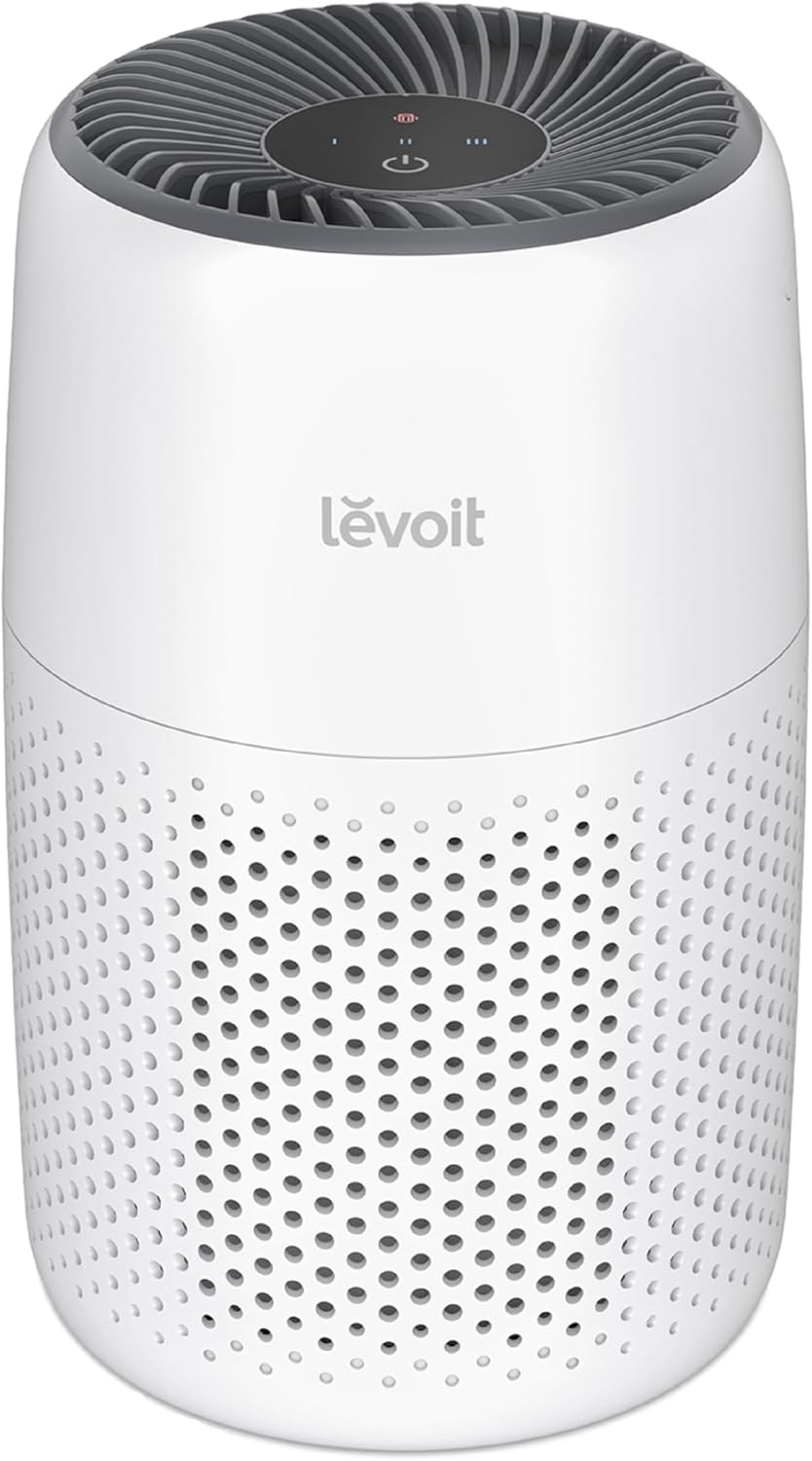
| Rated Power | 7W |
|---|---|
| Noise Level | 27-45dB |
| Adapter Input | 100-240V, 50/60 Hz |
The Levoit Core Mini-P is a small, plug-in air purifier intended for near-desk or bedside use in compact spaces. It uses a pre-filter and main HEPA-style filter to capture lint, hair, pet dander, smoke and other fine airborne particles while offering a quiet sleep mode and an auto-off display to reduce disturbances. The unit draws very little power and includes an aromatherapy sponge for light scenting when used with a couple drops of essential oil. Practical benefits include straightforward setup, a compact footprint that fits on nightstands or desks, and noise levels low enough for sleeping or focused work. Limitations are its coverage and airflow: the Core Mini-P is built for small zones rather than whole-room circulation in larger spaces, and the small filter means more frequent replacements under heavy use. The included adapter and simple controls make it easy for risk-averse buyers to operate without smart-home integration or complex maintenance.
Best for: Buyers who prioritize a simple, reliable purifier for a small bedroom, office, or dorm room and want a unit that is easy to set up and runs quietly without smart features.
Less Ideal for: People needing to clean the air in a full 300 sq ft open-plan living room or larger shared spaces should choose a higher-capacity purifier with greater airflow.
- Compact footprint fits on desks and nightstands
- Quiet operation suitable for sleep mode
- Captures pet dander, dust, smoke and other fine particles
- Low power draw with simple plug-in setup
- Limited coverage area not ideal for larger rooms
- Small filter requires more frequent replacement under heavy use
Verdict: A quiet, easy-to-use compact purifier for small personal spaces where low noise and simple operation are top priorities.
Choosing the Right Air Purifier for 300 Sq Ft Room: Key Factors to Consider
Clean-Air Delivery Rate (CADR) and Room Coverage
CADR measures how quickly an air purifier can reduce particulates in a room. For a 300 sq ft room you want a unit with a CADR that supports multiple air changes per hour at that footprint. Higher CADR values mean faster clearing of smoke, dust, and pollen, which is critical if occupants suffer allergies or if the room sees frequent activity.
Room coverage ratings provided by manufacturers are a starting point, but prioritize verified CADR figures where available. A purifier with an appropriate CADR will reach a target number of air exchanges without needing to run at maximum fan speed constantly, which improves longevity and comfort.
Filtration Technology and Filter Stages
Not all filters are equal. A true HEPA stage is essential for trapping fine particles down to 0.3 microns, while additional activated carbon or odor-targeting layers address smells and volatile organic compounds. Some designs add pre-filters to catch large debris and extend HEPA life, which lowers replacement frequency and cost.
Consider whether the purifier supports replaceable filter cartridges and how clearly filter life and replacement steps are signaled. For common indoor concerns—pollen, pet dander, cooking odors—look for multi-stage filtration that combines particulate capture with carbon-based gas adsorption.
Noise Levels and Fan Speed Control
A purifier that works well but is too loud will spend fewer hours running, defeating its purpose. Check measured noise levels at low, medium, and high fan speeds, especially the low-speed decibel rating for overnight use. Models with multiple speed steps or adaptive automatic modes let you balance quiet operation with cleaning power as conditions change.
Also evaluate how the unit signals mode changes. Subtle indicators and a night mode that dims lights or lowers display brightness improve usability in sleeping areas.
Energy Use and Continuous Operation Cost
Air purifiers often run for many hours a day, so energy consumption matters. Compare wattage at typical operating settings and whether the purifier offers energy-saving features like timers, eco modes, or intelligent sensors that reduce fan speed when air quality is good. Lower continuous power draw reduces operating costs and heat output, which is important in smaller rooms.
When estimating long-term cost, include replacement filter frequency and typical electricity use over months rather than focusing only on initial specifications.
Maintenance, Filter Availability, and Running Costs
A unit with cheap replacement filters or long filter life will be less expensive to own. Check how filters are replaced, whether replacements are easy to find, and if the purifier alerts you when service is needed. Simple access to service parts and clear instructions reduce downtime and user frustration.
Also consider build quality in areas that affect maintenance, such as washable pre-filters, tool-free access panels, and modular filter stacks that minimize mistakes during replacement.
Placement, Size, and Room Integration
Where you place a purifier affects its effectiveness. For a 300 sq ft room, you need a device that fits without obstructing airflow. Units with a small footprint can be tucked into corners, but those designs must still allow intake and exhaust clearance. Evaluate the purifier's suction direction and whether it draws air from the sides, bottom, or rear when planning placement.
Also consider aesthetic and noise factors for living spaces. A compact unit with subdued styling and manageable footprint is easier to integrate into bedrooms and common areas while still delivering the needed airflow.
Sizing the Purifier for Real-World Air Exchanges
Room ratings from manufacturers are helpful but can be optimistic. Calculate expected air changes per hour by matching the purifier's CADR to your 300 sq ft room height and layout. Aim for a unit that can provide at least two to four air exchanges per hour under typical household conditions.
Remember obstructions such as furniture and open doors will reduce effective coverage. When in doubt, slightly oversize the purifier for the space to maintain performance without excessive fan noise.
- Use CADR rather than advertised square-foot ratings when possible
- Account for ceiling height in coverage calculations
- Place units centrally or along unobstructed walls for best airflow
Managing Allergens and Pet Dander
If allergies or pets are a primary concern, prioritize HEPA-class filtration and accessible pre-filters. HEPA removes the fine particulates that trigger many symptoms, while pre-filters reduce hair and large debris buildup to extend service life.
Consider pairing the purifier with good cleaning habits like vacuuming with HEPA-filter vacuums and controlling pet access to sleeping areas to reduce overall particulate load.
- Run purifier continuously in bedrooms during allergy seasons
- Use higher fan speeds temporarily after activities that generate dust
Noise, Night Use, and Bedrooms
For bedroom placement, the unit should be quiet at night and have a dim or switchable display. Many purifiers advertise a quiet night mode that reduces fan speed and mutes indicators. Verify low-speed decibel ratings and look for user controls to schedule or adjust operation automatically.
If you are sensitive to fan noise or vibration, check for reviews that measure sound or mention humming. Some models include vibration-dampening feet or rubber mounts to minimize resonance with furniture.
- Choose models with a night mode and adjustable display brightness
- Look for multiple fan speeds and automatic sensing modes
Dealing with Odors and VOCs
Activated carbon stages are necessary to reduce cooking smells, smoke, and many volatile organic compounds. Pure HEPA filters do not address gases, so a combined filter stack is preferable in kitchens or rooms prone to odors.
Keep in mind carbon layers saturate over time. If odors return or the unit seems less effective, replacing the carbon filter or running higher airflow briefly can help restore perceived performance.
- Prefer multi-stage filters with dedicated carbon or adsorption media
- Check expected carbon filter life and replacement costs
Placement Tips and Avoiding Common Mistakes
Do not block intake or exhaust ports with furniture or walls. Leave several inches of clearance and avoid placing the purifier directly behind couches or curtains. Corners can work but may reduce circulation compared with a more open location.
Avoid putting the unit on soft surfaces that impede airflow. For rooms with multiple occupants, centrally locating the purifier or using two smaller units can produce more uniform air cleaning than a single device tucked away.
- Keep 6 to 12 inches clearance around intakes and exhausts
- Position intake opposite pollutant sources when possible
How We Chose the Best Air Purifier for 300 Sq Ft Room
We selected candidates by focusing on performance characteristics that directly affect how well an air purifier works in a roughly 300 sq ft space. Key filters included verified clean-air delivery rates appropriate for the specified room size, multi-stage filtration that includes a true HEPA element, and reported noise levels at typical operating speeds. We also prioritized units with reasonable energy consumption for continuous use and straightforward filter replacement systems for ongoing maintenance. To keep recommendations practical, we excluded specialty commercial-grade machines and units undersized for a 300 sq ft footprint. We did not include purifiers that rely solely on ionization without HEPA-class filtration. Final selection weighed measurable performance data and user-facing features such as intuitive controls, filter availability, and warranty coverage. The result is a set of options that balance efficiency, quiet operation, ease of ownership, and day-to-day running cost.
Our full evaluation process is outlined in our review methodology.
FAQ
How often should I run an air purifier in a 300 sq ft room?
Often continuous operation is best for consistent air quality, especially during allergy seasons. Many users run purifiers 24/7 on a low or automatic setting and increase fan speed only when needed.
Will a purifier for 300 sq ft remove cooking odors and smoke?
It depends on the filter stack. Units with activated carbon or dedicated adsorption media handle odors and many smoke-related gases better than HEPA alone. For heavy smoke events, higher airflow or temporary placement near the source helps.
How do I estimate the right CADR for my room?
Calculate required air changes per hour based on room volume. Then choose a purifier whose CADR supports that exchange rate at the expected ceiling height. Aiming for two to four air changes per hour is a common practical target for living spaces.
Are quieter purifiers less effective?
Not necessarily. Quiet operation usually means lower fan speed, which reduces immediate cleaning rate. However, a quieter unit that runs continuously can achieve similar cumulative air cleaning over time. Balance noise tolerance with required CADR.
How much does filter replacement frequency affect performance?
Filters that are clogged or past their service life lose efficiency and can reduce airflow. Regular replacement or cleaning maintains design performance. Expect replacement frequency to depend on usage, pollutant levels, and whether pre-filters are used.
Final Verdict
For a 300 sq ft room prioritize a purifier with an appropriate CADR, true HEPA filtration, and an activated carbon stage if odors are a concern. Balance noise and energy use so the unit will run when you need it most. Consider maintenance costs and filter availability as part of the ongoing ownership picture. Focus on measured airflow and real-world operating characteristics rather than headline coverage numbers. That approach helps ensure you choose a practical, reliable purifier that keeps the mid-size room comfortable and healthier over the long term.