
Note: This article contains affiliate links. If you click on these links and make a purchase, we may earn a small commission at no extra cost to you. This helps support our research and content. Read our full affiliate disclosure here.
If you are dealing with ammonia odor or elevated ammonia levels in a living space, choosing the right air purifier matters for comfort and safety. Ammonia is a small, reactive gas that standard particle-only units struggle to remove, so you need systems designed to capture gases and odors in addition to particles. This guide shortlists the seven best air purifiers for ammonia and explains the practical differences among technologies, room-size coverage, maintenance needs, and real-world performance factors. Below we summarize the top picks and then walk through what matters when you pick a unit for ammonia control, including filter types, airflow rates, and the recurring costs you should expect.
Top Picks at a Glance
| Best Overall The best all-around choice for most situations | Coway Mighty AP-1512HH |  |
| Best Quality Built to a higher standard if you want something more solid | Airpura C700 DLX |  |
| Best Value The sweet spot between price and what you get | GermGuardian AC4825E Tower Air Purifier |  |
| Best Budget The cheapest option that still gets the job done reliably | MEGAWISE True HEPA Air Purifier EPI810 |  |
| Top Rated A top-rated pick with lots of positive feedback | PuroAir 100i HEPA Air Purifier |  |
| Most Popular A crowd favorite that many people choose with confidence | Levoit Core 300-P |  |
| Best Seller A high-volume bestseller chosen again and again | VOOPNU HEPA Air Purifier DH-JH12 |  |
Coway Mighty AP-1512HH

| Coverage | Up to 1,748 sq. ft. in 60 minutes |
|---|---|
| Filtration stages | Pre-filter, Deodorization, Bipolar, HEPA |
| HEPA effectiveness | 99.97% of 0.3 μm particles |
| Modes | Auto, Eco, Timer |
| Filter lifespan | Up to 1 year |
The Coway Mighty AP-1512HH is a four-stage air purifier built to clean medium-to-large spaces quickly and quietly. It combines a washable pre-filter, deodorization/activated carbon stage, bipolar ionizer, and a True HEPA filter that captures 99.97% of 0.3 micron particles to reduce pollen, pet dander, smoke and fine particulate. A built-in air quality sensor drives Auto mode so the fan speed adjusts to changing conditions, and an LED indicator shows real-time air quality with an option to dim for sleep. The unit is straightforward to use, offers a filter indicator for maintenance, and includes eco and timer modes to reduce energy use. The purifier's coverage claim is up to about 1,748 sq ft per 60 minutes, which makes it suitable for open living areas or multiple adjacent rooms; custom replaceable filters are available for extra odor or smoke removal. Limitations are the need to replace filters periodically and that peak performance depends on correct placement and regular pre-filter cleaning rather than continuous factory calibration.
Best for: Buyers who want a reliable, sensor-driven purifier that balances strong particle filtration with practical features for everyday living spaces and occasional odor or gas concerns.
Less Ideal for: People who need a portable travel unit, or those seeking an ultra-compact bedroom-only purifier with minimal upfront filter maintenance.
- True HEPA filtration captures 99.97% of 0.3 μm particles for effective allergen and particulate removal.
- Four-stage system including washable pre-filter and activated carbon for odor and VOC reduction.
- Auto mode with real-time air quality sensor adjusts fan speed automatically.
- Filter life indicator and washable pre-filter simplify maintenance and tracking.
- Quiet operation and Eco mode reduce noise and energy use during light-duty periods.
- Filters require periodic replacement to maintain performance.
- Coverage and pollutant removal rates are dependent on room layout and placement rather than guaranteed for all real-world conditions.
Verdict: Choose the Coway Mighty AP-1512HH when you want a sensor-driven, high-efficiency purifier that handles allergens and reduces odors and gases across larger living areas.
Airpura C700 DLX

| CFM | 635 CFM |
|---|---|
| HEPA efficiency | 99.97% at 0.3 microns |
| Coverage | Up to 2,000 sq. ft (with 2 air exchanges/hour) |
The Airpura C700 DLX is a heavy-duty air purifier built for chemical and gas abatement in large rooms. It combines a very high airflow rate (listed at 635 CFM) with a deep carbon adsorption stage and a true HEPA barrier that captures 99.97% of particles down to 0.3 microns, making it well suited for tackling ammonia and other VOCs. The unit provides 360 degree air distribution and is rated to treat up to about 2,000 sq ft with multiple air exchanges per hour, so it is typically used in open living areas, workshops, or spaces with persistent odor or chemical concerns. Practical benefits include strong contaminant removal performance and relatively quiet operation for its capacity. Trade-offs are its size and weight and the fact that such high-capacity filtration requires periodic replacement of large carbon and HEPA filters and adequate power and placement to realize the stated coverage. It is best deployed where continuous high-flow filtration is needed rather than for small bedrooms or travel use.
Best for: Buyers who prioritize maximum chemical and particle removal in large indoor spaces and need continuous, high-flow filtration for odors or VOCs.
Less Ideal for: People seeking a compact, lightweight bedroom unit or an inexpensive occasional-use purifier should look at smaller models instead.
- Very high airflow (635 CFM) for rapid air exchanges in large rooms
- Deep carbon filtration designed for broad-spectrum chemical and VOC adsorption
- True HEPA barrier captures 99.97% of particles down to 0.3 microns
- 360 degree air distribution for even coverage up to roughly 2,000 sq ft
- Large and heavy which makes placement and moving more difficult
- Requires replacement of sizeable carbon and HEPA filters, adding ongoing maintenance
Verdict: Choose the Airpura C700 DLX when you need industrial-scale VOC and ammonia removal delivered by very high airflow and deep carbon adsorption.
GermGuardian AC4825E Tower Air Purifier

| Room coverage claim | 153 sq. ft. circulation every 12.5 minutes; up to 743 sq. ft. hourly |
|---|---|
| Filter type | True HEPA with activated carbon pre-filter |
| Speeds | Three fan speeds with sleep mode |
| Optional feature | UV-C light |
The GermGuardian AC4825E is a compact tower air purifier built around a True HEPA filter with an activated carbon pre-filter and optional UV-C sanitizer. It is intended for everyday home use in bedrooms, living rooms, basements, and offices and moves room air frequently — the manufacturer states full circulation for a 153 sq ft room about every 12.5 minutes and hourly for much larger rooms. Three fan speeds including a quiet sleep setting make it easy to run continuously, while the carbon layer helps reduce cooking, pet, and general household odors. The unit is compatible with several genuine GermGuardian replacement Filter B cartridges and UV-C bulbs for straightforward maintenance. Limitations to note are that odor and gas removal is performed by a basic activated carbon pre-filter rather than an advanced multi-layer gas-specific filter, so persistent chemical gases like strong ammonia will be reduced but not eliminated as quickly as with dedicated gas/chemical filters. Noise and filter-replacement costs are typical for this class but worth factoring into long-term use.
Best for: Buyers who want a reliable, space-saving purifier to reduce allergens and common household odors across bedrooms, living rooms, or offices and who prioritize continuous, low-effort operation.
Less Ideal for: Homes or workspaces dealing with strong chemical gases or industrial ammonia sources should choose a purifier with an explicit gas/chemical or higher-capacity carbon/adsorbent stage instead.
- True HEPA filter captures 99.97% of particles down to 0.1 microns for effective allergen removal
- Activated carbon pre-filter reduces common household odors from cooking and pets
- Compact tower design fits small to medium rooms and offers three fan speeds including quiet sleep mode
- Compatible with genuine GermGuardian Filter B replacements and UV-C bulbs for easy upkeep
- Uses a basic carbon pre-filter rather than a specialized gas- or ammonia-targeting filter
- Not designed as a primary solution for strong chemical fumes or very high ammonia concentrations
Verdict: Choose this compact GermGuardian tower if you want dependable HEPA filtration and basic odor reduction for everyday home use, but pick a specialized gas filter for heavy ammonia problems.
MEGAWISE True HEPA Air Purifier EPI810

| True HEPA | Filters 99.97% to 0.3 μm |
|---|---|
| Coverage | Up to 215 sq ft |
| Fan speeds | 6-speed settings |
| Noise level | <25 dB in sleep mode |
| Filter | Washable filter |
The MEGAWISE EPI810 is a compact True HEPA air purifier meant for small to medium rooms such as bedrooms or home offices. It captures 99.97% of particles down to 0.3 microns and pairs a 360 degree dual-channel airflow with six speed settings to move air through a washable filter—useful for recurring dust, pet dander, cooking odors, and smoke. A near-silent sleep mode runs under 25 dB for nighttime use, and a negative ion option offers an extra freshness step. The unit also includes a filter replacement indicator and a lightweight, portable form factor that fits on desks or nightstands. Important practical limits are its modest coverage cap around 215 square feet and reliance on a washable filter which may not perform like multi-stage disposable cartridges for heavy chemical odors; while it handles particulates well, persistent gaseous contaminants may require an activated carbon stage or larger purifier for faster removal. For everyday particulate control in smaller rooms this unit delivers strong value and quiet operation.
Best for: Buyers looking for an affordable, low-footprint purifier to reduce smoke, dust, and pet particles in a bedroom or small living space while keeping running costs low.
Less Ideal for: Homes that need fast removal of strong chemical or ammonia odors or very large rooms should consider larger purifiers with dedicated carbon adsorption stages instead.
- True HEPA filtration that captures 99.97% of particles down to 0.3 μm
- 360° dual-channel airflow for even circulation in rooms up to 215 sq ft
- Six fan speeds plus near-silent sleep mode for quiet overnight use
- Washable filter reduces ongoing filter purchase costs and is easy to clean
- Compact and lightweight design fits on desks, nightstands, or shelves
- Washable filter may not remove odors and gases as effectively as a dedicated activated carbon cartridge
- Coverage is limited to about 215 sq ft so larger open-plan spaces may need a bigger unit
- Negative ion feature can produce ozone-like byproducts in some environments
Verdict: A budget-friendly, compact HEPA purifier that quietly removes fine particles in bedrooms and small rooms while keeping operating costs low.
PuroAir 100i HEPA Air Purifier
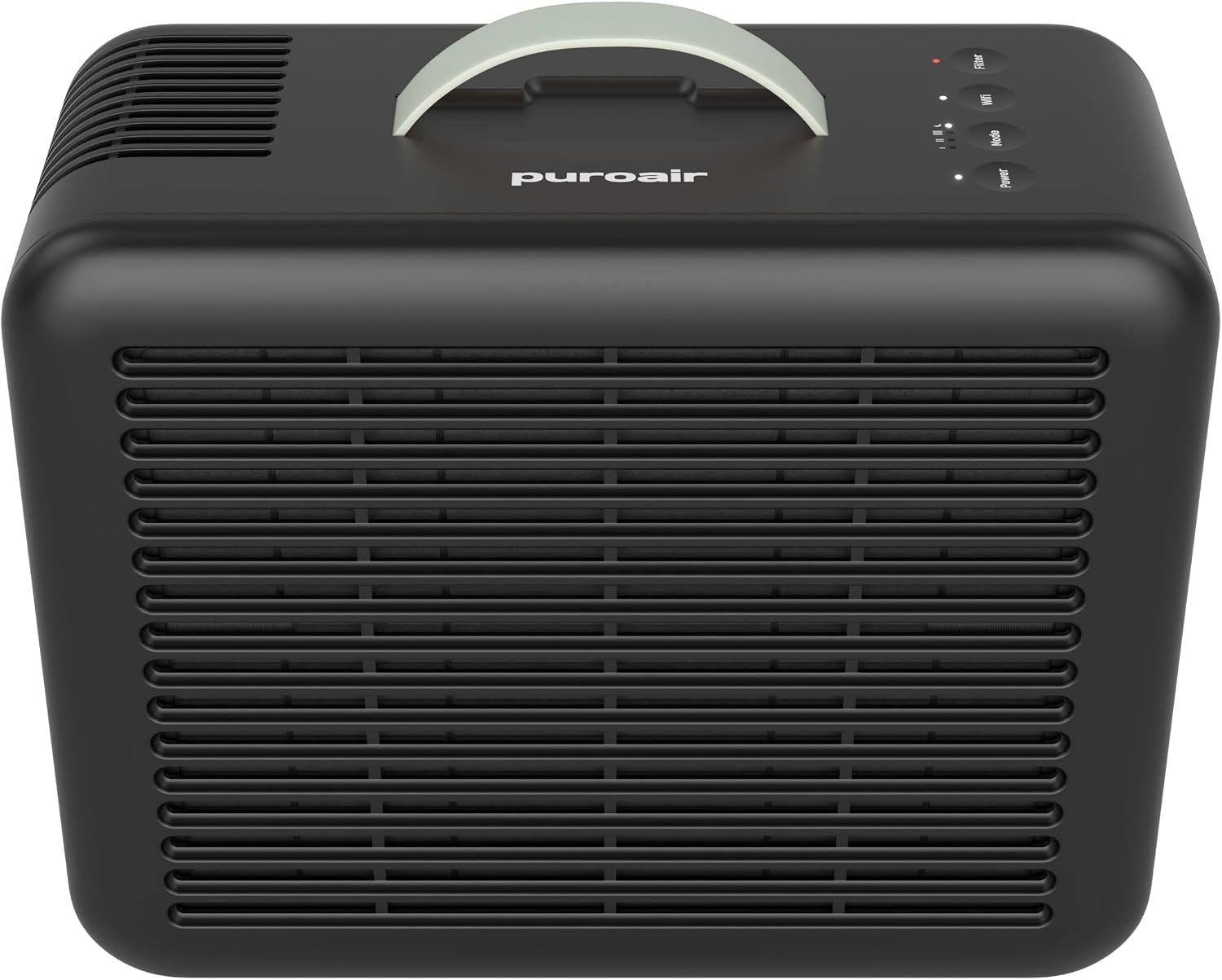
| Model | PuroAir 100i |
|---|---|
| Coverage | Up to 550 sq ft |
| Filtration | Pre-filter, True HEPA, Activated Carbon |
| Connectivity | Wi‑Fi, App control |
The PuroAir 100i is a small, Wi‑Fi enabled HEPA air purifier built for bedrooms, offices, and other compact spaces. It uses a three-layer filtration stack—pre-filter, True HEPA, and activated carbon—to capture dust, pollen, smoke, odors, and common household pollutants, and the manufacturer cites third‑party lab testing for particle removal. The unit offers multiple fan speeds, a quiet sleep mode for overnight use, and smartphone control through the PuroAir app so you can change settings remotely and run schedules. Its stated one‑hour coverage up to 550 sq ft means it can refresh air in medium rooms relatively quickly, and replacement filters are available as official parts. The practical downsides are that an activated carbon stage is required to reduce gaseous odors like ammonia, and effectiveness depends on carbon quantity and contact time, which the listing does not quantify. Also the compact footprint limits airflow compared with larger purifiers, so larger or heavily polluted spaces may need a higher‑capacity model or multiple units.
Best for: Buyers who prioritize dependable, lab‑tested particle removal and want a compact, app‑controlled purifier for bedrooms or medium rooms where consistent operation and easy maintenance matter.
Less Ideal for: Those needing industrial‑strength gas removal or whole‑house odor control should consider higher‑capacity units or dedicated gas/activated carbon systems rather than this compact model.
- Three-layer filtration with True HEPA and activated carbon for particles and basic odors
- App and Wi‑Fi control for remote monitoring and scheduling
- Quiet sleep mode suitable for overnight use
- Compact design covers up to 550 sq ft in one hour according to lab testing
- Genuine replacement filters available from the brand
- Listing does not specify activated carbon quantity or formal ammonia removal rate
- Smaller single‑room unit provides less airflow than larger purifiers for heavy odor loads
Verdict: A reliable, app‑enabled small‑room HEPA purifier with activated carbon that delivers dependable particle removal and convenient remote control.
Levoit Core 300-P

| Filter Type | 3 in 1 Filtration |
|---|---|
| Floor Area | 1073 square_feet |
| Noise Level | 24 db |
| Particle Retention Size | 0.3 micron |
| Wattage | 56 watts |
The Levoit Core 300-P is a small, user-friendly air purifier built around a 3-stage filtration system with a HEPA-grade original filter that captures 99.97% of particles down to 0.1–0.3 microns. It is typically placed in bedrooms, living rooms, or offices and runs on a 56W motor that delivers respectable CADR figures for smoke, dust, and pollen; the listing cites a 143 CFM CADR for smoke and AHAM verification. Controls are touch-based with a dedicated Sleep Mode that drops noise to about 24 dB and allows the display lights to be turned off for nighttime use. Practical benefits include straightforward setup, a compact footprint for tight spaces, and certifications such as AHAM, CARB, and ETL that back performance and safety claims. Limitations to consider: the Core 300-P does not include Auto Mode or smart connectivity, so you must adjust fan speeds manually, and the manufacturer recommends using genuine Levoit replacement filters for best results. For removing ammonia specifically, HEPA alone does not chemically neutralize gases, so expect particle removal and some odor reduction but limited direct ammonia adsorption unless paired with a dedicated activated carbon specialty filter.
Best for: Buyers who prioritize proven, tested particle cleaning and quiet night operation and who prefer a compact, easy-to-use purifier backed by strong social proof and certifications.
Less Ideal for: People who need active ammonia or VOC removal out of the box or who require smart controls and automated air-quality sensing should consider a model with dedicated carbon/adsorbent filtration and Auto Mode instead.
- HEPA-grade 3-stage filtration captures very fine particulates down to 0.1–0.3 microns
- AHAM verified CADR and industry certifications for tested performance and safety
- Very quiet Sleep Mode at about 24 dB suitable for bedroom use
- Compact, portable design that fits small rooms and desks
- Simple touch controls with timer and filter check indicator for easy operation
- No Auto Mode or smart connectivity — fan speed must be set manually
- HEPA-focused filter provides limited chemical gas adsorption unless you add or use a carbon-specific replacement filter
Verdict: Choose the Core 300-P if you want a compact, AHAM-verified HEPA purifier that quietly handles particles and common odors with reliable, certified performance.
VOOPNU HEPA Air Purifier DH-JH12

| Filter | H13 True HEPA triple-layer |
|---|---|
| Coverage (lab) | Up to 1,076 ft² per hour (250 ft²/15 min) |
| Noise | Down to 22 dB |
| Speeds | 3 fan speeds |
The VOOPNU DH-JH12 is a small tower air purifier that uses H13 true HEPA filtration with a 360 degree intake to capture fine particles, pet hair, pollen, smoke, and typical household odors across small to medium rooms. It is intended for continuous, simple operation via a pared-down control panel with three fan speeds and a timer, and VOOPNU rates it to clean up to about 1,076 ft² per hour in lab testing (about 250 ft² every 15 minutes). The unit runs quietly down to 22 dB, so it is suitable for bedrooms, nurseries, or offices, and it includes an essential oil tray if you want mild scenting. Certified to common safety and emissions standards, the purifier also offers a washable prefilter and a replaceable multi-layer filter system that the brand recommends changing every 3 to 6 months depending on use. Limitations are the small physical footprint and modest CADR relative to large-room purifiers, and for persistent strong gases like ammonia you may need activated-carbon–heavy or specialist gas filters rather than relying on HEPA alone.
Best for: Buyers who want a simple, low-noise purifier for bedrooms or living areas and prioritize reliable particle removal with straightforward controls and certified safety.
Less Ideal for: Homes with strong chemical or ammonia odors where heavy activated carbon or specialized gas-phase filtration is required, or very large open-plan spaces that need higher CADR output.
- H13 true HEPA filtration captures 99.97% of fine particulates for allergy and particle reduction
- 360 degree intake helps pull air from all sides for more even coverage in a room
- Very quiet operation down to 22 dB suitable for sleep or work environments
- Compact footprint makes placement flexible on desks, nightstands, or corners
- Essential oil tray offers optional light scenting without complex accessories
- HEPA filter does not remove gases effectively on its own, so ammonia and other VOCs may require a carbon-focused filter
- Coverage claim is based on lab testing and performance will vary in real homes with continuous pollutant sources
- Replacement filter cycle may be as frequent as every 3 months under heavy use
Verdict: Choose this unit if you want a compact, whisper-quiet HEPA purifier that reliably reduces airborne particles in bedrooms and small living spaces.
Choosing the Right Air Purifier for Ammonia: Key Factors to Consider
Type of Filtration Media
Not all filters remove gases. Ammonia is a volatile, small molecule that moves with the air and requires adsorption or chemical neutralization rather than particle capture alone. Look for dedicated gas-phase media such as activated carbon with high surface area, impregnated carbon specifically formulated for ammonia or acidic/basic reactive media. The form factor — pelletized carbon, thick carbon blocks, or chemically treated cloth — affects contact time and capacity.
Higher media mass usually equals longer service life, but media density and surface treatment matter more for ammonia affinity. Avoid systems that rely only on HEPA or electrostatic filters when ammonia is your primary concern, since those target particles rather than gaseous pollutants.
Airflow Rate and Room Coverage
A purifier's ability to reduce ammonia depends on how much air it processes and how often it exchanges the room's air. Check clean air delivery ratio or specified CADR-like figures for the intended room size and aim for enough exchanges per hour to lower steady-state concentrations. Units undersized for the room will leave ammonia levels largely unchanged despite having gas-phase media.
Placement matters. Position the purifier so airflow is not obstructed and so the intake is near the probable source of ammonia when practical. Consider portable units for spot treatment versus whole-room devices when ammonia comes from a single area.
Media Capacity and Replacement Frequency
Adsorbent media saturates over time, and ammonia capacity is finite. A unit with larger or denser media will typically require less frequent replacement, which reduces maintenance downtime and long-term costs. However, media that is too tightly packed can restrict airflow and reduce overall effectiveness, so look for a balance between capacity and designed airflow.
Manufacturers that publish estimated service life under typical loading provide a better basis for planning. If such data is absent, expect to inspect or replace gas-phase filters more frequently when ammonia sources are constant.
Contact Time and Filter Configuration
Effective gas removal requires sufficient contact time between polluted air and sorbent media. Designs that force air through thicker beds or use staged filtration where gas-phase media follows a particle filter tend to perform better. Staged approaches prevent premature clogging of the adsorbent by particles and allow the sorbent to focus on gaseous molecules.
Consider units that specify engineered flow pathways or larger sorbent volumes rather than thin surface-coated layers. In-room mixing and fan speed also affect contact time, so matched fan power and sorbent depth are important.
Operational Noise and Intended Use
Because ammonia problems can be persistent, many users run purifiers for long periods. Noise output at typical operating speeds matters for bedrooms, living areas, and workspaces. Higher fan speeds improve removal rate but raise noise and energy consumption. Choose models with multiple speed settings and quiet modes for overnight use or occupied spaces.
Also evaluate whether the unit's typical operating noise is acceptable for the intended room and whether the manufacturer lists a low-noise nighttime setting that still provides some level of gas-phase treatment.
Ease of Maintenance and Filter Access
Regular inspection and timely replacement of gas-phase media keep performance consistent. Choose units with straightforward access to the gas-phase filter, clear replacement intervals, and readily available replacement media. Units that require disassembly or special tools to access sorbent packs increase the chance of skipped maintenance.
User-replaceable cartridges and clear visual indicators for end-of-life reduce guesswork. Consider whether a purifier allows buying media in larger bulk forms or only through proprietary sealed cartridges, as this affects long-term convenience and cost.
How Gas-Phase Filtration Works
Gas-phase filtration removes gaseous pollutants like ammonia by adsorbing or chemically converting them on specialized media. Unlike HEPA filters that trap particles, adsorbents such as activated carbon capture gas molecules on their surface through physical adsorption and chemical affinity.
Different sorbents have different affinities. For ammonia, media that is either chemically treated to react with basic compounds or has a pore structure suited to small polar molecules will perform better. Understanding this helps you interpret specification sheets rather than relying solely on marketing claims.
- Adsorption is limited by media capacity and will saturate over time.
- Staged filtration protects sorbent media from particle loading.
- Media form (granular, block, impregnated cloth) affects airflow and contact time.
Sizing a Unit for Real-World Ammonia Sources
Estimate the area and typical ammonia source strength when selecting a purifier. A unit rated for a larger room than the source area is safer because ammonia often concentrates near the source and moves through the space. Consider air changes per hour needed to steadily reduce gas concentration rather than just one-off odor removal.
In spaces with continuous sources, such as pet areas or utility rooms, prioritize units with higher continuous airflow and larger sorbent loads. For occasional odor events, a smaller, portable unit placed close to the source may suffice.
- Match CADR or airflow figures to your room size and use case.
- For continuous sources, lean toward higher exchange rates and larger media volume.
- For spot treatment, prioritize portability and quick-start performance.
Placement, Ventilation, and Source Control
An air purifier reduces airborne ammonia but does not eliminate the source. Best results combine purifier use with basic source control such as proper cleaning, ventilation, and reducing indoor generation. Place the purifier so airflow is unobstructed and, when practical, near the ammonia source.
Mechanical ventilation and open windows can complement a purifier by lowering overall room concentrations. However, in some cases ventilation can spread pollutants; use purifiers alongside targeted ventilation strategies rather than as a sole solution.
- Place intake near the likely emission point for faster reduction.
- Avoid tightly enclosing purifiers in cabinets or corners that restrict airflow.
- Use continuous low-speed operation for ongoing sources and higher speeds for acute events.
Maintenance Best Practices
Inspect gas-phase filters regularly for odor breakthrough and follow recommended replacement intervals. If you detect recurring ammonia smell or a decline in odor removal, it is often a sign the adsorbent is saturated and needs replacement.
Keep pre-filters and particle filters clean to prevent premature loading of the sorbent. Record replacement dates and consider keeping spare gas-phase cartridges on hand if your source is persistent or replacement lead times are long.
- Replace or clean particle pre-filters according to schedule to protect gas media.
- Observe any manufacturer guidance for flushing or regenerating media if offered.
- Track operating hours and odor performance to time replacements effectively.
When to Choose a Portable Unit Versus Whole-Room Systems
Portable units excel at spot treatment where ammonia sources are localized, such as laundry rooms, pet areas, or near waste storage. They are typically lower cost to operate and easy to move to problem spots. However, their limited media capacity means frequent replacements with heavy use.
Whole-room systems or larger purifiers are better when ammonia is distributed through living spaces or when you need continuous control. They provide higher airflow and larger sorbent volumes but can be less convenient to relocate.
- Choose portable units for flexibility and spot remediation.
- Choose larger systems for continuous, whole-room ammonia control.
- Consider combining both approaches for occasional spikes and ongoing baseline control.
How We Chose the Best Air Purifier for Ammonia
We focused on features that directly affect a unit's ability to remove ammonia gas and associated odor rather than generic performance claims. Primary evaluation criteria included gas-phase filtration capability, measured or specified clean air delivery for the room size, and the contact time or residence time that determines how effectively an air stream passes through adsorbent media. We also considered practical operational factors: durable filter media, accessible filter replacement, and clear maintenance schedules. Noise at typical operating speeds and energy draw were included because owners often run purifiers continuously when managing persistent gases. Units lacking any dedicated gas-phase filtration or with insufficient airflow for typical room sizes were excluded. We prioritized products whose specifications and filter architectures align with real-world ammonia removal needs, and we favored devices that balance media capacity with practical filter replacement intervals.
Our full evaluation process is outlined in our review methodology.
FAQ
Can a HEPA filter remove ammonia?
No. HEPA filters capture particles but do not adsorb gases. To remove ammonia you need an air purifier with dedicated gas-phase media such as activated carbon or chemically treated sorbents.
How often do gas filters need replacing when ammonia is present?
Replacement frequency depends on source strength and media capacity. For persistent ammonia sources, expect shorter service intervals and plan on inspecting media every few months. Lighter, occasional odors may allow much longer intervals.
Will running a purifier on high speed always remove ammonia faster?
Higher fan speeds process more air and can reduce concentrations faster, but they also reduce contact time with sorbent and may shorten media life. Balance airflow and sorbent depth; staged filtration designs mitigate some tradeoffs.
Can I regenerate activated carbon at home?
Most consumer carbon filters are not designed for reliable home regeneration. Some specialty media can be reactivated under controlled conditions, but typical household methods are ineffective. Replacing cartridges as recommended is usually the practical approach.
Should I run the purifier 24/7 for ongoing ammonia issues?
Running continuously at a moderate speed is common for persistent sources because it maintains lower steady-state concentrations. Monitor noise, energy use, and filter life, and adjust operation or add a larger unit if media saturates quickly.
Final Verdict
When ammonia is the primary concern, prioritize a purifier with true gas-phase filtration, adequate media capacity, and airflow matched to the room. Pay attention to contact time and staged filter designs so sorbent media can focus on gaseous removal rather than being clogged by particles. Balance fan speed and noise with replacement intervals to find an operating point that maintains control without excessive maintenance. Choosing the right unit means accepting tradeoffs between portability and continuous capacity. Use a larger whole-room unit for ongoing problems and portable units for spot treatment. With appropriate sizing, placement, and maintenance you can achieve meaningful reductions in ammonia odor and airborne concentration.