
Note: This article contains affiliate links. If you click on these links and make a purchase, we may earn a small commission at no extra cost to you. This helps support our research and content. Read our full affiliate disclosure here.
If you print regularly at home or run a small office, ink expense quickly becomes the biggest ongoing cost. An All-in-One Printer with Cheap Ink keeps per-page costs down while still handling scanning, copying, and basic photo printing. In this guide we shortlisted the top options that balance low running costs with dependable output and useful features. Below you will find our top picks, with clear notes on ink economy, print reliability, and which environments each option fits best. The product list is followed by the key factors we used to evaluate each model to help you pick the right low-cost all-in-one for your needs.
Top Picks at a Glance
| Best Overall The best all-around choice for most situations | HP OfficeJet Pro 8125 |  |
| Best Quality Built to a higher standard if you want something more solid | Epson EcoTank ET-2800 |  |
| Best Value The sweet spot between price and what you get | Epson EcoTank ET-2400 |  |
| Best Budget The cheapest option that still gets the job done reliably | HP DeskJet 2955 All-in-One Printer |  |
| Top Rated A top-rated pick with lots of positive feedback | Canon PIXMA TR4720 |  |
| Most Popular A crowd favorite that many people choose with confidence | Canon PIXMA TR4720 |  |
| Best Seller A high-volume bestseller chosen again and again | Brother DCP-L2640DW |  |
HP OfficeJet Pro 8125
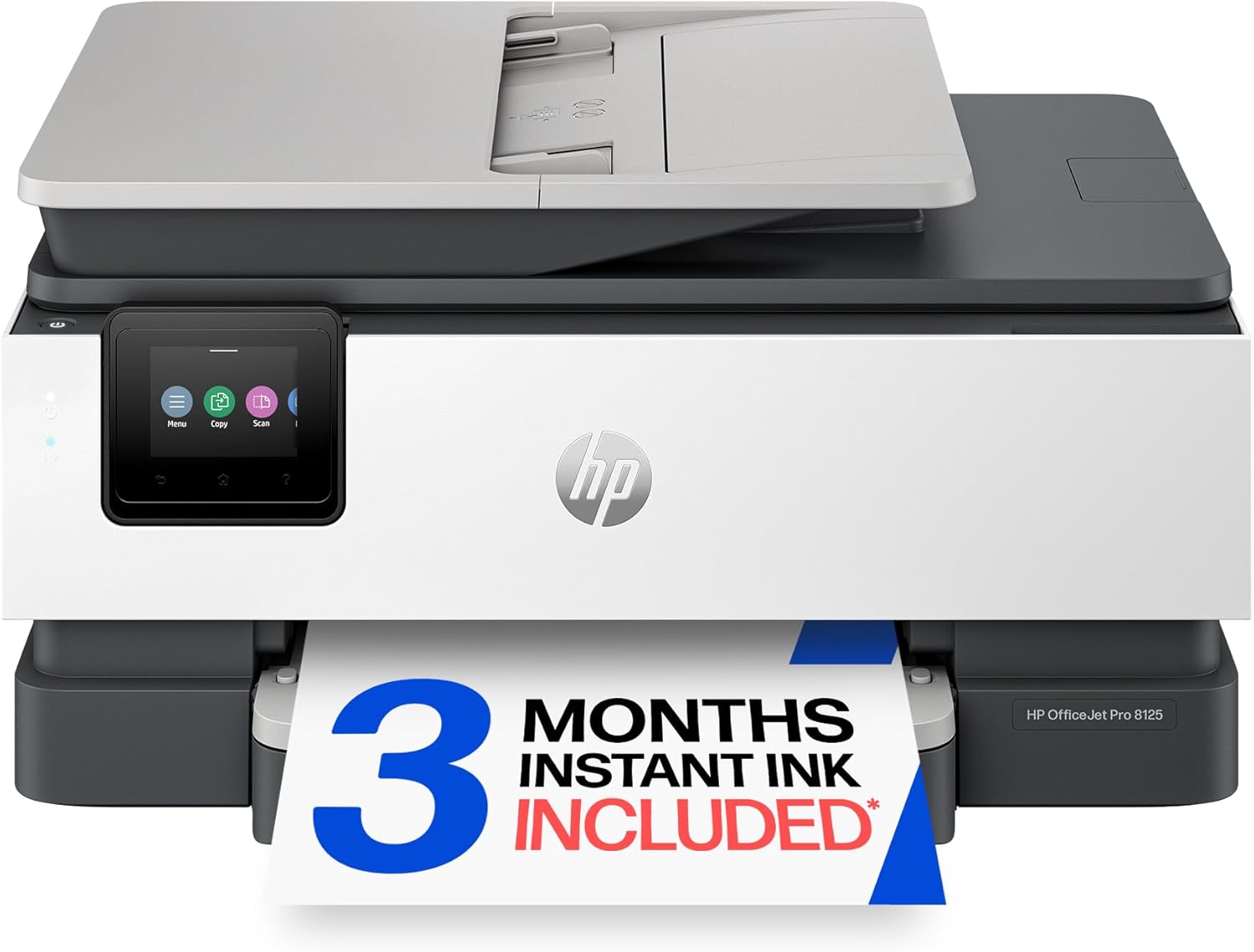
| Printer Type | HP Thermal Inkjet |
|---|---|
| Maximum Sheet Capacity | 225 |
| Duplex | Automatic (standard) |
| Color Pages per Minute | 10 pages_per_minute |
| B&W Pages per Minute | 20 pages_per_minute |
The HP OfficeJet Pro 8125 is a compact all-in-one inkjet aimed at home and small office use, delivering reasonably fast black output and usable color prints while handling everyday scanning and copying tasks. It supports automatic two-sided printing and a 35-sheet ADF for multi-page scans, and the 2.7-inch color touchscreen with a phone-like interface makes basic operations and setup straightforward. Connectivity options include Wi-Fi, Ethernet, USB and AirPrint, and the HP app plus an AI print formatting feature help trim wasted pages when printing from the web or email. The printer has a large 225-sheet input capacity so you can run larger jobs without frequent reloads, and HP includes starter cartridges and a 3-month trial of an ink delivery service for easier ink management. Expect typical inkjet limitations: color photo quality is good for documents but not on par with dedicated photo printers, and it uses HP 923 cartridges which are intended for original HP chips and may limit third-party cartridge options.
Best for: Buyers who want a versatile, easy-to-use all-in-one for a home or small office that balances speed, connectivity and hands-off ink management.
Less Ideal for: People who need studio-grade photo output or those who prefer printers that accept a wide range of third-party cartridges and refill options.
- Automatic duplex and 225-sheet input tray reduce manual handling for multi-page jobs
- 2.7-inch color touchscreen and intuitive HP app make setup and mobile printing simple
- Wide connectivity including dual-band Wi-Fi, Ethernet, USB and AirPrint
- Includes starter ink cartridges and a 3-month trial of Instant Ink for easy initial ink supply
- Requires original HP 923 cartridges with chip restrictions that limit use of many third-party cartridges
Verdict: Choose the OfficeJet Pro 8125 if you want a feature-rich home office all-in-one that combines decent speed, robust connectivity and simple ink delivery through HP's subscription service.
Epson EcoTank ET-2800
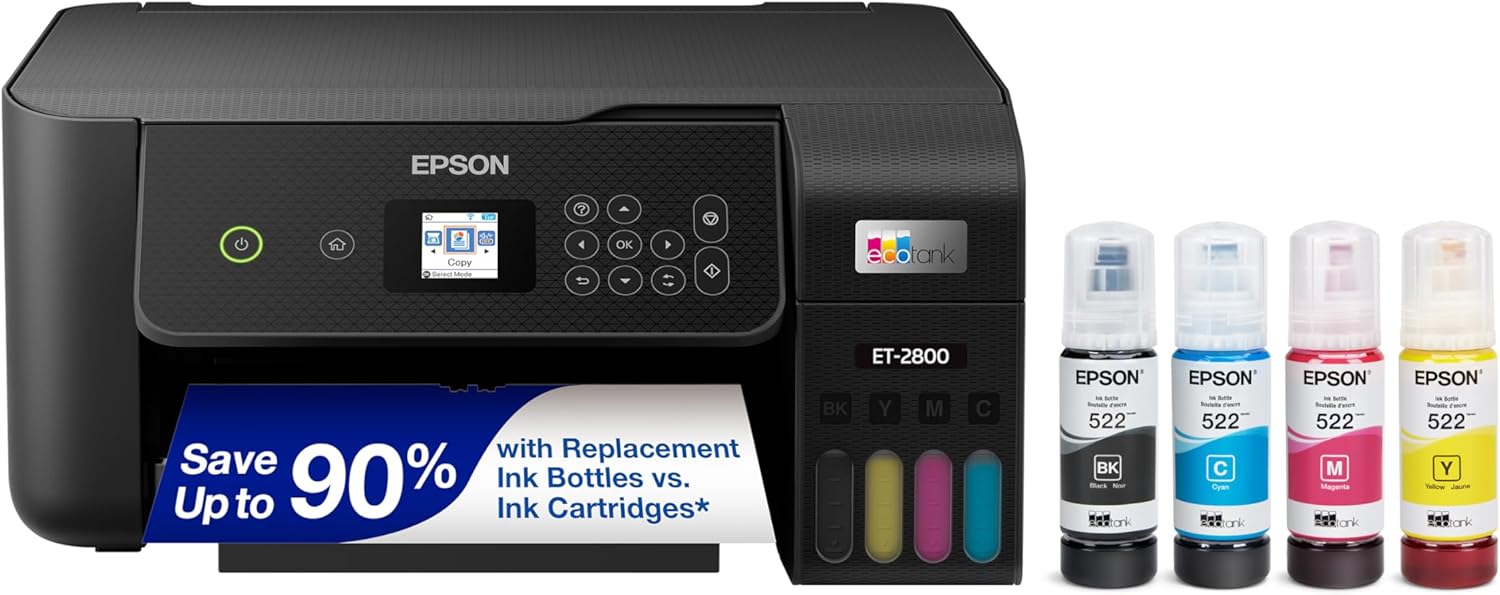
| Printer Type | Inkjet |
|---|---|
| Printer Connectivity Type | USB, Wi-Fi |
| Maximum print Resolution Color | 5760 x 1440 dpi |
| B&W Pages per Minute | 10 |
| Maximum Sheet Capacity | 100 |
The Epson EcoTank ET-2800 replaces cartridges with refillable high-capacity ink tanks, letting you print long runs without frequent replacements and lowering ongoing ink cost. It prints up to 10 ISO pages per minute for black-and-white and around 5 ppm for color, and uses PrecisionCore Micro Piezo heat-free technology to deliver sharp text and detailed color prints on plain and photo papers. Setup and everyday use are simple thanks to Wi-Fi and mobile/voice printing plus an LCD for local control, and the flatbed scanner/copier covers basic home document needs. Limitations include simplex-only printing, a single USB port, and modest color speed for heavier photo work; also Epson recommends genuine ink to maintain performance. For buyers focused on lower ink cost and reliable everyday output, the ET-2800 balances quality printing with very low ongoing consumable expense.
Best for: Buyers who prioritize low ongoing ink cost and reliable everyday printing for home use and want a simple, cartridge-free all-in-one that handles documents and occasional photos.
Less Ideal for: Users who need built-in automatic duplexing, heavy photo lab quality prints, or more advanced connectivity and paper handling for office workloads should consider higher-end models.
- Cartridge-free high-capacity refillable ink tanks significantly reduce frequency of ink replacement
- PrecisionCore Micro Piezo print technology produces sharp text and good color detail
- Wireless, mobile, and voice printing for convenient everyday use
- Includes flatbed scanner and copier for basic all-in-one functionality
- No automatic duplex (only simplex) which requires manual double-sided printing
- Single USB port limits wired connectivity options
Verdict: Choose the ET-2800 if you want a home all-in-one that cuts ink costs with refillable tanks while delivering dependable everyday print quality.
Epson EcoTank ET-2400

| Printer Type | Inkjet |
|---|---|
| Print Resolution | 5760 x 1440 dpi |
| B&W Pages per Minute | 10 ppm |
| Color Pages per Minute | 5 ppm |
| Printer Connectivity Type | USB, Wi-Fi |
The Epson EcoTank ET-2400 replaces cartridges with large refillable ink tanks so you can print far longer between refills, making it a practical choice for routine home printing. It prints color documents and photos with up to 5760 x 1440 dpi resolution, scans on a flatbed glass, and copies at speeds around 10 ppm for black and 5 ppm for color. Setup typically involves filling the four EcoFit bottles, connecting over Wi-Fi or USB, and using Epson's app for mobile printing and basic control. The rear-feed tray holds up to 100 sheets and the output holds about 30, so it is suited to multi-page jobs without constant reloading. Notable benefits are very low running cost per page thanks to the bundled ink bottles and Energy Star efficiency, plus crisp text from Epson's Micro Piezo printhead. Limitations include manual duplexing for two-sided pages and modest photo speed; this model also lacks an automatic document feeder or Ethernet port found on higher-tier EcoTank units. For buyers wanting simple, economical daily printing, it balances long-lasting ink with everyday convenience.
Best for: Buyers who prioritize low long-term ink costs and reliable everyday home printing will appreciate the ET-2400’s refillable tanks and straightforward wireless setup.
Less Ideal for: Users who regularly need fast two-sided printing, large office throughput, or advanced network ports should consider a higher-end model with ADF and automatic duplex.
- Cartridge-free EcoTank system cuts frequency and cost of ink replacement
- High maximum print resolution for sharp text and good photo quality
- Wireless and USB connectivity with mobile app control for easy at-home use
- Includes starter ink bottles that print thousands of pages before a refill is needed
- Rear-feed 100-sheet input reduces how often you reload for larger print jobs
- No automatic duplexing; two-sided printing is manual
- No auto document feeder or Ethernet connectivity for heavier office workflows
- Color print speed is relatively slow compared with faster home printers
Verdict: Choose the ET-2400 if you want an all-in-one home printer that dramatically lowers ink costs with refillable tanks while delivering strong everyday print quality.
HP DeskJet 2955 All-in-One Printer

| Printer Type | HP Thermal Inkjet |
|---|---|
| Print Speed (B&W) | 7.5 pages_per_minute |
| Print Speed (Color) | 5.5 pages_per_minute |
| Maximum Sheet Capacity | 60 |
| Connectivity | Apple AirPrint; USB; Wireless (Wi-Fi); Wireless direct printing; Mopria |
The HP DeskJet 2955 is a compact, budget-focused all-in-one designed for light home use, offering color printing, flatbed scanning, and copying in a small footprint. It connects via Wi‑Fi, Wireless Direct, AirPrint or USB and supports HP's app for scanning and mobile printing, plus a three-month trial of Instant Ink to simplify ink replacement. Print speeds are modest — about 7.5 ppm black and 5.5 ppm color — and duplexing is manual, so it is best for occasional documents, schoolwork, and recipes rather than high-volume tasks. Notable benefits include high-resolution photo-capable output settings and a 60-sheet input tray that keeps basic jobs convenient. Expect trade-offs typical of entry-level machines: slower throughput, manual two-sided printing, and reliance on HP 68 cartridges for best results. The printer's low power draw and recycled-plastic construction are bonuses for eco-minded buyers, and the Instant Ink trial can lower running costs if you continue the subscription after the trial ends.
Best for: Buyers prioritizing a low upfront cost who need a simple wireless all-in-one for occasional home printing, scanning, and copying and who are willing to use an ink subscription to lower running costs.
Less Ideal for: Do not choose this if you need fast, high-volume printing, automatic duplexing, or heavy photo production in a small office environment.
- Compact footprint fits small desks and home offices
- Wireless and mobile printing options including AirPrint and HP app
- Includes 3-month Instant Ink trial to simplify ink replacement and reduce short-term running costs
- 60-sheet input tray handles everyday document batches
- High maximum color print resolution when using supported photo papers
- Manual duplex only, no automatic two-sided printing
- Slow print speeds compared with higher-end home printers
- Uses HP 68 cartridges which can be costly without an ink subscription
Verdict: A compact, budget-oriented all-in-one that pairs low upfront cost with an Instant Ink trial to keep short-term ink costs down for light home use.
Canon PIXMA TR4720

| Printer Type | Inkjet |
|---|---|
| Printer Connectivity Type | Wi-Fi |
| Duplex | Automatic |
| Compatible Cartridge | PG-275, CL-276 |
| Maximum print Resolution Color | 4800 x 1200 dpi |
The Canon PIXMA TR4720 is a compact all-in-one inkjet designed for home use where reliability and simple setup matter. It handles printing, copying, scanning and faxing, and connects over Wi-Fi for mobile printing via the Canon app. Notable features include an automatic document feeder for multi-page scans and faxes, automatic duplex printing to save paper, and a 4800 x 1200 color resolution for reasonably sharp photo and document output. Setup and cartridge replacement are straightforward, and the printer ships with starter PG-275 black and CL-276 color cartridges so you can start printing right away. Limitations include modest paper capacity and consumer-grade ink costs typical of cartridge-based models, so frequent high-volume printing will be more expensive than tank-style alternatives. For everyday home documents, schoolwork and occasional photos this printer offers dependable, easy-to-use performance without complicated maintenance.
Best for: Buyers who prioritize a reliable, easy-to-use all-in-one for everyday home printing, schoolwork and occasional photo prints and who value straightforward setup and basic automation features.
Less Ideal for: Those who print large monthly volumes or need the lowest long-term ink cost should consider tank-style or business-oriented printers instead.
- All-in-one functions: print, copy, scan and fax in one compact unit
- Automatic document feeder for multi-page scanning and faxing
- Automatic duplex printing reduces paper use
- Wi-Fi and mobile app control make setup and remote printing simple
- High color resolution (4800 x 1200 dpi) for sharper photo prints
- Uses standard cartridges (PG-275/CL-276) which can be more expensive for heavy printing
- Relatively small paper capacity compared with larger home or office models
Verdict: A compact, reliable all-in-one that delivers easy setup and dependable home printing with standard replaceable cartridges.
Canon PIXMA TR4720

| Printer Type | Inkjet |
|---|---|
| Functions | Print, Copy, Scan, Fax |
| Maximum Print Resolution | 4800 x 1200 dpi |
| Connectivity | USB, Wi-Fi |
| Maximum Sheet Capacity | 100 |
The Canon PIXMA TR4720 is a compact 4-in-1 inkjet intended for home or small-office use that handles everyday documents and occasional photo prints. It connects via Wi-Fi or USB and supports mobile printing through Canon apps, making it simple to print from phones and cloud services. Key conveniences include a 100-sheet front paper tray, an auto document feeder for multi-page scans and faxes, and automatic duplex printing to save paper. The hybrid ink system aims for sharp black text and decent color photos up to letter size and borderless prints to 8.5 x 11. Setup and cartridge replacement are straightforward and the 2-line LCD keeps basic controls simple. Limitations are modest print speeds—about 8.8 ipm black and 4.4 ipm color—so it is not ideal for high-volume jobs, and photo color accuracy and longevity will not match dedicated photo printers. Power draw is low, and the printer uses Canon PG-275/CL-276 consumables, so ongoing ink cost depends on cartridge choices and usage patterns.
Best for: Buyers who want an affordable, space-saving all-in-one for household documents, schoolwork, and occasional photos and who prioritize straightforward setup and reliable basic features over high throughput.
Less Ideal for: Users who need fast, high-volume printing, professional-grade photo output, or the lowest possible per-page ink costs for heavy daily use should consider higher-capacity or laser alternatives.
- Wireless and USB connectivity plus mobile app support for easy phone and cloud printing
- Auto document feeder and automatic two-sided printing for multi-page workflows
- 100-sheet front paper tray and compact footprint fit small home or office spaces
- Hybrid ink system supports sharp black text and borderless photo printing up to letter size
- Relatively slow print speeds for color documents compared with faster office models
- Not optimized for heavy photo work or high monthly page volumes
Verdict: A compact, easy-to-use all-in-one that covers everyday home and small-office printing with simple mobile connectivity and Canon cartridge options that keep replacement straightforward.
Brother DCP-L2640DW

| Printer Type | Laser |
|---|---|
| B&W Pages per Minute | 36 pages_per_minute |
| Auto Document Feeder | 50 pages |
| Maximum Sheet Capacity | 250 |
| Printer Connectivity Type | Ethernet, USB, Wi-Fi |
The Brother DCP-L2640DW is a compact black-and-white laser all-in-one built for steady home or small office use. It prints up to 36 ppm, supports automatic duplex printing, and includes a 50-sheet auto document feeder and a 250-sheet tray to reduce refills during higher-volume jobs. Connectivity covers dual-band Wi-Fi, Ethernet, and USB, and Brother Mobile Connect lets you print and manage jobs from a phone. Toner options include standard and high-yield TN830 cartridges and the model is eligible for Brother Refresh subscription to simplify supply replacement. Practical benefits are fast text printing, low frequency of paper loading, and reliable single-pass scanning for document workflows. Limitations are that it only prints in monochrome, so it is unsuitable for color materials, and initial toner yield is relatively modest compared with some high-capacity office models, so busy offices may prefer higher-yield solutions. The unit is compact but still substantial in weight, so plan placement accordingly.
Best for: Practical buyers who want a dependable, low-maintenance monochrome all-in-one for steady document printing, scanning, and copying with easy mobile and network setup.
Less Ideal for: Anyone who needs color printing, photo output, or the highest possible toner yields for extremely heavy daily print volumes.
- Fast monochrome printing up to 36 pages per minute for quick document output
- Automatic duplex printing and 250-sheet tray reduce paper handling and refill frequency
- 50-page auto document feeder speeds multi-page scanning and copying tasks
- Multiple connectivity options including dual-band Wi-Fi, Ethernet, and USB plus a mobile app for remote management
- Eligible for Brother Refresh subscription and uses widely available TN830/TN830XL toners
- Monochrome only, so it cannot produce color prints or photos
- In-box toner yield is limited compared with some larger office models
Verdict: A reliable, fast monochrome multifunction laser that keeps supply management simple and is ideal for buyers who prioritize dependable document printing and low hassle replacement options.
Choosing the Right All-in-One Printer with Cheap Ink: Key Factors to Consider
Ink Cost Per Page
Ink cost per page is the single most important factor when prioritizing cheap-ink all-in-one printers. Look beyond the initial purchase price and calculate the cost of replacement cartridges or bottles on a per-page basis. High-yield cartridges or integrated ink-tank systems often offer the lowest per-page expense for text-heavy printing.
Also consider whether the manufacturer sells ink subscriptions or bulk refill options that lower long-term costs. Some printers accept third-party refills or remanufactured cartridges; while these can cut expenses, they may affect warranty or reliability. Estimating monthly page volume against per-page cost will reveal how quickly you recover any higher upfront cost for a more economical supply system.
Print Reliability and Output Quality
Reliable output reduces waste and hidden costs that negate cheap ink advantages. Choose models with consistent text density and color stability so you do not need to print multiple copies. For most home and small-office users, strong black text quality and acceptable color for charts and occasional photos are sufficient.
Check for user-accessible maintenance tools like nozzle checks and head-cleaning cycles that keep small issues from becoming expensive. A model that requires frequent manual intervention or wasteful cleaning cycles can end up costing more overall despite inexpensive ink.
Ink System Type and Refill Options
Different ink delivery systems directly affect long-term affordability. Cartridge-based models vary widely in cartridge capacity and cost, while ink-tank systems use refillable bottles and generally provide the lowest ongoing expense per page. Evaluate bottle capacity, refill ease, and how visible the remaining ink is to avoid unexpected runs.
Also review whether the printer supports automatic ink-level reporting and whether replacement supplies are easy to source. For those comfortable with non-OEM options, refill kits and remanufactured cartridges can lower costs, but consider the tradeoffs in reliability and potential warranty implications.
Connectivity and Daily Usability
A cheap-ink all-in-one still needs to be practical to use. Look for reliable Wi-Fi, mobile printing support, and an intuitive control panel or app. Network stability matters when multiple devices will use the printer; poor connectivity leads to repeated print attempts and wasted ink.
Features like automatic duplex printing, a sheet feeder for multi-page scanning, and straightforward driver installation can save time and reduce friction. Consider whether the printer's software provides easy ink-level tracking and straightforward maintenance prompts.
Print Speed and Duty Cycle
Print speed and rated monthly duty cycle determine whether a low-cost printer can handle your workload without excessive wear. A cheaper per-page cost may not help if the unit cannot sustain your typical monthly print volume, causing overheating or premature failures.
Choose a model whose duty cycle comfortably exceeds your expected monthly pages and whose rated speeds align with your patience level for batch jobs. Faster printers can improve productivity but sometimes use more ink per page during certain modes, so balance speed needs against ink economy.
Maintenance and Long-Term Support
Ongoing maintenance influences total cost of ownership. Frequent head cleanings, clogged nozzles, or hard-to-access cartridges increase downtime and hidden expense. Prefer designs with user-replaceable components and clear maintenance guides.
Also consider manufacturer support policies and the availability of replacement parts or consumables. A widely supported model will generally be easier and cheaper to maintain over several years than a niche device with limited support.
How Cheap Ink Changes the Ownership Math
Lower per-page ink costs alter the total cost of ownership by shifting expense from upfront purchase to ongoing supplies. For users who print large volumes, investing in an ink system with low running costs can pay off within months.
When evaluating long-term expense, include indirect costs such as time spent on maintenance, paper waste from misprints, and the availability of supplies. A model with slightly higher initial price and very low ink cost can be less expensive over the device lifetime than a cheaper unit with expensive cartridges.
- Calculate break-even based on expected monthly pages.
- Include potential downtime costs from maintenance or connectivity issues.
Ink-tank Versus Cartridge-based Approaches
Ink-tank systems use refillable bottles and often deliver the lowest cost per page, especially for black text. Cartridge systems are more familiar and can be convenient if you print infrequently, but cartridges usually carry higher per-page costs.
Consider refill frequency, the mess risk, and how easy it is to read remaining ink levels. For heavy users, an ink-tank model typically reduces interruptions and supply orders.
- Ink-tank: Low per-page cost, simple refills, bulk supply handling.
- Cartridge: Easier swaps, potentially higher per-page costs, less mess.
Practical Tips to Reduce Ink Consumption
Small habit changes and printer settings can significantly lower your ink bill. Use draft or economy modes for internal documents, switch to black-and-white when color is unnecessary, and print multiple pages per sheet for reference copies.
Regularly update drivers and firmware to benefit from manufacturer improvements that can reduce ink waste. When scanning documents instead of printing copies, use the printer's scan-to-file features to avoid unnecessary reprints.
- Enable draft mode for non-final copies.
- Use two-sided printing to cut page count.
- Disable color printing for text-only jobs.
Setting Realistic Expectations for Photo Printing
If you print photos occasionally, expect higher ink usage and slightly higher per-page costs than text printing. Cheap-ink all-in-ones can produce acceptable snapshots and small photo prints, but they may not match dedicated photo printers in color fidelity or longevity.
For important photo projects, consider using a higher-quality profile or sending select images to a specialized print service. For casual photo output, focus on models with good color balance and reliable small-format photo media handling.
- Use photo mode only when image quality matters.
- Choose media and paper weight recommended for photo printing.
Managing Supplies and Inventory
Plan for steady supply availability so you do not run out of ink unexpectedly. Keep a spare high-yield cartridge or a bottle of refill ink on hand if you rely on the printer for time-sensitive tasks. Track usage patterns over a few months to estimate reorder intervals.
If you use third-party refills, verify the supplier's reputation and return policy. Store open bottles and cartridges per the manufacturer's recommendations to avoid drying or contamination.
- Maintain a one-cartridge or one-bottle buffer for critical users.
- Log monthly page counts to predict reorder timing.
How We Chose the Best All-in-One Printer with Cheap Ink
We focused on objective, recurring-cost dimensions that matter when choosing an all-in-one printer aimed at low ink expenses. First, we prioritized measured ink cost per page or the availability of high-yield cartridges or tank systems that demonstrably reduce per-page expense. Second, print reliability and consistent color or black-and-white output were required so low cost did not come at the expense of frequent reprints. Third, we considered scanning and copying capability because an all-in-one should replace multiple devices without compromise. Fourth, connectivity and ease of use were evaluated so that cheaper ink does not force a more difficult daily workflow. Finally, we assessed maintenance needs and third-party refill compatibility where those options affect long-term cost. We excluded devices that sacrifice basic print quality or have known reliability problems, and we excluded single-function printers and specialty photo-lab style machines. The final shortlist reflects models that balance low running costs with practical performance across typical home and small-office tasks.
Our full evaluation process is outlined in our review methodology.
FAQ
Are ink-tank printers always cheaper to run than cartridge printers?
Often they are cheaper per page, especially for high-volume black text printing. However, the overall savings depend on your monthly page count, initial cost difference, and whether you need frequent color prints that may use more ink.
Can I use third-party refills to cut ink costs?
Third-party refills and remanufactured cartridges can lower expense but may affect print reliability and warranty coverage. They are a reasonable option for cost-conscious users who accept potential variability in quality.
How do I estimate my monthly ink usage?
Track the number of pages you print over a typical month, distinguishing color from black-and-white pages. Compare that to the stated page yield of cartridges or bottle capacities to calculate expected refill frequency and cost per month.
Will using economy or draft mode reduce quality noticeably?
Draft or economy modes reduce ink usage and are fine for internal documents. Expect lighter text and lower photo detail, so use them for drafts rather than final presentations or photo prints.
How often should I perform maintenance to avoid clogged nozzles?
Frequency depends on usage. Regular daily or weekly printing prevents drying, while infrequent use may require periodic nozzle checks and cleanings. Running a small test page once a week helps keep nozzles clear.
Final Verdict
Prioritize models with a demonstrable low ink cost per page and reliable printing performance. Balance the savings from cheaper ink systems against necessary features like duplexing, document feeder quality, and connectivity so the printer suits your workflow. If you print frequently, favor high-yield cartridges or ink-tank designs that lower ongoing costs. For light users, a cartridge-based all-in-one with easy maintenance may be preferable. Focus on ink economy, reliability, and practical features to select the right all-in-one printer with cheap ink for your home or small office.