
Note: This article contains affiliate links. If you click on these links and make a purchase, we may earn a small commission at no extra cost to you. This helps support our research and content. Read our full affiliate disclosure here.
If you bake at home, the right bread maker can turn weekly loaves from a chore into a routine that saves time and yields better results. For cooks on a budget, machines under $150 still offer programmable cycles, crust control, and enough capacity for family-sized loaves. This guide covers seven shortlisted models that represent the best balance of bake quality, ease of use, and durability in this price bracket. We evaluate each option for how it performs in real kitchens, focusing on loaf texture, control options, and maintenance needs. Read on for practical guidance that helps you choose the best bread maker for your baking habits.
Top Picks at a Glance
| Best Overall The best all-around choice for most situations | KITCHENARM Smart Bread Machine 2LB |  |
| Best Quality Built to a higher standard if you want something more solid | KBS 2.2lb Bread Maker MBF-011 |  |
| Best Value The sweet spot between price and what you get | Amazon Basics 2-Pound Bread Maker |  |
| Best Budget The cheapest option that still gets the job done reliably | Elite Gourmet Programmable Bread Maker EBM8103M |  |
| Top Rated A top-rated pick with lots of positive feedback | Cuisinart Bread Maker CBK-110P1ES |  |
| Most Popular A crowd favorite that many people choose with confidence | KBS 2.2LB Bread Maker |  |
| Best Seller A high-volume bestseller chosen again and again | OSIPOTO BM8205 2lb Bread Maker | 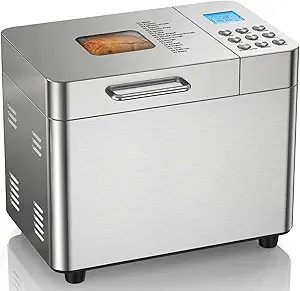 |
KITCHENARM Smart Bread Machine 2LB

| Capacity | 2 pounds |
|---|---|
| Wattage | 550 watts |
| Number of Programs | 29 |
| Voltage | 120 volts |
This KITCHENARM bread maker handles everything from basic loaves to gluten-free and specialty recipes with minimal fuss. You choose a program, add ingredients, and the machine handles knead, rise, and bake automatically; the 29 preset menus include bread, cake, jam, and yogurt options while a HOME MADE mode lets you program cycle times for custom recipes. It supports three loaf sizes and three crust colors, offers a 15-hour delay timer plus one-hour keep-warm, and keeps settings so repeat bakes can become one-press operations. The stainless-steel housing and Teflon-coated nonstick pan simplify cleanup, and the large LCD makes menu navigation straightforward. Practical extras include add-nuts alarms, power-interruption recovery, and ETL certification for U.S. outlets. At this price point the build and feature set are impressive, though the pan is Teflon coated rather than fully removable bakeware with a commercial nonstick finish, and advanced customization may be more than casual users need. It is a solid choice for people who want a versatile, programmable bread machine without stepping up to pro-level models.
Best for: Buyers who want a versatile, feature-rich bread maker that can handle everything from everyday sandwich loaves to specialty and custom recipes while staying budget-friendly.
Less Ideal for: Those who only want a very simple plug-and-play machine or who need a professional commercial-grade baking chamber should consider simpler units or higher-end models instead.
- Wide program selection with 29 automatic menus including bread and non-bread options
- Customizable HOME MADE mode lets you set individual cycle times for personalized recipes
- Three loaf sizes and three crust settings cover most household needs
- Large LCD and saved settings enable easy repeat baking and one-press operation
- ETL certified and includes practical features like delay timer, keep-warm, and power-interruption recovery
- Bread pan uses a Teflon food-grade coating rather than a higher-end removable nonstick insert
- Advanced cycle-level programming can be complex for users who only want basic presets
Verdict: A fully featured, programmable bread maker that gives home bakers the most versatility and customization for the price.
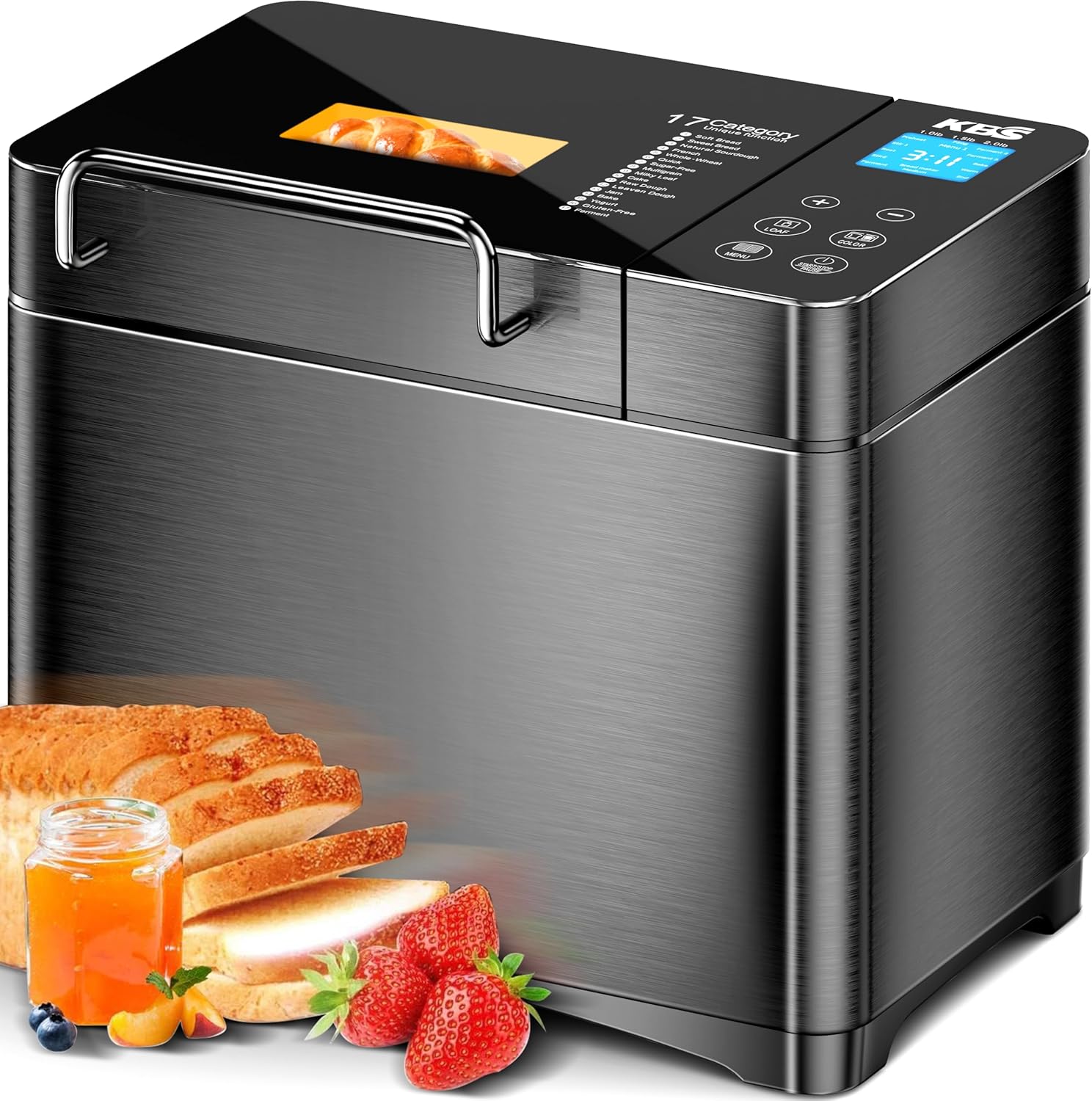
KBS 2.2lb Bread Maker MBF-011
| Capacity | 2.2 pounds |
|---|---|
| Wattage | 710 watts |
| Number of Programs | 17 |
| Voltage | 120 volts_of_alternating_current |
This KBS bread maker is built for performance-minded home bakers who want consistent, bakery-style loaves with minimal fuss. The 710W motor, dual quartz heaters and 360° convection system aim to deliver even browning and a crisper crust while the horizontal ceramic pan produces rectangular loaves. You get 17 programs including gluten-free, sourdough and quick bread, plus three loaf sizes and three crust settings, so it covers a wide range of recipes. The touchscreen control, 15-hour delay timer, 15-minute power-recovery and 1-hour keep-warm make scheduling and unattended baking easy, and the automatic nut/fruit dispenser does a clean mix-in step without monitoring. Practical extras include two kneading paddles, a viewing window and a recipe book. Trade-offs are typical for countertop machines: it is moderately heavy and takes counter space, and truly artisanal breads still benefit from hand shaping and oven finishing, but for fast, repeatable results this machine delivers strong performance for the price point.
Best for: Buyers who prioritize consistent, bakery-style loaves and programmable versatility for everyday home baking and value repeatable performance over manual techniques.
Less Ideal for: If you want a lightweight, ultra-compact machine for occasional use or prefer shaping and baking freeform artisan loaves in a conventional oven, this is not the best fit.
- Convection baking plus dual heaters for more even crust and crumb development
- Healthy ceramic nonstick pan without PTFE/PFOA for easier cleaning
- Auto nut/fruit dispenser automates add-ins for consistent results
- 17 built-in programs and multiple loaf/crust size options for recipe flexibility
- Touchscreen, 15-hour delay and power-recovery features for reliable unattended baking
- Relatively heavy and occupies significant countertop space compared with compact models
- Horizontal pan shape limits freeform artisan loaf styles
Verdict: A performance-focused bread maker that delivers consistent, bakery-style loaves with convection baking and automated mix-ins, making it a strong choice for home bakers under $150.
Amazon Basics 2-Pound Bread Maker

| Capacity | 2 pounds |
|---|---|
| Wattage | 550 watts |
| Number of Programs | 14 |
| Voltage | 120 volts |
This Amazon Basics bread maker handles the full bread-making cycle automatically: it mixes, kneads, proofs, and bakes up to a two-pound loaf. The unit offers 14 programs that cover standard loaves, dough-only cycles, gluten-free recipes, and even jam, plus three crust color settings so you can tailor results. The nonstick pan and paddle make loaf removal and cleanup straightforward, and the ExpressBake mode can produce a loaf in under 90 minutes when you need bread fast. The LCD and programmable timer let you delay start for fresh bread timing. On the downside the machine is a basic, countertop-focused model with a single loaf pan orientation and limited advanced customization for loaf shape or artisan-style crusts, and it is not the quietest during kneading. For someone optimizing kitchen utility and savings this model covers the essentials reliably and is simple to operate and maintain.
Best for: Budget-minded home cooks who want a straightforward, set-and-forget machine to produce everyday loaves, gluten-free options, and dough without fuss.
Less Ideal for: Bakers seeking high customization, multiple loaf shapes, or very quiet operation should consider more advanced or specialty machines.
- Automates mixing, kneading, rising, and baking for one-step fresh loaves
- 14 preset programs including gluten-free and dough cycles for versatility
- ExpressBake option produces bread in under 90 minutes for quick results
- Nonstick pan and paddle simplify loaf removal and cleanup
- Programmable timer and LCD make delayed-start baking convenient
- Limited customization for artisan-style loaves or alternative pan shapes
- Noticeable kneading noise compared with some higher-end models
Verdict: A practical, no-frills bread maker that reliably produces fresh 2-pound loaves with useful presets and a fast ExpressBake option.
Elite Gourmet Programmable Bread Maker EBM8103M

| Capacity | 2 pounds |
|---|---|
| Wattage | 550 watts |
| Number of Programs | 19 |
| Voltage | 120 volts |
The Elite Gourmet Programmable Bread Maker is a straightforward countertop machine for making fresh loaves, doughs, and even jam with minimal effort. You add ingredients to the nonstick pan, pick one of 19 programs — including gluten-free, whole wheat, pizza dough, and cake — then start; the unit handles mixing, kneading, rising, and baking. It supports three loaf sizes (1, 1.5, and 2 lb) and offers light/medium/dark crust settings, a 15-hour delay timer so you can wake to warm bread, and a 60-minute keep-warm function. The 550-watt motor and compact metal body keep energy use low and make it a good fit for small kitchens or apartments. Included accessories like a measuring cup, spoon, and blade remover simplify setup and cleanup, though the pan and paddle need hand washing. If you want an affordable way to replace store bread with homemade loaves and occasional specialty bakes, this model delivers reliable, easy results for everyday use.
Best for: Buyers seeking an affordable, no-frills machine to make regular homemade bread and occasional specialty bakes in small kitchens who prioritize ease of use and value.
Less Ideal for: Large households that bake multiple loaves daily or users who need heavy-duty, commercial-style throughput should consider a larger-capacity or higher-power model.
- Wide selection of 19 preset programs for breads, doughs, and jam
- Three loaf size options (1, 1.5, 2 lb) to fit different household needs
- 15-hour delay timer and 60-minute keep-warm for scheduled baking
- Compact, energy-efficient design suitable for small kitchens
- Includes useful accessories like measuring spoon, cup, and blade removal tool
- Bread pan and kneading blade require hand washing rather than dishwasher-safe care
- 550-watt motor and compact size limit throughput for heavy or continuous baking
Verdict: A budget-friendly, easy-to-use bread maker that delivers reliable 1–2 lb homemade loaves and useful presets for everyday baking.
Cuisinart Bread Maker CBK-110P1ES

| Capacity | 2 pounds |
|---|---|
| Wattage | 550 watts |
| Number of Programs | 12 |
| Voltage | 120 volts |
The Cuisinart CBK-110P1ES is a straightforward countertop bread machine that handles mixing, kneading, rising, and baking with minimal input. You pick a program on the LCD, choose crust color and loaf size, add ingredients, and the machine runs a full cycle or uses the 13-hour delay start so fresh bread is ready when you want it. Key features are 12 preprogrammed menus for breads and simple baked goods, a removable nonstick vertical bread pan for up to 2 lb. loaves, audible cycle reminders, and a 60-minute keep-warm function. Its compact footprint fits most counters while still delivering full-height loaves, and stainless steel accents give it a durable feel. Trade-offs include a basic control interface without touchscreen or app control and a hand-wash requirement for parts, so upkeep takes a little effort. For buyers after a reliable, no-frills machine that consistently produces standard loaves and supports specialty recipes like gluten-free or jam, this model performs as expected without unnecessary complexity.
Best for: Buyers who prioritize a dependable, easy-to-use machine that reliably produces everyday loaves and occasional specialty recipes without extra smart features or complexity.
Less Ideal for: Users who want app connectivity, touchscreen controls, or fully dishwasher-safe components should consider other models.
- 12 preprogrammed cycles for varied breads and simple baked goods
- Selectable crust color and three loaf-size options up to 2 lb.
- Removable nonstick vertical pan simplifies loaf removal
- 13-hour delay-start lets you schedule fresh bread when needed
- Compact footprint fits most kitchen counters while baking full-height loaves
- Controls are basic LCD with buttons rather than a modern touchscreen or smart features
- Removable parts require hand washing rather than dishwasher-safe cleaning
Verdict: A practical, reliability-focused bread maker that delivers consistent full-size loaves and useful preset programs without unnecessary frills.
KBS 2.2LB Bread Maker

| Capacity | 2.2 pounds |
|---|---|
| Wattage | 650 watts |
| Number of Programs | 19 |
| Voltage | 120 volts |
The KBS 2.2LB Bread Maker is a compact, fully programmable machine aimed at home bakers who want fresh loaves with minimal fuss. It handles mixing, proofing and baking automatically and offers 19 preset programs including sourdough, gluten-free and quick 90-minute cycles, plus a fully customizable program for fine tuning each stage. The included nonstick ceramic pan and paddle, 360-degree hot air circulation and three crust color settings help produce consistent crust and crumb without needing an oven. Practical extras include a 15-hour delay start, 1-hour keep-warm, power-failure resume and a clear viewing window so you can monitor progress. The brushed stainless housing and digital display make it simple to operate, and the accessory kit and recipe book are useful for beginners. Limits to consider are a 2.2 lb maximum loaf size, which may be small for large families, and a 650 W motor that means longer run times on heavier doughs compared with higher-wattage machines. For buyers seeking dependable home baking under $150, this model balances features and ease of use.
Best for: Buyers who want a reliable, feature-rich home bread maker that delivers consistent loaves and clear user feedback without needing advanced baking skills.
Less Ideal for: Those who regularly bake large loaves for big households or need the fastest, highest-power commercial-style performance should look at larger, higher-wattage machines.
- 19 preset programs including sourdough and gluten-free for versatile baking
- Healthy nonstick ceramic pan and paddle for even heat conduction and easier cleanup
- 15-hour delay start, 60-minute keep-warm and power-failure resume for flexible timing
- Compact stainless steel body with clear viewing window and digital controls
- 2.2 lb maximum loaf capacity may be small for larger households
- 650 W motor is modest, so heavy doughs or very frequent baking may take longer
Verdict: A well-equipped, user-friendly bread maker that packs versatile programs and healthy ceramic baking into a compact unit ideal for everyday home use under $150.
OSIPOTO BM8205 2lb Bread Maker

| Capacity | 2 pounds |
|---|---|
| Wattage | 600 watts |
| Number of Programs | 17 |
| Voltage | 120 |
The OSIPOTO BM8205 is a straightforward automatic bread machine aimed at home bakers who want fresh loaves with minimal fuss. You add ingredients, pick one of 17 programs and the machine handles kneading, rising and baking for 1 lb to 2 lb loaves, with three crust settings for light to dark. The 600W motor and claimed 360-degree heat distribution produce consistent crust and crumb for basic, whole wheat and gluten-free recipes, and the nonstick pan makes loaf removal and cleanup easier. A 15-hour delay timer and 1-hour keep-warm function let you schedule bread for morning or dinner, and an overheat protection feature pauses operation if temperatures get too high. The unit is compact enough for most counters and uses simple controls and an LCD for clear status. Limitations include modest power compared with larger machines and the need to hand-wash parts, but for routine home baking this model delivers reliable results without complicated setup or advanced baking knowledge.
Best for: Home cooks who want a low-risk, beginner-friendly machine that reliably makes everyday loaves on a predictable schedule.
Less Ideal for: Serious bakers who need faster bake cycles, advanced customization, or larger commercial-capacity machines.
- Large 2 lb maximum capacity with options for 1 lb and 1.5 lb loaves
- 17 preset programs covering basic, whole wheat, gluten-free, jam and more
- 15-hour delay timer and keep-warm function for scheduled baking
- Nonstick removable pan for easier loaf removal and cleaning
- Stainless steel exterior for a durable, kitchen-friendly finish
- Requires hand washing of components rather than dishwasher-safe parts
- 600W motor is adequate but not as fast as higher-wattage commercial-style machines
Verdict: A reliable, easy-to-use 2 lb bread maker that makes scheduled, home-style loaves with minimal effort, ideal for cautious buyers seeking predictable results.
Choosing the Right Bread Maker: Key Factors to Consider
Loaf Size and Capacity
Bread makers vary in maximum loaf weight, commonly from 1 to 2.5 pounds. Choose a capacity that matches how much bread you consume regularly. A too-small machine forces you to bake more frequently, while an oversized pan can waste energy and ingredients if you rarely bake full loaves.
Capacity also affects pan shape and slicing. Taller, narrower loaves slice differently than short, wide ones, which matters if you prefer sandwich slices or artisanal-style loaves. Confirm that the machine supports the loaf sizes you plan to bake most often.
Program Options and Flexibility
The number and type of presets determine what recipes you can run without manual intervention. Look for dedicated cycles for whole wheat, gluten-free, rapid bake, and dough-only modes if you plan to make a range of breads. Customizable crust settings let you choose a darker or lighter crust depending on recipe and preference.
Some machines let you set delay timers, which are useful for having fresh bread ready at a specific time. Others offer manual adjustments for knead or rise durations. More flexible programming expands the variety of recipes you can successfully make.
Control Layout and User Interface
A clear, simple control panel reduces mistakes and speeds up setup. Large, readable displays and intuitive buttons make it easier to switch programs, adjust crust color, and set timers. Backlit or higher-contrast displays are helpful in dim kitchens.
Consider whether the machine provides audio alerts and whether those alerts are loud enough for your household. Some buyers prefer tactile buttons to touch panels, especially for frequent use.
Pan and Paddle Design
The shape, coating, and removal mechanism of the baking pan influence both bake results and cleanup. Nonstick coatings ease removal, but they degrade over time. Removable paddles are easier to clean and reduce the chance of dough getting trapped in corners.
A good pan will heat evenly and lift out without spilling crumbs or oil. Check whether the paddle leaves a large hole in the bottom of the loaf and whether a collapsible or low-profile paddle is used to minimize waste.
Cleaning, Maintenance, and Replacement Parts
Regular cleaning extends a machine's life and prevents off-flavors from leftover crumbs or grease. Look for pans and paddles that are dishwasher safe or at least easily hand-washable. Machines that allow the lid to open fully and the interior to be wiped without awkward angles reduce maintenance time.
Also consider availability of replacement paddles and pans. Even if a model is inexpensive, the long-term cost and convenience of replacement parts matter if components wear out.
Cycle Time and Energy Use
Different programs run for widely varying durations. Rapid cycles can produce a loaf in under two hours but may sacrifice texture. Standard cycles often take three to four hours and typically yield better crumb and crust development. Longer cycles also mean the machine is drawing power for more time.
If you bake frequently, more efficient machines or those with shorter average cycle times can reduce electricity use. Factor cycle length into scheduling, especially if you use delay timers to have bread ready at a specific time.
How to Match a Bread Maker to Your Baking Style
Identify how you bake most often. If you regularly make sandwich loaves for daily meals, prioritize machines with consistent loaf shape, easy slicing geometry, and reliable crust settings. If you experiment with specialty flours, look for robust dough and whole-grain cycles that support longer kneading and rising.
Think about frequency. Heavy users benefit from durable pans and easy-clean features, while occasional bakers may accept simpler controls to save upfront cost. Consider whether you need rapid bake options or prefer longer, slower cycles that tend to improve crumb structure.
- Daily sandwich use: prioritize loaf consistency and easy slicing
- Artisanal or whole-grain baking: prioritize program flexibility and knead time
- Occasional baking: prioritize straightforward controls and easy cleanup
Using Delay Timers and Freshness Tips
Delay timers are helpful but require recipe adjustments. Because yeast activity stops once ingredients are chilled, use recipes specifically written for delayed-start cycles or refrigerate wet ingredients before starting a long delay. Avoid leaving dairy or eggs at room temperature during long delays.
After baking, cool loaves on a rack to avoid sogginess from trapped steam. If you plan to store bread, slice once cooled and keep in an airtight container or freeze in individual portions for longer-term storage.
- Use delay-friendly recipes or refrigerate perishable additions
- Cool on a rack before storing to preserve crust texture
- Freeze slices for longer shelf life and quick thawing
Common Maintenance Tasks to Keep a Machine Running
Wipe the interior after cooling to remove crumbs and spills that attract odors. Remove and wash the pan and paddle after each use. If the paddle is stuck, soak the pan to loosen stuck dough before prying, to avoid bending or damaging the paddle.
Periodically inspect seals around the lid and any vents for build-up. Check that the paddle shaft turns freely and that the pan sits level in its housing. Addressing small issues early extends usable life and maintains consistent baking results.
- Daily: remove pan and wash, wipe interior
- Weekly: inspect paddle and shaft for dough build-up
- Monthly: check lid seals and vent paths for residue
Recipes and Ingredient Adjustments for Better Results
Measure flour by weight when possible. Cup measurements vary and can change hydration balance, which affects crumb and rise. Adjust water or milk volumes slightly when using whole-grain or gluten-free flours, which absorb liquid differently than white flour.
Reduce sugar and fat slightly on rapid cycles, since these formulas can speed browning and interfere with rise. For improved crust control, try using the machine's crust setting combined with a short finish in a conventional oven if you want a crisper exterior.
- Weigh ingredients for consistency
- Adjust hydration for whole-grain or alternative flours
- Tweak sugar and fat for rapid cycles to prevent over-browning
How We Chose the Best Bread Maker
Our selection focused on machines that deliver consistent baking results without exceeding the $150 cap. We prioritized loaf quality and consistency, judging how evenly a machine bakes and how reliably it produces proper rise and crumb structure. Program flexibility was next, including the variety of loaf sizes, crust settings, and specialty cycles for whole wheat, gluten-free, or dough-only modes. Ease of use and cleaning were assessed by control layout, display clarity, and how accessible the baking pan and paddle are for regular maintenance. Durability and build quality were inferred from materials, motor ratings, and user-serviceable parts to estimate likely lifespan under normal home use. We also looked at energy efficiency and cycle length since longer cycles use more electricity and affect daily routines. We excluded units that lacked essential safety features, such as secure lid locks or overheat protection, and machines that omitted basic bread-size or crust options. Commercial and heavy-duty bakery appliances were not considered because they fall outside typical home use and the price limit. The final list reflects a balance of performance, user convenience, and expected longevity within the under $150 category.
Our full evaluation process is outlined in our review methodology.
FAQ
Can you use sourdough starter in a standard bread maker?
Often you can, but success depends on the machine's program flexibility. Sourdough requires longer, cooler fermentation stages, so use a dough cycle or manual settings when available and be prepared to finish shaping and proofing by hand for best results.
How long does a typical loaf cycle take?
Typical standard cycles run three to four hours. Rapid or express cycles can finish in under two hours but may produce a denser crumb. Cycle time varies with loaf size, program type, and recipe.
Is a nonstick pan necessary?
Nonstick pans make removal and cleaning easier, but high-quality manual greasing can work as well. Nonstick coatings can wear over time, so consider how easy replacement parts are to obtain.
Can I bake gluten-free bread in these machines?
Many machines include gluten-free presets, which adjust kneading and rise times. If a gluten-free program is not included, choose a dough cycle and monitor rise closely, as gluten-free doughs behave differently from wheat-based doughs.
What causes a heavy or dense loaf?
Dense loaves are usually due to underproofing, incorrect flour measurement, or insufficient kneading. Ensure yeast is fresh, measure ingredients accurately, and use a program with adequate knead and rise times for the recipe.
Final Verdict
Affordable bread makers can deliver very good results if you match features to your baking habits. Prioritize loaf consistency, program flexibility, and ease of cleaning to ensure daily use is convenient and reliable. Be mindful of tradeoffs: rapid cycles save time but may reduce texture, and lower-cost units may require more frequent maintenance. Choose the machine that best fits your typical loaf size and recipe types, and you will get the most value from a budget-friendly bread maker.