
Note: This article contains affiliate links. If you click on these links and make a purchase, we may earn a small commission at no extra cost to you. This helps support our research and content. Read our full affiliate disclosure here.
If you need a commercial cold press juicer that delivers good yield without a large upfront spend, the right budget option can make daily operations more efficient. You want reliable extraction, straightforward cleanup, and a design that stands up to commercial throughput. This guide shortlists the top budget commercial cold press juicers and explains the practical tradeoffs that matter for small cafes, juice bars, and pop-up operations. We evaluated machines for extraction efficiency, durability, serviceability, and running costs to help you pick a unit that matches your daily volume. Read on for our top picks and the criteria we used to evaluate them.
Top Picks at a Glance
| Best Overall The best all-around choice for most situations | TUUMIIST Cold Press Juicer TM880SJ |  |
| Best Quality Built to a higher standard if you want something more solid | Hurom H70 Slow Juicer |  |
| Best Value The sweet spot between price and what you get | AAOBOSI Cold Press Juicer JS2401 |  |
| Best Budget The cheapest option that still gets the job done reliably | Floisdace PT-030A Cold Press Juicer |  |
| Top Rated A top-rated pick with lots of positive feedback | anybear Cold Press Juicer SJ054C |  |
| Most Popular A crowd favorite that many people choose with confidence | EanOruus 3-in-1 Cold Press Juicer E-18 |  |
| Best Seller A high-volume bestseller chosen again and again | Ninja NeverClog Cold Press Juicer JC151 |  |
TUUMIIST Cold Press Juicer TM880SJ

| Capacity | 3 liters |
|---|---|
| Maximum Power | 350 watts |
| Wattage | 300 |
| Voltage | 120 volts |
| Number of Speeds | 60 |
The TUUMIIST TM880SJ is a slow, single-auger cold-press juicer designed to handle whole fruit and vegetables with minimal prep. Its 6.5" extra-wide chute and 100 oz hopper let you feed apples, celery, and large produce without much chopping, and the low-speed auger aims to preserve enzymes and deliver high juice yield with drier pulp. A smart touch panel offers one-touch modes for juice, nut milk, and sorbet, while auto-reverse and overheat protection help clear jams and protect the motor during heavy use. The machine is relatively quiet and built with stainless steel components and a metal-free filter mesh that should be easy to disassemble; parts are dishwasher-safe for faster cleanup. On the downside this is a single-auger, moderate-power unit so processing very fibrous wheatgrass or large volumes continuously may slow throughput and require pauses for the motor to cool. The 3-part assembly simplifies reassembly but some fine cleaning around the filter still requires a brush. For the price and features, it delivers strong juice yield and flexible output for household or light commercial batch prep.
Best for: Buyers who want a versatile cold-press juicer that minimizes prep time and produces high-yield juice, nut milk, or sorbet for daily family use or small batch commercial prep.
Less Ideal for: Operators needing continuous heavy-duty commercial throughput or frequent processing of hard, fibrous greens should consider higher-capacity commercial machines instead.
- 6.5" wide feed chute and 100 oz hopper reduce pre-chopping and speed batch preparation
- Low-speed auger and design claim high juice yield with drier pulp and better nutrient preservation
- Smart touch controls with modes for juice, nut milk, and sorbet add versatility
- Auto-reverse and overheat protection help prevent and clear jams during heavier use
- Dishwasher-safe parts and simple 3-part assembly make cleaning faster
- Single-auger, moderate-power design can slow with very fibrous ingredients or continuous heavy use
- Filter and tight areas still need manual brushing for complete cleaning
Verdict: Choose the TUUMIIST TM880SJ if you want a budget-friendly cold-press juicer that handles whole fruit with minimal chopping and delivers high-yield juice plus flexible nut milk and sorbet modes.
Hurom H70 Slow Juicer

| Wattage | 150 watts |
|---|---|
| Power Source | Corded Electric |
| Material | Plastic |
| Special Features | Easy to Clean |
The Hurom H70 is a countertop cold-press masticating juicer that prioritizes yield and low-maintenance cleanup. It uses a slow auger system and a strainer-free Easy Clean chamber that separates pulp without a mesh filter, so parts detach and rinse in under a minute and the juicer produces smoother juice with less pulp. A wide, self-feeding hopper reduces prep by accepting larger pieces and lets you top up while juicing, making short work of apples, carrots, leafy greens, and harder produce. At 150 watts it runs quietly and steadily for consistent extraction and the front-facing gauge lets you monitor juice volume as you go. The unit is plastic-bodied and hand-wash only, so it is lightweight and easy to move but requires disassembly for washing parts manually. While it is compact and strong for daily use, heavy commercial schedules may push the motor and plastic components harder than home-focused models built for continuous, high-volume cycles.
Best for: Buyers who want efficient, high-yield cold-press juicing with minimal cleanup and a compact footprint for daily or frequent home use.
Less Ideal for: Operators needing a true commercial-grade machine for nonstop high-volume service should choose a commercial extractor built for continuous duty cycles and metal construction.
- Strainer-free Easy Clean chamber that reduces scrubbing and speeds cleanup
- Large self-feeding hopper accepts bigger pieces and supports hands-free juicing
- Slow masticating auger yields more juice with less pulp and quieter operation
- Compact, balanced design fits easily on countertops and tucks away for storage
- Plastic construction and hand-wash-only care may limit durability under heavy commercial use
- Not intended for continuous, high-volume commercial shifts due to consumer-grade motor
Verdict: Choose the Hurom H70 when you want a compact, high-yield cold-press juicer that delivers smooth juice and very fast cleanup for frequent home or light commercial use.
AAOBOSI Cold Press Juicer JS2401

| Feed chute | 6.5" large feed chute |
|---|---|
| Functions | Juice, nut milk, sorbet |
| Capacity | 100 oz large capacity |
| Special features | Easy to Clean, Masticating, Quiet Motor |
The AAOBOSI JS2401 is a slow masticating juicer built for everyday home or light commercial use where quiet, efficient extraction matters. It accepts whole produce through a 6.5-inch feed chute so prep time is reduced, and its single-auger design squeezes juice gently to maximize yield while minimizing clogging. The motor is described as ultra-quiet, which keeps morning routines and shared spaces peaceful, and detachable parts plus a smooth internal path make rinsing the unit quick. Beyond juice it can be used to make nut milk and sorbet, so it is reasonably versatile for small businesses or high-volume home use. Limitations include hand-wash-only parts and the typical slower throughput of masticating machines compared with high-speed centrifugal juicers, so it is less suited to rapid back-to-back serving in very busy commercial settings. The 100 oz collection capacity helps reduce refills, but buyers should plan for slower per-item cycle times when staffing or service speed is a priority.
Best for: Buyers seeking a practical, efficient cold-press juicer that minimizes prep and running noise while delivering higher juice yield for small commercial stalls or busy home kitchens.
Less Ideal for: High-volume commercial operations that need very fast cycle times and dishwasher-safe parts should consider heavier-duty, faster machines instead.
- 6.5-inch wide feed chute fits whole fruits and cuts prep time
- Slow masticating extraction yields smoother juice and higher juice recovery
- Quiet motor suitable for morning service or shared spaces
- Detachable parts and smooth internal design speed up cleaning
- Versatile 3-in-1 function supports juice, nut milk, and sorbet
- Hand-wash-only parts rather than dishwasher-safe components
- Slower throughput compared with high-speed centrifugal juicers
Verdict: Choose the AAOBOSI JS2401 when you want a quiet, high-yield cold-press juicer that reduces prep time and is optimized for practical everyday or small commercial use.
Floisdace PT-030A Cold Press Juicer
| Wattage | 200 watts |
|---|---|
| Power Source | AC |
| Number of Speeds | 1 |
| Material | Stainless Steel |
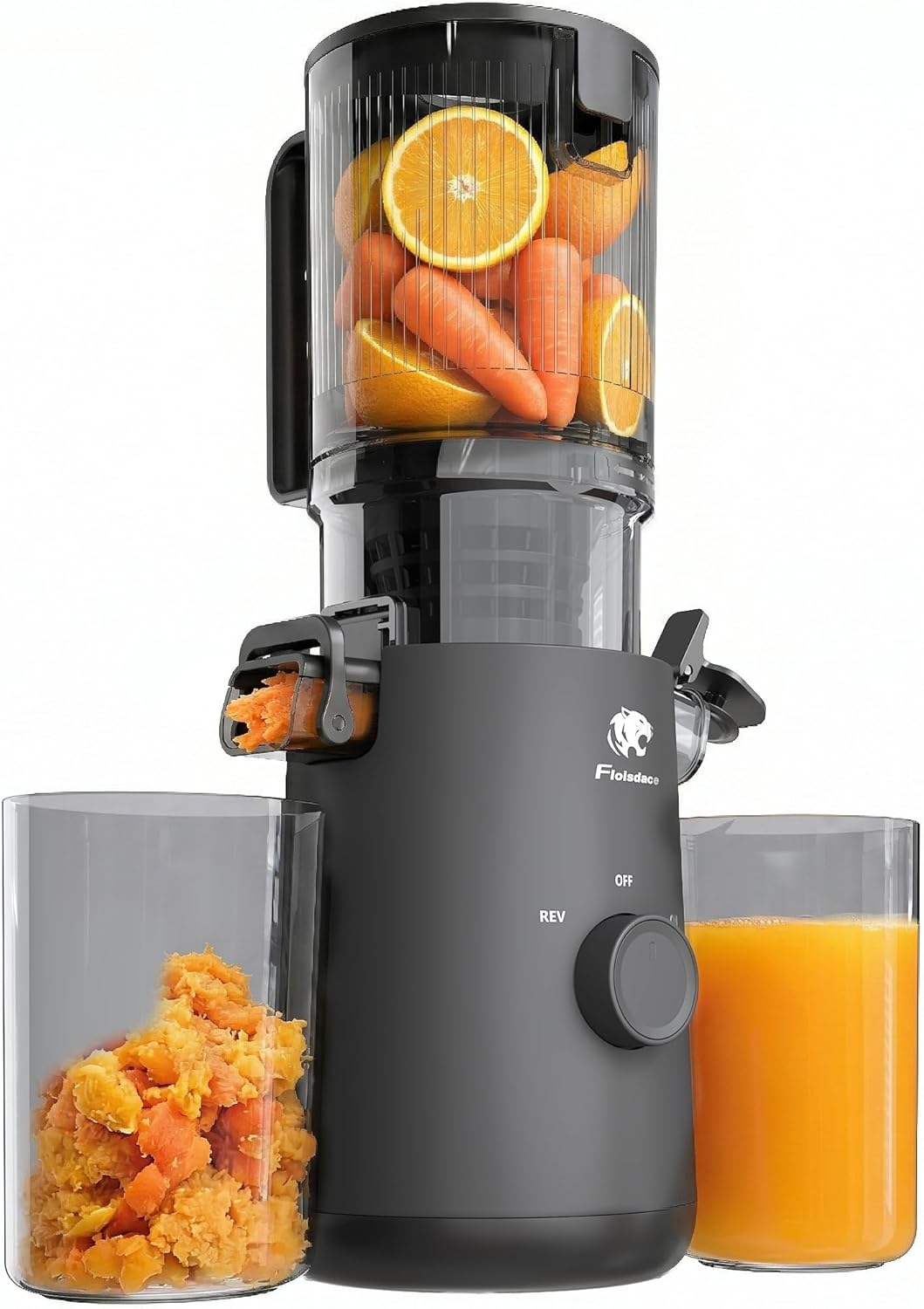
The Floisdace PT-030A is a masticating cold press juicer built for efficient, low-speed extraction of juice from whole produce. It runs at about 55 RPM to preserve nutrients and reduce heat, uses a wide 5.3-inch feed chute so many fruits can be fed whole, and includes an extra strainer for longer uninterrupted use. Its single-speed, AC brushless 200W motor delivers steady torque for tough items with lower noise than typical high-speed models. The unit emphasizes easy assembly and cleaning with a one-piece design and a cleaning brush, and the stainless steel construction and BPA-free parts improve durability and food safety. Limitations include a single speed so you cannot adjust for delicate items, and hand-wash-only care rather than dishwasher-safe parts. For buyers focused on value, this model offers strong juice yield and practical extras, but it lacks advanced speed controls and may require occasional manual reversing for jams despite the listed auto-reverse feature.
Best for: Buyers seeking an affordable cold-press juicer that prioritizes juice quality and minimal prep time will appreciate this model for daily home or light commercial use where budget matters.
Less Ideal for: Large-scale commercial operators or users who need variable-speed control, dishwasher-safe components, or heavy continuous throughput should consider higher-end or purpose-built commercial machines.
- Slow 55 RPM extraction preserves nutrients and yields smoother juice
- 5.3-inch feed chute accepts many whole fruits to reduce prep time
- 200W AC brushless motor provides steady power with relatively low noise
- Includes an extra replacement strainer for continued use without interruption
- Simple assembly and a cleaning brush make cleanup faster
- Only one speed control limits fine tuning for different produce textures
- Parts require hand washing rather than dishwasher convenience
- Claims of 99% extraction are optimistic and depend on produce and prep
Verdict: A budget-friendly cold press juicer that delivers high-yield, nutrient-preserving extraction and a large feed chute for whole fruits, making it a smart value pick for cost-conscious buyers.
anybear Cold Press Juicer SJ054C
| Maximum Power | 200 watts |
|---|---|
| Wattage | 200 watts |
| Voltage | 110 volts |
| Special Features | Easy to Clean |
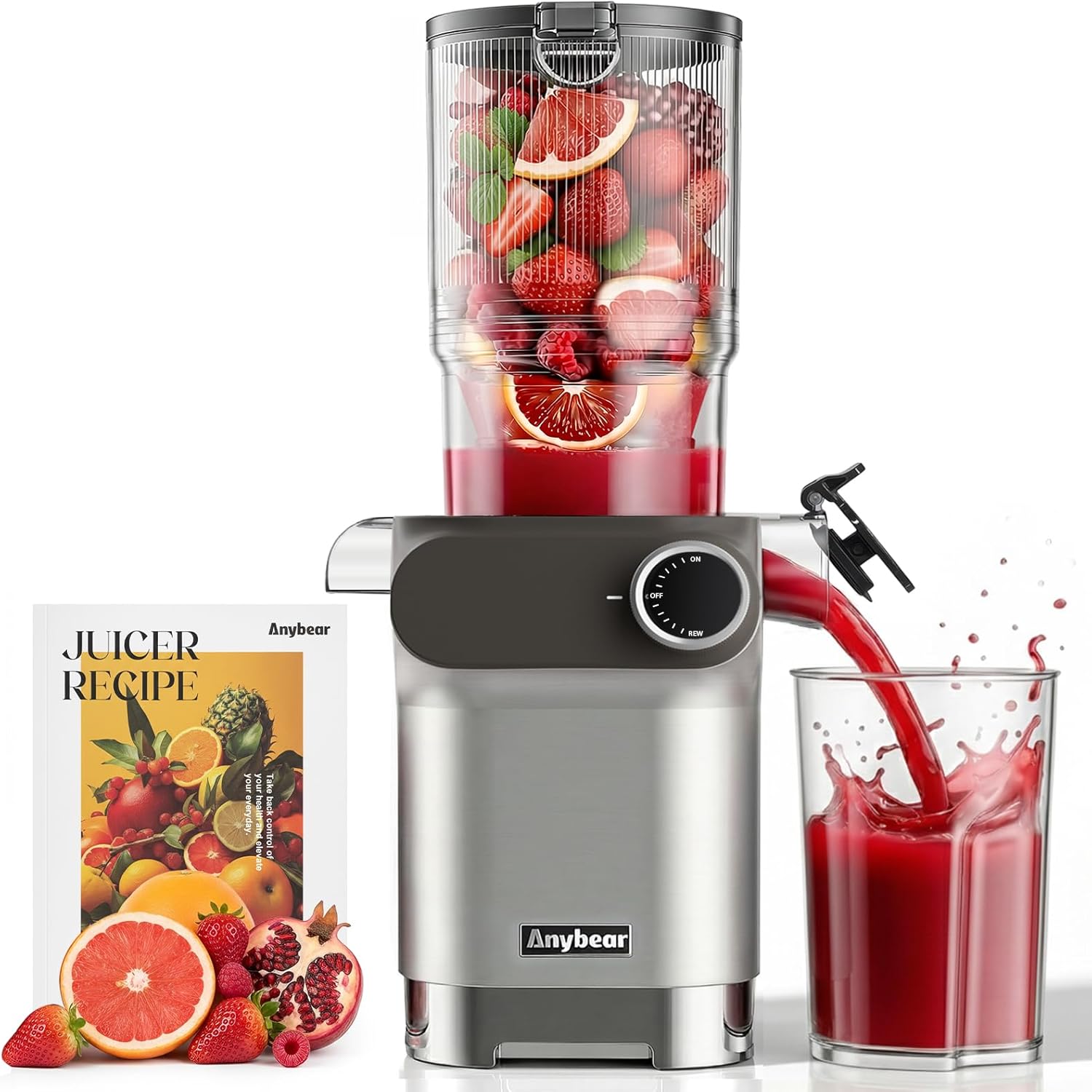
The anybear Cold Press Juicer SJ054C is a slow masticating juicer intended for home or light commercial use where juice quality and reliability matter. It uses a 200W, high-torque motor running at about 65 RPM with a single heavy-duty auger to slowly crush produce and reduce oxidation, which the brand says improves yield and flavor. A 4.3-inch feed chute accepts larger pieces so you spend less time pre-cutting, and key components use Tritan and stainless steel for food-contact durability. The one-piece stainless filter and included brush make disassembly and rinsing straightforward, though the unit is hand-wash only. Practical benefits include high juice extraction efficiency and a compact footprint that fits on a counter, while limitations are typical for slow juicers: throughput is lower than centrifugal machines and tougher maintenance may be needed for very fibrous produce. The extended 5-year warranty and responsive support add confidence for buyers looking for a durable budget commercial-style cold press juicer.
Best for: Buyers who prioritize reliable, high-yield cold-pressed juice and want a durable, low-speed juicer suitable for frequent daily use in a small commercial or heavy-home setting.
Less Ideal for: People who need very fast juice production for high-volume commercial lines or who want dishwasher-safe convenience should consider different models.
- High-torque 200W motor for steady low-speed extraction
- Large 4.3-inch feed chute reduces prep time
- Tritan and stainless steel food-contact parts resist staining and retain flavor
- Simple one-piece filter design and brush make cleaning faster
- Includes extended 5-year warranty and responsive customer support
- Lower throughput compared with high-speed centrifugal juicers
- Hand-wash only parts require manual cleaning
Verdict: Choose this juicer if you want a reliable, high-torque cold press machine that maximizes juice yield and comes with an extended warranty for peace of mind.
EanOruus 3-in-1 Cold Press Juicer E-18

| Capacity | 100 fluid ounces |
|---|---|
| Wattage | 250 watts |
| Power Source | ac |
| Voltage | 110 volts |
The EanOruus E-18 is a single-auger masticating juicer built for higher-volume home use and light commercial tasks. It uses a 250 W AC motor and an extra-wide 6.5 in feed chute that accepts whole fruit to reduce prep time, and a 100 oz hopper so you can load several batches at once. Two interchangeable strainers let you switch between juice and sorbet or produce creamy nut milk, and the auger+chamber design emphasizes slow, high-yield extraction for better nutrient retention. Practical touches include auto-reverse and an easily detachable pulp outlet to help prevent jams and speed cleaning, though most removable parts require hand washing. The machine is aimed at steady daily use rather than industrial continuous operation; the AC motor and overheat protection improve durability but the plastic blade components and polycarbonate parts mean you should follow cleaning and care instructions. For buyers comparing value, it balances large capacity and quiet operation with a focus on convenience over heavy commercial-grade metals and dishwasher-safe parts.
Best for: Buyers who want a high-capacity, quiet cold-press juicer that can handle whole fruits and multi-batch prep without upgrading to heavy commercial hardware and who prefer proven features like auto-reverse and overheat protection.
Less Ideal for: Businesses that need true industrial continuous-duty equipment or users who require fully dishwasher-safe metal components for heavy commercial cleaning cycles.
- Extra-wide 6.5-inch chute reduces prep by accepting whole fruit
- 100 oz hopper lets you load multiple batches for family or meal-prep use
- 250 W AC brushless motor provides steady, quiet extraction with overheat protection
- Includes interchangeable strainers for juice, nut milk and sorbet
- Auto-reverse and detachable pulp outlet help prevent jams and simplify clearing
- Most removable parts are hand-wash only rather than dishwasher-safe
- Some internal components are plastic rather than metal, so not built for industrial continuous duty
Verdict: Choose the EanOruus E-18 if you need a large-capacity, quiet cold-press juicer that handles whole fruits and multi-batch home or small-scale commercial prep affordably.
Ninja NeverClog Cold Press Juicer JC151

| Maximum Power | 150 watts |
|---|---|
| Number of Speeds | 2 |
| Power Source | Corded Electric |
| Capacity | 24 fluid ounces |
The Ninja NeverClog JC151 is a slow masticating juicer built to handle fibrous fruits and vegetables without frequent clogging. Its 150-watt high-torque motor turns an auger at low speed to extract juice from ingredients like celery, kale, carrots, and apples, while the NeverClog filter and Reverse program help clear jams. You get two interchangeable pulp filters to choose between less pulp or more fiber-rich juice, plus a 24 oz juice jug and 36 oz pulp container for larger batches. Practical touches include an anti-drip lever, compact countertop footprint that fits under cabinets, and dishwasher-safe juice-contact parts for easier cleanup. Because it focuses on steady, nutrient-preserving extraction rather than speed, juicing takes longer than a centrifugal machine but yields smoother, less foamy juice and better extraction from leafy greens. For someone who values reliable, everyday cold-pressed juice with minimal clog frustration, this model offers solid performance and straightforward controls, though it is not designed for high-volume commercial throughput or industrial use.
Best for: Buyers seeking a dependable, easy-to-use cold press juicer that minimizes clogging and delivers consistent, nutrient-focused juice for daily home or small-batch use.
Less Ideal for: People who need industrial or high-volume commercial juicing or who prioritize speed over juice quality should consider heavier-duty commercial machines or centrifugal models.
- High-torque 150W motor handles fibrous produce without frequent stalls
- NeverClog filter plus Reverse program reduces jams and improves extraction
- Two pulp filters let you choose texture from smooth to fiber-rich
- Larger 24 oz juice jug and 36 oz pulp container for batch juicing
- Dishwasher-safe juice-contact parts simplify cleaning
- Slower extraction speed compared with centrifugal juicers
- Not intended for heavy commercial throughput or continuous high-volume use
Verdict: Choose the Ninja JC151 when you want a budget-minded cold press juicer that reliably handles fibrous produce with fewer jams and easy cleanup.
Choosing the Right Budget Commercial Cold Press Juicer: Key Factors to Consider
Extraction Efficiency
Extraction efficiency determines how much usable juice you get from produce and directly affects ingredient costs. Higher efficiency means less waste and lower per-glass cost, which is crucial for businesses operating on slim margins.
When evaluating efficiency, consider whether the machine produces dry pulp, how it handles different textures such as leafy greens versus citrus, and whether multiple passes are needed. Machines that maintain low heat during pressing preserve nutrients and flavor while improving yield, so look for designs that prioritize gentle, continuous pressure.
Build Materials and Durability
Commercial use exposes equipment to long operating hours and frequent cleaning cycles, so durable materials matter. Stainless steel, reinforced plastics with food-safe ratings, and robust auger designs tend to withstand wear better than fragile components.
Assess the machine's frame, motor housing, and feeding chute for signs of heavy-duty construction. Consider whether consumable parts like screens and gaskets are replaceable and how often they require replacement under heavy use.
Throughput Capacity
Throughput capacity affects how many servings you can produce in a shift. For budget commercial units, balance realistic throughput expectations with the demands of your menu and peak periods.
Look at the recommended continuous run time and rated output per hour rather than theoretical cycle numbers. Machines with steady, continuous feed and easy pulp ejection will generally keep lines moving better than designs that require frequent resetting.
Cleaning and Daily Maintenance
Cleaning time can become a hidden labor cost in commercial settings. Components that disassemble quickly, have smooth surfaces, and avoid many small crevices reduce cleaning time and improve hygiene.
Also consider whether parts are dishwasher-safe or require hand cleaning, and whether the design allows for easy inspection of wear-prone areas. Frequent, simple maintenance routines help prevent costly downtime.
Serviceability and Parts Availability
Even budget commercial equipment will need parts replacement over time. Machines that use standardized, easy-to-source components simplify repairs and reduce downtime.
Verify that spare parts such as augers, seals, and screens are accessible and affordable. Consider whether the unit's design allows technicians to access and replace components without specialized tools.
Operating Cost and Energy Use
Operating cost includes electricity consumption, replacement parts, and routine maintenance. For high-volume operations, these recurring costs can eclipse the purchase price over time.
Evaluate the motor efficiency, rated power draw, and expected lifespan of wear parts. Lower energy draw and longer-lasting consumables reduce ongoing expenses and improve profitability.
Setting Realistic Expectations for Budget Commercial Units
Budget commercial cold press juicers aim to balance initial affordability with reasonable commercial performance. They are typically best suited to small operations with moderate volume rather than 24/7 industrial use. Expect solid extraction and good durability, but plan for more frequent maintenance and parts replacement than you might with heavy-duty industrial models.
Think about how the machine will be used across a typical business day. For busy rushes, a budget unit that can sustain steady throughput for defined periods and that has quick pulp clearing will be more valuable than one with a slightly higher theoretical yield but slower cycle times.
- Match rated throughput to your real peak-hour demand.
- Factor in short scheduled maintenance windows to prevent breakdowns.
- Prioritize units with easy pulp ejection for sustained service.
Practical Tips for Reducing Waste and Improving Yield
Small operational changes can improve yield regardless of the juicer model. For example, pre-processing produce by trimming cores, cutting into appropriate sizes, and rotating between harder and softer items can keep the auger working efficiently. Also, allow machines to run continuous cycles for a few seconds after feeding to squeeze residual liquid from pulp.
Periodic adjustment of feeding speed and routine inspection of screens and seals helps maintain extraction efficiency. Train staff on consistent feed patterns to avoid overloading and to prevent clogging that reduces yield.
- Trim and size produce for consistent feed.
- Alternate hard and soft produce to keep auger compression balanced.
- Purge machine briefly after batches to collect residual juice.
Sanitation and Health-Code Considerations
Commercial operations must meet local health-code requirements for food-contact surfaces and cleaning protocols. Choose a unit whose disassembly and surface finishes support thorough cleaning and sanitizing between shifts. Smooth, nonporous materials and removable components reduce contamination risk.
Develop a cleaning schedule that includes immediate rinse after each production run and a deeper daily sanitization. Keep a log for regulators and to help monitor component wear that may affect food safety.
- Rinse components immediately after use to prevent buildup.
- Schedule a full teardown and sanitization daily or per local code.
- Inspect seals and crevices regularly for residue accumulation.
Space, Footprint, and Workflow Integration
Consider how a juicer fits into your service flow. Compact footprint units save counter space but may require more frequent emptying of pulp bins. Conversely, larger machines can handle bigger batches but need more room and possibly a dedicated prep station.
Plan for access to power, waste disposal, and an adequate water source for cleaning. Position the machine to minimize staff movement between prep, juicing, and service areas to improve throughput.
- Measure available counter space and leave clearance for ventilation.
- Plan pulp and waste bin placement to avoid crossing service paths.
- Ensure easy access for maintenance and part replacement.
Training Staff and Establishing Routines
Consistent operator technique improves yield and reduces wear. Train staff on proper feed rates, how to clear minor jams, and daily maintenance tasks. Clear SOPs reduce the chance of operator error that can cause premature component failure.
Assign responsibilities for cleaning, part inspection, and ordering spare parts. A simple checklist helps maintain uptime and keeps consumable inventory at sensible levels.
- Create a short training module for new operators.
- Keep a maintenance checklist visible at the prep station.
- Track part usage to anticipate replacements before failure.
How We Chose the Best Budget Commercial Cold Press Juicer
We prioritized features that directly affect a commercial juice operation's cost, output, and downtime. First, extraction efficiency was measured as expected juice yield relative to produce input, since higher yield reduces ingredient costs. Second, build quality and materials were assessed for resistance to continuous use and for ease of repair in a commercial setting. Third, serviceability and parts availability were considered so operators can minimize downtime through routine maintenance and straightforward component replacement. Fourth, throughput and cycle time were reviewed to ensure machines can meet typical small-business production windows. Fifth, operating costs such as electricity draw and consumable wear parts were evaluated because they affect long-term expense. Units that relied on fragile hobbyist parts or had unclear commercial ratings were excluded. We focused on machines with documented cold-press extraction methods and robust feeding and auger systems. The items chosen reflect reliable extraction, realistic commercial endurance, easy daily cleaning, and sensible running costs. These criteria align with the scorecard metrics used below and with the practical needs of budget-focused commercial buyers.
Our full evaluation process is outlined in our review methodology.
FAQ
How much juice can a budget commercial cold press juicer produce per hour?
Output varies by machine and produce type, but budget commercial cold press juicers commonly handle moderate hourly volumes suitable for small cafes. Throughput is best gauged by the manufacturer's rated continuous run time and recommended input rate rather than a single number.
Will a budget unit handle leafy greens as well as hard fruits?
Many cold press designs handle both, but efficiency can differ. Leafy greens typically produce less liquid by weight and may require different feeding technique. Look for machines tested or rated for mixed produce to avoid disappointment.
How often do parts like screens and seals need replacement?
Replacement intervals depend on usage intensity and cleaning practices. Under typical small-business use, consumables may need inspection monthly and replacement on a cyclical schedule. Keeping spares on hand reduces downtime.
Are budget commercial cold press juicers difficult to clean?
Cleaning complexity varies by design. Models with fewer pieces and smooth surfaces are easier to clean quickly. Choose a unit whose disassembly fits your staff workflow and local sanitation requirements.
Can these juicers run continuously during a shift?
Budget commercial units can operate for extended periods but often have recommended duty cycles. Check the specified continuous run time and allow brief cooldowns as recommended to prevent motor strain.
What safety features should I expect on a commercial cold press juicer?
Basic safety features include secure locking feed chutes, overload protection, and non-slip bases. For commercial use, choose equipment with clear guards and fail-safes that stop the auger if jammed.
Final Verdict
For budget-focused commercial buyers, prioritize machines that deliver reliable extraction, easy cleaning, and straightforward serviceability. Expect tradeoffs between initial cost and long-term durability, and plan for a maintenance routine that minimizes downtime. Focus on extraction efficiency, parts availability, and realistic throughput for your peak demand to choose a unit that balances cost and operational reliability. With those priorities in place, you can pick a budget commercial cold press juicer that supports consistent service and manageable ongoing expenses.