
Note: This article contains affiliate links. If you click on these links and make a purchase, we may earn a small commission at no extra cost to you. This helps support our research and content. Read our full affiliate disclosure here.
If you want reliable bottle storage without spending a lot, a budget single-zone wine cooler can be the simplest way to maintain serving temperatures and protect wine from heat damage. These compact coolers focus on one temperature zone, which is ideal if you mainly store one wine style such as reds or whites or if you want a dedicated unit for ready-to-serve bottles. This guide highlights a short list of top picks for budget single-zone wine coolers, each chosen for practical features like temperature stability, usable capacity, noise, and footprint. Below we cover what matters when buying a budget cooler and explain how we evaluated these models so you can pick the right one for your space and drinking habits.
Top Picks at a Glance
| Best Overall The best all-around choice for most situations | BODEGA 24-Bottle Wine Cooler |  |
| Best Quality Built to a higher standard if you want something more solid | Zephyr Presrv 24" Wine Fridge |  |
| Best Value The sweet spot between price and what you get | Ivation 18-Bottle Wine Cooler |  |
| Best Budget The cheapest option that still gets the job done reliably | YDOOLNG 23L Wine Cooler JC-23 |  |
| Top Rated A top-rated pick with lots of positive feedback | Ivation 12-Bottle Wine Cooler |  |
| Most Popular A crowd favorite that many people choose with confidence | Antarctic Star Wine Cooler 3.2cu ft |  |
| Best Seller A high-volume bestseller chosen again and again | EUHOMY 16-Bottle Wine Cooler |  |
BODEGA 24-Bottle Wine Cooler
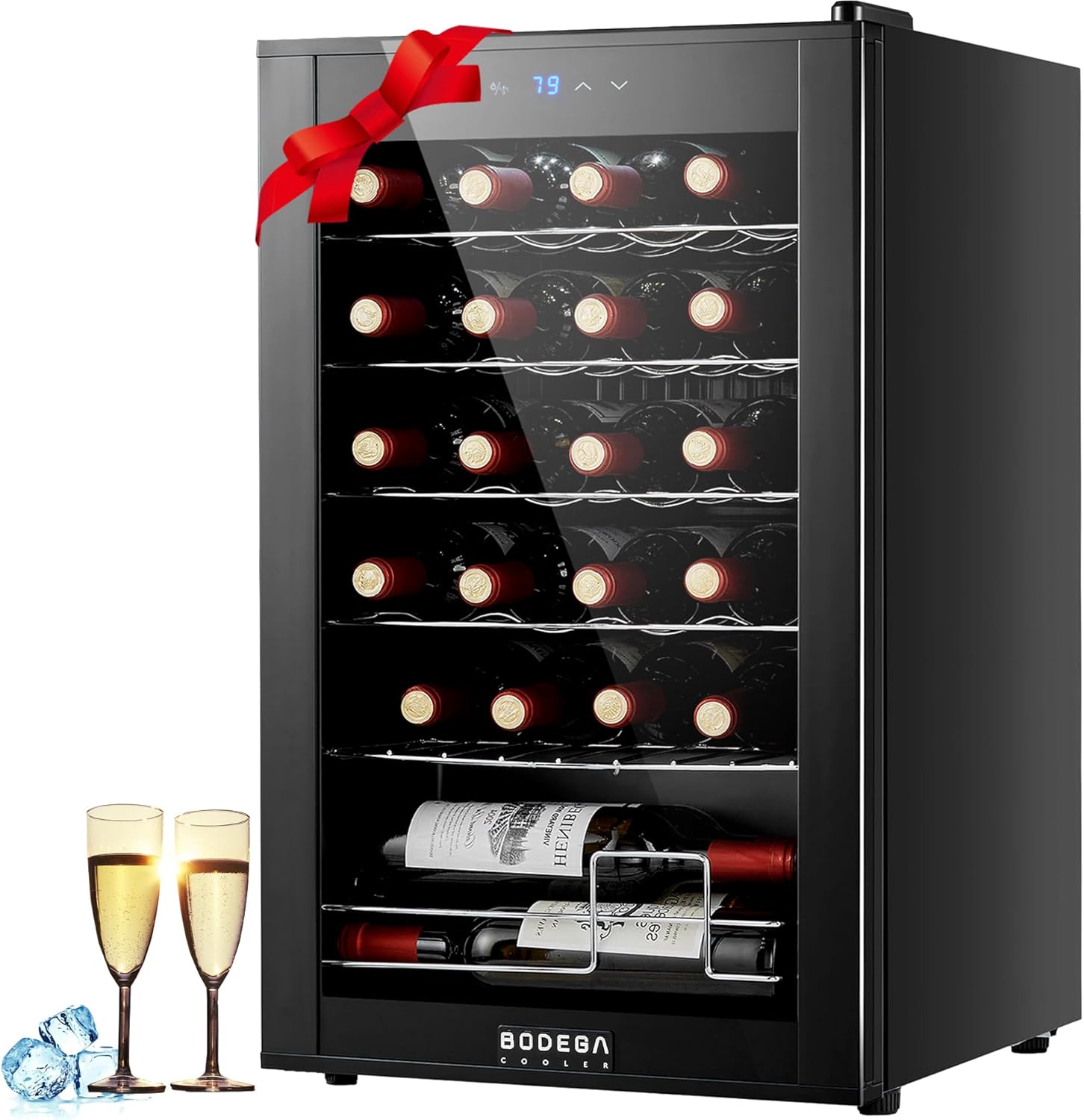
| Capacity | 2.5 cubic feet |
|---|---|
| Bottle Capacity | 24 Bottle |
| Temperature Range | 41°F to 64.4°F |
| Cooling Method | Compressor |
| Shelves | 6 removable metal shelves |
The BODEGA 24-bottle wine cooler is a single-zone, freestanding fridge that uses a compressor to reach and hold cellar-style temperatures between about 41°F and 64.4°F. It is typically used to store a small to medium personal collection in a kitchen, home bar, or office where fast cooling and steady temperature matter. Notable features include a digital panel on the glass door for temperature adjustments without opening the unit, a double-layer UV-protected glass door to reduce light exposure, six removable chrome-plated metal shelves, white LED interior lighting, and an automatic defrost cycle. In real use the compressor delivers quicker, more consistent cooling than thermoelectric models and the whisper-quiet operation makes it suitable for living spaces. The unit is compact for freestanding placement but large enough to hold roughly two dozen standard 750 ml bottles. Limitations are the single temperature zone, which means you cannot store wines requiring very different serving temperatures together, and the modest interior volume that may require careful shelf arrangement for larger or odd-shaped bottles.
Best for: Buyers seeking an affordable, reliable single-zone compressor cooler to preserve a modest personal collection in a kitchen, apartment, or home bar where quiet operation and steady temperatures matter.
Less Ideal for: Collectors who need dual-zone temperature control or those who want to store a large or mixed-size bottle inventory should consider larger or dual-zone models instead.
- Compressor cooling for faster, more consistent temperature control than thermoelectric units.
- Digital temperature panel on the door allows adjustments without opening the cooler.
- UV-protected double glass door reduces light exposure to preserve wine quality.
- Six removable chrome-plated shelves provide flexible storage layout.
- Quiet operation and white LED interior light suitable for living spaces.
- Single-zone cooling prevents storing wines that need different temperatures together.
- Compact 2.5 cu ft capacity limits the number and variety of bottles you can store.
Verdict: A budget-friendly compressor wine cooler that delivers steady, quiet single-zone cooling for a 24-bottle home collection.
Zephyr Presrv 24" Wine Fridge

| Configuration | Freezerless |
|---|---|
| Cooling Method | Active Cooling Technology |
| Number Of Shelves | 6 |
| Refrigerant | R-600A |
| Installation Type | Countertop |
The Zephyr Presrv 24" is a single-zone wine fridge built to store standard 750ml bottles at a stable temperature for home bars or kitchens. It uses active cooling technology, a reversible glass door with dual-pane low-e argon-filled glass, and six wooden shelves sized to accommodate larger-diameter bottles like Pinot Noir and Champagne. The interior lighting offers three color choices to show off the collection, and the unit includes a keyed lock for security. In practice this model fits under a counter or stands alone, keeps bottles organized on the wooden racks, and provides consistent cooling thanks to its active system and R-600A refrigerant. Trade-offs are the single temperature zone, which limits storing two very different wine types at once, and its modest net capacity relative to full-size cellar units. For someone prioritizing reliable temperature control, premium finishes, and presentation in a compact footprint, this fridge performs well; buyers who need multi-zone flexibility or larger commercial capacity should look elsewhere.
Best for: Buyers who want a compact, performance-focused single-zone wine fridge that maintains steady temperatures and showcases a curated bottle collection under a counter or as a freestanding unit.
Less Ideal for: People who need separate temperature zones for mixed wine storage or those who require large commercial-scale capacity.
- Active cooling technology for steady temperature control
- Large-diameter wooden racks accommodate wider bottles
- Dual-pane, low-e argon-filled glass door improves insulation
- Reversible door and keyed lock add installation flexibility and security
- Three-color LED interior lighting for display and visibility
- Single-zone design cannot maintain separate temperatures for red and white wines
- Net capacity is relatively modest compared to larger cellars
Verdict: Choose this Zephyr Presrv if you want a well-built, single-zone 24" wine fridge that delivers steady cooling and polished presentation for a curated home collection.
Ivation 18-Bottle Wine Cooler

| Capacity | 1.8 cubic feet |
|---|---|
| Bottle Capacity | 18 Bottle |
| Temperature Range | 41°F–64°F |
| Cooling Method | Compressor |
| Defrost System Type | Automatic |
The Ivation 18-Bottle Wine Cooler is a compact freestanding unit that uses a compressor and internal fan to keep temperatures steady between 41°F and 64°F, making it suitable for storing reds, whites, and sparkling wines. It typically sits on the floor or a countertop and is configured as a single-zone cooler with six wire racks that are removable to fit different bottle sizes. Notable features include a double-paned thermopane glass door that reduces UV exposure, a digital touch display with lock, soft LED interior lighting, and automatic defrost for low-maintenance operation. The compressor design and inverter help the cooler maintain set temperatures even when ambient room temperature fluctuates, which is valuable for long-term storage and reliability-focused buyers. Trade-offs are its single-zone layout, which does not allow separate temperatures for whites and reds, and modest capacity, which limits it to small collections or secondary storage. Energy consumption is moderate and the unit is intended as a dedicated wine fridge rather than a full-size cellar.
Best for: Buyers who prioritize a reliable, temperature-stable freestanding cooler for a small collection or secondary wine storage and want a low-maintenance unit with clear digital controls.
Less Ideal for: Collectors who need a large-capacity or dual-zone cellar for storing multiple wine types at different temperatures should consider larger or dual-zone models instead.
- Compressor cooling with internal fan for stable, consistent temperatures
- Double-paned thermopane glass door that helps block UV and insulates the interior
- Digital touch controls with lock and clear LCD for easy temperature management
- Removable wire racks accommodate different bottle sizes and simplify loading
- Single-zone design cannot maintain different temperatures for whites and reds
- Limited 18-bottle capacity may be too small for larger collections
Verdict: Choose this Ivation cooler when you want a compact, compressor-driven freestanding unit that keeps a small wine collection at stable, reliable temperatures.
YDOOLNG 23L Wine Cooler JC-23

| Capacity | 23 liters |
|---|---|
| Cooling Method | Compressor |
| Power | 55W |
| Voltage | 110 volts |
| Defrost System Type | Automatic |
This compact wine cooler is built as a budget-friendly freestanding unit that uses a compressor cooling system and a digital LED display for temperature control. It is sized for small collections and typically sits on a countertop or cabinet; buyers set a target temperature using the touch panel and the cooler circulates air with an internal fan for more even cooling. Notable features include double-layer tempered glass with interior blue LED lighting, five removable shelves/racks that match bottle shapes, and an automatic defrost system. The unit is relatively quick to cool thanks to its 55W compressor and is intended for ambient indoor use only rather than built-in installation. Expect simple, straightforward operation and modest energy use, but also a very small total capacity and a basic 3-month warranty, so long-term reliability and advanced vibration or humidity controls are limited compared with higher-end models.
Best for: Buyers prioritizing the lowest-cost way to keep a few bottles at serving temperature who need a small freestanding cooler for an apartment, office, or secondary spot.
Less Ideal for: Collectors who need long-term storage, strict humidity control, or room for dozens of bottles should choose a larger, feature-rich cellar instead.
- Compact 23L capacity fits small collections and tight spaces
- Compressor cooling with internal fan provides faster, more consistent cooling than passive units
- Digital LED display and touch controls allow precise temperature selection
- Double-layer tempered glass door with interior LED light lets you check bottles without opening the door
- Five removable shelves/racks accommodate common bottle shapes
- Very limited overall capacity for larger collections
- Short 3-month warranty and basic feature set compared with premium coolers
Verdict: If you want an inexpensive, countertop-friendly compressor cooler to chill a handful of bottles reliably, this 23L unit is a practical budget pick.
Ivation 12-Bottle Wine Cooler
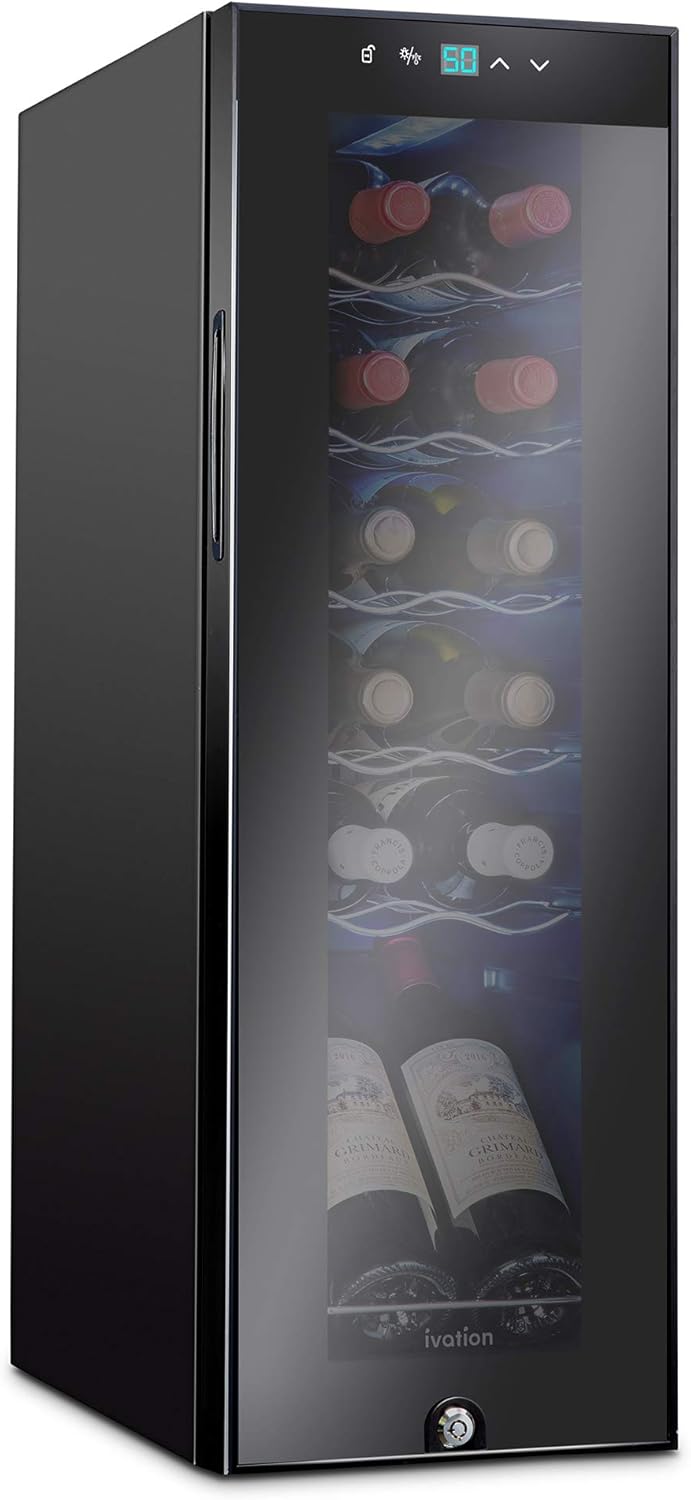
| Capacity | 1.2 cubic feet |
|---|---|
| Temperature Range | 41-64°F |
| Power | 95W / 1.2 Amps |
| Cooling Method | Compressor |
| Refrigerant | R-600A |
This Ivation 12-bottle cooler uses a compressor cooling system and internal fan to hold a stable 41–64°F range, making it suitable for both chilling and longer-term storage. It installs freestanding and has six removable wire racks so you can fit standard 750 ml bottles or rearrange for larger formats. The digital touch display shows temperature in Fahrenheit or Celsius and can be locked to prevent accidental changes, while the double-paned UV-resistant glass and rubber gasket help keep light and air out. Vibration-reducing compressor operation preserves sediment and the interior LED provides soft illumination for inspections without harsh heat. As a compact unit it draws modest power (rated 95W) and includes a keyed lock for security. Limitations include a small 1.2 cu ft capacity that restricts larger fermentation batches and single-zone control that prevents separate temperature settings for multiple products. The unit is best when you need a reliable, quiet compressor fridge with precise temperature stability in a compact footprint rather than a higher-capacity or dual-zone system.
Best for: Buyers seeking a compact, performance-focused compressor fridge that holds steady temperatures for precise fermentation or small-batch aging and who prioritize stability and quiet operation.
Less Ideal for: Those who need higher capacity, multiple temperature zones, or to run several fermentations at different setpoints simultaneously should look at larger or dual-zone units.
- Compressor cooling with inverter ensures stable, low temperatures suitable for fermentation control.
- Wide adjustable temperature range (41–64°F) with digital touch controls and lock for set-and-forget operation.
- Double-paned UV-resistant glass and airtight gasket protect contents from light and external air.
- Removable wire racks allow flexible bottle arrangement and easier cleaning.
- Quiet, vibration-reducing operation that minimizes disturbance to sediments or sensitive contents.
- Small 1.2 cubic foot capacity limits the number and size of fermentation vessels you can fit.
- Single temperature zone cannot maintain different temperatures for multiple simultaneous projects.
Verdict: Choose this cooler when you want a compact, compressor-driven fridge that delivers stable, low-temperature control for small-batch fermentation and precision cooling.
Antarctic Star Wine Cooler 3.2cu ft

| Capacity | 3.2 cubic feet |
|---|---|
| Cooling Method | Compressor |
| Temperature Range | 32°F–61°F |
| Number Of Shelves | 4 |
| Lock Type | Key |
This Antarctic Star wine cooler is a compact single-zone unit designed for home, office, or bar use where consistent, everyday storage is the priority. It cools with a compressor system across a working range of 32°F to 61°F and offers digital temperature control so you can set and maintain a target for long-term bottle storage or beverage chilling. The clear glass door, airtight seal, and internal LED light make bottles easy to see while helping retain humidity, and four adjustable wire shelves create flexible horizontal racking for up to 26 standard bottles or stacked cans. It is built as a freestanding unit with leveling legs and a keyed lock for security, and the brand highlights low vibration and a quiet compressor, which helps protect wine sediment and keeps noise down in living spaces. Trade-offs are its manual defrost system and relatively small 3.2 cu ft capacity, so it is best where steady, reliable cooling for a moderate collection matters more than large-capacity or multi-zone precision.
Best for: Buyers who prioritize dependable, stable single-zone cooling for a modest wine or beverage collection and want a compact freestanding unit that runs quietly in living or entertaining spaces.
Less Ideal for: Collectors who need multi-zone temperature control or those who need to store a large number of bottles should look for larger or dual-zone models.
- Compressor cooling with 32°F–61°F range and digital temperature control for stable single-zone storage
- Quiet, low-vibration operation that protects bottle sediment
- Clear glass door with airtight seal and interior LED lighting for visibility and humidity retention
- Adjustable wire shelves allow flexible horizontal racking for bottles or cans
- Freestanding design with leveling legs and keyed lock for security
- Manual defrost requires occasional user maintenance
- Capacity is limited to a moderate 3.2 cu ft, not suitable for large collections
Verdict: A reliable, quiet single-zone cooler that keeps a moderate collection at stable temperatures for home use.
EUHOMY 16-Bottle Wine Cooler

| Capacity | 1.7 cubic feet |
|---|---|
| Bottle capacity | 16 bottles (750ml) |
| Temperature range | 40°F to 61°F |
| Defrost system | Manual |
| Installation Type | Countertop |
The EUHOMY 16-Bottle Wine Cooler is a countertop freestanding unit that uses a compressor and circulating fan to keep bottles between 40°F and 61°F. It is typically used to store mixed collections of red, white, and sparkling wines or to chill beverages in a kitchen, home bar, or office. Notable features include a double-pane UV-protected glass door with an airtight seal, a digital control panel for setting temperature, soft blue LED interior lighting, four removable wire shelves for flexible bottle arrangements, and a reversible door with leveling feet for stable placement. In real use it cools steadily with claimed quiet operation around 38 dB and the compressor-based system handles warmer ambient temperatures better than thermoelectric coolers. Trade-offs are its modest 1.7 cu ft capacity, which limits large collections, and manual defrosting rather than an automated system. Energy consumption is moderate at the listed annual figure, so it is best where a compact, reliable cooler is needed rather than as a full cellar replacement.
Best for: Buyers who want a compact, reliable single-zone cooler for everyday wine and beverage storage and who prioritize steady temperature control and low noise over large capacity.
Less Ideal for: Collectors who need to store dozens of bottles or require multi-zone temperature control should look at larger or dual-zone units.
- Compressor cooling with circulating fan for consistent temperatures in varied room conditions
- Digital temperature control covering 40°F to 61°F for common wine and beverage needs
- Double-pane UV-protected glass door and airtight seal help protect bottles from light and preserve conditions
- Removable adjustable shelves and reversible door allow flexible placement and bottle arrangements
- Small 1.7 cu ft capacity limits the number of bottles you can store
- Manual defrost requires occasional maintenance
Verdict: A compact, quiet compressor wine cooler that delivers reliable single-zone temperature control for everyday collections and small home bars.
Choosing the Right Budget Single-Zone Wine Cooler: Key Factors to Consider
Temperature Stability and Control
Consistent temperature is the primary job of any wine cooler. For single-zone units, look for systems that hold the set temperature within a narrow band over daily cycles. Stable control prevents premature aging and flavor shifts that occur when wine experiences repeated warm-cold swings.
Temperature readouts and simple digital or dial controls help you confirm the set point. Because budget units often use smaller compressors or thermoelectric systems, check whether the cooler reaches and maintains the target under typical room conditions rather than just at a modest test lab setting.
Bottle Capacity and Shelf Layout
The stated bottle capacity may assume the most compact packing, but real-life usability depends on shelf spacing and whether shelves slide or tilt for longer bottles. Consider the mix of bottle types you plan to store—standard 750 ml Bordeaux bottles, taller Burgundy bottles, or a few magnums—and choose a layout that minimizes wasted space.
Removable or adjustable shelving increases flexibility and helps you adapt the cooler as your collection changes. For small kitchens or apartments, a compact footprint with vertical storage may be better than a wider unit that holds more bottles but will not fit under counter or in a narrow alcove.
Noise, Vibration, and Wine Health
Noise matters for living spaces, and vibration matters for wine. Compressors and fans in budget coolers can produce noise and micro-vibrations that disturb sediment and slowly affect wine development. If the unit will sit in a living room or near sleeping areas, choose a model with quiet operation ratings.
Look for shelves that isolate bottles from the compressor or have vibration-damping design. Thermoelectric coolers are often quieter but can struggle in warmer rooms. Consider where you will place the cooler and how noise and vibration will affect both enjoyment and wine condition.
Door Type, Seal, and UV Protection
A tight, well-made door seal keeps cool air in and warm air out, reducing runtime and protecting wine. Many budget single-zone coolers use a double-pane glass door; if so, verify the glass includes some UV filtering to protect wine from light exposure.
Reversible doors or options for solid-panel conversion increase installation flexibility. Check the hinge quality and whether the door closes smoothly to avoid gaps that drive up energy use and reduce temperature consistency.
Energy Use and Long-Term Upkeep
Lower upfront cost can be offset by higher electricity consumption or maintenance needs. Compare estimated energy use and consider how often maintenance tasks like defrosting or cleaning condensers are recommended. A unit with modest energy draw and accessible service points will cost less to own over time.
Also assess filter and gasket replacement ease. Units that are simple to clean and maintain keep long-term ownership pleasant and typically perform better across seasons.
Size, Venting, and Installation
Think about where the cooler will live and whether it needs built-in or freestanding placement. Many single-zone coolers require clearance for ventilation at the back or top. If you plan an under-counter install, confirm the unit supports that orientation and that there is adequate airflow.
Measure door swing and nearby cabinetry to ensure the door can open fully. Consider whether the cooler needs leveling feet or a flat, stable surface to minimize vibration and ensure consistent operation.
Thermoelectric Vs Compressor Cooling: Which Fits Your Space
Budget single-zone wine coolers typically use either thermoelectric or compressor-based cooling. Thermoelectric units are quieter and have fewer moving parts, which can be attractive in small living spaces. They work best in moderate ambient temperatures and for smaller capacities.
Compressor coolers cool more quickly and maintain low temperatures more reliably in warm rooms. They are generally better for larger capacities and for users who need precise control in variable climates. The trade-offs are more noise and slightly higher energy use.
- Thermoelectric: quieter, less powerful, best for small-capacity and moderate rooms
- Compressor: stronger cooling, better for higher ambient temperatures and larger loads
Placement Tips for Optimal Performance
Where you place a cooler affects its efficiency. Avoid direct sunlight or near heat sources such as ovens and dishwashers. Allow the recommended clearance for airflow so the compressor or thermoelectric heat sink can dissipate heat effectively.
If the unit will be installed under counter, confirm it is rated for built-in use and that ventilation pathways remain unobstructed. Level the cooler so shelves sit flat and bottles do not roll.
- Keep away from direct sunlight and heat sources
- Ensure proper clearance for airflow as specified in the manual
- Level the unit and allow door to open fully without obstruction
Organizing Bottles for Access and Stability
Organize bottles for both access and minimal movement. Use the front rows for bottles you reach for frequently and store longer-term bottles toward the back. Sliding or wire shelves help you retrieve a single bottle without disturbing others.
Store bottles horizontally so corks remain moist. If you plan to keep a mix of red and white at different ideal temperatures, single-zone coolers work best when you store bottles at a common serving temperature rather than trying to store multiple ideal temperatures at once.
- Front-facing storage for everyday bottles
- Horizontal storage to keep corks moist
- Group by drinking timeframe rather than by varietal when using one temperature zone
Maintenance and Cleaning Basics
Regular cleaning keeps the cooler performing well. Wipe shelves and interior surfaces with a mild, non-abrasive cleaner and ensure the door gasket is free of debris that could prevent a tight seal. Periodic defrosting or draining may be required depending on the model.
Clean condenser coils or vents if accessible to maintain cooling efficiency. Replace or clean any air filters according to the manufacturer guidelines to reduce dust buildup and keep airflow steady.
- Wipe interior and shelves regularly with mild cleaner
- Inspect and clean vents or coils to maintain efficiency
- Check and clean door gaskets to preserve a tight seal
What to Expect From a Budget Unit
Budget single-zone coolers offer practical performance for daily serving and short- to medium-term storage. Expect simpler controls, fewer frills, and compact capacities. You may trade off advanced insulation or ultra-quiet operation to get a lower price.
Good budget units still deliver consistent temperature within reasonable margins, usable shelving, and acceptable noise levels for kitchens or small living areas. Plan for realistic capacity expectations and look for units with good seals and clear temperature displays.
- Simpler feature sets and basic temperature controls
- Practical storage for serving temperatures and short-term aging
- Look for tight seals and clear temperature readouts
How We Chose the Best Budget Single-Zone Wine Cooler
We filtered contenders for the list by focusing on practical performance and ownership tradeoffs that matter for budget single-zone wine coolers. Key evaluation criteria included temperature stability and accuracy, usable bottle capacity and shelving layout, noise and vibration levels that affect cellar conditions, build quality and seal integrity for consistent cooling, and energy use for reasonable running costs. We favored units with straightforward temperature controls and delivery of rated capacity in real-world layouts rather than theoretical maximums. Models that lacked reliable temperature control, had poor door seals, or required frequent repairs were excluded. We also excluded niche or specialty coolers with advanced multi-zone features since this roundup focuses strictly on single-zone, value-oriented units. The result is a list of practical, lower-cost single-zone wine coolers that balance performance and ownership costs for typical home use.
Our full evaluation process is outlined in our review methodology.
FAQ
Can a single-zone cooler store both reds and whites?
Often you can store both, but a single-zone cooler holds a single set point. Choose a compromise serving temperature or store whites chilled in the fridge before serving. For long-term aging of different styles, separate storage conditions are preferable.
How quiet are budget single-zone wine coolers?
Noise varies. Thermoelectric models are usually quieter, while compressor units are louder but more powerful. Expect some fan or compressor hum; check noise ratings and placement if silence is important.
Do I need to defrost a budget wine cooler?
Some models are frost-free while others require occasional manual defrosting. Follow the unit's maintenance guidelines and defrost when ice buildup impairs shelving or airflow.
Can a budget cooler be built into cabinetry?
Some budget models are designed for built-in installation, but many require additional clearance for ventilation. Confirm the unit's built-in rating and follow ventilation instructions to avoid overheating.
How should I position bottles to protect corks?
Store bottles horizontally so the wine keeps the cork moist. This reduces the chance of cork drying and air ingress, which can cause oxidation over time.
Final Verdict
When choosing a budget single-zone wine cooler, prioritize temperature stability, a usable shelving layout, and a tight door seal. Decide whether quiet operation or stronger cooling is more important based on where the unit will be placed. Accept reasonable trade-offs on features to keep costs down but insist on reliable temperature control and good build quality. With those priorities in mind, you can confidently select a compact cooler that protects your bottles and fits your space.