
Note: This article contains affiliate links. If you click on these links and make a purchase, we may earn a small commission at no extra cost to you. This helps support our research and content. Read our full affiliate disclosure here.
If you need reliable frozen storage without wasting space or money, picking the right small freezer matters. A compact budget small freezer can serve as backup storage, a dorm or garage solution, or a compact companion for apartments where a full-size unit is impractical. You want an appliance that balances usable capacity, steady temperatures, and reasonable energy use. This guide showcases seven shortlisted budget small freezers that meet practical home needs. We evaluated units for energy efficiency, internal layout, temperature control, and noise to help you find the best fit. Read on for how each model performs against the criteria most buyers care about.
Top Picks at a Glance
| Best Overall The best all-around choice for most situations | BLACK+DECKER 2.0 Cu. Ft. Chest Freezer |  |
| Best Quality Built to a higher standard if you want something more solid | Whynter CUF-112SS Mini Freezer |  |
| Best Value The sweet spot between price and what you get | WANAI Chest Freezer 3.5 Cu Ft | 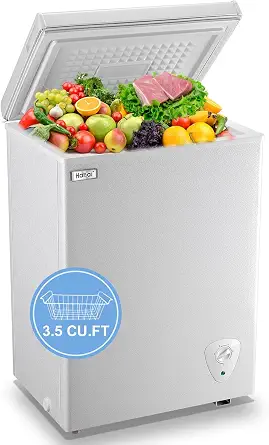 |
| Best Budget The cheapest option that still gets the job done reliably | 5 SUNDAY LIVING 3.5 Cu.ft Chest Freezer |  |
| Top Rated A top-rated pick with lots of positive feedback | DollarDash 3.5 Cu.Ft Chest Freezer |  |
| Most Popular A crowd favorite that many people choose with confidence | Upstreman BR321 3.2 Cu.Ft Mini Fridge |  |
| Best Seller A high-volume bestseller chosen again and again | Frostorm 3.2 Cu Ft Mini Fridge |  |
BLACK+DECKER 2.0 Cu. Ft. Chest Freezer

| Capacity | 2 cubic feet |
|---|---|
| Voltage | 115 volts |
| Number Of Shelves | 1 |
| Installation Type | Freestanding |
This BLACK+DECKER compact chest freezer provides straightforward extra frozen storage for kitchens, garages, or basements where space is limited. It holds about 70 pounds of food in 2.0 cu ft and includes a removable storage basket that helps keep frequently used items accessible. Temperature is controlled with an exterior mechanical dial offering up to seven settings and a compressor indicator light, so you can tune the interior coldness without opening the lid. Maintenance is simple thanks to manual defrost and an easy-access drain cap for water removal. Because it is a basic freestanding chest unit it lacks automatic defrost and digital controls, but that simplicity also means fewer parts to break and generally lower running costs. For buyers who want a compact, no-frills freezer to supplement existing refrigeration, this model delivers practical capacity and easy upkeep in a small footprint.
Best for: Buyers seeking an affordable, no-frills secondary freezer to expand household frozen storage in tight spaces who value simple reliable operation over advanced features.
Less Ideal for: People who need large capacity, automatic defrost, or precise digital temperature control should consider larger or feature-rich freezers instead.
- Compact 2.0 cu. ft. capacity stores up to about 70 lbs of frozen food
- Removable storage basket for organizing frequently used items
- Mechanical temperature dial with seven settings and exterior indicator light
- Manual defrost with easy-access drain simplifies cleaning and maintenance
- Manual defrost rather than auto-defrost requires occasional user maintenance
- No digital controls or thermometer for precise temperature readout
Verdict: A straightforward, budget-friendly compact chest freezer that adds reliable extra frozen storage in small spaces.
Whynter CUF-112SS Mini Freezer

| Capacity | 1.1 cubic feet |
|---|---|
| Wattage | 79 watts |
| Door Orientation | Reversible |
| Number Of Shelves | 1 |
| Specification Met | Energy Star |
The Whynter CUF-112SS is a compact upright freezer built for small-space cold storage like kitchens, offices, garages, or basements. It uses a compressor-based cooling system that reaches a mechanical temperature range near -11°F to 10.4°F and circulates cold air for consistent temperatures across the single removable slide-out wire shelf. Practical touches include a recessed handle, a reversible door for flexible placement, and a cylinder lock with two keys for secure storage. The unit is Energy Star rated and draws about 79 watts, so it keeps running costs low compared with larger freezers. Maintenance is manual defrost, which is simple but requires periodic thawing to avoid ice buildup. Capacity is small at 1.1 cubic feet, so it is best for frozen essentials, meal prep portions, ice cream, or breast milk rather than bulk storage. Build quality and features align with budget-oriented buyers who prioritize reliable freezing performance in a tight footprint.
Best for: Buyers who need dependable freezing performance in a very small footprint and want a simple, energy-efficient unit for essentials rather than bulk storage.
Less Ideal for: Anyone who needs large-capacity or multi-shelf freezer storage, fully automatic frost-free operation, or heavy-duty commercial freezing should choose a larger model instead.
- Compact upright design fits tight spaces and allows vertical organization
- Powerful compressor cooling with fan circulation for even temperature distribution
- Reversible door and recessed handle provide flexible placement and a clean look
- Cylinder lock adds security for stored items
- Energy Star rated for lower energy consumption relative to size
- Manual defrost requires occasional thawing and clearing of ice buildup
- Single shelf and small capacity limit storage to modest quantities
Verdict: A solid, energy-efficient mini upright freezer that delivers reliable compressor cooling and secure compact storage for buyers on a budget.
WANAI Chest Freezer 3.5 Cu Ft

| Capacity | 3.5 cubic feet |
|---|---|
| Wattage | 70 watts |
| Voltage | 110 volts |
| Number Of Shelves | 1 |
| Door Orientation | Top |
This WANAI 3.5 cu ft chest freezer is a simple, space-saving unit aimed at apartments, dorms, or secondary kitchen use. It uses an R600a compressor and a seven-level thermostat that lets you run temperatures from refrigerator range to deep freeze, making it handy for drinks, frozen meals, or bulk meat. The top-open lid and removable wire basket make loading and organizing small items straightforward, and the manual defrost with side drain is easy to manage for occasional maintenance. Noise is marketed below 45 dB and the listed power draw is about 70 watts, which keeps running costs low for regular use. Expect basic construction and fewer bells and whistles compared with larger models: there is no automatic defrost, no temperature display, and mobility is limited by the lack of wheels. For buyers prioritizing a low-cost, efficient freezer footprint, this delivers practical performance without extra complexity.
Best for: Buyers who need an affordable, no-frills secondary freezer for limited space and want simple temperature control and low operating cost.
Less Ideal for: Those who need large capacity, automatic defrost, built-in temperature monitoring, or frequent mobility between locations should consider larger or feature-rich alternatives.
- Compact footprint fits small kitchens, apartments, and dorm rooms.
- Seven-level adjustable thermostat covers refrigerator and freezer ranges for flexible storage.
- Removable basket simplifies organization of small or frequently used items.
- Energy-efficient R600a compressor with low listed wattage for modest running costs.
- Manual defrost requires periodic thawing and water removal via the side drain.
- No digital temperature display or precise readout for exact setpoint monitoring.
Verdict: A low-cost, compact chest freezer that gives practical, energy-efficient frozen storage for small-space shoppers.
5 SUNDAY LIVING 3.5 Cu.ft Chest Freezer

| Capacity | 3.5 cubic feet |
|---|---|
| Wattage | 58 watts |
| Voltage | 120 volts |
| Number Of Shelves | 1 |
| Door Orientation | Top |
This compact chest freezer is aimed at buyers who need extra frozen storage without a large footprint. It uses a compressor-driven system and offers seven temperature levels that span approximately -7.6 to -22.2°F, so you can dial in colder settings for long-term storage or milder ones for short-term use. The top-open design and included removable basket make it easy to organize small packages, ice cream, and frozen meals, and the unit is freestanding so it fits in a garage, dorm, or kitchen nook. At 58 watts it is relatively energy efficient for continuous use, and the manufacturer notes quiet operation under 40 dB for minimal noise. Trade-offs include limited capacity compared with full-size freezers and the need to keep it upright for 24 hours after delivery before first use. Build and finishes are basic but appropriate for a value-oriented appliance.
Best for: Buyers prioritizing the lowest-cost way to add usable frozen storage in a small space who want simple controls and modest energy use.
Less Ideal for: Those who need large-capacity freezing for bulk grocery shopping, meal prep for large families, or long-term deep freezing should look at larger chest or upright freezers.
- Small footprint fits tight spaces like dorms, apartments, or garages
- Seven adjustable temperature levels for flexible freezing needs
- Removable storage basket simplifies organization and access
- Relatively low power draw at 58 watts for continuous operation
- Quiet operation reported under 40 dB for bedroom or office placement
- 3.5 cu ft capacity limits bulk storage and long grocery hauls
- Basic construction and finishes compared with higher-end models
Verdict: A no-frills, energy-conscious compact chest freezer that delivers straightforward frozen storage at a budget price.
DollarDash 3.5 Cu.Ft Chest Freezer

| Capacity | 3.5 cubic feet |
|---|---|
| Door Orientation | Top |
| Installation Type | Freestanding |
This DollarDash 3.5 cu ft chest freezer is a budget-minded compact freezer intended for apartments, garages, dorms, or secondary storage. It uses an R600a compressor and a top-opening lid to deliver consistent cooling while running quietly around 38 dB. The seven-level temperature dial covers light cooling for drinks and fruit up to deep-freeze settings for meat and long-term storage, and the removable basket helps keep small items organized. The unit is freestanding and includes a drainage port and leveling legs to simplify placement and cleaning. Expect straightforward, mechanical controls rather than digital precision, and the compact footprint limits total storage compared with full-size freezers. For buyers who need simple, reliable freezing in a small footprint, this unit covers the basics without extra features like smart controls or frost-free automation.
Best for: Buyers who prioritize a simple, dependable secondary freezer for small spaces and want reliable mechanical cooling without premium features.
Less Ideal for: People who need large-capacity freezer storage, precise digital temperature control, or frost-free maintenance should look at larger or more feature-rich models.
- Compact 3.5 cu ft capacity fits tight spaces like apartments and garages
- Seven temperature levels let you switch between beverage cooling and deep freezing
- Quiet R600a compressor operates around 38 dB, suitable for bedrooms or offices
- Removable storage basket and drainage port make organizing and cleaning easier
- Mechanical knob control lacks precise digital temperature readout or alarms
Verdict: A practical, quiet, and affordable compact chest freezer that delivers reliable cooling for buyers who need dependable small-space cold storage.
Upstreman BR321 3.2 Cu.Ft Mini Fridge

| Capacity | 3.2 cubic feet |
|---|---|
| Freezer Capacity | 0.3 cubic feet |
| Defrost System Type | Manual Defrost |
| Voltage | 115 volts |
| Annual Energy Consumption | 206 kwh |
The Upstreman BR321 is a compact compressor mini fridge designed to deliver reliable cooling in tight spaces. Its 3.2 cu.ft interior includes a 0.3 cu.ft freezer and two adjustable glass shelves so you can store bottles, snacks, and small containers while customizing shelf height for taller items. Temperature is controlled with a five-level adjustable thermostat rated from about 32°F to 50°F, and the unit uses a rotary scroll compressor that balances cooling power with reasonable efficiency. Practical touches include a crisper drawer, reversible door, adjustable leveling feet, and a tight door seal to help hold temperature. It runs quietly at about 38 dB and carries ETL certification and Energy Star efficiency notes, which is helpful for long-haul or overnight use in noise-sensitive environments. Expect manual defrosting and a small footprint that limits total food volume; this model is best for drinks, lunch items, and short-term perishables rather than large grocery loads or long-term frozen storage. Installation is freestanding only and there is no lock on the door.
Best for: Buyers who want a dependable, quiet compact refrigerator for a truck cab, dorm, or small office and prioritize straightforward, reliable operation over advanced features.
Less Ideal for: People who need large-capacity refrigeration, extensive frozen storage, or programmable temperature control should look for larger or purpose-built units instead.
- Generous usable interior for a 3.2 cu.ft compact with a 0.3 cu.ft freezer.
- Adjustable glass shelves and crisper drawer allow flexible organization for bottles and food.
- Quiet operation around 38 dB suitable for sleeping or cab environments.
- Reversible door and leveling feet let you fit it into tight or uneven spaces.
- Energy-efficient compressor with ETL listing and modest annual energy consumption.
- Manual defrost means occasional maintenance to remove frost in the freezer.
- Not suited for storing large frozen items or maintaining hard ice cubes due to small freezer size.
- No door lock or advanced temperature controls beyond the basic 5-level dial.
Verdict: A quiet, energy-conscious 3.2 cu.ft compressor mini fridge that reliably chills drinks and perishables in compact spaces, making it a safe choice for risk-averse buyers needing simple dependable cooling.
Frostorm 3.2 Cu Ft Mini Fridge

| Capacity | 3.2 cubic feet |
|---|---|
| Freezer Capacity | 0.3 cubic feet |
| Defrost System Type | Automatic |
| Voltage | 115 |
The Frostorm 3.2 Cu Ft mini fridge is a compact freestanding refrigerator with a dedicated 0.35 cu ft upright freezer, designed for bedrooms, offices, and dorm rooms. It uses a simple mechanical 1–5 thermostat and a clear dial for temperature adjustments, and the freezer can reach typical freezer temperatures for ice and frozen snacks. The unit includes three interior shelves, door bins, adjustable shelving for customized storage, and a reversible door to suit different room layouts. It is ETL certified and rated for modest energy use, consuming about 0.6 kWh per day which translates to low running costs. Practical benefits include easy maintenance and manual defrost, plus a straightforward control layout that suits users who prefer simple, reliable operation. Limitations are the small freezer volume and modest fresh-food capacity, so it is best for light meal prep and drinks rather than full household food storage, and the mechanical thermostat lacks fine digital precision.
Best for: Buyers who prioritize a dependable, low-effort compact fridge for a bedroom, dorm, or small office and want a cute color option with simple controls and proven safety certification.
Less Ideal for: People who need large freezer capacity or a fridge that will store full weekly groceries for multiple people should consider a larger appliance.
- Dedicated upright freezer for ice and frozen snacks
- Reversible door adapts to different room layouts
- Adjustable interior shelves and door bins for flexible organization
- ETL certified and low daily energy consumption (~0.6 kWh/day)
- Freezer space is small and not suited for large frozen items
- Mechanical thermostat offers less precise temperature control than digital units
Verdict: A reliable, energy-efficient mini fridge with a small upright freezer and reversible door that suits risk-averse buyers seeking a simple, cute cooling solution for small spaces.
Choosing the Right Budget Small Freezer: Key Factors to Consider
Energy Consumption and Running Costs
Energy use directly affects lifetime operating costs for a small freezer. Look for models with lower annual kilowatt-hour estimates or efficient compressors because small units can run continuously and add noticeably to your power bill.
Consider how long you plan to run the appliance and whether it will be in conditioned indoor space or a garage subject to temperature swings. Higher ambient temperatures make compressors work harder, increasing energy draw, so better-insulated models or units with proven efficiency ratings reduce long-term costs.
Usable Interior Capacity and Layout
Advertised capacity measured in cubic feet can be misleading unless the internal layout matches your storage needs. Adjustable shelves, removable baskets, and flat floor space determine how easily you can store bulky items like frozen pizzas or tall containers.
Think about the mix of items you will freeze. If you need to organize many small items, baskets and compartments are helpful. For larger items, look for models with removable dividers or a single open cavity. Ease of loading and whether the door allows wide access also affect everyday usability.
Temperature Control and Stability
A freezer that holds a steady temperature preserves food quality and safety. Precise temperature control, whether via a numbered dial or digital thermostat, helps maintain consistent cold and react to seasonal or load changes.
Also consider how quickly the unit recovers temperature after the door is opened and how well it performs when loaded with unfrozen items. Models with better insulation and a responsive thermostat minimize temperature swings and reduce the risk of partial thawing.
Noise Levels and Placement
Noise matters if the freezer will sit near living areas or bedrooms. Compressors cycle on and off and some designs are quieter than others. Look for documented noise ratings if you intend to place the unit indoors.
Placement influences perceived noise. A unit in a basement or garage can tolerate louder operation, while a freezer in an apartment living room should be as quiet as possible. Consider fan noise, compressor hum, and vibration; rubber feet or anti-vibration pads can help reduce transmission to floors.
Defrosting, Maintenance, and Serviceability
Maintenance needs affect how practical a budget small freezer is over time. Manual-defrost models require periodic thawing, which can be labor intensive but often costs less upfront and can be more energy efficient in small sizes.
Check for easy-to-remove baskets and accessible interior corners to simplify cleaning. Clear instructions for defrosting and drainage, plus easily replaceable door gaskets, improve long-term ownership. Units that are straightforward to service reduce the chance that minor issues become major problems.
Durability and Insulation Quality
Durability of shell materials, door seals, and hinge mechanisms determines how long a budget unit remains useful. Good insulation slows heat ingress and reduces compressor runtime, which lengthens component life and lowers power use.
Inspect how well the door seals close and whether the cabinet shows solid construction. Inadequate insulation or flimsy seals increase frost buildup and energy use, which undermines the advantages of buying a lower-cost unit.
Where to Put a Small Freezer
Placement affects performance and convenience. Indoor locations with stable ambient temperatures let the compressor run less frequently and reduce stress on the unit. If you must put the freezer in a garage or unheated area, choose a model rated for wider operating temperatures.
Allow space around the cabinet for airflow and easier access to the power cord and controls. Place the freezer on a level, stable surface and avoid direct sunlight or proximity to heat sources like ovens or dryers.
- Leave clearance at the back and sides for ventilation.
- Avoid damp or exposed outdoor locations to prevent corrosion.
- Use anti-vibration pads on thin floors to reduce noise transmission.
Manual Defrost Vs Frost-Free
Manual-defrost freezers tend to be simpler and often more energy efficient in smaller sizes, but they require periodic defrosting to remove ice buildup. Frost-free models reduce maintenance by automatically cycling to prevent frost accumulation, yet they may use slightly more power and can be louder during defrost cycles.
For budget buyers, manual-defrost units can be an excellent choice if you are comfortable with occasional maintenance and want the lowest initial and operating costs. If hands-off convenience is a priority, look for frost-free designs that still meet your noise and energy expectations.
- Manual-defrost: lower complexity, lower energy, periodic maintenance.
- Frost-free: more convenience, potential extra energy use, usually higher cost.
Maximizing Storage in a Small Footprint
Organizing contents efficiently makes a small freezer far more useful. Use removable baskets for frequently accessed items and reserve deeper cavities for bulk or longer-term storage. Flat, stackable containers help you make the most of vertical space.
Label containers and keep an inventory so you do not forget items at the back. Rotating older items to the front reduces waste and makes it easier to maintain good temperature recovery because you minimize door-open time.
- Use baskets for small items and a flat bottom for bulkier food.
- Label and date packages to prevent long-forgotten items.
- Avoid overfilling to maintain airflow and temperature stability.
Understanding Capacity Ratings
Manufacturers list internal volume in cubic feet or liters, but actual usable space depends on interior features and wall thickness. Thicker walls improve insulation but reduce internal cubic footage compared with thinner-walled designs of the same external footprint.
Compare usable trays, baskets, and the size of the door opening rather than relying only on the number. Visualizing what you normally freeze and measuring a few typical items can help determine whether a given capacity will meet your needs.
- Check interior dimensions, not just overall cubic capacity.
- Consider the size of common items you freeze when evaluating layout.
- Remember that insulation thickness reduces usable internal space.
Power Considerations and Circuit Load
Small freezers typically draw modest current, but the compressor can produce a higher startup draw. Make sure the outlet and circuit you plan to use are in good condition and not already heavily loaded by other appliances.
Avoid plugging the freezer into extension cords or multi-outlet strips that are not rated for motor loads. If you plan to run the unit in a garage on a circuit shared with power tools or heaters, verify the combined loads to prevent nuisance tripping.
- Use a dedicated grounded outlet when possible.
- Avoid undersized extension cords and power strips.
- Check startup amp draw if you have older wiring or frequent tripping.
How We Chose the Best Budget Small Freezer
We focused on budget small freezers that deliver consistent cold, usable interior space, and low operating expense. Our selection filters emphasized concrete, measurable attributes: energy consumption and efficiency ratings to estimate running costs; usable internal capacity and shelf or basket layout to assess how much you can actually store; temperature stability and control options for safe long-term frozen storage; and noise levels for placement in living areas or near sleeping spaces. We also considered build quality and control ergonomics, such as the presence of adjustable shelves or removable baskets and clearly marked temperature controls. Models missing basic temperature control, poor insulation, or inconsistent cold performance were excluded. We prioritized units with straightforward maintenance, accessible defrosting options, and common safety features like door seals and basic alarms. These criteria reflect the dimensions buyers typically use to compare compact freezers on a budget without relying on brand prestige.
Our full evaluation process is outlined in our review methodology.
FAQ
How much space do I need to leave around a small freezer?
Leave a few inches on the sides and back to allow airflow and proper ventilation. Exact clearance varies by model, but insufficient space can reduce efficiency and increase run time.
Is a manual-defrost freezer better for budget shoppers?
Often yes. Manual-defrost units usually cost less and can be more energy efficient in small sizes, though they require periodic thawing to remove ice buildup.
Can I store frozen food safely in a small freezer in an unheated garage?
It depends on the unit's operating temperature range. Some compact freezers are rated for wider ambient temperatures, but many small freezers perform poorly in extreme heat or cold. Check the specified operating range before installation.
How noisy are budget small freezers?
Noise varies by design and compressor type. Budget units can be slightly louder, especially during compressor cycles, so consider placement and look for models with lower reported noise if you need a quiet unit.
How often should I defrost a manual small freezer?
Defrosting frequency depends on usage and humidity, but most owners find a few times per year is typical. Defrost when ice buildup reaches about a quarter-inch to maintain efficiency.
Final Verdict
When choosing a budget small freezer, prioritize energy efficiency and usable internal layout because those factors determine long-term cost and everyday usefulness. Decide whether you prefer the lower running cost and simplicity of manual defrost or the convenience of frost-free operation, and match noise and placement considerations to where the unit will live. Balance insulation and build quality against the internal space you need. By focusing on energy use, temperature stability, and a storage layout that fits your typical items, you can confidently select a compact freezer that meets both budget and practical needs.