
Note: This article contains affiliate links. If you click on these links and make a purchase, we may earn a small commission at no extra cost to you. This helps support our research and content. Read our full affiliate disclosure here.
When you camp with fuel-burning gear or sleep overnight in a tightly sealed tent or RV, carbon monoxide risk becomes a real concern. A purpose-built carbon monoxide detector for camping gives you an independent early warning system that works in small, mobile sleeping spaces where ventilation and fuel use vary. This guide covers the top shortlisted detectors suited to outdoor and vehicle camping, highlighting alarm responsiveness, battery life, portability, and ease of mounting. Below you will find compact, reliable options selected for campsite and RV use plus the evaluation criteria we applied to pick them. Use the quick summaries and the deeper buying guidance to choose the best detector for your setup.
Top Picks at a Glance
| Best Overall The best all-around choice for most situations | TOPTES CT-580 Carbon Monoxide Detector |  |
| Best Quality Built to a higher standard if you want something more solid | Klein Tools ET110 CO Meter |  |
| Best Value The sweet spot between price and what you get | X-Sense SC01 Combination Detector |  |
| Top Rated A top-rated pick with lots of positive feedback | First Alert CO400 Carbon Monoxide Alarm 2-Pack |  |
| Most Popular A crowd favorite that many people choose with confidence | Kidde Carbon Monoxide Detector KN-COB-LP2 | 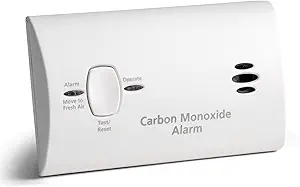 |
| Best Seller A high-volume bestseller chosen again and again | Kidde CO Detector COB |  |
TOPTES CT-580 Carbon Monoxide Detector

| Power Source | Battery Powered |
|---|---|
| Alarm | Audible |
| Sensor Type | Electrochemical |
The TOPTES CT-580 is a compact, battery-powered handheld CO detector designed for quick spot checks at home, in campsites, or on the road. It uses an electrochemical DDS sensor that reports CO concentration from 0 to 1000 ppm and claims a fast response time, with readings shown on a color TFT display. The unit offers three simultaneous alarm modes—visual indicator, audible alarm, and vibration—so it can alert you in noisy or dark environments, and the adjustable screen brightness and built-in flashlight make roadside or tent checks easier. It includes USB-C recharging, a protective case, and menu options such as alarm history and calibration settings that appeal to users who want more than a simple one-button alarm. The detector is built from ABS plastic for a grippy handheld feel and is certified by a national lab, which supports its accuracy claims. Expect a small, useful tool for periodic safety checks rather than a permanently installed monitored alarm system, since it is intended as a portable inspection device.
Best for: Campers and travelers who want a portable, accurate CO spot-check device with clear readouts and multiple alert modes for occasional safety checks.
Less Ideal for: People seeking a permanently installed, continuously monitored household CO alarm or integrated smart-home notification features.
- Electrochemical DDS sensor with 0–1000 ppm range for wide measurement capability
- Three alarm modes (visual, audible, vibration) improve detection in varied camping conditions
- Rechargeable via USB-C and includes protective case for travel convenience
- TFT color display with adjustable brightness and built-in flashlight for low-light use
- Designed as a handheld inspection tool, not a fixed, continuously monitored home alarm
Verdict: A compact, rechargeable handheld CO detector built for reliable spot checks while camping or traveling, with clear alarms and a color display.
Klein Tools ET110 CO Meter

| Power Source | Battery Powered |
|---|---|
| Alarm | Visual |
| Built-In Media | Batteries, Pouch |
The Klein Tools ET110 is a portable CO meter designed to detect and measure carbon monoxide concentrations and show temperature on a backlit LCD, making it useful for quick safety checks while camping or working near combustion sources. It reports CO from 0 to 1000 ppm and has both low (35 ppm) and high (200 ppm) exposure alarms plus a short-term exposure limit (STEL) alarm, so you get clear audible and visual warnings when levels approach dangerous ranges. The unit runs on four AAA batteries, includes a carrying pouch, and auto-powers off after 20 minutes to preserve battery life, which helps on multi-day trips. As a meter rather than a continuously mounted alarm, it is intended for spot checks and situational monitoring rather than unattended long-term room monitoring. The meter is built like a professional tool and is easy to operate, but because it is not certified as personal protective equipment it should be used as a detection aid alongside safe ventilation and common-sense precautions.
Best for: Campers and outdoors-minded users who prioritize accurate, portable CO measurement for spot checks near stoves, heaters, or vehicle exhaust and want a rugged tool they can carry on trips.
Less Ideal for: People seeking a leave-behind, continuously monitored campsite alarm or a certified personal safety device should choose a dedicated continuous CO alarm instead.
- Wide CO range up to 1000 ppm with distinct low and high alarm thresholds for actionable warnings
- Backlit LCD shows CO reading and temperature for quick, readable spot checks
- Includes 4 AAA batteries and a carrying pouch for immediate portable use
- Auto power-off conserves battery during intermittent field use
- Designed as a handheld spot meter, not a continuously monitored or permanently installed alarm
- Not intended to serve as personal protective equipment per the manufacturer
Verdict: A rugged, battery-powered handheld meter that gives campers fast, accurate CO readings and clear alarms for on-the-spot safety checks.
X-Sense SC01 Combination Detector

| Power Source | 10-Year Sealed Battery |
|---|---|
| Sensor Type | electrochemical, photoelectric |
| Alarm | Audible |
| Battery Type | Lithium metal |
The X-Sense SC01 is a compact standalone combination alarm that pairs a photoelectric smoke sensor with an electrochemical CO sensor and a sealed 10-year lithium battery, so you do not need wiring or battery swaps while it is in service. It mounts to a wall or ceiling with the included bracket and emits an 85 dB alarm when either smoke or CO is detected; the front LCD gives real-time CO readings and a battery status readout for quick checks. Because it is not hardwired and has a long-life internal battery, it is straightforward to install in portable living spaces like campers or cabins where AC wiring is limited. The unit does not support wireless interconnection or app control, so it is best used as a single protected point rather than part of a networked system. Its photoelectric sensor reduces nuisance alarms from cooking or steam compared with ionization-only units, but the fixed, non-replaceable battery means you replace the whole detector at end of life rather than swapping cells. For someone seeking reliable, low-maintenance CO and smoke protection in a camping or RV setting, this model covers the essentials without extra complexity.
Best for: Buyers who prioritize low-maintenance, standalone safety for temporary or mobile dwellings and want a single unit that covers both smoke and CO without wiring or app setup.
Less Ideal for: People who need networked alarms that communicate across multiple devices or those who prefer replaceable batteries and modular systems.
- Two-in-one protection with photoelectric smoke and electrochemical CO sensors
- 10-year sealed lithium battery eliminates regular battery replacements
- Front LCD shows real-time CO level and battery status for quick checks
- Simple rack-and-plate mounting for easy installation in temporary or mobile spaces
- Not networkable or Wi‑Fi enabled, so it will not alarm other units remotely
- Battery is non-replaceable, requiring full unit replacement at end of life
Verdict: A simple, maintenance-free combination smoke and CO detector that delivers reliable two-in-one protection for campers and other non-wired living spaces.
First Alert CO400 Carbon Monoxide Alarm 2-Pack

| Power Source | Battery Powered |
|---|---|
| Alarm | Audible, Visual |
| Sensor Type | Electrochemical |
| Unit Count | 2 Count |
| Operating Humidity | 10-95% RH |
The First Alert CO400 two-pack provides straightforward, reliable carbon monoxide monitoring designed for easy placement and use. Each unit uses an electrochemical sensor, the most accurate sensor type for CO detection, and runs on a single 9V battery so the alarms keep working during power outages or off-grid use. They sound an 85-decibel horn and provide visual alerts, and a single test/silence button makes checks and nuisance-silencing simple. The alarms include end-of-life notification and low-battery alerts so you know when to replace batteries or the unit. Installation is minimal — batteries installed and optional wall-mount hardware included — which makes these convenient for temporary setups like campsites, RVs, or cabins without wiring. The product is UL listed and carries a five-year limited warranty, but users should note the sensor is permanent and rated for that service life, meaning units will need replacement after that period rather than sensor swapping.
Best for: Buyers who prioritize reliable, easy-to-use CO detection for temporary or off-grid settings and want units that operate independently of house power.
Less Ideal for: People who need networked, smart, or hardwired multi-unit integration for central monitoring should consider other models with interconnect or Wi-Fi features.
- Electrochemical sensor for accurate CO detection
- Battery powered so it works during power outages or off-grid use
- Loud 85 dB alarm with visual alerts for clear notification
- Simple single-button test/silence and optional wall mount for flexible placement
- End-of-life and low-battery signals for long-term safety awareness
- Sensor has a fixed service life and the entire unit must be replaced after about five years
Verdict: A dependable, battery-run CO alarm pack built for simple, accurate protection when you need monitoring off the grid or in temporary lodging.
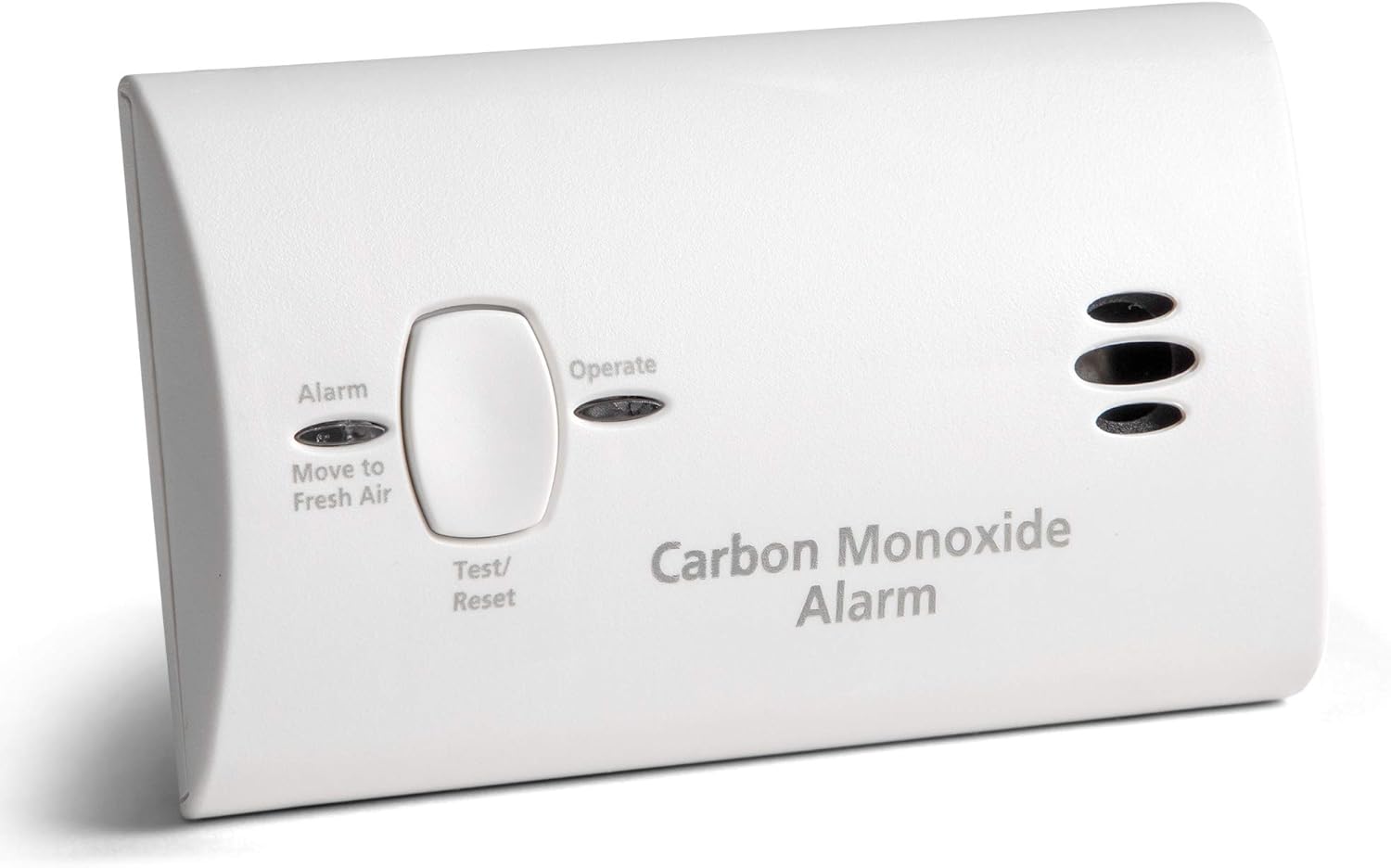
Kidde Carbon Monoxide Detector KN-COB-LP2
| Power Source | Battery Powered |
|---|---|
| Alarm | Audible |
| Operating Humidity | 10 to 95% relative humidity (RH), non-condensing |
| Product Style | 3rd Edition |
This Kidde CO detector is a compact, battery-powered alarm meant for simple home use and travel. It uses an electrochemical sensor to detect carbon monoxide and runs on two AA batteries so it continues to protect during power failures and can be placed on a tabletop or wall-mounted. When CO is detected a red LED flashes and an 85 dB alarm sounds, while a green LED shows normal power and a test/hush button lets you verify operation or temporarily silence chirps. The unit records event memory so you can see the last detection or test. Practical benefits include easy installation with no wiring, portability for camping or temporary lodging, and a clear audible and visual alert system. Important limitations are that it has basic functionality without a digital readout of CO levels and relies on replaceable AA batteries, so you need to monitor battery life for continuous protection.
Best for: Buyers who prioritize a proven, portable CO alarm with clear audible/visual alerts and want a simple plug-and-play device for camping or temporary stays.
Less Ideal for: People who need a continuous digital readout of CO levels or a long-life sealed battery alarm should consider other models designed for extended monitoring.
- Electrochemical sensor technology for reliable CO detection
- Runs on 2 AA batteries so it works during power outages and is portable for travel
- 85 dB alarm plus red and green LED indicators for clear audible and visual alerts
- Simple wall-mount or tabletop placement with an easy test/hush button
- Event memory records last detection or test for added context
- No digital numeric display of CO concentration
- Requires periodic AA battery replacement to maintain protection
Verdict: A small, portable battery CO detector that delivers reliable, no-wiring protection and clear alarms—good for campers and travelers who want simple, dependable CO detection.
Kidde CO Detector COB

| Power Source | Battery Powered |
|---|---|
| Alarm | Audible, Visual |
| Sensor Type | Electrochemical |
| Operating Humidity | 10 to 95% Relative Humidity, Non-Condensing |
| Upper Temperature Rating | 100 °F |
The Kidde COB is a simple, portable CO detector designed for straightforward protection at home or on the road. It uses an electrochemical sensor and two AA batteries so it operates during power outages and requires no wiring, making it easy to mount on a wall or set on a tabletop. The unit sounds a loud 85 dB alarm and shows LED status lights to communicate normal, warning, and alarm conditions, while a Test/Hush button lets you verify operation or temporarily silence nuisance alerts. Kidde states the device meets UL 2034 5th Edition standards and is ETL listed, which provides independent safety validation. The compact, lightweight design and included batteries make it convenient to pack for camping or travel, but the manufacturer notes it is not approved for use in RVs or boats and recommends removing batteries during transit. The detector has a 10-year replacement guideline and a limited warranty, so buyers should plan on eventual replacement rather than long-term maintenance-free service.
Best for: Buyers who prioritize dependable, tested CO detection and want a simple portable unit they can use at home and pack for trips or campsites where permanent detectors are not available.
Less Ideal for: People seeking a detector specifically certified for RVs, boats, or integrated hardwired systems should look for models designed for those applications.
- Battery-powered with two included AA batteries for use during power outages
- Electrochemical sensor and UL 2034 5th Edition testing for reliable CO detection
- Loud 85 dB alarm plus LED status lights for clear audible and visual alerts
- Compact, lightweight design that is easy to carry and mount for travel
- Not approved for use in RVs or boats, limiting some camping setups
- Requires battery replacement and eventual 10-year replacement rather than built-in long‑life battery
Verdict: A compact, UL-tested battery CO detector that gives risk-averse buyers a portable, easy-to-use safety device for home and travel.
Choosing the Right Carbon Monoxide Detector for Camping: Key Factors to Consider
Alarm Response Time
How fast a detector registers rising carbon monoxide levels and issues an audible alert is critical in a small camping space. Faster response time reduces the window between hazardous exposure and evacuation, especially when fuel-burning devices are used nearby or when ventilation is limited.
Look for detectors with documented alarm thresholds and clear performance indicators. Response time affects how you position the device relative to sleeping areas and fuel sources, and it should be a primary consideration when you need rapid warning for overnight use.
Battery Life and Power Options
Reliable power is essential on multi-night trips where mains power is unavailable. Battery life dictates how long a detector will provide protection without replacement or recharging, and alternate power options like USB charging or replaceable AA/AAA cells add flexibility.
Consider whether the detector supports long-life batteries, low-battery alerts you can hear at night, and the ability to run from external power banks. Longer battery life reduces maintenance and the risk of disabled protection mid-trip.
Portability and Mounting Flexibility
Camping detectors should be compact and easy to position near sleeping areas. Lightweight designs that can be clipped, hung, or stuck to fabric or walls let you place the sensor at breathing height for occupants in tents or RV bunks.
Mounting options affect where you can put the detector to get accurate readings without interfering with tent geometry or comfort. Portability also matters if you move between campsites or need to stow the unit in a pack.
Sensor Accuracy and Long-Term Stability
Accurate detection and minimal sensor drift reduce false alarms and ensure the detector remains reliable over many trips. Sensors with stable baselines and documented sensitivity at common CO concentration thresholds provide more trustworthy alerts.
Pay attention to indicators of sensor lifespan, whether the unit includes self-test routines, and how the device signals when sensor replacement or service is needed. Sensor reliability directly impacts your safety in enclosed camping environments.
Audibility and Visual Alarms
An alarm must be loud enough and unmistakable in a campsite environment. Audible volume, alarm tone pattern, and visual indicators like bright LEDs or display icons determine whether you will notice a warning during sleep or in noisy outdoor conditions.
Consider units with multi-sensory alerts and distinct test functions so you can verify the alarm is easily heard and seen from typical sleeping positions and distances in tents or small campers.
Environmental Durability
Camping exposes gear to humidity, temperature swings, dust, and occasional splashes. A detector built to tolerate these conditions will maintain function across seasons and locations.
Durability affects both the casing and the sensor. Look for units with ingress resistance, robust build quality, and operating temperature ranges that match your typical camping environments to avoid failures or degraded sensitivity.
Where to Place a Detector When Camping
Position the detector where it best represents the breathing zone of sleeping occupants. In a tent, hang or prop the unit at head height near the sleeping area rather than on the floor. In an RV, place the detector near sleeping berths and away from cooking appliances to avoid nuisance triggers.
Avoid placing the detector directly next to fuel-burning devices or in drafts that may dilute CO concentrations. If you move around a campsite, keep the detector with your sleeping area rather than next to transient heat sources.
- Hang at sleeping head level in tents
- Mount near bunks in campers, not in kitchens
- Keep away from open flames and direct ventilation
Setting Up and Testing Before Bed
Always test the detector after powering it up and before you sleep. Use the unit's built-in test function to confirm audible and visual alarms are working and that the low-battery indicator is not active. Do a quick placement check to ensure the alarm can be heard from each sleeping position.
If your detector uses replaceable batteries, carry spares in your camping kit. For rechargeable units, confirm the battery holds charge before the trip and pack a compatible charging cable or power bank.
- Run the detector test routine at setup
- Verify volume and LED visibility from sleeping spots
- Pack spare batteries or charging cables
Interpreting Alarm Signals and Taking Action
Understand what different alarm patterns and display readouts mean. A sustained loud alarm usually indicates hazardous CO levels requiring immediate evacuation to fresh air. Some units will indicate rising concentrations before full alarm thresholds are met; treat those warnings seriously and ventilate or move occupants.
If an alarm sounds, exit the enclosed space immediately, move upwind and to fresh air, and seek medical attention if symptoms like headache, nausea, or dizziness occur. Do not re-enter the space until the detector registers safe levels or a competent service confirms it is safe.
- Sustained alarm equals immediate evacuation
- Short or intermittent warnings indicate rising CO; ventilate and reassess
- Seek medical help for symptoms after exposure
Maintaining Your Detector on Multi-Night Trips
Check battery level daily and run quick functional tests each evening. Dust, condensation, or accidental impacts can impair sensors. Store the device in a dry part of your tent or camper when not in use to reduce exposure to moisture.
Rotate detector placement periodically if you change sleeping configurations. If the unit has a sensor expiration or service reminder, note that on your packing checklist so it is not used beyond its recommended life.
- Daily battery and test checks
- Keep dry when stowed
- Track sensor service life and replace as recommended
Common Nuisance Triggers and How to Avoid Them
Cooking with stoves near the detector, backdrafting from portable heaters, and proximity to vehicle exhaust can cause false or transient alarms. Minimizing smoke and ensuring proper ventilation will reduce nuisance alerts while preserving real protection.
If you experience repeated false alarms, adjust placement away from short-term combustion sources and verify the unit's installation and power status. Persistent false alarms may indicate a sensor issue that needs servicing or replacement.
- Keep detector away from immediate cooking area
- Ventilate after fuel use to avoid transient spikes
- Relocate if nuisance alarms continue
How We Chose the Best Carbon Monoxide Detector for Camping
We focused on attributes that matter most when using carbon monoxide detectors in camping environments. Primary evaluation criteria included alarm response time to rising CO levels, battery life and power options suitable for multi-night trips, compactness and mounting versatility for tents and RV interiors, sensor accuracy and longevity, and environmental durability against humidity and temperature swings. We also considered ease of use features such as readable displays, simple test/reset functions, and clear audible and visual alarms usable in noisy or dark campsites. Excluded were detectors designed solely for permanent home installation that lack portable power options or have large footprints unsuitable for tents or small camper interiors. We filtered out units without independent battery backup, devices lacking recognized sensor types for reliable CO detection, and any product with unverified alarm performance claims. The resulting list emphasizes practical, portable detectors that combine quick detection, dependable power, and mounting flexibility for camping scenarios.
Our full evaluation process is outlined in our review methodology.
FAQ
Can a portable carbon monoxide detector work inside a tent?
Yes. Portable detectors designed for camping can detect CO in tents, provided they are positioned correctly near sleeping areas and have reliable battery power. Ensure the unit is rated for small, enclosed spaces and test it before use.
How often should I replace the detector's batteries while camping?
How often depends on battery type and trip length, but check battery level daily. Use long-life batteries or rechargeable units with a power bank for multi-night trips, and carry spares to avoid loss of protection.
Do humidity and cold affect detector performance?
Humidity and temperature extremes can influence sensor performance and battery life. Choose detectors with operating ranges that match your camping conditions and protect the unit from direct moisture when possible.
Will the detector alert me to low levels before it reaches dangerous concentrations?
Some units provide pre-alarm indicators or rising-level warnings, while others only sound at defined hazardous thresholds. Both types are useful, but pre-alarm indicators offer earlier notice to ventilate or investigate.
Where should I store spare batteries and the detector between trips?
Store batteries and the detector in a cool, dry place away from direct sunlight and moisture. Keep spare batteries in original packaging or a sealed container to avoid accidental discharge and corrosion.
Final Verdict
Prioritize fast alarm response, dependable power, and flexible mounting when choosing a carbon monoxide detector for camping. Those factors directly affect how quickly you will be warned and how practical the unit is to use across different campsites and vehicles. Balance sensor accuracy and environmental durability against portability needs. Select a detector with clear audible and visual alarms, reliable battery options, and documented sensor stability so you can sleep with confidence in tents and small campers.