
Note: This article contains affiliate links. If you click on these links and make a purchase, we may earn a small commission at no extra cost to you. This helps support our research and content. Read our full affiliate disclosure here.
A garage is a common source of carbon monoxide buildup because vehicles and power equipment run in a semi-enclosed space. Choosing the right carbon monoxide detector for garages matters because your living spaces and family can be exposed to dangerous CO levels even when engines are running briefly. You need a unit that senses low concentrations reliably, mounts where it will actually detect leaks, and survives the temperature and humidity swings typical of garages. This guide shortlists the top carbon monoxide detectors designed or suitable for garage use. We evaluated models for sensor accuracy, installation flexibility, and ruggedness so you can pick a detector that gives timely alerts and durable performance. Read on for the evaluation criteria and practical tips to place and maintain a detector in a garage environment.
Top Picks at a Glance
| Best Overall The best all-around choice for most situations | X-Sense SC01 Combination Detector |  |
| Best Quality Built to a higher standard if you want something more solid | First Alert SMICO100-AC |  |
| Best Value The sweet spot between price and what you get | HEIMAN C1-S CO Detector |  |
| Best Budget The cheapest option that still gets the job done reliably | Kidde Carbon Monoxide Detector KN-COB-LP2 |  |
| Top Rated A top-rated pick with lots of positive feedback | Kidde KN-COB-DP2 CO Detector |  |
| Most Popular A crowd favorite that many people choose with confidence | First Alert CO606 Plug‑In CO Alarm |  |
| Best Seller A high-volume bestseller chosen again and again | X-Sense SC07 Combination Detector |  |
X-Sense SC01 Combination Detector

| Power Source | 10-Year Sealed Battery |
|---|---|
| Sensor Type | electrochemical, photoelectric |
| Alarm | Audible |
| Battery Type | Lithium metal |
The X-Sense SC01 combines photoelectric smoke sensing and an electrochemical CO sensor in a single, standalone unit intended for wall or ceiling mounting. It runs on a sealed 10-year lithium battery, so you can install it in locations without wiring and expect a decade of continuous protection without battery swaps. The unit includes a clear LCD that shows real-time CO concentration and battery condition, and it emits an 85 dB audible alarm when smoke or dangerous CO levels are detected. Installation is straightforward using the included bracket, screws, and anchors, and the heat-resistant plastic enclosure is appropriate for typical indoor environments. Limitations for garage use are that SC01 is not hardwired, not Wi-Fi connected, and it cannot interconnect with other alarms, so it will only alert locally; garages with noisy environments or detached workshops may benefit more from interconnected or hardwired options with remote alerts.
Best for: Buyers who want a low-maintenance, long-life combination detector for a single garage location and prefer a simple standalone installation without wiring or network setup.
Less Ideal for: People who need interconnected alarms, remote notifications, or hardwired installation for multiple zones or larger garage/shop setups should choose a different model.
- Two-in-one smoke and CO detection simplifies coverage in one device
- 10-year sealed lithium battery provides long maintenance-free operation
- LCD shows real-time CO levels and battery status for quick checks
- Photoelectric and electrochemical sensors reduce false alarms while keeping sensitivity high
- Easy standalone installation with included mounting hardware
- No wireless connectivity or ability to interconnect with other alarms
- Not hardwired so it only provides local alerts and may be less suitable for larger or noisy garages
Verdict: A maintenance-free, 10-year sealed-battery combination detector that delivers local smoke and CO protection with real-time CO readout for a single garage location.
First Alert SMICO100-AC

| Power Source | Corded Electric |
|---|---|
| Alarm | Smoke, CO |
| Sensor Type | Ionization |
| Built-In Media | Easy Adapter Plug, 9V Battery |
The First Alert SMICO100-AC is a hardwired combination smoke and CO alarm designed for interconnected home protection with a 9V battery backup. It uses First Alert Precision Detection and an ionization smoke sensor to reduce cooking nuisance alarms while still providing early smoke detection, and it sounds all linked units when one alarm trips. Installation is simplified by a quick connect plug so you can swap in or add units without complex rewiring, and the test/silence button makes periodic checks and temporary nuisance silencing straightforward. For garage use its hardwired power source and interconnect capability mean continuous coverage across adjacent living spaces and automatic alerting if a CO event triggers in the garage. The product is focused on basic, reliable sensing rather than smart features, so there is no app connectivity or advanced CO monitoring data, and ionization sensors are generally faster on flaming fires but can be less sensitive to slow smoldering than photoelectric types. Still, the combination of factory-quality hardwire interconnect and battery backup makes this a solid choice for performance-focused protection in homes with attached garages.
Best for: Buyers who prioritize dependable, performance-focused detection and want a hardwired, interconnectable combination alarm to protect an attached garage and adjacent living spaces.
Less Ideal for: People who need remote monitoring, app alerts, or detailed CO level readouts should consider a smart or digital CO monitor instead.
- Hardwired with battery backup for continuous protection during outages
- Interconnect capability alerts all linked alarms when one detects smoke or CO
- Quick connect plug simplifies installation and replacement
- Precision Detection reduces nuisance alarms from cooking while preserving early warning
- Uses an ionization smoke sensor which can be less sensitive to smoldering fires than photoelectric sensors
- No smart features or remote monitoring for CO levels
Verdict: A reliable hardwired smoke and CO combo with interconnect and battery backup made for performance-focused protection of garages and adjoining rooms.
HEIMAN C1-S CO Detector

| Sensor Type | Electrochemical |
|---|---|
| Power Source | Battery Powered |
| Alarm | 85 dB Audible/Visual |
| Battery Average Life | 10 years |
| Certification | UL 2034 5th Edition |
The HEIMAN C1-S is a compact, battery-powered carbon monoxide detector designed for simple DIY installation in spaces like garages, basements, or utility rooms. It uses a Japan-made FIGARO electrochemical sensor to detect CO and provides audible and visual alerts via an 85 dB alarm and LED indicator. The unit runs on a long-life lithium battery rated for about 10 years, so you avoid frequent battery changes and midnight chirps. The detector offers a one-touch test/silence button and can be mounted to ceilings or walls with included hardware, or set on a shelf. Its flame-retardant ABS+PC housing and UL 2034 5th Edition certification add confidence for code-sensitive installations. Limitations to note: it is a standalone battery device without smart connectivity or hardwiring, and the alarm is intended for open or semi-enclosed areas rather than large industrial spaces. For garage use it performs well as a low-maintenance, code-compliant CO monitor where wired interconnect or remote alerts are not required.
Best for: Buyers who want a low-maintenance, code-compliant CO detector for garages or utility spaces and prioritize reliable sensing and long battery life over smart features.
Less Ideal for: Users who need networked monitoring, interconnectivity with other alarms, or centralized alerts for large or multi-zone buildings should consider other solutions.
- Electrochemical FIGARO sensor for accurate CO detection
- Long-life lithium battery rated around 10 years to minimize maintenance
- 85 dB audible alarm plus LED visual indicator for clear alerts
- UL 2034 5th Edition certified and CSFM approved for compliance-minded installs
- Simple one-touch test/silence button and easy DIY mounting
- No smart connectivity or remote notifications
- Not hardwired or interconnectable with other alarms
Verdict: A simple, compliance-ready CO detector built for long battery life and reliable electrochemical sensing, ideal for garage and utility monitoring.
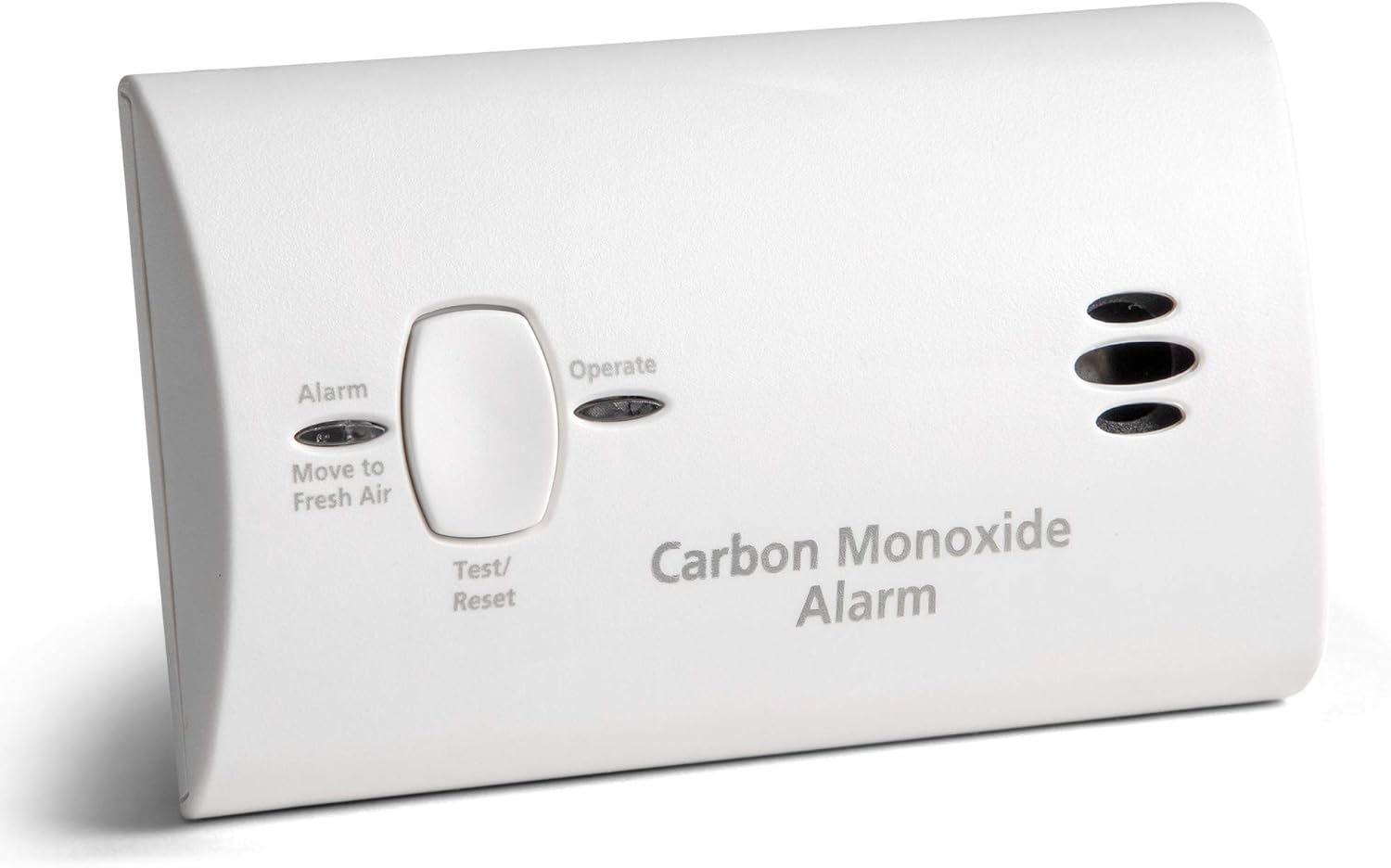
Kidde Carbon Monoxide Detector KN-COB-LP2
| Power Source | Battery Powered |
|---|---|
| Alarm | Audible |
| Operating Humidity | 10 to 95% relative humidity (RH), non-condensing |
| Product Style | 3rd Edition |
This Kidde CO detector uses an electrochemical sensor and runs on two AA batteries, making it simple to install in a garage without wiring. It is portable enough to mount on a wall or sit on a shelf and provides clear status feedback with green and red LEDs plus an 85 dB audible alarm when CO is detected. The unit includes a test/hush button for momentary silence of nuisance alerts and a low-battery indicator; event memory records the last detection or test. Its battery operation also ensures continued detection during power outages, which is useful in detached garages. The compact form and UL listing make it a practical basic CO alarm, though it lacks a digital CO readout or hardwiring/interconnect capability found on higher-end models. For buyers who want a straightforward, easy-to-install detector for a garage or workshop, this model covers essential safety needs without extra features.
Best for: Buyers who want an affordable, no-frills CO alarm to place in a garage or workshop and prefer simple battery operation and easy installation.
Less Ideal for: Those who need a hardwired, interconnected system or a detector with a digital CO ppm display for precise readings.
- Electrochemical sensor for accurate CO detection
- Runs on 2 AA batteries so no wiring is required
- Portable design supports wall mounting or tabletop placement
- 85 dB alarm and LED indicators provide clear alerts
- Includes test/hush button and event memory for basic diagnostics
- No digital CO concentration display
- Not hardwired or interconnectable with other alarms
Verdict: A straightforward, battery-powered CO alarm that provides reliable, easy-to-install protection for garages without adding complexity.
Kidde KN-COB-DP2 CO Detector

| Power Source | Plug In; AA Battery Backup |
|---|---|
| Alarm | 85 dB Audible |
| Operating Humidity | 10 to 95% RH, non-condensing |
| Product Style | 3rd Edition |
The Kidde KN-COB-DP2 is a plug-in carbon monoxide detector designed to provide continuous monitoring where you can access a standard 120V outlet, with two AA batteries as a backup. It uses an electrochemical sensor to detect CO and shows measured CO levels on a digital display that updates every 15 seconds, while peak level memory records the last event for quick review. Installation is straightforward: plug it into an outlet and use the Test-Hush button to silence nuisance alarms for about eight minutes. An 85 dB alarm provides a loud audible alert appropriate for garages where noise and distance can mask lower-volume units. The unit is UL listed and meets common safety standards, and the included batteries let it keep working during power outages. Limitations include the need for an outlet in the desired location and no Wi-Fi or smart features for remote alerts, so it is best used as a local, reliable monitor rather than part of a connected system.
Best for: A buyer who values straightforward, dependable CO protection for spaces like garages and wants a locally visible readout and reliable backup power.
Less Ideal for: People who need remote alerts, app integration, or want battery-only wireless placement far from outlets should consider alternative smart or battery-powered models.
- Electrochemical sensor for accurate CO detection
- Digital display with 15-second updates and peak level memory
- Plug-in power with AA battery backup ensures operation during outages
- 85 dB alarm loud enough for garage environments
- Simple plug-and-play installation with Test-Hush silence function
- Requires a nearby 120V outlet for primary power
- No smart connectivity or remote notifications
Verdict: Choose this Kidde plug-in CO detector when you want a simple, reliable local monitor with a clear digital readout and battery backup for garage safety.
First Alert CO606 Plug‑In CO Alarm

| Power Source | Corded Electric |
|---|---|
| Sensor Type | Electrochemical |
| Alarm | Carbon Monoxide |
| Operating Humidity | 10-95% RH |
The First Alert CO606 is a straightforward plug‑in carbon monoxide alarm that uses an electrochemical sensor and includes a 9V battery backup so it continues protecting during power outages. It plugs directly into any standard outlet, which makes installation instant and maintenance minimal, and a single test/silence button lets you verify operation or mute nuisance alerts. The unit emits a loud 85 dB alarm when CO levels rise and provides an end‑of‑life chirp to indicate replacement time; it meets UL standards and carries a seven‑year limited warranty. Practical for garage placement, the electrochemical sensor gives reliable CO detection near fuel‑burning equipment, and the battery backup guards against interruptions caused by shop or household power cycles. Limitations are the fixed plug form factor, which occupies an outlet and may need a nearby receptacle on a usable wall, and there is no digital display or connectivity for remote monitoring or logged readings.
Best for: Buyers who want a reliable, no‑frills CO detector they can install quickly in a garage near fuel‑burning equipment and trust to keep operating through power interruptions.
Less Ideal for: People who need networked monitoring, remote alerts, or a wall‑mounted low‑profile detector that does not occupy an outlet should consider other options.
- Electrochemical sensor for accurate CO detection
- Built‑in battery backup ensures operation during power outages
- Simple plug‑in design requires no tools or mounting
- Single test/silence button for easy verification and nuisance alarm muting
- Loud 85 dB alarm and UL compliance for trusted safety performance
- Plug‑in form blocks the outlet it uses and requires an accessible receptacle nearby
- No digital readout or wireless connectivity for remote alerts or history
Verdict: A reliable, easy‑to‑install plug‑in CO alarm with battery backup that provides continuous, accurate protection for garages where simple, dependable monitoring is the priority.
X-Sense SC07 Combination Detector

| Power Source | 10-Year Sealed Battery |
|---|---|
| Alarm | 85 dB |
| Sensor Type | Photoelectric, Electrochemical |
| Battery Type | Lithium metal |
The X-Sense SC07 combines a photoelectric smoke sensor with an electrochemical CO sensor in a single standalone unit designed for long-term, low-maintenance protection. It is powered by a sealed 10-year lithium battery so you avoid periodic battery changes and late-night chirps, and the included mounting bracket and screws make ceiling or wall installation straightforward. The photoelectric sensor helps cut down cooking-related false alarms and responds reliably to smoldering fires, while the CO sensor provides continuous monitoring for invisible carbon monoxide. The unit meets UL 217 and UL 2034 standards and emits an 85 dB alarm; its LCD lets you check status at a glance. This model does not support wireless interconnection, Wi-Fi, or linking to a base station, so it acts as a single-zone device rather than part of a networked system. Its compact, heat-resistant plastic housing is typical for domestic detectors and the sealed battery design means the whole unit must be replaced at end of life rather than swapping cells.
Best for: Buyers who prioritize dependable, low-maintenance, code-compliant carbon monoxide and smoke detection for a single location and want a set-and-forget device.
Less Ideal for: Users who need alarms that interconnect across multiple rooms or provide remote notifications and app alerts should consider networked or Wi‑Fi models instead.
- 10-year sealed lithium battery eliminates regular battery replacements and chirps
- Dual sensors: photoelectric smoke for smoldering fires and electrochemical CO for reliable CO detection
- UL 217 and UL 2034 certification supports code-compliant installation
- Simple mounting hardware included for easy ceiling or wall installation
- LCD display provides quick status and reading visibility
- Not networkable — no wireless interconnection or Wi‑Fi for remote alerts or linked alarms
- Sealed battery design requires replacing the entire unit at end of life rather than swapping batteries
Verdict: Choose the SC07 when you want a simple, UL‑certified, maintenance-free smoke and CO combo that protects a single area for a full decade.
Choosing the Right Carbon Monoxide Detector for Garages: Key Factors to Consider
Sensor Type and Accuracy
The detector's sensing technology and documented accuracy determine how quickly and reliably it responds to carbon monoxide in a garage. Electrochemical sensors are common and offer good sensitivity to low CO concentrations, while other sensor types may drift more over time. A unit with clear sensitivity thresholds and documented response times reduces the risk of missed or delayed alerts.
Accuracy directly affects safety decisions. In a garage you may see transient spikes when an engine starts; a detector that distinguishes brief breath-level spikes from sustained hazardous levels helps avoid nuisance alarms while still warning of real danger.
Operating Temperature and Humidity Tolerance
Garages can get very cold in winter and hot in summer, with occasional condensation. Check the detector's specified operating temperature and humidity ranges to ensure reliable performance where you plan to install it. Units rated only for indoor household environments might fail or report inaccurate readings outside their stated limits.
A detector with a wider environmental tolerance will function more consistently and avoid false readings or premature sensor failure. Temperature tolerance also affects placement choices, since basements, attics and detached garages can vary significantly from conditioned home interior spaces.
Mounting Options and Placement Flexibility
Proper placement is essential for garage detection. A detector should be mountable on walls or ceilings and offer clear guidance for locating it relative to vehicle exhaust paths, doors, and ventilation. Some detectors include magnetic or bracket mounts for metal surfaces commonly found in garages, which can simplify installation.
Flexibility in installation helps you position the unit where CO is likely to accumulate while keeping it protected from direct vehicle exhaust streams, water spray, and physical damage. Look for models with multiple mounting choices and a clear kit of included hardware.
Power Source and Backup
Power reliability matters because garages can lose power or might not have convenient outlets. Battery-powered detectors or plug-in units with battery backup provide continuous coverage during outages. Consider battery life, replacement ease, and whether the unit uses common battery types or sealed long-life cells.
Hardwired detectors are an option in garages attached to a home's electrical system but may require professional installation. For detached garages, battery or rechargeable options are usually more practical. Backup power reduces the chance of the detector being offline when it is most needed.
Alarm Output and Diagnostics
Clear, loud alarms and visible status indicators help ensure alerts are noticed over vehicle noise or when you are in a nearby house. Look for units with distinct alarm patterns, LED indicators, and a test button to confirm operation. Diagnostic features such as sensor fault alerts and end-of-life warnings are important to avoid false confidence in an ageing detector.
A detector that provides understandable status signals and regular self-checks makes maintenance easier and improves long-term reliability, so you can trust notifications when CO levels rise.
Durability and Maintenance Needs
Garages expose detectors to dust, vibration, and occasional bumps. Durable housing and protective design extend service life. Consider how often the sensor needs replacement or calibration and whether the unit requires routine cleaning to avoid dust-related false readings.
Low-maintenance designs reduce the chance of lapses in protection. Units with washable covers or easy-access battery compartments simplify upkeep, while clearly stated service intervals prevent unexpected end-of-life failures.
Where To Mount a Garage Carbon Monoxide Detector
Mount a detector where vehicle exhaust is likely to accumulate but avoid placing it directly in the exhaust path. A wall mounted detector about 3 to 6 feet above the floor often catches CO that pools at lower levels in cold conditions while remaining visible and reachable for testing and battery changes.
If your garage is attached to living spaces, place at least one detector near the connecting door to provide early warning before CO reaches the house. In larger garages, consider multiple detectors or one centrally located ceiling unit plus a wall unit near frequently used entries.
- Avoid mounting inside corners where airflow is stagnant.
- Keep the detector away from doors and windows that create drafts which can mask CO buildup.
- Do not place the unit next to fuel-burning equipment where it can be directly exposed to exhaust.
Placement Tips for Attached and Detached Garages
Attached garages are a direct risk to indoor air quality, so place a detector on the garage wall closest to the interior door. This setup helps give early notification if CO starts migrating toward living areas. Ensure the detector is not mounted over heating vents or in direct sunlight, which can affect readings.
In detached garages, position detectors closer to typical vehicle parking spots and workbenches where engines might be run. If the garage has multiple zones or a workshop area, think about a detector near the tool area and one near the entry to the house for broader coverage.
- Consider supplemental detectors if you run generators or gas-powered tools inside the garage occasionally.
- For garages with lofts or storage, ensure detectors remain unobstructed by stored items or boxes.
Installation Practicalities and Wiring
Installation should match the detector's power requirements. Battery-only models are straightforward: mount the bracket, snap the unit in place, and test. Plug-in units require an accessible outlet that remains powered when the garage is in normal use. Hardwired installations may need a licensed electrician and can offer continuous power without battery changes.
Ensure any wiring follows local electrical codes and that the location chosen for the detector makes future maintenance and testing accessible. Use the included mounting hardware and verify the unit sits securely on the chosen surface to avoid vibration-related faults.
- Label hardwired connections and record installation dates for future reference.
- Test the detector after installation and at regular intervals to confirm operation.
Maintenance and Testing Schedule
Test your detector monthly using the built-in test button to ensure the alarm and electronics work. Replace batteries according to the manufacturer recommendations or when the low-battery signal activates. For sealed or long-life battery models, note the expected service interval and plan replacements accordingly.
Clean dust and debris from the exterior with a dry cloth occasionally. Avoid spraying cleaners or solvents into sensor openings. Keep a record of sensor end-of-life notifications and plan to replace the unit when the sensor indicates it can no longer guarantee accurate readings.
- Perform a full test after any power outage or after using gas-powered equipment in the garage.
- Replace detectors according to their stated lifespan rather than waiting for failure.
Understanding Alarm Levels and Response
Carbon monoxide detectors use published concentration thresholds to trigger different alarm conditions. Familiarize yourself with what concentration ranges and alarm patterns indicate an immediate threat versus a cautionary alert. This helps you decide whether to ventilate the garage, turn off equipment, or evacuate and call for professional assistance.
If an alarm sounds, move everyone to fresh air immediately and ventilate the area if it is safe to do so. Do not re-enter the garage until the detector has cleared or emergency responders deem it safe.
- Regularly review the detector manual so alarm meanings and recommended responses are clear to everyone in the household.
- Install a detector near shared doors so alarms are audible from inside the home.
How We Chose the Best Carbon Monoxide Detector for Garages
We focused on features and performance factors that matter specifically for garage installations. Key evaluation criteria included sensor type and accuracy, which determine how reliably a detector reports rising carbon monoxide at low and moderate concentrations. We also considered environmental tolerance, such as operating temperature range and humidity resistance, because garages experience wider conditions than living rooms. Mounting and installation options were assessed to ensure units can be positioned where they will sense vehicle exhaust effectively. Power and backup options were important for continuous protection during outages or intermittent use. Finally, alert clarity and maintenance needs such as end-of-life indication and sensor lifespan were weighed to judge long-term ownership convenience. We excluded consumer units intended only for indoor living spaces that lack temperature tolerance or clear garage-mounting options. We also filtered out detectors without reliable test or end-of-life diagnostics. The final list emphasizes practical durability, accurate sensing, and installation flexibility for garage scenarios.
Our full evaluation process is outlined in our review methodology.
FAQ
Can I use a regular home carbon monoxide detector in a garage?
Often you can, but check the detector's operating temperature and humidity specifications first. Many household units are designed for conditioned indoor spaces and may not tolerate the wider temperature range or dust exposure common in garages.
How many detectors does a typical garage need?
Most small single-bay garages are adequately covered by one properly placed detector. Larger or multi-zone garages may require multiple units to ensure prompt detection in all areas.
Where should a detector be placed relative to the car?
Mount the detector on a wall or ceiling where exhaust is likely to pool but not directly above tailpipes or where fumes concentrate, which can cause nuisance alarms or sensor saturation. Position about 3 to 6 feet above the floor depending on local guidance.
Do garage carbon monoxide detectors need special maintenance?
Maintenance is similar to other detectors: monthly tests, battery changes or scheduled replacements, and periodic cleaning to remove dust. However, expect to check units more often in dusty or workshop-heavy garages.
Should a detector in a detached garage be hardwired?
Hardwiring can provide continuous power but is not always practical for detached garages without existing wiring. Battery-powered or plug-in units with battery backup are common and reliable alternatives for detached structures.
Final Verdict
Prioritize sensor accuracy, environmental tolerance, and installation flexibility when choosing a carbon monoxide detector for a garage. Consider how the unit handles temperature swings, where it can be mounted, and whether its power options match your garage setup. Regular testing and adherence to the device's maintenance schedule keep protection reliable. Choose a detector that balances accurate, timely alerts with durable design so you can confidently protect vehicles, tools, and the people who use your garage.