
Note: This article contains affiliate links. If you click on these links and make a purchase, we may earn a small commission at no extra cost to you. This helps support our research and content. Read our full affiliate disclosure here.
If you rely on carrot juice for its flavor and nutrients, the right cold press juicer makes a big difference in yield, texture, and vitamin retention. A machine built for slow, gentle extraction reduces heat and oxidation so you get more juice per root and a brighter, smoother cup. This guide presents seven shortlisted cold press juicers chosen for efficiency with hard, fibrous vegetables like carrots. We evaluate each unit on factors that matter for daily juicing: how much juice it extracts from carrots, how easy it is to clean and prep, and whether the machine is durable enough for frequent use. Read on to find the models best suited to heavy carrot juicing and how to match features to your routine.
Top Picks at a Glance
| Best Overall The best all-around choice for most situations | Ninja NeverClog Cold Press Juicer JC151 |  |
| Best Quality Built to a higher standard if you want something more solid | Hurom H70 Slow Juicer |  |
| Best Value The sweet spot between price and what you get | TUUMIIST Cold Press Juicer TM-580SJ |  |
| Best Budget The cheapest option that still gets the job done reliably | NEWBULIG Cold Press Juicer |  |
| Top Rated A top-rated pick with lots of positive feedback | anybear Cold Press Juicer SJ081 |  |
| Most Popular A crowd favorite that many people choose with confidence | Jocuu Slow Masticating Juicer |  |
| Best Seller A high-volume bestseller chosen again and again | EanOruus 3-in-1 Cold Press Juicer E-18 |  |
Ninja NeverClog Cold Press Juicer JC151

| Maximum Power | 150 watts |
|---|---|
| Number of Speeds | 2 |
| Capacity | 24 fluid ounces |
| Included Components | 24 oz juice jug, 36 oz pulp container, 2 pulp filters, auger |
The Ninja NeverClog JC151 is a slow masticating juicer designed to power through fibrous produce like carrots and leafy greens using a 150W high-torque auger and NeverClog cold press technology. It comes with two interchangeable pulp filters so you can choose less pulp for smoother juice or lots of pulp for thicker, fiber-rich blends, and its Start/Stop plus Reverse programs help clear jams and boost extraction. The larger 24 oz juice jug and 36 oz pulp container let you make multiple servings without stopping, and an anti-drip lever reduces mess when pausing to pour. Cleanup is straightforward since all juice-contact parts are dishwasher safe and the unit claims easier assembly than many centrifugal models. Trade-offs are that it is a slow juicer by design so throughput is lower than high-speed centrifugal machines, and the 150W motor is modest compared with some premium masticating models, which may affect long continuous extraction on very heavy loads. For carrot juice specifically, the JC151 handles dense, fibrous roots well and gives good yield with minimal clogging.
Best for: Buyers who want reliable cold-pressed carrot and vegetable juice with good yield control and easy cleanup, and who value nutrient-preserving slow extraction over speed.
Less Ideal for: People who need very fast batch output or who regularly process very large quantities of produce and prefer commercial-strength motors should consider higher-capacity or faster models.
- High-torque 150W auger extracts juice from fibrous ingredients like carrots and celery
- Two interchangeable pulp filters let you control juice texture from smooth to pulpy
- Large 24 oz juice jug and 36 oz pulp container support longer, continuous juicing
- Reverse program and NeverClog design reduce jams with dense or stringy produce
- Dishwasher-safe juice-contact parts for easier cleanup
- Lower throughput compared with high-speed centrifugal juicers due to slow masticating design
- 150W motor is modest versus some higher-end masticating models for extended heavy use
Verdict: A practical cold-press juicer that handles fibrous carrots well and gives good yield control for everyday home juicing.
Hurom H70 Slow Juicer

| Wattage | 150 watts |
|---|---|
| Power Source | Corded Electric |
| Material | Plastic |
| Special Features | Easy to Clean |
| Unit Count | 1 Count |
The Hurom H70 is a slow masticating juicer built to extract high yields with minimal fuss, making it well suited to regular vegetable juicing like carrots. It uses a strainer-free Easy Clean chamber and a two-part auger that filters pulp without a mesh screen, which simplifies rinsing and cuts cleanup time. The front-facing gauge and wide self-feeding hopper let you add larger pieces or whole apples while it runs, reducing prep work. At 150 watts and low RPMs, it runs quietly and aims to preserve flavor and nutrients; for dense produce such as carrots the slow-squeeze action delivers more juice and drier pulp than typical centrifugal models. Practical limitations are its plastic construction and hand-wash-only care, which means you will handle parts frequently, and its weight and compact footprint still require counter space for regular use. The H70 is positioned as a balance of performance and convenience rather than a commercial machine, so heavy daily commercial use may exceed its intended scope.
Best for: Buyers focused on maximum juice yield and nutrient retention from hard vegetables who want a countertop juicer that is easy to run and quick to clean for frequent home use.
Less Ideal for: People who need a heavy-duty commercial juicer or who prefer dishwasher-safe components and metal construction should consider other options.
- Strainer-free Easy Clean chamber reduces scrubbing and speeds cleanup
- Wide self-feeding hopper accepts larger pieces to minimize prep
- Slow masticating auger yields high extraction from fibrous vegetables like carrots
- Quiet operation thanks to low-speed design
- Main components are plastic and require hand washing
- Not intended for continuous commercial duty
Verdict: If you want a home cold-press juicer that maximizes carrot juice yield while keeping cleanup fast, the Hurom H70 is a strong, user-friendly choice.
TUUMIIST Cold Press Juicer TM-580SJ
| Maximum Power | 300 watts |
|---|---|
| Wattage | 300 |
| Power Source | AC |
| Voltage | 120 volts_of_alternating_current |
| Number of Speeds | 55 |
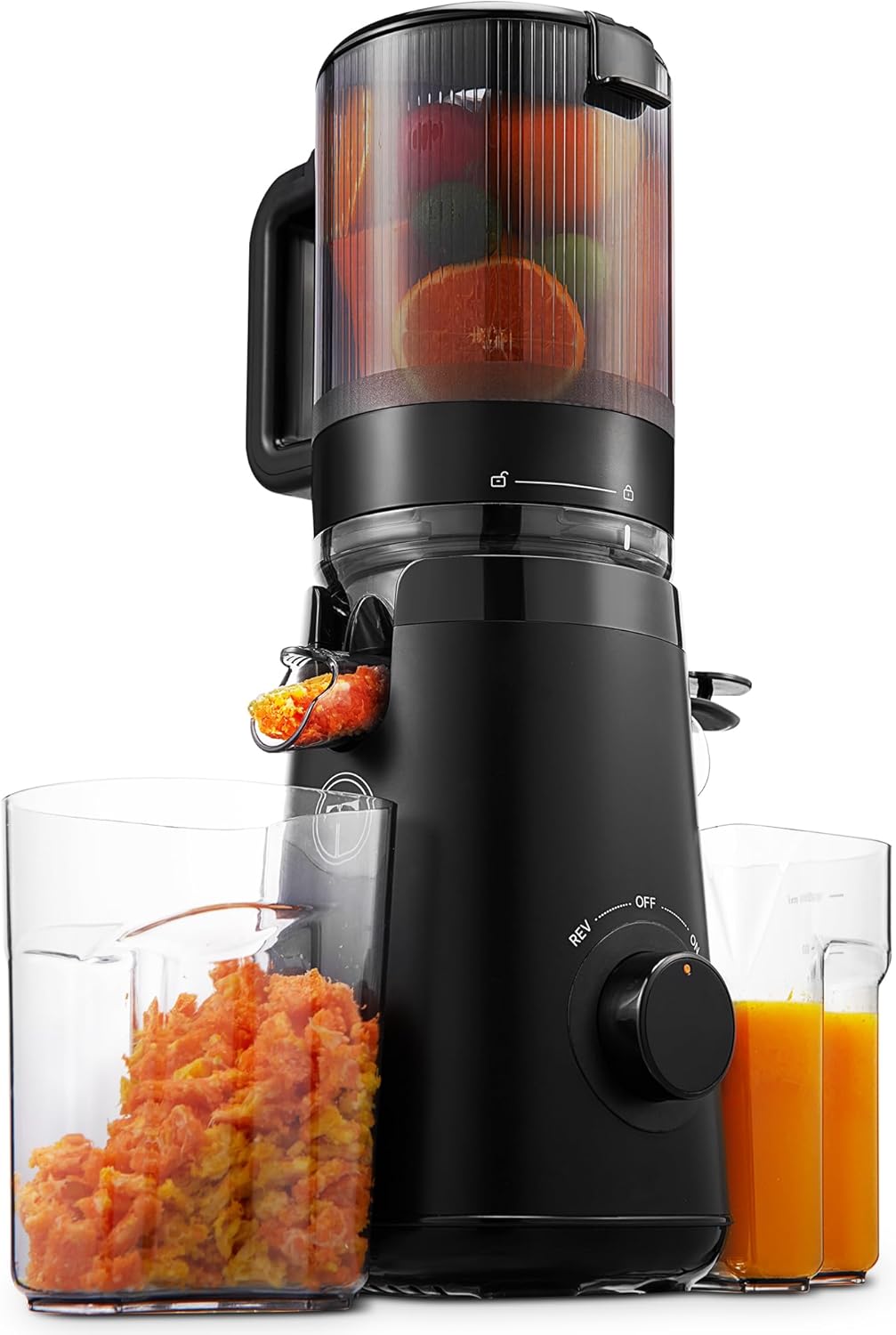
The TUUMIIST TM-580SJ is a masticating cold press juicer that uses a single auger to slowly squeeze whole fruits and vegetables at about 55 RPM, which preserves nutrients and increases juice yield. It is intended for everyday countertop use and accepts larger items thanks to an extra-large feed chute, so you can often add carrots and apples without pre-cutting. The 300-watt motor provides steady low-speed torque suited to harder produce like carrots, and the unit ships with a cleaning brush, residue cup, and juice cup to simplify post-use cleanup. The no-mesh-filter design and one-piece assembly aim to make disassembly and washing faster, though heavier pulp loads may still require occasional manual clearing. Materials are BPA-free ABS and some parts are dishwasher safe, but buyers should follow the assembly guidance to ensure proper operation. For users focused on extracting nutrient-rich carrot juice with minimal prep, this model balances yield and convenience, while those wanting commercial-grade speed or metal components may prefer a heavier-duty alternative.
Best for: Buyers who want to make nutrient-dense carrot and vegetable juices at home with minimal chopping and value high yield and straightforward cleanup.
Less Ideal for: Commercial users or anyone needing a heavy-duty, metal-bodied juicer for continuous large-volume juicing should look at more industrial models.
- Extra-large feed chute fits whole fruits and many vegetables, reducing prep time
- Slow 55 RPM cold-press extraction preserves nutrients and boosts juice yield
- 300-watt motor provides consistent low-speed torque for harder produce like carrots
- Includes cleaning brush and simple one-piece parts to make cleaning faster
- BPA-free materials for safer contact with juice
- Plastic (ABS) construction rather than metal may feel less durable over heavy daily use
- May require manual clearing with very fibrous or high-pulp batches despite no-mesh-filter design
Verdict: A practical, high-yield cold press juicer that accepts whole produce and is optimized for making nutrient-rich carrot juice at home with minimal prep.
NEWBULIG Cold Press Juicer
| Wattage | 200 watts |
|---|---|
| Voltage | 120 volts |
| Feed chute | 4.25 inches |
| Included components | Fruit residue cup, Juice cup, Power supply base |
| Special features | Easy to Clean, Masticating, Quiet Motor, Safety Lock |
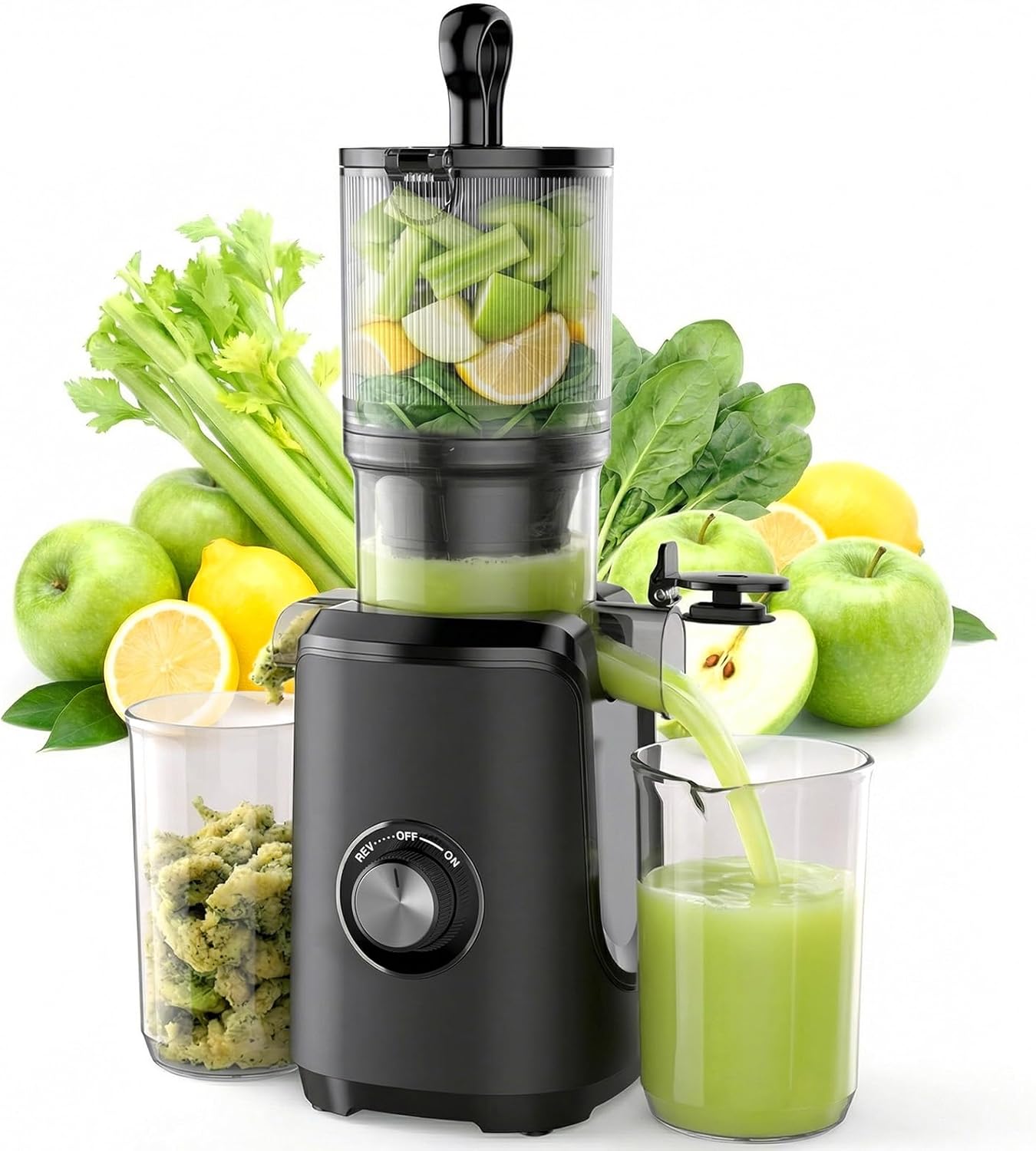
The NEWBULIG Cold Press Juicer is a budget-friendly masticating juicer meant for daily home use, especially with carrots and other firm produce. It uses a slow 200-watt auger to squeeze juice gently, reducing heat and oxidation so you get brighter flavor and more nutrients than with fast centrifugal models. A 4.25-inch feed chute accepts whole carrots or large chunks, cutting prep time, and the reverse function helps clear pulp clogs without disassembly. Parts detach for hand washing and a small cleaning brush is included, though the manufacturer recommends hand washing only. The unit also has a safety lock and a quiet motor, so it runs unobtrusively in the kitchen. On the downside, cleaning still requires rinsing and scrubbing rather than dishwasher convenience, and the 200-watt motor will be slower than high-power models when processing very large batches. For buyers focused on value, it balances yield and nutrient retention with a modest price and straightforward features.
Best for: Buyers wanting an affordable cold-press juicer that preserves nutrients and handles carrots with minimal prep while keeping noise and complexity low.
Less Ideal for: Users who need rapid, high-volume juicing, full dishwasher cleanup, or commercial-level throughput should consider higher-powered or commercial machines instead.
- Wide 4.25" feed chute reduces chopping for whole carrots and large produce
- Slow masticating auger minimizes heat and oxidation for better nutrient retention
- Reverse function clears clogs quickly without taking the unit apart
- Quiet motor and safety lock make it suitable for home kitchens
- Detachable parts and included cleaning brush simplify hand-clean maintenance
- Not dishwasher-safe; parts require hand washing and some scrubbing
- 200-watt motor is slower for very large or continuous juicing tasks
Verdict: A low-cost, nutrient-preserving masticating juicer that makes carrot juice with less prep thanks to a wide feed chute and a helpful reverse function.
anybear Cold Press Juicer SJ081

| Wattage | 350 watts |
|---|---|
| Special Features | Powerful Motor |
| Material | ABS, PC, Stainless Steel |
| Included Components | Juicer, Brush, 28 Recipes |
The anybear SJ081 is a single-auger cold press juicer built for steady, high-yield extraction of fruits and vegetables including hard produce like carrots. It uses a dual-stage auger and a 350W high-torque motor to squeeze out juice at low speed, which reduces heat and oxidation for fresher flavor and longer-lasting juice. A 4.9 inch feed chute accepts larger pieces so you can process whole apples and long vegetables with less prep, and the REV reverse function helps clear jams when working with fibrous produce. The one-piece stainless filter and included brush simplify cleanup, though the unit is hand-wash only. Materials are BPA-free and food-safe, and the package includes a recipe booklet and a five-year warranty for peace of mind. Expect quieter operation than centrifugal juicers and slightly slower throughput, so it is best for routine cold-pressed carrot or green juices rather than quick bulk juicing sessions.
Best for: Buyers who prioritize a reliable, long-lasting cold-press machine for daily carrot and vegetable juices and want consistent high yield with minimal clogging.
Less Ideal for: If you need very fast, high-volume commercial juicing or want dishwasher-clean parts for frequent heavy use, this is not the best fit.
- Dual-stage auger and 350W motor for higher juice yield from hard and fibrous produce
- Wide 4.9" feed chute reduces chopping and speeds prep
- REV reverse mode clears jams when juicing fibrous ingredients
- BPA-free food-grade materials suitable for daily family use
- One-piece stainless steel filter and brush make cleanup faster
- Slower throughput than centrifugal juicers, so larger batches take more time
- Requires hand washing for parts rather than dishwasher-safe cleaning
Verdict: Choose the anybear SJ081 if you want a dependable, high-yield cold press juicer built to handle carrots and fibrous produce with minimal clogging.
Jocuu Slow Masticating Juicer

| Wattage | 150 watts |
|---|---|
| Number of Speeds | 2 |
| Power Source | Corded Electric |
| Special Features | Auto-Reversing, Portable |
| Product Care Instructions | Dishwasher Safe |
The Jocuu Slow Masticating Juicer is a single-auger cold press machine designed to extract higher-yield, less-oxidized juice from fibrous produce like carrots and beets. It offers two speed modes for soft and hard ingredients, a reverse function to clear clogs, and an auto-shutoff motor protection that stops operation after extended use. The small feed chute and low-speed operation reduce noise and make the unit safer around children, while detachable parts are dishwasher-safe for easier cleanup. In practice it handles carrot juice well: the slow spiral auger and fine filter separate pulp efficiently and produce a smooth, high-purity juice with good yield. Expect moderate throughput because of the small feeding chute and 150 W motor, so it is best for daily home batches rather than large-volume juicing. Build is mostly plastic with stainless steel cutting parts, which keeps weight and cost down but is less heavy-duty than pro commercial machines. The included brush and reverse mode make maintenance straightforward, and a two-year motor coverage provides added reassurance.
Best for: Buyers who prioritize extracting high-purity carrot and vegetable juices at home and want a quieter, easy-to-clean cold press juicer backed by user feedback and a short warranty.
Less Ideal for: People who need to juice large quantities quickly or want a heavy-duty commercial machine for frequent, high-volume use.
- Two-speed motor handles soft fruits and hard root vegetables like carrots
- Slow masticating auger maximizes juice yield and reduces oxidation
- Reverse function and included brush help clear jams and ease cleaning
- Detachable, dishwasher-safe parts simplify maintenance
- Built-in motor protection auto-shuts after extended operation and includes two-year motor coverage
- Small feed chute slows processing of large produce and requires more prep
- Mostly plastic construction is less robust than commercial metal models
- 150 W motor limits continuous high-volume juicing
Verdict: A quiet, easy-to-clean cold press juicer that gets strong carrot juice yield for home use while offering clog-clearing and motor protection for risk-averse buyers.
EanOruus 3-in-1 Cold Press Juicer E-18

| Maximum Power | 250 watts |
|---|---|
| Wattage | 250 watts |
| Power Source | ac |
| Voltage | 110 volts |
| Capacity | 100 fluid ounces |
The EanOruus E-18 is a single-auger cold press juicer built for high-capacity household use and batch juicing. It accepts whole fruits and vegetables through a 6.5-inch wide chute and feeds them into a slow-turning auger driven by a 250W AC motor that emphasizes steady extraction and quieter operation. The unit ships with juice and sorbet strainers plus a pulp filter and detachable pulp outlet so you can switch between fresh juice, nut milk, or frozen fruit sorbet with minimal reconfiguration. A 100 oz hopper reduces trips to refill when making large batches, and the auto-reverse and overheat protection help clear jams and protect the motor during heavy use. Most removable parts are polycarbonate and hand-wash only, so cleanup takes some time but the design aims for straightforward disassembly. At about 250 watts and with plastic components in the extraction path, this is a capable, family-sized cold press machine that balances yield and convenience, though users who expect dishwasher-safe parts or metal filters should plan for manual cleaning and routine care.
Best for: Buyers who want a dependable, family-capacity cold press juicer that handles whole fruits and high-volume carrot or vegetable batches with minimal prep and motor protection features.
Less Ideal for: Shoppers who prioritize dishwasher-safe parts or all-metal extraction components for heavy commercial use should consider other models aimed at professional kitchens.
- Extra-wide 6.5-inch chute accepts whole fruits for minimal prep
- Large 100 oz hopper lets you juice multiple servings or batches at once
- Includes separate strainers for juice and sorbet plus a pulp filter for versatility
- Auto-reversing function and overheat protection reduce jams and protect the motor
- Whisper-quiet AC motor provides steady torque for fibrous produce like carrots
- Removable parts are hand-wash only which adds cleanup time
- Extraction components use plastic rather than metal, which may wear faster
Verdict: Choose the EanOruus E-18 if you need a quiet, high-capacity cold press juicer that accepts whole produce and is built for large batches of carrot juice and similar blends.
Choosing the Right Cold Press Juicer for Carrot Juice: Key Factors to Consider
Juice Yield and Pulp Dryness
Yield measures how much juice you extract from carrots relative to their weight. Higher yield lowers waste and reduces how often you need to buy produce. For carrot juice specifically, look for designs that crush and press fibers thoroughly rather than just slicing them; this squeezes out more liquid and leaves a drier pulp.
Pulp dryness is a visible indicator of extraction efficiency. Drier pulp usually means you are getting most of the liquid and nutrients from the carrot. If you plan to juice frequently, better extraction saves money and produces a thicker, more concentrated juice that holds flavor longer.
Motor Torque and RPM
Torque and rotation speed determine how well a cold press juicer handles hard roots like carrots. Higher torque lets the auger chew through fibrous tissue without stalling, while low RPM reduces heat and oxidation that degrade sensitive vitamins.
Choose a motor rated for continuous or heavy duty cycles if you intend to juice large batches. Models with low RPM but strong torque are ideal for carrot juice because they balance yield with nutrient preservation and reliable operation over time.
Feed-Chute Size and Prep Time
Feed-chute dimensions affect how much chopping you must do before juicing. A wider chute reduces prep time by allowing longer carrot pieces or whole baby carrots to pass through, while a narrow chute forces more cutting and slows the process.
If you prioritize quick morning routines, a larger chute or an efficient pusher will speed things up. However, wider chutes can sometimes increase the chance of clogging with dense produce, so weigh convenience against reliable extraction for carrots.
Ease of Cleaning and Maintenance
Juicing carrots creates sticky residue and fibrous buildup that can be time-consuming to clean. Machines that disassemble easily and provide simple, tool-free access to the auger and screens make cleanup much faster. Dishwasher-safe parts or included cleaning brushes also reduce the friction of regular upkeep.
Consider how many pieces the juicer breaks into and whether small crevices trap pulp. Regular maintenance habits such as immediate rinsing after use help, but the initial design determines how much effort cleaning will require over time.
Build Materials and Long-Term Durability
Materials in contact with produce should be food-safe and durable. Stainless steel components, reinforced augers, and robust housings resist wear and staining from carotene-rich juice. A solid build also reduces vibration and mechanical stress during extended runs.
Durability matters if you plan to juice carrots daily or process large batches. Heavier, well-supported units tend to deliver steadier extraction and fewer service issues than lighter, plastic-heavy designs.
Why Cold Pressing Is Better For Carrot Juice
Cold pressing extracts juice at low speeds and with high pressure, which minimizes heat and oxidation. For carrots, that means brighter color, reduced foam, and retention of heat-sensitive nutrients like certain antioxidants. The gentle action also tends to yield smoother texture and less separation than high-speed centrifugal extraction.
- Lower RPM reduces enzyme breakdown and oxidation
- Smoother mouthfeel with less foam and separation
- Often yields a richer, more concentrated flavor profile
Preparing Carrots for Best Results
Proper prep helps any cold press juicer run more efficiently. Trim tops and ends, remove blemishes, and cut carrots to lengths that match the feed-chute. For very dense or aged carrots, slicing into thinner pieces or briefly steaming then cooling can increase yield and reduce strain on the motor.
- Wash and scrub rather than peeling to retain nutrients
- Cut carrots to fit the chute, or halve/quarter for narrow chutes
- Remove thick woody cores when present for smoother extraction
Managing Pulp and Using Leftovers
Carrot pulp is fibrous and versatile. After juicing, use the dry pulp in recipes, garden compost, or baked goods to reduce waste and get more value from each carrot. Storing pulp briefly in the fridge and incorporating it into smoothies, muffins, or veggie burgers is a practical way to use leftover fiber.
- Add pulp to batter for muffins or pancakes
- Mix pulp into soups and stocks for body and fiber
- Compost dry pulp to enrich garden soil
Noise, Footprint, and Kitchen Integration
Cold press juicers vary in size and operating noise. If you juice in the morning around others, select a unit with quieter operation and non-slip feet to minimize disruption. Consider countertop space and where you will store the machine when not in use. Taller centrifuge-style units are not relevant here; focus on compact vertical or horizontal cold press designs that match your kitchen layout.
- Measure countertop clearance and storage cabinet height
- Look for models with cord storage or compact footprints
- Check noise descriptions if early-morning juicing matters
Common Problems and How To Avoid Them
The most frequent issues when juicing carrots are clogging, motor stalls, and difficult cleaning. Prevent clogs by cutting produce to appropriate sizes, alternating carrots with softer produce or a small amount of water, and feeding at a steady pace rather than forcing large chunks. Regularly inspect and clear the screen or strainer to keep flow consistent. To avoid motor strain, do not run the unit continuously beyond recommended duty cycles. If you plan to make large batches, give the motor short rests between runs and use a heavier-duty model designed for continuous operation.
- Alternate hard and soft produce to maintain a steady feed
- Use a tamper or pusher gently rather than forcing material
- Perform quick rinses immediately after juicing to prevent dried buildup
How We Chose the Best Cold Press Juicer for Carrot Juice
Our selection prioritized machines that handle hard, fibrous produce efficiently and consistently. We focused on slow-rotation dual-gear or single-gear auger designs proven to reduce heat and oxidation during extraction. Key technical filters included torque and auger geometry, feed-chute design for whole or chunked carrots, and specification data indicating consistent low-RPM operation. We assessed real-world usability factors such as hopper and chute size, pusher ergonomics, and whether the unit supports continuous or batch extraction, since those influence prep time for carrots. Durability and materials were evaluated by looking for stainless-steel contact parts, reinforced augers, and robust motor housings rated for extended duty cycles. We also considered maintenance: how parts disassemble, compatibility with simple scrubbing, and whether cleaning tools or rinse cycles were provided. Items were excluded if they were centrifugal or high-speed designs, lacked clear spec data for torque or RPM, or had user reports of clogging with dense root vegetables. Final picks balance extraction efficiency, ease of cleaning, and long-term reliability for heavy carrot use.
Our full evaluation process is outlined in our review methodology.
FAQ
How much carrot should I expect to use per glass of juice?
It depends on the juicer and carrot size, but cold press models typically yield more juice per weight than high-speed machines. Many users find a pound of carrots makes roughly one to two cups of juice, though yield varies with carrot freshness and extraction efficiency.
Can I juice carrots with minimal prep to save time?
Some machines with wider chutes let you feed long carrot pieces or whole baby carrots, which reduces prep. However, trimming ends and cutting very thick carrots into chunks improves reliability and prevents jams.
Will cold pressing preserve the nutrients in carrot juice?
Cold pressing reduces heat and oxidation compared with high-speed methods, which helps preserve certain nutrients and antioxidants. Proper storage in an airtight container and refrigeration also slows degradation after extraction.
How often should I clean the juicer if I juice carrots daily?
Ideally, rinse and disassemble key parts immediately after each session and perform a thorough clean daily. Quick rinses prevent dried carrot residue that becomes harder to remove over time.
Can cold press juicers handle other root vegetables like beets?
Many cold press units designed for carrots can handle other firm roots, but beets are dense and can stain parts. If you plan to process multiple root vegetables, prioritize durable, stain-resistant materials and frequent cleaning to avoid color transfer.
Final Verdict
When choosing a cold press juicer for carrot juice, prioritize extraction efficiency, motor torque, and ease of cleaning. Those three tradeoffs most directly affect how much juice you get, how often the machine requires maintenance, and how long it will last under frequent use. Balance a larger feed-chute and convenient prep against the need for steady torque and simple disassembly. For daily carrot juicing, favor models that yield dry pulp, run at low RPM with high torque, and come apart for fast cleaning so you can sustain a regular routine with minimal hassle.