
Note: This article contains affiliate links. If you click on these links and make a purchase, we may earn a small commission at no extra cost to you. This helps support our research and content. Read our full affiliate disclosure here.
If you operate a café, juice bar, or catering service, a commercial cold press juicer affects both product quality and daily efficiency. You need equipment that produces clear, nutrient-rich juice while standing up to continuous use and quick cleaning cycles. This guide focuses on the top cold press juicers for business use, shortlisted for commercial throughput, ease of maintenance, and reliable yield. Below we cover machines suited to repeated daily runs and outline the performance and service features that matter most when choosing a unit for a busy operation.
Top Picks at a Glance
| Best Overall The best all-around choice for most situations | Canoly C16 Cold Press Juicer |  |
| Best Quality Built to a higher standard if you want something more solid | NAMA J2 Cold Press Juicer |  |
| Best Value The sweet spot between price and what you get | ACOQOOS AMJ-90 Cold Press Juicer |  |
| Best Budget The cheapest option that still gets the job done reliably | NEWBULIG Cold Press Juicer |  |
| Top Rated A top-rated pick with lots of positive feedback | anybear Cold Press Juicer SJ054C |  |
| Most Popular A crowd favorite that many people choose with confidence | EanOruus 3-in-1 Cold Press Juicer E-18 |  |
| Best Seller A high-volume bestseller chosen again and again | Ninja NeverClog Cold Press Juicer JC151 |  |
Canoly C16 Cold Press Juicer

| Maximum Power | 250 watts |
|---|---|
| Wattage | 250 watts |
| Power Source | ac |
| Number of Speeds | 45 |
| Capacity | 2.65 liters |
The Canoly C16 is a single-auger cold press juicer designed for versatile kitchen use, able to produce fresh juice, frozen fruit sorbets, and nut milk using interchangeable 3-in-1 strainers. It accepts large produce through a six-inch feed chute to reduce prep time and uses a 250-watt AC brushless motor with auto-reverse to handle tougher ingredients while running quietly. The unit emphasizes easy cleanup with tool-free disassembly and dishwasher-safe parts, and its large hopper capacity supports batch processing for multiple servings. Control is via a touchpad and the design claims whole-fruit processing while minimizing clogging. Important limitations are its relatively modest 250W power compared with heavy commercial juicers and a plastic auger/blade construction that may wear faster under constant heavy use, so businesses that need continuous high-throughput operation should consider duty-cycle expectations. For balanced kitchen-to-light commercial tasks it offers strong convenience, variety of outputs, and quieter operation than many centrifugal models.
Best for: Shop owners or small cafes that want a quiet, versatile cold-press machine for making a variety of products and occasional batch runs without heavy industrial demand.
Less Ideal for: High-volume commercial juicing operations or juice bars that need industrial-grade motors and metal augers for nonstop, heavy-duty throughput should look at larger commercial models.
- Three strainers let you make juice, sorbets, and nut milk from one machine
- Large 6-inch feed chute reduces prep time by fitting whole or large produce
- Quiet AC brushless motor with auto-reverse for smoother extraction and less clogging
- Tool-free disassembly and dishwasher-safe parts simplify cleanup
- 250W motor and plastic auger parts limit suitability for heavy continuous commercial use
Verdict: A quiet, versatile cold-press juicer that handles juice, sorbet, and nut milk well for small commercial or high-end cafe use where convenience and lower noise matter.
NAMA J2 Cold Press Juicer

| Power | 200 watts |
|---|---|
| Voltage | 120 |
| Number of Speeds | 1 |
| Capacity | 30 fluid ounces |
The NAMA J2 is a hands-free single-auger masticating juicer built for steady, efficient extraction of fruits, vegetables, and leafy greens. You load whole ingredients into the wide self-feeding hopper and the 200 W motor runs at a low speed to press juice out with minimal heat and foam, which preserves flavor and nutrients. Its included strainers and coarse filter let you adjust pulp level, and the unit is designed for continuous operation with quiet performance and a focus on maximizing yield. Cleanup is simplified with quick-release parts, a spinning brush, and mostly rinseable components, though the manufacturer advises hand washing certain pieces. Practical limits are its single speed operation and 30 fl oz capacity, which make it better suited to steady batch processing than very high-throughput commercial use, and the J2 is not fully dishwasher-safe so cleaning still takes hands-on time after busy shifts.
Best for: Buyers who need a reliable cold-press juicer that maximizes yield and runs quietly for regular batch production in small commercial or high-volume home scenarios.
Less Ideal for: Those running heavy commercial throughput who need multi-speed control, larger capacity hopper systems, or fully dishwasher-safe parts for rapid nonstop service.
- Self-feeding wide hopper for hands-free batching
- Low-speed masticating action that preserves nutrients and increases juice yield
- Quiet 200 W motor suitable for continuous operation in busy environments
- Includes multiple strainers and containers to control pulp and collect juice
- Quick-release parts and included cleaning brush speed up teardown and rinsing
- Only one speed setting limits control for delicate ingredients or high-throughput tuning
- Some parts require hand washing rather than dishwasher-safe convenience
- 30 fl oz capacity may require frequent emptying during large-volume production
Verdict: Choose the NAMA J2 when you want a quiet, high-yield cold-press juicer that handles hands-free batches reliably for performance-focused small-scale juicing.
ACOQOOS AMJ-90 Cold Press Juicer

| Maximum Power | 350 watts |
|---|---|
| Number of Speeds | 60 |
| Capacity | 100 OZ |
| Material | BPA-Free ABS |
The ACOQOOS AMJ-90 is a slow masticating juicer designed to handle whole fruit with minimal prep and to produce juice, sorbet, and nut milk from a single unit. It uses a 6.5-inch extra-wide feed chute and a 100 oz gravity-fed hopper so you can load batches and walk away, which speeds throughput in a small commercial setting or busy juice bar. Running at 60 RPM with a 350 W motor, it emphasizes low-heat extraction for higher yield and drier pulp, and the manufacturer claims up to 90% extraction and longer freshness. The unit includes dishwasher-safe BPA-free parts and a cleaning brush to shorten turnaround between batches, and built-in overheat protection helps with repeated use. Limitations for business use are the 350 W motor and consumer-grade 1-year warranty, which may constrain continuous heavy-duty operation compared with commercial-rated machines, and the need to remove hard pits to protect the auger. For a small cafe or pop-up juice stand seeking a versatile, space-saving cold press solution, this model delivers strong yield and easy batching, but high-volume operations should consider industrial-grade alternatives.
Best for: Small cafes, juice bars, or food businesses that need a compact, multipurpose cold-press machine to increase yield and reduce prep without investing in full commercial equipment.
Less Ideal for: Larger high-throughput operations or establishments that require industrial-duty continuous use and factory-grade service plans should look at commercial-rated juicers instead.
- Large 6.5-inch feed chute and 100 oz hopper enable batch loading and reduce prep time
- Slow 60 RPM masticating action preserves nutrients and yields drier pulp
- Dishwasher-safe, BPA-free detachable parts and included brush speed cleaning between uses
- Three functions (juice, sorbet, nut milk) increase versatility for varied menu items
- Overheat protection helps prevent motor damage during repeated cycles
- 350 W motor and consumer warranty may not suit continuous, very high-volume commercial use
- Manufacturer notes to remove hard pits and seeds, adding a prep step for some ingredients
Verdict: A space-saving, versatile cold-press juicer that boosts yield and speeds batching for small commercial setups while remaining budget-friendly compared with industrial machines.
NEWBULIG Cold Press Juicer
| Wattage | 200 watts |
|---|---|
| Voltage | 120 volts |
| Feed chute | 4.25 inches |
| Special Features | Reverse function, Safety Lock, Quiet Motor |
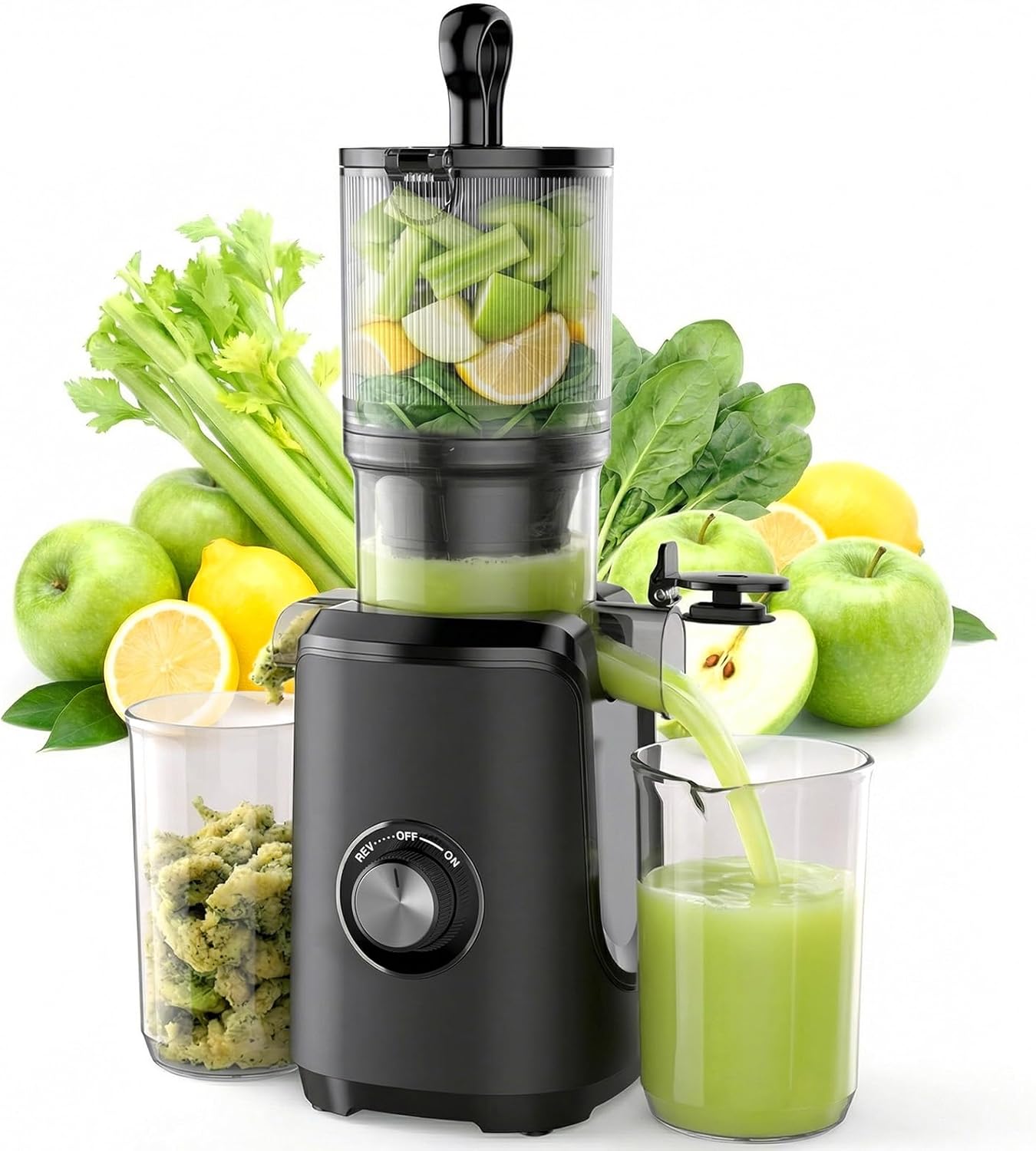
The NEWBULIG Cold Press Juicer is a single-auger masticating machine built for daily home or light commercial use where nutrient retention and quiet operation matter. It uses a slow-speed motor to minimize heat and oxidation, preserving enzymes and flavor, and the 4.25-inch feed chute accepts whole carrots and many other items with less prep. A reverse function clears clogs quickly without full disassembly, and the included juice and pulp cups plus a cleaning brush make post-juice cleanup straightforward, though parts are hand-wash only. Safety lock and blade-free design add usable peace of mind in busy environments. At 200 watts it is modestly powered, so expect steady throughput rather than high-output commercial speeds; this model is best for small-scale juicing or as a budget-friendly addition to a café or juice bar testing menu items. Build materials are common consumer plastics and stainless steel rather than heavy-duty commercial alloys, so durability under constant heavy use may be limited.
Best for: A cost-conscious buyer seeking a nutrient-preserving, quiet cold press juicer for small-scale service or testing menu items who values easy feeding and clog recovery over commercial throughput.
Less Ideal for: Businesses that need high-volume, nonstop juicing for heavy customer traffic should choose a true commercial-grade juicer built for continuous heavy use.
- Wide 4.25-inch feed chute reduces prep time by fitting many whole fruits and vegetables
- Slow masticating motor reduces oxidation to preserve nutrients and flavor
- Reverse function quickly clears clogs without disassembly
- Includes juice cup, pulp cup, and cleaning brush for easier cleanup
- Safety lock and blade-free design improve safe operation
- 200-watt motor limits continuous high-volume throughput compared with commercial juicers
- Parts require hand washing which slows turnaround in busy service settings
Verdict: A budget-friendly masticating juicer that preserves nutrients and handles whole produce with minimal prep, ideal for small-scale or trial commercial use.
anybear Cold Press Juicer SJ054C
| Wattage | 200 watts |
|---|---|
| Voltage | 110 volts |
| Maximum Power | 200 watts |
| Special Features | Easy to Clean |
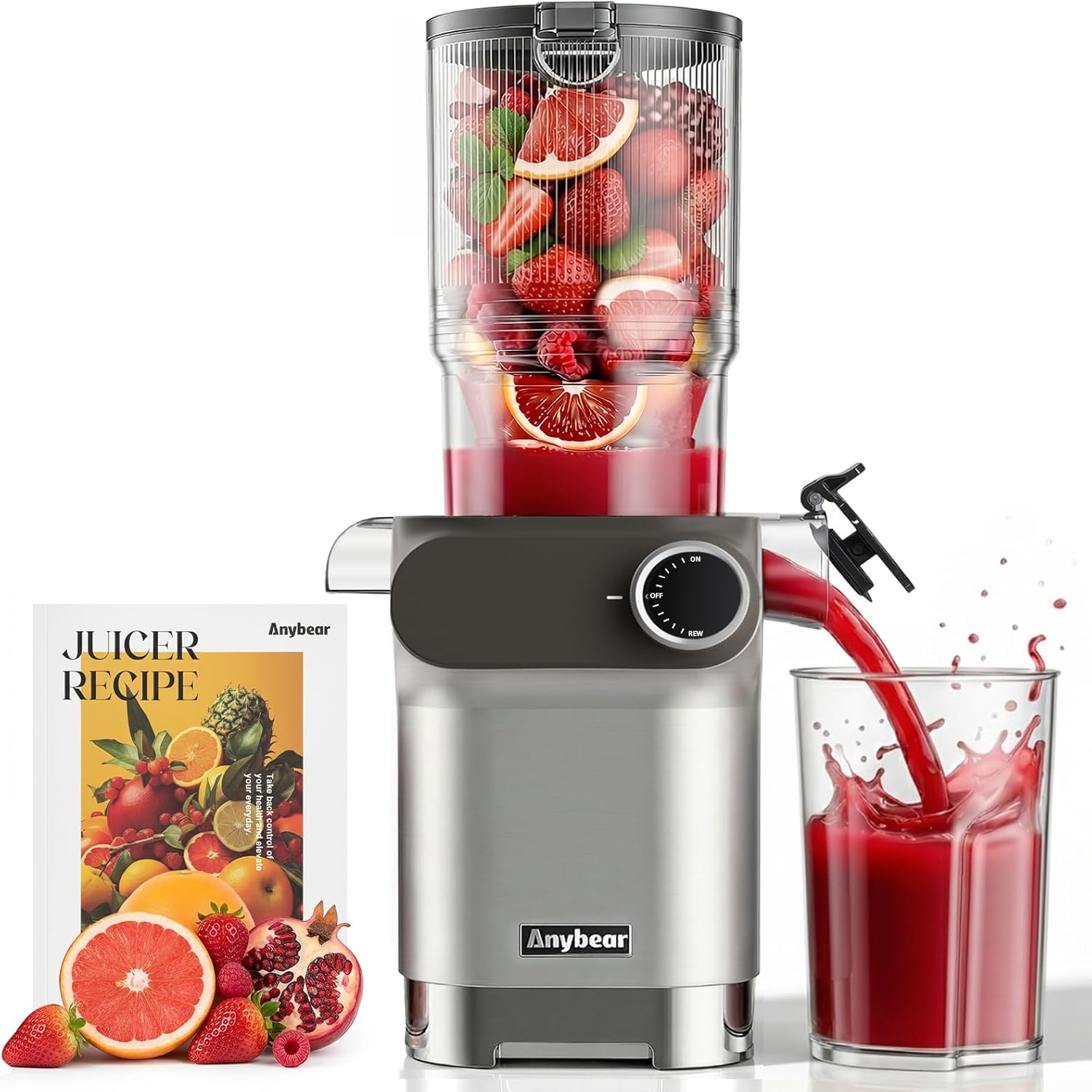
The anybear SJ054C is a slow masticating juicer built to deliver high-yield, low-oxidation juice for frequent use. It runs at about 65 RPM with a 200W, high-torque motor and a heavy-duty auger that handles whole fruits and many vegetables through a 4.3-inch feed chute, so you can load larger items without constant pre-cutting. The design emphasizes easy maintenance: Tritan feed components, a one-piece stainless steel filter and a simple three-step disassembly that the included brush makes quicker to rinse between batches. For business settings the motor and auger promise steady extraction and the claimed high yield helps reduce produce waste. Limitations to consider are the hand-wash care requirement and the absence of explicit commercial-duty ratings, so continuous heavy back-to-back shifts may require periodic cool-downs. The unit also lacks dishwasher-safe parts, so plan for staff time to clean during busy service hours.
Best for: Small-scale juice businesses or cafes that need consistent cold-pressed juice output and value high yield and easy, routine cleaning over industrial continuous-duty equipment.
Less Ideal for: Large commercial kitchens or high-volume juice bars that require certified commercial-grade machines and fully dishwasher-safe cleaning workflows.
- High-torque 200W motor for slow, efficient extraction
- 4.3-inch wide feed chute reduces prep and speeds throughput
- One-piece stainless steel filter and simple disassembly make daily cleaning faster
- Tritan feed components are food-grade and resist staining and odors
- Hand wash only parts increase cleaning labor compared with dishwasher-safe designs
- Not specified or certified for continuous commercial use
Verdict: Choose this juicer if you run a small cafe or juice counter and want a high-yield, low-oxidation cold press machine that is easy to operate and maintain.
EanOruus 3-in-1 Cold Press Juicer E-18

| Wattage | 250 watts |
|---|---|
| Capacity | 100 fluid ounces |
| Power Source | ac |
| Voltage | 110 volts |
The EanOruus E-18 is a 3-in-1 single-auger masticating juicer built for heavy use and batch work. It processes whole fruit through a 6.5-inch wide chute into a 100 oz hopper so you can load multiple servings at once, and the included interchangeable strainers let you switch between juice, nut milk and sorbet. A 250W AC brushless motor with auto-reverse and overheat protection provides steady, high-yield extraction while keeping noise low, and the detachable pulp outlet and removable parts make rinsing and hand-washing straightforward. For business settings the large hopper and whole-fruit feed reduce prep time, and the robust motor is designed for repeated runs. Expect plastic and polycarbonate construction rather than metal components, so long-term heavy-commercial use may show wear, and parts are hand-wash only which adds cleaning time compared with dishwasher-safe units. The unit includes common accessories such as strainers, pusher and brush, and its premium gray finish fits a professional counter.
Best for: Operators who need a high-capacity cold-press juicer for repeated batches and want a machine that minimizes prep while offering versatility for drinks and frozen treats.
Less Ideal for: Anyone seeking a fully commercial-grade stainless steel juicer designed for continuous nonstop service or who requires dishwasher-safe components for fast turnover.
- Extra-large 100 oz hopper for batch juicing and fewer refills
- 6.5-inch wide chute accepts whole fruits to reduce prep time
- 250W AC brushless motor with auto-reverse and overheat protection for consistent extraction
- Interchangeable strainers enable juice, nut milk and sorbet from one machine
- Detachable pulp outlet and removable parts simplify rinsing and cleanup
- Primary construction uses plastic and polycarbonate rather than heavier metal parts
- Removable parts are hand-wash only, adding manual cleaning time
Verdict: Choose the EanOruus E-18 when you want a versatile, high-capacity cold-press juicer that speeds batch prep and handles juice, nut milk and sorbet in one unit.
Ninja NeverClog Cold Press Juicer JC151

| Maximum Power | 150 watts |
|---|---|
| Number of Speeds | 2 |
| Capacity | 24 fluid ounces |
| Power Source | Corded Electric |
The Ninja NeverClog JC151 is a slow masticating juicer designed to extract juice from fibrous fruits and vegetables using a 150-watt high-torque auger. It runs two simple programs — Start/Stop and Reverse — to help clear jams and improve extraction, and includes two interchangeable pulp filters so you can choose between smoother juice or more fiber. The kit ships with a 24 oz juice jug and a 36 oz pulp container, which makes preparing multiple servings or small batches straightforward for light commercial or high-home use. Built-in anti-drip control and dishwasher-safe juice-contact parts reduce mess and speed cleanup. Practical limits are the modest 150W motor and consumer-oriented build, which mean it is not intended for continuous heavy commercial throughput; expect slower processing than larger commercial masticators and occasional need to use Reverse on very dense loads. For buyers who want reliable, low-foam cold-pressed juice with easy cleanup and sensible pulp control, this unit balances performance and convenience in a compact footprint.
Best for: Buyers seeking a dependable, easy-to-use cold press juicer for steady small-batch production or light commercial tasks who prefer low-maintenance features and predictable performance.
Less Ideal for: Businesses needing nonstop, high-volume juicing or industrial throughput should choose a purpose-built commercial juicer with higher power and continuous-duty design.
- High-torque 150W motor designed for extracting juice from fibrous produce
- Two interchangeable pulp filters for customized pulp level
- Includes larger 24 oz juice jug and 36 oz pulp container for batch prep
- Dishwasher-safe juice-contact parts and anti-drip lever simplify cleanup and reduce mess
- Reverse function and simple controls help clear jams and prolong run time
- 150W motor and consumer-grade design are not built for continuous heavy commercial use
- Not as fast as larger commercial cold-press juicers for high-volume operations
Verdict: Choose the Ninja JC151 if you want a compact, reliable cold-press juicer that delivers controlled pulp levels and easy cleanup for steady small-batch or light commercial juicing.
Choosing the Right Cold Press Juicer for Business: Key Factors to Consider
Juice Yield and Extraction Efficiency
Extraction efficiency determines how much usable juice you get from a kilogram of produce, which directly affects ingredient costs and profit margins. In a commercial setting small differences in yield add up across dozens or hundreds of servings per day.
Look for machines with slow, high-torque augers and well-engineered press chambers that minimize pulp moisture. Consistent extraction also reduces waste and helps you predict ingredient needs for menu planning.
Daily Throughput and Cycle Time
Throughput measures how much juice the unit can produce in an hour under realistic operating conditions. For a business, rated throughput is more useful than single-shot cycle time because it reflects continuous loading, feed handling, and occasional cleaning between batches.
Consider peak service periods and whether the machine can sustain output without overheating or jamming. A higher throughput can justify greater upfront investment by reducing labor and queuing during rush times.
Cleaning, Maintenance, and Downtime
Ease of cleaning affects labor costs and how quickly a machine can return to service between shifts. Commercial units should allow fast disassembly without tools, have smooth surfaces that resist pulp buildup, and use materials that tolerate frequent sanitation.
Maintenance access and the availability of replaceable wear parts determine how long the machine will remain productive. Factor in realistic cleaning cycles per day and whether the design supports quick routines during busy shifts.
Build Quality and Replaceable Components
A commercial juicer will face far heavier use than home equipment, so robust construction matters. Look for reinforced housings, long-life bearings, and augers made from wear-resistant materials.
Assess which parts are user-replaceable and how readily they are available. A design that limits service to field technicians will increase downtime and operating cost compared with one that allows quick on-site swaps of common wear items.
Food-Safety and Sanitary Features
Juice prepared for sale must meet high standards for hygiene. Machines should use food-grade materials throughout the feed path, minimize crevices where pulp can lodge, and support thorough cleaning and sanitizing protocols.
Consider whether the unit's surfaces are corrosion-resistant and whether its assembly supports inspections and quick sanitation during and after service.
Operational Comfort and Noise
Noise and ergonomics affect both staff experience and customer perception in open-concept venues. Lower-noise machines reduce staff fatigue and make the service area more pleasant.
Also evaluate feed-chute size, hopper ergonomics, and controls. A design that reduces repetitive motions or awkward lifting will improve throughput and reduce the risk of staff strain.
Understanding Commercial Cold Press Technology
Cold press juicers extract juice by slowly compressing produce rather than using high-speed blades. This method preserves more of the fruit or vegetable matrix and typically yields juice with clearer appearance and less oxidation during short-term storage.
For business use you should focus on mechanical robustness and the ability to maintain steady pressure over extended cycles. Components such as heavy-duty augers, reinforced housings, and efficient pulp separation systems matter more than the consumer-facing speed claims.
- Slow, high-torque extraction preserves nutrients and color
- Consistent pressure reduces variation between batches
- Designs that minimize heat and friction protect flavor
Sizing Your Machine to Your Service Volume
Estimate average and peak daily liters to choose a machine sized for your busiest shift. Undersized equipment forces frequent pauses and extra staff, while oversized machines may increase capital and floor-space costs without commensurate benefit.
Factor in menu variety. If you plan to run leafy green blends and root-vegetable blends, expect different throughputs because some produce requires more force and time to extract efficiently.
- Calculate expected daily liters and peak-hour demand
- Match hopper and feed-chute capacity to staff workflow
- Consider modular setups if you need redundancy during peak hours
Sanitation Best Practices for Busy Operations
Implement a regular cleaning schedule that fits between service periods. Quick-rinse routines for short breaks plus a full sanitation at shift end help prevent bacterial buildup and maintain consistent juice quality.
Train staff on disassembly and reassembly procedures, and store spare seals and common wear parts onsite to minimize downtime. Use food-safe cleaning agents and verify materials are compatible with frequent sanitation cycles.
- Perform quick rinse after each busy run and deep clean daily
- Keep a checklist for component inspection and replacement
- Rotate spare parts to avoid service interruptions
Energy Use and Operational Cost Considerations
Energy consumption affects operating margins in high-volume setups. Compare rated power draw in realistic use cases rather than peak wattage alone, and consider machines that sustain output without thermal cutouts that interrupt service.
Also account for labor time spent on cleaning and maintenance when projecting total cost of ownership. A slightly higher-energy unit with faster cleaning cycles can be cheaper overall than a low-power model that requires long service intervals.
- Review duty-cycle ratings and cooling design
- Estimate labor minutes per day for cleaning
- Include parts replacement frequency in cost models
Workflow Integration and Placement
Plan machine placement to streamline staff movement between produce prep, juicing, and customer service. A convenient location reduces transit time and the potential for cross-contamination.
Consider noise, drainage, and access to power when selecting placement. Ensure there is adequate room for safe disassembly and that splash or pulp does not interfere with adjacent equipment.
- Allow clearance for disassembly and maintenance
- Place near prep sinks and drainage points
- Account for ventilation and noise in open spaces
How We Chose the Best Cold Press Juicer for Business
Our selection focused on machines engineered for continuous, revenue-driving use in commercial settings. We prioritized measurable operational criteria: juice yield under heavy loads, sustained daily throughput in liters per hour, durability of key wear parts, and serviceability including ease of disassembly and parts replacement. Food-safety features and sanitary design also mattered, like tool-free cleaning access and materials rated for frequent sanitation. We excluded hobby or single-family models that lack commercial duty ratings, small-capacity units intended only for occasional home use, and machines without documented parts support. We also filtered out designs that sacrifice yield for speed or that use heat-producing components that reduce nutrient preservation. The editorial framework emphasized objective, scoreable dimensions: extraction efficiency, throughput, build longevity, cleaning and maintenance, and food-safety design. Those same dimensions guided our scoring and recommendations.
Our full evaluation process is outlined in our review methodology.
FAQ
How much juice can a commercial cold press juicer produce per hour?
Hourly production varies by machine and produce type. Typical commercial models are rated by liters per hour under continuous loading, and you should choose a unit with a rated throughput above your peak-hour needs to avoid bottlenecks.
What maintenance does a cold press juicer for business typically require?
Daily cleaning and periodic inspection of seals, bearings, and auger surfaces are common. Many commercial designs allow fast, tool-free part swaps for common wear items to reduce downtime.
Can cold press juicers handle leafy greens and fibrous roots equally well?
Performance depends on the machine design. High-torque augers and efficient pulp separation systems handle leafy greens better, while robust press chambers and slower feed rates improve extraction from fibrous roots.
Are commercial cold press juicers noisy in a customer-facing environment?
Noise levels vary. Some commercial units are engineered for lower noise to suit open counters. If noise is a concern, prioritize models with sound-dampening housings and test them under load if possible.
How important is spare-part availability for a business juicer?
Very important. Readily available wear parts and simple replacement procedures reduce downtime and long-term costs. Businesses should budget for routine replacement of seals, screens, and augers.
Final Verdict
When selecting a cold press juicer for business use, prioritize extraction efficiency and sustained throughput over cosmetic features. Durable construction, easy cleaning, and simple parts replacement minimize downtime and operating cost. Balance your expected daily liters and menu requirements against maintenance demands and sanitary design to choose a unit that keeps production steady. Focus on the tradeoffs between throughput and ease of service. A slightly slower, more robust machine can be a better long-term choice than a faster unit that requires frequent intervention. Choose the machine that matches your peak service needs and supports efficient workflows.