
Note: This article contains affiliate links. If you click on these links and make a purchase, we may earn a small commission at no extra cost to you. This helps support our research and content. Read our full affiliate disclosure here.
Running a juice bar means balancing peak‑hour throughput with consistent juice quality and minimal downtime. The right commercial juicer for juice bars can handle continuous heavy use, deliver reliable yield, and be quick to disassemble and sanitize between batches. This guide shortlists the top commercial juicers suited to a juice bar environment and explains the practical tradeoffs you should expect. Below we present vetted picks covering high-volume extraction, ease of cleaning, and serviceability. Use the evaluation criteria to match a model to your daily volume and maintenance capacity.
Top Picks at a Glance
| Best Overall The best all-around choice for most situations | Hurom H70 Slow Juicer |  |
| Best Quality Built to a higher standard if you want something more solid | Robot Coupe J80 Juicer |  |
| Best Value The sweet spot between price and what you get | Canoly C16 Cold Press Juicer |  |
| Best Budget The cheapest option that still gets the job done reliably | Barfly Large Manual Juicer |  |
| Top Rated A top-rated pick with lots of positive feedback | NAMA J2 Cold Press Juicer |  |
| Most Popular A crowd favorite that many people choose with confidence | Zulay Kitchen Cast Iron Juicer |  |
| Best Seller A high-volume bestseller chosen again and again | EanOruus 3-in-1 Cold Press Juicer |  |
Hurom H70 Slow Juicer

| Wattage | 150 watts |
|---|---|
| Power Source | Corded Electric |
| Material | Plastic |
| Special Features | Easy to Clean |
The Hurom H70 is a single-auger cold-press juicer built for daily use where yield and cleanup matter. It uses a strainer-free Easy Clean chamber and a two-part auger system to separate pulp without a mesh filter, which makes disassembly and rinsing faster than many mesh-based slow juicers. The self-feeding wide-mouth hopper accepts larger pieces and reduces prep time while the slow squeeze action maximizes juice extraction for a smoother, lower-pulp result. At 150 watts it runs quietly compared with high-speed centrifugal machines, and the front-facing gauge lets you monitor juice volume during operation. Practical limits to note are its compact size and plastic construction, which are great for countertop fit but mean it is less heavy-duty than stainless commercial juicers and may handle very large continuous-volume demands less well. The H70 suits users who prioritize easy cleanup and high yield in a smaller footprint rather than nonstop, industrial-scale throughput.
Best for: Buyers who want a balanced juicer that maximizes yield and minimizes cleanup in a compact footprint and who value quiet, efficient cold-press performance for regular service.
Less Ideal for: Operators who need a heavy-duty stainless commercial juicer for continuous, high-volume production should choose a purpose-built industrial model instead.
- Strainer-free Easy Clean chamber that rinses quickly and reduces mesh maintenance.
- Large self-feeding hopper minimizes chopping and speeds prep.
- Slow masticating auger increases juice yield and produces lower-pulp juice.
- Quiet operation compared with high-speed juicers and blenders.
- Front-facing gauge lets you monitor juice level during use.
- Plastic construction and compact form are less suitable for heavy continuous commercial throughput.
- Not designed for industrial-scale, nonstop juicing shifts.
Verdict: Choose the Hurom H70 when you want high-yield, low-pulp cold-pressed juice with fast, no-mesh cleanup in a compact countertop juicer.
Robot Coupe J80 Juicer

| Power Source | Corded Electric |
|---|---|
| Voltage | 120 |
| Wattage | 746 watts |
| Special Features | Automatic Juicer with Pulp Ejection |
| Capacity | 6.5 liters |
The Robot Coupe J80 is a heavy-duty centrifugal juicer built for commercial use in juice bars and small cafes. It pairs a powerful motor with an automatic feed and pulp ejection system so operators can process large volumes of fruit and vegetables with minimal intervention, and the 6.5 quart waste container reduces downtime between emptying. The stainless steel motor base, anti-drip spout, and included grating disc and fine mesh filter basket help produce clear juice while keeping cleanup and countertop mess to a minimum. Controls are simple push-button operation, so staff can train quickly, and the machine is designed to run continuously at high speed for busy service periods. Expect hand-wash maintenance for parts and a relatively large footprint and weight typical of commercial equipment, so plan counter space and handling accordingly. For operations that need fast throughput and consistent extraction, the J80 focuses on durability and speed rather than home-style compact convenience.
Best for: Operators running juice bars, cafes, or small foodservice outlets who prioritize fast throughput, durable construction, and continuous-use capability.
Less Ideal for: Home users or occasional juicers who need a compact, lightweight appliance or minimal cleaning and storage requirements.
- Automatic feed with pulp ejection speeds continuous juicing and lowers operator intervention
- Stainless steel motor base and anti-drip spout improve durability and reduce countertop mess
- Large 6.5 quart waste container cuts down on emptying during busy service
- Includes grating disc and fine mesh filter basket for clearer juice
- Requires hand washing of parts which increases cleaning time
- Commercial size and weight demand dedicated counter space and handling
Verdict: A rugged, high-throughput commercial centrifugal juicer engineered to keep juice bars moving during peak service.
Canoly C16 Cold Press Juicer

| Maximum Power | 250 watts |
|---|---|
| Wattage | 250 watts |
| Power Source | ac |
| Number of Speeds | 45 |
| Capacity | 2.65 liters |
The Canoly C16 is a single-auger cold-press juicer designed for heavy home or small commercial use, with three strainers for juice, sorbet, and nut milk. It accepts large fruit through a 6-inch feed chute and runs on a quiet 250 W brushless AC motor that emphasizes steady torque and reduced clogging. The 90 oz hopper and 2.65 L capacity let you process larger batches without constant refilling, and the auto-reverse plus tool-free disassembly make it easier to clear jams and clean between runs. Controls use a touchpad with many speed settings to adapt to soft fruit, hard root vegetables, or nut milk tasks. Practical downsides are its plastic construction for internal parts and relatively high weight, which mean it is less portable than compact machines and may show wear over time with frequent heavy use. Also its many speed options can be overkill if you just want a simple on/off juicer. For operators focused on yield and low-noise operation, the C16 balances capacity, cleaning convenience, and steady motor performance.
Best for: Buyers who want a practical, higher-capacity cold-press machine that prioritizes juice yield, quiet operation, and easier cleaning for frequent batch production.
Less Ideal for: Those needing a rugged stainless steel commercial-grade juicer for continuous all-day service or operators who require a lightweight, highly portable unit.
- Wide 6-inch feed chute reduces prep time by allowing whole fruit and large produce.
- Quiet 250 W brushless AC motor designed for steady torque and reduced clogging.
- 3-in-1 strainers enable juice, frozen sorbet, and nut milk from one machine.
- Large 90 oz hopper and 2.65 L capacity support batch processing for multiple servings.
- Tool-free disassembly and dishwasher-safe parts simplify cleaning and maintenance.
- Internal parts use plastic materials which may wear faster under heavy commercial use.
- Relatively heavy and bulky, limiting portability and tight-counter placement.
Verdict: A practical choice for small juice bars or high-volume home use that need quiet, high-yield cold-press batching with easy cleaning.
Barfly Large Manual Juicer

| Material | Aluminum |
|---|---|
| Special Features | Removable Strainer Plate |
| Power Source | Manual |
| Capacity | 0.6 liters |
The Barfly Large Manual Juicer is a robust hand-press built for extracting citrus quickly without electricity. It uses a heavy-gauge aluminum bowl and lever assembly to press lemons and limes with minimal effort, while the removable strainer plate separates seeds and pulp for smoother pours. Non-skid silicone feet and an integral spout make it stable on a counter and easy to direct juice into a container or cocktail shaker, so it fits smoothly into fast-paced bar workflows. Because it is manual, there are no motors to maintain and it produces little heat or foam, which helps preserve juice flavor during service. The unit is hand-wash only and sized for countertop use with a 0.6 liter capacity, so it is best for moderate-volume stations rather than nonstop high-throughput operations where an electric commercial juicer would move more fruit per hour. For bars that want a durable, low-maintenance citrus press that maximizes yield and keeps service costs down, this model is a practical choice.
Best for: Small commercial bars or budget-conscious operators who need a durable, low-maintenance citrus press to squeeze fresh juice on a counter without electricity.
Less Ideal for: High-volume juice bars or kitchens that need continuous, motorized extraction to process large quantities of fruit quickly.
- Heavy-gauge aluminum construction for durability in regular use
- Removable strainer plate eases cleaning and keeps seeds out of juice
- Non-skid silicone feet and integral spout provide stable, mess-free pouring
- Manual operation requires no power and has low maintenance
- Hand wash only care increases cleaning time compared with dishwasher-safe parts
- 0.6 liter capacity and manual operation limit throughput for very high-volume juice bars
Verdict: A sturdy, low-cost manual juicer that delivers high-yield fresh citrus for small commercial bars without the complexity of powered machines.
NAMA J2 Cold Press Juicer

| Maximum Power | 200 watts |
|---|---|
| Power Source | Corded Electric |
| Voltage | 120 |
| Number of Speeds | 1 |
| Capacity | 30 fluid ounces |
The NAMA J2 is a masticating, single-auger cold press juicer aimed at continuous, hands-free juicing. It uses a self-feeding wide hopper so you can load a full recipe and walk away while the auger slowly crushes and presses produce at about 50 RPM, which helps preserve nutrients and reduce heat buildup. The 200 W motor and stainless steel/tritan construction are built for steady use, and included accessories such as coarse and fine strainers, juice and pulp containers, and a cleaning brush make setup and daily cleanup straightforward. Practical benefits include higher juice yield from leafy greens and firmer produce, quieter operation compared with centrifugal machines, and a compact footprint for tighter prep areas. Limitations are the single speed control and lower throughput compared with heavy-duty commercial juicers, so very high-volume shops may find cycle times longer and may need to run multiple machines or choose a commercial-grade extractor designed for continuous heavy output.
Best for: Buyers who prioritize reliable, consistent extraction and low-maintenance daily operation in a small commercial or busy juice-bar prep area seeking higher yields and quieter running during service.
Less Ideal for: High-volume juice bars that need nonstop, industrial-level throughput and fastest cycle times should consider higher-capacity commercial extractors instead.
- Self-feeding wide hopper allows hands-free loading of recipes
- Masticating auger extracts more juice and reduces pulp, especially from leafy greens
- 200 W motor designed for quiet, steady operation
- Includes multiple strainers and containers for ready-to-use juicing and easy cleaning
- Single speed limits control over extraction for very different produce types
- Not as high-throughput as industrial commercial juicers for continuous heavy use
Verdict: Choose the NAMA J2 when you need a dependable, quiet cold-press juicer that boosts yield and simplifies daily prep in a smaller commercial or busy juice-bar setting.
Zulay Kitchen Cast Iron Juicer

| Material | Cast Iron & Stainless Steel |
|---|---|
| Capacity | 0.6 liters |
| Power Source | Manual |
| Recommended Uses For Product | Citrus |
This cast iron lever juicer uses a long handle and a 5-inch bowl to press citrus quickly and with minimal effort, making it suitable for steady commercial throughput as well as home use. The cast iron body and stainless-steel strainer parts feel robust and resist bending during aggressive pressing, and rubber feet help keep the press stable on a counter. Because it is manual, it needs no power and can run continuously without overheating, and the detachable strainer makes it easier to dump seeds and pulp between batches. Hand-wash care and the juicer's weight mean it is not a set-and-forget countertop appliance — you should plan for occasional cleaning and moving. Capacity is modest at 0.6 liters so very high-volume operations will need to empty the bowl frequently or pair this press with a secondary container. For bars and small juice stations it delivers high extraction, consistent lever action, and simple maintenance without electrical complexity.
Best for: Small juice bars, cocktail stations, and operators who value durable, low-maintenance manual equipment and prefer proven customer-favored tools backed by many reviews.
Less Ideal for: High-volume commercial operations that need continuous powered extraction or automated pulp and waste handling should choose a dedicated electric juicer instead.
- Heavy cast iron construction built for repeated use
- Large 5-inch bowl handles limes to grapefruits
- Detachable stainless-steel strainer keeps seeds out of juice
- Manual lever gives strong mechanical advantage with minimal effort
- Rubber feet improve stability during pressing
- Requires hand washing and regular emptying of the 0.6 L bowl
- Relatively heavy and not as quick as powered commercial juicers
Verdict: A rugged manual cast-iron press that delivers high-extraction citrus juice reliably for small commercial bars and busy countertop stations.
EanOruus 3-in-1 Cold Press Juicer
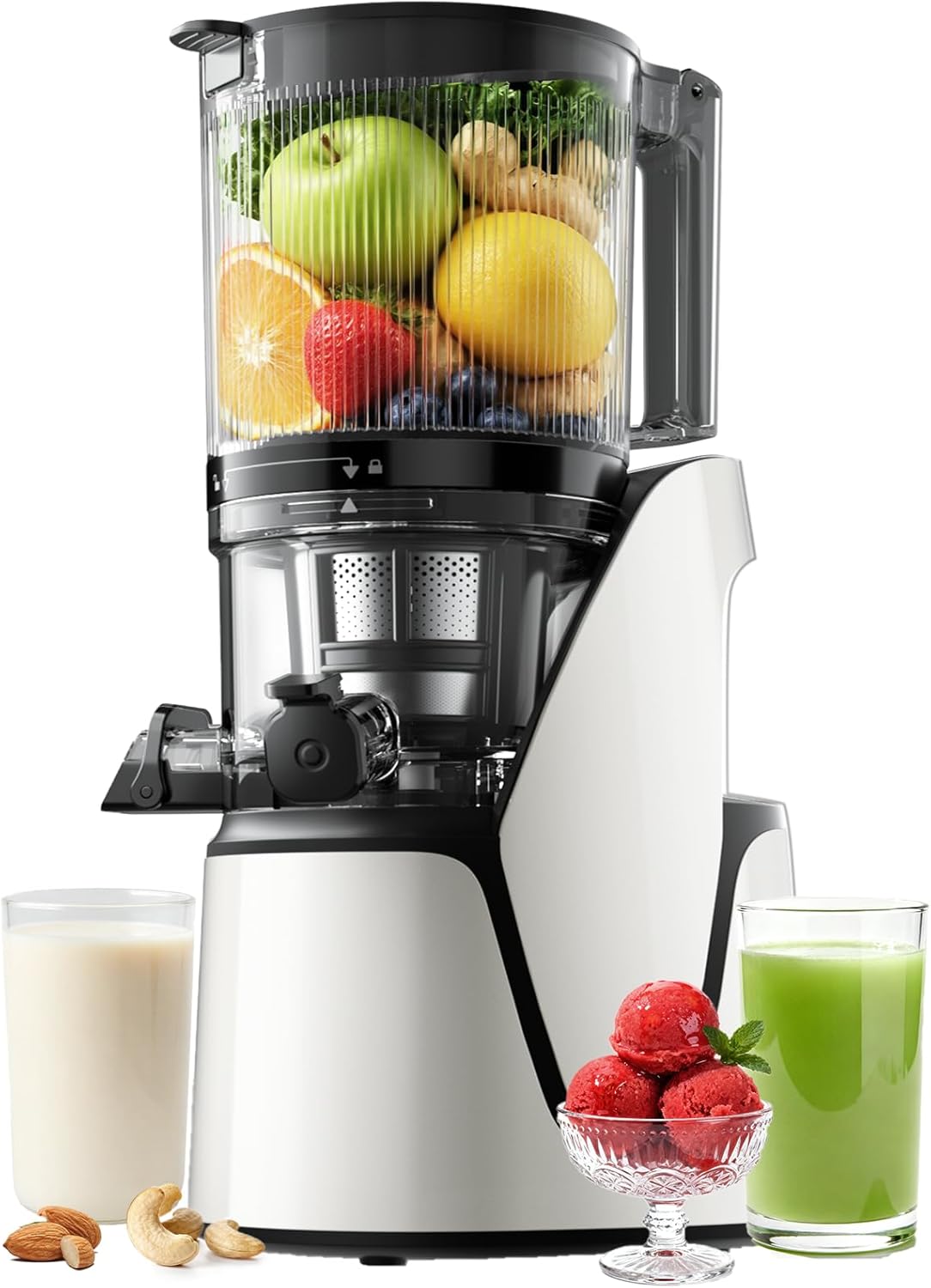
| Maximum Power | 250 watts |
|---|---|
| Power Source | AC |
| Voltage | 110 volts |
| Capacity | 100 fluid ounces |
This single-augur masticating juicer is built for high-volume home or light commercial use, offering a 6.5-inch wide chute and a 100 oz hopper so you can feed whole fruits and large batches with less prep and fewer refills. It runs on a 250 W AC brushless motor designed for steady, high-yield extraction and includes two strainers to switch between juice and sorbet plus parts for nut milk, making it genuinely versatile. Auto-reverse and overheat protection help prevent jams and protect the motor during continuous runs, and most removable parts are hand-washable for straightforward cleaning. Practical limits are that it is a single-auger unit rated at 250 watts, so heavy nonstop commercial duty at a busy juice bar may push it harder than industrial models, and plastic components mean buyers should expect wear over time under heavy use. For risk-averse buyers the included safety features and straightforward maintenance make it an easy-to-understand option, but those needing true commercial throughput should compare to higher-power, metal-built machines.
Best for: Shops or small-scale operators who prioritize reliability and easy, low-prep batch juicing with safe, straightforward operation rather than maximum industrial throughput.
Less Ideal for: High-volume juice bars that require nonstop commercial-grade metal-built machines and higher horsepower for continuous peak output should look at heavier-duty commercial models.
- Extra-wide 6.5-inch chute accepts whole fruits to reduce prep time
- 100 oz hopper lets you process large batches with fewer refills
- Auto-reverse and overheat protection reduce jams and protect the motor
- Includes juice and sorbet strainers plus nut milk components for multi-function use
- Quiet AC brushless motor provides steady extraction with good nutrient yield
- 250 W single-auger design is less suited to continuous heavy commercial throughput
- Major components and blades are plastic which may wear faster under heavy daily use
Verdict: A versatile, safety-minded cold-press juicer that reduces prep time and handles large batches, making it a good fit for low- to mid-volume commercial settings looking for reliable, easy operation.
Choosing the Right Commercial Juicer for Juice Bars: Key Factors to Consider
Throughput Capacity
Throughput determines how many drinks you can serve during peak periods. For a busy juice bar you want a machine rated for continuous operation and capable of producing enough liters per hour to match your busiest shifts. Underestimating required throughput leads to long service times, longer customer waits, and pressure on staff.
Consider both the machine's rated liters or cups per hour and how it performs with dense produce such as beets or carrots. Some machines maintain near-rated throughput across a range of produce; others slow down significantly when handling fibrous items.
Extraction Yield
Yield affects your cost of goods and flavor consistency. Higher extraction yield means you get more juice from the same weight of produce, lowering raw ingredient waste and improving margins. Yield also influences drink texture and concentration, which matters for signature recipes.
Look for machines that report juice yield for common items and that are known to minimize foam and oxidation. Machines that compact pulp thoroughly will usually return better usable juice volume.
Ease of Cleaning and Sanitization
Cleaning frequency is often the limiting factor in maintaining service speed. Machines that disassemble into a few large parts and avoid tiny crevices reduce labor time and contamination risk. Quick, tool-free teardown is ideal when you need to clean between menu changes or shifts.
Also evaluate how easy it is to rinse pulp out and to access sealing surfaces. Materials that tolerate frequent washing and sanitizing without degrading are important for long life and food-safety compliance.
Durability and Corrosion Resistance
Commercial juicers operate in a wet, acidic environment that can prematurely wear inferior components. Stainless steel housings, food-grade plastics that resist staining, and reinforced feed mechanisms increase longevity. Durable motors and robust gearing reduce the chance of midshift failures.
Check that wear parts are made from replaceable, hard-wearing materials and that seals and bearings are specified for frequent cycling and acidic contact.
Serviceability and Parts Availability
Even the most reliable machines need routine maintenance. Fast access to replacement screens, gaskets, and drive components minimizes downtime. Machines designed for easy field servicing let staff replace common wear parts quickly without returning a unit to a workshop.
Consider how straightforward it is to source parts locally or through an authorized network, and whether basic repairs can be performed with commonly available tools.
Noise, Vibration, and Operator Comfort
Noise and vibration impact staff comfort and the guest experience in an open juice bar. Machines with excessive noise may require special placement or dampening. Reduced vibration lowers stress on fasteners and bearings, improving longevity.
Assess operational sound levels and whether the machine requires anti-vibration mounts or isolation pads to stay stable on a service counter.
Commercial Vs. Residential Units: Why It Matters
Commercial juicers are engineered for prolonged cycles and higher daily throughput than residential models. They use heavier-duty motors, reinforced feed systems, and materials chosen to withstand continuous acidic contact. Choosing a commercial-grade unit prevents frequent breakdowns and keeps service consistent during busy periods.
Commercial units can also differ in how they manage pulp and foam, which affects juice clarity and yield. While residential machines may be tempting for their compact size, they often lack the cooling, sealing, and service features needed in full-shift operation.
- Commercial units prioritize continuous runtime and repairability.
- Design differences affect yield, foam, and pulp dryness.
- Service-friendly layouts reduce long-term operating cost.
Installation and Space Planning
Plan the juicer location to allow easy access for loading, juice collection, and daily teardown. Leave clearance for lid removal and part separation, and position the machine near a drain or prep sink if possible to speed cleaning.
Consider power requirements and ventilation. Many commercial juicers draw higher continuous current than home appliances and benefit from dedicated circuits. Also account for weight and mounting needs; some high-throughput machines need bolting to a counter or secure anti-vibration pads.
- Allow extra counter space for preprocessing produce and for pulp bins.
- Check electrical specs and provide appropriate outlets.
- Plan for wastewater and sanitizing workflows nearby.
Daily Workflow: From Prep to Cleanup
A smooth daily workflow minimizes labor and keeps service times short. Set a consistent routine for produce prep, feeding the juicer, transferring juices into holding containers, and clearing pulp. Staff training on optimal feed rates and common jams will reduce stoppages.
Scheduled short clean cycles during lulls help prevent buildup. Keep spare parts like extra screens and gaskets on hand to swap quickly and resume service, and use designated sanitizing stations to avoid cross-contamination.
- Standardize prep sizes to avoid unexpected jams.
- Train multiple staff on teardown and reassembly.
- Keep spare wear parts and cleaning tools in a labeled kit.
Produce Selection and Processing Tips
Different fruits and vegetables respond differently in commercial juicers. Leafy greens and wheatgrass often need a slower, more delicate approach to avoid clogging, while hard roots require robust feed mechanisms. Pre-cutting produce to uniform sizes speeds throughput and reduces motor strain.
Rotate menu items to match seasonal produce and to avoid excessive wear from one type of ingredient. For high-fiber loads, consider batching similar items to optimize screen life and cleanup cycles.
- Pre-cut dense roots and hide large cores before juicing.
- Use separate prep containers to avoid cross-flavor contamination.
- Monitor screen condition when running fibrous items continuously.
Maintenance Schedule and Long-Term Care
A preventive maintenance schedule keeps a machine running reliably. Weekly inspections of seals, bearings, and screens catch wear before failure. Lubricate moving parts if the manufacturer recommends it and replace seals on a routine basis based on hours of operation.
Keep a maintenance log with run hours and replaced parts to forecast service needs and budget for inevitable wear items. Regular professional servicing once or twice a year will extend the life of a high-use commercial juicer.
- Track run hours to time seal and bearing replacements.
- Keep an inventory of frequently replaced parts on site.
- Schedule periodic professional inspections for drive and motor health.
How We Chose the Best Commercial Juicer for Juice Bars
We focused on factors that matter in a high-volume juice bar environment: continuous throughput capacity, extraction efficiency and yield, durability of wet components, speed and simplicity of cleaning between shifts, and access to service parts for fast repairs. We screened for machines designed for extended run times and for materials that tolerate frequent acidic exposure. Performance metrics included realistic throughput measured in liters or cups per hour and average yield for common produce types. We also prioritized machines with straightforward disassembly and few crevices that trap pulp to reduce cleaning time and cross-contamination risk. Excluded from consideration were single-serve, personal, or low-capacity countertop models that cannot sustain commercial service, plus units with obvious maintenance complexity or proprietary parts that limit field repair. The final selections emphasize machines that balance high extraction rate with manageable cleaning and maintenance needs so operators can keep a juice bar running with minimal interruptions.
Our full evaluation process is outlined in our review methodology.
FAQ
How do I choose the right capacity for a juice bar?
Estimate average and peak hourly demand, then choose a machine rated above your peak to avoid bottlenecks. Factor in downtime for cleaning and any menu items that require slower extraction. If in doubt, select a slightly higher throughput model to provide headroom.
How often should commercial juicers be sanitized during service?
Sanitizing frequency depends on usage and local regulations, but at minimum sanitize all food-contact parts daily and perform quick rinses between heavy batches. For high-traffic shifts, schedule short clean cycles during lulls and a full teardown at shift end.
What maintenance items should I stock for a juice bar machine?
Keep spare screens, gaskets, seals, and a basic tool kit on hand. Also stock a small supply of motor brushes if the design uses them and a spare pulp bin. Having common wear parts available reduces downtime.
Can a commercial juicer handle leafy greens and wheatgrass?
Many commercial units can process leafy greens, but performance varies. Some designs handle leafy produce better with reduced clogging and more consistent yield. Test processing methods and consider batching greens separately to manage pulp and screen wear.
Are there special electrical requirements for commercial machines?
Commercial juicers may require dedicated circuits and higher amperage than residential outlets. Verify the unit's electrical specifications before installation and consult an electrician to ensure safe, code-compliant wiring.
Final Verdict
Choosing the right commercial juicer for a juice bar comes down to matching throughput and yield to your daily demand while minimizing cleaning and maintenance time. Prioritize machines designed for continuous operation, with easy teardown, replaceable wear parts, and corrosion-resistant materials. Balance higher upfront durability against routine maintenance needs and ensure staff are trained to perform quick clean cycles to keep service moving. Assess your busiest hour volume first, then choose a machine that offers modest headroom and straightforward serviceability so you can maintain consistent quality with minimal downtime.