
Note: This article contains affiliate links. If you click on these links and make a purchase, we may earn a small commission at no extra cost to you. This helps support our research and content. Read our full affiliate disclosure here.
If you run a cafe, juice bar, or catering operation, a Commercial Juicer can make or break service speed and product consistency. The right unit handles continuous extraction, minimizes downtime for cleaning, and delivers stable yields from a variety of produce. This guide shortlists six well-suited commercial juicers chosen for durability, throughput, and real-world maintenance demands. You will get clear evaluation criteria and practical notes to help match a model to your daily volume and sanitation constraints. Next, we lay out the key factors that affect performance and usability, then present our top picks and why each suits specific high-volume workflows.
Top Picks at a Glance
| Best Overall The best all-around choice for most situations | Waring Pulp Eject Juice Extractor |  |
| Best Quality Built to a higher standard if you want something more solid | Waring WJX80 Juice Extractor |  |
| Best Budget The cheapest option that still gets the job done reliably | LIYUANJUN Commercial Centrifugal Juicer |  |
| Top Rated A top-rated pick with lots of positive feedback | Sunkist J-1 Commercial Juicer |  |
| Most Popular A crowd favorite that many people choose with confidence | Eurolux Cast Iron Juicer ELJ-5001B |  |
| Best Seller A high-volume bestseller chosen again and again | Hamilton Beach Commercial 932 Juicer |  |
Waring Pulp Eject Juice Extractor

| Maximum Power | 1.2 hp |
|---|---|
| Wattage | 1000 watts |
| Voltage | 120 volts |
| Number of Speeds | 1 |
| Capacity | 12 quarts |
The Waring Pulp Eject Juice Extractor is a commercial-grade centrifugal juicer built for high-volume operations. It uses a 1.2 horsepower brushless induction motor running at 3,600 RPM to process whole fruit and vegetables through a 3.15-inch feed chute, which cuts prep time by allowing larger pieces to be loaded intact. A stainless-steel filter basket and shredder disc work to maximize juice yield while ejecting pulp into a 12-quart container so the machine can run for extended periods without constant emptying. The powder-coated die-cast metal housing and stainless components feel durable for restaurant and juice-bar environments, and a manual thermal protection reset helps prevent motor damage from overloads. Practical limits include a single speed, so it is optimized for centrifugal-style juicing rather than delicate cold-press extraction, and hand-wash-only parts mean cleanup requires time compared with some dishwasher-safe commercial models. For busy front-of-house or back-of-house operations that need fast throughput and robust construction, this machine delivers reliable performance.
Best for: Operators who need a dependable, high-throughput centrifugal juicer for busy juice bars, restaurants, or catering where speed and durability matter more than cold-press extraction.
Less Ideal for: Small home users, low-volume operators, or anyone seeking a cold-press or multi-speed juicer for delicate produce or quieter, easier cleaning options should look elsewhere.
- Powerful 1.2 HP brushless induction motor for sustained commercial use
- Wide 3.15-inch feed chute reduces prep time by fitting large fruits and vegetables
- 12-quart pulp container supports extended continuous operation
- Stainless-steel filter basket and shredder disc designed to maximize juice yield
- Durable powder-coated die-cast metal housing built for heavy use
- Single speed operation limits control compared with multi-speed or masticating juicers
- Parts require hand washing which increases cleanup time
- Relatively large and heavy, so it needs a dedicated counter space
Verdict: A rugged, high-throughput centrifugal juicer built for commercial kitchens that need fast, continuous juice production.
Waring WJX80 Juice Extractor

| Maximum Power | 1000 watts |
|---|---|
| Power Source | Corded Electric |
| Voltage | 120 |
| Capacity | 12 quarts |
The Waring WJX80 is a commercial-grade centrifugal juice extractor built for high-volume juice production in cafes, bars, and foodservice operations. It uses a powerful brushless induction motor (listed as 1.2 HP / 1000 watts) and a stainless steel filter basket and shredder disc to process whole fruits and vegetables quickly while ejecting pulp continuously into a separate container. Typical use is continuous back-to-back juicing where speed and yield matter more than very fine extraction; the snap-up spout and removable blade speed up service and basic maintenance, and the included cleaning brush and dishwasher-safe parts reduce downtime. Practical benefits include robust stainless steel construction that stands up to heavy use and a design focused on throughput and easy pulp disposal. Limitations are the centrifugal method itself, which produces more foam and slightly lower yield on leafy greens compared with masticating models, and the unit is large and loud compared with home machines, so it is best suited to commercial spaces with room for a dedicated juicer.
Best for: Operators who need a durable, high-throughput juicer for busy foodservice settings and prioritize speed, uptime, and simple pulp management.
Less Ideal for: Small cafes, home users, or operators who prioritize maximum yield from leafy greens and ultra-quiet operation should consider other styles of juicers.
- Powerful 1.2 HP (1000 W) brushless induction motor for continuous commercial use
- Stainless steel filter basket and shredder disc designed for higher juice yield and durability
- Continuous pulp-eject system reduces interruptions during high-volume production
- Removable blade and snap-up spout speed servicing and simplify cleaning
- Centrifugal extraction yields more foam and lower efficiency on leafy greens than masticating juicers
- Large footprint and industrial noise level make it unsuitable for small or quiet spaces
Verdict: Choose the Waring WJX80 when you need a rugged, high-speed centrifugal juicer built to handle continuous commercial service and easy pulp ejection.
LIYUANJUN Commercial Centrifugal Juicer

| Power | 370 watts |
|---|---|
| Speed | 2800 RPM |
| Voltage | 110V 60Hz |
| Noise | 30-40dB |
| Material | Aluminum, Stainless Steel |
This LIYUANJUN commercial centrifugal juicer is built for frequent use, with an aluminum and stainless steel body and a 370W pure copper motor that spins at about 2800 RPM to extract juice quickly. It separates juice from pulp automatically and claims roughly 75% yield, which is useful in busy settings like small juice bars, cafes, or households that make large batches. A deep feed chute reduces prep time for larger fruit pieces and the machine offers multiple juice outlet positions for flexible pouring. Practical notes: it is loud enough to expect during high-speed operation despite the listed 30–40 dB, and the manufacturer recommends resting the motor after about 20 minutes of continuous use to protect longevity. It is not suitable for very hard items like sugarcane or soft, low-juice fruits such as bananas, and pits must be removed. Cleaning and assembly are straightforward thanks to its removable parts, but its commercial construction makes it heavier than domestic models. Overall, it is a no-frills, heavy-duty extractor aimed at efficiency and durability rather than quiet or specialty juicing.
Best for: Buyers looking for a budget-minded commercial-style juicer that prioritizes throughput and durability for small commercial operations or busy home kitchens.
Less Ideal for: Shoppers who need a quiet, specialty cold-press/masticating juicer or who plan to juice very hard items like sugarcane or mostly soft fruits should look elsewhere.
- Robust stainless steel and aluminum construction for commercial durability
- 370W pure copper motor with ~2800 RPM for fast extraction
- Deep feed chute reduces chopping and speeds prep
- Automatic separation of juice and pulp yields drier pulp and higher juice yield
- Multiple juice outlet positions for flexible pouring and setup
- Not suitable for very hard items like sugarcane or for very soft, low-juice fruits
- Requires cooling/rest breaks after extended continuous use to protect the motor
Verdict: A rugged, no-frills commercial centrifugal juicer that delivers fast, high-yield extraction for budget-conscious buyers who need reliable throughput.
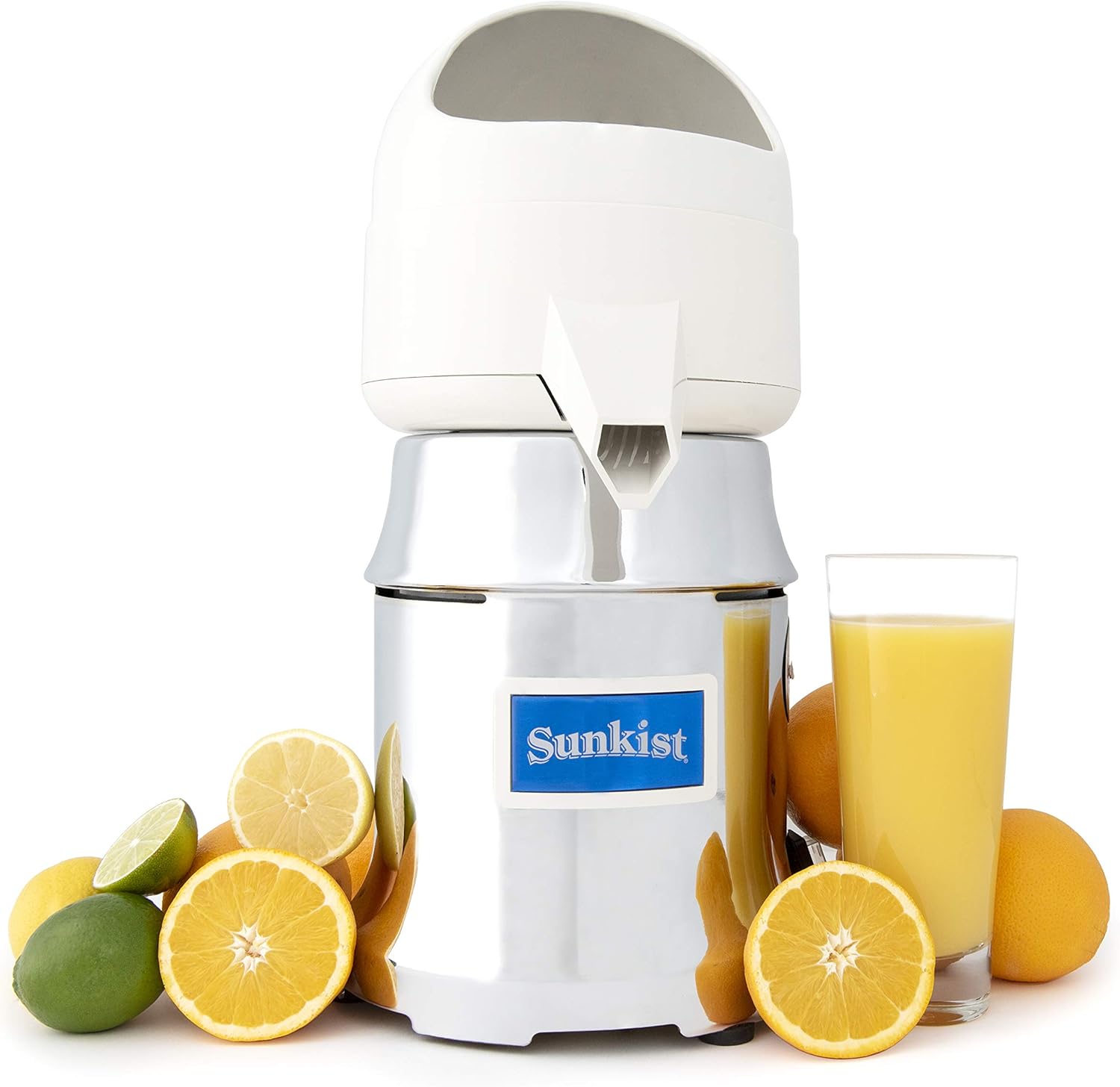
Sunkist J-1 Commercial Juicer
| Wattage | 200 watts |
|---|---|
| Power Source | Corded Electric |
| Material | Chrome-plated steel, Corrosion-proof white plastic |
| Blade Material | Stainless Steel |
| Capacity | 20 gallons |
The Sunkist J-1 is a commercial-grade citrus press built to produce juice quickly and reliably in busy environments. It uses a 200-watt motor and three interchangeable extracting bulbs to handle different citrus sizes, and its chrome-plated steel and corrosion-proof plastic construction make it durable for frequent use. The unit is effectively portable for moving between prep stations and the parts that contact juice are dishwasher safe, which speeds cleanup during long shifts. With a stated 20-gallon capacity and stainless steel blade components, this press is aimed at continuous extraction rather than occasional home use. Expect straightforward operation: place fruit on the bulb, activate the motorized press, and collect juice from the spout. The trade-offs are its professional scale and weight, which make it less convenient for small kitchens, and the machine focuses solely on citrus so it will not replace multipurpose juicers. For cafes, bars, and concession stands that need a dependable citrus-only extractor, the Sunkist J-1 delivers consistent output and easy maintenance.
Best for: Operators who prioritize a rugged, purpose-built citrus extractor for steady, high-volume juice production in commercial settings.
Less Ideal for: Individuals seeking an all-in-one juicer for occasional home use or those who need to process non-citrus produce.
- Commercial-grade chrome-plated steel and corrosion-proof plastic construction for durability
- 200-watt motor with three interchangeable bulbs to fit multiple citrus sizes
- Dishwasher-safe juice-contact parts for faster cleaning between shifts
- Portable design suitable for moving around busy workstations
- Designed specifically for citrus so it cannot process other fruits or vegetables
- Professional size and capacity make it impractical for typical home kitchens
Verdict: Buy this if you need a dependable, commercial-grade citrus press that delivers consistent high-volume extraction and easy cleanup.
Eurolux Cast Iron Juicer ELJ-5001B

| Material | Stainless Steel Cast Iron |
|---|---|
| Capacity | 15 ounces |
| Power Source | Manual |
| Special Features | Easy to Clean, Portable, Rust Resistant |
The Eurolux cast iron juicer is a commercial-style manual press built for high-volume citrus and pomegranate juicing. It uses a long lever and heavy cast iron frame to deliver strong pressing force so you get more juice with less wrist effort, and the removable stainless steel cup collects up to the unit capacity. Parts that contact fruit are removable for cleaning and many are dishwasher-safe, while suction feet on the base help keep the press stable during use. Practical benefits include quick single-handed operation, a durable metal construction that tolerates frequent use, and a substantial weight that reduces movement while pressing. The trade-offs are that it is large and heavy compared with small handheld reamers, and it occupies countertop space; the 15-ounce capacity means you empty the cup frequently during long juicing sessions. This model is best when you need a reliable, no-power commercial-style press that minimizes manual squeezing effort rather than a compact or electric juicer.
Best for: Buyers who want a durable, no-electricity juicer for frequent or commercial-style citrus and pomegranate pressing and who prioritize extraction power and stability over compact size.
Less Ideal for: People seeking a lightweight, compact, or electric juicer for occasional home use or those who need a larger built-in collection capacity.
- Heavy cast iron construction built for continuous, commercial-style juicing
- Lever-operated press delivers strong extraction with reduced manual effort
- Removable stainless steel cup and fruit-contact parts for easier cleaning
- Suction feet provide stability during use to prevent sliding
- Large and heavy footprint makes it less portable or space-efficient
- 15-ounce cup requires frequent emptying during high-volume juicing
Verdict: Choose this heavy-duty manual press when you need a stable, commercial-grade juicer that delivers strong, efficient extraction without electricity.
Hamilton Beach Commercial 932 Juicer

| Power Source | Manual |
|---|---|
| Wattage | 800 watts |
| Capacity | 8 fluid ounces |
| Material | Metal |
The Hamilton Beach Commercial 932 is a robust, manual citrus extractor built for frequent use in restaurants and busy kitchens. Its lever arm delivers very high force to squeeze maximum juice with minimal pulp and oil, while the removable stainless-steel strainer cone and funnel make rinsing and sanitizing straightforward. Metal construction and an enamel finish resist corrosion from citrus acids, and nonslip Sure Grip feet keep the unit stable during repeated extraction. Because it is manual, the 932 needs no power hookup and avoids motor maintenance, but it does require physical effort and counter space; the unit is substantial and intended to sit in a prep area rather than be tucked away. NSF certification and heavy-duty gears mean it meets commercial hygiene and durability expectations, though cleaning still involves disassembly and hand washing. For kitchens that need reliable, high-output citrus juicing without electrical components, the 932 is a practical workhorse.
Best for: Buyers who prioritize reliable, factory-quality performance and hygiene for a commercial or high-volume home setup and prefer a durable, serviceable machine over an electric model.
Less Ideal for: Those who need a compact, lightweight countertop appliance or want fully automatic, hands-free juicing should consider motorized juicers instead.
- Commercial-grade metal construction resists acid corrosion for long life
- High-leverage arm delivers strong extraction for maximum juice yield
- Removable stainless-steel strainer cone and funnel for easier cleaning and sanitizing
- NSF certification and heavy-duty gears suited for foodservice use
- Sure Grip feet keep the juicer stable during operation
- Requires manual effort for each extraction since it has no motor
- Hand wash only parts; not dishwasher-safe
Verdict: Choose the 932 when you need a proven, NSF-certified manual juicer that delivers durable, high-yield extraction for commercial use.
Choosing the Right Commercial Juicer: Key Factors to Consider
Throughput and Duty Cycle
Throughput measures how much produce a machine can handle per hour and is critical for commercial settings. Higher throughput reduces wait times and helps maintain steady service during peak periods.
Duty cycle describes how long the motor can run before it needs a cooldown. A unit with a longer duty cycle or continuous-run rating is essential for cafes and bars that operate several hours without breaks, while lower-rated machines risk overheating and service interruptions.
Build Materials and Construction
Stainless steel construction and heavy-gauge components generally hold up better under continuous use and resist corrosion from acidic juices. Metal feed chutes, augers, and strainers are less likely to warp or crack than plastic alternatives.
Look for models with robust bearings and sealed motors to protect against moisture and particulate ingress. Solid construction reduces unexpected downtime and lowers the frequency of major repairs, which is important where replacement units would disrupt service.
Yield and Extraction Consistency
Yield consistency affects margins and flavor. Machines that extract more liquid and less waste from the same quantity of produce improve cost-efficiency and reduce prep volume.
Different extraction methods and screen designs perform variably across soft fruits, leafy greens, and hard roots. Consider how consistent the juice output is over a long run, not just on single shots, because pulsed or clog-prone units can lower effective throughput.
Serviceability and Parts Availability
Commercial equipment should be easy to service in-house or by a technician. Quick access to common wear parts such as seals, blades, and screens shortens repair times.
Availability of replacement parts and clear service documentation are vital. Units designed with modular components and tool-free disassembly reduce labor costs for routine repairs and keep a busy business running with minimal downtime.
Cleaning, Sanitation, and Compliance
Sanitation is non-negotiable in foodservice. Look for machines with removable parts that can be fully disassembled, cleaned, and reassembled easily. Smooth surfaces and minimal crevices help prevent residue buildup.
Consider whether parts are dishwasher-safe or require manual cleaning, and how long cleaning cycles take. Faster, simpler cleaning procedures reduce labor time and help meet health-code requirements without cutting into service hours.
Noise, Vibration, and Placement Needs
Noise and vibration impact staff comfort and customer experience, especially in open-concept spaces. Heavier-duty machines often isolate vibration better, but larger motors can still produce significant sound.
Plan machine placement to balance workflow efficiency and acoustics. Anti-vibration feet and rubber mounts can reduce noise transfer, and understanding footprint and ventilation needs prevents heat-related issues in busy kitchens.
Types of Commercial Juicers and Which Work Best
Commercial juicers fall into broad categories such as centrifugal, masticating (slow), and hydraulic or press systems, each with pros and cons for commercial use. Centrifugal units excel at speed with high throughput for firm fruits, while masticating systems often yield more juice from leafy greens and have gentler extraction for improved flavor stability.
- Centrifugal: Fast throughput, good for high-volume simple fruit juicing.
- Masticating: Better yields for greens and softer produce, often quieter.
- Hydraulic/press: Best yields and clarity, but larger footprint and slower cycle times.
Maintenance Routines That Keep a Unit Running
Establish a daily, weekly, and monthly maintenance schedule to extend service life. Daily tasks typically include disassembly of food-contact parts for cleaning, inspection of seals and screens, and quick motor checks. Weekly checks can cover blade sharpness and more detailed inspections for wear, while monthly tasks should include bearing lubrication where specified and verification of electrical connections.
- Daily: Rinse and sanitize removable parts, check seals.
- Weekly: Inspect wear components and screens, test motor load.
- Monthly: Lubricate service points, tighten fasteners, verify safety interlocks.
Optimizing Workflow Around a Juicer
Design the juicing station to minimize handling and waste. Position prep, juicing, and serving areas in sequence so ingredients flow in a single direction. Use designated bins for peels and pulp to accelerate disposal and avoid cross-contamination. Train staff on loading techniques that reduce clogs and on signs that indicate a unit is approaching overload. Having a basic troubleshooting checklist at the station helps staff resolve minor stoppages rapidly without escalating to service calls.
- Place prep, juicing, and service stations in a linear workflow.
- Use color-coded bins and utensils to maintain sanitation.
- Provide quick-reference troubleshooting for common clogs.
Energy Use and Ventilation Considerations
Commercial juicers can draw significant power, especially when rated for continuous operation. Verify that the electrical supply and circuit protection in your location match the unit's requirements to avoid tripped breakers during busy periods. Adequate ventilation prevents heat buildup around the motor and helps maintain electrical performance. Units with higher duty cycles may need more clearance and airflow, so plan installation with manufacturer ventilation recommendations in mind.
- Confirm electrical circuit capacity and wiring before installation.
- Allow recommended clearances for ventilation and heat dissipation.
- Consider peak-power demands if multiple appliances share circuits.
Pulp Handling and Waste Management
High-volume juicing generates substantial pulp that must be handled efficiently. Some units expel dry pulp that is easier to compost or transport, while others produce wetter waste needing more frequent disposal. Assess how the pulp output fits your waste-management plan. Larger operations may integrate a dedicated collection system or link pulp to composting workflows, while small operators should prioritize compact, easy-to-empty containers.
- Dry pulp reduces disposal frequency and cost.
- Designate collection bins that fit your service cadence.
- Plan for staff routines to empty pulp without interrupting service.
How We Chose the Best Commercial Juicer
We prioritized attributes that matter in high-volume foodservice settings where reliability and throughput directly affect operations. Our selection filters emphasized build quality and component longevity, measured capacity for continuous juicing, and serviceability for quick maintenance. We checked specification sheets and typical use-case data to gauge motor and feed-system robustness, then screened for cleaning access and parts replacement simplicity. Noise and vibration levels were considered for open-kitchen environments where staff comfort and customer experience matter. Exclusions included consumer-grade and countertop-only models not designed for continuous operation, units with unclear parts availability, and devices lacking removable components needed for thorough sanitation. The final picks balance sustained throughput, ease of cleaning, spare-parts accessibility, and consistent extraction across fruit and vegetable types.
Our full evaluation process is outlined in our review methodology.
FAQ
How often should I replace wear parts like screens or seals?
Replacement frequency depends on throughput and produce types but often falls between three months and a year in heavy use. Inspect wear parts weekly for visible damage or deformation, and maintain a small stock of commonly replaced items to reduce downtime.
Can commercial juicers handle leafy greens and wheatgrass?
Many commercial masticating and hydraulic systems handle leafy greens well and yield more juice than centrifugal units. However, performance varies by design, and continuous runs with high volumes of greens may require models specified for that produce type.
What sanitation steps are required between service shifts?
At minimum, remove and wash all food-contact parts, sanitize surfaces, and run a brief motor check. Deeper cleaning that disassembles strainers and feed components should happen daily or as required by local health codes.
Are commercial juicers noisy to operate in open seating areas?
Noise varies widely. Masticating machines tend to be quieter than high-speed centrifugal units, but larger motors still generate sound. Consider acoustic dampening and placement away from seating when possible.
Do commercial juicers need special electrical circuits?
Some models require dedicated circuits due to higher current draw, especially those rated for continuous operation. Verify the unit's electrical specifications and consult an electrician if you are unsure about your current setup.
Final Verdict
Choosing the right Commercial Juicer means balancing throughput, yield, and maintenance needs against your daily service patterns. Prioritize units with the duty cycle and parts accessibility that match your busiest shifts, and plan for straightforward cleaning workflows to meet sanitation requirements. With a clear understanding of throughput needs and serviceability, you can select a machine that minimizes downtime and supports consistent juice quality.