
Note: This article contains affiliate links. If you click on these links and make a purchase, we may earn a small commission at no extra cost to you. This helps support our research and content. Read our full affiliate disclosure here.
Choosing the right compact all-in-one printer for home use matters because it determines how smoothly you handle daily tasks like homework, receipts, occasional photos, and document scanning. A small footprint is helpful, but you also need dependable print quality, straightforward wireless setup, and economical ink or toner to keep running costs reasonable. This guide shortlists the top compact all-in-one printers for home use so you can quickly find a machine that fits your desk, workflow, and connectivity needs. We evaluated candidates on print and scan performance, setup and connectivity, and operating costs to identify reliable options for typical household workloads. Read on for the practical tradeoffs and features to prioritize before you buy.
Top Picks at a Glance
| Best Overall The best all-around choice for most situations | Brother Work Smart 1360 MFC-J1360DW | 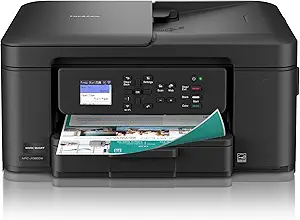 |
| Best Quality Built to a higher standard if you want something more solid | Epson Expression Premium XP-7100 |  |
| Best Value The sweet spot between price and what you get | Epson EcoTank ET-2800 |  |
| Best Budget The cheapest option that still gets the job done reliably | HP DeskJet 2955 All-in-One Printer |  |
| Top Rated A top-rated pick with lots of positive feedback | Canon PIXMA TS6520 |  |
| Most Popular A crowd favorite that many people choose with confidence | Canon PIXMA TR4720 |  |
| Best Seller A high-volume bestseller chosen again and again | Brother DCP-L2640DW Laser All-in-One |  |
Brother Work Smart 1360 MFC-J1360DW

| Printer Type | Inkjet |
|---|---|
| Print media | Envelopes, Glossy photo paper, Paper (plain) |
| Scanner Type | Flatbed, Sheetfed |
| Duplex | Automatic |
| Printer Connectivity Type | USB, Wi-Fi |
The Brother Work Smart 1360 is a space-conscious all-in-one inkjet aimed at home and small home-office use. It handles everyday tasks—printing documents, copying, and flatbed or ADF scanning—while offering wireless printing, USB connectivity, and cloud/phone integration through Brother Mobile Connect. Notable features include automatic two-sided printing, a 20-sheet single-sided automatic document feeder, and a 150-sheet input tray that reduce trips to reload paper. Print speeds are competitive for the class, rated up to 16 ppm black and 9 ppm color, and Page Gauge and ink subscription options make keeping replacement cartridges easier. Image quality is good for reports, flyers, and casual photo prints using Brother LC501 inks, though color photo fidelity will not match photo-dedicated machines. Setup and mobile printing are straightforward, but expect ongoing ink costs typical of color inkjets and occasional driver or app quirks depending on your device. For buyers wanting a compact multifunction that balances features, connectivity, and footprint, the Work Smart 1360 covers the essentials without extra bulk.
Best for: Buyers who want a compact, feature-balanced all-in-one for home or a small home office that prioritizes easy mobile/cloud printing and basic productivity features over premium photo quality.
Less Ideal for: If you need professional-grade photo output, very high monthly page volumes, or a larger touchscreen interface, consider a dedicated photo printer or higher-end office model instead.
- Automatic duplex printing for two-sided documents
- 20-sheet automatic document feeder plus flatbed scanner for mixed scanning tasks
- Wireless, Wi‑Fi Direct and USB connectivity with mobile app support
- 150-sheet paper tray reduces how often you reload paper
- Compact footprint suited to small desks or home offices
- Uses standard color ink cartridges so color printing can be relatively costly over time
- 1.8" color display is small compared with touchscreens on higher-end models
Verdict: A compact, well-rounded all-in-one that delivers convenient wireless printing, automatic duplex, and basic office features for most home users.
Epson Expression Premium XP-7100

| Printer Type | Inkjet |
|---|---|
| Print Resolution | 4800 dpi |
| Maximum Copy Speed Black and White | 15.8 pages_per_minute |
| Printer Connectivity Type | Wireless |
| Duplex | Automatic |
The Epson Expression Premium XP-7100 is a compact home all-in-one that balances everyday document printing with good photo output. It prints using a five-color Claria Premium ink set and supports borderless photos up to 8 x 10 inches while offering automatic two-sided printing and a 30-page auto document feeder for multi-page jobs. The 4.3-inch touchscreen, SD card slot and USB support let you print photos directly without a computer, and wireless plus Ethernet connectivity includes Wi-Fi Direct for easy mobile printing. For text documents it delivers reasonable speed and sharp black output, and for images it reaches high optical resolution settings for detailed color prints. Downsides are modest photo print speed in high-quality modes and reliance on Epson Genuine cartridges for best results, which raises operating costs over time. The XP-7100 is a small, versatile unit best suited to home users who want both photo capability and everyday office features in one machine.
Best for: Home users who need a compact all-in-one that handles both everyday document workflows and occasional high-quality photo printing with convenient mobile and card-based printing.
Less Ideal for: Users who print photos frequently in large volumes or need the fastest photo throughput should consider a dedicated photo printer instead.
- Five-color Claria Premium ink produces vibrant, high-resolution photos
- 30-page auto document feeder and automatic duplex simplify multi-page tasks
- 4.3-inch touchscreen plus SD card and USB let you print photos without a PC
- Wireless, Wi-Fi Direct and Ethernet connectivity support flexible mobile printing
- High-quality photo prints can be slow compared with single-function photo printers
- Best results require Epson Genuine cartridges which increase running costs
Verdict: Choose the XP-7100 if you want a compact home all-in-one that delivers quality photo prints plus practical office features in one machine.
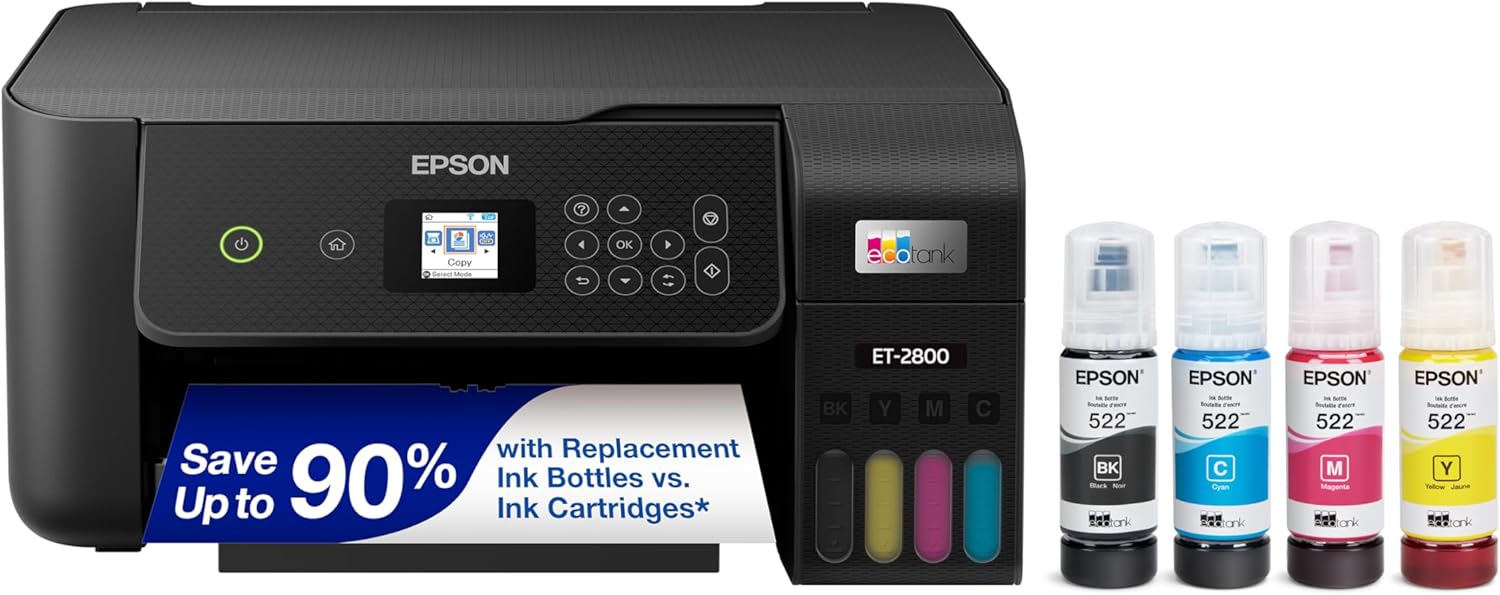
Epson EcoTank ET-2800
| Printer Type | Inkjet |
|---|---|
| Printer Connectivity Type | USB, Wi‑Fi |
| Maximum print Resolution Color | 5760 x 1440 dpi |
| B&W Pages per Minute | 10 |
| Maximum Sheet Capacity | 100 |
The Epson EcoTank ET-2800 is a small all-in-one inkjet designed to cut running costs by replacing cartridges with refillable ink tanks. It prints, scans and copies for everyday home tasks and uses Epson's PrecisionCore/Micro Piezo technology to deliver sharp text and decent color photos at a high maximum resolution. Setup and daily use center on the front-facing tanks and app-based controls for wireless and voice-activated printing, and the included ink bottles are sized to last thousands of pages so you refill infrequently. The ET-2800 handles photos and plain paper, supports borderless 4×6 and 5×7 prints, and offers a 100-sheet capacity for moderate jobs, but it lacks automatic duplexing and an automatic document feeder which slows two-sided or batch scanning. Print speed is modest at about 10 ppm for black and 5 ppm for color, making it better for households that print regularly but not large office volumes. If you want low-cost, low-waste home printing in a compact footprint, this model is a practical pick with a few limitations for heavy multi-page workflows.
Best for: Buyers who want an affordable, low-maintenance home printer that minimizes ongoing ink costs and fits a small desk or shelf while handling occasional photo and document tasks.
Less Ideal for: Users who routinely print or scan long multi-page jobs, need fast two-sided printing, or require advanced office features like an ADF and high duty-cycle performance.
- Cartridge-free high-capacity refillable ink tanks that reduce frequent replacements
- Wireless and app control with voice-activated printing for easy mobile use
- High maximum print resolution for sharp text and detailed photos
- Compact all-in-one design that fits home workspaces
- No automatic duplex printing, so two-sided printing must be manual
- Lacks an automatic document feeder for batch copying or scanning
Verdict: Choose the ET-2800 if you prioritize low ink costs and a compact cartridge-free all-in-one for everyday home printing.
HP DeskJet 2955 All-in-One Printer

| Printer Type | HP Thermal Inkjet |
|---|---|
| Maximum Sheet Capacity | 60 |
| Color Pages per Minute | 5.5 pages_per_minute |
| B&W Pages per Minute | 7.5 pages_per_minute |
| Printer Connectivity Type | Apple AirPrint; USB; Wireless (Wi-Fi); Wireless direct printing; Mopria |
The HP DeskJet 2955 is a small, budget-focused all-in-one designed for basic home printing, copying, and flatbed scanning. It connects via dual-band Wi‑Fi, AirPrint, Mopria, or USB and is controlled through an icon LCD and the HP app for easy mobile printing and scanning. Print speeds are modest — up to about 7.5 ppm black and 5.5 ppm color — and the 60-sheet input tray and manual duplex support suit occasional document jobs rather than heavy use. Notable features include HP AI formatting to clean up web pages and emails, a 3‑month trial of HP Instant Ink for automated cartridge delivery, and an ENERGY STAR certified design using recycled plastics. The printer uses standard HP 68 cartridges, so replacement inks are widely available but recurring ink costs will matter for frequent color printing. Setup and daily use are straightforward, but expect basic copy/scan resolution and no automatic duplexing, so you will trade professional throughput for a compact, inexpensive unit that handles typical home tasks well.
Best for: Someone looking for an inexpensive, space-saving all-in-one to cover light home printing, occasional scans, and mobile printing without extra frills.
Less Ideal for: People who need high-volume output, fast photo-quality printing, or automatic two-sided copying should consider a higher-capacity model instead.
- Compact footprint fits small home desks or shelves
- Wireless printing with AirPrint, Mopria and HP app for phone-based workflows
- Includes 3-month trial of Instant Ink to simplify ink replenishment
- ENERGY STAR certified and built from recycled plastics
- 60-sheet input tray and flatbed scanner for basic home document tasks
- Print speeds and copy/scan resolution are modest compared with higher-end models
- No automatic duplexing; double-sided printing is manual
Verdict: A compact, budget-friendly all-in-one that handles everyday home printing and mobile workflows with minimal footprint and straightforward setup.
Canon PIXMA TS6520

| Printer Type | Inkjet |
|---|---|
| Duplex | Automatic |
| Printer Connectivity Type | USB, Wi-Fi |
| Display Type | OLED |
| Color Pages per Minute | 9 pages_per_minute |
The Canon PIXMA TS6520 is a compact home all-in-one that delivers dependable everyday printing, scanning, and copying without extra complexity. It uses a two-cartridge hybrid ink system to produce sharp text and reasonably vibrant color photos, and supports borderless prints up to letter size. Setup is straightforward via the Canon PRINT app, AirPrint, or Mopria, and dual-band Wi-Fi plus a 1.42 inch OLED status display make routine use and monitoring easy. Automatic two-sided printing helps reduce paper use, and the flatbed scanner handles occasional document or photo scanning tasks. Speed and paper capacity are modest, so it is best for light to moderate home workloads rather than heavy office runs, and it lacks an automatic document feeder for multi-page scanning. For buyers who want a compact, reliable machine for schoolwork, recipes, and home documents, the TS6520 balances print quality and fuss-free operation.
Best for: Home users who prioritize a compact, fuss-free printer that reliably handles occasional documents, school projects, and photo prints with simple wireless setup.
Less Ideal for: People who need high-volume printing, frequent multi-page scanning, or a large input tray for sustained office use should choose a higher-capacity model.
- Auto duplex printing reduces paper usage and speeds two-sided jobs
- Dual-band Wi-Fi and mobile printing support make wireless setup and printing straightforward
- Compact footprint and intuitive 1.42" OLED display fit small home workspaces
- Two-cartridge hybrid ink system yields sharp text and good color for photos
- Single-sheet input capacity and no automatic document feeder limit throughput for multi-page tasks
- Starter ink tanks are small, so ongoing ink replacement may be needed with frequent photo printing
Verdict: A compact, reliable all-in-one that delivers easy wireless printing and solid everyday print quality for home use.
Canon PIXMA TR4720

| Printer Type | Inkjet |
|---|---|
| Print Resolution | 4800 x 1200 |
| B&W Pages per Minute | 8.8 |
| Color Pages per Minute | 4.4 |
| Printer Connectivity Type | USB, Wi-Fi |
The PIXMA TR4720 is a space-conscious 4-in-1 inkjet designed for everyday home printing and light office tasks. It handles printing, copying, scanning and faxing, and the front 100-sheet tray plus automatic duplex and a small auto document feeder make multi-page jobs simpler without needing a larger machine. Canon's hybrid ink system delivers sharp black text and acceptable color photo prints up to letter size, and the 4800 x 1200 maximum resolution gives decent detail for occasional photos. Setup and mobile printing are straightforward using the Canon Print app and Wi‑Fi, and a basic 2-line LCD provides simple controls. Expect modest speeds—about 8.8 ipm black and 4.4 ipm color—so it is best for moderate daily volumes rather than heavy batches. Consumable choices are Canon CL-276 and PG-275 cartridges, and while the unit is energy efficient at low wattage, ongoing ink costs will be the main ownership expense. For buyers who want a compact, feature-rich home AIO, the TR4720 covers core needs without taking much space.
Best for: Buyers who want a compact, do-it-all home printer that is easy to set up, supports mobile printing, and handles occasional photo and document jobs without occupying much space.
Less Ideal for: Users who need fast, high-volume printing or the lowest long-term ink cost should consider business-class or ink-tank alternatives instead.
- All-in-one functionality with printing, scanning, copying and faxing in a compact footprint
- Automatic two-sided printing and a 100-sheet front tray simplify duplex and multi-page jobs
- Auto document feeder for multi-page scans and copies
- Wi‑Fi and Canon Print app make mobile and cloud printing straightforward
- High maximum print resolution (4800 x 1200) for sharper text and better photo detail
- Print speeds are modest, especially for color pages
- Uses cartridge-based ink which can be costly with frequent use
Verdict: A compact, full-featured home all-in-one that balances small size and easy mobile use for everyday document and occasional photo printing.
Brother DCP-L2640DW Laser All-in-One

| Printer Type | Laser |
|---|---|
| Maximum Print Resolution Black and White | 1200 x 1200 dots_per_inch |
| B&W Pages per Minute | 36 pages_per_minute |
| Maximum Sheet Capacity | 250 |
| Printer Connectivity Type | Ethernet, USB, Wi-Fi |
The Brother DCP-L2640DW is a compact monochrome laser multifunction printer designed for home or small office use. It prints up to 36 ppm and produces sharp black-and-white output at up to 1200 x 1200 dpi, while a 50-sheet auto document feeder and 250-sheet tray make multi-page copy and scan jobs convenient. You can connect via dual-band Wi-Fi, Ethernet, or USB and manage printing and scanning from mobile devices using the Brother Mobile Connect app. Practical features include automatic duplex printing to reduce paper use and a toner save mode to stretch consumables. The unit ships with starter toner and accepts Brother TN830/TN830XL cartridges and DR830 drum units for predictable replacement cycles. Trade-offs include monochrome-only output, so it is not suitable for color documents or photos, and the device is a bit heavier and deeper than the smallest desktop ink models, which could matter in very tight spaces.
Best for: Buyers who prioritize reliable, fast black-and-white printing, predictable consumable paths, and straightforward networked setup for a home or small office environment.
Less Ideal for: Anyone who needs color printing, photo output, or the absolute smallest lightweight desktop footprint should consider color inkjet alternatives instead.
- Fast monochrome printing up to 36 ppm for high-volume jobs
- 50-sheet auto document feeder speeds multi-page scans and copies
- 250-sheet input tray reduces how often you refill paper
- Dual-band Wi-Fi, Ethernet, and USB give flexible, secure connectivity
- Automatic duplex printing and toner-save mode help lower running costs
- Prints only in black and white so no color or photo capability
- Larger and heavier than some compact inkjet all-in-ones
Verdict: A dependable, fast monochrome all-in-one that suits risk-averse buyers who want straightforward networking and predictable toner supply for home or small office printing.
Choosing the Right Compact All-in-One Printer for Home: Key Factors to Consider
Print and Copy Performance
Print and copy speed matters because it directly affects how long you wait for homework, forms, or multi-page handouts. Look beyond the fastest number and consider both the first-page-out time and sustained speed for typical small jobs. Document text and mixed-color pages often have different throughput, so choose a model whose published speeds align with the kinds of jobs you run most.
Copy quality is important for household use when duplicating pages or scanning multi-page documents into a single file. Evaluate whether the machine produces crisp black text and legible color graphics at normal draft and standard quality settings, since you will likely use those settings most of the time.
Scan Resolution and Workflow
Scanning performance affects how usable digital copies of receipts, forms, and photos will be. For most home uses, optical scan resolution in the 300 to 600 dpi range is sufficient, but for photos or detailed archival scans higher resolutions can help. Also consider the speed of flatbed scans and whether an automatic document feeder is present for multi-page scanning tasks.
Workflow features like one-touch scan to email or mobile apps, automatic color detection, and simple file format options (PDF, searchable PDF) reduce friction when you need digital copies quickly. Good scanning software and driver compatibility with common home platforms make day-to-day use much easier.
Connectivity and Mobile Printing
Connectivity options determine how easily every household device can send jobs to the printer. Reliable Wi-Fi with strong single-band or dual-band support helps prevent dropped jobs. A printer that supports Apple AirPrint, Mopria, or built-in mobile apps simplifies printing from phones and tablets. Ethernet ports are rarely necessary in purely home setups, but a USB port can be handy for direct connections or initial setup.
Also assess whether the printer offers simple setup routines and clear on-device menus. Guest network printing, PIN-protected printing, and robust Wi-Fi recovery behavior are useful in busy home environments with multiple users and devices.
Consumables and Running Costs
Ink and toner expenses often become the dominant lifetime cost for home printers. Consider page yields for standard and high-yield cartridges and whether cost-effective high-yield or third-party options are widely available. Some compact models use combined color cartridges, which can increase waste because you must replace the entire color pack when one color runs out.
Also look at how easy it is to monitor ink levels and swap cartridges. Machines that support duplex printing and draft modes for everyday documents help reduce paper and ink use, which lowers running costs over time.
Physical Size and Placement
A compact footprint is the main reason to choose this category, but small dimensions can trade off with paper handling and input capacity. Check the printer's depth and height to ensure it fits on shelves or small desks, and verify how much clearance is needed when opening trays or access panels. A folding or integrated paper tray can keep the device compact when idle.
Consider whether you need a front-loading paper path versus a rear tray for specialty media. Placement also affects ease of access for scanning and copying tasks, so prioritize a shape that suits your available space and how you interact with the machine daily.
Noise and Daily Use Comfort
Noise levels matter in a home where people work, study, or sleep in nearby rooms. Compact printers can be louder during warm-up or color printing cycles. Look for models with quieter modes for draft printing or that advertise reduced noise during scanning operations.
Also think about the user interface and control panel readability. Large, responsive touch panels and intuitive physical buttons reduce frustration for less technical users and make routine tasks like copying or rescanning simple.
Best Placement and Setup Tips for Small Spaces
Place a compact all-in-one printer on a stable surface that leaves room for any paper trays to extend and for the scanner lid to open fully. Measure depth and height with trays and the lid open before you commit to a location.
If you plan to use Wi-Fi, position the printer where it gets a strong signal from your router or consider a short wired setup for initial configuration. Keep cords organized and avoid blocking vents to prevent overheating in tight nooks.
- Leave 4 to 6 inches of clearance behind for cable routing.
- Store extra paper and cartridges nearby in a dry spot.
- Avoid stacking items on top of the printer to prevent heat build-up.
Paper Handling and Media Support
Compact models often limit input capacity and specialty media handling. If you occasionally print photos or envelopes, confirm the printer supports the paper sizes you need and has a dedicated feed or path for heavier stock.
Look for models with manual-feed slots or multipurpose trays that accept different sizes without repeated tray switching. Automatic duplexing is a helpful feature for two-sided documents and saves paper without adding much bulk.
- Check maximum supported paper weight for photo or cardstock printing.
- Verify A4 or letter support depending on your region.
- Confirm whether automatic duplexing is included if you print two-sided documents often.
Mobile Printing and App Features
Mobile printing is often the most convenient way to handle casual home jobs. Native support for common mobile printing standards avoids installing drivers on every device and simplifies printing from phones and tablets.
Printer maker apps vary in capability. Useful app features include quick setup wizards, scan-to-cloud or email, and ink-level notifications. Evaluate whether the app ecosystem supports the workflows you use most, such as scanning receipts to cloud storage or printing directly from photo galleries.
- Look for AirPrint or Mopria certification for broad mobile compatibility.
- Prioritize printers with straightforward app-driven setup and firmware updates.
- Consider security features like guest printing or PIN release if multiple household members share the device.
Maintaining Print Quality Over Time
Routine maintenance keeps output quality consistent. Basic tasks include cleaning the scanner glass, running occasional head clean cycles for inkjets, and using genuine or properly formulated replacement cartridges to avoid clogging.
If you print infrequently, choose machines with better idle maintenance routines or models that store cartridges in a way that reduces drying. Regular short print runs can help prevent nozzle clogging in ink-based systems.
- Run a nozzle check monthly if your print volume is low.
- Keep a small test-page habit to confirm color balance and alignment.
- Follow manufacturer recommendations for deep clean cycles sparingly to avoid wasting ink.
Security and Privacy for Home Printing
Even in home networks, basic security matters. Ensure the printer supports secure Wi-Fi standards and can join your primary network rather than an open or guest connection. Some devices offer PIN-protected printing or password-protected access to stored scans.
When scanning sensitive documents, check where scanned files are saved and whether the accompanying app or software uses secure transfer methods. Disable unnecessary network services if you do not use them to reduce potential exposure.
- Use strong Wi-Fi encryption and keep firmware updated.
- Disable cloud features you do not need to minimize data exposure.
- Regularly review app permissions on mobile devices that connect to the printer.
How We Chose the Best Compact All-in-One Printer for Home
We focused on devices designed specifically for small-home footprints and light-to-moderate monthly duty cycles. Primary evaluation criteria included print and scan performance, connectivity options, ease of setup and daily use, consumables efficiency, and physical size. For print and scan performance we looked at measured or commonly reported ISO-equivalent speeds, color accuracy and scan resolution capabilities relevant to documents and casual photos. Connectivity and setup assessed wireless reliability, mobile printing support, and ease of pairing from common home devices. Consumables efficiency considered typical ink or toner yields, support for high-yield cartridges, and how straightforward replacement is. We excluded large office-targeted machines, specialty photo-only printers, and any model intended for heavy commercial duty. Also excluded were printers lacking basic network or mobile printing features that most households expect. The final list favors devices that balance compact dimensions with practical output quality and low-friction operation for everyday home tasks.
Our full evaluation process is outlined in our review methodology.
FAQ
How much printing can a compact all-in-one handle each month?
Most compact all-in-one printers are designed for light-to-moderate monthly volumes, often a few hundred pages per month. Heavy daily printing can shorten component life and increase consumable costs, so consider a higher-duty machine if you plan sustained heavy use.
Do compact all-in-ones support duplex scanning and printing?
Some compact models include automatic duplex printing, but duplex scanning via an automatic document feeder is less common in the smallest units. If two-sided scanning is important, confirm the device explicitly lists duplex scan or an ADF with double-sided capability.
Are inkjet or laser compact all-in-ones better for home use?
It depends on typical tasks. Inkjets generally offer better photo and color graphics quality and have lower upfront cost, while compact laser models produce fast, sharp black text and may have lower per-page cost for monochrome printing. Choose based on your mix of color versus black-and-white jobs.
Can I print directly from my phone without installing drivers?
Yes. Many compact all-in-one printers support mobile printing standards such as AirPrint or Mopria, which let you print from phones and tablets without installing traditional desktop drivers. Native mobile apps also provide additional scanning and device management features.
How do I reduce ink or toner costs at home?
Use draft or economy print modes for everyday documents, enable duplex printing to cut paper use, and choose models that offer high-yield cartridges or subscription options. Monitoring ink levels and replacing only what is needed also helps control waste and cost.
Final Verdict
For home buyers, prioritize a compact all-in-one that fits your available space while offering reliable wireless connectivity, acceptable print and scan quality, and manageable running costs. Decide whether color photo quality or fast monochrome text matters more to your household, and weigh features like duplexing, ADFs, and mobile printing accordingly. Balance footprint against input capacity and consumables efficiency. Choosing a model with straightforward setup and predictable running costs will deliver the best long-term value for typical home printing needs.