
Note: This article contains affiliate links. If you click on these links and make a purchase, we may earn a small commission at no extra cost to you. This helps support our research and content. Read our full affiliate disclosure here.
Picking the right compact knife sharpener makes regular maintenance fast and less intimidating. A small, well-designed sharpener gives you consistent angles, safer handling, and a usable edge without needing a full sharpening setup or expensive tools. This guide covers seven shortlisted compact sharpeners that fit home kitchens, focusing on how each performs on common kitchen blades and how simple they are to use and store. Read on for clear evaluation criteria and the essential traits to weigh when choosing a compact sharpener for routine edge care.
Top Picks at a Glance
| Best Overall The best all-around choice for most situations | AnySharp Easy Knife Sharpener |  |
| Best Quality Built to a higher standard if you want something more solid | Brod & Taylor VG2 Classic Knife Sharpener |  |
| Best Value The sweet spot between price and what you get | AccuSharp Knife Sharpener |  |
| Best Budget The cheapest option that still gets the job done reliably | Smith's CCKS 2-Step Knife Sharpener |  |
| Top Rated A top-rated pick with lots of positive feedback | Work Sharp Guided Field Sharpener |  |
| Most Popular A crowd favorite that many people choose with confidence | KitchenIQ Edge Grip 2-Stage Sharpener |  |
| Best Seller A high-volume bestseller chosen again and again | KITCHELLENCE 3-Stage Knife Sharpener |  |
AnySharp Easy Knife Sharpener

| Included Components | 1 x Knife Sharpener |
|---|---|
| Material Type | Plastic |
| Grit Type | Light |
| Pre-set Angle | 20 degrees |
The AnySharp Easy Knife Sharpener is a small, non-electric tool designed to restore kitchen and utility knives quickly and safely. It locks to a smooth countertop with a lever-activated PowerGrip suction base so you can pull the blade through the tungsten carbide sharpening slot without holding the unit, which keeps hands away from the edge. Its pre-set 20-degree angle simplifies use for most Western-style kitchen knives and the light grit carbide delivers a noticeably sharper edge in a few passes. Because it is compact and plastic-bodied it stores easily in a drawer and requires no power or maintenance, making it convenient for everyday touch-ups. The unit is best for routine home sharpening rather than heavy reprofiling of damaged blades, and the fixed angle means it is not adjustable for specialty knives. For casual cooks who want a fast, safe way to refresh blades, this sharpener is a practical, space-saving choice.
Best for: Buyers who want a simple, low-effort way to keep everyday kitchen knives sharp and prefer a compact, safe tool that stores in a drawer.
Less Ideal for: Professional chefs or users needing adjustable angles, precision reprofiling, or heavy-duty resurfacing should choose a different sharpening system.
- Hands-free operation with lever PowerGrip suction for stable, safe sharpening
- Pre-set 20-degree tungsten carbide edge suitable for common kitchen knives
- Compact, lightweight design stores easily and needs no power
- Produces quick sharpening results in just a few passes
- Fixed 20-degree angle is not adjustable for specialty or Asian-style blades
- Plastic body and light grit are not intended for heavy reshaping or very damaged blades
Verdict: A compact, hands-free sharpener that delivers fast, everyday edge restoration for typical kitchen knives without electricity or skill.
Brod & Taylor VG2 Classic Knife Sharpener

| Sharpening stages | 3-action (sharpen, hone, serrated) |
|---|---|
| Sharpening material | Tungsten carbide |
| Base option | Nylon base (Classic) |
The Brod & Taylor VG2 Classic is a compact, manual V-sharpener that streamlines daily sharpening and light repair work without electricity. You set the blade into the guided V, and spring-loaded bars automatically find the correct angle so a few firm pulls will bring a dull edge back to usable sharpness; a tip-down action for sharpening, tip-up for honing, and a serrated-mode for scalloped edges cover most kitchen needs. The tungsten carbide rods cut quickly and are designed to last years before needing replacement, and the nylon base keeps the unit lightweight and stable on counters. Because it is hand-operated and not abrasive like some electric units, it removes less metal and is gentler on high-end steels. The trade-offs are that it is not for significant edge reprofiling on very damaged knives and it relies on user pulls for consistency, so technique still matters for the best results. For a compact tool that maintains and refreshes a kitchen knife fleet, the VG2 is practical and reliable.
Best for: Buyers who prioritize fast, repeatable edge maintenance and want a compact, non-electric tool to keep kitchen knives performing well with minimal setup.
Less Ideal for: Users needing aggressive regrinding, full edge reprofiles, or a motorized system for high-volume sharpening should look at sharpening stones or powered machines instead.
- Spring-loaded V guide automatically sets the correct sharpening angle for consistent pulls
- Three-action design supports sharpening, honing, and serrated-edge maintenance
- Tungsten carbide sharpening bars cut quickly and have long service life
- Hand-operated design avoids heat and excessive metal removal compared with electric sharpeners
- Not intended for major edge reprofiling or repairing heavily chipped blades
- Performance depends on consistent user technique and controlled pulls
Verdict: A compact, guided V sharpener that offers quick, repeatable edge maintenance for cooks who want dependable performance without a powered tool.
AccuSharp Knife Sharpener

| Material Type | Acrylonitrile Butadiene Styrene |
|---|---|
| Grit Type | Coarse |
| Included Components | Sharpener |
The AccuSharp Knife Sharpener is a small, hand-held pull-through tool designed to restore and hone a wide range of kitchen and outdoor knives. You use it by placing the blade in the guide and pulling it through the carbide sharpening channel a few times to remove burrs and re-establish an edge, and its reversible diamond-honed tungsten carbide blades double service life. The full-length ergonomic handle and finger guard make it safe and comfortable for right- or left-handed users, and the plastic housing is easy to clean and dishwasher safe. It delivers a noticeably sharper edge in seconds, which is handy for routine touch-ups on chef, paring, serrated, fillet, and utility knives without the setup of stones or stropping. Limitations are that pull-through carbide sharpeners remove more metal than finer stones and cannot replace skillful whetstone honing for precision edges, and very damaged or heavily chipped blades may need professional regrinding first.
Best for: Buyers who want a compact, no-fuss sharpener to quickly maintain kitchen and outdoor knives with minimal time and technique required.
Less Ideal for: People seeking a fine honing system for razor-polish edges or collectors wanting blade-preserving, low-removal sharpening methods.
- Fast edge restoration that sharpens most blades in about ten seconds
- Diamond-honed tungsten carbide blades that are reversible for longer life
- Ergonomic full-length handle and finger guard for safer, comfortable use
- Dishwasher-safe plastic body for easy cleaning
- Pull-through carbide action removes more metal than fine stones and is less suited for precision polishing
- Not ideal for heavily damaged or chipped blades that need regrinding
Verdict: A compact, easy-to-use sharpener that quickly restores usable edges with durable carbide blades, ideal for routine maintenance.
Smith's CCKS 2-Step Knife Sharpener

| Included Components | 1 sharpener |
|---|---|
| Material Type | Synthetic |
| Grit Type | Coarse,Fine |
The Smith's CCKS 2-Step Knife Sharpener is a pocketable pull-through sharpener that combines crossed tungsten carbide for fast edge restoration and crossed ceramic rods for finishing and polishing. You use the coarse slot for very dull blades with three to four pulls to re-establish the bevel, then finish with the ceramic stage for a smoother cutting edge. The unit is built from lightweight synthetic material, includes non-slip rubber feet and a lanyard hole, and even floats, which makes it convenient for fishing, hunting, and campsite use. Its preset angles simplify sharpening for users who do not want to set bevels manually, but the pull-through design and fixed angles limit precision compared with stones or guided systems and can remove more metal if overused. For everyday outdoor carry or quick touch-ups at home, it is fast, easy, and durable; for reshaping high-end kitchen knives or practicing fine sharpening technique, a sharpening stone or guided sharpener is a better choice.
Best for: Buyers who want an inexpensive, carry-friendly sharpener for quick touch-ups on pocket, fillet, and outdoor knives without learning sharpening technique.
Less Ideal for: People seeking precision bevel control or those who routinely resurface high-end kitchen knives should choose a sharpening stone or guided system instead.
- Two-stage system (tungsten carbide coarse and ceramic fine) for quick edge restoration and finishing
- Very compact and lightweight with a lanyard hole so it is easy to carry on packs or keychains
- Non-slip rubber feet improve safety and control during use
- Floats in water, making it suitable for fishing and other wet outdoor activities
- Fixed preset angles limit precision compared with stones or guided sharpening systems
Verdict: A budget-friendly, pocketable two-stage sharpener that gives fast, reliable edge touch-ups for outdoor and everyday knives.
Work Sharp Guided Field Sharpener

| Material Type | Diamond and Ceramic Sharpener |
|---|---|
| Grit Type | Coarse, Fine |
| Included Components | WSGFS221 |
The Work Sharp Guided Field Sharpener is a portable guided-angle sharpener built for hunters, campers, and home users who want a complete sharpening kit in a small package. It uses removable diamond plates for material removal, a rotating ceramic honing rod with coarse, fine, and grooved surfaces for hooks and serrations, and a leather strop for final polishing, all while holding consistent 20° and 25° angles. Setup is tool-free and everything stores inside the unit, so it is easy to carry in a pack or keep in a kitchen drawer. The guided angles and included guides simplify sharpening for users who do not want to freehand an edge, and the mix of abrasives covers quick reshaping through final honing. Because it is compact and designed for field use, the abrasive surfaces are smaller than bench models, so heavy re-profiling on very dull blades will take longer than a full-size system. Still, for maintaining sharpness on hunting, pocket, and kitchen knives away from a bench, this sharpener is reliable and straightforward to use.
Best for: Buyers who prioritize a dependable, portable sharpener for field use or regular at-home maintenance and want a guided system that delivers consistent edges without specialized skill.
Less Ideal for: Users who need rapid, high-volume reprofiling or a benchtop precision system for professional workshop work should choose a larger, more aggressive sharpener.
- Complete kit with diamond plates, ceramic rod, and leather strop for full-edge maintenance
- Guided 20° and 25° angles make consistent sharpening easy for non-experts
- Compact, self-contained design stores all components without tools for travel
- Rotating ceramic rod includes grooved surface for fish hooks and serrations
- Smaller abrasive surfaces mean heavy reprofiling is slower than larger bench systems
- Not intended for industrial or commercial use per manufacturer guidance
Verdict: A rugged, travel-ready guided sharpener that reliably maintains knife edges with a complete set of abrasives and easy, repeatable angles.
KitchenIQ Edge Grip 2-Stage Sharpener

| Material Type | Plastic |
|---|---|
| Grit Type | Fine |
| Model Number | 50009 |
The KitchenIQ Edge Grip 2-Stage Sharpener is a small, user-friendly pull-through sharpener designed for quick edge restoration and touch-ups. It uses a coarse carbide slot to re-establish a dull or damaged edge and a fine ceramic rod slot to hone and polish the blade, all at preset angles so you do not need to set bevels manually. The patented V-grip base and non-slip rubber feet let you stabilize the tool on a countertop edge or flat surface while the soft-grip handle keeps it steady during pulls. Because it is compact it tucks into a drawer and is convenient for occasional home use rather than full-scale blade re-profiling. It works on most straight-edge and some serrated knives but is limited to pull-through sharpening technique, so professional sharpening or aggressive re-profiling is better handled with stones or electric systems. For everyday home cooks who want a fast, low-skill way to keep blades working, this is an effective, affordable option.
Best for: Buyers who want a simple, low-effort way to keep everyday kitchen knives sharp and who value compact tools with clear, proven user feedback.
Less Ideal for: Sharpening enthusiasts who need precise angle control, professional chefs, or anyone requiring heavy re-profiling or factory-quality edge restoration.
- Two-stage system with carbide for fast edge setting and ceramic rods for honing
- Patented V-grip allows safe use on countertop edges and prevents blade tip drag
- Preset sharpening angles remove need for skill or angle adjustments
- Compact, lightweight design stores easily in a drawer
- Non-slip rubber feet and soft-grip handle improve stability during use
- Not suitable for extensive re-profiling or replacing professional sharpening
- Pull-through design can remove more metal over time if overused
- Limited effectiveness on some serrated or specialty blades
Verdict: A compact, foolproof two-stage pull-through sharpener that gives home cooks a fast, reliable way to restore and maintain knife edges.
KITCHELLENCE 3-Stage Knife Sharpener
| Brand Name | KITCHELLENCE |
|---|---|
| Number of Items | 1 |
| Material Type | Plastic |
| Included Components | Yes |
| Item Weight | 180 g |
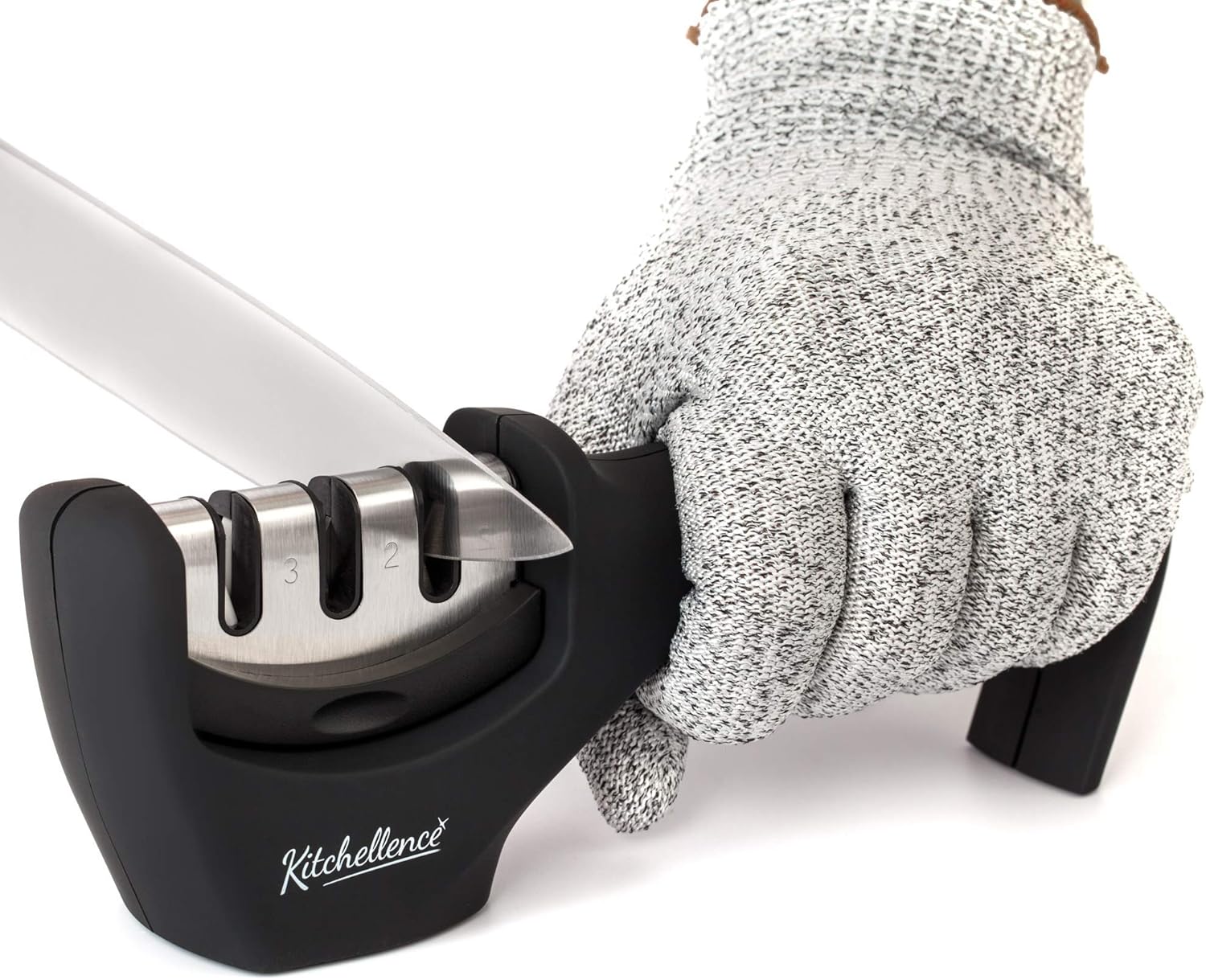
This compact sharpener gives a simple three-step process for bringing dull kitchen knives back to usable condition. The first diamond rod repairs and straightens nicked or damaged edges, the second carbide or ceramic slot reprofiles the blade to a V-shape, and the third fine-tuning slot polishes the edge for smoother cutting. It is held by an ergonomic non-slip base and handle that makes it easy to pull blades through whether you are right- or left-handed, and the included cut-resistant glove adds a layer of safety for occasional users. Built from ABS plastic it is lightweight and easy to store on a counter or in a drawer. Expect fast, noticeable improvement on common stainless-steel kitchen knives, but it is not a replacement for a professional sharpening service for very high-end or severely damaged blades. Frequent use on very thin or specialty blades may remove more metal than desired, so use the coarser stages sparingly.
Best for: Buyers who want a low-risk, easy-to-use sharpening tool to maintain everyday kitchen knives and prioritize safety and simplicity over professional-level sharpening.
Less Ideal for: Users seeking precision edges on high-end chef knives or those who need restoration for heavily damaged or specialty blades should look to professional sharpening or more advanced tools.
- Three distinct sharpening stages for repair, sharpening, and polishing
- Ergonomic non-slip base and ambidextrous handle for stable, easy use
- Includes a cut-resistant glove for added user safety
- Compact, lightweight ABS construction that stores easily
- Plastic housing may feel less durable than metal-bodied sharpeners
- Not intended for precision sharpening of high-end or specialty knives
Verdict: A safe, easy-to-use three-stage sharpener that reliably refreshes household knives for risk-averse buyers.
Choosing the Right Compact Knife Sharpener: Key Factors to Consider
Sharpening Method
Different compact sharpeners use carbide, ceramic, or guided abrasive systems, and the method directly affects the edge you get. Carbide slots remove metal quickly and can reshape a dull edge in a few strokes, which is useful for very blunt blades but risks removing more steel than necessary. Ceramic or fine-grit stages hone and refine the bevel for a smoother, longer-lasting edge.
Think about how often you plan to sharpen and whether you need frequent light touch-ups or occasional reshaping. Frequent light honing benefits from gentler abrasives, while an aggressor carbide stage is helpful when recovering heavily used blades.
Angle Control and Consistency
A compact sharpener should guide the blade at a consistent angle to produce a repeatable bevel. Guided systems with fixed angle slots are easiest for most users because they remove the guesswork. Manual push-style sliders require more user control and can produce inconsistent results if strokes vary.
Consider the typical blade types you own. Western-style chef knives tolerate slightly thicker angles, while thin Asian blades benefit from shallower angles. Matching the sharpener's preset angles or its ability to accommodate multiple angles to your knives preserves edge geometry and performance.
Safety and Handling
Sharp tools must also be safe to use, especially in a compact device that sits on a countertop or in a drawer. Look for non-slip bases, finger guards, and secure blade channels that prevent the knife from shifting during strokes. An ergonomic grip on the body reduces wrist strain and encourages controlled, even passes.
Safety features become more important when sharpening in confined spaces or when multiple household members may use the tool. A stable platform and clear instructions help prevent accidents and damaged blades.
Size, Storage, and Portability
The main advantage of a compact sharpener is its small footprint. Consider where you will keep it and how often you will transport it. Compact designs that pack a protective cover or nested parts are easier to store in drawers and travel with you for seasonal kitchens or outdoor use.
However, extreme miniaturization can compromise ergonomics. Balance the need for small size with comfortable handling and adequate grip surfaces so you can sharpen safely and effectively.
Durability and Replacement Parts
A good compact sharpener uses durable abrasives and a solid housing. Replaceable abrasive cartridges or media extend the useful life of the tool and are often more economical than replacing the entire unit. Metal-reinforced slots or well-bonded ceramic rods resist wobble and uneven wear.
Check whether the design protects abrasive elements from contamination and whether replacement parts are simple to swap. Durable materials reduce long-term costs and ensure the sharpener performs consistently over time.
Cleaning and Hygiene
Sharpening generates metal filings and abrasive dust, so a model that is easy to clean will stay sanitary and functional. Look for designs where the abrasive modules can be removed for brushing or rinsing, and avoid sealed slots that trap debris. Smooth, nonporous housings wipe down quickly and prevent buildup of grime.
Regular cleaning maintains sharpening performance and reduces the risk of cross-contamination between different blade types or food-preparation tasks.
When to Sharpen Versus When to Hone
Understanding the difference between sharpening and honing helps you decide how often to use a compact sharpener. Honing realigns a slightly rolled edge and is best for regular upkeep. Sharpening removes metal to recreate the bevel and is needed when the edge is visibly dull or has sustained nicks.
Use a compact sharpener for light to moderate metal removal and regular maintenance. Reserve more aggressive reshaping for when the blade has lost its edge geometry entirely.
- Hone weekly or after heavy use to maintain a keen edge.
- Sharpen occasionally when honing no longer restores cutting performance.
- Test edge sharpness with simple cutting tasks rather than relying solely on sight.
Maintaining Edge Geometry on Different Kitchen Knives
Not all kitchen knives share the same factory bevel. When selecting a compact sharpener, consider whether it supports the bevel angles common to your knives. Some compact devices offer multiple preset angles; others are best for a single, universal angle.
If you use both thin, high-angled blades and thicker Western-style blades, choose a tool that can handle that variety without forcing an incorrect bevel profile.
- Look for multi-angle options if you own diverse knives.
- Avoid forcing a knife through a slot that feels tight or off-angle.
Safe Sharpening Technique for Home Users
A controlled, repeatable motion yields the best results. Stabilize the sharpener on a flat surface, hold the knife by the handle, and draw the blade through the sharpening slot with even pressure. Do not rush strokes; a smooth pass is better than aggressive force.
Finish with light passes in a finer stage or a ceramic rod to polish the edge and reduce burrs. Always wipe the blade after sharpening to remove metal particles before returning the knife to storage.
- Use consistent pressure and angle for each stroke.
- Keep fingers clear of the blade path and use provided guards.
- Inspect the edge under good light after sharpening.
Storing and Transporting Compact Sharpeners
Compact sharpeners are popular because they are easy to tuck away. If you plan to store the tool in a drawer, choose a model with a protective cover or removable abrasive elements to prevent damage and accidental contact. For travel, ensure components lock together and do not rattle.
Label or separate sharpeners if you maintain different grits for distinct tasks to avoid mix-ups.
- Use covers or cases to protect abrasives.
- Store in a dry place to prevent contamination.
- Keep replacement parts organized with the main unit.
Cleaning and Long-Term Care
Regularly remove accumulated metal dust to keep abrasive surfaces working efficiently. Brush or rinse removable modules according to the manufacturer instructions and let parts dry completely before reassembly. Avoid submerging housings that contain bonded abrasives or non-waterproof components.
Inspect abrasive elements for uneven wear and replace cartridges or rods when they no longer produce consistent results.
- Clean after heavy sharpening sessions.
- Replace worn abrasives to maintain sharpening performance.
How We Chose the Best Compact Knife Sharpener
We applied practical, hands-on criteria aimed at buyers who need a small, reliable tool for keeping kitchen knives sharp. Primary considerations included measurable sharpening performance across common blade steels and edge types, the ease and safety of the sharpening action, and how consistently the tool reproduces a correct bevel. We also evaluated durability and materials to ensure ceramic, carbide, or guided systems resist wear over time. User ergonomics and storage footprint were important for compact tools used frequently in small kitchens. Finally, we considered cleaning and maintenance needs so the tool stays sanitary and effective. We excluded multi-step benchtop systems and any tools intended primarily for professional sharpening stations. We focused on compact, consumer-oriented designs that are safe for typical home users and compatible with common kitchen knives. The selection filters favored straightforward adjustment, documented angle guidance, and modest maintenance requirements.
Our full evaluation process is outlined in our review methodology.
FAQ
How often should I use a compact knife sharpener on my kitchen knives?
It depends on use. For home cooks who use knives daily, light honing with a compact sharpener every one to two weeks keeps edges responsive. Perform a full sharpening only when honing no longer restores cutting performance.
Will a compact sharpener damage high-end knives?
Not if used correctly. Aggressive carbide stages remove metal quickly and can shorten blade life if overused. Choose gentler abrasives for regular maintenance and limit heavy sharpening to times when the edge needs reshaping.
Can I sharpen serrated knives with a compact sharpener?
Most compact sharpeners are designed for straight edges and are not suitable for serrated blades. Serrations require specialty tools or individual rod sharpening techniques to preserve tooth geometry.
Do compact sharpeners work on all kitchen blade steels?
They work on most common steels but performance varies. Harder steels may take longer to abrade and might require finer finishing stages. Very soft or very hard specialty steels may need specific abrasives for optimal results.
How can I tell when abrasive elements need replacement?
Signs include inconsistent edge formation, increased number of strokes required, visible uneven wear, or a scraping feel instead of smooth abrasion. Replace cartridges or rods when maintenance no longer restores a clean bevel.
Final Verdict
Choose a compact knife sharpener that matches the bevels and stones your knives need while prioritizing safety and consistent angle control. Expect to balance convenience against aggressiveness: aggressive carbide stages solve heavy dulling quickly but should be used sparingly, while ceramic and finer abrasives are better for routine upkeep. Prioritize a stable base, ergonomic handling, and replaceable or cleanable abrasive elements so the tool performs well over time. With the right compact sharpener, you can keep kitchen knives performing reliably without complex equipment.