
Note: This article contains affiliate links. If you click on these links and make a purchase, we may earn a small commission at no extra cost to you. This helps support our research and content. Read our full affiliate disclosure here.
Serrated knives need a different approach than straight-edge blades. If you use serrated kitchen knives regularly, the right knife sharpener will restore cutting performance without removing too much metal or changing the scalloped tooth profile. This guide covers the top shortlisted knife sharpeners for serrated knives, focusing on tools that work reliably with scalloped edges and that are safe for home use. We evaluate ease of use, compatibility with common serration sizes, and how gently each tool restores the edge to practical sharpness. Read on to find a model that fits how you cook and how often you sharpen.
Top Picks at a Glance
| Best Overall The best all-around choice for most situations | Work Sharp Precision Adjust Knife Sharpener |  |
| Best Quality Built to a higher standard if you want something more solid | Chef'sChoice Trizor 15XV |  |
| Best Value The sweet spot between price and what you get | Amazon Basics 4-in-1 Knife Sharpener |  |
| Best Budget The cheapest option that still gets the job done reliably | Siyurongg Serrated Knife Sharpener |  |
| Top Rated A top-rated pick with lots of positive feedback | AccuSharp Knife Sharpener ACCU-001C |  |
| Most Popular A crowd favorite that many people choose with confidence | SHARPAL 191H Knife Sharpener |  |
| Best Seller A high-volume bestseller chosen again and again | KITCHELLENCE 3-Stage Knife Sharpener |  |
Work Sharp Precision Adjust Knife Sharpener

| Included Components | 320 & 600 Grit Tri-Brasive, Diamond, Fine Ceramic, Angle Adjustable Chassis, Benchtop Base, Knife Clamp, Slide Rod |
|---|---|
| Model Number | WSBCHPAJ |
| Manufacturer Warranty Description | 3 YEAR |
| Material Type | Acrylic, Ceramic, Neoprene, Plastic, Steel |
The Work Sharp Precision Adjust is a benchtop guided sharpening system that uses a three-sided abrasive jig and clamp to deliver repeatable edge angles from 15 to 30 degrees in 1-degree steps. It is typically used by clamping the knife in the v-block, setting the desired angle on the chassis, and sliding the chosen abrasive rod—coarse diamond, medium, or fine ceramic—across the blade to reprofile, sharpen, or polish both plain and serrated edges with control. The included benchtop base and slide rod make sharpening fast and stable compared with freehand methods, and the angle indexing helps you reproduce the same bevel every time. The tri-brasive selection covers aggressive metal removal through final polishing, so you can restore dull blades or refine a keen edge without needing separate stones. Limitations include the manual slide technique which requires some practice for consistent pressure and speed, and the unit is a benchtop jig rather than a standalone electric sharpener, so it is best for users willing to spend a few minutes per blade to get precise results.
Best for: Buyers who want a versatile, repeatable guided sharpening system for kitchen and pocket knives and value precise angle control over quick automated sharpening.
Less Ideal for: Anyone seeking a fully automatic electric sharpener or a tool-free instant edge — or those unwilling to practice a manual technique for best results.
- Adjustable angle from 15 to 30 degrees in 1-degree increments for repeatable bevels
- Tri-brasive system (coarse diamond and fine ceramic) lets you move from reprofiling to polishing without extra tools
- V-block clamp and benchtop base provide stable, safe positioning for consistent sharpening
- Includes a guided chassis and slide rod that speed up sharpening compared with freehand stones
- Manual sliding technique takes practice to master consistent pressure and stroke speed
Verdict: If you want precise, repeatable sharpening with full angle control and abrasive variety for serrated and plain blades, this guided benchtop system delivers professional-level results.
Chef'sChoice Trizor 15XV

| Material Type | Diamond |
|---|---|
| Grit Type | Fine |
| Stages | Three |
| Included Components | Knife Sharpener |
The Chef'sChoice Trizor 15XV is a 3-stage electric sharpener built to convert and refine household knives to a 15-degree Trizor edge using 100-percent diamond abrasives and patented stropping disks. Users run blades through stage 1 (medium diamond) to form the initial bevel, stage 2 (fine diamond) to hone the edge, and stage 3 to polish and strop for a razor finish; the spring-loaded angle guides keep the blade aligned automatically. In practice it is fast and repeatable — initial sharpening takes about a minute and touch-ups are a matter of seconds — and it works on both straight edges and many serrated knives thanks to the flexible abrasive polishing stage. The unit focuses on precision slicing rather than heavy material removal, so it produces a very keen edge with minimal guesswork. Limitations include fixed angle options centered on 15-degree performance and a bulkier countertop footprint compared with handheld systems, so it is best for cooks who want fast, professional-style edges rather than a compact travel tool.
Best for: Buyers who prioritize razor-sharp, performance-oriented edges and want a fast, repeatable electric system for kitchen and serrated knives.
Less Ideal for: Users seeking a compact, travel-ready sharpener or those whose knives require non-15-degree factory angles.
- Uses 100% diamond abrasives for fast, durable sharpening
- Three-stage system (sharpen, hone, strop) yields a polished, long-lasting edge
- Spring-loaded precision angle guides remove guesswork for consistent results
- Works on both straight-edge and many serrated knives due to the polishing/stropping stage
- Fixed angle focus on 15-degree edges limits use for blades that require other factory angles
- Larger countertop unit that is less portable than manual or compact sharpeners
Verdict: Choose the Trizor 15XV when you want a quick, repeatable electric sharpener that transforms household and serrated knives into razor-sharp 15-degree edges.
Amazon Basics 4-in-1 Knife Sharpener
| Included Components | Knife Sharpener |
|---|---|
| Grit Type | Coarse, Medium, Fine |
| Material Type | Metal, Plastic |
| Item Type Name | 4-in-1 Knife Sharpener with Safety Glove |
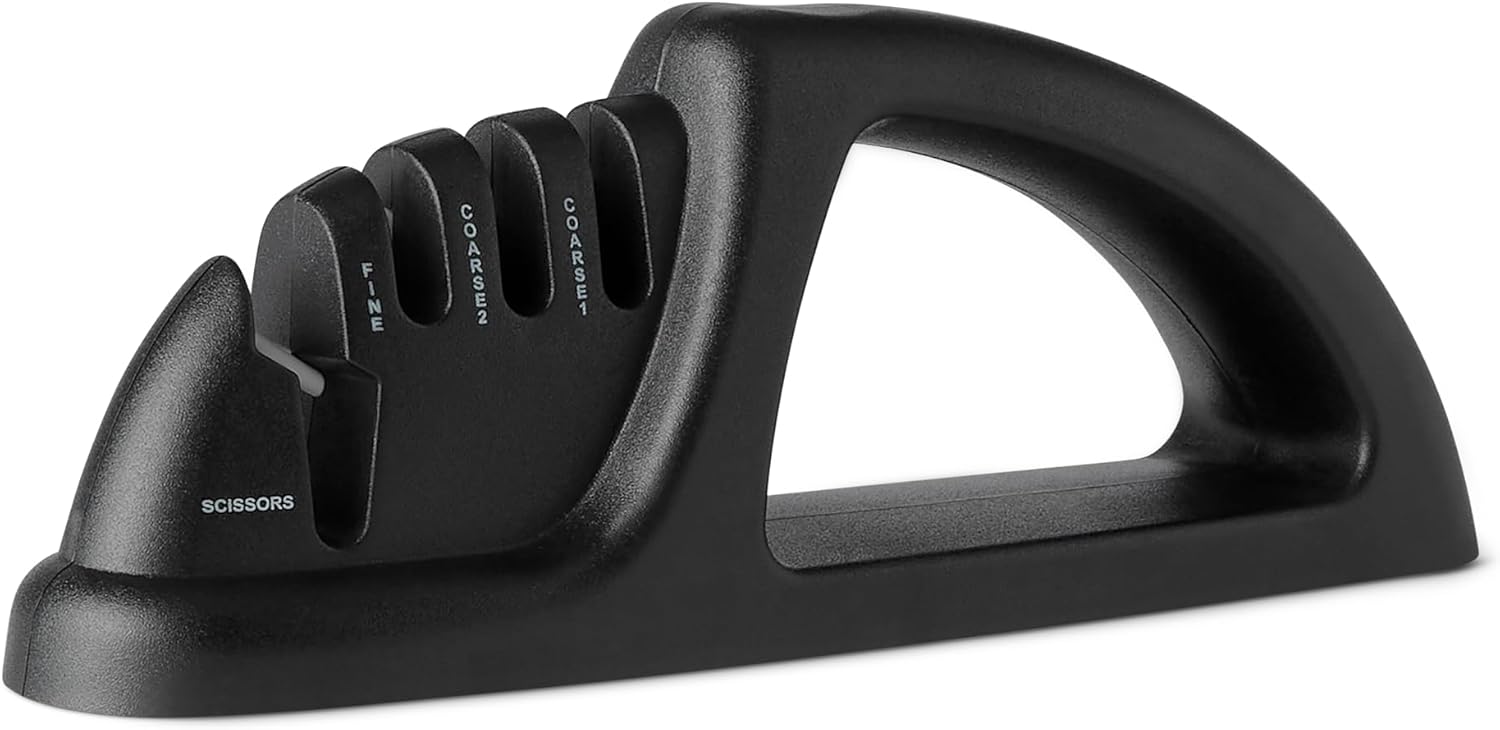
This Amazon Basics 4-in-1 sharpener is a simple, countertop tool that guides straight-edge knives through coarse, medium, and fine stages and includes a dedicated slot for scissors. You use it by pulling the blade through each appropriate slot a few times while the non-slip silicone base keeps the unit steady; the included cut-resistant glove helps prevent accidents during handling. Its plastic and metal construction is easy to rinse clean and the three grit stages make it suitable for restoring dull kitchen, pocket, and hunting knives quickly without special skills. Important limits: it is not designed for serrated blades, so it cannot restore scalloped edges, and manual pull-through sharpeners like this remove material relatively quickly compared with professional honing. The unit is best for routine touch-ups and household sharpening rather than precision restoration of high-end chef knives.
Best for: Someone who wants a low-effort, safe way to keep everyday straight-edge kitchen and utility knives sharp without paying for professional service and who values practical, easy maintenance.
Less Ideal for: Users who need to sharpen serrated knives or who require precision reprofiling and sharpening of premium chef knives should look to specialty tools or professional sharpening services instead.
- Three sharpening stages (coarse, medium, fine) for progressive edge refinement
- Dedicated scissor slot expands usefulness beyond knives
- Non-slip silicone base improves stability during use
- Includes cut-resistant glove for safer blade handling
- Not suitable for serrated knives
- Manual pull-through design is not for precision reprofiling of high-end blades
Verdict: A straightforward, safety-minded sharpener for routine upkeep of straight-edge knives and scissors, but it cannot service serrated edges.
Siyurongg Serrated Knife Sharpener

| Material Type | Diamond |
|---|---|
| Grit Type | Fine |
| Number of Items | 1 |
This pocket-sized sharpener uses a fine diamond rod in a retractable, pen-like housing to restore and polish serrated edges and other small cutting points. It is intended for quick touch-ups rather than full blade reprofiling: you extend the slender rod, run it along the serrations or hooks, and the fine grit smooths and refines the edge. The ergonomic barrel and pocket clip make it easy to carry for camping or everyday kitchen use, and the diamond abrasive offers good wear resistance so the tool holds up to repeated use. Because the rod is narrow and fine-grit, it will not remove large amounts of metal quickly, so heavy-duty restorations or very dull serrations will still need a more aggressive sharpener or professional service. For routine maintenance of serrated knives, scissors tips, fish hooks, and similar small tools this sharpener is convenient and durable.
Best for: Buyers who want an inexpensive, portable tool to keep serrated knives and small cutting points maintained between major sharpenings.
Less Ideal for: Those needing fast metal removal or full-edge re-profiling for heavily damaged or very dull serrated blades should choose a more aggressive or professional sharpening solution.
- Diamond abrasive offers strong wear resistance and effective polishing for serrations
- Retractable pen design with pocket clip is highly portable
- Ergonomic grip reduces hand fatigue during use
- Fine grit is good for polishing and routine edge maintenance
- Fine rod is not suited for heavy re-profiling or repairing very dull serrations
Verdict: A budget-friendly, pocketable diamond rod sharpener built for quick maintenance and polishing of serrated knives and small cutting tools.
AccuSharp Knife Sharpener ACCU-001C

| Material Type | Acrylonitrile Butadiene Styrene |
|---|---|
| Grit Type | Coarse |
| Included Components | Sharpener |
| Model Number | ACCU-001C |
The AccuSharp ACCU-001C is a simple, hand-held pull-through sharpener meant for quick edge restoration in the kitchen, workshop, or outdoors. You insert the blade and pull it through the diamond-honed tungsten carbide blades; the reversible carbide inserts give a coarse grit for rapid material removal and a longer service life because they can be flipped. Its molded ergonomic handle and full-length finger guard make it easy and safe to use for right- and left-handed users, and the unit is dishwasher safe for low-effort cleaning. In practice it sharpens common chef, paring, cleaver, and many serrated blades fast—often in under 10 seconds—so it is handy for routine maintenance rather than precision honing. Limitations include the coarse-only sharpening media, which can remove metal quickly and is not a substitute for fine stropping or a whetstone for refined edges, and it may shorten time between full re-profiles if blades are heavily damaged.
Best for: Buyers who prioritize a dependable, no-fuss tool to quickly restore cutting performance on everyday knives and serrated blades will appreciate this sharpener.
Less Ideal for: Those seeking a precision finishing tool, a fine polishing stage, or a full reprofile solution should look at stones or multi-stage systems instead.
- Very fast edge restoration for dull knives
- Diamond-honed tungsten carbide blades with reversible inserts for longer life
- Ergonomic, ambidextrous handle with a full finger guard for safe use
- Dishwasher-safe plastic body for easy cleaning
- Uses coarse carbide grit only, so it does not produce a finely polished edge
- Not intended for precision sharpening or restoring severely chipped blades
Verdict: A fast, reliable pull-through sharpener that gets everyday and serrated knives back to usable edges with minimal effort.
SHARPAL 191H Knife Sharpener

| Material Type | Ceramic, Tungsten Carbide |
|---|---|
| Grit Type | Fine |
| Manufacturer | Sharpal Inc. |
The SHARPAL 191H is a small, three-stage handheld sharpener built for everyday kitchen tasks. It combines tungsten carbide slots to quickly reestablish a bevel, a ceramic honing stage for finer edge refinement, and a dedicated tungsten carbide scissor slot, so you can service knives and scissors with one unit. The sharpener mounts to smooth countertops using an enhanced suction base that locks it in place and frees both hands, which helps with consistent strokes and safer use for left- or right-handed users. Its compact footprint makes it easy to store, and the materials listed indicate durable carbide and ceramic abrasives suited for routine maintenance rather than heavy reprofiling. Limitations include a simple guided-angle design that cannot replace a full sharpening system for damaged or heavily chipped serrations, and it does not provide adjustable angles for professional regrinding. For cooks who want a fast, stable tool to refresh common kitchen blades and scissors, the 191H is a practical, low-effort option with clear safety and convenience features.
Best for: Buyers who prioritize a stable, easy-to-use sharpener for routine home maintenance and want reassurance from a well-reviewed, proven design.
Less Ideal for: Professional sharpeners or users needing to restore or reprofile badly damaged serrated blades should look to whetstones or powered systems instead.
- Three-stage system (tungsten carbide and ceramic) covers both coarse setting and fine honing.
- Dedicated scissors sharpening slot adds versatility beyond knives.
- Strong suction base improves stability and safety during use.
- Compact size is easy to store and suitable for home kitchens.
- Not designed for restoring heavily damaged or chipped serrated edges.
- Fixed guided angles limit use for custom bevels or professional reprofiling.
Verdict: If you want a compact, stable, and user-friendly sharpener to quickly refresh kitchen knives and scissors, the SHARPAL 191H delivers reliable everyday performance.
KITCHELLENCE 3-Stage Knife Sharpener
| Material Type | Plastic |
|---|---|
| Included Components | Yes |
| Item Weight | 180 g |
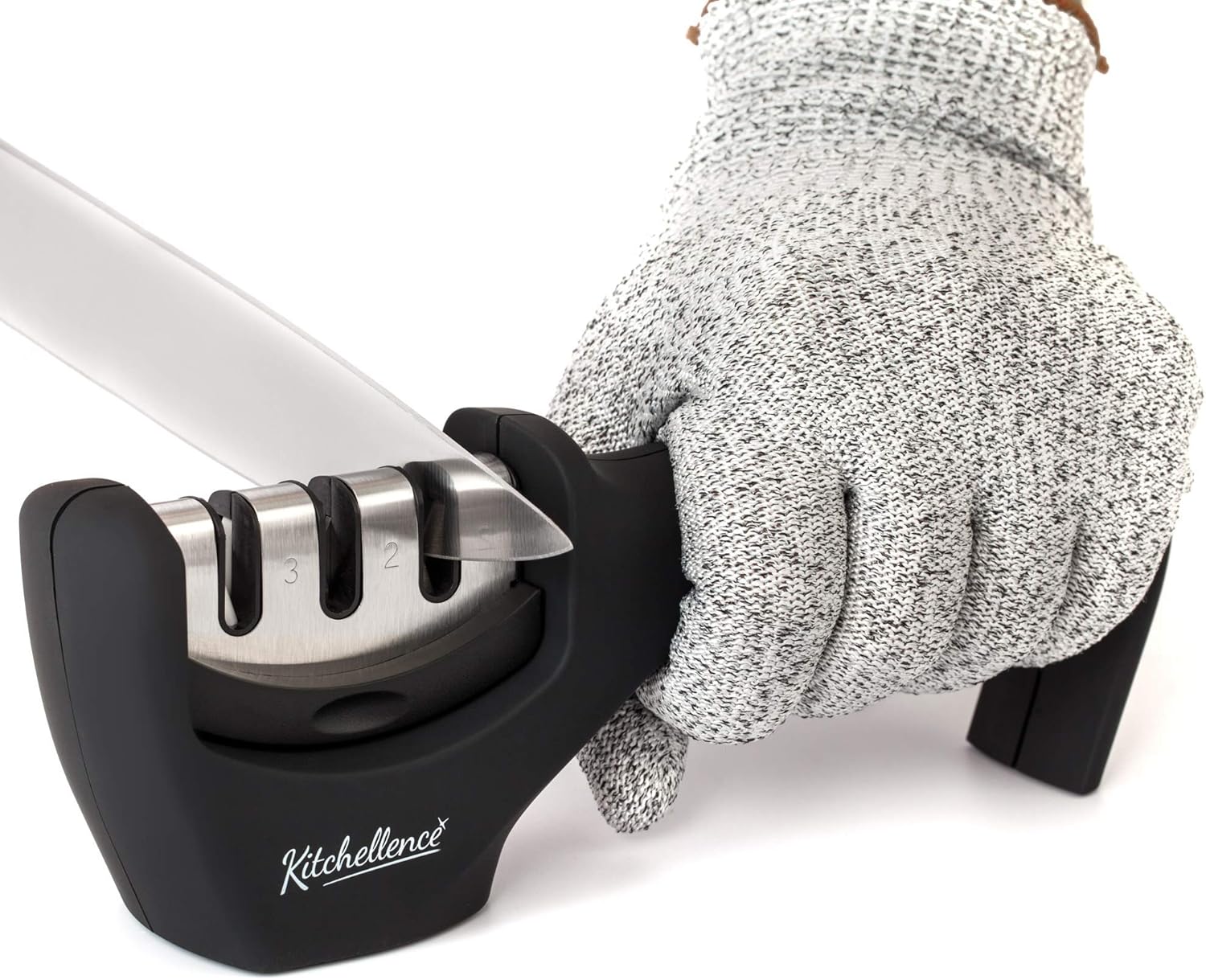
This three-slot manual sharpener is built to repair, sharpen, and polish blades in quick passes, using a diamond rod to re-true damaged edges, a middle slot to restore the V-bevel, and a fine slot to finish and polish. It is handheld with an ergonomic, non-slip base that makes it easy for right- or left-handed users to stabilize the unit while pulling blades through the slots a few times. The included cut-resistant glove and a stable base are practical safety touches for cautious users. Construction is plastic ABS, which keeps the unit lightweight and durable for home kitchens but means it is not a bench-mounted or professional-grade tool. Because the design focuses on straight-edge restoration, it works best on plain edges and may not fully reprofile deep chips or recreate factory serrations on serrated knives. For routine maintenance and quick edge refreshes, this is a compact, safe option that delivers noticeable improvement with minimal skill required.
Best for: Buyers who want a safe, simple way to keep everyday straight-edge kitchen knives sharp without specialist tools and who prioritize ease of use and safety.
Less Ideal for: Users seeking a tool to fully restore or reprofile serrated blades or to perform heavy-duty professional sharpening should look at dedicated serration-specific or bench grinders.
- Three-stage system (repair, sharpen, polish) for stepwise edge restoration
- Diamond sharpening rod for faster material removal on damaged blades
- Ergonomic non-slip base and included cut-resistant glove improve user safety
- Lightweight ABS construction makes it easy to store and use in the kitchen
- Not designed to restore or reshape serrated blades to factory serrations
- Plastic body limits stability compared with bench-mounted sharpeners
Verdict: A compact, easy-to-use three-stage sharpener that reliably refreshes straight edges while prioritizing safety for cautious home cooks.
Choosing the Right Knife Sharpener for Serrated Knives: Key Factors to Consider
Serration Size and Tooth Pitch
Serrated knives vary widely in the width and depth of their scalloped teeth. Matching the sharpener tip or rod to the tooth pitch ensures the abrasive contacts the gullets where metal needs work. Using a tip that is too large will skip the valley between teeth and leave the edge dull, while a tip that is too small can concentrate wear on a tiny area and lengthen sharpening time.
Before buying, note whether most of your serrated knives have fine micro-serrations or larger scallops. Many dedicated serration tools provide multiple tip sizes or a tapered profile to accommodate a range of pitches. Choosing the right fit reduces the chance of altering the blade profile and helps preserve cutting performance.
Abrasive Type and Aggressiveness
Sharpening abrasives range from ceramic and diamond to hardened steels or coated rods. Diamond abrasives cut fast and remove more metal, making them useful for very dull blades but potentially shortening the time between regrinds if used excessively. Ceramic abrasives remove less metal and can refine a bevel without aggressive material removal, which is better for routine touch-ups.
Consider how often you plan to sharpen and the current condition of your serrated knives. For maintenance, a gentler abrasive is usually preferable because it maintains the original tooth geometry longer. If you expect to correct very worn serrations, a more aggressive abrasive may be necessary but should be used sparingly.
Guided Angle Vs Freehand Control
Some sharpeners offer guides that position the abrasive at a consistent angle, while others are simple rods for freehand work. Guides can speed up the process and reduce the risk of uneven sharpening, especially for beginners. However, overly rigid guides may not reach into deep or unusually shaped serrations.
Freehand rods give more flexibility for irregular serrations but require steady technique to maintain consistent contact. Evaluate whether you prefer a guided system for repeatability or a tapered rod that lets you adapt to each tooth individually. Safety features such as ergonomic handles and non-slip grips also matter when working with handheld tools.
Edge Preservation and Metal Removal
Maintaining the original tooth profile is the primary goal when sharpening serrated knives. Tools that remove large amounts of metal can round off scallops and change cutting character over time. Look for sharpeners designed to work within the gullets and restore the micro-bevel at the tip of each serration rather than re-profiling the entire edge.
Regular light maintenance with a fine abrasive typically yields the best long-term results. Reserve aggressive reprofiling for rare occasions when teeth are damaged or extremely dull. Choosing a tool with a controlled cutting action helps balance sharpness with longevity.
Comfort, Control, and Safety
Hand comfort and secure control are practical concerns when sharpening serrated knives because the process often involves repetitive small strokes. Ergonomic handles, non-slip surfaces, and a stable posture while working reduce fatigue and the risk of slips that could damage the blade or cause injury.
Also consider whether the tool offers a way to steady the knife or clamp the handle for safer single-handed sharpening. Models that are easy to grip and position help maintain consistent pressure and angle, improving results and making routine maintenance quicker.
Maintenance, Durability, and Replacement Parts
Abrasive elements wear with use, especially diamond and coated components. Check how the sharpener is maintained: can rods be replaced, are guides serviceable, and does the manufacturer specify expected lifetime for abrasive surfaces? Tools with replaceable tips or affordable service parts extend the useful life of the sharpener.
Durability also affects cost of ownership. A well-built, low-maintenance sharpener that holds its abrasive integrity reduces long-term expense and preserves edge consistency. Consider whether the tool requires special cleaning procedures and whether those fit your routine.
When to Sharpen Serrated Knives
Serrated knives usually go longer between full regrinds than straight-edge blades, but they still need periodic attention. Signs a serrated blade needs sharpening include reduced slicing performance on bread or tomatoes, or visible rounded tips on the scallops. If the blade pushes rather than slices, individual teeth are likely dulled and should be addressed.
Routine touch-ups are often brief and target only the dulled teeth rather than the full edge. Reserve aggressive work for teeth that are visibly damaged or when the entire blade is very dull. Frequent light maintenance keeps the knife functional and prevents the need for heavy re-profiling.
- Dull cutting on soft produce indicates need for touch-up
- Visible rounded scallop tips suggest metal removal is required
- If many teeth are damaged, consider professional regrind
Types of Sharpening Tools for Serrations
There are several practical tool forms for serrated blades: tapered ceramic or diamond rods, conical sharpening stones, guided manual systems with replaceable tips, and compact handheld devices built specifically for scalloped edges. Each form balances control, reach, and aggressiveness differently.
Tapered rods excel at reaching into gullets and offer precise control for individual teeth. Guided systems speed up repeatable work but may struggle with irregular tooth shapes. Choose the form that suits how often you sharpen and how uniform your serrations are.
- Tapered rods: precise, good for single-tooth work
- Guided tip systems: repeatable angles, faster for full-blade touch-ups
- Conical stones: moderate material removal for reshaping
Technique Tips for Safe, Effective Sharpening
Work slowly and address one scallop at a time. Insert the rod into the gullet and use a few light strokes toward the blade tip to hone the bevel. Avoid long, aggressive motions that remove too much metal along the entire tooth.
Maintain a consistent light pressure and keep the rod aligned with the tooth contour. After sharpening, test the edge on soft produce and adjust as needed. Clean any abrasive residue from the blade and dry it thoroughly to prevent corrosion.
- Use light pressure and short strokes
- Follow the contour of each scallop
- Finish with a light stropping motion if possible
Storing and Caring for Your Sharpener
Protect abrasive surfaces from knocks and contamination. Store rods and tips in a dedicated pouch or case to prevent chipping ceramic surfaces or wearing diamond coatings prematurely. Keep replaceable parts together so you can swap them when wear becomes noticeable.
Clean abrasive elements according to manufacturer guidance, usually with a soft brush and water or a mild solvent if grease accumulates. Avoid dropping or banging the tool, as brittle abrasives can crack and lose effectiveness.
- Store in a dry, padded case
- Clean abrasives gently after use
- Replace worn tips to maintain results
When to Seek Professional Reprofiling
If multiple teeth are chipped, deformed, or the entire scallop profile is lost, home sharpening may not restore original performance. Professional reprofiling can reestablish correct tooth geometry and remove metal in a controlled way that home tools cannot replicate safely.
Consider professional service when the knife no longer performs despite repeated maintenance or when you fear losing significant blade life by attempting aggressive home reprofiling. Professionals use controlled machines and have the skill to preserve blade integrity while reshaping teeth.
- Chipped or missing teeth
- Blade that drags across food despite maintenance
- When preserving resale or heirloom value
How We Chose the Best Knife Sharpener for Serrated Knives
We evaluated candidates based on criteria that matter for maintaining serrated blades at home. First, compatibility with serration geometry was essential: effective sharpeners must fit into scalloped gullets and match common serration pitches without reshaping the teeth. Second, material and abrasive type were considered because ceramic, tapered diamond, and conical rods remove metal at different rates and affect long-term edge life. Third, usability was reviewed, including how easy it is to align the rod with individual serrations, whether the tool offers guided angles, and how safe it feels during use. Durability and maintenance were included so tools that wear out quickly or require frequent replacement were deprioritized. Finally, versatility and portability were considered for people who need a dedicated serration tool versus multiuse sharpeners. We excluded general-purpose bench systems that require professional setup and devices that cannot reach into a typical serration gullet. The list focuses on practical, repeatable solutions that keep serrated knives functional without over-grinding.
Our full evaluation process is outlined in our review methodology.
FAQ
How often should I sharpen serrated knives?
It depends on use. Many serrated knives only need light maintenance a few times a year for typical home use, while heavy daily use may require attention every few weeks. Focus on performance: sharpen when slicing becomes less efficient.
Can I use a straight-edge sharpener on serrated knives?
Straight-edge sharpeners are not effective for scalloped teeth because they cannot reach into gullets. They may polish flat faces but will not restore individual serrations. Use a tapered rod or a dedicated serration tool instead.
Will sharpening change the appearance of my serrated edge?
Light maintenance should not alter the visible profile of serrations, but aggressive material removal or using the wrong tip size can round scallop tips and change cutting behavior. Use the gentlest effective abrasive and match the tip to the tooth pitch.
Are diamond rods too aggressive for regular maintenance?
Diamond rods cut faster and remove more metal, so they are best for restoring very dull teeth or fixing damage. For routine touch-ups, finer ceramic rods are usually gentler and help preserve the original geometry.
Can I sharpen serrated kitchen shears with these tools?
Some tapered rods and conical tools can address small serrations on shears, but access and clamping differ. Use a tool that allows safe positioning and matches the serration size. If unsure, test on a small area first.
Final Verdict
Choose a sharpener that matches the serration size and offers the right abrasive for how often you plan to maintain your blades. Prioritize tools that reach into gullets precisely and remove metal conservatively to preserve tooth geometry. Balance ease of use with longevity: a slightly gentler abrasive used regularly will typically keep serrated knives performing longer than occasional aggressive reprofiling. With a suitable tool and the right technique, you can keep serrated knives functional and extend their service life.