
Note: This article contains affiliate links. If you click on these links and make a purchase, we may earn a small commission at no extra cost to you. This helps support our research and content. Read our full affiliate disclosure here.
If you need a full-featured printer without surrendering desk real estate, a compact printer can be the best solution. Compact printers are designed to fit on small shelves, apartment desks, or shared workstations while still handling everyday tasks like documents, invoices, and occasional photo prints. This guide shortlists the top compact printers built for small spaces and evaluates them on the features that matter most to home and small-office users. We examine print quality, connectivity, paper handling, and ease of use to help you pick a model that balances footprint and functionality. Read on to see the top compact choices and which features to prioritize.
Top Picks at a Glance
| Best Overall The best all-around choice for most situations | Epson WorkForce Pro WF-3823 |  |
| Best Quality Built to a higher standard if you want something more solid | Epson EcoTank ET-2800 |  |
| Best Value The sweet spot between price and what you get | Brother Work Smart 1360 Printer | 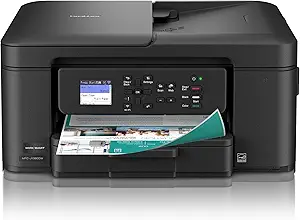 |
| Best Budget The cheapest option that still gets the job done reliably | HP DeskJet 2955 All-in-One |  |
| Top Rated A top-rated pick with lots of positive feedback | Canon IVY Mini Photo Printer |  |
| Most Popular A crowd favorite that many people choose with confidence | HP DeskJet 2855e All-in-One Printer | 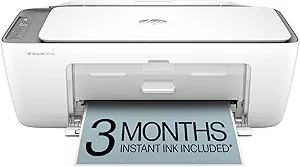 |
| Best Seller A high-volume bestseller chosen again and again | Canon PIXMA TS6520 |  |
Epson WorkForce Pro WF-3823
| Printer Type | Inkjet |
|---|---|
| Print Speed B&W | 21 pages_per_minute |
| Print Speed Color | 11 pages_per_minute |
| Maximum Sheet Capacity | 250 |
| Duplex | Automatic |
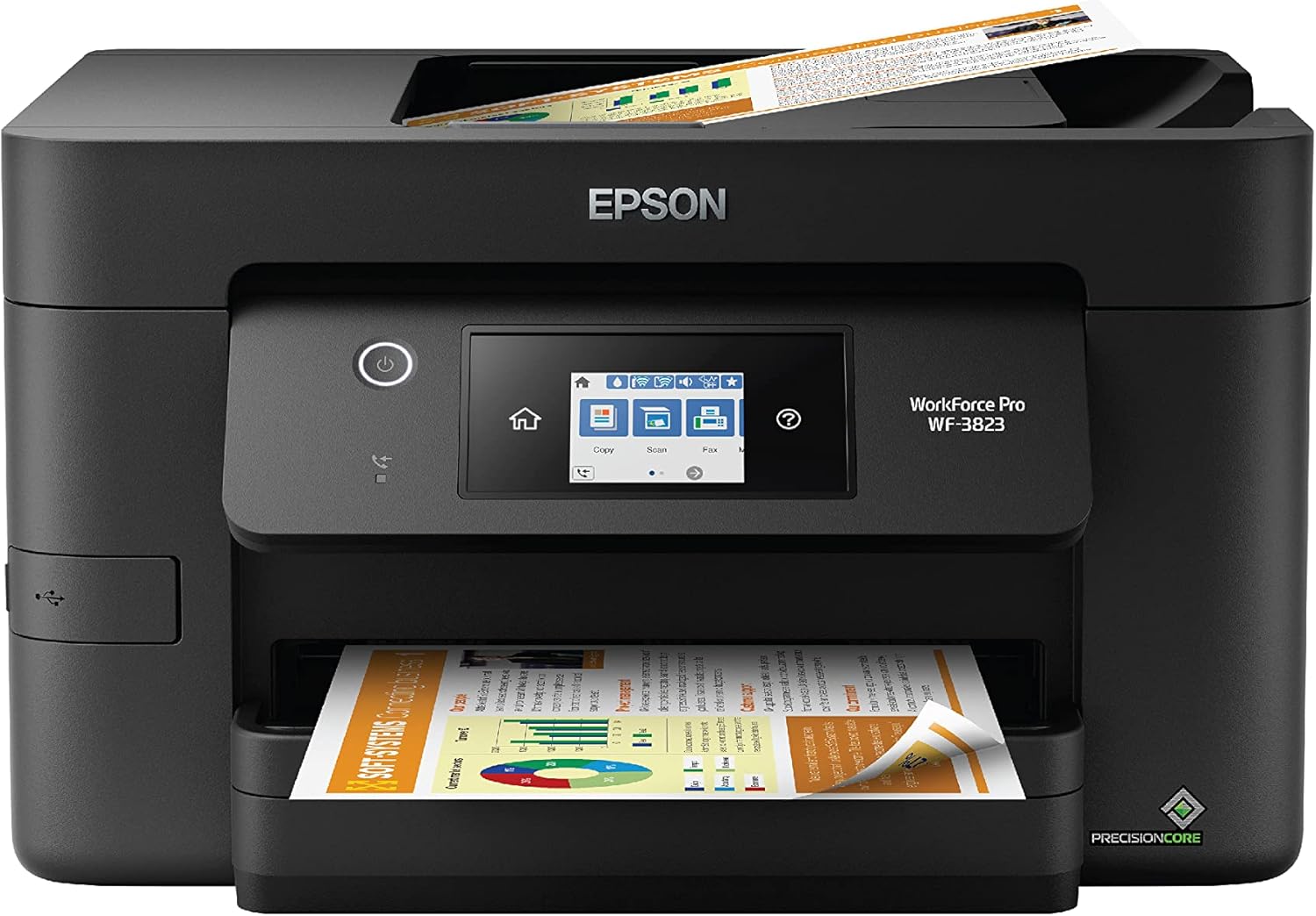
The Epson WorkForce Pro WF-3823 is a compact all-in-one inkjet that handles printing, scanning, copying and faxing for home offices and small workgroups. It uses PrecisionCore heat-free print technology and DURABrite Ultra pigment inks to deliver sharp, fade-resistant documents and photos, with up to 21 ppm black and 11 ppm color ISO-rated speeds and fast first-page-out times. Practical touches include a 35-sheet automatic document feeder for multi-page scans, automatic two-sided printing to save paper, a 250-sheet input tray for longer runs, and a 2.7-inch color touchscreen plus the Epson Smart Panel app for mobile setup and control. Connectivity covers wired Ethernet, USB and built-in Wi-Fi with Wi-Fi Direct for easy smartphone printing. The WF-3823 is focused on reliable, business-style output in a relatively small footprint, though it requires genuine Epson T822 cartridges and larger volume users should factor ink costs into the decision. For everyday office documents and mixed home-office tasks it balances speed, print quality and useful workflow features in a compact package.
Best for: Buyers who want a compact, reliable all-in-one that prioritizes fast black document printing and handy workflow features for a small home office or shared workgroup.
Less Ideal for: Users who need the lowest cost-per-page for very high monthly volumes or who prioritize fast, high-volume color and photo printing.
- Fast black printing up to 21 ISO ppm for quick document throughput
- Automatic two-sided printing and 35-sheet ADF streamline multi-page jobs
- 250-sheet paper tray reduces refill frequency for moderate volume use
- Works with Epson Smart Panel app and supports wireless, Wi‑Fi Direct and Ethernet connectivity
- Requires genuine Epson T822 cartridges which can raise ongoing ink costs
- Color printing is slower (11 ppm) compared with black and may be slower for photo-heavy jobs
Verdict: A compact, productivity-focused all-in-one that delivers fast black prints, useful automation features, and flexible wireless connectivity for small offices.
Epson EcoTank ET-2800
| Printer Type | Inkjet |
|---|---|
| Functions | Print, Copy, Scan |
| Connectivity | USB, Wi-Fi |
| Max Color Resolution | 5760 x 1440 dpi |
| Tray Capacity | Maximum Sheet Capacity 100 |
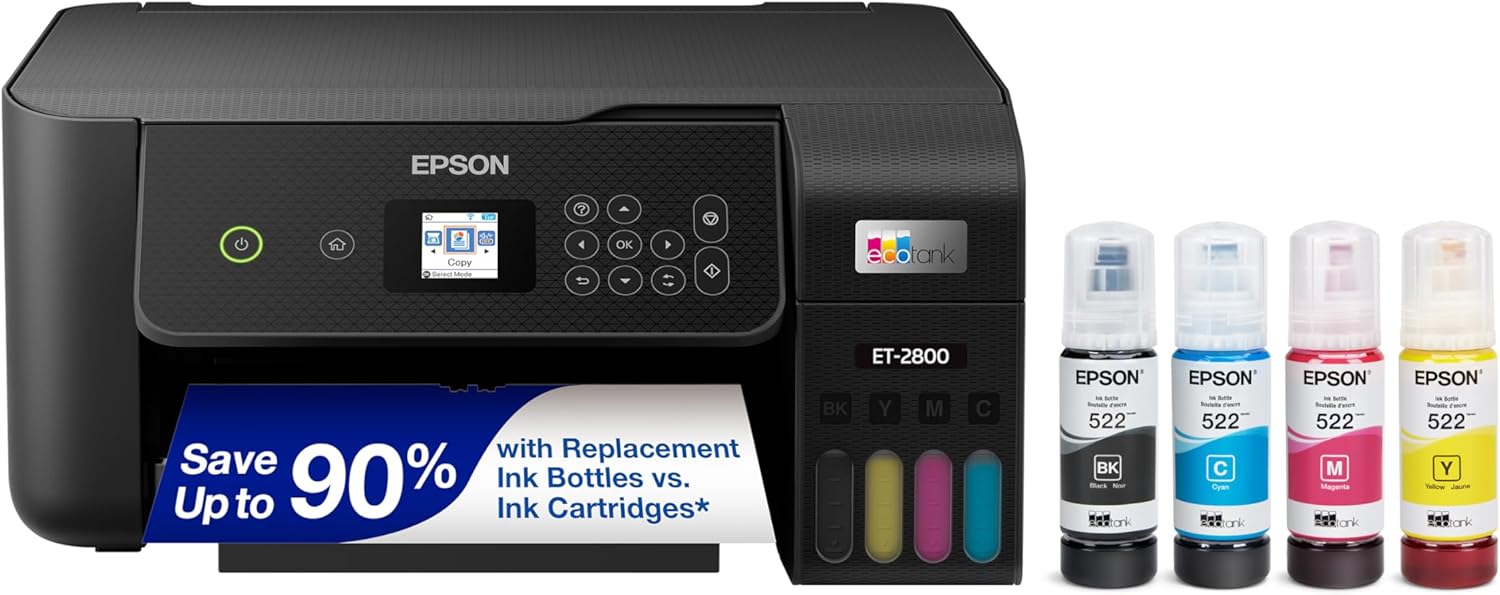
The EcoTank ET-2800 replaces cartridges with large refillable ink tanks, making it a practical pick for users who print frequently and want lower ink upkeep. It prints, copies, and scans with a flatbed scanner and supports wireless and USB connections plus app and voice-activated printing for easy mobile workflows. Photo and document output use Epson PrecisionCore Micro Piezo technology at a high optical resolution, so text is sharp and color photos are detailed on common paper types. Its key practical benefits are very low running cost per page—Epson claims a single refill set equals roughly 90 cartridges—and a 100-sheet feed capacity that handles typical home workloads without constant refills. Limits to expect: color speed is modest at about 5 ppm, duplexing is not automatic, and Epson recommends genuine ink to avoid performance issues. Setup and filling the tanks take more initial time than installing cartridges, but afterward the unit is notably economical and reliable for everyday home printing.
Best for: Buyers who prioritize low long-term ink costs and reliable everyday performance in a compact home printer will appreciate this model for document and occasional photo printing.
Less Ideal for: Users who need fast color throughput, automatic two-sided printing, or production-level volume should consider more business-oriented printers instead.
- Cartridge-free high-capacity ink tanks significantly reduce how often replacements are needed
- Wireless, USB, app and voice printing make mobile and home workflows simple
- High optical resolution and PrecisionCore technology deliver sharp text and detailed color prints
- 100-sheet capacity handles everyday home print jobs without constant reloading
- Color print speed is relatively slow compared with office-focused models
- No automatic duplexing; manual two-sided printing required
Verdict: Pick the EcoTank ET-2800 if you want a compact home all‑in‑one that cuts ink costs with cartridge-free refill tanks while delivering sharp prints for everyday use.
Brother Work Smart 1360 Printer

| Printer Type | Inkjet |
|---|---|
| Functions | Print, Copy, Scan |
| Duplex | Automatic |
| Maximum Sheet Capacity | 150 |
| Printer Connectivity Type | USB, Wi‑Fi |
The Brother Work Smart 1360 is a compact all‑in‑one inkjet aimed at home and small‑office users who need basic, reliable printing plus copying and scanning. It handles everyday jobs from to‑do lists and schoolwork to short business reports, offering wireless printing, USB connectivity, AirPrint and Mopria support, and a simple 1.8" color display for on‑device control. Productivity features include automatic two‑sided printing, a 20‑sheet single‑pass automatic document feeder for multi‑page scans and copies, and a 150‑sheet input tray so you can load batch jobs without constant refills. Print speeds are respectable for the class at up to 16 ppm black and 9 ppm color, and Brother's Page Gauge and Mobile Connect app make ink management and remote printing straightforward. Limitations include standard yield starter cartridges that will need replacing sooner than high‑yield options, and it is not designed for heavy duty volume or photo studio quality output. For buyers prioritizing space savings and practical day‑to‑day performance, it covers the essentials well.
Best for: Buyers who need a space‑saving, no‑frills multifunction printer for everyday home or small‑office tasks and who value wireless mobile printing and automated duplexing.
Less Ideal for: Users who require high monthly page volumes, enterprise features, or professional lab‑quality photo output should look at larger capacity or specialized photo printers.
- Automatic duplexing for two‑sided printing reduces paper use
- 20‑sheet ADF and flatbed scanner for quick multi‑page copying and scanning
- Wireless printing plus AirPrint and Mopria make mobile printing easy
- 150‑sheet tray reduces the need for frequent paper refills
- Compact footprint suitable for small desks or home offices
- Starter ink cartridges are standard yield and will need early replacement
- Not intended for high‑volume production or professional photo printing
Verdict: A compact, practical all‑in‑one that delivers reliable everyday printing and smart mobile features for small spaces.
HP DeskJet 2955 All-in-One

| Printer Type | HP Thermal Inkjet |
|---|---|
| Scanner Type | Flatbed |
| Maximum Sheet Capacity | 60 |
| Color Pages per Minute | 5.5 pages_per_minute |
| Printer Connectivity Type | Apple AirPrint; USB; Wireless (Wi-Fi); Wireless direct printing; Mopria |
The HP DeskJet 2955 is a small, budget-oriented all‑in‑one designed for everyday home use. It prints color and black documents, copies and flatbed scans, and connects via USB, AirPrint, Mopria, or Wi‑Fi for mobile printing from phones and laptops. The 60‑sheet input tray and manual duplex support keep the design compact, while the HP app and an included 3‑month Instant Ink trial simplify mobile workflows and ink replacement. Print speeds are modest — up to about 7.5 ppm black and 5.5 ppm color — so it suits light duty rather than high‑volume jobs, and the initial page appears in around 20 seconds. Resolution specs support decent text and basic photo prints when using appropriate papers, but photo quality will not match higher-end photo printers. The unit is energy efficient and uses HP 68 cartridges for straightforward supply replacement. If you need a small, inexpensive printer for recipes, schoolwork, and occasional photos, the DeskJet 2955 delivers the essentials without extra complexity.
Best for: Buyers wanting an inexpensive, space-saving printer for light home tasks like documents, schoolwork, and occasional photos who value easy mobile printing and low upfront complexity.
Less Ideal for: People who need fast, high-volume printing, automatic duplexing, or professional photo-quality output should consider higher-capacity or dedicated photo printers.
- Compact all‑in‑one design fits small home workspaces
- Wireless and mobile printing support including AirPrint and Mopria
- Includes 3‑month Instant Ink trial to simplify ink replacement
- Energy efficient and made with recycled plastics
- Modest print speeds and manual duplex limit throughput for heavy use
- Small 60‑sheet tray requires frequent refills for larger jobs
Verdict: A compact, budget-friendly all‑in‑one that delivers straightforward home printing and easy mobile setup for light-duty users.
Canon IVY Mini Photo Printer

| Print size | 2 x 3" |
|---|---|
| Print resolution | 314 x 400 DPI |
| Connectivity | Bluetooth |
| Maximum sheet capacity | 10 |
| Printer type | Thermal |
The Canon IVY Mini is a compact thermal photo printer designed to turn smartphone images into 2 x 3-inch borderless prints you can peel and stick. It pairs over Bluetooth to the Canon Mini Print app where you edit, crop, add filters and then send jobs to the printer; prints take under a minute and the device uses Zero Ink technology so there are no cartridges to replace. The unit supports glossy 2 x 3 media in small ZINK-style packs and holds up to 10 sheets, making it convenient for on-the-go use, parties, and scrapbooking. Print resolution is modest at 314 x 400 dpi, which delivers good-looking casual photos but will not match lab prints for fine detail or color depth. Battery and paper are the main ongoing consumables, and throughput is limited by the small sheet capacity and relatively slow per-print time, so it is best for short runs rather than bulk printing. For buyers who want a truly portable, low-maintenance way to get instant physical photos from a phone, the IVY is straightforward and reliable.
Best for: Buyers who prioritize a dependable, low-maintenance compact printer for casual phone photos and want quick peel-and-stick prints for events, travel, or memory keeping.
Less Ideal for: People who need high-volume or high-resolution photo output for professional work or who prefer larger print sizes and full-color lab-grade results.
- Truly pocketable design for easy transport and mobile use
- Zero Ink thermal printing so no ink cartridges or messy replacements
- Peel-and-stick glossy 2 x 3" prints for instant sharing and scrapbooking
- Simple Bluetooth pairing and app-based editing before printing
- Automatic borderless printing with quick setup and minimal moving parts
- Small 10-sheet capacity requires frequent paper refills for larger events
- 314 x 400 dpi resolution is fine for casual snapshots but not for high-detail photo work
Verdict: Choose the Canon IVY when you want a reliable, truly portable thermal printer that produces instant peel-and-stick 2×3 photos with minimal upkeep.
HP DeskJet 2855e All-in-One Printer
| Printer Type | Inkjet |
|---|---|
| Scanner Type | Flatbed |
| Compatible Cartridge | HP 67 |
| Printer Connectivity Type | single band wi-fi (2.4ghz only) |
| Maximum Sheet Capacity | 60 |
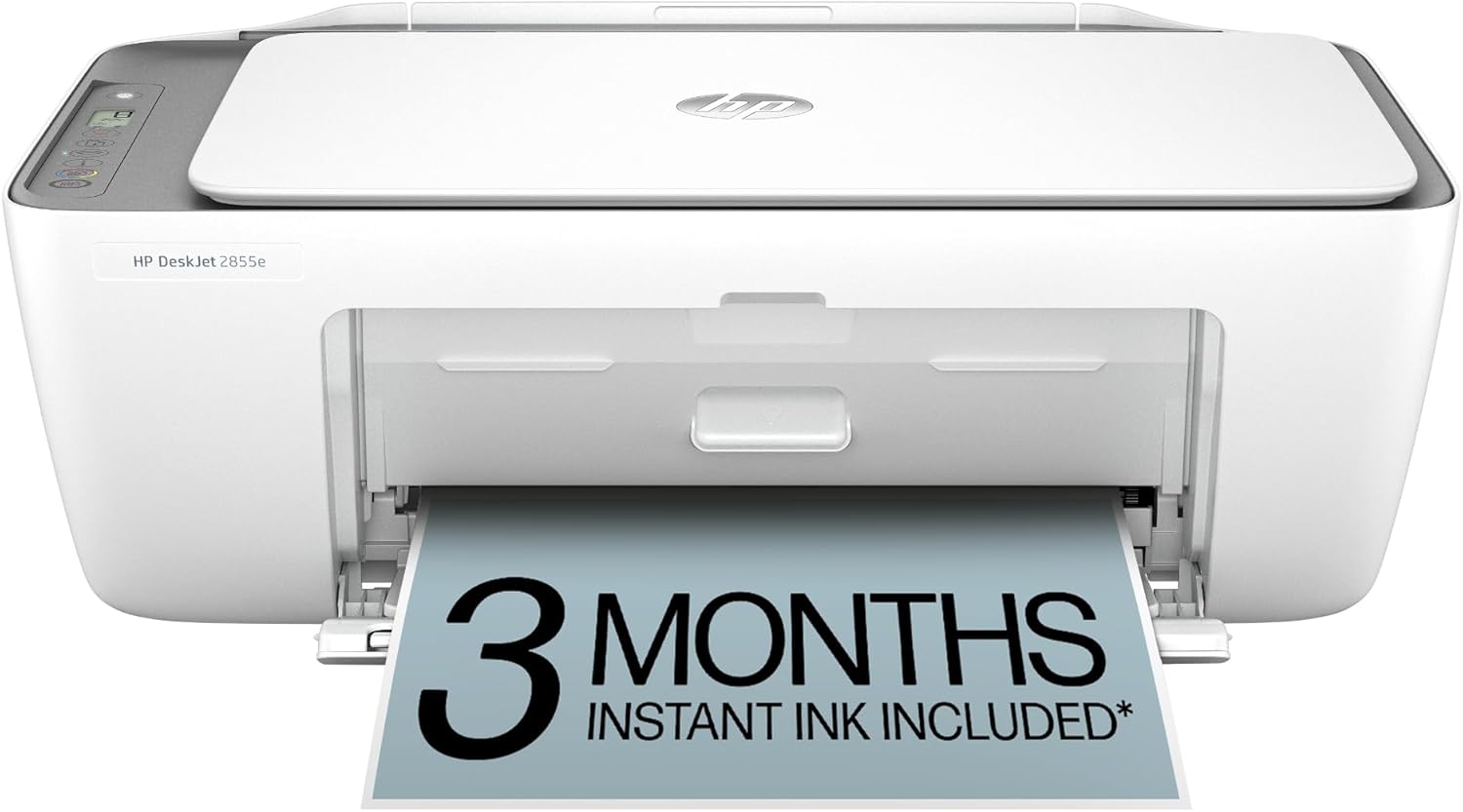
The HP DeskJet 2855e is a small all-in-one inkjet designed for home use where space and simple wireless printing matter most. It prints color and black documents, scans on a flatbed, and copies with manual duplexing when you need two-sided output. Setup and daily use lean on the HP app and single-band 2.4 GHz Wi-Fi so you can print from a smartphone or PC without a direct cable most of the time, and HP includes a three-month Instant Ink trial when you activate HP+. Print quality is reasonable for documents, web pages, and casual photo prints thanks to a quoted 4800 x 1200 dpi color resolution, while speeds are modest at about 5.5 ppm color and 7.5 ppm black. The 60-sheet tray keeps the footprint compact but means frequent refills in busier households. If you want a simple, budget-friendly printer for occasional home documents, the 2855e delivers straightforward features; power users who need faster speeds, automatic duplex, or robust network options will find it limited.
Best for: Buyers who want a small, app-driven all-in-one for light home printing, scanning, and copying with easy smartphone workflows and a low initial setup barrier.
Less Ideal for: Users who need fast page throughput, built-in automatic duplex, robust office networking, or high-volume capacity should consider larger, more capable models.
- Compact footprint suited to small desks or counters
- All-in-one functions: print, scan, copy in one unit
- Mobile-first workflow with HP app and smartphone printing
- Includes 3-month Instant Ink trial with HP+ activation
- Decent color resolution for document and casual photo prints
- Only single-band 2.4 GHz Wi-Fi so no 5 GHz support
- No automatic duplexing; two-sided prints must be manual
- 60-sheet input tray requires frequent refills under heavier use
Verdict: A compact, app-focused all-in-one that fits small home desks and simple mobile printing needs.
Canon PIXMA TS6520

| Printer Type | Inkjet |
|---|---|
| Duplex | Automatic |
| Printer Connectivity Type | USB, Wi-Fi |
| Display Type | OLED |
| Color Pages per Minute | 9 pages_per_minute |
The Canon PIXMA TS6520 is a small, budget-focused all‑in‑one that handles everyday home and light office printing with a simple, user-friendly approach. It uses a two‑cartridge hybrid ink system to deliver sharp black text and reasonably vibrant color prints, and its flatbed scanner covers basic scanning and copying tasks. Setup is straightforward via the Canon PRINT app, AirPrint, or Mopria, and built‑in Wi‑Fi (including dual‑band support) makes mobile printing easy. The 1.42” OLED shows status and ink levels at a glance, and automatic two‑sided printing helps reduce paper use. On the downside it has a very small input capacity and no automatic document feeder, so it is not suited for high-volume batching or multi-page scanning. Print speeds are modest for color jobs but acceptable for typical household use. Overall, the TS6520 is a reliable, space-saving choice for buyers who want capable printing, scanning, and copying without extra enterprise features.
Best for: Buyers who prioritize a reliable, easy-to-use compact printer for home, student, or small‑office tasks and want straightforward wireless/mobile printing without extra complexity.
Less Ideal for: People who need high daily page volumes, frequent multi-page scanning, or a large paper tray should look at higher-capacity multifunction models.
- Compact footprint fits small desks or shelves
- Automatic two-sided (duplex) printing saves paper
- Straightforward mobile and wireless printing with dual-band Wi‑Fi
- Hybrid two‑cartridge ink system delivers clear text and good color for photos and documents
- Very limited paper input capacity and no automatic document feeder
- Not designed for high-volume or heavy multi-page scanning tasks
Verdict: A compact, no-frills all‑in‑one that delivers dependable wireless printing, scanning, and automatic duplexing for risk-averse home and student buyers.
Choosing the Right Compact Printer: Key Factors to Consider
Footprint and Placement
A compact printer's physical footprint is the defining factor for small-space buyers. Measure the width, depth, and height and compare those to your intended location, whether a narrow shelf, a corner desk, or a shared counter. Consider clearance for opened trays and access panels so you do not end up with a model that technically fits but cannot be used without moving it.
Beyond raw dimensions, think about ventilation and cable routing. Compact printers often sit close to walls or under cabinets, so ensure there is enough space for airflow and for power and network cables. A printer that is easy to tuck away but still accessible for paper loading and maintenance will save time and frustration.
Print Quality and Resolution
Print quality affects how you use the device day to day. For text-heavy tasks, look for models that produce crisp, dark text with consistent toner or ink coverage. If you occasionally print photos or marketing materials, check advertised resolution and sample output for color accuracy and fine detail.
Remember that higher resolution does not always mean better results if the ink system or driver processing is weak. For mixed use, prioritize balanced performance: strong text reproduction with satisfactory photo prints rather than extreme specialization in one area.
Connectivity and Network Features
How you connect to the printer is a major convenience factor. Wireless printing with stable Wi-Fi is essential for modern small offices and homes. Look for reliable Wi-Fi setup options, support for mobile printing protocols, and wired Ethernet if you expect heavier shared use. Some compact models include direct-print features like a memory card slot or USB host that can reduce steps for occasional users.
Also consider security features and network management options. Even in small networks, features like password-protected Wi-Fi setup, guest printing, or simple web-based admin pages can simplify maintenance and protect your print jobs.
Paper Handling and Media Versatility
A compact printer's paper handling determines whether it meets your workflow without frequent refills. Check input tray capacity and whether the device supports common media sizes you use, such as legal paper, envelopes, labels, or glossy photo paper. Some compact printers use single multipurpose trays that require switching media often; others provide a small dedicated feed plus a rear tray for specialty media.
If you print infrequently in bursts, smaller trays are usually fine. If you produce moderate volumes or mixed media, prefer models with slightly larger input capacity or easy-to-use manual feed paths to reduce interruptions.
Operational Cost and Consumables
Ongoing cost is often the largest lifetime expense for printers. Evaluate how frequently ink or toner cartridges need replacement and whether high-capacity or economy cartridges are available. Consider whether the manufacturer offers subscription or bulk-replacement options and whether third-party supplies are compatible without voiding service terms.
Also factor in yield per cartridge and cost per page for your typical print mix. A compact device with low upfront cost can become expensive if it uses small, low-yield consumables that need frequent replacing.
Setup, Maintenance, and Usability
Ease of setup and daily operation determines how smoothly a compact printer fits into your workspace. Look for straightforward setup utilities, clear front-panel controls or a simple mobile app, and easily accessible refill areas. Maintenance tasks such as replacing cartridges, clearing paper jams, and updating firmware should be doable without moving the unit.
User-friendly drivers and mobile apps cut down the time spent managing print jobs. For shared environments, features like job cancel from the device or simple status indicators for low supplies are useful time-savers.
Best Setup Tips for Small Desks
Place the printer so that paper trays can open fully without obstruction and leave a few inches of clearance behind for cable access. If desk space is limited, consider a wall shelf or a small rolling cart that allows you to slide the unit out for maintenance.
Keep a small bin or tray for spare cartridges and a basic toolkit nearby. Regularly clean the feed rollers and remove dust from the paper path to avoid jams that are especially inconvenient in tight spaces.
- Measure twice before buying to ensure tray clearance
- Use a surge protector with a spare outlet for peripheral power
- Store spare paper and cartridges within arm's reach
Mobile and Cloud Printing Workflows
Enable mobile printing features to reduce the need for a dedicated desktop. Most compact printers support direct wireless printing from phones and tablets via standard protocols or a manufacturer app. Configure a consistent Wi-Fi SSID and keep the printer's firmware up to date for compatibility.
For cloud-based workflows, set up email-to-print or cloud-printing options if available. This allows you to send documents from anywhere and collect them at the compact unit without transferring files between devices.
- Test mobile printing with typical file types before relying on it
- Keep the printer on the same subnet as primary devices for best performance
Balancing Speed and Image Quality
Compact printers often trade speed for smaller mechanics and less robust paper paths. If you need occasional fast drafts, look for settings that favor draft mode for text jobs. Reserve higher quality settings for finished documents or photos.
Understand that color photo prints at high quality will take longer and may increase consumable usage. Adjust print presets to match the job type to optimize throughput and cost.
- Use draft mode for internal documents to save ink and time
- Create a custom print preset for frequent job types
Maintaining Print Quality Over Time
Regular maintenance preserves output quality. Run any built-in head cleaning or alignment utilities periodically, especially if the printer sits unused for stretches. Store unused photo paper in a dry place to avoid humidity-related defects.
Rotate through color print jobs occasionally to keep ink lines from drying in some systems, and replace cartridges promptly when low to avoid streaks or faint output.
- Run a maintenance cycle monthly if usage is light
- Keep firmware current for print-driver fixes and quality improvements
When to Choose Laser Vs. Ink in a Small Footprint
Within compact printers, both laser and ink technologies appear with small chassis. Laser-based compact units are often better for heavy text volumes thanks to toner longevity and faster first-page output. Ink-based compacts usually offer superior color photo quality and lower upfront cost for casual use.
Decide based on your print mix: frequent, high-volume text favors compact laser. Occasional color documents and photos favor compact ink devices. Consider consumable yield and replacement frequency as part of that decision.
- Choose laser for mostly black-and-white office documents
- Choose ink for mixed document and photo output needs
How We Chose the Best Compact Printer
We evaluated compact printers against practical, real-world needs for small-footprint printing. Our selection focused on units that minimize desk footprint while maintaining useful capabilities. Primary evaluation criteria included print quality for text and photos, connectivity options such as reliable Wi-Fi and mobile printing support, paper handling including input capacity and media versatility, operational cost factors like ink or toner efficiency, and ease of setup and daily use. We excluded oversized multifunction machines and specialized commercial printers that require dedicated space or heavy-duty maintenance. We also screened out models lacking basic wireless capability or models with consistently poor reliability reports. The final shortlist emphasizes devices that balance size with usable tray capacity, decent output resolution, straightforward network setup, and reasonable ongoing supply consumption. These are the dimensions that truly matter for buyers seeking compact printers for home offices and small workspaces.
Our full evaluation process is outlined in our review methodology.
FAQ
How much desk space will a compact printer actually save?
A compact printer reduces width and depth compared with standard units, often by several inches in each dimension. The real savings depend on tray design and whether the model uses a rear feed or front-loading input; measure intended space and account for tray clearance to know the effective footprint.
Are compact printers more expensive to operate per page?
Operational cost varies by model and printing technology. Some compact printers use smaller cartridges with lower yield, which can raise cost per page. Others support high-yield or economy supplies that bring costs down. Evaluate yield and replacement frequency for your expected monthly volume.
Can compact printers handle envelopes and specialty media?
Many compact printers accept envelopes and a limited range of specialty media via a multipurpose or rear feed. However, capacity is usually smaller and may require manual feed. Check the media specifications to ensure it supports the sizes and weights you plan to use.
Is wireless printing reliable on compact models?
Wireless printing can be reliable on compact models if the device has a good Wi-Fi radio and you place it within strong signal range. Performance depends on network conditions and firmware quality. For mission-critical environments, consider a wired Ethernet option if available.
Do compact printers require special maintenance?
Maintenance needs are similar to larger printers: occasional head cleaning, paper path checks, and cartridge replacement. Because compact units can have tighter internal tolerances, regular cleaning and using recommended supplies can prevent jams and preserve print quality.
Final Verdict
Choosing the right compact printer requires balancing physical size with the features you actually use. Prioritize footprint and tray clearance first, then match print technology to your typical output: laser for high-volume text, ink for color and photos. Pay attention to connectivity and consumable yields since these determine long-term convenience and cost. If you focus on the factors discussed here, you can confidently pick a compact printer that fits your workspace and handles your daily printing needs without compromise.