
Note: This article contains affiliate links. If you click on these links and make a purchase, we may earn a small commission at no extra cost to you. This helps support our research and content. Read our full affiliate disclosure here.
If you need a printer that fits tight spaces and connects easily to phones, tablets, and laptops, choosing the right compact wireless printer matters. Size, wireless reliability, and print quality affect how smoothly you handle everyday tasks like homework, invoices, and occasional photos. This guide shortlists the top compact wireless printers that balance a small footprint with dependable connectivity and usable print performance. We evaluated models for real-world home and small-office needs, focusing on speed, mobile printing, and ease of setup. Read on to see which features matter most and which shortlisted options match different priorities.
Top Picks at a Glance
| Best Overall The best all-around choice for most situations | Canon PIXMA TS6520 |  |
| Best Quality Built to a higher standard if you want something more solid | Epson EcoTank ET-2800 |  |
| Best Value The sweet spot between price and what you get | Brother HL-L2405W Laser Printer |  |
| Best Budget The cheapest option that still gets the job done reliably | HP DeskJet 2955 All-in-One Printer |  |
| Top Rated A top-rated pick with lots of positive feedback | Canon PIXMA TS4320 |  |
| Most Popular A crowd favorite that many people choose with confidence | HP DeskJet 2855e | 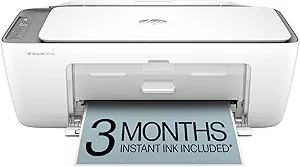 |
| Best Seller A high-volume bestseller chosen again and again | TATTMUSE A285M Portable Thermal Printer |  |
Canon PIXMA TS6520

| Printer Type | Inkjet |
|---|---|
| Print media | Paper (plain) |
| Printer Connectivity Type | USB, Wi-Fi |
| Duplex | Automatic |
| Color Pages per Minute | 9 pages_per_minute |
The Canon PIXMA TS6520 is a compact wireless all-in-one inkjet that handles everyday documents and photos with dependable print quality and an easy setup. It uses a two-cartridge hybrid ink system to produce sharp black text and vibrant color prints, and the 1.42-inch OLED display makes status checks and basic navigation straightforward. Duplex printing is automatic, which helps reduce paper use, and Wi-Fi support — including AirPrint and the Canon PRINT app — makes mobile printing simple from phones and tablets. The flatbed scanner covers basic scan and copy needs, though there is no automatic document feeder so bulk scanning requires manually placing pages. Print speeds are reasonable for home use, and the single paper tray keeps the footprint small, but monthly page volumes will show the limits of a two-cartridge setup compared with higher-capacity cartridge systems. Overall, it balances size, ease of use, and image quality for families, students, and hybrid workers who want a capable, space-saving printer without advanced business features.
Best for: Buyers who want a small, easy-to-use all-in-one that produces good everyday documents and photos and prioritizes space savings and wireless convenience.
Less Ideal for: Users who need high-volume printing, frequent multi-page scanning, or advanced business features should consider larger office-focused models instead.
- Compact footprint fits small home workspaces
- Automatic duplex printing saves paper and speeds workflows
- Reliable wireless connectivity with AirPrint, Canon PRINT app, and dual-band Wi-Fi
- Good print quality for documents and photos from the hybrid 2-cartridge ink system
- Simple setup and clear 1.42-inch OLED status display
- No automatic document feeder so multi-page scanning requires manual effort
- Single paper tray and modest sheet capacity limit heavy printing sessions
Verdict: Choose the PIXMA TS6520 if you want a compact, wireless all-in-one that delivers good everyday print and photo quality with automatic two-sided printing in a small footprint.
Epson EcoTank ET-2800
| Printer Type | Inkjet |
|---|---|
| Print Output | Color |
| Maximum print Resolution Color | 5760 x 1440 dpi |
| B&W Pages per Minute | 10 |
| Printer Connectivity Type | USB, Wi-Fi |
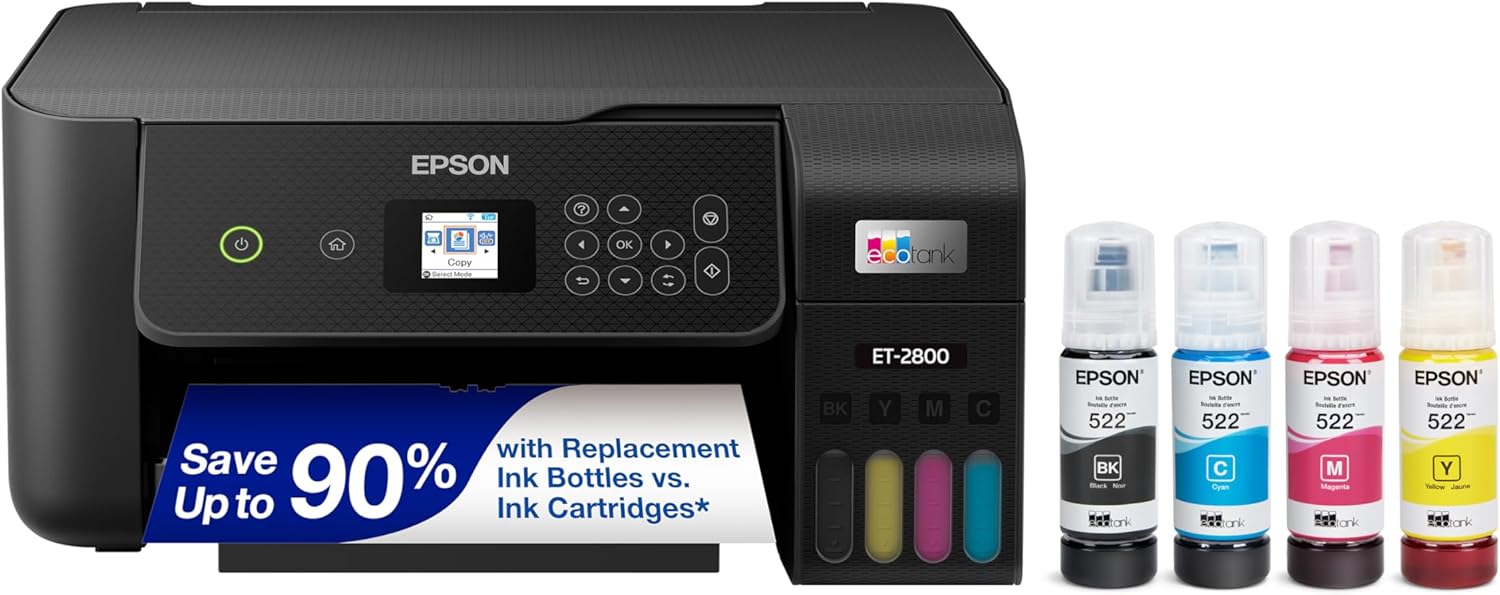
The Epson EcoTank ET-2800 is a compact cartridge-free all-in-one that replaces disposable cartridges with high-capacity refillable ink tanks, making it suited for frequent home printing. It prints, scans and copies with a high-resolution flatbed scanner and supports wireless and USB connectivity plus voice-activated printing for easy mobile workflows. Epson's PrecisionCore Micro Piezo print technology yields sharp text and respectable color photos, and the included ink set is rated to produce thousands of pages before refill, which cuts running costs and reduces waste. The 10 ppm black speed and 5 ppm color speed are modest but fine for typical home documents, while borderless photo support and high max dpi let you handle occasional photos. Limitations include simplex-only printing and basic paper handling with a single tray and a 100-sheet capacity, so it is not designed for heavy office throughput or automatic duplex jobs. Setup is straightforward and the refill bottles are keyed to avoid spills, but Epson recommends genuine ink to maintain performance and warranty coverage.
Best for: Buyers who prioritize low running costs and consistent print quality in a compact home printer and want convenient wireless and mobile-printing workflows.
Less Ideal for: Users who need heavy daily office printing, automated two-sided copying, or large paper capacity should consider a larger office-focused model.
- Cartridge-free EcoTank system greatly reduces frequency of ink replacement
- Wireless and voice-activated printing for easy mobile and hands-free use
- High-resolution print capability suitable for detailed documents and photos
- Included ink yield supports thousands of pages, lowering long-term cost
- No automatic duplex printing, so two-sided jobs require manual flipping
- Single tray and 100-sheet capacity limit large or continuous print runs
Verdict: Choose the ET-2800 if you want a compact, cartridge-free home printer that cuts ink costs and handles everyday wireless printing with good quality.
Brother HL-L2405W Laser Printer

| Printer Type | Laser |
|---|---|
| Print Speed | 30 pages_per_minute |
| Maximum Print Resolution | 1200 x 1200 |
| Printer Connectivity Type | USB, Wi-Fi |
| Maximum Sheet Capacity | 250 |
The Brother HL-L2405W is a small, no-frills monochrome laser printer built for home and home-office use where speed and reliability matter more than color or multifunction features. It prints one-sided black-and-white pages at up to 30 ppm with a 1200 x 1200 dpi resolution for sharp text and simple graphics, and the 250-sheet tray reduces how often you reload paper. Setup and mobile printing are handled via built-in dual-band Wi-Fi and a USB 2.0 port, plus Brother Mobile Connect for sending jobs from phones and tablets. The printer supports envelopes and specialty paper through a manual feed and is eligible for Brother Refresh toner subscription if you want automated supplies. You will not get automatic duplexing, color, scanning, or copying here, so it is best as a dedicated, space-saving print engine rather than an all-in-one. Power use and toner yield are typical for entry laser models, and using Brother genuine TN830/TN830XL cartridges keeps output consistent.
Best for: Buyers who want a compact, dedicated black-and-white printer that prioritizes speed, reliable text quality, and low desktop footprint for a home or small office.
Less Ideal for: Anyone who needs color printing, an all-in-one scanner/copier, or automatic two-sided printing should choose a different model.
- Fast monochrome printing up to 30 pages per minute for quick document runs
- Compact footprint and 250-sheet tray suitable for small desks or home offices
- Dual-band Wi-Fi plus USB connection and mobile printing via Brother Mobile Connect
- 1200 x 1200 dpi resolution yields crisp text and clear black-and-white prints
- No automatic duplexing, scanning, or copying functions included
Verdict: A compact, fast monochrome laser printer that delivers dependable text-first performance for space-conscious home and small-office users.
HP DeskJet 2955 All-in-One Printer

| Printer Type | HP Thermal Inkjet |
|---|---|
| Print Speed (B&W) | 7.5 pages_per_minute |
| Print Speed (Color) | 5.5 pages_per_minute |
| Input Capacity | 60 sheets |
| Connectivity | Wi‑Fi; AirPrint; USB; Wireless direct; Mopria |
The HP DeskJet 2955 is a small, budget-focused all-in-one that handles everyday home printing, scanning, and copying. It connects via dual-band Wi‑Fi, AirPrint and USB, and includes an intuitive icon LCD and the HP app for printing from phones. The 60-sheet input tray and flatbed scanner make it suitable for short runs like school worksheets, recipes, and letters, while HP AI formatting helps trim web pages before printing to avoid wasted pages. Print speeds are modest—around 7.5 ppm black and 5.5 ppm color—and duplexing is manual, so larger or frequent print jobs will be slower and require extra handling. The printer ships with starter HP 68 setup cartridges and a three-month Instant Ink trial to simplify ink replenishment, though ongoing ink costs depend on subscription choices. Its compact footprint and recycled-plastic construction make it a practical fit for tight spaces, but it is not intended for high-volume office use or photo-grade printing.
Best for: Buyers seeking an affordable, compact all-in-one for occasional home printing, scanning, and copying who prioritize simple wireless setup and low upfront cost.
Less Ideal for: People who need fast, high-volume printing, automatic duplexing, or professional photo-quality output should choose a more capable model.
- Compact footprint that fits small home workspaces
- Wireless and mobile printing support including AirPrint and the HP app
- Includes flatbed scanner and basic copy functions for home tasks
- 60-sheet input tray and starter cartridges make it ready for light use out of the box
- Three-month Instant Ink trial simplifies ink replacement for infrequent users
- Modest print speeds and manual duplex make it slow for larger print jobs
- Not designed for high-quality photo prints or heavy office workloads
Verdict: A compact, wallet-friendly all-in-one that covers basic home printing and scanning with easy wireless setup and low upfront commitment.
Canon PIXMA TS4320

| Printer Type | Inkjet |
|---|---|
| Duplex | Automatic |
| Printer Connectivity Type | USB, Wi-Fi |
| Compatible Cartridge | PG-295/CL-286 |
| Maximum print Resolution Color | 1200 x 1200 dpi |
The Canon PIXMA TS4320 is a small, budget-friendly all-in-one inkjet that handles everyday home tasks like documents, school projects, and photos. It connects over USB or dual-band Wi‑Fi and supports mobile printing via the Canon app, AirPrint, and Mopria, which makes printing from smartphones and laptops straightforward. The two-cartridge hybrid ink system produces sharp text and vivid color photos, and automatic duplexing saves paper for longer print jobs. The flatbed scanner is useful for occasional scans and copies, though there is no automatic document feeder or touchscreen display, so multi-page workflows are more manual. Paper capacity is modest at 100 sheets and print speeds are targeted at casual use rather than high-volume jobs, so expect slower throughput on large batches. Setup is simple and the unit's compact footprint fits easily on a shelf or desk, making it a practical choice if you want reliable, space-conscious printing without advanced office features.
Best for: Buyers who want a dependable, space-saving all-in-one for occasional home printing, photos, and schoolwork and prioritize straightforward wireless setup and consistent basic performance.
Less Ideal for: Users who need fast, high-volume output or frequent multi-page scanning and copying where an ADF, larger paper capacity, or faster engine is required.
- Compact footprint fits easily on a desk or shelf
- Dual-band Wi‑Fi plus mobile printing (Canon app, AirPrint, Mopria) for convenient wireless use
- Automatic two-sided printing reduces paper usage
- Hybrid two-cartridge ink system delivers sharp text and vibrant photo color
- No automatic document feeder or touchscreen, making multi-page scanning and controls more manual
- Modest 100-sheet tray and moderate print speeds not suited to high-volume printing
Verdict: A compact, reliable wireless all-in-one that delivers straightforward home printing and good photo quality without taking up much space.
HP DeskJet 2855e
| Printer Type | Inkjet |
|---|---|
| Scanner Type | Flatbed |
| Compatible Cartridge | HP 67 |
| Maximum print Resolution Color | 4800 x 1200 dpi |
| Printer Connectivity Type | single band wi-fi (2.4ghz only) |
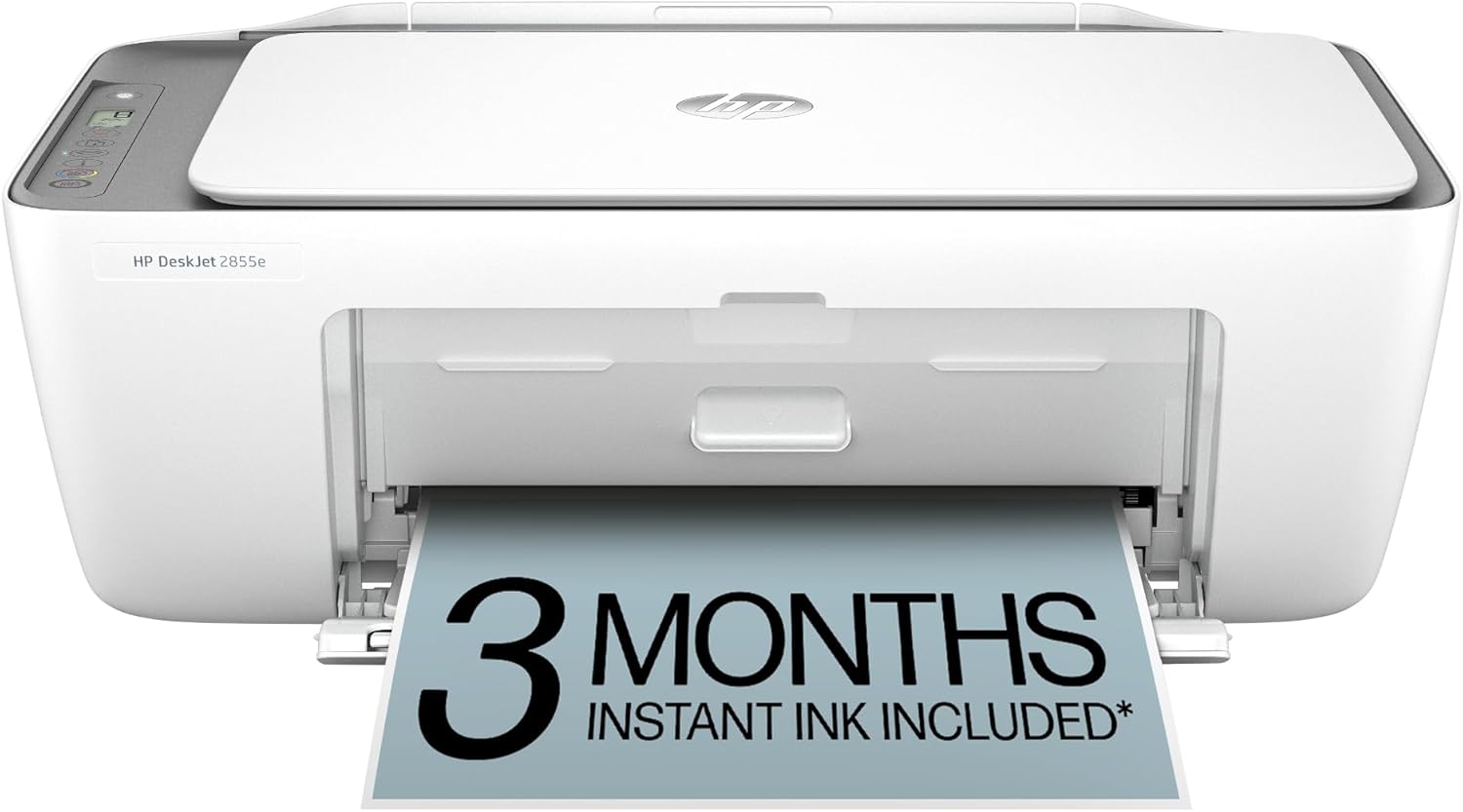
The HP DeskJet 2855e is a small all-in-one inkjet designed for home use where space and simplicity matter. It handles basic color and black-and-white printing, flatbed scanning, and copying, with print speeds around 5.5 ppm color and 7.5 ppm black. Setup and everyday control rely on the HP app, which also enables HP+ features like a three-month Instant Ink trial and AI-driven web-page formatting to avoid wasted pages. The printer uses HP 67 cartridges and supports a single-band 2.4 GHz Wi-Fi connection plus a USB 2.0 port. Its 60-sheet input tray and manual duplexing keep the unit compact, but mean heavier users will need to reload paper more often and flip pages for double-sided jobs. Image quality is reasonable for documents and casual photos but not for professional photo work. For buyers who prioritize straightforward wireless printing, compact footprint, and app-driven convenience, this is a practical choice; power users who need faster speeds, automatic two-sided printing, or advanced photo quality should consider larger models instead.
Best for: Buyers who want a compact, app-driven home printer that handles occasional color documents, scans, and copies without complicated setup and who value reassurance from established features and service options.
Less Ideal for: Users who need fast, high-volume printing, automatic duplexing, or professional-grade photo output should look at more capable office or photo printers.
- Compact all-in-one design fits small desks or shelves
- App-based control and HP AI formatting to simplify mobile and web printing
- Includes 3-month Instant Ink trial with HP+ activation for easy ink delivery
- 60-sheet input tray suitable for typical home document tasks
- Single-band 2.4 GHz Wi‑Fi only and no automatic duplexing
- Not optimized for high-volume or professional photo printing
Verdict: A compact, easy-to-use home all-in-one that delivers reliable app-driven printing and a short Instant Ink trial for buyers who prioritize simplicity and space savings.
TATTMUSE A285M Portable Thermal Printer

| Printer Type | Thermal |
|---|---|
| Maximum Media Size | 8.5 x 11 inch |
| Connectivity | Bluetooth, USB |
| Maximum Print Resolution Black and White | 203 dots_per_inch |
| B&W Pages per Minute | 7 |
The TATTMUSE A285M is a small, rechargeable thermal printer built for on-the-go black-and-white printing. It prints directly to thermal paper so there is no ink, toner, or ribbon to replace, and supports multiple thermal media widths including US Letter and A4, roll or single-sheet formats. Bluetooth pairing and a companion app make printing from phones and tablets straightforward, while a USB-C connection and downloadable driver allow use with laptops and PCs. At about 7 ppm and roughly 203 dpi effective resolution, it is suitable for receipts, invoices, short documents and boarding passes rather than high-detail photos. The built-in paper bin and 160-sheet capacity make it convenient for mobile work, and the unit is lightweight for travel. Important limitations are that it only prints monochrome on thermal paper and laptops require a driver and wired connection; it also cannot use regular copy paper. For everyday mobile printing tasks where speed and simplicity matter, this unit delivers a portable, low-maintenance solution, but it is not a substitute for full-featured office laser or inkjet printers when color or standard paper handling is needed.
Best for: Buyers who prioritize reliable, low-maintenance mobile printing for invoices, receipts, and short documents and want a compact device that travels easily.
Less Ideal for: Those who need color printing, photo-quality output, standard copy-paper support, or a full-featured office printer for high-volume document workflows should look elsewhere.
- Inkless thermal printing eliminates ink, toner, and associated maintenance
- Supports multiple thermal paper sizes including US Letter and A4 for flexible use
- Bluetooth app control for phone/tablet printing plus USB-C for computer connection
- Lightweight, rechargeable design with built-in paper bin for mobile use
- Can handle continuous roll and single-sheet thermal media and holds up to 160 sheets
- Prints only in monochrome on thermal paper, not compatible with regular copy paper
- Laptops and desktops require a driver and wired USB connection rather than Bluetooth
- Resolution and speed are modest compared with office-grade printers
Verdict: A285M is a travel-ready, inkless thermal printer that gives reliable monochrome printing from phones and laptops when you need fast, low-maintenance output on the go.
Choosing the Right Compact Wireless Printer: Key Factors to Consider
Wireless Connectivity Options
Compact wireless printers differ in how they connect to your devices. Dual-band Wi-Fi and Wi-Fi Direct reduce interference on crowded home networks and let multiple users connect without a router. Mobile printing standards such as AirPrint and Mopria simplify printing from phones and tablets, while a dedicated app can add features like remote scanning.
Choosing a model with robust wireless options means fewer connection drops, faster transfers of print jobs, and simpler day-to-day use. If you rely on smartphones for most prints, prioritize straightforward mobile-print compatibility and a stable wireless radio over advanced desktop-only features.
Print Speed And Duty Cycle
Print speed, typically measured in pages per minute, determines how long routine printing tasks take. For occasional home use, moderate speeds may suffice, but a faster compact printer noticeably improves productivity for households that print homework, invoices, or multi-page documents regularly.
Duty cycle indicates how many pages a device can handle per month before wear becomes a concern. Even compact models vary widely in recommended monthly volumes. Match the duty cycle to your estimated monthly output to avoid overworking a small machine and shortening its usable life.
Output Quality For Text And Photos
Quality needs vary by use case. For mostly text documents, sharp black-and-white output and consistent toner or ink delivery are more important than high-resolution photo performance. If you occasionally print photos or color graphics, check supported resolutions and whether the printer uses separate color cartridges to improve color management.
Ink and toner technologies affect longevity and running costs as well as quality. Consider how often you print color pages versus monochrome and whether acceptable photo quality is required for occasional prints rather than frequent photo production.
Size, Design, And Placement
A defining feature of compact wireless printers is their small physical footprint. But compact designs trade off features such as large paper trays and high-capacity cartridges. Measure the intended shelf or desk space and allow clearance for paper input/output and access to cartridges. Vertical designs save desk space but may be harder to reach for some users.
Also think about visibility and noise. A compact printer placed in a living area should have quiet operation and a neutral appearance, while a tucked-away model can prioritize capacity over style.
Cartridge Cost And Replacement
Running costs can outweigh upfront differences over time. Compact printers often use smaller cartridges, which can mean more frequent replacements. Look at estimated page yields and whether high-yield options are available. Some models use ink tanks or refillable systems that reduce long-term costs but may increase initial complexity.
Consider how easy it is to change cartridges and whether the printer supports separate cartridges for each color, which can save money when you only need to replace one color.
Setup, App Support, And Usability
A small, capable printer is only useful if it is easy to set up and operate. Good manufacturers include clear setup wizards, intuitive mobile apps, and straightforward firmware updates. App features such as cloud printing, scan-to-email, or on-device editing can meaningfully increase usefulness for remote work or school tasks.
Also evaluate control interfaces. A simple touchscreen or clear LED indicators reduce friction for nontechnical users and make routine tasks like recalibrating or aligning print heads less frustrating.
Which Compact Wireless Printer Is Right For A Small Desk
When desk space is limited, focus first on the unit's footprint and paper handling. Low-profile and vertical units take up less horizontal space but check feed and output areas so you do not block monitors or keyboards. Consider printers with fold-away trays or top-loading paper paths to minimize obstruction.
Also factor in how often you will access the machine. If you need to change cartridges frequently or clear paper jams, a model with front access is easier to maintain in tight spaces.
- Measure desk clearance including open trays
- Prefer front-access cartridges for cramped setups
- Look for fold-away trays to save horizontal space
Mobile Printing And App Features That Matter
Mobile printing is a core advantage of wireless printers. Support for AirPrint, Mopria, or a stable vendor app simplifies sending jobs from phones and tablets. Apps can also provide scanning, cloud uploads, and firmware updates, turning a compact printer into a small multi-function hub.
Check whether the app supports secure printing or job preview so you can avoid wasted pages. The quality of the mobile experience often determines how seamlessly the printer integrates into a smartphone-centric household.
- Verify AirPrint or Mopria support for native mobile printing
- Look for app features like scan-to-cloud and job preview
- Secure-print options help protect sensitive documents
Managing Ongoing Costs And Consumables
Consumables dominate lifetime costs for small printers. Buy a machine with clear yield specifications and optional high-yield cartridges if you expect regular volume. Refillable ink tank systems offer the lowest per-page cost but check initial setup complexity and spare-part availability.
Also consider subscription or bulk-replacement options if available from the manufacturer, and verify how easy it is to obtain cartridges locally to avoid downtime.
- Compare page yields and high-yield cartridge availability
- Consider refillable tank systems for heavy color use
- Confirm local consumable availability to prevent delays
Speed Versus Quality: Balancing Priorities
Faster printers reduce wait times but can sacrifice color depth or fine detail in some compact designs. If most of your printing is text, prefer units with higher monochrome ppm and fast first-page-out times. For occasional photos, look for models that offer a dedicated photo mode or higher DPI settings.
Think about realistic workloads. A compact printer that is slightly slower but produces better text clarity and fewer reprints may be preferable to a marginally faster machine that wastes ink or produces poor-quality output.
- Prioritize monochrome speed for document-heavy users
- Choose higher DPI or photo modes for occasional images
- Factor first-page-out time into perceived responsiveness
Network Security And Multiuser Environments
In homes where multiple people connect to the printer, network security matters. Look for WPA2 or WPA3 support and features such as password-protected Wi-Fi Direct to prevent unauthorized use. Some printers also offer user-level controls or guest networks to separate printing traffic from other devices.
If the printer will be shared across different devices, pick models that handle concurrent jobs gracefully and provide clear status reporting so users know when the device is busy or out of ink.
- Prefer WPA2/WPA3 and secure Wi-Fi Direct implementations
- User controls and guest modes help manage shared use
- Clear status reporting reduces accidental job conflicts
How We Chose the Best Compact Wireless Printer
We compiled this list by applying practical filters that reflect everyday home and small-office needs. Primary technical criteria included wireless connectivity options and stability, assessing support for dual-band Wi-Fi, Wi-Fi Direct, and common mobile printing protocols. Print speed and duty cycle were used to estimate real-world throughput for typical users who print documents and occasional color pages. Color and black-and-white output quality were evaluated conceptually through supported resolutions and ink/toner technology to ensure acceptable text and basic image reproduction. Size and physical footprint were measured against compact-design standards so units would fit small desks or shelves. Finally, setup and ongoing usability were considered, including ease of installation, app usability, and cartridge access for replacements. We excluded large-format and heavy-duty office machines that exceed compact dimensions or duty cycles. Specialty commercial printers and devices that require network administration were not considered. The resulting picks represent compact wireless printers that best balance speed, connectivity reliability, print quality, and everyday convenience for home and small-office use.
Our full evaluation process is outlined in our review methodology.
FAQ
Do compact wireless printers support printing from smartphones?
Often they do. Most compact wireless printers support mobile protocols like AirPrint or Mopria or offer a vendor app. Support varies by model, so check the specific connectivity options before buying.
How much desk space do compact wireless printers actually save?
It depends. Compact designs reduce horizontal footprint and may be vertical, but you still need clearance for paper trays and access to cartridges. Measure your intended location and compare dimensions, including open tray length.
Are refillable ink tanks a good option for compact models?
They can be for users who print color frequently because refillable tanks lower per-page costs. However, these systems may increase the unit's height or complexity and sometimes require more maintenance than cartridge-based models.
Will a compact wireless printer handle occasional photo printing?
Usually basic photo printing is possible, but output quality varies. Look for models that support higher DPI and a photo or high-quality color mode if you plan to print images occasionally.
How do I reduce connection drops with a wireless printer?
Place the printer within a good line of sight to your router or use dual-band Wi-Fi to avoid crowded 2.4 GHz interference. Enabling Wi-Fi Direct for device-to-printer connections can also improve reliability for mobile printing.
Final Verdict
When choosing a compact wireless printer, prioritize the few features that matter most to how you print. If documents dominate your workload, favor units with faster monochrome speeds and reliable wireless connectivity. If color and occasional photos are important, focus on output quality, color cartridge configuration, and consumable yields. Remember that a small footprint often means tradeoffs in tray capacity and consumable size, so match the duty cycle and cartridge options to your expected monthly volume. With those tradeoffs in mind, you can confidently pick a compact wireless printer that fits your space and daily needs.