
Note: This article contains affiliate links. If you click on these links and make a purchase, we may earn a small commission at no extra cost to you. This helps support our research and content. Read our full affiliate disclosure here.
A countertop filtered water dispenser for home use makes it simple to get clean, ready-to-drink water without rewiring plumbing or filling reusable bottles. Whether you want consistent cold water for beverages, warm water for tea, or an easy source of filtered tap water for cooking, the right dispenser improves convenience and reduces single-use plastic. This guide shortlists the top options for home kitchens and evaluates each pick on filtration performance, flow and dispensing reliability, ease of setup, and maintenance needs. Scroll through our top picks and read the buying factors that matter so you can choose a dispenser that fits your daily routine and water-quality goals.
Top Picks at a Glance
| Best Overall The best all-around choice for most situations | Bluevua ROPOT Countertop RO |  |
| Best Quality Built to a higher standard if you want something more solid | PHILIPS Countertop RO Dispenser |  |
| Best Value The sweet spot between price and what you get | Culligan 40 Cup Glass Dispenser |  |
| Best Budget The cheapest option that still gets the job done reliably | PUR 30-Cup Water Filter Dispenser |  |
| Top Rated A top-rated pick with lots of positive feedback | Purcooflow P3 Countertop RO |  |
| Most Popular A crowd favorite that many people choose with confidence | Brita UltraMax 27-Cup Dispenser |  |
| Best Seller A high-volume bestseller chosen again and again | DREO RO Countertop Water Filter WF113 |  |
Bluevua ROPOT Countertop RO
| Purification Method | Reverse Osmosis |
|---|---|
| Power Source | Corded Electric |
| Maximum Flow Rate | 0.26 liters per minute |
| Supported Water TDS Level Maximum (PPM) | 1000 |
| Filter Life Cycle | 24 months |
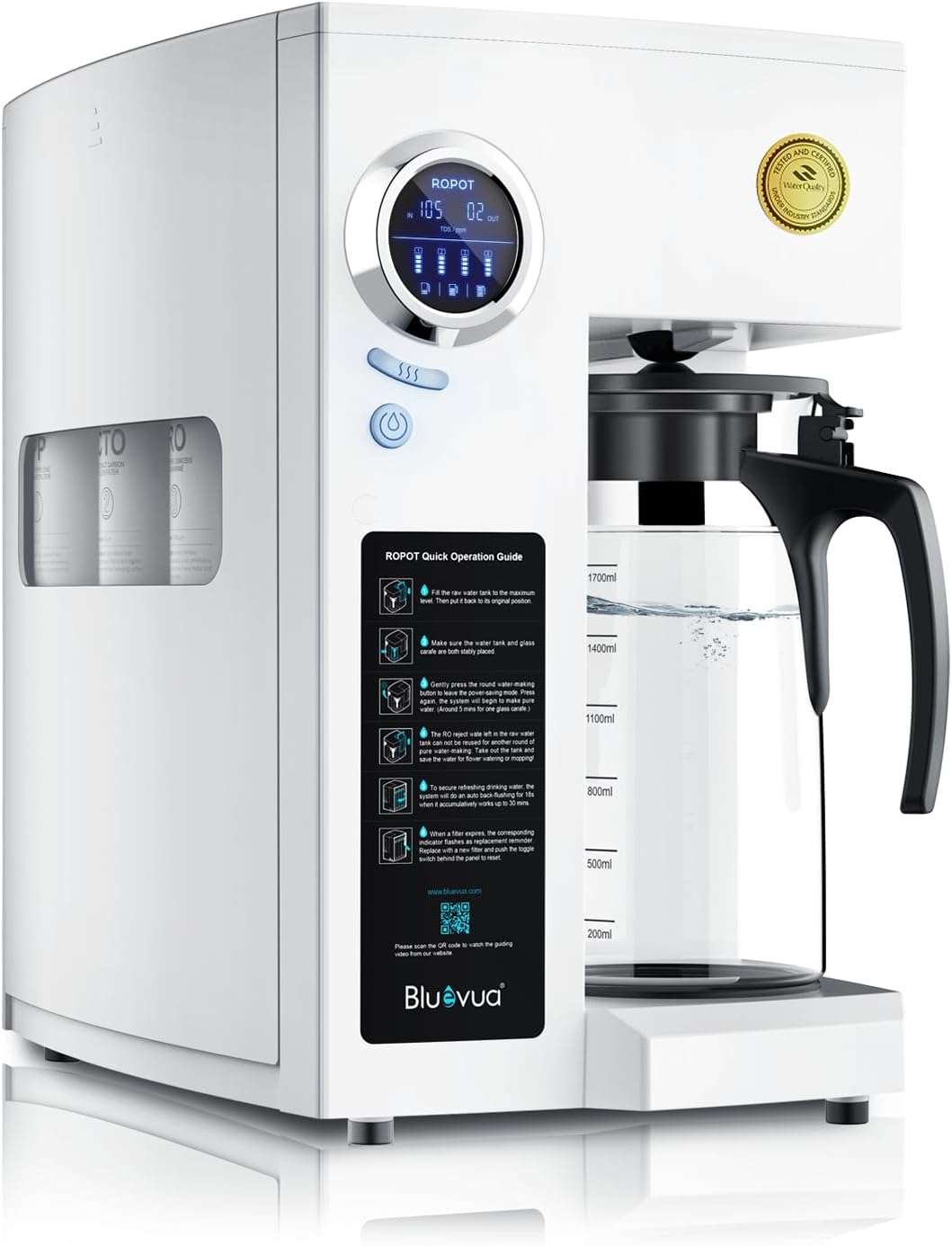
The Bluevua ROPOT is a portable countertop reverse osmosis system designed to deliver bottled-quality water without installation. You fill the unit, plug it in and the internal RO membrane plus supporting pre/post filters remove a wide range of contaminants while an included remineralization stage restores taste and essential minerals. The unit uses a high borosilicate glass carafe instead of plastic, which reduces the risk of secondary contamination and makes the dispenser easy to pour from. A small LCD filter-life and TDS display helps you monitor water quality and replacement timing, and the system conserves water with an advertised 2:1 pure-to-drain ratio and an auto standby power-saving mode. Filters last roughly 12 to 24 months depending on usage, and replacement cartridges and accessory kits are available. Expect slower flow compared with plumbed systems given the 0.26 L/min max rate and the need to refill the countertop reservoir, so this suits kitchens where portability and water quality matter more than high-volume dispensing.
Best for: Buyers who want near-bottled water quality from a portable countertop unit and value a glass carafe, straightforward setup, and easy filter monitoring.
Less Ideal for: Large households or users who need fast, high-volume dispensing or a permanently plumbed under-sink solution should consider a different system.
- True reverse osmosis filtration with five stages including remineralization for improved taste
- Borosilicate glass carafe reduces plastic contact and looks premium
- No-plumbing countertop design is plug-and-play and portable
- Filter life and TDS monitor on the unit make maintenance easier
- Maximum flow rate is low (0.26 L/min), so dispensing and refill cycles are slow
Verdict: Choose the Bluevua ROPOT if you want a no-plumb countertop RO that delivers bottled-quality water in a premium glass carafe with easy monitoring.
PHILIPS Countertop RO Dispenser

| Purification Method | Aquaporin Inside® Technology, Reverse Osmosis |
|---|---|
| Power Source | Corded Electric |
| Lower Temperature Range | 40 °F |
| Upper Temperature Rating | 203 °F |
| Filter Life Cycle | 12 months |
The PHILIPS countertop RO dispenser combines a full reverse osmosis purification chain with instant temperature control for everyday home use. It sits on the counter, plugs in, and stores filtered water in a 1.8 L jug while a separate compressor-cooled tank supplies chilled water and an instant-heating element delivers water up to 203°F. The six-stage RO filtration with Aquaporin technology and a remineralization stage reduces very small contaminants and returns beneficial minerals, and the control panel shows real-time TDS in/out so you can monitor performance. Practical touches include preset portion buttons, a change-filter indicator, and a built-in self-cleaning routine to limit scale buildup. The unit produces about 200 ml/min, so expect modest flow compared with plumbed systems, and it requires periodic filter replacement roughly every 12 months and routine flushing of the source tank. The dispenser is best for households that want high-quality, on-demand hot and cold water without installing plumbing, accepting a larger countertop footprint and regular maintenance.
Best for: Buyers who prioritize filtration performance and on-demand temperature control without installing plumbing and want to monitor water quality in real time.
Less Ideal for: Households that need very high flow rates, a compact lightweight unit, or a fully plumbed integrated dispenser should consider other options.
- Six-stage reverse osmosis with Aquaporin technology plus remineralization for improved taste and reduced TDS
- Instant hot (up to 203°F) and cold (40°F) water with selectable temperature presets
- Real-time TDS display showing both source and filtered water for performance transparency
- Countertop, plug-in design requires no plumbing and includes a portable 1.8 L jug
- Relatively slow output (about 200 ml/min) compared with plumbed dispensers
- Larger and heavier countertop footprint that needs regular maintenance and annual filter changes
Verdict: Choose this PHILIPS countertop RO dispenser if you want factory-quality reverse osmosis filtration plus instant hot and cold water with realtime TDS monitoring without any plumbing installation.
Culligan 40 Cup Glass Dispenser

| Capacity | 320 fluid ounces |
|---|---|
| Purification Method | Activated Carbon, Ion Exchange |
| Power Source | Gravity Powered |
| Maximum Flow Rate | 0.18 liters per minute |
This glass countertop dispenser pairs a large 320-ounce reservoir with a 5-stage Culligan with ZeroWater filter designed to remove dissolved solids and a long list of contaminants, including lead, chlorine, mercury, and Total PFAS. You fill the top, gravity does the work, and water is dispensed through an easy-use spigot, making it convenient for household drinking water or for serving at gatherings. The included TDS meter and change-filter indicator let you monitor filter performance and know when to replace cartridges, and the glass construction keeps plastic out of the loop for a cleaner presentation. Because filtration is concentrated in a single replaceable cartridge, expect periodic filter costs and slower flow compared with plumbed or electric systems, and the dispenser is countertop-only so it needs space. For buyers who want high contaminant reduction in a reusable, attractive dispenser without plumbing, this is a practical, straightforward option.
Best for: Homeowners who prioritize strong contaminant reduction and want a reusable, countertop solution for everyday drinking water or entertaining without plumbing or electricity.
Less Ideal for: People who need instant high-volume dispensing, a plumbed-in solution, or the fastest possible flow rate for frequent heavy use.
- 5-stage filtration certified to reduce lead, Total PFAS, chlorine, and many other contaminants
- Includes TDS meter and change-filter indicator for easy monitoring of filter performance
- Large 320-ounce (40-cup) glass reservoir suitable for family use or hosting
- Gravity-powered design needs no electricity and has a simple drop-in filter replacement
- Filter cartridges will require regular replacement, adding ongoing cost
- Gravity flow produces a relatively slow fill and dispense rate compared with plumbed or electric units
Verdict: Choose this dispenser if you want a large, attractive countertop unit that delivers certified, high-level contaminant reduction and built-in monitoring without plumbing or electricity.
PUR 30-Cup Water Filter Dispenser

| Capacity | 7.09 liters |
|---|---|
| Filter Life Cycle | 2 months / 40 gallons |
| Purification Method | Ion Exchange |
| Container Type | Dispenser |
The PUR 30-Cup Water Filter Dispenser is a slim countertop pitcher-style dispenser designed to store and filter a large batch of drinking water for the fridge. It uses a Genuine PUR dispenser filter that is NSF certified to reduce chlorine, mercury, copper, zinc and other substances, and the filter is rated to last up to 40 gallons or roughly two months. Practical features include a pull-down spout so you can pour while water is still filtering, a carrying handle for easy refills, LockFit to secure the filter, and dishwasher-safe components for simpler cleaning. The design fits conveniently in most refrigerator doors and holds up to 30 cups so you can refill less often than with smaller pitchers. The main limitations are that filters must be replaced regularly and that the dispenser does not remove microbes, so it is meant for improving taste and reducing chemicals rather than disinfecting water. For someone focused on lowering bottled-water spending and getting noticeably better-tasting tap water, this dispenser is a straightforward, family-friendly option.
Best for: Buyers who want an affordable, fridge-friendly way to reduce tap water taste and chemical contaminants and who prefer a low-effort, batch-style dispenser for household use.
Less Ideal for: People who need certified microbial removal, point-of-use disinfection, or a fully hands-off, long‑interval filtration system should consider other water-treatment options.
- Large 30-cup capacity reduces refill frequency and fits in most refrigerator doors
- Genuine PUR filter certified to reduce chlorine, mercury, copper, zinc and other contaminants
- Pull-down spout allows pouring while filtering for continuous use
- Dishwasher-safe parts and carrying handle make refilling and cleaning easy
- Filter needs replacement every ~40 gallons or two months, adding ongoing cost
- Does not filter microbes, so it is not a disinfecting solution
Verdict: A practical, budget-friendly countertop dispenser that delivers better-tasting tap water for families while cutting bottled-water waste and cost.
Purcooflow P3 Countertop RO

| Purification Method | Reverse Osmosis |
|---|---|
| Power Source | Corded Electric |
| Supported Water TDS Level Maximum (PPM) | 500 |
| Filter Life Cycle | 6 months |
| Capacity | 528 gallons |
The Purcooflow P3 is a countertop reverse osmosis purifier designed to deliver near–bottled-water quality without installation. You fill the 3.6L feed tank, plug the unit in, and the system automatically filters water into a detachable pitcher until full, making it convenient for kitchens, offices, or rentals. It uses a dual-carbon plus RO composite arrangement that the manufacturer describes as a 4-in-2 filtration path and includes a polishing activated carbon stage for improved taste. Notable practical benefits are the smart auto-fill/auto-stop dispensing, a compact footprint that keeps the unit on your counter, and twist-and-pull filter cartridges that simplify semiannual maintenance. The P3 is also marketed with SGS-verified removal of contaminants and a relatively efficient 3.5:1 pure-to-drain ratio, which reduces wastewater compared with many RO systems. Limitations to expect: it relies on municipal tap water under 500 ppm TDS, it requires a power outlet, and the pitcher capacity is modest so heavy daily demand will need frequent refills.
Best for: Buyers who prioritize a reliable, low-hassle source of high-purity drinking water without permanent installation and who want a system that signals when routine maintenance is due.
Less Ideal for: Homes that need high daily volumes of purified water, off-grid setups without power, or properties using untreated well water without prefiltration.
- No plumbing or tools required — plug-and-play countertop setup
- Auto-fill and auto-stop dispensing for hands-off operation
- Compact footprint with detachable pitcher for easy pouring
- Efficient 3.5:1 pure-to-drain ratio to reduce wastewater
- Twist-and-pull filter cartridges make semiannual replacement quick
- Designed for municipal tap water only (TDS under 500 ppm), not untreated well water
- Requires an electrical outlet to operate
- Modest pitcher capacity means frequent refills under heavy use
Verdict: If you want a reliable, no-plumbing countertop RO that auto-dispenses near–bottled quality water with straightforward maintenance, the Purcooflow P3 is an efficient plug-and-play choice.
Brita UltraMax 27-Cup Dispenser

| Capacity | 27 cups |
|---|---|
| Includes | 1 Standard Brita filter |
| Filter compatibility | Fits Standard and Elite Brita filters |
| Material Type | Plastic |
The Brita UltraMax is a fridge-friendly 27-cup countertop dispenser designed to give families easy access to filtered tap water. It ships with one Standard Brita filter and uses a top-loading cartridge that reduces chlorine taste and odor plus select heavy metals, producing noticeably better-tasting water for everyday drinking. The dispenser has an easy-lock lid, a precision-pour spigot for controlled pouring, and a sticker filter indicator to remind you when to replace the cartridge. Its large capacity cuts how often you refill and fits on most refrigerator shelves to save counter space. Limitations are few but practical: the included Standard filter lasts about two months under average use whereas the longer-life Elite filter is optional, and the dispenser is plastic which may feel less premium than glass appliances. Expect straightforward setup and low-maintenance operation for routine household hydration.
Best for: Buyers who prioritize proven performance and social proof want a high-capacity, low-fuss dispenser that consistently improves tap water taste for everyday family use.
Less Ideal for: Those seeking a glass or stainless-steel aesthetic or someone who wants a maintenance-free, multi-year filter solution without periodic cartridge changes should consider other options.
- Large 27-cup capacity reduces refill frequency
- Includes a Brita Standard filter and fits Brita Elite and Standard filters
- Fridge-friendly shape and easy-lock lid save counter and shelf space
- Precision-pour spigot for controlled dispensing
- Standard filter requires replacement roughly every two months with average family use
- Plastic construction may feel less premium than glass alternatives
Verdict: Choose the Brita UltraMax when you want a high-capacity, trusted countertop dispenser that reliably improves tap water taste for everyday household use.
DREO RO Countertop Water Filter WF113
| Purification Method | Reverse Osmosis |
|---|---|
| Capacity | 5 liters |
| Pure to Drain Rate | 3:1 |
| Filter Life Cycle | 6 months |
| Included Components | WF113 Body, 1 RO Filter, 2 Autofill Pitchers |
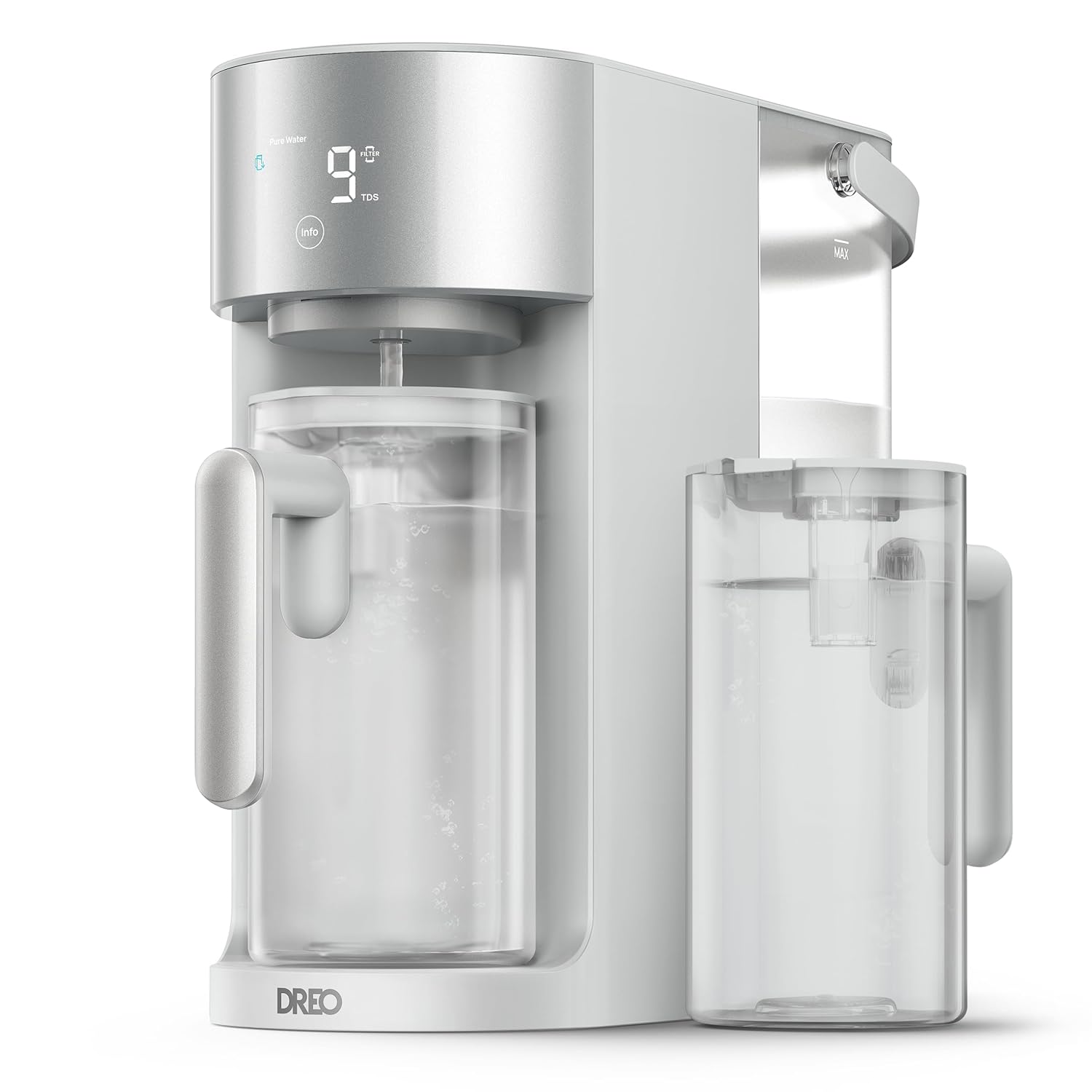
The DREO WF113 is a plug-in countertop reverse osmosis purifier that delivers highly filtered drinking water without hard plumbing or installation. It uses a 7-stage RO filter and a built-in TDS meter to monitor incoming and purified water, and the unit includes two autofill pitchers so you can grab ready water without lifting the tank. Key conveniences are the touch controls, filter life indicator, and an automatic flushing routine to reduce internal buildup. The system claims a 3:1 pure-to-drain ratio to limit waste compared with many RO units, and filters are quick to replace with a twist-in design. For everyday home use the compact footprint and included pitchers make it a good fit for a small family or apartment kitchen. Limitations to expect are the need to replace RO filters periodically and the ongoing drain water from RO operation, and the unit adds some bulk on the counter compared with a simple pitcher filter.
Best for: Someone who prioritizes reliable, lab-tested contaminant removal and wants easy, low-effort monitoring and maintenance without installing under-sink plumbing.
Less Ideal for: People who need a truly portable or ultra-compact solution or who want zero wastewater operation; those on a very tight budget for recurring filter replacements should consider simpler alternatives.
- 7-stage RO filtration with SGS testing to NSF/ANSI 58 standards for broad contaminant removal
- Built-in TDS meter and filter life indicator for real-time water quality and maintenance alerts
- Auto-fill pitchers and a 5L tank provide ready-to-serve filtered water without plumbing
- Self-cleaning auto-flush feature reduces manual maintenance of internal tubing
- Compact, install-free countertop design that is easy to set up and replace filters
- Produces drain wastewater as part of RO process despite a improved 3:1 ratio
- Requires periodic RO filter replacements and consumables
- Occupies counter space and is heavier than basic pitcher-style filters
Verdict: Choose the DREO WF113 if you want a compact, install-free countertop RO system with real-time TDS monitoring and hands-free pitchers for dependable, lab-tested drinking water.
Choosing the Right Countertop Filtered Water Dispenser for Home Use: Key Factors to Consider
Filtration Performance
Effective filtration determines the water quality you actually get from a countertop filtered water dispenser for home use. Look for clear information on what contaminants the filter reduces, such as chlorine, sediment, lead, or volatile organic compounds. Some filter media target taste and odor while others focus on specific heavy metals or microbiological concerns.
Know what your tap water needs by checking local water quality reports or test results. A dispenser with a multi-stage filter typically provides broader coverage, but replacement frequency and certification to standards from independent labs are better indicators of consistent performance than marketing terms alone.
Dispensing Flow And Temperature Options
Flow rate affects how quickly you can fill glasses, pitchers, or a kettle. For regular household use you want a dispenser that provides steady flow without sputtering or long delays between pours. Consider whether the unit offers temperature control — cold, room temperature, or hot — and whether those modes meet your daily routines, such as making tea or filling a water bottle.
Also consider the spigot design and activation method. Lever or push-button taps that feel solid are less likely to drip. If you use the dispenser frequently, a faster flow and reliable tap mechanism reduce frustration and make the unit more practical for everyday tasks.
Installation And Countertop Fit
Countertop dispensers should be simple to get running without altering plumbing. Check how the unit connects to your water source, whether it uses a reservoir you fill manually or a hose attachment to a faucet. Make sure the footprint and height match available counter space and that the dispenser clears overhead cabinets.
If the dispenser connects to a faucet, verify compatibility with your kitchen faucet type. Also consider the reservoir capacity versus how often you want to refill; a larger tank reduces refill frequency but takes more counter space.
Maintenance And Filter Replacement
Ongoing maintenance affects total ownership convenience. Filters with long service life reduce how often you need to replace them, but replacement cost and ease of access matter just as much. Look for designs where the filter is easy to reach and swap without tools.
Check whether the manufacturer provides clear replacement intervals and whether the unit has simple indicators or instructions for when to change filters. Also consider cleaning needs for the reservoir and spigot to prevent buildup or bacterial growth over time.
Build Quality And Materials
Durable materials extend the life of a countertop filtered water dispenser for home use. Stainless steel or BPA-free plastics resist corrosion and avoid imparting tastes to water. Pay attention to seals and fittings since these are frequent failure points that can cause leaks.
A well-built dispenser will also have thoughtful design touches like rubber feet to prevent slipping and an easy-to-clean exterior. Higher-quality components may cost more initially but usually translate to fewer service issues and longer useful life.
Capacity And Household Needs
Match dispenser capacity to your household size and daily water usage. A small reservoir is fine for one or two people who refill frequently, but larger families will want a higher-capacity tank or faster refill methods to avoid constant upkeep. Consider how often you are willing to refill or replace filters and balance that against the unit's storage capacity.
Also think about peak usage times, such as mornings when multiple people may need water quickly. Choose a dispenser with either sufficient capacity or rapid replenishment to comfortably meet those peak demands.
Installation Options And What They Mean
Countertop filtered water dispensers for home use generally install in one of two ways: a refillable reservoir you fill manually, or a direct connection that taps the kitchen faucet. A manual-reservoir model requires no connectors and is the simplest to set up, but it needs more frequent refilling. Faucet-connected units provide continuous supply but require an adapter and may limit faucet movement.
When choosing, check hose length and connector type for faucet hookups, and plan counter placement so refilling or connecting is convenient. Consider how often you want to handle installation tasks versus the convenience of a semi-permanent hookup.
- Manual reservoir: easiest setup, needs frequent refills
- Faucet connection: continuous supply, requires adapter
- Placement: leave space for refilling and airflow around the unit
Filter Types And Multi-Stage Systems
Countertop dispensers use a range of filter media, from activated carbon for taste and odor reduction to ion exchange and mechanical filtration for sediment removal. Multi-stage filters combine media types to tackle a broader spectrum of contaminants. Understanding the stages helps you match a dispenser to your water-quality concerns.
If you have specific issues like hard water or known contaminants in municipal reports, choose a filtration approach that targets those issues. Otherwise, an activated carbon-based multi-stage filter covers the most common household concerns.
- Activated carbon: improves taste, reduces chlorine
- Mechanical/sediment: captures particulates
- Ion exchange or specialized media: reduces select heavy metals
Daily Use Habits That Affect Longevity
How you use the dispenser influences its longevity. Frequent filling of large pitchers increases wear on the tap mechanism, while leaving water to sit in a reservoir can require more frequent cleaning. Rinse and dry removable parts on a schedule to prevent buildup.
If you expect heavy daily use, prioritize sturdier spigots and easier filter access. For occasional use in a smaller household, a compact, lower-capacity unit with infrequent maintenance may be preferable.
- Clean reservoir and spigot regularly to avoid biofilm
- Match dispenser capacity to daily consumption
- Use durable dispensing mechanisms for high-frequency use
Noise And Energy Considerations
Most countertop filtered water dispensers are passive and quiet, but models with refrigeration or active heating will consume electricity and produce some noise. If you want chilled water on demand, expect higher energy use and occasional compressor sound.
Consider where the dispenser will sit. A noisy compressor close to seating areas or bedrooms can be disruptive. For minimal energy impact, choose a unit that provides filtered room-temperature water or cold water via thermal blocks rather than large refrigeration systems.
- Passive dispensers: minimal noise and energy use
- Refrigerated units: colder water but higher energy draw
- Hot water features: check safety locks and energy usage
Common Maintenance Tasks And Tips
Routine tasks keep a countertop filtered water dispenser working reliably. Replace filters according to the manufacturer schedule, typically measured in gallons or months. Clean and sanitize the reservoir every few weeks or as recommended to prevent tastes or microbial growth.
Inspect seals and hoses for wear during filter changes and address small leaks promptly. Keep replacement filters on hand if you have limited access to deliveries or stores so you do not run the unit past recommended filter life.
- Replace filters on schedule and track service intervals
- Sanitize reservoirs and spigots periodically
- Check seals and hoses during each maintenance cycle
How We Chose the Best Countertop Filtered Water Dispenser for Home Use
We prioritized products that address the main responsibilities of a countertop filtered water dispenser for home use: removing common contaminants, delivering a steady flow at usable temperatures, and staying simple to install and maintain. Our selection criteria emphasized measurable filtration performance against chlorine, taste and odor compounds, sediment, and common heavy metals where applicable. We evaluated dispensing reliability by looking for consistent flow rates, temperature control when present, and sturdy faucet design that minimizes leaks and drips. Durability and build quality were considered by focusing on materials used for tanks, housings, and seals, plus user-accessible parts for maintenance. Ease of maintenance and filter replacement frequency influenced picks because ongoing upkeep determines long-term convenience. Capacity and footprint were used to ensure options suit typical kitchen counters and household consumption patterns. We excluded units that require permanent plumbing modification or under-sink installation, and we filtered out designs with opaque filtration claims or no clear serviceability. Our final list favors transparency in filter specifications, reliable dispensing mechanics, and practical installation for home countertop use.
Our full evaluation process is outlined in our review methodology.
FAQ
How often should I replace the filter in a countertop dispenser?
Replacement intervals vary by filter type and household use, but most filters are rated by gallons or months. Expect to change common carbon-based filters every 3 to 6 months for typical home use, with heavier use requiring more frequent swaps.
Can I connect a countertop dispenser directly to my kitchen faucet?
Many countertop units offer a faucet adapter for a semi-permanent connection, but compatibility depends on your faucet type. Faucet-connected models provide continuous supply but require an appropriate adapter and may limit some faucet movement.
Do countertop filtered dispensers remove lead and other heavy metals?
Some filter media are designed to reduce select heavy metals, but not all standard carbon filters remove lead effectively. Check independent test results or specifications for heavy metal reduction if that is a primary concern.
Is it hard to keep the dispenser sanitary?
No. Regular cleaning and following the manufacturer's sanitizing instructions keeps units sanitary. Empty and rinse reservoirs periodically, and clean the spigot area to avoid residue and bacterial buildup.
Will a countertop dispenser cool or heat water quickly?
Passive dispensers do not actively cool or heat water. Units with refrigeration or heating elements can provide chilled or hot water but typically consume more energy and may produce noise from compressors or heating components.
Final Verdict
When choosing a countertop filtered water dispenser for home use, prioritize filtration performance and dispensing reliability first. Match the unit's capacity and installation method to your daily habits and counter space so you avoid frequent refilling or awkward placement. Also weigh maintenance requirements, filter life, and material quality because these shape long-term convenience and costs. Focus on dispensers that clearly state filtration capabilities, provide easy access for filter changes, and offer the flow and temperature options you use most. That approach will help you pick a practical, low-maintenance unit that reliably delivers better-tasting, safer water for everyday home use.