
Note: This article contains affiliate links. If you click on these links and make a purchase, we may earn a small commission at no extra cost to you. This helps support our research and content. Read our full affiliate disclosure here.
If you want better-tasting water at the kitchen sink without a complicated installation, a countertop water filter for home use is an easy, practical option. These units sit on the counter or connect to the faucet and reduce common contaminants while preserving flow and convenience. This guide covers seven shortlisted countertop water filters picked for everyday home use. We focus on real-world priorities like filtration effectiveness, flow rate, ease of setup, and maintenance. Read on to find the type of unit that fits your routine and water-quality goals.
Top Picks at a Glance
| Best Overall The best all-around choice for most situations | Waterdrop C2SL Countertop RO |  |
| Best Quality Built to a higher standard if you want something more solid | AquaTru Carafe Smart Alkaline |  |
| Best Value The sweet spot between price and what you get | Purewell 3-Stage Countertop Filter |  |
| Best Budget The cheapest option that still gets the job done reliably | iSpring CKC1C Countertop Water Filter |  |
| Top Rated A top-rated pick with lots of positive feedback | Aigerri Countertop RO TJYJ001 |  |
| Most Popular A crowd favorite that many people choose with confidence | Brita UltraMax 27-Cup Dispenser |  |
| Best Seller A high-volume bestseller chosen again and again | DREO RO Countertop Water Filter |  |
Waterdrop C2SL Countertop RO

| Purification Method | Reverse Osmosis |
|---|---|
| Filter Life Cycle | 12 months |
| Capacity | 75 gallons |
| Pure to Drain Ratio | 3:1 |
| Power Source | Corded Electric |
The Waterdrop C2SL is a plug-in countertop reverse osmosis system designed to give 1–2 people near-RO quality drinking water without any plumbing or drilling. It uses a 0.0001 μm RO membrane in a 7-stage process and adds a mineral cartridge to improve taste, then automatically refills a detachable 40 oz glass pitcher from the machine's 108 oz feed tank. Setup is simple: fill the tank, plug it in, follow the voice-guided first-time rinse, and use the smart display and voice alerts to track filter life and refill status. The unit is intended for everyday drinking, cooking, and beverage prep and reports a 3:1 pure-to-drain ratio and up to 528 gallons / 12 months of filter life under typical conditions. Practical benefits include no-fuss countertop placement, a glass pitcher with no plastic contact, and clear maintenance reminders. Limitations include its sizing for only small households and the typical RO wastewater; it is not a whole-house solution and requires periodic filter replacements based on local water quality.
Best for: Buyers who want near-RO purity without installing under-sink plumbing and value simple setup, a glass pitcher, and mineral-enhanced taste for everyday drinking in a small household.
Less Ideal for: Large families, whole-house needs, or anyone who wants a high-volume or zero-waste solution should look at under-sink or tankless RO systems instead.
- 7-stage RO filtration with a 0.0001 μm membrane for broad contaminant reduction
- Mineral cartridge restores calcium and magnesium for improved taste
- Autofill detachable 40 oz glass pitcher avoids plastic contact and fits in a refrigerator
- Smart display and voice alerts simplify setup and remind when to refill or change filters
- Countertop plug-in design requires no drilling or faucet connection
- Sized for 1–2 people so output may be limited for larger households
- Produces wastewater at a 3:1 pure-to-drain ratio, not zero-waste
Verdict: Choose the C2SL if you want a compact, no-plumbing countertop RO that delivers mineralized drinking water and simple, voice-guided maintenance for a small household.
AquaTru Carafe Smart Alkaline

| Purification Method | Reverse Osmosis |
|---|---|
| Power Source | Corded Electric |
| Maximum Flow Rate | 0.5 gpm |
| Operating Pressure Range | 40 – 85 psi |
| Filter Life Cycle | 6 months |
The AquaTru Carafe Smart Alkaline is a compact countertop RO purifier that plugs into a standard outlet and delivers purified water into a removable borosilicate glass carafe. It uses a four-stage filtration train — pre/carbon, reverse osmosis, and VOC carbon elements — that the brand rates to reduce 84 contaminants including lead, PFAS, microplastics, fluoride, and arsenic, making it useful for drinking, cooking, and beverage prep. Installation is tool-free: fill the upper tank, run power, and the pump-driven RO process dispenses clean water into the carafe; a simple control panel and built-in filter indicators handle maintenance reminders. Filter life is relatively long for a countertop unit with pre-filter rated up to six months and RO/VOC filters up to a year, which lowers running costs and downtime. Trade-offs are the modest output flow (0.5 gpm max) and the small clean-water capacity aimed at daily household use rather than high-volume filling, so it suits kitchens where countertop space and purity matter more than bulk throughput.
Best for: Buyers who prioritize lab-grade contaminant removal and taste improvement in a compact countertop unit and want a low-maintenance RO system without plumbing changes.
Less Ideal for: Households that need high-volume or continuous dispensing for large families or frequent entertaining should consider larger under-sink systems with higher throughput.
- Certifies reduction of 84 contaminants including PFAS, lead, fluoride, and microplastics
- Four-stage filtration with long filter lifespans reduces replacement frequency
- Borosilicate glass carafe keeps water tasting neutral and avoids plastic contact
- Plug-in countertop design requires no plumbing or drilling and is easy to set up
- Limited clean-water capacity and modest flow rate make it less suited for heavy daily filling
Verdict: Choose the AquaTru Carafe if you want a countertop RO purifier that delivers high contaminant removal and long-lasting filters without any plumbing work.
Purewell 3-Stage Countertop Filter

| Purification Method | Activated Carbon, Silver Ion, Hollow Fiber UF Membrane |
|---|---|
| Capacity | 2.25 gallons |
| Filter Life Cycle | 6 months |
| Supported Water TDS Level Maximum (PPM) | 500 |
| Upper Temperature Rating | 100 °F |
The Purewell 3-stage gravity countertop filter uses a stainless steel upper and lower chamber and a composite filter (activated carbon, silver ion, hollow fiber UF membrane) to deliver filtered water without electricity. You fill the top chamber and gravity forces water through the 0.01μm membrane and carbon block into the lower chamber where the stainless spigot dispenses it. The system is simple to use and portable for indoor or outdoor use, and the small pore size combined with an NSF/ANSI 42 and 372 certification means it removes chlorine, sediment, rust, organic matter and many particulates. Filters are rated for roughly 3,000 gallons each (6,000 gallons combined) and recommended replacement is about every six months depending on water quality. Practical accessories like a non-slip stand and a fitted stainless spigot reduce leaks and make setup straightforward. Limitations are the modest 2.25 gallon capacity and gravity-fill workflow, which means it is slower than plumbed or electric filters and needs refilling for larger households.
Best for: Buyers who want a reliable, low-maintenance countertop filter that delivers high particulate removal without plumbing or electricity and prefer verified certifications and durable materials.
Less Ideal for: Large families or users needing continuous, high-volume filtered water should consider plumbed or electric systems instead.
- 0.01μm hollow fiber UF membrane plus activated carbon and silver ion for fine particulate and chlorine reduction
- NSF/ANSI 42 and 372 certifications for verified chlorine reduction and lead-free materials
- Non-electric gravity operation allows use indoors or outdoors and simple setup
- 304 food-grade stainless steel housing and included spigot and stand for durable, leak-resistant operation
- 2.25 gallon capacity and gravity-fed flow make it slower and require frequent refills for larger households
- Filter elements do not lower TDS and must be replaced about every six months
Verdict: Choose this Purewell countertop gravity filter if you want certified, high-precision filtration without plumbing or electricity and a durable stainless-steel system for everyday home use.
iSpring CKC1C Countertop Water Filter
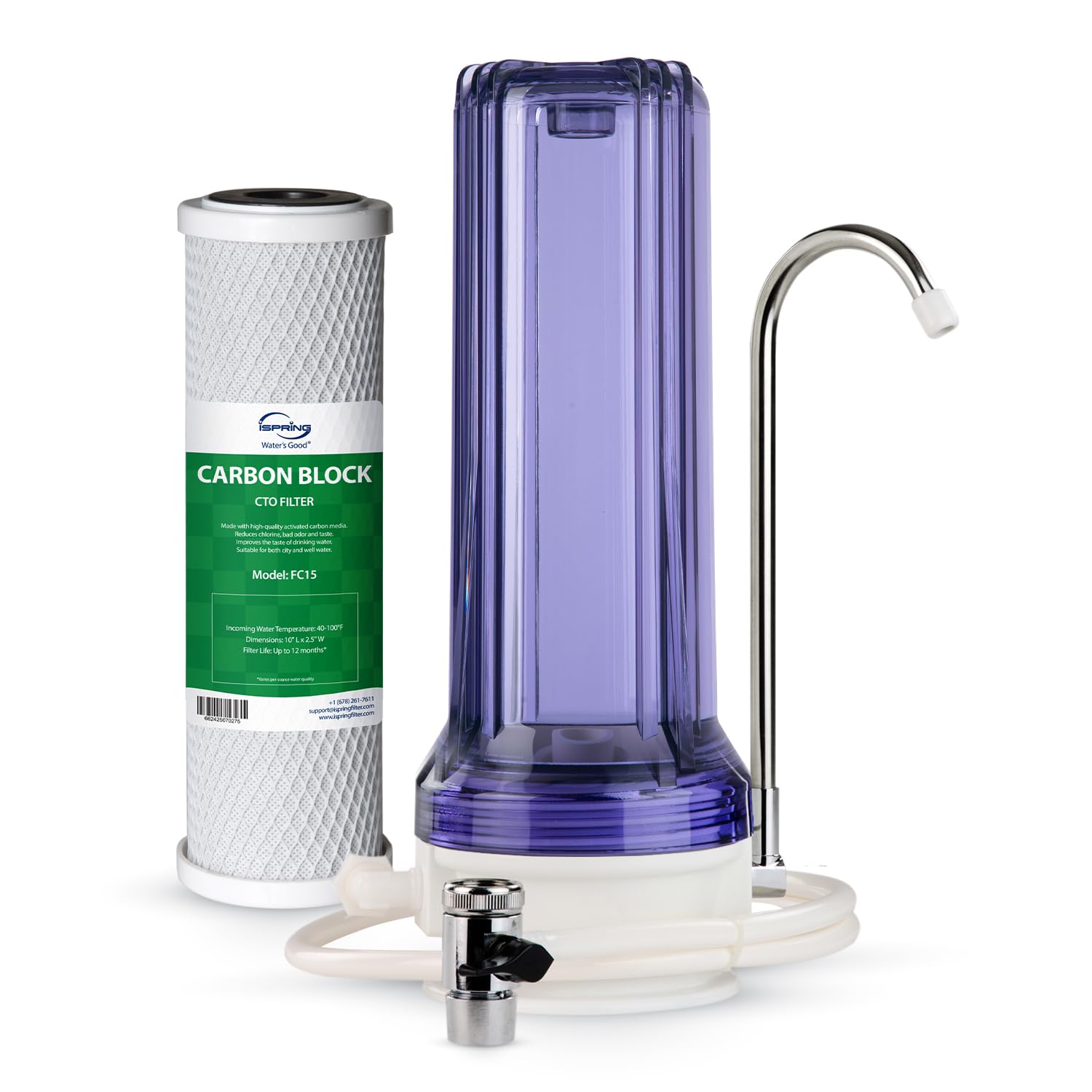
| Model Number | CKC1C |
|---|---|
| External Testing Certification | ANSI, NSF |
| Included Components | Housing, Carbon Block Filter, Tubing, Wrench, Diverter Valve, O-ring |
| Material Type | Food-grade Materials |
The iSpring CKC1C is a simple countertop filtration system that installs without drilling and connects directly to most kitchen faucets using the included diverter valve and tubing. Its clear housing makes it easy to see the 5-micron carbon block filter and judge when a change is needed, and the cartridge is independently tested to meet NSF/ANSI standards for chlorine and sediment reduction. In daily use it delivers noticeably fresher drinking water and removes common tastes and odors while leaving beneficial minerals intact, which is handy for drinking and cooking. The kit includes the housing, carbon block filter, wrench, O-ring and faucet adapters so you can set it up yourself quickly, and the manufacturer rates the cartridge life at roughly 6 to 12 months depending on local water quality. It does not reduce dissolved solids like an RO system, so it is not intended where TDS reduction is required, but for most households wanting an affordable, easy-to-install improvement to tap water it is an effective, low-maintenance option.
Best for: Buyers looking for an inexpensive, easy-to-install countertop filter to noticeably improve taste and remove chlorine and sediment without plumbing changes.
Less Ideal for: People who need a system to lower total dissolved solids, produce mineral-free water, or who require under-sink or whole-house filtration.
- No-drill installation with included diverter valve and adapters
- Clear housing allows visual inspection of the filter
- NSF/ANSI tested 5-micron carbon block reduces chlorine, sediment, rust, and odors
- Includes necessary components (housing, filter, tubing, wrench, O-ring) for quick setup
- Does not remove dissolved solids or function as a reverse osmosis system
Verdict: A budget-friendly, NSF-tested countertop filter that delivers better-tasting tap water with easy, tool-free installation.
Aigerri Countertop RO TJYJ001
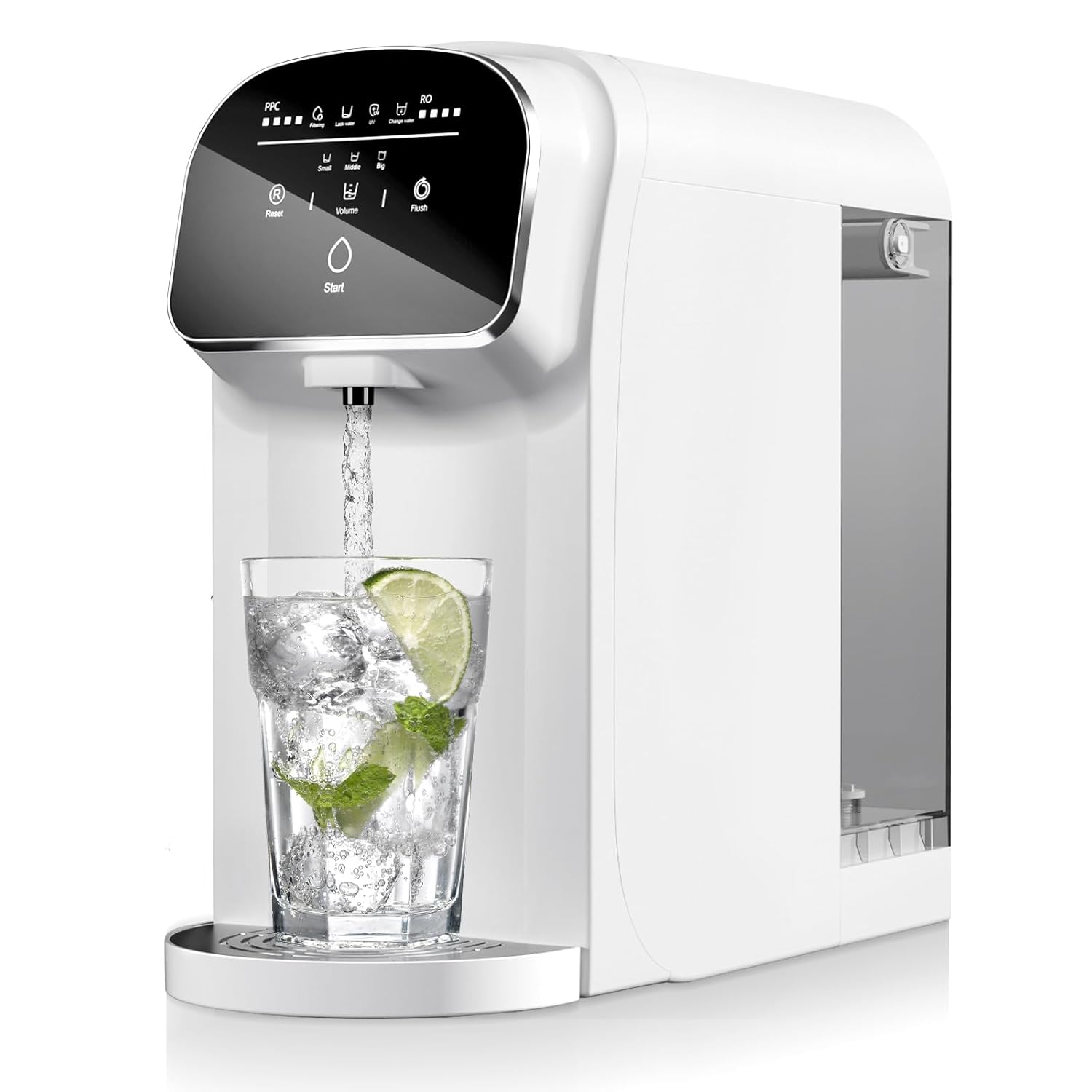
| Purification Method | Reverse Osmosis |
|---|---|
| Capacity | 5 liters |
| Other Special Features of the Product | 5 Stages RO Filter, Self Cleaning, Reduce TDS, Reduce PFAS, Change Filter Indicator |
| Installation Type | Countertop |
This Aigerri countertop RO is a self-contained plug-and-play purifier designed for homes, offices, and RVs where installation is not desired. You fill the 5L feed tank, plug the unit in, and the system uses a five-stage sequence—pre-filter (PPC), RO membrane, and UV—to produce cold or ambient purified water into a separate 2L purified tank. Notable practical features include a high-efficiency 5:1 pure-to-drain ratio that cuts wastewater compared with traditional RO units and filter-change indicators for straightforward maintenance. The compact, countertop form fits into small kitchens without plumbing work, and the manufacturer rates the included filters for hundreds of gallons of service. Trade-offs are the countertop footprint and the need to refill the feed tank periodically rather than continuous plumbed flow, and replacement filters are a recurring cost. For buyers who prioritize steady, high-quality purification without hiring a plumber, this unit offers a reliable, easy-to-use solution.
Best for: Buyers who want dependable, high-purity drinking water without plumbing work and prefer a fuss-free, maintenance-transparent countertop system for daily home use.
Less Ideal for: Those who need a plumbed, always-on supply or have very limited counter space should consider plumbed under-sink systems or smaller point-of-use purifiers instead.
- Plug-and-play countertop design requires no plumbing or professional installation.
- 5-stage filtration plus UV for comprehensive contaminant reduction.
- 5:1 pure-to-drain ratio reduces wastewater versus typical RO systems.
- Large 5 liter feed tank with a separate purified water tank for immediate use.
- Filter change indicator simplifies maintenance planning.
- Requires regular refilling of the feed tank rather than providing continuous plumbed water.
- Replacement filters add ongoing operating cost.
Verdict: Choose this Aigerri countertop RO if you want a reliable, installation-free system that delivers high-purity water with efficient waste reduction.
Brita UltraMax 27-Cup Dispenser
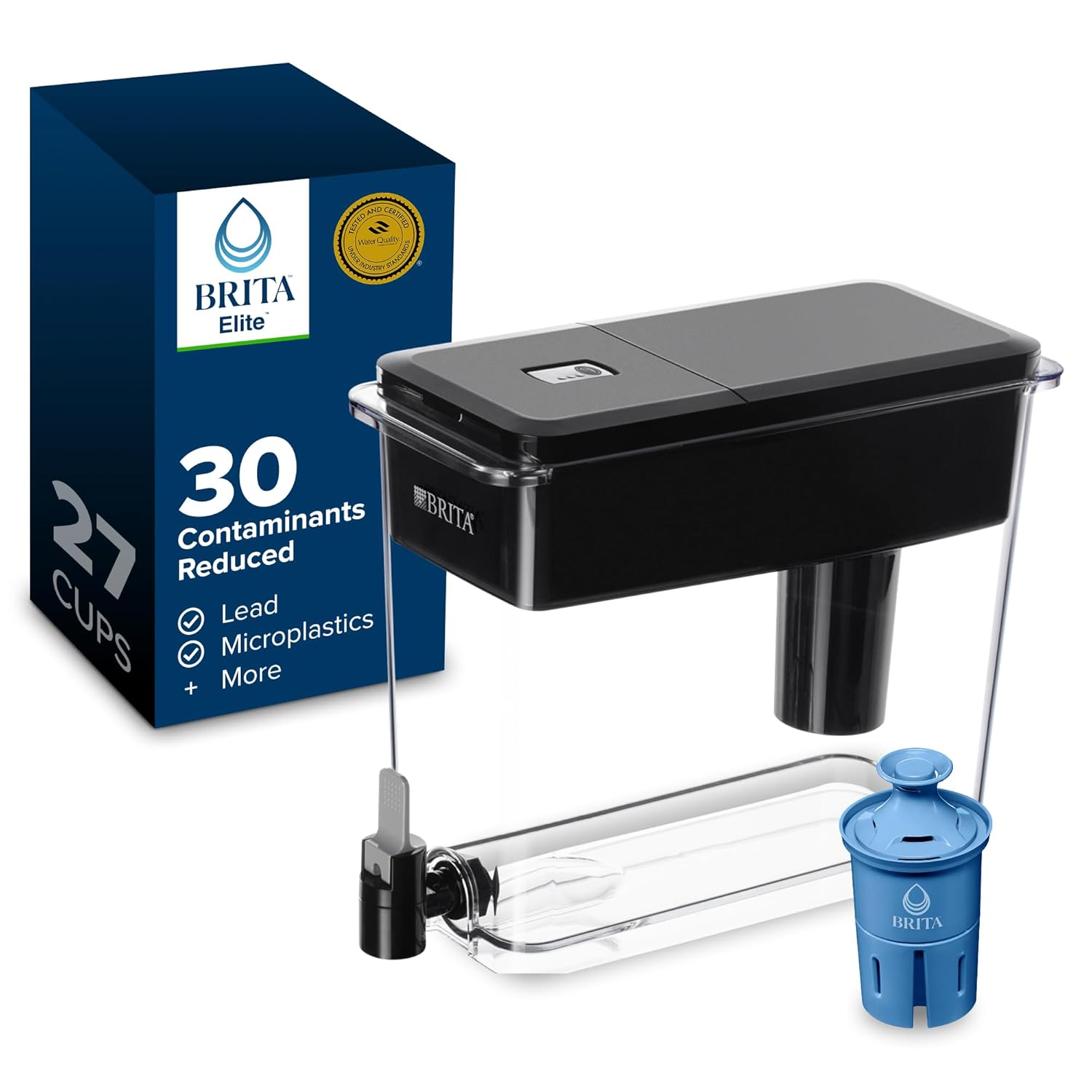
| Capacity | 27 cups |
|---|---|
| Filter life cycle | 120 gallons / 6 months |
| Purification method | Activated Carbon |
| Supported Water TDS Level Maximum (PPM) | 600 |
The Brita UltraMax is a large-capacity countertop water dispenser designed for families who want filtered tap water without a faucet attachment. It holds 27 cups and uses the Brita Elite filter with Advanced Carbon Core Technology, which is certified to reduce 99% of lead and over 30 other contaminants including chlorine and microplastics. Setup is simple: insert the Elite filter, fill the top reservoir, and use the front spigot to serve water or chill the dispenser in the fridge. The main benefits are the long filter life and capacity — the Elite cartridge is rated for about 120 gallons or roughly six months of typical household use, which lowers replacement frequency compared with many pour-through pitchers. Because it is freestanding and BPA-free, it fits on counters and in many refrigerators. Limitations include the need to replace proprietary Brita filters to maintain certified performance and the dispenser's freestanding design, which does not attach to plumbing or provide instant hot water options.
Best for: Buyers who prioritize proven contaminant reduction and want an easy, high-capacity countertop solution backed by broad customer feedback and certifications.
Less Ideal for: Households wanting a plumbed-in or under-sink system, instant hot water, or those who prefer non-proprietary filter media should consider other options.
- Large 27-cup capacity suitable for families or frequent use
- Certified Elite filter reduces 99% of lead plus 30+ contaminants including microplastics
- Long filter life (approx. 120 gallons or six months) reduces replacement frequency
- BPA-free freestanding design with convenient spigot that fits on counters and in many fridges
- Requires Brita Elite replacement filters to achieve certified contaminant reduction
- Freestanding dispenser does not connect to plumbing for continuous refill
Verdict: Choose the UltraMax when you want a high-capacity, certified countertop dispenser that reduces lead and microplastics with a long-life Elite filter.
DREO RO Countertop Water Filter

| Purification Method | Reverse Osmosis |
|---|---|
| Capacity | 5 liters |
| Pure to Drain Rate | 3:1 |
| Included Components | RO filter and 2 autofill pitchers |
| Other Special Features of the Product | Built In TDS Meter, Change Filter Indicator, Touch Control |
The DREO countertop RO system is a plug-and-play reverse osmosis purifier designed for everyday home use without plumbing. It uses a 7-stage RO filter to remove a wide range of contaminants and reports real-time TDS for both feed and purified water, plus a filter-life indicator so maintenance is straightforward. The unit includes two autofill pitchers and an auto-fill sensor so one pitcher stays ready while the other refills automatically, and an internal self-cleaning flush helps reduce biofilm and keeps lines clear. With a stated pure-to-drain ratio of 3:1 and a filter life of about 265 gallons (1000 L), it is more water-efficient than many traditional RO benches and aims to lower bottled-water costs. Practical limits are its countertop footprint and the relatively modest tank volume, so it suits households that want filtered drinking water on demand rather than whole-house treatment. Setup is simple and does not require tools, but buyers should plan routine filter replacements and occasional descaling to maintain performance.
Best for: Buyers who want a reliable, install-free countertop RO system that provides lab-tested contaminant reduction with easy monitoring and low setup fuss.
Less Ideal for: Households needing whole-house filtration, users who want very large on-board storage, or those unwilling to perform periodic filter replacements and occasional descaling.
- 7-stage reverse osmosis filtration removes a broad range of impurities
- Built-in TDS meter and filter-life indicator for easy, visible monitoring
- Auto-fill dual-pitcher system provides continuous ready-to-use water
- Self-cleaning flush reduces internal buildup and simplifies maintenance
- Countertop tank capacity is limited, so it may require more frequent refills in larger households
- Filter life rated to ~265 gallons means recurring replacement costs
Verdict: A convenient, install-free countertop RO unit that gives risk-averse buyers visible TDS monitoring and ready-to-drink water with minimal setup.
Choosing the Right Countertop Water Filter for Home Use: Key Factors to Consider
Filtration Performance and Contaminant Reduction
How well a countertop water filter removes contaminants directly impacts the water's safety and taste. Look for filters that list specific reductions, such as chlorine, lead, cysts, and volatile organic compounds, and prefer certified media when available. A cartridge that targets the contaminants common in your water source will be more effective than a one-size-fits-all approach. If you have known issues like high lead or sediment, prioritize filter technologies designed for those problems because general-purpose filters may not address them adequately.
Flow Rate and Daily Throughput
Flow rate determines how quickly filtered water is available for drinking and cooking. A low flow rate can be frustrating during meal prep or when filling large containers, so check published flow or throughput numbers and consider your household demand. Throughput affects how often you refill the pitcher or wait for filtered water. Units with higher throughput or larger holding tanks reduce interruption to daily routines. Balance throughput against filtration stage complexity because multi-stage filters sometimes slow flow.
Installation and Faucet Compatibility
One of the main appeals of countertop filters is tool-free or minimal installation. Confirm the unit's faucet adapter types and whether an adapter is included for the common faucet styles in your home. If your faucet has an integrated sprayer or a nonstandard spout, you may need a different mounting approach. Consider how easily you can switch between filtered and unfiltered water and whether the unit requires any permanent changes to plumbing.
Maintenance Frequency and Replacement Costs
Regular filter replacement preserves performance. Understand expected filter life in gallons or months and how that maps to your household usage. Short-lived cartridges can add recurring cost and inconvenience, while longer-life filters require less frequent intervention. Also check how easy replacement cartridges are to source and whether the manufacturer provides clear instructions. If replacement parts are hard to find, a low upfront cost can become expensive over time.
Materials, Build Quality, and Food-Safety Standards
Materials that contact water should be food-grade and resistant to corrosion or leaching. Durable housings and quality seals reduce the chance of leaks and prolong product life. A well-constructed unit also resists staining and odor retention. Look for clear material descriptions and any relevant safety certifications that indicate the filter is intended for potable water use.
Size, Countertop Footprint, and Aesthetics
Countertop space is often limited. Consider the physical footprint of the unit and whether it fits comfortably on your counter without obstructing regular tasks. Taller units may not fit under cabinets while wider units can crowd prep areas. Aesthetics matter if the filter will be in a visible location. Choose a design that complements your kitchen or that can be stored when not in use without adding setup complexity.
Types of Countertop Filtration Technologies
Countertop filters use a few common approaches: activated carbon adsorption, mechanical sediment filtration, ion exchange, and sometimes small reverse-osmosis or ceramic stages. Each technology targets different contaminants and has tradeoffs in flow and maintenance.
Activated carbon is the workhorse for chlorine, taste, and odor reduction, while mechanical filters catch visible particles. Ion exchange can reduce hardness or specific heavy metals, and ceramic elements provide long-lived particulate filtration. Combining technologies in stages often gives broader coverage but may reduce flow and increase cartridge complexity.
- Activated carbon: Best for chlorine and organic taste and odor compounds.
- Mechanical sediment: Traps sand, rust, and large particles to protect finer media.
- Ion exchange: Targets certain dissolved ions like hardness minerals or lead when designed for that purpose.
- Ceramic: Long-life particulate barrier, often used where sediment is a primary issue.
Matching a Filter to Your Water Source
Start by getting a sense of your water quality. Municipal water suppliers publish water-quality reports, and private wells can be tested by a lab. Knowing the likely contaminants helps you select media that addresses real risks rather than hypothetical ones.
For example, if your water is already chlorinated but shows no heavy metals, a carbon-focused unit will improve taste and odor without unnecessary complexity. If you have visible sediment, prioritize mechanical prefilters or ceramic stages to prevent premature clogging of finer media.
- Check local water quality reports for common contaminants.
- Test well water for bacteria and metals before choosing a filter.
- Match filter media to the most likely local contaminants.
Practical Installation Tips
Plan where the unit will sit and how the faucet adapter connects. If your faucet is used frequently for washing or filling large pots, choose a model that lets you quickly switch between filtered and unfiltered water without repeated adjustments.
Keep spare cartridges on hand and set a calendar reminder for replacements based on the stated life in gallons or months. Tighten fittings by hand and check for leaks after the first fill; most issues stem from loose seals that are simple to fix.
- Measure clearance under cabinets if the unit is tall.
- Keep a small towel handy during initial setup to catch drips.
- Verify that included adapters match your faucet or plan for an extra adapter if needed.
Maintenance Best Practices
Flush new filters according to the manufacturer's instructions to remove loose carbon fines and conditioning agents. Regular flushing and following replacement intervals maintain performance. If the unit has a visible sediment prefilter, clean or replace it more frequently in areas with particulate matter.
Store replacement cartridges in a cool, dry place and avoid touching filter media with bare hands. Inspect seals and housing periodically for discoloration or wear and replace any parts that look compromised to avoid contamination.
- Flush new cartridges before first use.
- Replace cartridges on schedule based on gallons or months.
- Inspect housings and seals during each cartridge change.
Measuring Performance at Home
You can verify basic improvements with simple tests. Taste and odor changes are immediate, while basic TDS meters can show reductions in total dissolved solids when relevant. For targeted contaminant verification, use test strips or send a sample to a lab for a detailed analysis.
Keep before-and-after records if you are monitoring specific issues. Consistent testing over time can reveal when a cartridge is approaching end of life and help you refine replacement schedules for your household.
- Use TDS meters for a quick water-quality baseline.
- Consider lab testing for lead or bacterial concerns.
- Track changes over time to anticipate filter replacement.
How We Chose the Best Countertop Water Filter for Home Use
We prioritized factors that matter for everyday home use and that clearly affect long-term performance and convenience. Primary evaluation criteria included filtration performance against common contaminants, measured by certified reduction lists and filter media types. Flow rate and real-world throughput were assessed to ensure a unit can supply drinking and cooking needs without long waits. Ease of installation and faucet compatibility was another priority since countertop units are often chosen to avoid plumbing changes. Filter life and replacement cost were weighed to estimate ongoing maintenance. Build quality and materials were considered for durability and food-safety concerns. We excluded units that require permanent plumbing modifications or that lack transparent filtration specifications. We also filtered out products without clear replacement-part availability or those built from materials not rated for potable water. The resulting shortlist focuses on reliable countertop solutions that balance contaminant reduction, daily flow, and predictable maintenance.
Our full evaluation process is outlined in our review methodology.
FAQ
How often should I replace countertop filter cartridges?
Replacement intervals usually depend on gallons treated or months in use and often range from three months to a year. Heavier household use or poorer source water shortens cartridge life, so follow the manufacturer's stated gallons and monitor taste or flow changes.
Will a countertop filter remove lead and other heavy metals?
Some countertop filters use specific media that reduce lead and certain heavy metals, but not all models address these contaminants. Check the filter's specified reduction list or certification to confirm it targets heavy metals.
Can I install a countertop filter on any kitchen faucet?
Many countertop units include adapters for common faucet types, but compatibility varies. Faucets with unusual spouts, built-in sprayers, or pull-down heads may need a different adapter or installation approach.
Do countertop filters improve taste and odor?
Yes. Activated carbon stages in countertop filters are effective at reducing chlorine, organic compounds, and other tastes and odors, producing noticeably better-tasting water in most municipal supplies.
Are countertop filters suitable for well water?
They can be useful for specific issues common to wells, such as sediment or taste concerns, but well water often requires targeted treatment for bacteria, nitrates, or metals. Test your water first and choose a filter designed for the identified problems.
Is maintenance difficult for countertop units?
Maintenance is generally straightforward and involves replacing cartridges and occasional cleaning. Most designs are tool-free for filter swaps, but frequency and complexity vary by model and water quality.
Final Verdict
Countertop water filters for home use are a practical way to improve taste and reduce common contaminants without plumbing changes. Prioritize filtration effectiveness and flow rate based on your household demand, and factor in installation ease and ongoing replacement costs. By matching the filter media to your water's specific issues and planning for regular maintenance, you can secure cleaner, better-tasting water with minimal disruption.