
Note: This article contains affiliate links. If you click on these links and make a purchase, we may earn a small commission at no extra cost to you. This helps support our research and content. Read our full affiliate disclosure here.
If your home draws from a private well, a countertop water filter can be a practical first line of defense against sediment, odor, and common contaminants. You need a solution that handles higher turbidity and possible biological contaminants while still delivering enough flow for drinking, cooking, and filling a pot. This guide shortlists the most capable countertop water filters for well water—options that pair effective multi-stage filtration with manageable maintenance. Below you will find our top picks and an explanation of the evaluation criteria used to vet them, including filtration capability, flow performance, and ease of upkeep. Use these summaries to match a model to your well's specific water quality concerns.
Top Picks at a Glance
| Best Overall The best all-around choice for most situations | Bluevua ROPOT Countertop RO |  |
| Best Quality Built to a higher standard if you want something more solid | AquaTru Carafe Smart Alkaline |  |
| Best Value The sweet spot between price and what you get | Waterdrop WD-CTF-01 Countertop Filter |  |
| Best Budget The cheapest option that still gets the job done reliably | PUR 30-Cup Water Filter Dispenser |  |
| Top Rated A top-rated pick with lots of positive feedback | Aigerri Countertop RO TJYJ001 |  |
| Most Popular A crowd favorite that many people choose with confidence | ZeroWater 22-Cup Ready-Read Dispenser |  |
| Best Seller A high-volume bestseller chosen again and again | DREO RO Countertop Water Filter 5L |  |
Bluevua ROPOT Countertop RO
| Purification Method | Reverse Osmosis |
|---|---|
| Power Source | Corded Electric |
| Maximum Flow Rate | 0.26 liters per minute |
| Supported Water TDS Level Maximum (PPM) | 1000 |
| Filter Life Cycle | 24 months |
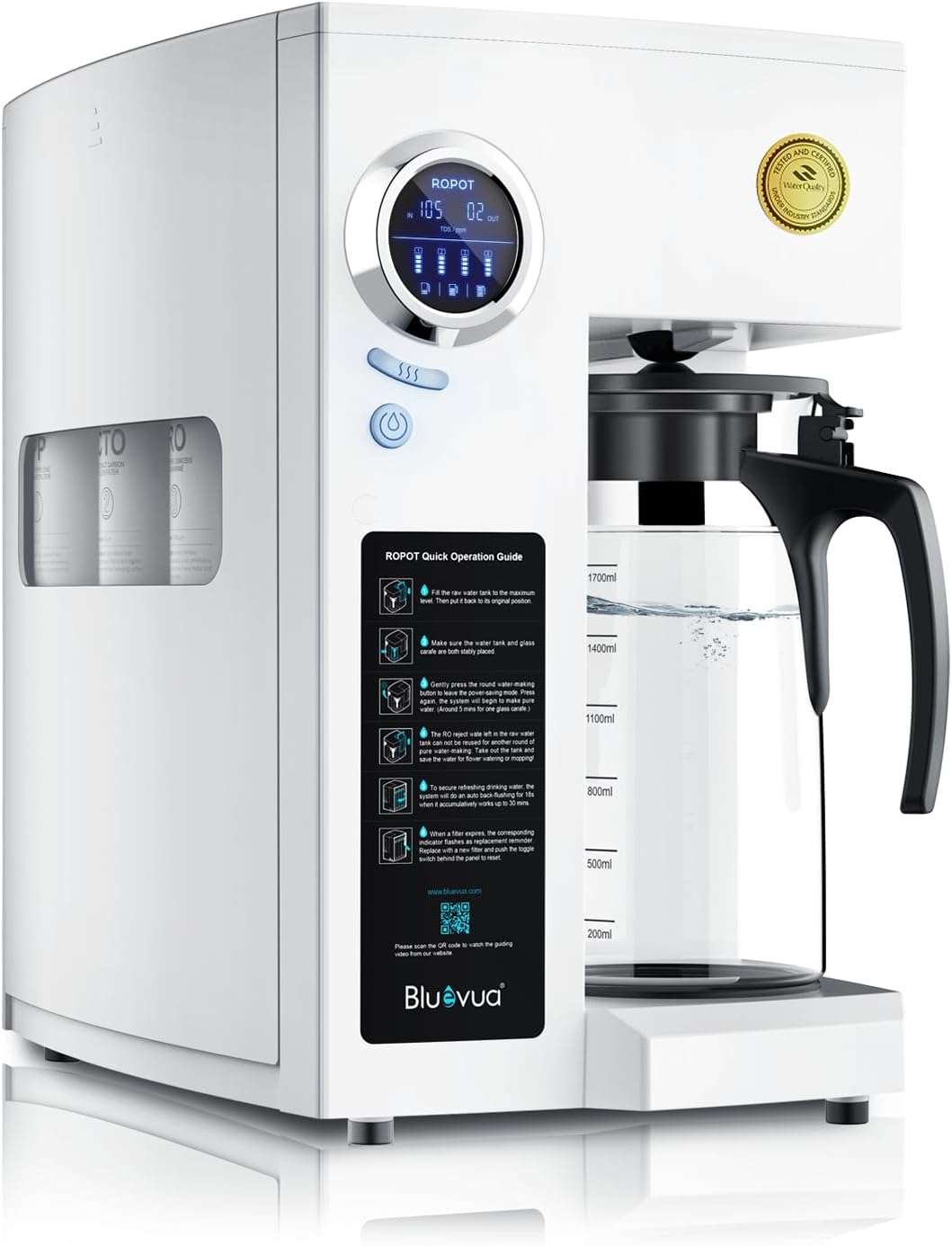
The Bluevua ROPOT is a portable countertop reverse osmosis system designed to deliver bottled-quality water without any plumbing. You fill the top reservoir, plug the unit in, and the built-in RO stack plus a remineralization stage produces low-TDS water that dispenses into the included borosilicate glass carafe. A clear practical benefit is the glass carafe, which avoids plastic contact and looks at home on a kitchen counter, while the smart display reports filter life and TDS so you can monitor water quality. The unit uses a power-saving standby mode and claims a 2:1 pure-to-drain ratio to reduce wastewater compared with some RO systems. Filters are rated to last roughly 12 to 24 months depending on use, and replacement parts and multi-packs are available. Limitations to consider are the modest 0.26 L/min flow rate and the 1.7 L carafe capacity, which mean it is best for drinking and cooking rather than high-demand tasks; frequent heavy use will require more refill cycles. For well-water users you should verify your incoming TDS and sediment levels because very high levels may need pre-treatment before the ROPOT to protect filter life.
Best for: Homeowners who want a countertop RO system that produces low-TDS drinking water with minimal installation and prefer a glass storage carafe and visible filter monitoring.
Less Ideal for: Large households or users needing high continuous output or very high-volume dispensing should consider plumbed RO units or systems with higher flow and larger storage capacity.
- True reverse osmosis filtration with remineralization for lower TDS and improved taste
- Borosilicate glass carafe reduces plastic contact and looks upscale on the counter
- Plug-in countertop design requires no plumbing or installation
- Smart display shows filter life and TDS for easy maintenance tracking
- Power-saving standby and a claimed 2:1 pure-to-drain ratio help reduce waste and energy use
- Relatively slow maximum flow rate, so filling large containers takes time
- 1700 ml capacity means frequent refills for multiple users or high daily usage
Verdict: Choose the ROPOT if you want a no-install countertop RO that delivers low-TDS water into a glass carafe with on-device TDS and filter-life monitoring.
AquaTru Carafe Smart Alkaline

| Purification Method | Reverse Osmosis |
|---|---|
| Power Source | Corded Electric |
| Maximum Flow Rate | 0.5 gpm |
| Operating Pressure Range | 40 – 85 psi |
| Supported Water TDS Level Maximum (PPM) | 300 |
The AquaTru Carafe Smart Alkaline is a compact countertop reverse osmosis purifier designed to remove a wide range of contaminants that typical pitcher filters miss. You fill the inlet tank, plug the unit into a standard outlet, and the built-in pump and RO stages push treated water into the included glass carafe for drinking, cooking, or making coffee and baby formula. Notable features include a four-stage filter set (prefilter, RO membrane, VOC carbon, and mineralization options across SKUs), built-in filter life indicators, and borosilicate glass carafe for better taste and fewer plastic contact points. For well water users this unit can reduce contaminants like lead, arsenic, PFAS, and microplastics when source water meets the stated TDS and pressure ranges, and the RO membrane life of up to 1–2 years keeps ongoing maintenance intervals reasonable. Limitations are that it requires electricity, has a modest output flow (about 0.5 gpm maximum), and is intended for countertop use rather than whole-house or high-flow applications, so larger households or heavy daily cooking use may find its capacity too small without refilling often.
Best for: Buyers focused on performance who want countertop RO-level contaminant reduction and clear, great-tasting drinking water without plumbing changes.
Less Ideal for: Those who need whole-house treatment, very high daily volumes, or an off-grid solution should consider larger or hard‑plumbed systems instead.
- Reverse osmosis filtration removes a broad set of contaminants including PFAS, lead, and microplastics.
- Compact countertop design with a removable borosilicate glass carafe reduces plastic contact and looks tidy on a counter.
- Longer filter lifetimes on major stages (RO up to 1–2 years) reduce frequency of replacements.
- Built-in filter life indicators simplify maintenance and prevent guesswork.
- Requires a 120V power outlet and is not usable during power outages.
- Limited clean water capacity and modest flow rate mean frequent refills for larger daily use.
- Not designed for whole-house or high-flow applications common with heavy well-water demand.
Verdict: Choose the AquaTru Carafe when you need countertop reverse osmosis performance to cut PFAS, lead, and microplastics without installing plumbing.
Waterdrop WD-CTF-01 Countertop Filter

| Purification Method | 5-stage filtration |
|---|---|
| Maximum Flow Rate | 1.6 gpm |
| Capacity | 8000 gallons |
| Operating Pressure Range | 15-100 psi |
| Material Type | 304 Food-Grade Stainless Steel |
The Waterdrop WD-CTF-01 is a countertop faucet filter that connects to most standard kitchen taps and uses a five-stage cartridge to cut chlorine, heavy metals, hydrogen sulfide, and sediments while keeping a high flow. Installation is straightforward with included hoses, adapters, and a wrench, and a twist switch makes it easy to toggle between filtered and tap water. Built from 304 food-grade stainless steel with an anti-slip base, it is durable and looks at home on a countertop while delivering up to 1.6 gallons per minute so filling pitchers and kettles is quick. The replaceable cartridge is rated for about 8,000 gallons or 12 months under municipal water conditions, which reduces maintenance frequency. Limitations to note are faucet compatibility and function on nonstandard taps since it does not fit pull-out, spray-style, or sensor faucets, and it is not designed to lower total dissolved solids levels, so it may not address all well-water issues without supplemental treatment.
Best for: Buyers who want a durable countertop filter that delivers fast, reliable reduction of chlorine and metals for everyday drinking and cooking, and who prioritize low-maintenance, long-life cartridges.
Less Ideal for: Homes with nonstandard kitchen faucets or well-water users who need TDS reduction, softening, or targeted removal of specific well contaminants without additional systems.
- Five-stage filtration reduces chlorine, sediments, heavy metals, and hydrogen sulfide
- Fast flow up to 1.6 gallons per minute for quick dispensing
- Durable 304 food-grade stainless steel construction with anti-slip base
- Long cartridge life rated for about 8,000 gallons or 12 months
- Not compatible with pull-out, spray-style, or sensor-activated faucets
- Does not reduce total dissolved solids (TDS), so it will not soften or lower mineral content
Verdict: Choose this countertop filter if you need a low-maintenance, stainless-steel system that reliably removes chlorine and heavy metals while keeping a fast flow for daily use.
PUR 30-Cup Water Filter Dispenser

| Capacity | 7.09 liters |
|---|---|
| Filter Life Cycle | 2 months / 40 gallons |
| Purification Method | Ion Exchange |
| Supported Water TDS Level Maximum (PPM) | 500 |
The PUR 30-Cup Water Filter Dispenser is a slim, countertop pitcher-style dispenser designed to store and filter a large batch of drinking water for the fridge. You fill the top reservoir and water passes through a genuine PUR filter that uses ion exchange to reduce chlorine, mercury, copper, zinc and other chemical and physical substances; the unit includes one filter certified for up to 40 gallons or about two months of regular use. It has a pull-down spout that lets you pour while the reservoir is still filtering, a carrying handle for refilling, LockFit to secure the cartridge, and it is dishwasher safe for easy cleaning. The dispenser's larger 30-cup capacity and faster filtration compared with PUR pitcher filters make it useful for families or anyone who wants more chilled filtered water on hand without constant refills. For well water users, note that PUR filters target chemical and taste contaminants rather than microbes or heavy sediment, so pre-treatment or a different certified well-water solution may be required if your source has bacteria or high particulate load.
Best for: Buyers looking for an affordable, higher-capacity countertop filter to keep chilled, better-tasting tap water on hand and reduce bottled-water spending.
Less Ideal for: Homes with untreated well water that has bacteria, high sediment, or specific contaminants requiring specialized or certified well-water treatment should consider a whole-house or dedicated well treatment system instead.
- Large 30-cup capacity reduces how often you refill and fits in most refrigerators
- Includes a genuine PUR filter certified up to 40 gallons or 2 months
- Pull-down spout allows pouring while filtering for continuous use
- Slim, dishwasher-safe plastic design is easy to clean and store
- NSF-certified reduction of chlorine and several metals improves taste and odor
- Not certified to remove microbes so it is not a standalone solution for bacterially contaminated well water
- Plastic housing may retain odors over time compared with some materials
Verdict: Choose this dispenser if you want an inexpensive, high-capacity countertop filter that delivers noticeably better tasting tap water for fridge storage.
Aigerri Countertop RO TJYJ001
| Purification Method | Reverse Osmosis |
|---|---|
| Capacity | 5 liters |
| Installation Type | Countertop |
| Other Special Features | 5 Stages RO Filter; 5:1 Pure to Drain; UV; Self Cleaning |
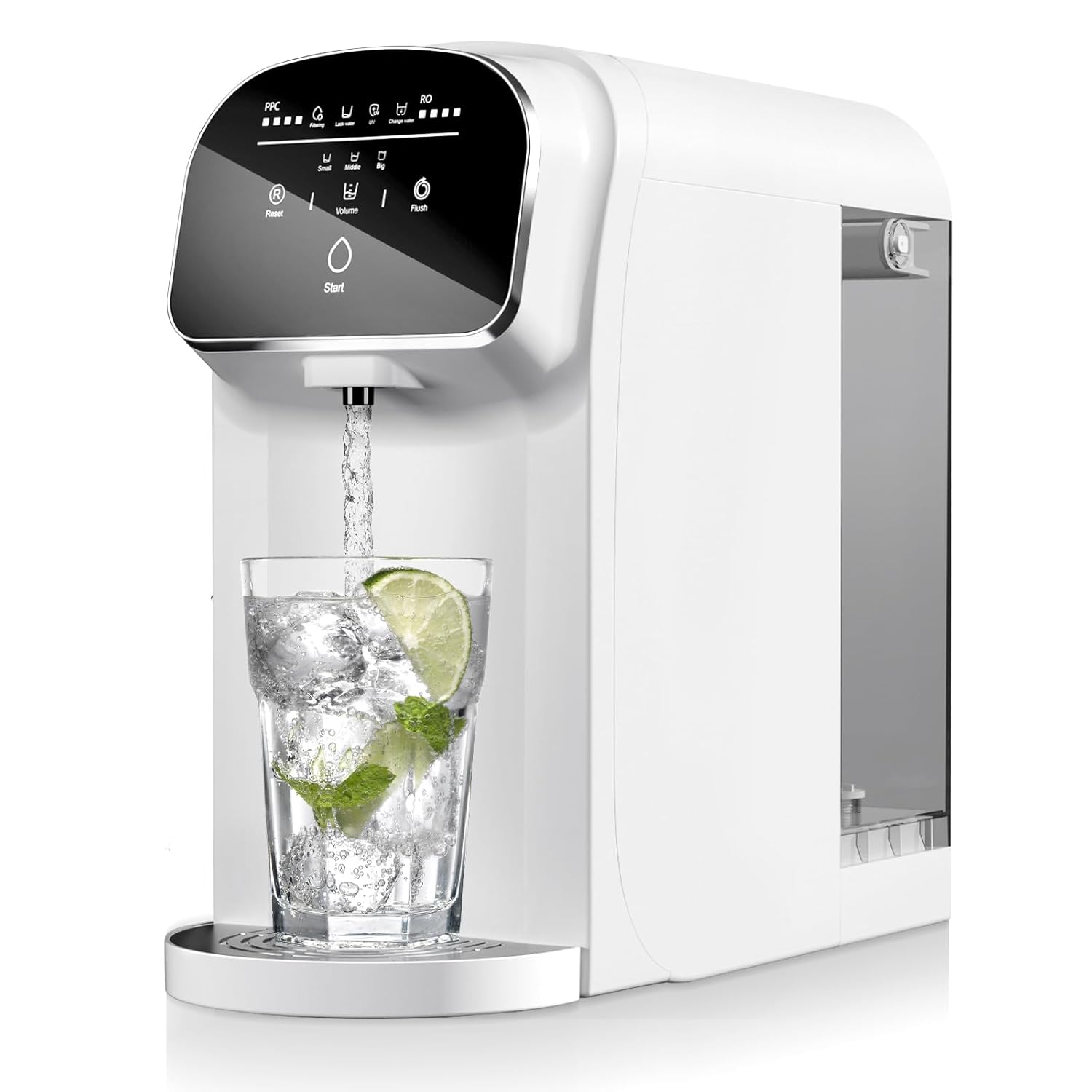
The Aigerri countertop RO system is a portable, no-install reverse osmosis purifier designed for everyday drinking water use in kitchens, offices, RVs, and apartments. You fill the 5 L feed tank, plug the unit in, and the five-stage filtration sequence (including a PPC prefilter, RO membrane and UV) produces purified water into a separate purified water tank; the manufacturer rates up to 529 gallons from the supplied filters. Notable practical features are the high-efficiency 5:1 pure-to-drain ratio, which reduces wastewater compared with older RO units, and the built-in UV stage for extra microbial protection. The compact countertop design and quick-change cartridge layout make maintenance straightforward for routine filter swaps. Important limitations are its countertop footprint and the need to refill the feed tank rather than supplying a continuous plumbed feed, and the system weight that limits portability for frequent moves. For households using well water seeking reliable contaminant reduction without plumbing work, this system provides multi-stage treatment and simple operation.
Best for: Buyers who prioritize reliable, multi-stage contaminant removal without plumbing work and want a straightforward, low-maintenance countertop RO for well water treatment.
Less Ideal for: People who need a continuous plumbed-in system or have extremely limited counter space and cannot accommodate a moderately sized countertop appliance.
- Five-stage filtration including RO membrane and UV for broad contaminant reduction
- 5 L feed tank plus a separate purified water tank for daily convenience
- High-efficiency 5:1 pure-to-drain ratio reduces wastewater compared with traditional RO systems
- Plug-and-play countertop design requires no plumbing or professional installation
- Quick-change preinstalled filters simplify routine maintenance
- Requires manual filling of the feed tank rather than direct plumbing supply
- Countertop footprint and unit weight limit placement flexibility
Verdict: Choose this Aigerri countertop RO when you need a reliable, no-plumb multi-stage purifier that delivers strong contaminant reduction and lower wastewater for well water without installation.
ZeroWater 22-Cup Ready-Read Dispenser

| Capacity | 5.2 liters |
|---|---|
| Purification Method | Ion Exchange |
| Supported Water TDS Level Maximum (PPM) | 1 |
| Included Components | 22-Cup Dispenser, 5-Stage Filter, TDS Meter |
| Container Type | Plastic |
The ZeroWater 22-Cup Ready-Read dispenser is a countertop pitcher-style system that uses a 5-stage ion exchange filter to remove total dissolved solids and common heavy metals, and it includes a TDS meter so you can verify water quality before pouring. Typical use is filling the top reservoir, allowing water to pass through the multi-stage filter into the lower 22-cup tank, and checking the TDS meter to know when the filter needs replacement. Notable features include IAPMO certification for reduction of lead, PFOA/PFOS, chromium and mercury, a change-filter indicator via the TDS readout, and an ergonomic handle for serving. Practical benefits for well-water households include substantial reduction of dissolved minerals and metals and the ability to monitor performance in real time with the included meter. Important limitations are that it targets dissolved solids and certain contaminants but is not a comprehensive treatment for microbiological contamination or specific chemical contaminants not listed in certifications, and replacement filters will be a recurring cost depending on local water quality.
Best for: Buyers who want measurable assurance that their filtered water has low dissolved solids and verified reductions in heavy metals, especially those comparing real-world performance across options using third-party certifications and user reviews.
Less Ideal for: Homes with microbiological contamination, chemical spills, or contaminants not covered by the filter's certifications should rely on full-scale well treatment or lab-tested point-of-entry solutions instead.
- Five-stage ion exchange filtration reduces total dissolved solids and heavy metals.
- Built-in TDS meter lets you verify filter performance and know when to replace the cartridge.
- IAPMO certification for reduction of lead, PFOA/PFOS, chromium and mercury provides independent validation.
- Large 22-cup capacity reduces refills and works well for a kitchen countertop.
- Includes one filter and a TDS meter so you can start testing immediately.
- Not designed to guarantee removal of microbiological contaminants such as bacteria or viruses.
- Replacement filters are required and frequency depends on well water TDS, creating ongoing cost.
- Power source listed as corded electric in specs may be misleading since the unit is passive; it does not address all treatment needs for problem wells.
Verdict: Choose this dispenser if you want a countertop filter that demonstrably lowers TDS and certain heavy metals and lets you monitor results with a built-in meter.
DREO RO Countertop Water Filter 5L

| Purification Method | Reverse Osmosis |
|---|---|
| Capacity | 5 liters |
| Pure to Drain Rate | 3:1 |
| Included Components | Body, 1 RO Filter, 2 Autofill Pitchers |
| Other Special Features of the Product | Built In TDS Meter, Change Filter Indicator, Touch Control |
The DREO RO Countertop Water Filter is a plug-in reverse osmosis purifier designed for countertop use and daily household drinking-water needs. It uses a 7-stage RO cartridge and reports a 3:1 pure-to-drain ratio while providing real-time TDS readouts and filter-life reminders on a touch control panel. The system includes a 5-liter tank and two auto-fill pitchers so one pitcher can be grabbed while the other refills automatically, and an internal self-cleaning flush helps reduce biofilm and mineral buildup. Installation is straightforward because it requires no plumbing work, making it suitable for renters or anyone who wants filtered water without under-sink modifications. Practical limitations to consider are the need to replace RO cartridges periodically (rated around 265 gallons per filter) and the typical RO drain water for each batch, so water usage will be higher than non-RO pitchers. The unit is fairly compact for a countertop RO and works well for families wanting consistent impurity removal and easy maintenance features like twist-to-replace filters and change indicators.
Best for: Buyers who prioritize reliable contaminant removal and simple, low-effort operation for household drinking water and want a plug-in countertop unit that does not require plumbing changes.
Less Ideal for: People who need a zero-waste system or have extremely high daily water demand where RO drain volume would be impractical.
- 7-stage RO filtration with SGS-tested impurity removal for broad contaminant reduction
- Built-in TDS meter and filter-life indicator for easy monitoring of water quality and maintenance
- Auto-fill dual-pitcher system provides ready-to-grab pitchers and hands-free refilling
- Self-cleaning auto-flush reduces internal buildup and simplifies upkeep
- Countertop, install-free design works without plumbing changes
- Produces drain water as part of RO process, increasing overall water use
- Filter lifespan is limited to specified gallons so periodic cartridge replacement is required
Verdict: Choose this countertop RO when you want a compact, install-free system that delivers lab-grade contaminant reduction with hands-off monitoring and auto-fill convenience.
Choosing the Right Countertop Water Filter for Well Water: Key Factors to Consider
Filtration Capability and Target Contaminants
Not all countertop filters are built to handle the same contaminants. With well water you may face sediment, rust, iron staining, hydrogen sulfide odors, and occasionally bacterial or protozoan threats. Look for systems with multi-stage filtration that include a sediment prefilter plus media designed for iron or manganese reduction if those are present.
If microbiological contamination is a concern, choose a system with an established barrier or treatment stage appropriate for bacteria and protozoa. Remember that countertop systems have limits: severe chemical contamination may require point-of-entry treatment or professional remediation. Match the filter's stated reductions to your well's test results to ensure the unit addresses the specific issues you face.
Flow Rate and Daily Throughput
Countertop filters vary widely in how much water they can produce per minute and how long a cartridge will last before flow drops. For a family that uses filtered water for cooking, beverages, and occasional pot filling, a higher flow rate reduces frustration and makes the unit practical for daily use.
Check rated gallons per minute and the cartridge's total capacity. A tiny-capacity filter that clogs quickly is a poor fit for high-demand households. Also consider how flow changes as the filter loads with sediment; some designs allow backflushing or have larger sediment chambers to sustain flow longer between service intervals.
Maintenance Frequency and Replacement Cost
Maintenance burden includes how often you must replace cartridges, how easy the replacement is, and ongoing supply availability. Well water with high sediment will shorten cartridge life, so systems with long-life sediment elements or washable prefilters can lower running costs and hassle.
Factor in both time and money: an inexpensive initial unit that needs monthly cartridges may cost more in the long run than a higher-capacity system with annual replacements. Clear labeling of service intervals and straightforward access to cartridges are signs of homeowner-friendly design.
Installation and Compatibility with Kitchen Fixtures
Countertop units are favored for their minimal plumbing changes, but not every kitchen faucet or sink layout is equally compatible. Confirm that the unit includes a diverter or adapter that fits your faucet type, or be prepared to use a small footprint faucet attachment. Some models have quick-connect hoses and do not require tools, while others might need a hole-drilling or permanent faucet install.
If you rent or prefer a no-permanent-modification setup, prioritize models that attach without tools and disconnect easily. Verify hose lengths and connector styles to ensure the system will sit comfortably on your counter without stressing the fittings.
Materials, Build Quality, and Durability
Well water can be harder on equipment because of higher sediment loads and mineral content. Durable housing materials and robust seals help prevent leaks and premature failure. Look for corrosion-resistant metals or thick-walled plastics in contact with water, and quality O-rings and threaded connections.
Higher build quality often correlates with longer service life and fewer emergency repairs. Assess warranty terms and the availability of replacement parts when durability is a priority.
Certification and Testing Evidence
Third-party test results or certifications provide independent verification of a filter's reductions. While countertop systems are not all eligible for the same certifications, documented lab testing for contaminant reduction or NSF/ANSI claims where available adds confidence.
If your well test shows specific problematic contaminants, seek documentation that a filter reduces those contaminants. In the absence of certifications, look for clear performance data from an accredited lab or detailed technical specifications from the manufacturer.
Understanding Well Water Challenges
Well water quality varies by geology, depth, and nearby activities. Common issues include turbidity from suspended particles, iron and manganese staining, sulfur odors, and occasional bacterial presence. Knowing the specific problems in your well water guides the type of countertop filtration that will be effective.
Start with a municipal or lab-based well-water test to identify contaminants and concentrations. The test results let you prioritize sediment removal, mineral reduction, or microbiological barriers and avoid buying a system that does not address your key issues.
- Sediment causes cloudiness and can foul cartridges rapidly.
- Iron and manganese cause staining and metallic taste.
- Hydrogen sulfide produces a rotten-egg smell at low concentrations.
- Microbial contamination requires dedicated treatment stages or disinfection.
When a Countertop Filter Is the Right Choice
Countertop filters are ideal if you need improved drinking and cooking water without altering plumbing or installing whole-house equipment. They are also a good interim solution while you evaluate long-term treatment options for well remediation.
Choose a countertop unit when your concerns are localized to drinking water rather than overall household supply. These units are portable, often easier to maintain, and a lower-commitment step than permanent point-of-entry systems.
- Suitable for renters or those avoiding permanent plumbing changes.
- Useful as a targeted solution for drinking water only.
- Can be used temporarily while diagnosing well problems.
Fitting a Countertop Filter to Your Kitchen
Measure available counter space and note how the unit's hoses will route to the sink. Some models sit tall and require clearance under cabinets, while others are compact. Confirm hose length and whether the included diverter fits your existing faucet.
Consider where you will store replacement cartridges. A unit with easy top-access or twist-off housings simplifies swaps. Also think about drip containment and a small tray underneath the unit if your counter is porous or if you want extra protection during cartridge changes.
- Check faucet adapter compatibility before purchase.
- Allow room for ventilation around the unit to avoid mildew.
- Keep replacement parts organized nearby for quick service.
Maintaining Performance Over Time
Regular maintenance keeps a countertop filter effective. Follow replacement intervals closely and monitor flow rate and taste as indicators that service is due. For sediment-heavy wells, inspect and clean any washable prefilter elements frequently.
Keep a maintenance log noting cartridge changes and any changes in water appearance or smell. This habit helps identify when well conditions shift and whether a higher-capacity or different treatment approach is needed.
- Track replacement dates and gallons treated if possible.
- Flush new cartridges per instructions to remove manufacturing fines.
- Store spare cartridges properly to avoid contamination.
When to Consider Upgrading Beyond Countertop Filtration
If testing shows persistent bacterial contamination, high iron, or chemical pollutants at significant concentrations, a countertop filter may not be sufficient. Upgrading to a point-of-entry or professionally designed treatment system is appropriate when you need whole-house protection or when water quality affects appliances and plumbing.
Use countertop filtration as part of a layered approach. For many homes, combining a robust point-of-entry prefilter with a dedicated countertop drinking-water system provides both appliance protection and high-quality potable water.
- Whole-house treatment protects appliances and plumbing.
- Professional remediation may be required for well construction or contamination issues.
- Combine treatments strategically rather than relying on a single solution.
How We Chose the Best Countertop Water Filter for Well Water
We evaluated countertop water filters for well water using criteria that matter for private-supply households. Filtration capability was a primary filter: systems had to demonstrate multi-stage media or certified reductions for common well contaminants such as sediment, iron particulates, chlorine byproducts, and microbial risks where applicable. Flow rate and throughput were tested conceptually: we prioritized units that maintain usable faucet flow without frequent filter changes or prolonged wait times. Build quality and plumbing adaptability were another focus, selecting units with durable housings, clear access to cartridges, and flexible faucet or diverter connections for typical kitchen setups. Maintenance and cost of ownership were assessed by cartridge life estimates and how easy the replacement process is for homeowners. Ease of installation and instruction clarity were also required; products needing complex plumbing modifications were excluded. We excluded point-of-entry whole-house systems and undersink-only designs, concentrating strictly on countertop solutions intended for well water conditions. Performance claims were weighed against available specifications and common well-water concerns rather than marketing language. Together these filters represent reliable, practical options for homeowners seeking effective countertop filtration for well water.
Our full evaluation process is outlined in our review methodology.
FAQ
Can a countertop filter remove bacteria from well water?
Some countertop systems include barriers or treatment stages that reduce bacteria and protozoa, but effectiveness depends on the technology used. If bacterial contamination is confirmed, consider systems designed for microbiological control or consult a water-treatment professional.
How often will I need to change cartridges with well water?
Cartridge life depends on sediment load and contaminant concentrations. Expect more frequent changes with high turbidity wells; some users may swap cartridges every 3 to 6 months, while low-sediment conditions can extend life to a year or more.
Will a countertop filter help with iron staining?
Certain media stages are formulated to reduce dissolved iron and remove particulate iron that causes staining. For significant iron problems, a specialized iron-removal step or prefilter is advisable to protect downstream cartridges and maintain flow.
Are countertop filters hard to install on a kitchen sink?
Most countertop filters install with a faucet diverter or an included adapter and do not require permanent plumbing changes. Installation difficulty varies by faucet type, so confirm compatibility and read the instructions before purchasing.
Can I use a countertop filter year-round in cold climates?
Countertop filters function in cold climates but should be protected from freezing. If your kitchen experiences subfreezing temperatures, ensure the unit and hoses are kept above freezing and drain the system before prolonged absences.
Final Verdict
For private wells, prioritize a countertop water filter that addresses the contaminants shown on your well test while offering sufficient flow for daily use. Balance filtration capability against maintenance frequency: a robust multi-stage unit with a washable sediment prefilter can reduce cartridge churn and sustain performance. If your well shows serious contamination beyond what a countertop unit can reliably handle, plan for a whole-house or professionally engineered solution. For drinking water improvements, choose a countertop model that matches your specific contaminant profile and has clear service intervals so you can maintain consistent water quality with confidence.