
Note: This article contains affiliate links. If you click on these links and make a purchase, we may earn a small commission at no extra cost to you. This helps support our research and content. Read our full affiliate disclosure here.
If your household relies on a private well, choosing the right under-sink drinking water filter can mean the difference between clear, palatable water and recurring taste, odor, or contaminant issues. Well water can contain sediment, iron, hydrogen sulfide, and microbial or chemical contaminants that typical municipal-focused filters do not prioritize. A properly selected under-sink system gives you targeted treatment at the point of use, protecting drinking and cooking water without reworking your whole plumbing. This guide shortlists the top under-sink drinking water filters for well water and explains how they were chosen. We focused on contaminant removal performance, maintenance requirements, and flow impact so you can pick a solution that fits your water quality challenges and household habits. Read on for the evaluation framework and practical buying guidance before the product list.
Top Picks at a Glance
| Best Overall The best all-around choice for most situations | iSpring CU-A4 Under-Sink Filter |  |
| Best Quality Built to a higher standard if you want something more solid | iSpring RCC7P-AK Reverse Osmosis System |  |
| Best Value The sweet spot between price and what you get | CuZn UC-200 Under Sink Filter |  |
| Best Budget The cheapest option that still gets the job done reliably | Amazon Basics Under-Sink Water Filter System |  |
| Top Rated A top-rated pick with lots of positive feedback | ICEPURE WFS5300A Under-Sink Filter |  |
| Most Popular A crowd favorite that many people choose with confidence | APEC Water ROES-50 |  |
| Best Seller A high-volume bestseller chosen again and again | Waterdrop WD-15UA Under-Sink Filter |  |
iSpring CU-A4 Under-Sink Filter

| Purification Method | Mechanical Filtration, Chemical Absorption, Redox, and Ultrafiltration |
|---|---|
| Filter Life Cycle | 6 months |
| Capacity | 8000 gallons |
| Installation Type | Under Sink |
The iSpring CU-A4 is a tankless, under-sink drinking water system built around a 0.01 micron ultrafiltration membrane plus KDF and granular activated carbon polishing stages. It installs under the sink and supplies a dedicated brushed-nickel faucet for drinking water, so it is used just like a standard filtered tap for drinking, coffee makers and refrigerators. The multi-stage design removes sediment, chlorine, lead and many metals while retaining beneficial minerals and it produces no wastewater since it is not reverse osmosis. Push-to-connect fittings and twist-on/twist-off cartridges simplify installation and filter changes, and the system is compact for under-sink mounting. Limitations include that it does not lower TDS or function as an RO system, and filter life varies with source water so high sediment well water may require more frequent cartridge changes.
Best for: Buyers who want a robust, maintenance-friendly under-sink filter that removes chlorine, sediment and many heavy-metal contaminants while keeping installation and cartridge changes simple.
Less Ideal for: Homes that need very low TDS water, desalination, or the absolute highest dissolved-solids removal should choose an RO system instead.
- 0.01 micron ultrafiltration membrane for very fine particle and microbe reduction
- Multi-stage KDF and GAC polishing reduces chlorine, chloramine and some heavy metals
- Tankless design with no wastewater production
- Push-to-connect fittings and twist-on cartridges make installation and filter changes straightforward
- Does not reduce total dissolved solids or replace a reverse osmosis system
Verdict: A compact, tankless ultrafiltration under-sink system that balances strong contaminant reduction with simple installation and low maintenance for everyday drinking water.
iSpring RCC7P-AK Reverse Osmosis System

| Purification Method | Reverse Osmosis, Alkaline, Activated Carbon, Carbon block |
|---|---|
| Power Source | Corded Electric |
| Upper Temperature Rating | 100 °F |
| Supported Water TDS Level Maximum (PPM) | 2000 |
| Capacity | 75 gallons |
The iSpring RCC7P-AK is an under-sink 6-stage reverse osmosis system built to deliver consistent, high-quality drinking water especially from low-pressure well supply. It combines sediment and carbon prefilters with an RO membrane, an alkaline remineralization cartridge, and a top-mounted booster pump to recover usable flow and reduce wastewater. Typical use is direct under-sink installation feeding a dedicated faucet and optionally a refrigerator via adapter; the clear first-stage housing makes visual filter checks straightforward. The pump helps maintain efficiency when household water pressure is low, and the system reports reduction of a wide range of contaminants including lead, chlorine, fluoride, arsenic, PFAS, and high TDS. Maintenance is regular cartridge and membrane replacement and space is required under the sink for the housings and pump. Buyers should expect installation plumbing work and periodic filter/membrane costs, but will get near-complete contaminant removal and a remineralized final taste profile for well water applications.
Best for: Buyers with well water or low-pressure municipal lines who prioritize thorough contaminant removal and steady filtered flow for drinking and cooking.
Less Ideal for: People who need a plug-and-play countertop solution or who cannot accommodate under-sink plumbing and routine filter maintenance.
- Booster pump preserves flow and RO efficiency on low-pressure well supplies
- Six-stage filtration including alkaline remineralization restores minerals and improves taste
- Transparent first-stage housing for quick visual filter checks
- Reduces a broad list of contaminants including PFAS, lead, fluoride, and chlorine
- Includes faucet, housings, pump, and universal 100-240V power adapter for easy setup
- Requires under-sink space and basic plumbing for installation
- Ongoing costs for replacement filters and RO membrane
Verdict: Choose this system when you need dependable RO-level contaminant removal and a booster pump to keep flow strong from well water while adding back minerals for better taste.
CuZn UC-200 Under Sink Filter

| Model Number | UC-200 |
|---|---|
| Included Components | Stainless Steel Connection Hose |
| Material Type | NSF Approved Material Components |
| Filter Life | Up to 5 years / 50,000 gallons |
| Certified Reductions | NSF/ANSI 42 components; PFAs, PFOA/PFOS, Lead, Chlorine |
The CuZn UC-200 is a three-stage under-sink filter designed for straightforward direct-connection to a kitchen or bathroom cold-water line. It combines micro-sediment membranes, KDF-55 media and coconut shell carbon to cut chlorine, bad tastes and odors, lead, PFAS/PFOA/PFOS and microplastics without performing reverse osmosis, so healthy minerals remain in the water. Installation is intentionally simple with included fittings and a stainless steel connection hose, and the unit is sized for minimal under-sink space. Its standout feature is the very long service life: CuZn rates the UC-200 for up to five years or roughly 50,000 gallons depending on water quality, which reduces replacement frequency and ongoing cost compared with typical cartridge filters. Limitations to expect are that it does not lower TDS and performance depends on incoming well water quality, so very hard or heavily contaminated supplies may still need pre-treatment or an RO system for total dissolved solids removal.
Best for: Buyers who want a low-maintenance, cost-efficient under-sink filter that improves taste and reduces common contaminants while avoiding the complexity of RO systems for well water.
Less Ideal for: Homes needing significant TDS reduction, desalination, or treatment for very high contaminant loads should consider RO or multi-stage treatment systems instead.
- Long rated filter life up to 5 years or ~50,000 gallons reduces replacement frequency
- Multi-stage media (micro-sediment, KDF-55, coconut shell carbon) targets chlorine, lead, PFAS and sediment
- Simple direct-connect installation with included stainless steel connection hose
- Retains beneficial minerals because it is not a reverse osmosis system
- Does not reduce total dissolved solids (TDS) or replace an RO system for mineral/solute removal
- Effectiveness depends on incoming water quality so very heavy contamination may need additional treatment
Verdict: Pick the UC-200 if you want a durable, easy-to-install under-sink filter that delivers long service life and broad contaminant reduction without removing beneficial minerals.
Amazon Basics Under-Sink Water Filter System

| Purification Method | Activated Carbon |
|---|---|
| Installation Type | Under Sink |
| Capacity | 11000 gallons |
| Supported Water TDS Level Maximum (PPM) | 500 |
This under-sink system uses an activated carbon block to reduce chlorine, bad taste, and odor and installs directly to standard 3/8" or 1/2" cold-water lines using the included fittings. The twist-and-lock cartridge and push-to-connect fittings make installation and annual replacement straightforward for a homeowner comfortable working under a sink, and the kit includes hoses, a convertor, screws, and Teflon tape for a complete hookup. It is certified to NSF/ANSI 42 and 372 which confirms basic aesthetic contaminant reduction and lead-free materials, and Amazon rates the cartridge life at 12 months or 11,000 gallons with municipal water. Practical limits for well-water buyers are that the system is built for chlorine and taste/odor reduction and does not advertise removal of common well-water issues like iron, sediment, bacteria, or nitrates, so additional pretreatment may be needed. For households wanting a low-cost, easy-to-install carbon polishing filter for drinking water, this is a sensible option; those needing broader contaminant removal should look at more specialized multi-stage or media systems.
Best for: Buyers seeking a low-cost, easy-to-install under-sink carbon filter to improve taste and odor for household drinking water and who prioritize simple annual cartridge replacement.
Less Ideal for: Homes on untreated well water with iron, sediment, bacterial, or chemical contamination that require multi-stage filtration or targeted treatment systems.
- NSF/ANSI 42 and 372 certified for reduction of chlorine and lead-free materials
- Twist-and-lock cartridge and push-to-connect fittings simplify installation and filter changes
- Includes necessary hoses and fittings for direct connection to 3/8" and 1/2" cold-water lines
- Rated for up to 11,000 gallons or 12 months of service life under municipal water conditions
- Designed for chlorine and taste/odor reduction only and does not target iron, sediment, bacteria, or other common well-water contaminants
Verdict: A budget-friendly, NSF-certified under-sink carbon filter that delivers simple installation and reliable chlorine and taste improvement for households wanting an affordable drinking-water polish.
ICEPURE WFS5300A Under-Sink Filter

| Purification Method | Activated Carbon |
|---|---|
| Maximum Flow Rate | 2.5 gpm |
| Filter Life Cycle | 3 years |
| Capacity | 22000 gallons |
| Other Special Features of the Product | Chlorine Reduction, NSF certified |
The ICEPURE WFS5300A is an under-sink activated carbon cartridge system built for long service life and straightforward installation. It connects directly to a cold water line and is intended to deliver improved drinking water taste by reducing chlorine, odors, heavy metals, and sediment through a carbon block with a 0.5 micron outer layer. The unit claims a tested flow rate up to 2.5 gallons per minute and a large rated capacity of 22,000 gallons or roughly three years of use under typical municipal conditions. Installation is plug-and-play with adapter fittings for 1/2" or 3/8" female NPT threads and filter changes are designed to be quick. Important limitations for well water: this model is a single-stage carbon filter and is optimized for chlorine, taste, and particulates rather than bacteria, nitrates, or iron removal, so users with common well contaminants should plan complementary treatment. For households prioritizing a durable, easy-to-service under-sink carbon filter for improved taste and basic contaminant reduction, this delivers high capacity and simple upkeep.
Best for: Buyers who want a low-maintenance, high-capacity under-sink carbon filter to reliably improve taste and reduce chlorine and sediment with minimal service.
Less Ideal for: Homes on untreated well water with microbial, nitrate, or iron issues should choose a multi-stage system or add specialized pre/post-treatment instead.
- High rated capacity: 22,000 gallons or about three years between cartridge replacements under typical use
- Fast claimed flow rate up to 2.5 gallons per minute that supports normal kitchen use
- NSF/ANSI 42 and 372 certifications for chlorine, taste, odor reduction and lead-free materials
- Tool-free, quick filter change and simple under-sink plug-and-play installation with included adapters
- Single-stage activated carbon design does not address microbial contaminants, nitrates, or dissolved iron common in well water
Verdict: Choose this high-capacity, easy-to-install carbon under-sink filter if you want a reliable, low-maintenance solution to improve taste and reduce chlorine and sediment.
APEC Water ROES-50

| Purification Method | Reverse Osmosis |
|---|---|
| Filtration Stages | 5-Stage |
| Daily Output (GPD) | 50 gallons |
| Operating Pressure Range | 40-85 psi |
| Supported Water TDS Level Maximum (PPM) | 2000 |
The APEC Water ROES-50 is a 5-stage under-sink reverse osmosis system designed to deliver very high-purity drinking water for a household tap. It uses sediment and carbon prefilters, a high-rejection RO membrane, and a postfilter to reduce chlorine, heavy metals, fluoride, PFAs, microplastics and other common well-water contaminants, and the system includes a storage tank and dedicated faucet for steady flow. Installation is DIY-friendly with quick-connect fittings and color-coded tubing, and routine maintenance is straightforward: prefilters typically last 6 to 12 months while the membrane and postfilter last 12 to 24 months depending on incoming water quality. The unit is WQA/NSF-certified components and sized for typical homes on municipal or well supplies up to the stated TDS limit, but its 50 GPD rating and 0.03 gpm maximum flow mean it is intended for drinking and cooking rather than whole-house use. Expect occasional filter changes and minor under-sink space requirements for the tank and housing when fitting this system on a well.
Best for: Buyers who want a proven, certified under-sink RO that reliably lowers a wide range of well-water contaminants and value systems with strong customer feedback and easy DIY installation.
Less Ideal for: Homes seeking whole-house filtration or higher on-demand flow for multiple simultaneous taps should consider higher-capacity or point-of-entry systems instead.
- Comprehensive 5-stage filtration removes chlorine, heavy metals, fluoride, PFAs and microplastics
- Certified performance with WQA/NSF-level construction for reliable contaminant rejection
- Includes tank, brushed-nickel faucet, and installation kit for a complete under-sink setup
- DIY-friendly quick-connect fittings and color-coded tubing simplify installation and servicing
- 50 GPD capacity and low flow rate are suitable only for drinking and cooking, not whole-house supply
- Requires periodic filter and membrane replacements on a schedule that depends on feed water quality
Verdict: Choose the ROES-50 if you need a well-regarded, certified 5-stage under-sink RO that reliably produces very high-purity drinking water for a household tap.
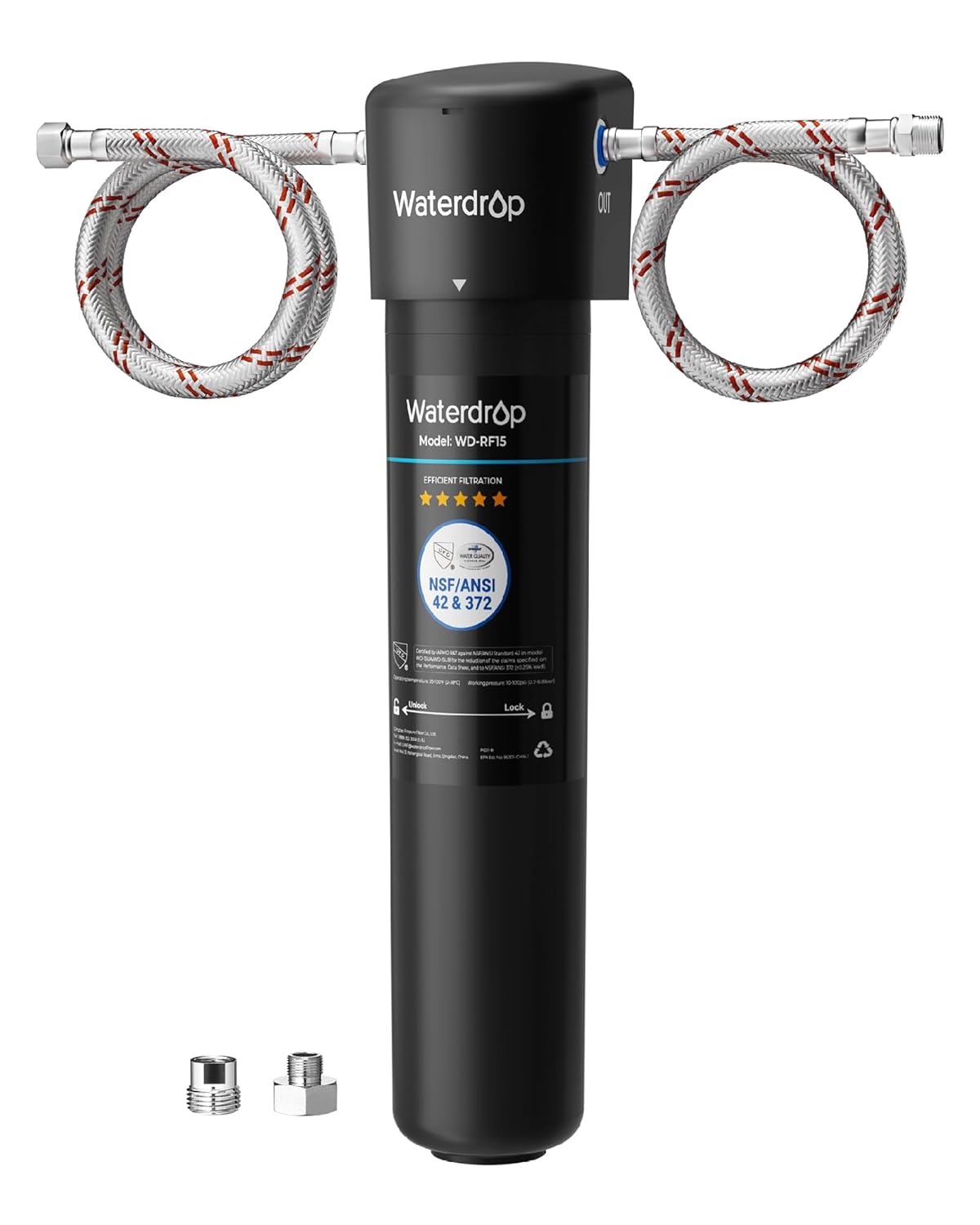
Waterdrop WD-15UA Under-Sink Filter
| Purification Method | Activated Carbon |
|---|---|
| Maximum Flow Rate | 0.75 gpm |
| Capacity | 19000 gallons |
| Filter Life Cycle | 2 years |
| Installation Type | Under Sink |
The Waterdrop WD-15UA is an under-sink activated carbon filtration system that connects directly to a cold water feed and is intended to deliver fresher tasting drinking water under your sink. It installs with push-to-connect fittings and a 3/8" direct-connect hose plus a 3/8"–1/2" converter, so no drilling or professional plumbing is required for most standard household connections. The filter is rated for a long service life—about 19,000 gallons or up to 24 months on municipal water—and is certified to reduce chlorine, bad taste and odor, and lead; the manufacturer also highlights PFAS and PFOA/PFOS reduction. With a tested flow rate around 0.75 gpm at 60 psi, it provides a steady supply for drinking, cooking, and appliances like ice makers. Important limitations: the system is designed for cold municipal water only, is not intended for well water or hot water, and TDS readings may not reflect contaminant removal because beneficial minerals are retained. Buyers should check under-sink clearance for the taller cartridge before ordering.
Best for: Homeowners who prioritize low-maintenance, certified contaminant reduction and want an easy DIY under-sink filter for municipal drinking water.
Less Ideal for: People on private well systems or anyone needing hot water filtration or multi-stage microbial treatment should look at well-specific or higher-stage systems instead.
- Long rated service life (up to 19,000 gallons or 24 months) reduces replacement frequency
- Push-to-connect direct installation with included 3/8" hose and 3/8"–1/2" converter simplifies DIY setup
- NSF/IAPMO-certified reductions for chlorine, taste, odor and tested for lead removal
- Maintains a respectable flow rate (~0.75 gpm) suitable for drinking and cooking applications
- Manufacturer states the system is not suitable for well water, so it is not appropriate for private well treatment
- Larger cartridge size requires checking under-sink clearance before installation
- Does not treat hot water and is intended for cold water feed only
Verdict: Choose the WD-15UA if you want a simple, long-life, certified under-sink carbon filter that delivers steady drinking-water performance with minimal maintenance for municipal cold water.
Choosing the Right Drinking Under-Sink Water Filter for Well Water: Key Factors to Consider
Contaminant Coverage
Well water can contain a wide range of contaminants that vary by geology and local conditions. A drinking under-sink system should explicitly address the most likely issues at your well, such as sediment, iron and manganese staining, hydrogen sulfide odors, and microbial activity. If your well testing shows heavy metals, look for media or cartridges rated to reduce those specific ions or consider an additional targeted stage.
Knowing what your well water contains is the starting point. Test your water for common inorganic and microbiological contaminants before buying so you can match filter technologies to the actual risks rather than generic marketing claims.
Filter Lifespan and Ongoing Maintenance
Under-sink filters require periodic cartridge or media replacement, and the cadence can vary from a few months to a few years depending on system type and water quality. For well water with high sediment or iron, cartridges may clog faster and require more frequent changes, increasing ongoing cost and maintenance time.
Consider systems with easily accessible cartridges and clear replacement indicators. Factor in the availability and cost of replacement parts and whether you are comfortable performing regular changes yourself. Systems that allow partial servicing rather than full assembly replacement are usually cheaper to maintain over time.
Flow Rate and Faucet Performance
Point-of-use under-sink filters must provide adequate flow for drinking and cooking tasks without long wait times. Higher filtration capacity or very fine media can reduce flow or take longer to deliver a full glass of water. For households that use the filtered faucet frequently, prioritize systems with higher rated flow and minimal pressure drop.
If you have low incoming well pressure, choose a filter designed to operate with modest head loss or consider adding a small boost pump at the source. Manufacturer flow rates assume clean media; expect some drop as cartridges load with sediment.
Installation Complexity and Plumbing Compatibility
Under-sink systems vary from simple replacement cartridges that attach to existing cold-water lines to multi-stage housings that need additional fittings, mounting brackets, and sometimes a separate dedicated faucet hole. Check whether your under-sink space has the clearance and shutoff valves required for the chosen unit.
Simpler installations reduce the chance of leaks or improper sealing. If you are not comfortable working with under-sink plumbing, factor in the potential need for professional installation and the cost and scheduling implications that may bring.
Treatment Redundancy and Stage Design
Multi-stage systems can combine sediment prefiltration, activated carbon for taste and organic removal, and specialty media for iron, hardness, or specific ions. Redundancy is helpful when a single contaminant source can foul downstream stages quickly. A robust prefilter protects more expensive downstream media and extends service life.
Review how the stages are arranged and whether the system allows swapping or upgrading individual stages as your needs change. Modular designs often provide more flexibility and long-term value.
Certifications, Testing, and Documentation
Third-party testing or certification for specific contaminant reduction claims provides independent validation of a system's performance. Look for test data or certification lines that reference the contaminants important to well water rather than generic claims about filtration. Clear manufacturer documentation about replacement intervals, expected treated gallons, and installation steps reduces uncertainty.
Also consider warranties and customer support access for troubleshooting installation or performance questions. Well-water conditions vary, and good documentation helps you adapt the system to local needs.
Why Point-of-Use Under-Sink Filters Make Sense for Wells
A point-of-use under-sink drinking filter treats water at the faucet used for drinking and cooking without altering the rest of the household plumbing. For well owners, this targeted approach is often more cost-effective than whole-house treatment when concerns are limited to taste, odor, or specific contaminants that primarily affect drinking water.
Under-sink systems let you focus investment where it matters most. They are typically less invasive to install than whole-house systems, require smaller media volumes, and are easier to maintain. For households with localized contaminant issues or where the well water is otherwise acceptable for bathing and laundry, an under-sink filter can be the most practical solution.
- Conserves treatment to drinking and cooking water points
- Smaller footprint and simpler installation than whole-house systems
- Often lower upfront cost and easier DIY maintenance
Common Well Water Contaminants and How Filters Address Them
Well water contaminants vary by location and depth. Sediment and turbidity are common and can be controlled with sediment prefilters. Iron and manganese cause staining and metallic taste and can be addressed with specialized media or oxidizing stages. Hydrogen sulfide produces a rotten-egg odor and may need catalytic carbon or oxidation stages.
Microbial contamination is less common in properly constructed wells but can occur. Point-of-use systems rarely replace a disinfection plan, but some under-sink units include stages that reduce bacterial or viral loads when paired with appropriate upstream treatments. Understanding which contaminants are present guides the stage selection and whether supplemental treatment is necessary.
- Sediment prefilters protect finer downstream media
- Carbon stages reduce taste, odor, and many organic compounds
- Specialty media target iron, manganese, and sulfur compounds
Testing Your Well Before You Buy
Before selecting any under-sink solution, get a comprehensive laboratory water test that includes inorganic ions, metals, microbial indicators, and parameters like pH and hardness. A basic test will reveal the obvious issues, but a full profile helps you match filter technologies precisely to the contaminants present.
Bring the test results to installers or use them to compare product specifications. Some systems list specific reduction capabilities for contaminants measured in the report. Testing also establishes a baseline so you can monitor changes over time and know when maintenance or additional treatment is required.
- Test for metals, hardness, pH, and microbial indicators
- Use results to prioritize treatment stages
- Retest after installation to confirm performance
Maintaining an Under-Sink System with High Sediment or Iron
Wells with high sediment or iron loadings require more frequent maintenance. Sediment will clog prefilters, reducing flow and stressing downstream media. Choose systems with replaceable prefilter cartridges and consider carrying spare cartridges if your well produces periodic surges of particulate matter.
Flushing or backwashing options, where available in the system design, can extend cartridge life. Monitor flow and taste as simple indicators of when service is due. A clear maintenance routine prevents performance degradation and protects the more costly stages of the system.
- Keep spare prefilter cartridges on hand for fast replacement
- Monitor faucet flow and taste as early warning signs
- Consider systems with accessible housings for quick service
When to Consider Additional or Upstream Treatments
If your lab test shows high levels of microbial contamination, persistent chemical contaminants, or levels of iron and manganese that exceed the expected capacity of point-of-use media, you may need upstream solutions such as well disinfection, shock chlorination, or a whole-house iron removal system. Under-sink filters are not a substitute for correcting a contaminated well source.
Under-sink units work best when paired with a basic pre-treatment plan that limits large particulates and protects the drinking-water stages. Use under-sink filtration as part of a layered approach to water safety and quality rather than the sole line of defense when serious source issues exist.
- Serious microbial problems often need source-level remediation
- High iron loads may require whole-house iron removal before point-of-use
- Use under-sink systems alongside regular well maintenance
How We Chose the Best Drinking Under-Sink Water Filter for Well Water
We evaluated systems with well-water challenges in mind and prioritized criteria that matter for private wells. First, contaminant removal capability was essential. We looked for systems with media or filter stages targeting common well issues such as sediment, iron, manganese, hydrogen sulfide, chlorine byproducts, and reduction options for heavy metals and microbial presence where applicable. Second, long-term maintenance and consumables were considered because private-well owners often handle filter changes themselves. Systems with clear replacement intervals, accessible cartridges, and reasonable DIY servicing scored higher. Third, flow rate and real-world water pressure impact were assessed to ensure the filter can deliver adequate faucet flow without excessive delay. Fourth, installation complexity and compatibility with standard under-sink plumbing were weighed; easier installs reduce the chance of improper setup that limits performance. We also considered build quality and certifications or test data that validate claims. Exclusions: we excluded point-of-entry whole-house systems and countertop or pitcher devices because they do not match the under-sink point-of-use scope for drinking water. The final selections balance contaminant coverage, maintainability, and practical home installation considerations.
Our full evaluation process is outlined in our review methodology.
FAQ
Can an under-sink filter remove iron and manganese from well water?
Some under-sink systems include specialty media effective at reducing dissolved iron and manganese at point of use. However, high concentrations may overwhelm small point-of-use cartridges, so test your water and consider whether whole-house treatment is necessary for heavy loads.
How often will I need to change cartridges with well water?
Replacement frequency depends on contaminant levels and usage. Wells with more sediment or iron will clog prefilters sooner, sometimes requiring changes every few months. Systems with larger-capacity media or clearer source water can go much longer.
Will an under-sink filter solve bad taste and odor from a well?
Activated carbon stages in many under-sink systems are effective at reducing taste and odor issues, including organic compounds and some sulfur-related smells. For persistent hydrogen sulfide or severe odors, catalytic media or upstream remediation may be required.
Do under-sink filters protect against bacteria in well water?
Most under-sink filters are not designed as a standalone microbial disinfection solution. Some units can reduce bacterial counts when combined with appropriate upstream treatments, but confirmed bacterial contamination typically requires source remediation or a certified disinfection step.
Is professional installation required for under-sink filters?
Many under-sink systems can be installed by a competent DIYer with basic tools, shutoff valves, and a little plumbing knowledge. Complex multi-stage units or setups with limited under-sink space may benefit from professional installation to ensure leak-free connections and correct flow orientation.
Final Verdict
For well-water households, prioritize under-sink drinking filters that match your lab test results and handle the specific contaminants you face. Focus on contaminant removal capability, maintenance demands, and how the system affects faucet flow. Remember that point-of-use filters are best used as part of a layered approach when source issues exist. Choose a system that balances robust prefiltration with replaceable downstream media, and plan for realistic maintenance intervals based on your well conditions. With the right match between your water quality and the system design, an under-sink filter can deliver safer, better-tasting drinking water without major plumbing changes.