
Note: This article contains affiliate links. If you click on these links and make a purchase, we may earn a small commission at no extra cost to you. This helps support our research and content. Read our full affiliate disclosure here.
If you keep a small wine collection or need a dedicated unit for daily drinking bottles, a countertop wine cooler can protect wine quality without a lot of space. Choosing the right cooler matters because inconsistent temperatures, vibration, or the wrong internal layout can age bottles prematurely or make them unpleasant to drink. This guide shortlists the top countertop wine coolers that are suited to small kitchens, apartments, and tabletop storage. We evaluated units on capacity, cooling stability, noise, and ease of use to help you pick the best option for your routine. Read on to see the top picks and the criteria we used to evaluate them.
Top Picks at a Glance
| Best Overall The best all-around choice for most situations | Koolatron 6 Bottle Wine Fridge WC06 |  |
| Best Quality Built to a higher standard if you want something more solid | Wine Enthusiast 6-Bottle Countertop Cooler |  |
| Best Value The sweet spot between price and what you get | Icyglee Beverage Refrigerator WC-6B |  |
| Best Budget The cheapest option that still gets the job done reliably | RibasuBB 8-Bottle Wine Cooler |  |
| Top Rated A top-rated pick with lots of positive feedback | Cuisinart 8-Bottle Wine Cellar CWC-800CEN |  |
| Most Popular A crowd favorite that many people choose with confidence | Antarctic Star 0.9 Cu. Ft. Wine Cooler |  |
| Best Seller A high-volume bestseller chosen again and again | EUHOMY 18L Wine Fridge |  |
Koolatron 6 Bottle Wine Fridge WC06
| Cooling Method | Thermoelectric |
|---|---|
| Capacity | 0.6 cubic feet |
| Temperature Range | 46-66°F (8-18°C) |
| Included Components | 2 Removable Wire Shelves |
| Installation Type | Freestanding; Counter Top |
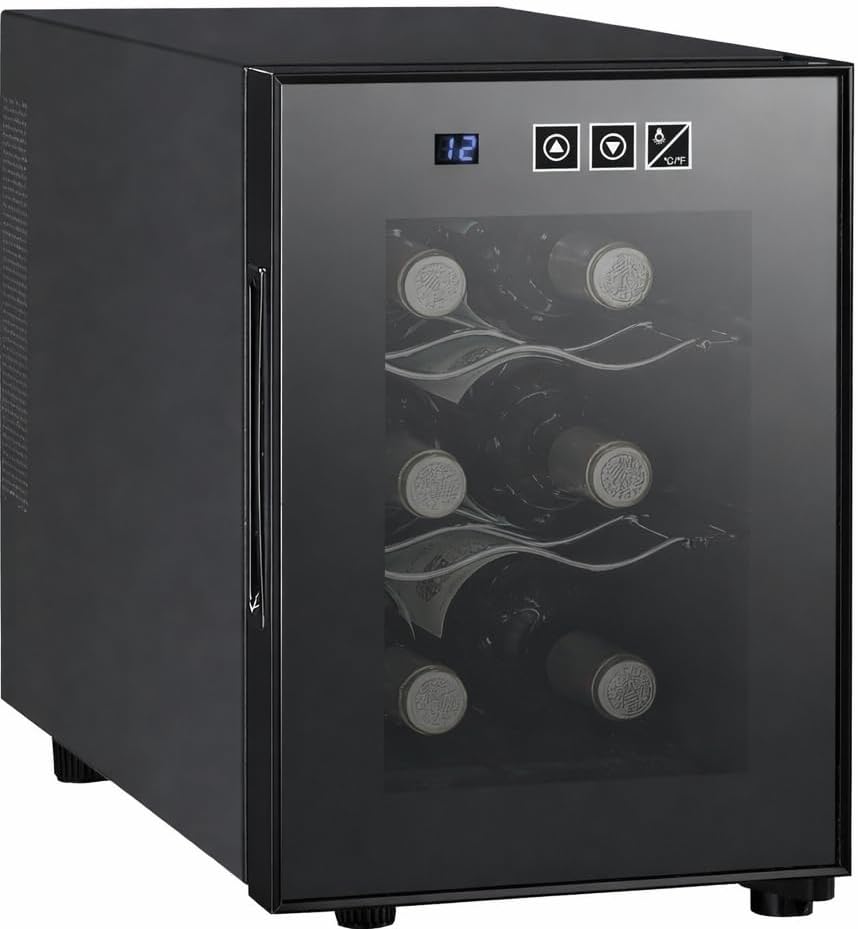
The Koolatron 6 Bottle Wine Fridge is a small countertop thermoelectric cooler that keeps up to six standard wine bottles at serving temperatures between 46 and 66°F. It is typically used on a countertop, sideboard, or in tight spaces where a full-size cellar would not fit, and it runs quietly with vibration-free cooling to avoid disturbing bottle sediment. Key features include external touch screen digital controls for setting temperature and the interior LED light, two removable wire racks for different bottle shapes, and a mirrored double-pane door that blocks UV light. Practical benefits are its compact footprint and simple controls that make it easy to store ready-to-serve bottles close at hand, plus the low-noise thermoelectric system that is suitable for living spaces. The main limitations are the small capacity and single-zone cooling, so it cannot store a larger collection or maintain different temperatures for reds and whites simultaneously, and thermoelectric cooling is less effective than compressor units in very warm rooms.
Best for: Buyers who want a space-saving, easy-to-use countertop cooler to keep a handful of bottles at serving temperature and value quiet operation and simple digital controls.
Less Ideal for: Collectors who need larger capacity, separate temperature zones, or strong cooling performance in very warm rooms should consider larger compressor-based units.
- Compact countertop design fits small kitchens, apartments, and offices
- Digital external touch controls and LED light for easy temperature management
- Mirrored double-pane glass door provides UV protection
- Quiet, vibration-free thermoelectric cooling preserves sediment and reduces noise
- Only six-bottle capacity limits storage to a few ready-to-serve bottles
- Single-zone cooling cannot hold different wines at different temperatures
Verdict: A compact, quiet countertop wine cooler that keeps a small selection of bottles at serving temperature with easy digital controls.
Wine Enthusiast 6-Bottle Countertop Cooler

| Capacity | 6-Bottle |
|---|---|
| Cooling Method | Thermoelectric |
| Shelves | 3 wood shelves |
| Installation Type | Countertop |
| Energy Rating | Energy Star |
This Wine Enthusiast 6-bottle countertop cooler is built for small collections that need consistent, quiet temperature control. It uses thermoelectric (solid-state) cooling and a digital touchscreen with LED readout to set and monitor storage temperatures for reds, whites, or rosés, and is designed to sit on a counter or bar. The unit has three wood shelves and three door shelves that keep bottles organized while the glass door and metallic finish give it a clean, modern look. Because it is thermoelectric rather than compressor-driven it runs quietly and is more energy-efficient, but it works best in moderate ambient conditions and may struggle to reach the lowest setpoints if the room is warmer than recommended. The cooler is freestanding only and needs clearance for airflow, so it is not suitable for built-in installation. For someone who wants a compact, low-noise cooler to protect a handful of bottles, this is a practical, space-saving option; buyers who need heavy-duty cellar temperatures or built-in undercounter fitment should look elsewhere.
Best for: Buyers who prioritize quiet, energy-efficient countertop cooling for a small, curated wine selection and want straightforward digital temperature control.
Less Ideal for: Not a good fit for collectors needing built-in or undercounter installation or for users who require very low cellar temperatures in warm environments.
- Compact footprint fits on counters or small bars
- Digital touchscreen and LED display for precise temperature setting
- Thermoelectric solid-state cooling provides quiet, vibration-free operation
- Three wood shelves plus door shelves keep bottles organized and accessible
- Energy Star rated for efficient everyday use
- Thermoelectric cooling is less effective than a compressor in hot ambient rooms
Verdict: A compact, quiet, and energy-efficient countertop cooler that reliably stores a small wine collection with precise digital temperature control.
Icyglee Beverage Refrigerator WC-6B

| Refrigerator Net Capacity | 0.6 cubic feet |
|---|---|
| Capacity | 18 liters |
| Temperature Range | 40-61℉ |
| Cooling Method | Compressor |
| Defrost System Type | Manual Defrost |
This Icyglee mini beverage refrigerator is a small, compressor-cooled countertop cooler meant for keeping drinks and a couple of bottles cold in tight spaces. It offers one removable wire shelf so you can switch between bottle and can layouts and a temperature dial that ranges roughly from 40 to 61 degrees Fahrenheit for storing beer, soda, or white wines. The compressor cooling delivers steady temperatures faster than thermoelectric alternatives and the unit is claimed to run quietly under normal use, which makes it suitable for offices, bedrooms, or a small home bar. Practical details include a mirrored glass door with UV resistance and a tight seal to help maintain chill, but capacity is limited to about six bottles and six cans or roughly 21 standard cans, so it will not replace a full-size fridge. The small footprint and freestanding design make installation effortless, though manual defrosting is required and there is minimal internal organization beyond the single shelf. For buyers who prioritize compact, reliable cooling on a countertop, it does the job well; those needing larger capacity or advanced features should look elsewhere.
Best for: Buyers who want a space-saving, reliable countertop cooler to keep a small rotation of drinks chilled without fuss and who value steady compressor cooling and quiet operation.
Less Ideal for: People who need to store many bottles or a larger variety of drinks or who want features like multiple temperature zones or digital controls.
- Compressor cooling provides faster, more consistent chilling than thermoelectric units
- Compact footprint fits easily on counters, in offices, or small bars
- Removable shelf lets you reconfigure for bottles or stacked cans
- Whisper-quiet operation suitable for bedrooms and workspaces
- Mirrored UV-resistant door and tight seal help protect beverages from light and temperature loss
- Very limited internal capacity not suitable for larger collections
- Manual defrost requires occasional maintenance
- Single shelf offers limited organization options
Verdict: A compact, compressor-cooled countertop fridge that delivers reliable, quiet chilling for a small drinks lineup.
RibasuBB 8-Bottle Wine Cooler

| Capacity | 8 Bottle |
|---|---|
| Cooling Method | Thermoelectric |
| Temperature Range | 46-64.4°F |
| Power Source | Corded Electric |
| Additional Features | LED Display |
This compact RibasuBB wine cooler is a countertop-friendly fridge that stores up to eight bottles and uses thermoelectric cooling to maintain temperatures between about 46 and 64 degrees Fahrenheit. It is typically used on a countertop, bar cart, or small floor space where you want ready-to-serve reds, whites, or sparkling wines without a full cellar. The unit has four removable shelves that accommodate different bottle shapes, a blue LED interior light for visibility, and a touchscreen digital display for precise temperature setting. Thermoelectric cooling runs quietly and avoids compressor vibration that can disturb wine, but it is less effective in very warm rooms and does not offer active humidity control. The glass door and key lock are convenient for display and basic security, and small adjustable feet help level the cooler on uneven surfaces. For buyers needing a simple, low-footprint cooler for occasional wine storage, the RibasuBB provides straightforward controls and a modern look, though it sacrifices heavy-duty insulation and commercial-grade cooling performance found in larger compressor models.
Best for: Buyers who want an inexpensive, space-saving countertop wine cooler for everyday home use and display rather than long-term cellar storage.
Less Ideal for: Those seeking heavy-duty, cellar-grade cooling, humidity control, or large-capacity storage for an extensive collection should consider larger compressor-based units.
- Compact countertop design fits small kitchens, offices, or bars
- Digital temperature display with touch controls for precise setting
- Four removable shelves accept various bottle shapes and sizes
- Thermoelectric cooling operates quietly with minimal vibration
- Built-in LED light and glass door make bottles easy to see
- Thermoelectric cooling is less effective in hot ambient temperatures compared with compressor units
Verdict: A budget-friendly, quiet countertop cooler that makes it easy to store and display eight bottles for everyday drinking.
Cuisinart 8-Bottle Wine Cellar CWC-800CEN
| Capacity | 6 liters |
|---|---|
| Size | 8 Bottle |
| Cooling Method | Thermoelectric |
| Number Of Shelves | 8 |
| Power Source | Electric |
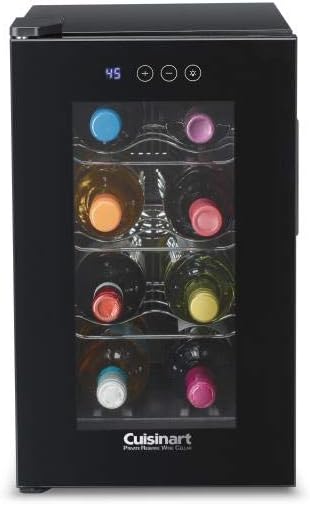
The Cuisinart 8-Bottle Private Reserve wine cellar is a compact freestanding unit designed to store up to eight bottles at controlled serving temperatures. It uses a thermoelectric cooling system that runs quietly and is energy efficient, while touchscreen controls and an LED readout let you set temperatures from 39°F to 68°F. Contoured chrome racks and soft interior lighting keep bottles organized and visible, and the unit includes three removable racks to fit a mix of reds, whites, and champagnes. Typical countertop use is simple: plug it in, set the target temperature, and let the cellar maintain a steady environment without a compressor's vibration or noise. Important limitations are its small 6-liter net capacity appropriate only for short-term storage or small collections and the thermoelectric system is less effective in very warm room temperatures compared with compressor models. The unit is hand-wash for care and intended as an energy-conscious, low-noise option for daily serving and light storage rather than long-term cellar aging.
Best for: Buyers who prioritize a quiet, energy-conscious countertop cooler for daily serving and short-term preservation and want simple controls and neat bottle display.
Less Ideal for: Collectors who need larger capacity or long-term aging performance and users who require strong cooling in hot ambient rooms should consider larger compressor models.
- Quiet thermoelectric cooling for low-noise operation
- Touchscreen controls and LED display for simple temperature setting
- Soft interior lighting and contoured chrome racks for tidy, visible storage
- Compact freestanding design fits on countertops and includes three removable racks
- Small overall capacity suited to serving and short-term storage rather than building a collection
- Thermoelectric cooling is less efficient at maintaining set temperature in very warm rooms
Verdict: A quiet, compact countertop wine cellar that reliably holds serving-temperature bottles for daily use and small collections.
Antarctic Star 0.9 Cu. Ft. Wine Cooler

| Capacity | 0.9 cubic feet |
|---|---|
| Refrigerator Net Capacity | 0.6 cubic feet |
| Temperature Range | 40-61 °F |
| Cooling Method | Compressor |
| Defrost System Type | Manual Defrost |
This Antarctic Star countertop wine cooler is a small compressor-driven fridge designed for keeping a couple of bottles or a handful of cans chilled on a counter, dorm, or office. It holds about 0.9 cu. ft. with horizontal racking that fits two standard wine bottles plus several cans, and the compressor cooling keeps temperatures steady across the advertised 40 to 61°F range. The reinforced, airtight glass door and soft blue LED interior light make it easy to see contents and help maintain humidity, while manual defrost and a compact footprint mean simple setup and placement. In real use the unit runs quietly with little vibration, so it will not disturb sediments in wine or be noisy in small rooms. Expect the limitations of very small capacity and manual defrosting, so this is best for short-term storage and display rather than larger collections or long-term aging management.
Best for: Buyers who want a compact, reliable countertop cooler to keep a few bottles or cans chilled and prefer a steady compressor-driven temperature with minimal noise.
Less Ideal for: Not a good fit for collectors needing long-term multi-bottle storage, large-capacity cooling, or fully automatic maintenance features.
- Compressor cooling keeps temperature steady across 40–61°F
- Compact countertop form fits small spaces like dorms, offices, or bars
- Quiet operation with low vibration suitable for wine storage
- Airtight glass door and LED interior light for visibility and humidity control
- Very limited capacity suitable for just a couple of bottles or a small number of cans
- Manual defrost requires occasional maintenance
Verdict: A quiet, compressor countertop cooler that reliably chills a couple of bottles or cans without taking much space.
EUHOMY 18L Wine Fridge
| Capacity | 18 liters |
|---|---|
| Cooling Method | Compressor |
| Temperature Range | 40°F to 61°F |
| Number Of Shelves | 1 |
| Installation Type | Countertop |
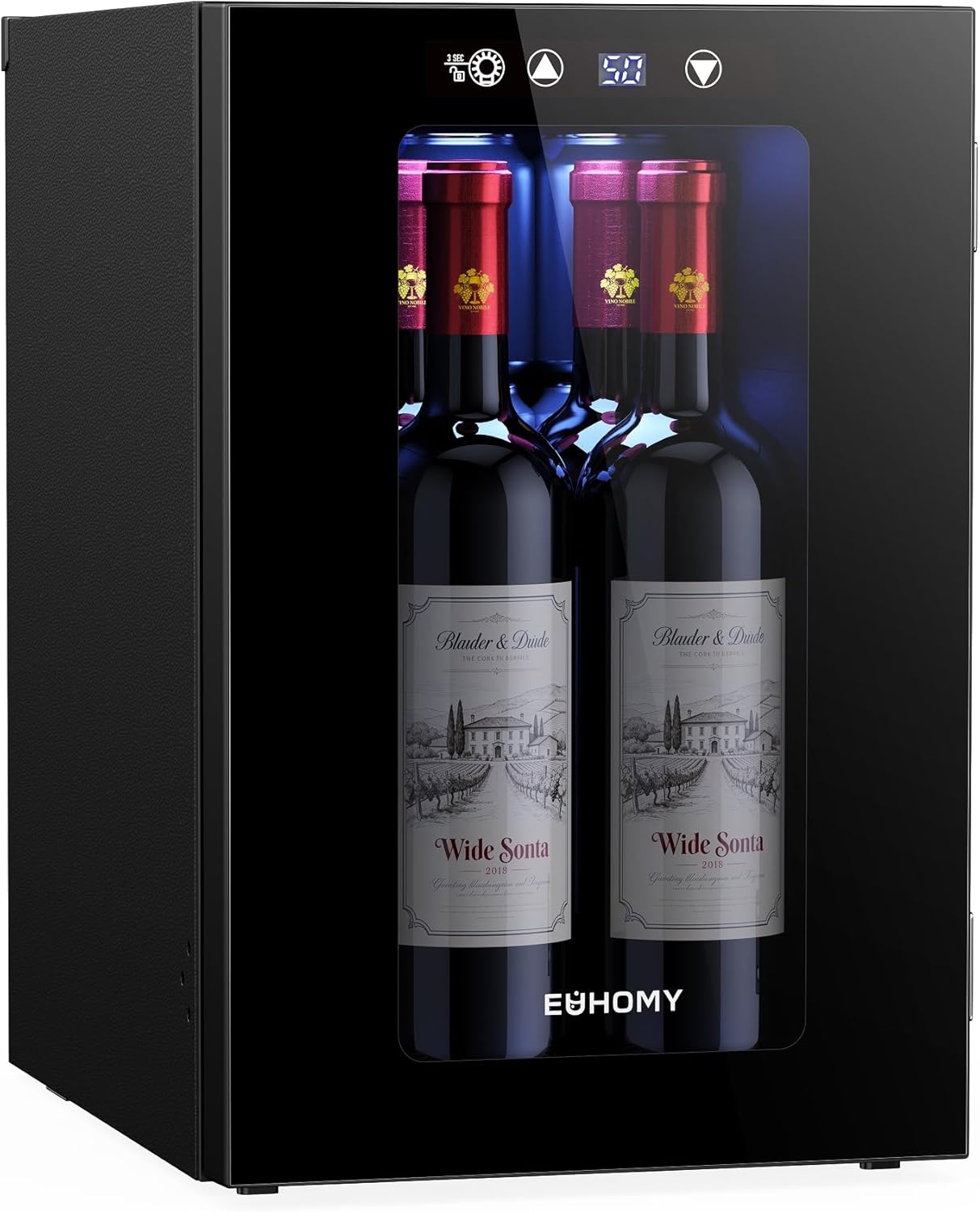
The EUHOMY 18L Wine Fridge is a small compressor-cooled cooler designed for countertop or freestanding use to store a handful of bottles and cans. It offers a digital touchscreen that sets temperatures between 40°F and 61°F, a double-pane glass door with LED interior lighting, and one removable shelf so you can fit bottles or stacks of cans. The compressor system provides steady cooling and the manufacturer states quiet operation around 38 dB, which helps the unit sit beside a bar, office, or kitchen without creating a constant noise nuisance. Practical benefits include the ability to keep red, white, sparkling wine, or beer at ready-to-serve temperatures and the compact footprint that fits tight spaces. Limitations to expect are the very small 18 L capacity that only holds about four 750 ml bottles or up to two dozen cans when arranged differently, manual defrosting, and a single door orientation without reversible mounting, so placement options are somewhat constrained.
Best for: Buyers who want a reliable, compact cooler to keep a small selection of wines or beverages at controlled serving temperatures without complicated setup or large space requirements.
Less Ideal for: Those who need to store larger collections, organize many bottle sizes, or require a built-in undercounter installation should look at larger-capacity or different-format coolers.
- Digital touchscreen with adjustable 40°F–61°F temperature range for precise control
- Compressor cooling for consistent, dependable chilling compared with thermoelectric units
- Compact countertop form that fits small kitchens, dorms, or home bars
- Double-pane glass door with LED lighting showcases contents while blocking UV rays
- Very limited 18 L capacity suitable for only a few bottles or a small can stash
- Manual defrost requires occasional maintenance and can be inconvenient
Verdict: A compact, compressor-cooled countertop wine fridge that delivers quiet, accurate temperature control for buyers who need dependable short-term storage for a few bottles.
Choosing the Right Countertop Wine Cooler: Key Factors to Consider
Cooling Technology
Different countertop wine coolers use either compressor or thermoelectric systems, and that choice affects performance. Compressor units reach lower temperatures and recover faster after the door opens, which is useful if you frequently access bottles. Thermoelectric coolers can be quieter and produce less vibration, but they struggle in hot ambient spaces and may not hold very low setpoints reliably.
Think about where the cooler will live. If it sits in a kitchen near heat sources or in a warm climate, a compressor model typically maintains target temperatures more consistently. For bedroom or living-room placement where noise is a concern, a high-quality thermoelectric unit can be acceptable if you do not need very low temperatures.
Temperature Stability
Consistent internal temperature is critical to preserving wine character. Look for coolers that hold a setpoint within a narrow range and that recover quickly after the door is opened. Fluctuations and wide swings accelerate chemical reactions in wine, affecting aroma and aging.
Consider features like digital thermostats, auto-defrost cycles, and well-sealed doors. Units with good insulation and tight door seals will have less temperature drift during daily use, which is especially important for long-term storage of wines you plan to cellar for months.
Bottle Capacity and Shelf Design
Capacity numbers alone can be misleading because shelf shape and spacing determine how many standard and larger-format bottles actually fit. Some countertop coolers advertise a maximum count by tightly nesting bottles, which reduces practicality. Shelves that slide or pull out make access easier and reduce the risk of knocking other bottles when loading or unloading.
Also consider whether the unit's shelves accept different bottle shapes. Flatter or angled shelves allow storing both Bordeaux and Burgundy shapes more effectively. If you plan to store sparkling wines or larger-format bottles, verify shelf spacing and whether a removable shelf lets you create extra vertical clearance.
Noise and Vibration
Noise level is an important day-to-day comfort factor for countertop placement. Compressor coolers typically produce more audible sound and can transmit vibration that disturbs sediment in older wines. Look for models with vibration dampening, rubber mounts, or low-speed fans to minimize movement inside the cabinet.
Manufacturers sometimes list decibel ratings, but real-world placement and surface contact matter. Placing a cooler on a solid, level counter and leaving a small clearance space around it reduces resonance and improves quiet operation.
Controls and User Interface
Intuitive controls and a clear temperature display make it easy to set and verify the cooler's conditions without guessing. Digital controls with precise temperature readouts are preferable to simple analog knobs because they let you set exact setpoints and often include lockouts to prevent accidental changes.
Additional practical controls include interior lighting with adjustable intensity, a child lock for door controls, and a reversible door for flexible placement. Consider how easy it is to reach controls when the unit sits under cabinets or on a counter.
Energy Use and Insulation
Because countertop coolers run continuously, energy efficiency affects ongoing operating costs. Units with thicker insulation, efficient compressors, or low-wattage thermoelectric modules consume less power and keep internal temperatures more steadily.
Look for well-sealed doors and quality gaskets, which reduce compressor runtime. While efficiency metrics vary by model type and ambient conditions, better-insulated units are generally more forgiving in warm kitchens and require less frequent cooling cycles.
Where to Place a Countertop Wine Cooler
Placement affects both performance and convenience. Choose a level, ventilated surface away from direct sunlight, ovens, or other heat sources. If a cooler is tucked under cabinets, ensure there is enough clearance for airflow and the unit's exhaust.
Avoid placing the cooler on a vibrating or unstable surface. A sturdy countertop keeps vibration transfer to a minimum and helps the unit run quietly. Also consider door swing direction and how you will access bottles during everyday use.
- Leave a few inches of clearance at the rear for ventilation.
- Keep the cooler out of direct sunlight and away from cooking heat.
- Place on a level surface to minimize noise and vibration.
How to Read Capacity and Size Specs
Manufacturers often list capacity in bottles, but that figure assumes standard Bordeaux-shaped bottles stored on multiple shallow shelves. Real usable capacity depends on shelf depth, interior width, and whether shelves are removable or adjustable.
When comparing specs, check internal dimensions and shelf configuration. If you plan to store a mix of bottle shapes, prioritize a cooler with adjustable or removable shelves so you can configure space as needed.
- Compare internal width and shelf depth, not just bottle count.
- Look for removable or adjustable shelves for flexibility.
- Consider door style; frameless glass doors may reduce usable interior space slightly.
Maintenance and Cleaning Tips
Routine cleaning extends the life of a countertop wine cooler and preserves wine quality. Wipe down the interior shelves and gasket periodically with a mild, nonabrasive cleaner. Remove and dry shelves before reinserting to prevent trapped moisture.
If the unit has a drip tray or condensate channel, check and empty it as needed. For units that require periodic defrosting, follow the manufacturer schedule and avoid using sharp tools to remove ice buildup, which can damage internal surfaces.
- Unplug the cooler before deep cleaning.
- Use a soft cloth and mild detergent for interior cleaning.
- Inspect door gaskets regularly and clean to maintain a tight seal.
Tips for Storing Different Wine Types
Serve-ready wines and bottles meant for short-term drinking benefit from slightly different conditions than wines you intend to cellar. For immediate consumption, set the cooler to the serving temperature appropriate for the wine style rather than long-term cellar range.
If you mix storage goals, use the coolest, most stable area for long-term bottles and reserve a shelf near the door or top for bottles you access often. This reduces temperature cycling for stored bottles when you open the door for a frequently used bottle.
- Reds: keep toward the middle to upper range of the cooler's setpoint.
- Whites and rosés: store lower for quick chilling.
- Sparkling wines often need extra vertical space; plan shelving accordingly.
Interpreting Noise Ratings and Real-World Quiet
Decibel ratings are a starting point, but perceived noise depends on frequency and the environment. Low-frequency vibration can be more intrusive even at lower decibel levels. Look for user-focused features such as vibration-damping shelves or rubber feet.
If noise is a top priority, thermoelectric models generally run quieter but may not offer the same cooling range as compressors. Measure actual noise in your placement area when possible or select units advertised with vibration control features.
- Place the cooler on a solid counter to reduce resonance.
- Rubber feet and anti-vibration mounts help protect wine sediment.
- Consider thermoelectric models for bedroom placement where low noise matters.
How We Chose the Best Countertop Wine Cooler
We prioritized features that directly affect how well a countertop wine cooler protects and serves bottles in everyday home use. Cooling stability was a primary filter: we selected units that maintain a consistent setpoint across the usable interior and recover quickly after the door is opened. Capacity and internal layout were next, since shelf design and usable bottle count determine how a cooler fits personal collections and bottle shapes. Noise and vibration were weighted heavily because countertop placement often puts coolers near living spaces. We preferred quieter compressors or high-quality thermoelectric systems and checked for vibration control that can disturb sediment in aged wines. Build quality and finish matter for long-term durability and for how well the unit integrates visually on counters. Controls and usability were included as concrete criteria, including thermostat responsiveness, display clarity, and how easy it is to load bottles. Energy efficiency and insulation were considered for running costs and temperature holdover during power interruptions. Units with poor temperature consistency, excessive vibration, or flimsy construction were excluded. Overall we focused on reliable cooling performance, practical capacity, quiet operation, intuitive controls, and solid build.
Our full evaluation process is outlined in our review methodology.
FAQ
Can a countertop wine cooler cellar wine long term?
A countertop cooler can cellar wine for months if it provides stable temperatures, low vibration, and consistent humidity. Many countertop units are better suited to short- to medium-term storage, so check stability and insulation if you plan to cellar bottles for years.
What temperature should I set for mixed red and white bottles?
For mixed storage, choose a compromise temperature that preserves reds without overchilling whites, or use separate shelves with slightly different setpoints if the unit supports dual zones. If only one zone is available, set it to a middle range and chill whites briefly before serving.
How noisy are countertop wine coolers in real homes?
Noise varies by cooling technology and placement. Compressor models tend to be louder than thermoelectric units and can transmit vibration. Real-world noise depends on surface contact and ventilation, so placement and anti-vibration features significantly affect perceived sound.
Do countertop wine coolers need regular maintenance?
Yes. Regularly clean the interior, check and clean the door gasket, and empty any condensate trays. Some units require occasional defrosting. Routine maintenance helps preserve temperature performance and prevents odors or mold growth.
Will a countertop wine cooler fit large-format or sparkling bottles?
Some models have adjustable or removable shelves to accommodate taller bottles and sparkling formats. Verify internal height and shelf flexibility before assuming large-format bottles will fit comfortably.
Final Verdict
When choosing a countertop wine cooler, prioritize consistent temperature control and low vibration because those directly affect wine preservation and drinkability. Balance usable capacity and shelf flexibility against noise and the cooler's fit in your available space. Consider energy efficiency and control layout if the unit will run continuously on a kitchen counter. Focus on the factors most important to your routine: choose a unit with strong temperature stability for longer storage, or pick a quieter, more convenient model if frequent access and low noise are priorities. That approach will help you pick a countertop cooler that protects bottles and fits your daily use confidently.