
Note: This article contains affiliate links. If you click on these links and make a purchase, we may earn a small commission at no extra cost to you. This helps support our research and content. Read our full affiliate disclosure here.
If you run an indoor grow tent, humidity is one of the biggest variables that affects plant health and pest risk. Choosing the right dehumidifier for grow tents helps you maintain stable relative humidity, prevent mold, and protect bud density or leaf development depending on your crop stage. The right unit also avoids excess cycling, minimizes heat load, and fits the confined footprint of a tent. This guide shortlists the top dehumidifier options for grow tents across common tent sizes and crop densities. We evaluated units for capacity, control precision, energy draw, and practical tent-friendly features so you can pick the best fit for your setup. Read on for the key factors and practical advice that informed our selections.
Top Picks at a Glance
| Best Overall The best all-around choice for most situations | AC Infinity Hydrone 5 |  |
| Best Quality Built to a higher standard if you want something more solid | AC Infinity TERRAFORM 8 |  |
| Best Value The sweet spot between price and what you get | Waykar 34 Pint Dehumidifier |  |
| Best Budget The cheapest option that still gets the job done reliably | Eva-Dry Mini Dehumidifier E-333 |  |
| Top Rated A top-rated pick with lots of positive feedback | KNKA 80-Pint Dehumidifier PD30MA-20 |  |
| Most Popular A crowd favorite that many people choose with confidence | TABYIK DH-CS01 35 oz Dehumidifier |  |
| Best Seller A high-volume bestseller chosen again and again | ToLife Dehumidifier TZ-C2 |  |
AC Infinity Hydrone 5

| Floor Area | 16 square_feet |
|---|---|
| Capacity | 2 liters |
| Tank Volume | 2 liters |
| Number of Speeds | 10 |
| Dehumidification Capacity | 2 liters_per_day |
The AC Infinity Hydrone 5 is a small grow-tent dehumidifier built for precise humidity management around 2-3 plants. It uses a PWM-controlled rotary motor to offer 10 distinct drying levels and instant on/off response, which makes dialing in target humidity simple during different growth stages. The unit is engineered to work across a wide temperature range, including very cold or hot conditions, and includes a drain hose and an exhaust port for ducting dry air into a tent; an optional intake port supports closed-loop setups for greater efficiency. It pairs with outlet or smart controllers and supports app-based monitoring and automations for VPD and alerts, so you can integrate it into a controlled grow environment. Practical limits are its modest 2 liters per day dehumidification capacity and 2-liter tank, so it suits small tents and light loads rather than larger multi-plant rooms, and it runs intermittently rather than continuous high-capacity extraction.
Best for: Growers running a single small tent or 2-3 plants who prioritize precise, low-capacity humidity control and smart automation integration.
Less Ideal for: Large grow rooms or heavy moisture loads that need high daily extraction rates or continuous industrial-style dehumidification.
- Precise humidity control with 10 PWM-controlled drying levels
- Works effectively across extreme hot and cold environments
- Ductable exhaust and optional intake support closed-loop or external setups
- Smart-controller and app compatibility for automated VPD and alerts
- Includes drain hose for continuous drainage option
- Low extraction rate (2 liters per day) limits use to small tents or light moisture loads
- 2-liter internal tank requires frequent emptying if not using continuous drain
Verdict: Buy this if you need a compact, smart-ready dehumidifier that delivers fine-grained humidity control for a small grow tent.
AC Infinity TERRAFORM 8

| Capacity | 45 pints |
|---|---|
| Item Weight | 70.6 pounds |
| Model Number | AC-ACN8 |
The TERRAFORM 8 is an all-in-one climate unit that cools, heats, dehumidifies, and exchanges air through a single duct while using AI-driven VPD control to maintain target conditions in a grow tent. Typical use is in controlled grows where users set a temperature or VPD target and let the unit auto-switch between cooling, heating, and fan modes to hold that setpoint, with optional connectivity to AC Infinity controllers for logging and alerts. Notable features include single-duct output for simplified installation, a self-evaporative condensate system to reduce manual draining, and built-in automation and graphs for temperature, humidity, and VPD. In practice it streamlines environmental control and reduces the need for separate heater, A/C, and dehumidifier equipment, and the local storage of programming keeps climates stable if Wi-Fi drops. Important limitations are its weight and size for portable setups, the need to manually reconfigure ducting for active drying, and that advanced app features require compatible AC Infinity controllers.
Best for: Growers who prioritize precise, automated climate control and want a single unit to manage temperature, humidity, and VPD in a tent or small room with data tracking and alerts.
Less Ideal for: Casual or budget growers who need a lightweight, inexpensive dehumidifier or standalone A/C rather than a combined, heavier climate system.
- Combines cooling, heating, dehumidifying, and air exchange in one ducted unit for simpler installs
- AI-driven VPD control and auto-switching maintain stable grow conditions with minimal tweaking
- Self-evaporative design reduces how often you need to empty condensate drains
- Local program storage and alerts help retain control during Wi-Fi outages
- Integrates with AC Infinity controllers for data logging and automations
- Large and heavy compared with single-purpose tent dehumidifiers or portable A/Cs
- Active drying requires manual two-duct setup rather than an automatic mode
- Advanced remote features require purchasing a compatible controller
Verdict: Buy this if you want a single, automated climate appliance that actively manages temperature, humidity, and VPD in a grow tent with integrated logging and control.
Waykar 34 Pint Dehumidifier
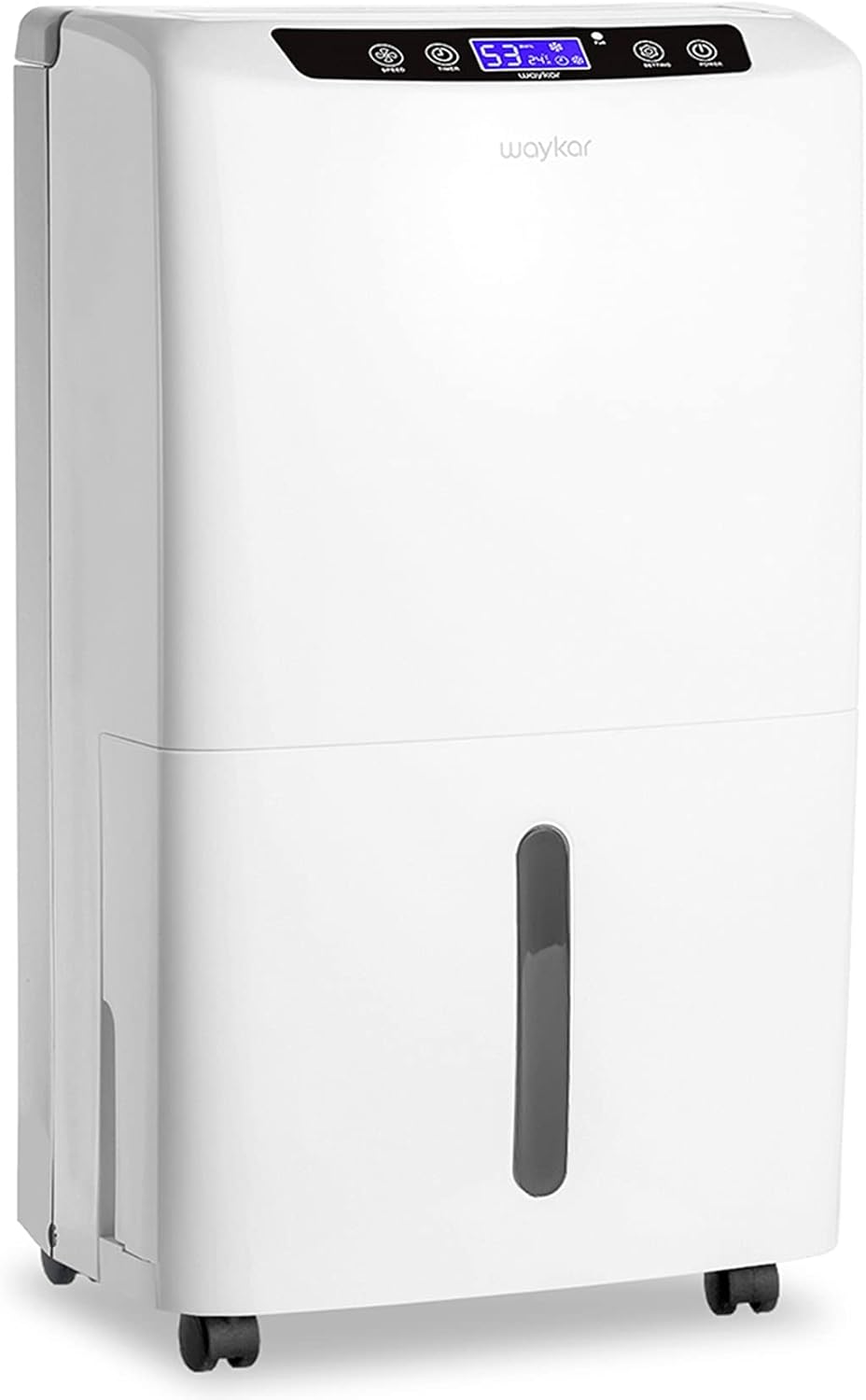
| Dehumidification Capacity | 34 pints_per_day |
|---|---|
| Floor Area | 2000 square_feet |
| Tank Volume | 0.66 gallons |
| Air Flow Capacity | 62 cfm |
| Wattage | 230 watts |
The Waykar 34 Pint Dehumidifier is a compact, Energy Star certified unit built to remove up to 34 pints of moisture per day and maintain a 30%–80% humidity setpoint. It is typically used in basements, large rooms, or enclosed grow spaces where steady humidity control is needed; set the target humidity and the unit cycles to hold that level using its auto mode or continuous mode. Notable features include a removable 0.66 gallon tank with a supplied drain hose for unattended continuous drainage, a 24-hour timer, two fan speeds, automatic defrost, and overload protection for more reliable continuous operation. Practical benefits for controlled environments include targeted airflow with a 90° manual swing and a wider low-end humidity setting down to 30% for deeper drying. Limitations to consider are the relatively small internal tank for heavy condensation (meaning continuous drain is preferred for long runs) and a moderate airflow of 62 CFM which makes it best for single tents or small multi-tent setups rather than very large grow rooms.
Best for: Growers who value steady, energy-efficient humidity control in one or a few small-to-medium grow tents and want a unit that can run unattended with continuous drainage.
Less Ideal for: Large commercial grow rooms or setups requiring high airflow and very fast dehumidification; those users should choose a higher-capacity, higher-CFM commercial unit.
- Energy Star certified for more efficient continuous operation
- Wide 30%–80% humidity control range for deeper drying when needed
- Includes drain hose for continuous drainage to avoid frequent tank emptying
- Automatic defrost and overload protection for reliable low-temperature or long-run use
- Compact, portable design with ergonomic handle and washable filter
- 0.66 gallon tank is small for heavy condensation and requires using the drain hose for long unattended runs
- 62 CFM airflow is moderate, so it may struggle to quickly dry larger grow rooms
- Only two fan speeds provide less fine-grained airflow control
Verdict: A compact, energy-efficient dehumidifier that reliably maintains low humidity in small to medium grow tents when set up with continuous drainage.
Eva-Dry Mini Dehumidifier E-333

| Floor Area | 333 square_feet |
|---|---|
| Capacity | 6 ounces |
| Dehumidification Capacity | 0.38 pints_per_day |
| Operation Mode | Continuous |
| Voltage | 110 volts |
The Eva-Dry E-333 is a rechargeable, cordless mini dehumidifier that uses crystallized silica gel beads to pull moisture from small enclosed spaces. It is intended for closets, cabinets, cars, gun safes and similar small volumes and is easy to hang or set inside a tent or enclosure. The unit absorbs roughly 4 to 6 ounces of water and gives a color-change indicator so you know when to recharge the beads; recharge is done by plugging the unit in to dry the beads for reuse. Because it is cordless and contains no compressor, it is silent, leak-free, and requires no ongoing power while deployed. Practical benefits include long service life, portability, and simple maintenance with no filters to replace. Limitations are its very low daily dehumidification rate compared with electric units, a small capacity that needs frequent recharging in high-humidity or larger spaces, and reliance on manual recharging rather than automatic drainage or continuous operation.
Best for: Buyers who prioritize a low-cost, maintenance-light moisture solution for very small enclosed spaces and want a cordless, rechargeable option they can move around easily.
Less Ideal for: People needing continuous humidity control, large-room dehumidification, or automated drainage should choose a powered dehumidifier instead.
- Cordless, rechargeable silica gel system requires no batteries or continuous power.
- Color-change moisture indicator shows when recharging is needed.
- Compact, hangable design fits closets, safes, cars, and small enclosures.
- Non-toxic, spill-free operation with no filters to replace.
- Very low dehumidification capacity compared with powered dehumidifiers.
- Small 6 oz absorption capacity requires frequent recharges in humid conditions.
- Not suitable for continuous automated moisture control or large spaces.
Verdict: A budget-friendly, cordless silica-gel dehumidifier that works well for tiny enclosed spaces where portability and zero runtime power are the priority.
KNKA 80-Pint Dehumidifier PD30MA-20

| Capacity | 80 pints per day |
|---|---|
| Tank Volume | 1.45 gallons |
| Wattage | 360 watts |
| Floor Area | 4500 square_feet |
| Operation Mode | AUTO, DRY, SETTING |
The KNKA PD30MA-20 is a performance-focused dehumidifier built for large, damp spaces such as basements. Its high-efficiency compressor can remove up to 80 pints per day under extreme conditions and about 56 pints in typical basement conditions, while an internal 1.45 gallon tank plus a supplied 6.56 ft drain hose enable continuous drainage to avoid frequent emptying. Controls include AUTO, DRY, and a SETTING mode for 30%–80% RH, and the digital display with a color-changing humidity indicator makes it easy to monitor conditions at a glance. The unit is designed to run quietly (40–45 dB), has a washable filter, casters for moving between rooms, cord storage, a 12-hour timer, and a child lock for steady, unattended operation. Expect good energy efficiency thanks to ENERGY STAR certification and a 360 watt power draw, but note that humidity readings come from the air inlet and may differ slightly from a separate hygrometer; the unit also needs upright siting for 24 hours before first use. For heavy-duty basement dehumidification this model balances strong capacity with thoughtful usability features.
Best for: Buyers who need powerful, reliable moisture removal in large basements or very damp rooms and prioritize steady performance and easy continuous drainage.
Less Ideal for: People seeking a compact or ultra-light unit for small rooms or occasional use should consider lower-capacity, more portable models instead.
- High maximum dehumidification capacity up to 80 pints per day for large, very humid spaces
- Includes 6.56 ft drain hose and built-in tank for continuous drainage to reduce manual emptying
- ENERGY STAR certified and uses a high-efficiency compressor for lower operating costs relative to output
- Quiet operation (40–45 dB) and caster wheels make it suitable for basements and living spaces
- Digital display with real-time humidity readout and color indicator simplifies monitoring and control
- Humidity reading is measured at the air inlet and may not match a separate room hygrometer
- Requires upright placement for 24 hours before first use to avoid operational issues
Verdict: Choose this KNKA if you need a strong, ENERGY STAR certified dehumidifier that can handle large basements with continuous-drain capability and quiet operation.
TABYIK DH-CS01 35 oz Dehumidifier

| Applicable Area | 280 square_feet |
|---|---|
| Capacity | 1000 ml |
| Tank Volume | 1000 ml |
| Wattage | 40 watts |
| Dehumidification Capacity | 0.45 liters_per_day |
This small Peltier dehumidifier is built to remove modest amounts of moisture from enclosed spaces using very low power. It collects up to about 450 ml (16 oz) per day under warm, humid conditions and stores collected water in a transparent 1,000 ml tank with a removable groove for easier emptying. The unit is simple to operate with a one-button control, a dedicated light button for seven-color ambient lighting, and an automatic shutoff that kicks in when the tank nears full and flashes a red indicator. Noise is low at about 28 dB, so it runs quietly in a tent or small room. Practical limits are its modest daily dehumidification rate and single speed operation, so it is best for small, well-sealed enclosures where humidity is only mildly elevated; it will be slow in cooler or very damp conditions and is not sized for larger grow tents or heavy-duty continuous extraction. For small grow tents or localized moisture control it is easy to move, energy efficient, and fuss-free to maintain.
Best for: Buyers who need a quiet, energy-efficient dehumidifier for a small, tightly sealed grow tent or microclimate and prioritize low noise and simple, reliable operation.
Less Ideal for: Growers with larger tents, high transpiration loads, or settings that require precise humidity control and faster extraction should choose a more powerful compressor or commercial dehumidifier.
- Low power draw suitable for continuous use in small enclosed spaces
- Transparent 1,000 ml tank with easy-remove groove for straightforward emptying and cleaning
- Very quiet operation around 28 dB so it does not disturb light cycles or monitoring
- Auto shutoff and visual alert when the tank nears full for safe unattended use
- Rated dehumidification is low (about 0.45 L/day) so it cannot keep up with high humidity loads
- Single speed operation limits control over extraction rate and responsiveness
Verdict: A compact, ultra-quiet, energy-efficient option for small sealed grow tents that need mild humidity reduction rather than heavy-duty extraction.
ToLife Dehumidifier TZ-C2

| Floor Area | 1000 |
|---|---|
| Capacity | 95 fluid ounces |
| Number of Speeds | 2 |
| Wattage | 93 watts |
| Air Flow Capacity | 95 liters per minute |
The ToLife TZ-C2 is a small, portable dehumidifier that uses thermoelectric semiconductor condensation to pull moisture from the air and collect it in a removable 95 oz tank. It offers two operating modes: a higher-power mode for faster dehumidification and a low-noise sleep mode that runs under 30 dB, plus an auto shutoff when the tank is full or not seated correctly. The unit includes a seven-color LED ambient light you can lock as a night light and a carry handle for moving between rooms. In practice it works best in confined spaces where air exchange is limited; the manufacturer rates coverage to about 1000 sq ft but real-world performance is strongest in bedrooms, bathrooms, closets, or grow tents with small footprints. Important limitations are its modest airflow (95 L/min) and 93 watt power design, which mean it will take longer to drop humidity in larger or tightly ventilated tents compared with compressor dehumidifiers, and the unit will cycle off after 48 hours by design to protect its lifespan.
Best for: Growers seeking a quiet, low-maintenance dehumidifier for a small grow tent who prioritize reliable safety features and easy portability.
Less Ideal for: Large or high-humidity grow tents that need rapid, continuous moisture removal or precise low-RH control should use a larger compressor dehumidifier instead.
- Compact and portable with a built-in handle for easy placement in small spaces
- Quiet sleep mode under 30 dB suitable for overnight use near plants or tents
- Large 95 oz removable tank with automatic shutoff to prevent overflow
- Simple two-speed control keeps operation intuitive and low-maintenance
- Semiconductor (thermoelectric) design provides lower extraction rate than compressor dehumidifiers for heavy-duty grow setups
- Manufacturer notes the unit will stop after extended run periods to protect lifespan, which can interrupt continuous dehumidification
Verdict: A quiet, easy-to-use portable option for small grow tents where gentle, low-noise humidity control and safety features are the priority.
Choosing the Right Dehumidifier for Grow Tents: Key Factors to Consider
Capacity Vs Tent Size
Matching a dehumidifier's moisture removal capacity to your grow tent size and plant transpiration rate is the first priority. A unit undersized for the tent will run continuously and may never reach the target relative humidity, encouraging mold and mildew. Conversely, an oversized unit can short-cycle, which reduces dehumidifier lifespan and can drive up energy costs.
Estimate peak moisture load during the most humid stage of the crop cycle and size the dehumidifier to handle short bursts as well as steady-state extraction. For multi-crop or densely planted tents, choose higher capacity or plan staged control using a humidistat to avoid excessive on/off cycling.
Control Accuracy and Setpoints
Precise humidity control is critical in a grow tent because small RH swings can change plant transpiration and disease risk. Look for units with accurate digital humidistats, the ability to set low RH targets, and consistent sensor performance near the setpoint. Manual or basic on/off systems can cause wider RH swings, especially in small volumes like tents.
Also consider control interfaces that allow remote monitoring or integration with environmental controllers common in grow rooms. Reliable automatic restart and clear status indicators reduce the need for hands-on adjustments during a crop cycle.
Condensate Management Options
How the dehumidifier handles condensate affects convenience and compatibility with tent setups. Many growers prefer continuous drain capability so water can be routed out of the tent and into a reservoir or drain. Units with internal pumps or gravity-drain options increase placement flexibility, but pump units need reliable routing and more maintenance.
If you rely on a bucket, check the bucket capacity and how easy it is to access without disturbing the environment. Automatic shutoff on a full bucket can protect the unit, but it also means intervention is required unless you use a continuous drain.
Heat Output and Airflow
Dehumidifiers add heat to a tent because the refrigeration cycle rejects warm air. In tightly controlled environments, that added heat can push temperatures out of range, so assess how much waste heat a unit produces and whether your existing ventilation can compensate. Some units move more air while producing less net heat per pint removed; others are compact but warmer.
Consider pairing the dehumidifier's placement with your exhaust and intake airflow so heat and moisture removal are balanced. Proper circulation inside the tent also helps even humidity distribution and reduces localized condensation on plants or walls.
Noise, Vibration, and Mounting
Noise and vibration matter when you are working near the tent or operating in a shared space. A dehumidifier with high fan speeds or a rattly compressor can be disruptive and may transfer vibration to supports, grow racks, or plants. Choose units with rubber mounting points or low-vibration designs for quieter operation.
If you need to wall-mount or hang components, verify mounting options and clearances to maintain service access. Quieter units generally run at lower fan speeds or use variable-speed controls, which also tend to conserve energy.
Maintenance and Filter Access
Regular maintenance keeps performance consistent over a grow cycle. Easy access to filters, simple condensate path cleaning, and straightforward defrost or coil maintenance reduce downtime. Some units require periodic coil cleaning or filter replacement more often in dusty grow environments, so consider how easy those tasks are.
A dehumidifier that is easy to service will spend more time removing moisture and less time off-line, which supports consistent growing conditions across multiple crop turns.
Sizing a Dehumidifier for Different Tent Volumes
Calculating the right capacity starts with tent volume and expected transpiration. For small tents under 4×4 feet, lower-capacity units can suffice if ventilation removes heat reliably. Larger tents or multi-tiered systems need higher extraction rates to cope with combined plant transpiration and any supplemental humidity from watering systems.
If you are unsure, size up slightly rather than down to avoid persistent high RH during peak growth. Also factor in ambient humidity in the room containing the tent because it affects the dehumidifier workload once tent ventilation exchanges air with the surrounding room.
- Measure tent internal volume to estimate needed extraction.
- Account for peak humid periods like early lights-off hours.
- Consider future upgrades or denser canopy plans when sizing.
Placement and Airflow Best Practices Inside a Tent
Place the dehumidifier near an exhaust or in a corner with unobstructed intake and discharge paths. Avoid directing exhaust straight at plants, which can cause uneven drying or local hotspots. Good internal circulation ensures humidity is pulled from the canopy level where moisture accumulates.
Keep the unit elevated slightly off the tent floor to allow condensate plumbing and to reduce dust pickup. Ensure ducting and tent ports used for drainage and power maintain a sealed environment and do not introduce additional air leaks that negate dehumidification efforts.
- Keep intake clear of dense foliage and filter access reachable.
- Route drain lines through airtight ports to maintain negative pressure when required.
- Position airflow to promote even RH throughout the canopy.
Managing Heat and Electrical Load
Dehumidifiers add thermal load that must be balanced with your tent's cooling strategy. In small tents, the extra heat from a dehumidifier can raise temperatures quickly, so pair it with adequate exhaust or consider running during cooler periods. Track both temperature and RH so control actions do not fight each other.
Also assess the circuit and plug options in the grow area. Running multiple high-draw devices on the same circuit can lead to nuisance tripping. Choose a unit whose rated current fits your electrical plan and leaves headroom for lights and other equipment.
- Monitor temperature when first installing the unit to gauge heat impact.
- Avoid running multiple high-draw appliances on a single circuit.
- Consider duty cycle scheduling to spread heat and power usage.
Continuous Drain Vs Bucket: Which Works for Tents?
Continuous drain is often the most convenient option for grow tents because it removes the need to access the tent to empty a bucket. Gravity-fed drains require lower placement of the drain exit; pump-assisted drains allow more flexible placement but add a component that needs maintenance.
Buckets are simple but require frequent checking in busy grows. If you rely on a bucket, choose a larger-capacity option and a unit with a clear full-bucket indicator to avoid surprises. Also confirm that the bucket or drain path does not create spill risks inside your tent environment.
- Use continuous drain routing when possible to avoid frequent tent access.
- Install pumps outside the tent for easier maintenance if pump-assisted drain is used.
- Secure drain lines to prevent kinks or pinches that stop flow.
Routine Checks and Seasonal Considerations
Regularly check filters, condensate paths, and sensor calibration to keep humidity control consistent. Seasonal changes in ambient humidity and temperature will change the dehumidifier workload, so adjust setpoints and schedules across crop cycles. In cool seasons, watch for frost on coils if the unit runs at low ambient temperatures.
Plan maintenance between crop turns so you do not risk mid-cycle downtime. Simple tasks like filter cleaning and visual inspections reduce the chance of a mid-grow failure that could jeopardize crop quality.
- Inspect filters and coil fins monthly in dusty grows.
- Adjust setpoints seasonally to avoid over-dehumidification in dry months.
- Schedule maintenance during dark periods or between crops to minimize disruption.
How We Chose the Best Dehumidifier for Grow Tents
We selected the units on this list by applying grow-tent specific filters that reflect real indoor growing needs. First, capacity and moisture removal rate under warm and cool conditions were essential because tents can experience wide temperature swings and demand different extraction rates during vegetative and flowering stages. Second, we prioritized energy efficiency and duty-cycle performance to reduce electrical load and avoid overheating the tent. Third, control precision mattered: accurate humidistats, low humidity setpoints, and reliable auto-shut or continuous-drain options help maintain target RH without constant manual intervention. Other important criteria included footprint and mounting flexibility for tight tent spaces, condensate management options compatible with tent setups, and noise levels since many growers work in small spaces. We excluded units designed solely for whole-room residential use with large footprints or slow response times in small enclosures. The final list reflects a balance of extraction capability, control features, footprint, drainage flexibility, and operational efficiency for common grow-tent scenarios.
Our full evaluation process is outlined in our review methodology.
FAQ
What relative humidity should I target in a grow tent?
Target RH depends on growth stage. Vegetative stages usually do well at moderately higher RH, while flowering typically benefits from lower RH to reduce mold risk. Many growers adjust setpoints 5 to 10 percent between stages and monitor plant response closely.
Can a residential dehumidifier work in a grow tent?
Some small residential units will work for tiny tents, but they must offer precise control and fit the tent footprint. Ensure the unit can handle peak moisture loads and that its heat and airflow profile will not disturb the tent environment.
Do I need a pump for the drain line inside a tent?
A pump is useful when the drain outlet must go upward or when you cannot place the exit lower than the unit. Gravity drains are simpler and less to maintain but require appropriate routing. Choose based on tent layout and access.
How often should I clean the dehumidifier filter in a grow tent?
Filter cleaning frequency depends on build-up from the grow environment, but monthly inspections are common. Clean or replace filters whenever you notice reduced airflow or visible dust and debris to maintain extraction efficiency.
Will a dehumidifier affect my tent temperature control?
Yes. Dehumidifiers generate waste heat, which can raise tent temperatures. Balance the unit with your ventilation and adjust cooling schedules or fan speeds as needed to avoid stressing plants.
Final Verdict
Choosing a dehumidifier for a grow tent is about matching extraction capacity, control accuracy, and installation style to your tent volume and crop schedule. Prioritize units that provide reliable humidistats, flexible condensate management, and a footprint that fits your tent while keeping noise and heat manageable. Balance the tradeoffs between capacity and cycling to maintain stable humidity without excessive energy draw. Ultimately, pick the option that best fits your tent size, ventilation plan, and maintenance preferences so you can maintain consistent RH through the crop cycle and reduce risk to plant health.