
Note: This article contains affiliate links. If you click on these links and make a purchase, we may earn a small commission at no extra cost to you. This helps support our research and content. Read our full affiliate disclosure here.
Picking the right digital thermostat makes a tangible difference in home comfort and energy use. The correct unit holds temperature steady, prevents short cycling, and can reduce heating and cooling runtime when programmed well. For many homes, swapping an old mechanical or basic unit for a modern digital thermostat is one of the most cost-effective upgrades you can make. This guide lists seven shortlisted digital thermostats that meet common needs for accuracy, scheduling, and connectivity. We evaluated temperature accuracy, compatibility with common HVAC setups, user controls, and energy reporting so you can match a thermostat to how you live. Read on to find the thermostat features that matter most for your system and lifestyle.
Top Picks at a Glance
| Best Overall The best all-around choice for most situations | ecobee Smart Thermostat Enhanced |  |
| Best Quality Built to a higher standard if you want something more solid | ecobee Smart Thermostat Premium |  |
| Best Value The sweet spot between price and what you get | Sensi Smart Thermostat ST55 |  |
| Best Budget The cheapest option that still gets the job done reliably | Aowel AW701 Non-Programmable Thermostat |  |
| Top Rated A top-rated pick with lots of positive feedback | Honeywell TL7235A1003 Digital Thermostat |  |
| Most Popular A crowd favorite that many people choose with confidence | Google Nest Thermostat |  |
| Best Seller A high-volume bestseller chosen again and again | Amazon Smart Thermostat |  |
ecobee Smart Thermostat Enhanced

| Connectivity Technology | Wi-Fi |
|---|---|
| Controller Type | Amazon Alexa, Android, Apple HomeKit, Google Assistant, iOS |
| Power Source | Corded Electric |
| Voltage | 24 volts |
| Display Type | LCD |
The ecobee Smart Thermostat Enhanced is a wall-mounted, hardwired smart thermostat that manages heating and cooling through Wi‑Fi and the ecobee app while integrating with Alexa, Siri, Google Assistant, and HomeKit. It uses built-in radar occupancy sensing and included SmartSensor support to detect presence, preheat or precool rooms, and suggest schedule adjustments that can reduce HVAC runtime. The device is designed for DIY installation and ships with a backplate, wire labels, screws, trim and a Power Extender Kit for systems without a C wire, plus a 4-inch LCD and an included rechargeable battery. In daily use you can control temperature from the touchscreen, app, or voice, and eco+ features automate away/sleep settings and humidity-aware adjustments. The practical benefits are clear: remote control, compatible smart home integrations, and occupancy-driven savings without constant manual scheduling. Limitations are that it is intended for 24 VAC HVAC systems and will not work with line-voltage or millivolt systems, and homes with unusual wiring should verify compatibility before purchase.
Best for: Buyers who want a balanced, full-featured smart thermostat that blends energy savings, presence-based comfort, and broad smart home integration for everyday use.
Less Ideal for: Homes with line-voltage heating, millivolt systems, or atypical 0-10V controls should avoid this unit and seek a model made for those systems.
- Radar-based occupancy sensing for room-aware preheating and automatic adjustments
- Works with major smart assistants and Apple HomeKit for voice and remote control
- Includes Power Extender Kit and wiring accessories for easier DIY install
- Energy-saving eco+ features that automate away and sleep temperature changes
- Not compatible with line-voltage, millivolt, or 0-10VDC systems so check system compatibility
- Requires a 24 VAC HVAC system which excludes some older or specialty setups
Verdict: A well-rounded smart thermostat that combines radar presence sensing, wide smart home compatibility, and included installation kit to deliver real energy savings and hands-off comfort.
ecobee Smart Thermostat Premium

| Controller Type | Amazon Alexa, Android, Apple HomeKit, Google Assistant, iOS |
|---|---|
| Connectivity Protocol | Wi-Fi |
| Power Source | Battery Powered |
| Voltage | 24 volts |
| Number of Batteries | 1 Lithium Ion battery (included) |
The ecobee Smart Thermostat Premium is a high-end smart thermostat designed to optimize comfort and save energy through advanced sensors and integrations. It installs on a wall and pairs with the included SmartSensor to reduce hot and cold spots while using radar occupancy sensing and geofencing to detect presence and adjust setpoints automatically. The unit has a large, vibrant LCD, built-in Alexa or Siri voice control plus speaker functionality, and a built-in air quality monitor that sends alerts and filter reminders. It supports dual-band Wi‑Fi, works with HomeKit, Google Assistant, SmartThings and more, and includes a Power Extender Kit for systems without a C-wire, making DIY installs easier for most 24VAC systems. Trade-offs are its premium metal design and feature set that may be overkill for users who want a minimal programmable thermostat, and some advanced features require an Apple home hub or additional subscriptions for full smart security integration.
Best for: Buyers who prioritize precise comfort, energy savings, and deep smart-home integration and want a thermostat that actively manages rooms and indoor air quality.
Less Ideal for: If you only need a simple programmable thermostat or want to avoid extra smart-home setup, this premium model is more capability than necessary.
- Built-in voice assistants and speaker for hands-free control and media playback
- Included SmartSensor and radar occupancy sensing to manage hot/cold spots and occupancy-based adjustments
- Built-in air quality monitor with alerts and filter reminders
- Dual-band Wi‑Fi and broad smart home platform support for integrations
- Power Extender Kit and trim plate included for easier DIY installation on homes lacking a C-wire
- Premium feature set may be unnecessary for users who only need basic scheduling
- Some advanced integrations require an Apple home hub or optional subscriptions for security alerts
Verdict: Choose the ecobee Smart Thermostat Premium when you want a top-tier, sensor-driven thermostat that maximizes comfort, energy savings, and smart-home integration.
Sensi Smart Thermostat ST55

| Connectivity Technology | Wi-Fi |
|---|---|
| Controller Type | Amazon Alexa, Apple HomeKit, Google Assistant, SmartThings, Vera |
| Power Source | Corded Electric |
| Display Type | LED |
| Number of Batteries | 2 AA batteries required. (included) |
The Sensi ST55 is a wall‑mounted smart thermostat that replaces a traditional programmable thermostat and connects to 2.4 GHz Wi‑Fi for remote control via the Sensi app and voice assistants. It supports common HVAC systems including furnaces, heat pumps, boilers and air conditioners and offers features like flexible scheduling, usage reports, smart alerts and a filter indicator to help you monitor system performance. The unit is designed for DIY installation with included mounting hardware, wire stickers and step‑by‑step app guidance, and it usually does not require a common wire in many homes. A simple LED display with button control keeps the interface familiar while app and voice control add convenience and remote access. Practical owners will appreciate Energy Star certification and built‑in maintenance reminders that can reduce runtime and energy use, though advanced users may find the display and button controls less modern than full touchscreen models. Battery backup and included batteries simplify setup but the thermostat requires 24 VAC system compatibility for full power.
Best for: Buyers who want a straightforward, energy‑saving smart thermostat that is easy to install themselves and integrates with common voice assistants and smart‑home platforms.
Less Ideal for: If you want a premium touchscreen display or need a thermostat for an uncommon HVAC setup, consider models with advanced displays or confirmed compatibility for your system.
- Works with Alexa, Google Assistant, Apple HomeKit and SmartThings for voice and smart‑home integration
- Energy Star certified with usage reports and scheduling to reduce HVAC energy use
- Designed for DIY install with mounting hardware, wire labels and guided app instructions
- App remote access and smart alerts provide maintenance reminders and system diagnostics
- Basic LED and button interface rather than a full color touchscreen
- Requires a compatible 24 VAC HVAC system for wired power to enable all features
Verdict: A practical, Energy Star certified smart thermostat that makes DIY installation and cross‑platform smart‑home control simple while cutting HVAC energy use.
Aowel AW701 Non-Programmable Thermostat

| System compatibility | Conventional single-stage 1H/1C |
|---|---|
| Power source | 2 AAA batteries (no C-wire required in most systems) |
| Display | Blue backlit LCD with humidity |
| Adjustable settings | Heat/Cool swing 0.2°F–2.0°F; temp calibration; 3-min compressor delay |
| Terminals | RH/RC, C, W, Y, G, O, B |
The Aowel AW701 is a simple, no-frills thermostat built for conventional single-stage heating and cooling systems. It provides straightforward push-button control of one heat and one cool stage, a large blue backlit LCD for easy reading, and a humidity readout. Installation is designed to be easy for most homes: it runs on two AAA batteries and normally does not require a C-wire, and the universal sub-base mounts to a wall or junction box. Technically minded users will appreciate adjustable heating and cooling swing (0.2°F–2.0°F), temperature calibration, and a selectable 3-minute compressor delay. Practical benefits include clear display characters for older eyes, low-battery indication, and simple terminal labeling to speed wiring. Limitations are that it is non-programmable and only supports single-stage conventional systems, so it will not work with multistage, most heat pump, line-voltage, mini-split, RV, or hydronic setups. If you want scheduling, smart-home integration, or multi-stage support, look elsewhere; if you need a reliable, inexpensive replacement thermostat for a basic system, this covers the essentials well.
Best for: Buyers who need an affordable, easy-to-install replacement thermostat for a standard single-stage furnace and central AC and prioritize simplicity over advanced features.
Less Ideal for: Anyone who wants programmable schedules, smart-home connectivity, multi-stage HVAC support, or who has a heat pump, line-voltage, mini-split, or RV system should look at more capable models.
- Easy installation that typically does not require a C-wire
- Large blue backlit LCD and clear characters for readable temperature and humidity
- Adjustable heat/cool swing and temperature calibration for finer control
- Battery powered with low-battery indicator and easy access compartment
- Three-minute compressor delay to protect HVAC compressor
- Non-programmable so it lacks scheduling or energy-saving weekly programs
- Not compatible with multistage systems, most heat pumps, line-voltage baseboard heat, mini-splits, or RV HVAC setups
Verdict: Aowel AW701 is a budget-friendly, easy-to-install digital thermostat that reliably replaces basic single-stage HVAC thermostats when you need a simple, readable control without programming or smart features.
Honeywell TL7235A1003 Digital Thermostat

| Power Source | Hardwired |
|---|---|
| Connectivity Protocol | Wi-Fi |
| Control Type | Button Control |
| Wattage | 3600 watts |
| Control Range | 40 to 86 F |
The Honeywell TL7235A1003 is a simple hardwired line-voltage digital thermostat for single-stage heating circuits run at 240 VAC. It uses a DPST switch and a thermistor sensor to maintain set temperature between 40 and 86 F with 1 F sensitivity, and the small LCD and on-demand backlight make the display easy to read. Installation is wall-mounted and includes a bracket for a straightforward swap with similar line-voltage units, and the unit is rated for full load amps of 15 at 240 VAC so it will handle most residential electric heaters. Practical benefits include quiet, near-silent switching compared with mechanical click-type thermostats and an on-panel heating indicator so you can tell at a glance when the system is calling for heat. The thermostat is non-programmable, so it is best suited where set-and-forget or manual adjustments are fine; it does not offer scheduling or advanced energy-saving algorithms. For anyone needing a rugged, no-frills control that reads accurately and operates quietly, this is a dependable choice, but buyers seeking remote control or multi-stage features should look elsewhere.
Best for: Buyers who prioritize simple, reliable temperature control and quiet operation for a line-voltage electric heating system and do not need scheduling or smart features.
Less Ideal for: People who want programmable schedules, remote app control, or multi-stage HVAC management should consider other digital or smart thermostats.
- Hardwired line-voltage design compatible with 240 VAC heating circuits
- Digital display with on-demand backlight for easy reading in varied lighting
- Soundproof operation reduces audible clicking compared with mechanical thermostats
- Heating indicator provides clear visual confirmation when heat is on
- 1 F temperature sensitivity for precise control within the 40–86 F range
- Non-programmable so it cannot run schedules or automated energy-saving setbacks
- Limited to single-stage heating control and rated for 15 A full load at 240 VAC
Verdict: A dependable, no-frills hardwired digital thermostat that delivers quiet, accurate temperature control for 240 VAC heating systems.
Google Nest Thermostat
| Connectivity Technology | Bluetooth, Wi-Fi |
|---|---|
| Power Source | Battery Powered |
| Display Type | LCD |
| Screen Size | 2 inches |
| Compatibility Note | Works without a C wire in most homes |
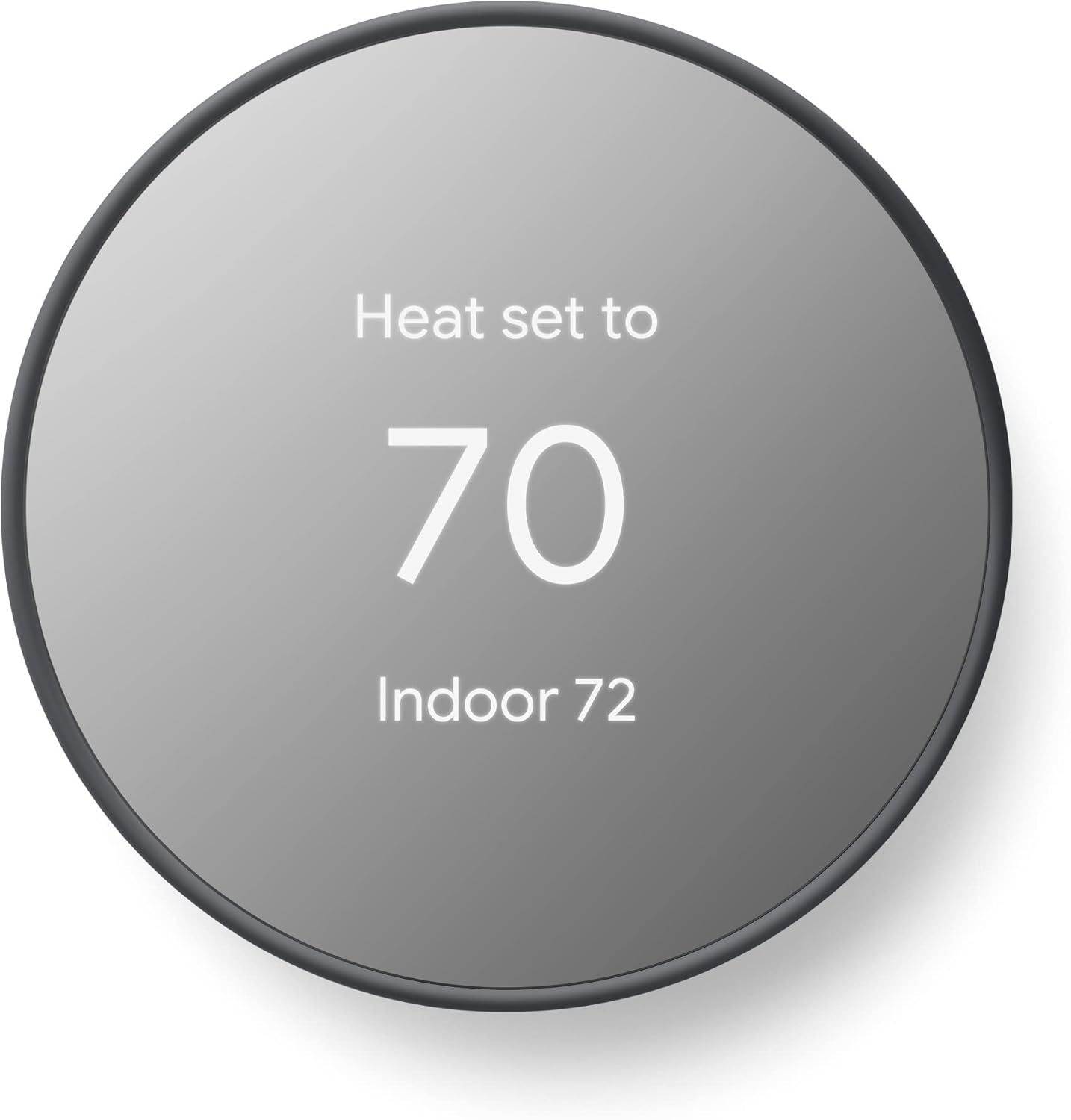
The Google Nest Thermostat is a compact smart thermostat that replaces a standard wall unit to let you control temperature from the Google Home app, voice assistants, or directly on the device. It supports Wi‑Fi (2.4 and 5 GHz) and Bluetooth Low Energy, can run on batteries without a C wire in many homes, and is designed for DIY installation in about 30 minutes. In daily use the Nest can learn simple patterns, automatically set an Eco temperature when it detects nobody is home, and surface suggested schedule tweaks with Savings Finder to help reduce energy use. It also provides HVAC monitoring alerts that flag potential system issues. The display and touch-side control are straightforward, and integration with Google Assistant and Matter-certified platforms makes voice control convenient. Limitations include potential compatibility gaps with some heating-only, cooling-only, or high-voltage systems that may require a C wire or power accessory, and advanced users may miss the deeper manual programming options found on higher-end Nest models.
Best for: Buyers who prioritize easy setup, remote and voice control, and verified energy savings features backed by widespread user adoption and reviews.
Less Ideal for: Homes with uncommon or older HVAC wiring where a C wire is unavailable and owners who need highly detailed manual scheduling or pro-level diagnostics.
- Works over Wi‑Fi and Bluetooth for remote app and voice control
- Designed for easy DIY installation and usually runs without a C wire
- Savings Finder and Eco Temperature features help reduce energy use
- HVAC monitoring that sends alerts for potential system issues
- Not compatible with some high-voltage or unusual HVAC systems without additional power
- Fewer advanced manual programming and customization options than Nest Learning models
Verdict: A simple, app-first smart thermostat that makes remote control and energy-saving automation easy for most households.
Amazon Smart Thermostat
| ASIN | B08J4C8871 |
|---|---|
| Requires C-wire | Yes |
| Works with | Alexa and Ring |
| Manufacturer tech | Honeywell Home |
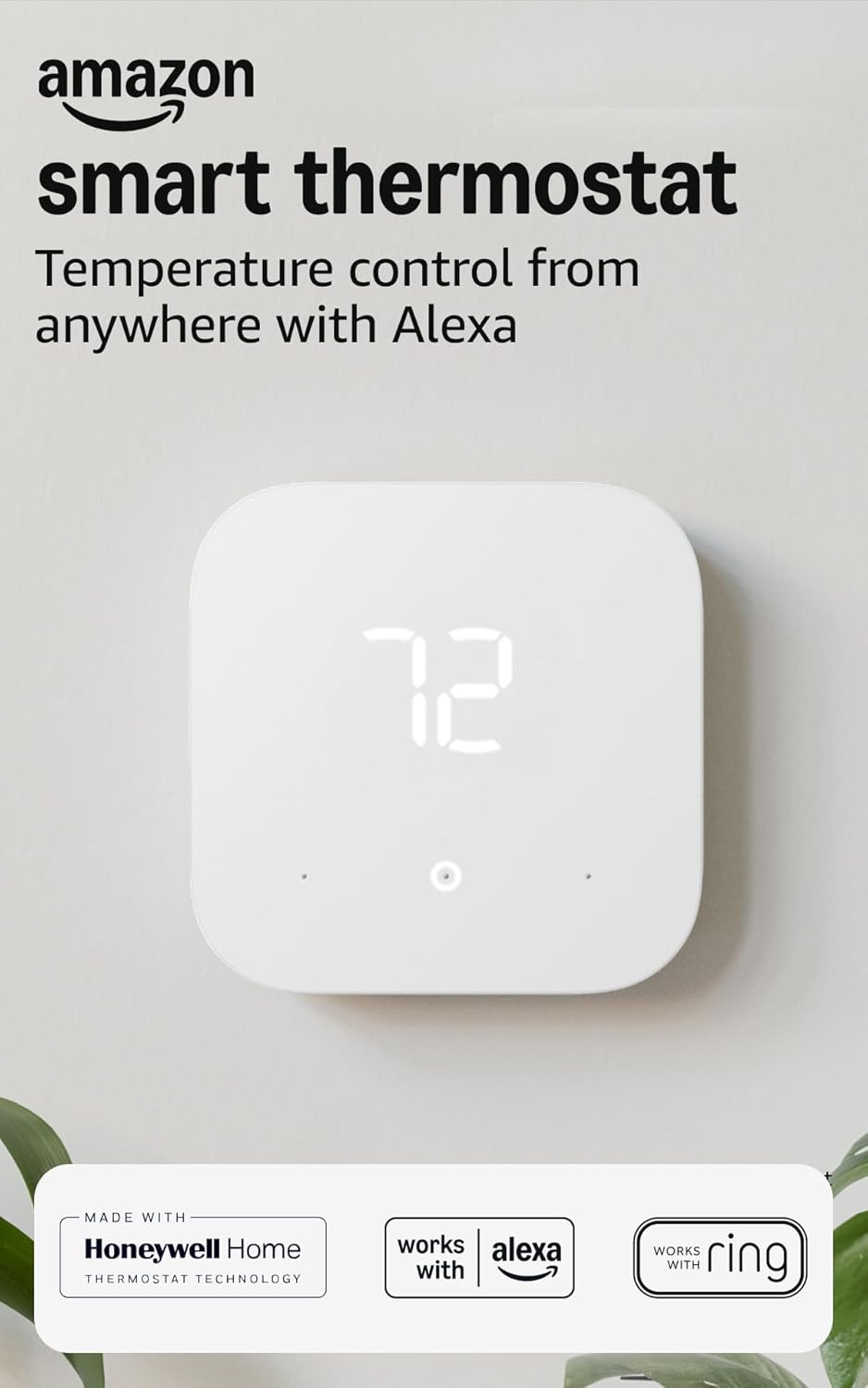
The Amazon Smart Thermostat is a basic smart thermostat that replaces a traditional wall thermostat and adds Alexa integration for remote control and automation. It is typically installed by a homeowner or installer using a required C-wire and guided step-by-step setup in the Alexa app. Once configured you can create schedules for home, away, and sleep, monitor and adjust temperature from anywhere with the app, and link the thermostat to Alexa devices for voice control and presence-based adjustments. The unit uses Honeywell Home thermostat technology under the hood and supports Alexa+ features for routines and multi-device control. Practical benefits include straightforward DIY installation guidance, support for energy-saving schedules and potential local utility rebates, and simple voice control with compatible Echo or Ring devices. Limits to expect are the thermostat's focus on core smart features rather than advanced HVAC diagnostics or multi-stage equipment support, and reliance on the Alexa ecosystem for the smoothest experience.
Best for: Buyers who want a reliable, low-friction smart thermostat that adds Alexa voice control, simple scheduling, and remote access without complex setup or specialist HVAC features.
Less Ideal for: People needing advanced HVAC diagnostics, multi-stage or commercial system support, or those who prefer a non-Alexa smart-home platform.
- Works with Alexa and Ring for voice and presence-based control
- App-guided installation with C-wire compatibility simplifies DIY setup
- Supports scheduling and remote temperature control for energy savings
- Built on Honeywell Home thermostat technology for proven reliability
- Requires a C-wire which may need professional wiring in older homes
- Does not emphasize advanced HVAC diagnostics or multi-stage system controls
Verdict: Choose this thermostat if you want a reliable, Alexa-first smart thermostat that delivers simple scheduling, remote control, and energy-saving features with easy guided setup.
Choosing the Right Digital Thermostat: Key Factors to Consider
Temperature Accuracy and Sensor Placement
A thermostat's temperature sensor and where it sits in the home determine how closely indoor temperature matches the setpoint. Units with higher accuracy and the ability to use remote sensors reduce hot and cold spots. If a thermostat is mounted near sunlight, drafts, or heat sources, its readings will be biased, so models that allow calibration or include remote probes are helpful.
Accuracy matters because small errors can cause the HVAC system to run more than necessary or fail to meet comfort expectations. Look for specifications on sensor accuracy and options to offset readings or add remote sensors when evaluating units.
Wiring Compatibility and Installation
Different HVAC systems use different wiring configurations. Many modern digital thermostats require a common 24V C-wire for power, while some offer battery-only operation or power-stealing modes. Confirming wiring compatibility with your furnace, heat pump, or multi-stage system avoids installation headaches.
Ease of installation also affects whether a homeowner can DIY or needs professional help. Check whether the thermostat has clear wiring labels, a compatible terminal block, and supports common system types like single-stage heat/cool, heat pumps, and multi-stage equipment.
Scheduling, Programming, and Controls
A thermostat's scheduling features determine how much control you have over day-to-day comfort and energy savings. Flexible schedules with weekday/weekend or multiple setpoints per day let you reduce runtime when no one is home and restore comfort before occupants return.
User interface design matters as much as features. A confusing menu will discourage use of energy-saving programs. Evaluate whether the unit offers easy temporary holds, quick-set buttons, and an intuitive mobile app if remote programming is important to you.
Smart Features and Integration
Connectivity options like Wi-Fi, Bluetooth, or proprietary hubs affect how a thermostat integrates with other smart-home devices and voice assistants. Remote access allows temperature adjustments away from home and can provide useful runtime and energy reports.
Consider whether you need geofencing, learning algorithms, or support for schedules pushed from a home automation system. Be aware that some connected features depend on cloud services, so check expectations around data privacy and firmware support.
Compatibility With HVAC Types and Functions
Not all thermostats support every HVAC function. Some are designed for simple single-stage heat/cool setups, while others handle heat pumps, auxiliary heat, humidification, and multiple stages of heating and cooling. If your system uses a heat pump, two-stage compressor, or separate heating source, confirm the thermostat supports those specific functions.
Choosing the wrong type can result in improper cycling, loss of control over auxiliary heat, or inability to control whole-home ventilation. Prioritize thermostats that explicitly list the functions your system requires.
Reliability, Firmware, and Support
Thermostats are long-term devices, and firmware updates or support policies affect their longevity. Models with a track record of receiving security and stability updates reduce the risk of lost features or integrations over time.
Also consider physical durability and warranty terms. Units that survive household wear and have straightforward reset and recovery options make maintenance easier for homeowners.
Installation Tips for a Smooth Swap
Before you remove the old thermostat, turn off power at the furnace or breaker and photograph the existing wiring for reference. Label wires or take a clear picture so you can map each conductor to the new unit's terminals.
If a C-wire is missing, there are three common solutions: use a thermostat that supports battery-only or power-stealing operation, install a C-wire adapter, or run a new conductor from the HVAC control board. Each option has tradeoffs in reliability and complexity.
After wiring, verify system responses by switching to heat and cool modes and testing fan control. Allow a full cycle to ensure stages and auxiliary heat behave correctly.
- Turn power off before disconnecting any wires
- Label or photograph existing connections
- Confirm HVAC mode behavior after installation
Using Remote and Multi-Room Sensors
Remote sensors help solve uneven-temperature problems by reporting temperature from rooms where occupants actually spend time. Many digital thermostats support one or more wireless sensors that can be assigned to averages or prioritized zones.
If you live in a home with distinct thermal zones, placing sensors in representative rooms avoids setting the whole house by an outlier location like a sunny hallway. Check sensor battery life and wireless range when planning placements.
- Place sensors away from direct sunlight and vents
- Use an average of sensors for balanced control
- Replace sensor batteries on a predictable schedule
Energy-Saving Strategies With Digital Controls
Digital thermostats enable strategies that reduce runtime without sacrificing comfort. Program setbacks for sleeping hours and workday absences. Even modest setbacks of a few degrees during long absences can compound into noticeable energy savings.
Use scheduling combined with gradual recovery settings when available to avoid abrupt HVAC demand spikes. Geofencing and smart schedules can automate setbacks based on occupancy, but always provide easy manual overrides for guests or unusual days.
- Set weekday and weekend schedules separately
- Use gradual recovery to bring temperature back before occupancy
- Combine occupancy sensing with manual override options
Privacy and Network Considerations
If you choose a connected thermostat, treat it like any other smart device on your home network. Use a strong, unique Wi-Fi password and consider placing devices on a guest VLAN if your router supports network segmentation.
Review the device's privacy statements to understand what data is transmitted to cloud services. For many homeowners, local control options or limited cloud dependency reduce exposure and maintain functionality during intermittent internet outages.
- Use secure Wi-Fi credentials and network segmentation when possible
- Check cloud dependency for critical features
- Keep firmware updated for security patches
When to Call a Professional
Call a qualified HVAC technician if you encounter unfamiliar wiring beyond typical control wires, if your system uses line-voltage circuits, or if installation requires modifying the control board. Touching high-voltage equipment or incorrectly wiring multi-stage systems can damage equipment.
Also seek professional help when your system includes integrated equipment such as whole-home humidifiers, dehumidifiers, or zone dampers tied to the thermostat. A technician can verify compatibility and ensure features like auxiliary heat are correctly wired and configured.
- Get professional help for line-voltage or unfamiliar wiring
- Ask a technician about integrating humidifiers or zone controls
- Have an HVAC pro verify auxiliary heat and staging
How We Chose the Best Digital Thermostat
We prioritized criteria that matter to people replacing or upgrading a thermostat in typical single-family and multi-zone homes. Accuracy and sensor performance were key because a thermostat that reads room temperature correctly prevents runaway cycles and keeps comfort consistent. Compatibility and wiring support were next: we checked whether units support common HVAC setups and wiring standards so installations are straightforward for most systems. Ease of programming and daily controls are essential for long-term satisfaction, so we favored interfaces that let users quickly set schedules, temporary holds, and temperature offsets. Smart features and connectivity were evaluated for homeowners who want remote access, scheduling automation, and energy reports. Reliability and firmware update practices were considered to reduce maintenance and integration headaches. We excluded models limited to commercial HVAC only and products that require professional-only installation without homeowner-accessible wiring options. The list focuses on residential-capable digital thermostats that offer clear installation guidelines, measurable temperature control, and useful user features. Our criteria emphasize measurable specs and real-world usability rather than marketing claims.
Our full evaluation process is outlined in our review methodology.
FAQ
Do I need a C-wire for a digital thermostat?
Many digital thermostats work best with a dedicated 24V common or C-wire for reliable power. Some units offer battery-only operation or power-stealing modes, but those can be less reliable over time. If a C-wire is missing, a C-wire adapter or running a new conductor are common solutions.
Can a digital thermostat control a heat pump and auxiliary heat?
Some digital thermostats explicitly support heat pumps and auxiliary or emergency heat functions. It depends on the thermostat's wiring terminals and programmed options. Verify that the unit supports your specific heat pump wiring and stage configuration before installation.
How do remote temperature sensors affect comfort?
Remote sensors allow the thermostat to measure temperature where people spend time rather than at the thermostat location. Using sensors typically reduces hot and cold spots and improves perceived comfort, especially in homes with uneven heating or cooling.
Will a smart thermostat save energy on its own?
A smart thermostat provides tools like scheduling, geofencing, and learning algorithms that can reduce runtime, but savings depend on how they are configured and used. Proper scheduling, setbacks, and owning fewer temperature extremes are what actually produce energy reductions.
What happens to my thermostat settings during a power outage?
Many digital thermostats retain schedules and settings in nonvolatile memory, but battery-backed units can keep the clock and temporary settings during short outages. Connected features that rely on cloud services will be unavailable until internet service is restored.
Final Verdict
Choosing the right digital thermostat means balancing accurate sensing, wiring compatibility, and the control features you will actually use. Prioritize units that match your HVAC wiring and support the control functions your system requires, such as heat pump staging or auxiliary heat. If remote access and integrations matter, check connectivity and privacy considerations. Focus on installation options and long-term reliability rather than chasing every headline feature. With the right match, a modern digital thermostat improves comfort and can reduce energy use while giving you clearer control over home temperature.