
Note: This article contains affiliate links. If you click on these links and make a purchase, we may earn a small commission at no extra cost to you. This helps support our research and content. Read our full affiliate disclosure here.
Choosing the right dough mixer affects your baking speed, dough texture, and how often you actually use the machine. Whether you bake bread weekly or make large batches for sharing, the right mixer reduces manual effort and delivers consistent gluten development for better rise and crumb. This guide presents seven shortlisted dough mixers that stood out for home and hobby bakers, each evaluated for power, bowl capacity, build, and ease of use. Read on to see which features matter most and which mixers suit different baking routines.
Top Picks at a Glance
| Best Overall The best all-around choice for most situations | Cuisinart Stand Mixer SM-50BC |  |
| Best Quality Built to a higher standard if you want something more solid | KitchenAid Artisan 5-Quart Mixer |  |
| Best Value The sweet spot between price and what you get | CUSIMAX Stand Mixer 5-Qt |  |
| Best Budget The cheapest option that still gets the job done reliably | OLIXIS 4.2 Qt Stand Mixer |  |
| Top Rated A top-rated pick with lots of positive feedback | KitchenAid Classic Series K45SS 4.5-Quart |  |
| Most Popular A crowd favorite that many people choose with confidence | Aucma 6.5QT Stand Mixer |  |
| Best Seller A high-volume bestseller chosen again and again | Kitchen in the box 3.2QT Stand Mixer | 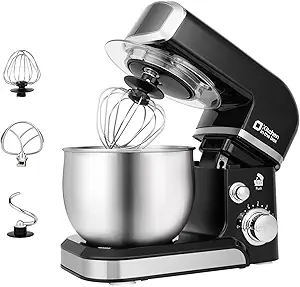 |
Cuisinart Stand Mixer SM-50BC
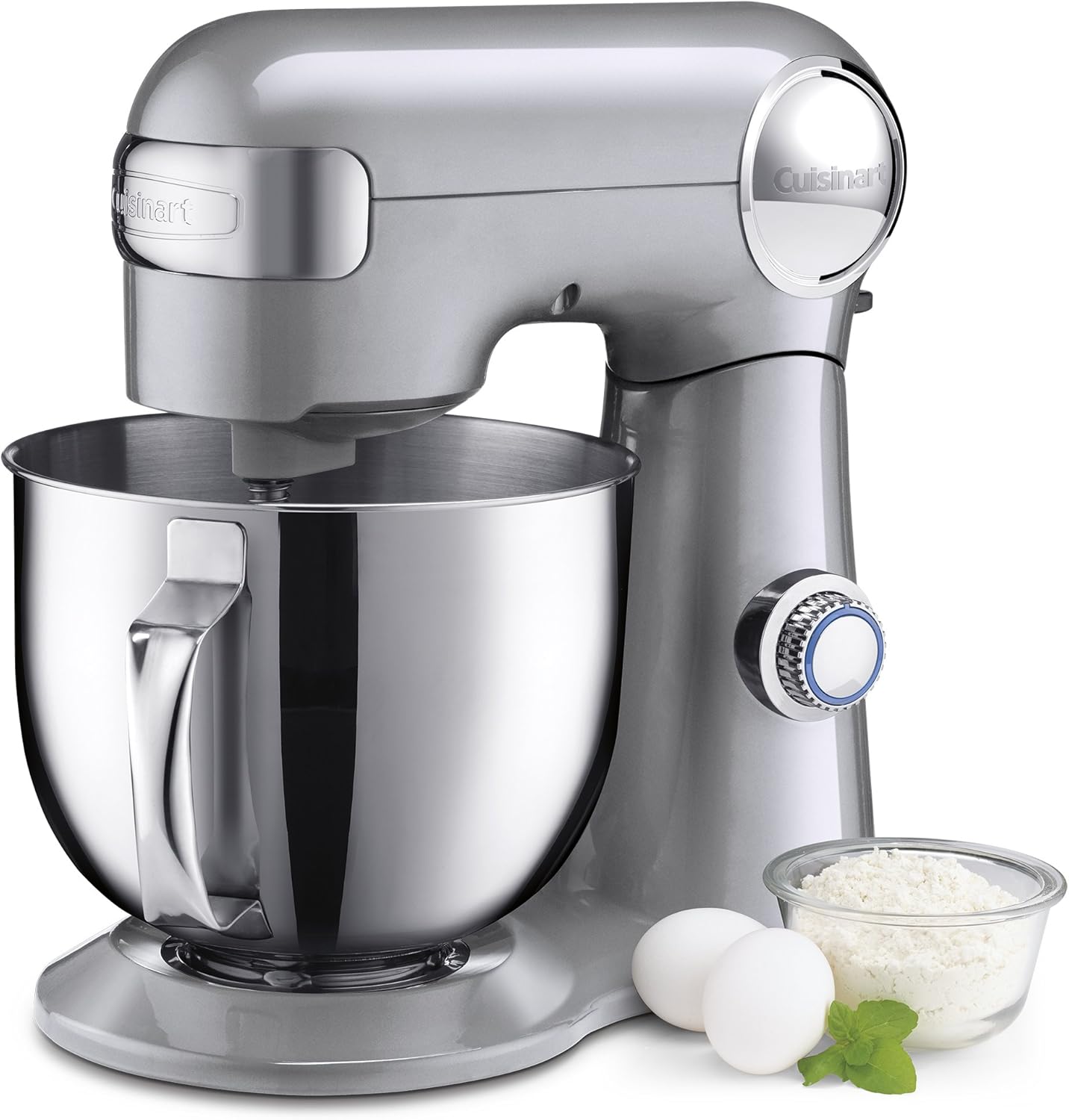
| Wattage | 500 watts |
|---|---|
| Number of Speeds | 12 |
| Capacity | 5.5 quarts |
| Voltage | 110 volts |
The Cuisinart SM-50BC is a straightforward, metal-built stand mixer aimed at everyday baking and prep tasks. Its 500-watt motor and 12-speed knob controls cover gentle folding through high-speed whipping, while the tilt-back head and 5.5-quart stainless bowl make loading and removing batter or dough simple. Included accessories — a chef's whisk, flat paddle, and dough hook — handle mixing, creaming, and kneading; the splash guard with pour spout keeps counters cleaner during wetter batters. The mixer is compatible with a range of optional attachments for pasta, meat grinding, and frozen desserts, which expands its usefulness beyond basic mixing. Dishwashable bowl and accessories simplify cleanup, and the die-cast metal construction feels durable on the counter. It is not the most powerful or heavy-duty mixer for very large or stiff artisan bread doughs compared with commercial units, but for home bakers making cookies, cakes, yeasted loaves, and everyday doughs it provides reliable performance and good versatility.
Best for: Home bakers who want a dependable, versatile mixer for daily baking and moderate dough work and value a durable, easy-to-use machine.
Less Ideal for: Commercial bakers or users who regularly mix very large volumes or extremely heavy doughs should consider a higher-capacity, heavier-duty machine.
- 500-watt motor with 12 speeds for a wide range of mixing tasks
- 5.5-quart stainless steel bowl suitable for family-sized batches
- Includes whisk, paddle, dough hook, and splash guard with pour spout
- Die-cast metal construction feels sturdy and durable
- Accessories and bowl are dishwasher safe for easy cleanup
- Not ideal for very large commercial batches or extremely stiff artisan doughs
- No digital controls or timers for precision timing
Verdict: A solid, versatile 5.5-quart mixer that handles most home baking tasks reliably and expands with optional attachments.
KitchenAid Artisan 5-Quart Mixer

| Capacity | 5 quarts |
|---|---|
| Wattage | 325 watts |
| Number of Speeds | 10 |
| Voltage | 120 volts |
The KitchenAid Artisan 5-Quart Tilt-Head Mixer is a durable, metal-constructed stand mixer designed for both everyday baking and heavier dough work. Its 325-watt motor and 10-speed knob let you move from slow stir to high-speed whip, while the tilt-head design makes attaching tools and adding ingredients simple. The polished stainless-steel 5-quart bowl with handle is roomy enough for large cookie batches or multiple loaves of dough, and the removable bowl and dishwasher-safe finish ease cleanup. The mixer accepts a wide range of optional hub-powered attachments, expanding it into a grinder, pasta maker, or food processor for more ambitious bakers. Noise is modest and controls are straightforward, though serious commercial bakers may find the motor less powerful than larger bowl-lift models. For home cooks focused on performance and durability, this mixer combines consistent mixing, solid build quality, and accessory versatility in a countertop-friendly package.
Best for: Bakers who prioritize reliable performance and long-term durability for home dough work and multi-recipe use, and who want the flexibility to add hub-driven attachments over time.
Less Ideal for: Users who regularly mix very large commercial-scale batches or need the highest motor torque should consider larger bowl-lift or commercial mixers instead.
- Robust metal construction built for long-term use
- 10-speed control covers stirring, kneading, whipping, and more
- 5-quart stainless-steel bowl handles large batches up to about 9 dozen cookies
- Tilt-head design provides easy access for adding ingredients and changing attachments
- Compatible with many hub-powered attachments to expand functionality
- 325-watt motor is less powerful than larger bowl-lift commercial-style mixers
Verdict: A durable, versatile 5-quart stand mixer that delivers dependable mixing performance for serious home bakers who want long-term reliability and accessory expandability.
CUSIMAX Stand Mixer 5-Qt

| Capacity | 5 liters |
|---|---|
| Wattage | 650 watts |
| Number of Speeds | 8 |
| Controls Type | Touch |
The CUSIMAX Stand Mixer is a hands-free kitchen mixer suited to making dough, batters, and whipped egg whites for home baking. It pairs a 650W motor and metal gear system with a 5-quart stainless steel bowl and three attachments (dough hook, flat beater, wire whip), letting you mix everything from sticky bread dough to light meringues. The tilt-head and built-in handle make attaching the bowl and accessories simple, while non-slip feet and a splatter shield keep the workspace tidy. The digital touch controls provide eight speeds and a 15-minute timer so you can set consistent mixing times and pause when needed. Practical benefits include the sturdy-feeling motor for heavier doughs and the timed, repeatable settings that help standardize recipes. Limits to consider are the plastic housing which may not feel as robust as premium metal-bodied units and the 15-minute timer cap may be short for very long kneading sessions without restarting. For everyday home bakers the mixer balances power, capacity, and useful controls at a value-oriented level.
Best for: Bakers who want a practical, capable home mixer that handles dough and everyday baking tasks reliably while offering timed, repeatable control.
Less Ideal for: Serious home bakers who need a heavy-duty, all-metal commercial-style mixer for very large or continuous kneading sessions.
- 650W motor and metal gear system provide enough torque for bread dough and dense batters
- 5-quart stainless steel bowl handles family-size batches
- Digital touch controls with 8 speeds and 15-minute timer for repeatable results
- Includes dough hook, flat beater, and wire whip for common mixing tasks
- Tilt-head with handle and splash guard make attachment changes and ingredient addition easier
- Plastic housing may feel less durable than metal-bodied mixers
- Timer limits mixing runs to 15 minutes without manual restart
Verdict: A value-focused 5-quart mixer with a strong motor and digital controls that makes reliable dough mixing and everyday baking simple.
OLIXIS 4.2 Qt Stand Mixer

| Capacity | 4.2 quarts |
|---|---|
| Wattage | 300 watts |
| Number of Speeds | 10 |
| Noise Level | 60 db |
The OLIXIS 4.2 Qt Stand Mixer is a budget-minded countertop mixer designed for everyday home baking tasks. It uses a 300W motor and a ten-speed knob control to handle everything from cake batters to moderate bread doughs, and the tilt-head makes attaching the included dough hook, whisk, and flat beater straightforward. The stainless steel bowl and removable splash lid add convenience for mixing wetter batters and help keep counters cleaner, while an unusually multifunctional bowl cover bundles measuring and separating tools to save drawer space. At about 60 dB it runs at a reasonable noise level for home kitchens, though the motor will be slower under very heavy dough compared with higher-wattage professional mixers. Build materials combine ABS and aluminum for a lightweight 6.9 pound appliance that is easy to move and store but may feel less substantial during very long kneading cycles. For the price, it delivers the core mixing features most home bakers need, with a few clever extras trimmed to keep the cost down.
Best for: Home bakers on a budget who want a compact, ready-to-use mixer for cakes, cookies, and small to medium bread doughs without paying for commercial power or premium build.
Less Ideal for: People who regularly mix very large batches or need a heavy-duty, professional-grade mixer for frequent long kneading sessions should look at higher-powered models.
- Includes dough hook, whisk, flat beater and stainless steel bowl for common baking tasks
- Ten-speed control handles a wide range of mixing from slow kneading to faster whipping
- Compact 4.2 quart capacity fits small kitchens and storage spaces
- Multifunction bowl cover adds measuring, egg separation, and slicing tools to save counter clutter
- 300W motor may struggle with very heavy or large batches of stiff dough
- Lightweight ABS construction can feel less robust than heavier, professional-grade mixers
Verdict: A feature-packed, affordable stand mixer that gives budget-minded home bakers the attachments and speed range needed for everyday doughs and batters.
KitchenAid Classic Series K45SS 4.5-Quart
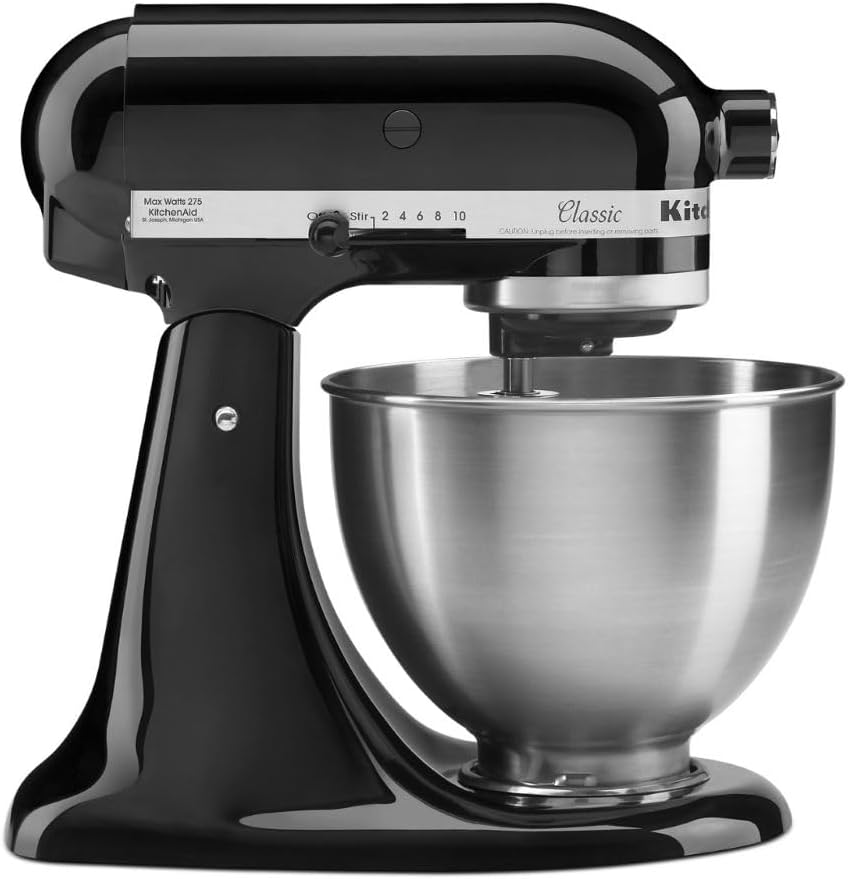
| Capacity | 4.5 quarts |
|---|---|
| Wattage | 275 watts |
| Number of Speeds | 10 |
| Voltage | 120 volts |
| Included Components | Flat beater, Dough hook, 6-wire whip, 4.5-quart bowl |
The KitchenAid Classic Series K45SS is a straightforward tilt-head stand mixer built for routine baking and home cooking. It mixes, kneads, and whips using a 275-watt motor and a 4.5-quart stainless steel bowl, and includes a coated flat beater, coated dough hook, and 6-wire whip for common tasks. Ten speed settings let you go from gentle stirring to high-speed whipping, while the metal body and 59 touchpoints around the bowl promote consistent contact and durability during use. The power hub also accepts optional attachments for grinders, pasta makers, and other accessories if you want to expand beyond basic mixing. The tilt-head design makes adding ingredients and swapping tools simple, though the smaller 4.5-quart bowl is best suited to typical household batches rather than large commercial quantities. If you want a dependable, no-frills mixer that will handle batters, cookie dough, and bread dough reliably, this model covers those bases with a compact footprint and solid build quality.
Best for: Home bakers who prioritize a reliable, well-built mixer for everyday doughs, batters, and whipping tasks and value long-lasting construction over pro-level capacity.
Less Ideal for: Those who regularly bake in very large batches or need commercial‑scale capacity and clearance should consider larger bowl-lift models instead.
- Durable metal construction for long-term use
- Includes key mixing tools: flat beater, dough hook, and wire whip
- 10-speed range covers most home baking tasks
- 4.5-quart stainless steel bowl suitable for typical household batches
- Power hub accepts optional attachments to increase versatility
- 4.5-quart capacity can be limiting for very large batches
- Tilt-head design may offer less bowl clearance than bowl-lift models
Verdict: A sturdy, no-frills stand mixer that reliably handles everyday doughs and batters while offering expansion via optional attachments.
Aucma 6.5QT Stand Mixer

| Wattage | 660 watts |
|---|---|
| Voltage | 120 volts |
| Number of Speeds | 6 |
| Capacity | 6.5 quarts |
| Noise Level | 76 db |
The Aucma stand mixer is a practical, budget-friendly machine for home bakers who need a roomy bowl and enough power to handle heavy dough. Its 660W pure copper motor and dough hook tackle stiff bread and cookie dough, while six speed settings plus pulse give control for everything from whipped egg whites to mixing batter. The 6.5 quart stainless steel bowl with dual handles is large enough for family batches and the tilt-head design makes attaching the whisk, beater, or hook straightforward. Accessories are dishwasher safe and the included splash guard helps keep counters cleaner when adding ingredients. Noise is reported around 76 dB, so it is not whisper quiet, and the mixer uses ABS housing rather than metal, which keeps weight and cost down but feels less premium. For everyday home baking the Aucma delivers solid mixing performance and useful extras, but buyers seeking a heavier-duty, pro-grade metal body or very quiet operation may prefer higher-end alternatives.
Best for: Home bakers who want reliable dough-mixing performance and a large bowl for family-sized batches while valuing proven functionality and included accessories.
Less Ideal for: Those who prioritize a metal, pro-grade chassis or the quietest possible operation should consider higher-end models instead.
- Powerful 660W motor capable of handling thick bread and cookie dough
- Large 6.5 quart stainless steel bowl with dual handles for family-sized batches
- Comes with whisk, beater, dough hook, and splash guard, all dishwasher safe
- Tilt-head design makes installing accessories and removing the bowl easy
- ABS housing instead of metal construction gives a less premium feel
- Reported noise level around 76 dB is louder than quieter premium mixers
Verdict: Aucma's 6.5QT stand mixer delivers strong, reliable mixing power and a large bowl with useful accessories, making it a sensible pick for home bakers who want performance without premium pricing.
Kitchen in the box 3.2QT Stand Mixer

| Capacity | 3.2QT |
|---|---|
| Wattage | 300 watts |
| Number of Speeds | 6 |
| Included Components | Whisk, Beater, Dough Hook |
| Voltage | 120 |
This Kitchen in the box mixer is a lightweight, space-saving stand mixer intended for 1–2 person households and small kitchens. It uses a 300W motor with six speeds and planetary rotation to handle tasks from whipping cream and meringues to mixing thick batters and small amounts of dough. The tilt-head design and removable 3.2QT stainless steel bowl make loading and cleaning straightforward, and the transparent splash guard helps contain mess while mixing. Included aluminum dough hook, flat beater, and stainless-steel whisk cover typical home baking needs, and four suction feet keep the unit steady during use. Practical limits: the bowl is small so it is poorly suited to large batches or frequent heavy dough work, and the 300W motor and compact chassis mean it will struggle with very stiff or high-volume doughs. For everyday small-batch recipes the unit is convenient, affordable, and easy to store, but serious bakers should choose a larger-capacity, higher-power model.
Best for: Buyers who want a compact, easy-to-store mixer for everyday small-batch baking and prefer a low-risk, simple appliance that handles common household recipes.
Less Ideal for: Those who bake large batches, work with heavy bread dough regularly, or need a high-power, professional-grade mixer should look at larger capacity, more powerful models.
- Compact, lightweight design that saves counter and storage space
- 3.2QT stainless steel removable bowl is easy to clean and suitable for small batches
- Six speeds with planetary rotation cover a range of mixing tasks from whipping to dough mixing
- Includes three durable attachments: aluminum dough hook, flat beater, and stainless-steel whisk
- Transparent anti-splash lid and suction feet improve cleanliness and stability during use
- Small 3.2QT bowl limits batch size and is not suited for large or commercial baking
- 300W motor and compact build may struggle with very stiff doughs or heavy continuous use
Verdict: A compact, beginner-friendly stand mixer built for reliable small-batch doughs and everyday home baking.
Choosing the Right Dough Mixer: Key Factors to Consider
Motor Power and Torque
Doughs, especially high-hydration or enriched recipes, demand sustained torque. A mixer's motor rating indicates peak power but not necessarily how it performs under heavy load. Look for mixers with gear reduction or planetary gear systems that convert motor RPM to usable torque without overheating.
Higher torque reduces kneading time and prevents the motor from stalling mid-cycle, which preserves dough structure and extends component life. Consider whether the mixer offers thermal protection and how long it can run continuously when planning large batches.
Mixing Action and Attachment Design
How the agitator moves relative to the bowl affects gluten development and ingredient incorporation. Planetary mixers sweep the bowl perimeter while rotating the tool, which generally yields more even mixing than single-point spiral mechanisms for some recipes.
Attachment shape and fit matter too. A hook designed for dough will fold and stretch effectively; a paddle or whisk is better for lighter batters. Check how the mixer secures attachments and whether it allows easy removal for cleaning.
Bowl Capacity and Material
The capacity you need depends on batch sizes. Small households may want a compact 3 to 4 quart bowl, while those who bake multiple loaves or large sweet doughs will benefit from larger 6+ quart bowls. Overfilling a bowl reduces mixing efficiency and can overwork the machine.
Bowl material matters for durability and maintenance. Stainless steel bowls resist staining and are easy to clean, while enameled options may chip. Consider whether the bowl has a handle, a stable base, and whether splash guards or pouring lips are included for wet mixes.
Speed Controls and Presets
A useful speed range lets you start slow to hydrate flour and then increase speed for kneading. Variable speed control is preferable to a few fixed settings because it gives finer control over dough development. Some mixers include timers or programmable presets for common workflows like autolyse or bulk mixing phases.
Look for mixers with smooth speed ramps to avoid flour puffing or ingredient fly-off. Digital controls can offer greater precision, but mechanical knobs are often more durable and easier to repair.
Build Quality and Serviceability
A heavy-duty metal gearbox and die-cast housing typically outlast lightweight plastics under frequent use. Robust construction reduces vibration and prolongs alignment of gears and shafts, which is critical when mixing dense doughs.
Serviceability is important for long-term ownership. Check whether routine wear parts are replaceable and how accessible the drive components are for maintenance. A machine that is simple to disassemble and reassemble will likely have a longer usable life.
Ease of Cleaning and Maintenance
Dough can dry on attachments and bowls quickly, so easy-clean surfaces and removable parts save time. Removable bowls, dishwasher-safe attachments, and simple splash guards reduce cleanup time and encourage regular use.
Maintenance considerations include how to clean gear housings, whether seals need periodic replacement, and how easy it is to clear trapped dough from crevices. Machines with fewer nooks and smooth surfaces are generally easier to keep sanitary.
Choosing the Right Mixer Size for Your Baking Habits
Match bowl capacity to how much dough you usually make. Small households and occasional bakers often prefer compact mixers that handle double batches comfortably, while avid bakers or those preparing bread for gatherings need larger bowls and higher torque to maintain performance with increased dough mass.
- 3 to 4 quarts: single loaves, small batches, space-saving.
- 5 to 6 quarts: versatile for most home bakers and family-sized batches.
- 7 quarts and up: frequent bakers and larger batches; requires more motor torque.
Understanding Power Ratings and Real-World Performance
Manufacturer wattage or horsepower figures can be useful but do not tell the whole story. Look for descriptions of continuous duty capability, gear reduction, and torque handling under load. A lower-watt motor with effective gearing can outperform a higher-watt unit that overheats or trips thermal protection during long kneading cycles.
- Check duty cycle or manufacturer guidance on continuous run time.
- Seek gear-driven designs or planetary systems for consistent torque.
- Note thermal cutoff features to prevent motor damage during heavy use.
Attachments and Accessories That Expand Use
Beyond the basic dough hook, some mixers accept optional attachments that convert the machine for shredding, grinding, or pasta making. Decide whether you want a simple, dedicated dough mixer or a multi-use kitchen hub. Removable, standardized fittings make swapping tools easier and increase the machine's versatility.
- Standard dough hook shapes: C-hook for folding, spiral for intensive kneading.
- Optional splash guards, pouring shields, and scraper tools reduce mess and cleanup.
- Accessory compatibility affects long-term flexibility; check attachment mount type.
Noise, Vibration, and Countertop Stability
Powerful mixers can vibrate and make noise. Heavier bases and rubber feet reduce movement and countertop damage. If noise is a concern, look for designs that isolate the motor from the housing or advertise low-noise operation. Stability not only improves user comfort but also ensures consistent mixing action.
- Look for non-slip feet or suction mounts for steady operation.
- Consider weight and center of gravity to minimize rock and tilt.
- Metal gear housings typically damp vibration better than thin plastics.
Safety Features and Overload Protection
Kneading dense doughs places sustained stress on mechanical and electrical systems. Overload protection prevents motor burnout by stopping the mixer when current spikes or temperatures rise. Other safety features include locked head latches, auto-shutoff when the bowl is removed, and secure attachment locks to prevent tools from ejecting during operation.
- Thermal cutoffs extend motor life by preventing overheating.
- Interlocks and head-lock mechanisms reduce the risk of accidental contact.
- Easy-to-access power switches and reset procedures make handling jams safer.
How We Chose the Best Dough Mixer
We focused on attributes that most directly affect mixing quality and long-term ownership for home bakers. Core evaluation criteria included motor durability and torque under load, mixing action and planetary coverage to ensure even incorporation, bowl capacity and material for batch size flexibility, and control options such as speed range and timers for recipe precision. We also assessed build quality and serviceability, including how easy it is to access drive components and the availability of standard attachments. Noise level and thermal protection were considered because sustained dough mixing stresses motors. We excluded models intended primarily for light whipping or single-ingredient tasks that lack the torque or gearing needed for dense doughs. Final selections reflect machines that meet practical torque, capacity, and control thresholds suited to regular bread and enriched-dough baking.
Our full evaluation process is outlined in our review methodology.
FAQ
What size bowl do I need to bake two loaves at once?
For two standard loaves, a 5 to 6 quart bowl is usually sufficient. This capacity gives room for dough expansion and efficient mixing without overworking the motor. If you frequently double recipes or make enriched doughs, consider a larger 6+ quart bowl.
Can a stand mixer handle high-hydration doughs?
Many dough mixers can handle high-hydration doughs, but success depends on motor torque and mixing action. Machines with strong torque and appropriate dough hooks will mix sticky, wet doughs more effectively than low-power models that may stall or overheat.
How long should I knead dough in a mixer?
Kneading time varies by recipe and hydration, but typical kneading cycles range from 5 to 12 minutes. Watch the dough for windowpane development and elasticity rather than relying solely on a timer. Reduce or extend time based on dough feel and recipe guidance.
Are metal bowls better than plastic for dough mixing?
Stainless steel bowls are generally preferred because they are durable, hygienic, and resist staining. Plastic bowls can be lighter and cheaper but may scratch or retain odors over time. Choose a material that balances durability and weight for your needs.
How do I prevent my mixer from overheating during long batches?
Avoid continuous overloading by breaking large batches into smaller ones when possible. Allow rest periods between long cycles and follow manufacturer guidance on duty cycles. Mixers with thermal protection will shut off to prevent damage and will usually restart after cooling.
Final Verdict
Prioritize torque, bowl capacity, and a mixing action suited to the kinds of dough you make most often. If you bake large or dense loaves regularly, lean toward machines with higher continuous-duty torque and bigger bowls. For occasional bakers, a mid-sized mixer with reliable planetary mixing and easy-clean features will offer the best balance of convenience and performance. Focus on the tradeoffs between power and size to pick a mixer that matches your batch frequency and recipe types.