
Note: This article contains affiliate links. If you click on these links and make a purchase, we may earn a small commission at no extra cost to you. This helps support our research and content. Read our full affiliate disclosure here.
When you run a dual fuel heating system, the thermostat is the piece that ties electric heat pumps and a backup furnace together. Picking the right Dual Fuel Thermostat affects comfort, efficiency, and how smoothly the system shifts between heat sources as outdoor conditions change. This guide highlights a curated short list of the top Dual Fuel Thermostats, focusing on control accuracy, scheduling flexibility, and compatibility with common whole-home setups. Below you will find the shortlisted products and an explanation of the evaluation criteria we used to identify dependable options for everyday use.
Top Picks at a Glance
| Best Overall The best all-around choice for most situations | Lennox L40 Smart Thermostat |  |
| Best Quality Built to a higher standard if you want something more solid | ecobee Smart Thermostat Premium |  |
| Best Value The sweet spot between price and what you get | Garystat Heat Pump Thermostat G721 |  |
| Best Budget The cheapest option that still gets the job done reliably | Coiiwsei RTH715 Programmable Thermostat |  |
| Top Rated A top-rated pick with lots of positive feedback | White‑Rodgers 80 Series 1F85U-42PR |  |
| Most Popular A crowd favorite that many people choose with confidence | Google Nest Thermostat |  |
| Best Seller A high-volume bestseller chosen again and again | Sensi Smart Thermostat ST55 |  |
Lennox L40 Smart Thermostat

| Controller Type | Touchscreen |
|---|---|
| Temperature Control Type | Programmable |
| Connectivity Technology | Wi-Fi |
| Control Method | App, Touch, Voice |
The L40 is a smart, touchscreen thermostat aimed at homeowners who want programmable schedules, remote app control, and integration with common voice assistants. It supports Wi‑Fi connectivity and offers up to four separate 7‑day schedules plus Schedule IQ to automate temperature changes and a One‑Touch Away mode for quick energy savings. Practical features include automatic changeover between heating and cooling, compressor short‑cycle protection, maintenance reminders, and geo‑fencing Smart Away to reduce run time when the house is empty. Installation is simplified with the Lennox Smart Technician tools and it provides diagnostic reports and emailed alerts useful for proactive maintenance. Important limitations are its stated incompatibility with communicating HVAC equipment from other brands, so it only suits conventional single‑stage or dual‑fuel heat pump systems that use standard wiring, and some advanced proprietary integrations may not be available. For buyers seeking a clean touchscreen interface with solid scheduling and energy features for a conventional Lennox or non‑communicating system, the L40 is a capable option.
Best for: Homeowners who want a modern touchscreen thermostat with reliable scheduling, remote app and voice control, and features that help balance comfort and energy savings for conventional single‑stage or dual‑fuel systems.
Less Ideal for: Those with communicating or proprietary HVAC control systems from other brands or buyers needing universal compatibility across advanced communicating equipment.
- Touchscreen with intuitive app, voice, and touch control for remote management
- Advanced scheduling (four 7‑day schedules plus Schedule IQ) for flexible automation
- Smart Away geo‑fencing and One‑Touch Away mode to reduce energy use when away
- Built‑in diagnostics, emailed alerts, and technician tools for easier service
- Not compatible with communicating HVAC equipment from other brands
- Designed for single‑stage and certain dual‑fuel systems only, limiting fitment in some installations
Verdict: Choose the L40 if you want a touchscreen Wi‑Fi thermostat that delivers flexible scheduling, remote control, and diagnostics for conventional single‑stage and dual‑fuel systems.
ecobee Smart Thermostat Premium

| Compatibility | Most 24VAC HVAC systems (up to 95%) |
|---|---|
| Connectivity Protocol | Wi-Fi |
| Power Source | Battery Powered (24 volts) and PEK included |
| Included Components | SmartSensor, backplate, wire labels, screws, PEK, trim plate |
The ecobee Smart Thermostat Premium is a high-end smart thermostat designed to optimize comfort and reduce energy use through intelligent controls and sensors. It installs on standard 24VAC HVAC systems and includes a Power Extender Kit for homes without a C-wire, plus an included SmartSensor to detect and correct hot or cold spots. The unit offers dual-band Wi‑Fi, app control, and built-in voice assistants (Siri or Alexa) for hands-free operation, and it adds live view integration with an ecobee doorbell camera. Notable capabilities include an onboard air quality monitor with alerts, radar-based occupancy sensing for better presence detection, and integrations with HomeKit, Google Assistant, SmartThings, and IFTTT. In practice this delivers targeted temperature adjustments, remote control and scheduling from the app, and potential energy savings through occupancy-aware automation. Trade-offs are the premium positioning and its reliance on the app and cloud features for some advanced functions, and full Siri support requires an Apple home hub. Installation is made easier by included hardware and wiring aids but may still require checking system compatibility first.
Best for: A performance-minded buyer who wants precise, sensor-driven comfort and broad smart home integration to squeeze maximum efficiency from a dual fuel or multi-stage HVAC setup.
Less Ideal for: Buyers seeking a minimal, budget thermostat with only basic scheduling and local controls or those who prefer to avoid cloud-dependent features entirely.
- Includes SmartSensor to manage hot and cold spots and improve room-level comfort.
- Built-in air quality monitor provides alerts and filter reminders.
- Radar occupancy sensing improves presence detection for smarter schedules.
- Dual-band Wi‑Fi and broad smart home integration with Siri, Alexa, Google, HomeKit, SmartThings, and IFTTT.
- Power Extender Kit and trim kit included to simplify DIY installation without a C-wire.
- Premium price point relative to basic smart thermostats.
- Some advanced features depend on the ecobee app and cloud services to work fully.
Verdict: Choose this thermostat if you want a high-performance, sensor-driven smart thermostat that maximizes comfort and energy savings while integrating with major smart home platforms.
Garystat Heat Pump Thermostat G721

| Controller Type | Push Button |
|---|---|
| Additional Features | Heat Pump Thermostat |
| Connectivity Technology | O, B, E/W, W2, R, G, Y, C |
| Power Source | 24VAC power |
| Display Type | LCD |
The Garystat G721 is a straightforward non-programmable thermostat built for heat pump systems and conventional forced-air gas, oil or electric furnaces. It provides basic heating and cooling control with separate buttons for setpoint adjustments, a large green backlit LCD for easy reading, and a built-in temperature and humidity monitor so you can track conditions at a glance. Installation is flexible: it runs on 24VAC power or two AAA batteries and supports common thermostat terminals including O, B, E/W, W2, R, G, Y and C; a C-wire is not required. The unit includes protections like a three-minute compressor delay and a low battery reminder. Because it is non-programmable there are no scheduling features, so it is best used where simple manual control and clear readout matter more than automated setbacks. The display size and button layout make it especially usable for homeowners who prefer tactile controls and straightforward operation rather than app or Wi-Fi features.
Best for: Buyers who want a simple, easy-to-read thermostat for reliable day-to-day temperature control and straightforward manual operation rather than automated schedules or smart features.
Less Ideal for: People seeking programmable schedules, remote control, or integration with smart-home systems should consider a programmable or Wi‑Fi thermostat instead.
- Works with heat pump and conventional forced-air systems for flexible installation.
- Large backlit LCD and separate buttons make setpoint changes simple and readable.
- Dual power options (24VAC or 2 AAA batteries) allow operation without a C-wire.
- Includes humidity readout so you can monitor indoor moisture along with temperature.
- Compressor delay and low battery reminder help protect HVAC equipment and prevent short cycling.
- Non-programmable design lacks scheduling and energy-saving setback features.
- No Wi-Fi or remote app control for smart-home integration.
Verdict: A practical, no-frills heat pump thermostat with a large readable display and simple manual controls that suits buyers who prioritize ease of use over smart features.
Coiiwsei RTH715 Programmable Thermostat

| Power Source | Corded Electric |
|---|---|
| Voltage | 24 volts_of_alternating_current |
| Display Type | LCD |
| Number of Batteries | 2 AA batteries required. |
This Coiiwsei RTH715 is a straightforward programmable thermostat intended to replace common home HVAC controls. It offers a clear backlit LCD, push-button controls and a 7-day / 5-1-1 programming schedule that makes it easy to set separate weekday and weekend temperature routines. The unit supports single-stage and multi-stage systems including forced-air gas, oil or electric furnaces, hot water and steam systems, and many heat pumps without auxiliary heat, so it fits many typical installations. Installation is simplified by a universal sub-base and large terminal blocks, and the package includes a wall plate, wiring labels and screws. Limitations worth noting are the lack of Wi-Fi or smart integration, no support for heat pumps with auxiliary or emergency heat and incompatible line-voltage or 110-240V baseboard systems, so it is not suitable for specialty or smart-home setups. For buyers who want an affordable, no-frills programmable replacement that covers most conventional systems, this thermostat covers the essentials reliably.
Best for: Buyers looking for an inexpensive, reliable programmable replacement thermostat for a conventional residential HVAC system who prioritize straightforward scheduling and simple installation over smart features.
Less Ideal for: Households that need smart connectivity, remote control, or support for dual-fuel setups with auxiliary/emergency heat should consider a different thermostat.
- Wide compatibility with many conventional HVAC systems including single- and multi-stage forced-air, hot water and steam systems
- 7-day and 5/1/1 programmable schedules for flexible temperature control
- Large backlit LCD and simple push-button controls for easy daily use
- Includes wall plate, wiring labels and screw set to simplify installation
- No Wi-Fi or smart-home connectivity for remote control or app scheduling
- Not compatible with heat pumps that require auxiliary or emergency heat and with line-voltage or 110-240V electric baseboard systems
Verdict: A budget-friendly programmable thermostat that reliably handles most conventional HVAC systems without smart features.
White‑Rodgers 80 Series 1F85U-42PR

| Power Source | AC/DC |
|---|---|
| Display Type | LCD |
| Programmable Options | 7-day or 5-1-1-day |
| Compatibility | Conventional, Multi-stage, Heat Pump, Dual Fuel |
| Number of Batteries | 2 AA (included) |
The White‑Rodgers 80 Series 1F85U-42PR is a programmable wall thermostat designed to replace standard mechanical or basic digital controllers and to manage conventional and heat pump systems including dual fuel setups. It offers 7-day or 5‑1‑1 scheduling with four periods per day so you can set different temperatures for wake, leave, return and sleep. The large backlit LCD and simple setup menu make everyday use and temperature checks straightforward, and the built-in Easy DIY Install Wizard plus pluggable terminals and a level simplify installation for a confident DIYer. Notable extras include keypad lockout, filter change reminders, auto heat/cool changeover and dual power (hardwire or battery) so it stays running during power interruptions. The thermostat is not compatible with line voltage baseboard systems and it lacks smart features such as Wi‑Fi or app control, so it functions as a reliable, no-frills programmable unit rather than a connected smart thermostat.
Best for: Buyers who prioritize a dependable, professionally styled programmable thermostat for central HVAC or dual fuel systems and want clear local controls and easy installation. It suits homeowners who value straightforward scheduling and factory-quality temperature control over connected features.
Less Ideal for: People who need smart home integration, remote control via an app, or who use line-voltage baseboard heating should look at connected or line-voltage-compatible alternatives.
- Wide HVAC compatibility including multi-stage and heat pump systems with dual fuel support
- Large backlit LCD and straightforward programming options for daily schedules
- Easy DIY installation with built-in wizard, level and pluggable terminals
- Keypad lockout and filter reminder add practical household controls
- Dual power operation (hardwire or batteries) keeps thermostat functional during outages
- No Wi‑Fi or remote/app control for remote scheduling or monitoring
- Not compatible with line voltage (110/220V) baseboard heating systems
Verdict: Choose this thermostat when you want a reliable, easy-to-install programmable controller that handles multi-stage and dual fuel HVAC systems without the complexity of smart features.
Google Nest Thermostat
| Connectivity Technology | Bluetooth, Wi-Fi |
|---|---|
| Power Source | Battery Powered |
| Display Type | LCD |
| Control Type | Remote Control, Voice Control |
| Specific Uses For Product | Heat Pump |
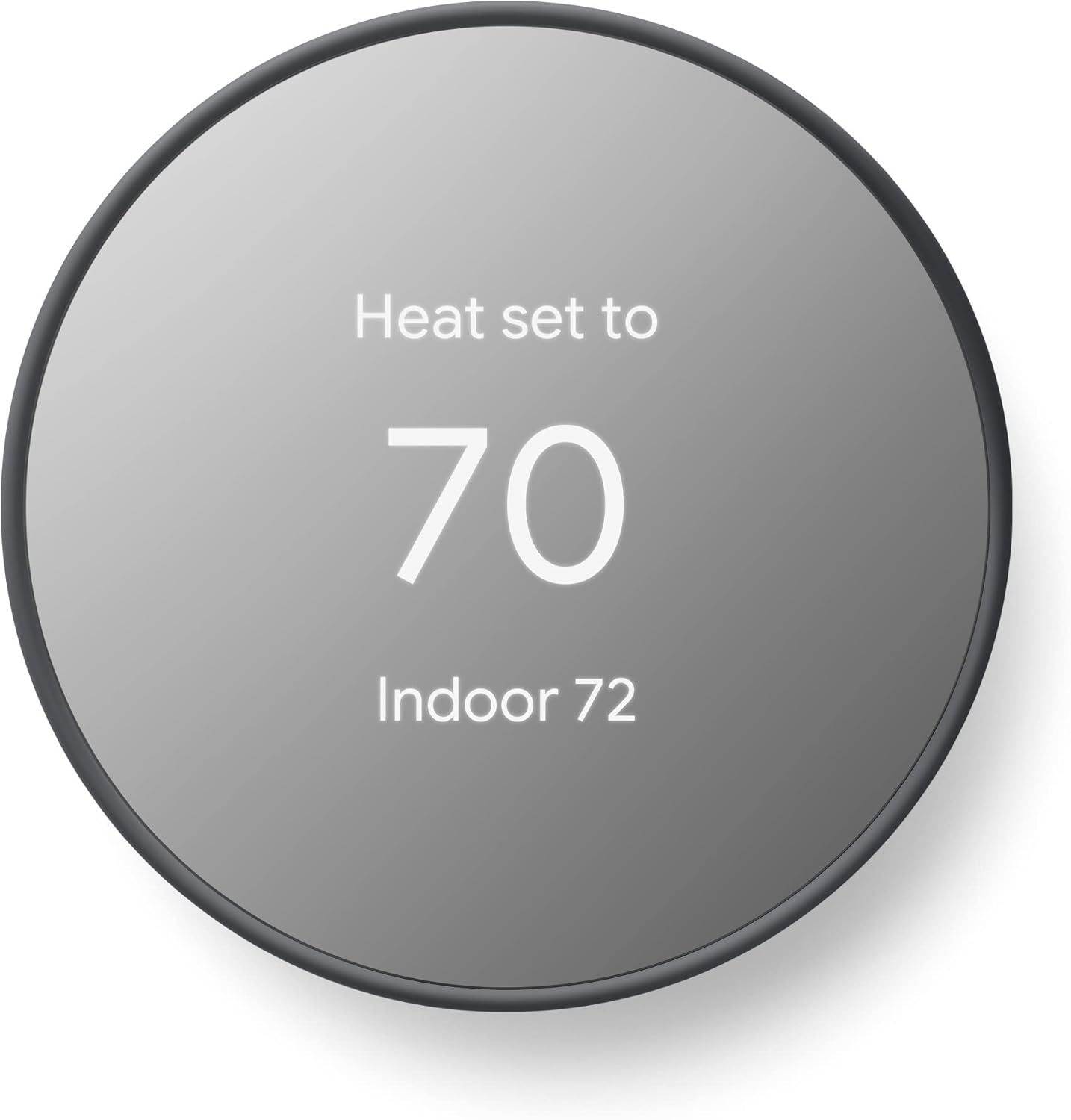
The Google Nest Thermostat is a compact Wi‑Fi smart thermostat designed to give homeowners easy remote control and simple energy-saving features. It installs on a wall plate and pairs with the Google Home app so you can adjust temperature from a phone, tablet, or voice assistant. Notable features include Savings Finder suggestions, Eco Temperatures when the house is empty, basic HVAC monitoring with alerts, and quick schedule setup via the app. It runs on two included A batteries and is designed to work without a C wire in many homes, though some systems may still require a C wire or power accessory. Practical benefits are straightforward: intuitive app control, voice assistant integration, and automatic adjustments to reduce wasted heating and cooling. Limitations include reliance on Wi‑Fi and internet for remote features and voice control, potential compatibility issues with certain heating or 110/120V systems, and fewer advanced customization options compared with higher-end learning models.
Best for: Buyers who want an affordable, app-driven smart thermostat that saves energy with simple automation and works well within a Google smart home setup.
Less Ideal for: People who need advanced, self-learning scheduling or professional-grade HVAC diagnostics should consider higher-end models built for those use cases.
- Easy mobile and voice control via Google Home and compatible assistants
- Savings Finder and Eco Temperatures help reduce energy use automatically
- Designed for straightforward DIY installation with included mounting hardware
- Battery powered and can run without a C wire in many homes
- Basic HVAC monitoring that can alert you to potential system issues
- Remote and voice features require working Wi‑Fi and internet
- May need a C wire or power accessory for some HVAC setups
Verdict: Choose the Nest Thermostat if you want a budget-friendly smart thermostat that delivers easy app and voice control plus automatic energy-saving features.
Sensi Smart Thermostat ST55

| Compatibility | Air Conditioner, Boiler, Furnace, Heat Pump |
|---|---|
| Connectivity | Wi‑Fi (2.4 GHz) |
| Control Methods | App, Touch, Voice |
| Power Source | Corded Electric (24 V) |
The Sensi ST55 is a wall‑mounted Wi‑Fi thermostat designed for straightforward DIY replacement of a traditional thermostat while adding smart control and energy‑saving features. It connects to 2.4 GHz Wi‑Fi and pairs with the Sensi mobile app to enable remote access, scheduling, usage reports, and maintenance alerts, and it works with common HVAC types including boilers, furnaces, heat pumps, and air conditioners. The unit keeps a familiar button interface and LED display so it fits where a conventional thermostat sat and is simple to use day to day, while the app guides installation and includes a built‑in level to simplify mounting. Notable extras include Energy Star certification for reduced HVAC energy use, smart alerts and filter reminders, and compatibility with voice assistants and select smart home platforms. Limitations to consider are the basic 5‑inch display and button controls rather than a large touchscreen, and the device expects a standard 24 V HVAC wiring environment which may require checking older systems for compatibility.
Best for: Buyers who want a dependable, easy‑to‑install smart thermostat that looks and operates like a traditional unit but adds remote control, scheduling, and energy reports for steady, risk‑averse upgrades to home comfort.
Less Ideal for: Customers who want a large color touchscreen interface or advanced multi‑zone controls should consider higher‑end models with more display and control options.
- Easy DIY installation with step‑by‑step app guidance and built‑in level
- Remote control and scheduling via 2.4 GHz Wi‑Fi and the Sensi mobile app
- Energy Star certification and usage reports to help reduce HVAC energy use
- Works with major smart platforms and voice assistants for convenient voice control
- No large color touchscreen; uses a smaller LED screen and button controls
- Requires standard 24 V wiring environment which may need verification on older systems
Verdict: A conservative, reliable smart thermostat that delivers easy DIY installation, app remote control, and Energy Star energy savings without steep complexity.
Choosing the Right Dual Fuel Thermostat: Key Factors to Consider
Switching Logic and Temperature Thresholds
Accurate switching logic is central to dual fuel performance because it defines when the thermostat will favor the heat pump or the backup furnace. Good controllers use outdoor temperature inputs or calculated efficiency thresholds to avoid short-cycling and to engage auxiliary heat only when truly needed.
Thermostats vary in how they let you configure those thresholds. Some allow manual setback temperatures or fixed outdoor cutover points, while others use adaptive logic that learns system behavior. Knowing how a model decides which heat source to use helps you avoid unnecessary fuel use and keeps indoor temperatures stable during cold snaps.
Wiring, Compatibility, and System Types
Dual fuel systems can have different control circuits and wire counts depending on the heat pump, furnace, and any staging or outdoor sensor wiring. Confirming that a thermostat supports common terminals for heat pump reversing valves, auxiliary heat, and outdoor sensor inputs prevents installation headaches.
Compatibility also includes whether the thermostat supports line-voltage accessories, multistage compressors, or simple single-stage systems. Clear wiring diagrams and support for standard control voltages make it more likely the thermostat will integrate without custom adapters or extra modules.
Scheduling Flexibility and Remote Control
The thermostat is a primary tool for balancing comfort and efficiency. Flexible scheduling lets you reduce furnace runtime during predictable absences while ensuring the home is comfortable when occupied. Remote control and smartphone apps are useful for making changes on the go or for monitoring system behavior and run times.
Look for models that offer multiple daily periods, weekday/weekend differentiation, and temporary holds. Integration with home automation platforms or voice assistants can add convenience but should not be the sole reason to choose a thermostat if core dual fuel features are weak.
Installation Complexity and Support
Some dual fuel thermostats are designed for DIY installation while others expect professional setup. Complexity arises from needing an outdoor temperature sensor, multistage wiring, or configuring auxiliary heat thresholds. Good installation guides, clear terminal labeling, and accessible customer support reduce the risk of incorrect wiring and poor system behavior.
Consider whether the thermostat provides clear setup wizards for dual fuel mode and whether it allows firmware updates or remote diagnostics that a technician can use to fine-tune operation after installation.
Energy Management and Reporting
Energy-saving features like adaptive setbacks, run-time reports, and usage monitoring help you understand how the heat pump and furnace are operating. Some thermostats track runtime for each heat source or estimate energy use, enabling decisions that lower operating cost without sacrificing comfort.
Reporting can also flag abnormal behavior that indicates a system issue. If long-term efficiency is a priority, choose a thermostat that exposes run-time data and supports configurable energy-saving modes.
How Dual Fuel Thermostats Work
Dual fuel thermostats coordinate two heat sources by monitoring temperature and applying logic to select the most efficient source. They typically accept an outdoor temperature input or use settable thresholds to determine when a heat pump remains efficient versus when the backup furnace should take over.
The thermostat communicates with both the heat pump and the furnace control circuits. When conditions favor the heat pump, it maintains control to minimize fossil fuel use. When the outdoor temperature crosses configured limits or when additional heat capacity is needed, the thermostat engages auxiliary or emergency heat as appropriate.
- May require an outdoor sensor input for precise cutover control
- Often supports auxiliary heat staging to prevent short-cycling
- Can provide run-time data to monitor which source is active
Common Installation Scenarios
Installation scenarios vary from simple single-stage systems with a few wires to multistage systems requiring careful terminal mapping. Many homes will need an outdoor sensor and clear labeling to wire the thermostat for dual fuel operation correctly.
If a system has a communicating control bus or proprietary connectors, the thermostat must support that communication style or use standard control contacts. Planning ahead and reviewing wiring diagrams for both the heat pump and furnace reduces on-site surprises.
- Single-stage heat pump plus single-stage furnace: typically straightforward wiring
- Multistage or variable-capacity compressors: may need additional terminals
- Outdoor sensor required for precise temperature-based switching
Using Outdoor Sensors Vs Fixed Cutover Points
Some thermostats use an outdoor temperature sensor to make switching decisions dynamically. That approach adapts to local weather and can be more efficient in regions with variable winter conditions. Other thermostats use fixed cutover points that you set manually, which can be simpler but may require occasional adjustment.
Outdoor sensor-based switching reduces guesswork but adds an installation step. Fixed cutover points are easy to set and understand but may not capture short-term weather swings that affect system efficiency.
- Outdoor sensor: better for variable climates and automated efficiency
- Fixed cutover: easier setup, good for predictable climates
- Make sure the thermostat supports the sensor type your installer prefers
Maintaining and Troubleshooting Dual Fuel Systems
Regular maintenance of both the heat pump and furnace keeps switching behavior predictable. Dirty coils, low refrigerant, or furnace control faults can force one source to run inefficiently and confuse thermostat logic.
If the thermostat appears to switch improperly, verify outdoor sensor readings, wiring to auxiliary heat terminals, and any setpoint thresholds. Firmware updates or a simple reset sometimes resolve unexpected control behavior.
- Check outdoor sensor placement and wiring when diagnosing cutover issues
- Confirm thermostat configuration matches system stage counts
- Keep records of runtime data to spot abnormal source usage
When to Call a Technician
Call a qualified HVAC technician if you encounter repetitive short-cycling, persistent temperature swings after switching, or wiring uncertainties. These issues can indicate misconfigured control logic, incorrect wiring, or problems in one of the heat sources.
A technician can verify the system wiring, test outdoor sensor calibration, and adjust auxiliary heat thresholds. Professional commissioning ensures the thermostat and the dual fuel system operate safely and efficiently.
- Short-cycling or frequent source switching
- Inability to configure correct stage counts or thresholds
- Unclear wiring diagrams or proprietary control interfaces
How We Chose the Best Dual Fuel Thermostat
We narrowed the field by focusing on features and real-world reliability that matter for dual fuel installations. Key evaluation criteria included control logic and switching intelligence, which determines how effectively a thermostat decides when to use the heat pump versus the backup heat source. Compatibility and wiring support were assessed to ensure the thermostat integrates with typical system configurations and common control circuits. Scheduling and remote-control features were evaluated for flexibility and ease of use, including options for adaptive or learning schedules. Installation complexity and documentation were considered to estimate whether a homeowner or HVAC technician can commission the device without repeated service calls. Finally, we checked energy-management capabilities, such as setback schedules and integration with energy-saving modes, because those directly affect operating cost and comfort. We excluded devices that lack explicit dual fuel switching support or rely on nonstandard wiring that would require major system changes. We also excluded products without clear provisioning for auxiliary heat thresholds or without documented control logic for source prioritization. The listed thermostats passed these filters and scored well across the dimensions above.
Our full evaluation process is outlined in our review methodology.
FAQ
Do I need an outdoor sensor for a dual fuel thermostat?
Often, an outdoor sensor improves switching decisions by providing actual ambient temperature data. While some thermostats allow fixed cutover points without a sensor, using an outdoor sensor generally yields more efficient and adaptive control.
Can I install a dual fuel thermostat myself?
It depends on your system and wiring comfort level. Simple single-stage systems with clear terminal labels are sometimes suitable for DIY installation. Systems needing outdoor sensors, multistage wiring, or complex control mapping are best handled by a technician.
How does the thermostat decide when to use the furnace instead of the heat pump?
The thermostat uses either a configured cutover temperature or sensor-driven logic to determine efficiency. When outdoor temperatures drop below the set threshold or when auxiliary heat is needed for faster recovery, the thermostat engages the furnace.
Will a smart thermostat save energy in a dual fuel setup?
Smart features like adaptive scheduling and setback routines can reduce runtime for both heat sources, which often lowers energy use. Savings depend on system efficiency, climate, and how aggressively schedules and setbacks are used.
What should I check if the thermostat keeps switching sources too often?
Start by verifying outdoor sensor placement and calibration, then confirm auxiliary heat and compressor staging settings. If wiring and settings look correct, a technician should inspect the heat pump and furnace for faults that cause inefficient operation.
Final Verdict
Choose a Dual Fuel Thermostat that provides transparent switching logic, clear wiring support, and flexible scheduling. Prioritize models that let you configure or use an outdoor sensor and that expose run-time or energy data so you can monitor how each heat source performs. If you are unsure about wiring or system staging, professional installation and commissioning reduce the chance of improper switching. Focus on compatibility and control features first, then on app convenience, to ensure reliable comfort and efficient operation.