
Note: This article contains affiliate links. If you click on these links and make a purchase, we may earn a small commission at no extra cost to you. This helps support our research and content. Read our full affiliate disclosure here.
Picking the right efficient water heater matters because it directly affects your energy bills, hot-water availability, and long-term maintenance needs. The right unit can reduce monthly costs and improve household comfort without requiring frequent service or complicated changes to your plumbing. This guide covers seven shortlisted efficient water heaters that represent practical choices for typical homes. We evaluated units across capacity, energy performance, and installation demands to help you find an option that fits your hot-water patterns and mechanical setup. Read on for the factors we judged and how to match features to your home.
Top Picks at a Glance
| Best Overall The best all-around choice for most situations | Senville SENWH-HP50US 50-Gallon |  |
| Best Quality Built to a higher standard if you want something more solid | Rinnai RXP199iN Tankless Water Heater |  |
| Best Value The sweet spot between price and what you get | EcoSmart ECO 11 Tankless Water Heater |  |
| Best Budget The cheapest option that still gets the job done reliably | xwdzswgs 3000W Tankless Water Heater |  |
| Top Rated A top-rated pick with lots of positive feedback | Westinghouse 14kW Tankless Water Heater |  |
| Most Popular A crowd favorite that many people choose with confidence | Bosch Tronic 3000T ES2.5 Mini-Tank |  |
| Best Seller A high-volume bestseller chosen again and again | Rheem RTEX-18 Tankless Electric |  |
Senville SENWH-HP50US 50-Gallon

| Capacity | 50 gallons |
|---|---|
| UEF | 3.75 |
| First Hour Rating | 69-Gal FHR |
| Power Source | dc |
The Senville SENWH-HP50US is a hybrid heat pump electric water heater that uses ambient air to preheat water before the electric element finishes the job, which makes it far more efficient than conventional electric tanks. It is sized for medium to large homes and the 50-gallon capacity plus a 69-gallon first hour rating mean it can handle back-to-back showers, laundry, and dishwashing without frequent runout. Key attributes include ENERGY STAR certification, a 3.75 UEF for strong energy performance, and UL and AHRI certification for safety and performance standards. In practice the unit lowers electricity use substantially compared with standard electric heaters, and the hybrid system can be the main reason for year-over-year utility savings. Trade-offs are typical of heat pump water heaters: it needs adequate surrounding air space and performs best in moderate-to-warm locations, and it is heavier and larger than simple tank-only models which can complicate installation. The included warranties for parts and compressor add confidence for long-term ownership.
Best for: Buyers who want a cost-conscious, energy-efficient primary water heater for a medium to large household and value long-term utility savings over the lowest upfront cost.
Less Ideal for: Homes with very tight mechanical closets, unheated basements, or locations where ambient air is consistently cold are poor candidates for this hybrid heat pump design.
- High efficiency with 3.75 UEF and ENERGY STAR certification for lower operating costs
- 50-gallon capacity and 69-gallon first hour rating suitable for multiple simultaneous uses
- Certified by UL and AHRI for verified safety and performance
- Hybrid heat pump design extracts ambient heat to reduce electricity use by a large margin
- Requires adequate surrounding air space and best performance in moderate-to-warm environments
- Heavier and larger than conventional electric tanks, which can complicate installation
Verdict: Choose this hybrid unit if you want a factory-certified, energy-saving 50-gallon water heater that cuts operating costs while reliably serving a medium to large household.
Rinnai RXP199iN Tankless Water Heater

| Power Source | Natural Gas or Propane |
|---|---|
| Flow Rate | 11 gpm |
| Maximum Temperature | 140 °F |
| Heat Output | 199000 british thermal units |
| Wattage | 98 watts |
The Rinnai RXP199iN is a compact, condensing tankless water heater engineered for high-demand homes that need continuous hot water without a traditional storage tank. It produces up to 11.1 gallons per minute and up to 199,000 BTU, so multiple fixtures can run at once while the Smart-Circ recirculation pump learns usage patterns to cut wait time for hot water. The unit is convertible between natural gas and propane and can be adapted for indoor or outdoor install with Versa Vent, giving flexibility during replacement or new installs. Key practical features include a Quick Flush routine that simplifies maintenance and compatibility with the Rinnai Central app via a sold-separately Control-R module for remote diagnostics. The condensing design achieves a very high UEF (.98) for lower energy waste, but this model requires professional installation and space for venting and gas hookup, and Wi-Fi control needs an extra module. For buyers prioritizing continuous high flow and efficiency, this model balances strong performance with features that reduce hot-water wait and operating cost.
Best for: Homeowners who prioritize high continuous hot-water output and top-tier energy efficiency and who want features that reduce wait time for hot water in larger or busy households.
Less Ideal for: Buyers wanting a simple DIY replacement or those who only need occasional low-flow hot water from a small unit should consider smaller non-condensing or point-of-use options instead.
- Very high energy efficiency (UEF 0.98) lowers operating costs compared with non-condensing units
- Delivers up to 11.1 GPM and 199,000 BTU, supporting multiple fixtures simultaneously
- Smart-Circ built-in recirculation pump reduces hot water wait by learning usage patterns
- Convertible for natural gas or propane and supports indoor or outdoor installation with Versa Vent
- Quick Flush feature makes routine maintenance easier
- Requires professional installation and appropriate venting adaptations
- Wi-Fi remote control requires a separately sold Control-R module
Verdict: Buy this if you need a high-performance, ultra-efficient tankless heater that supplies strong continuous flow and minimizes hot-water wait with built-in recirculation.
EcoSmart ECO 11 Tankless Water Heater

| Heat Output | 11 KW |
|---|---|
| Wattage | 13000 watts |
| Voltage | 220 volts |
| Flow Rate | 3.1 gpm |
| Maximum Temperature | 140 °F |
The EcoSmart ECO 11 is a wall-mounted, self-modulating electric tankless heater intended for point-of-use or low-flow situations like a single bathroom or sink. It heats water on demand using up to 13 kW at 240 V and can deliver roughly 1.3 to 3.1 gallons per minute depending on inlet temperature, with digital temperature control and an LED display for 1 degree adjustments. Its compact footprint saves floor space and makes it suitable for installations near the fixture to cut hot-water wait time. Self-modulating electronics mean the unit scales power to match flow, which improves thermal efficiency and reduces standby waste compared with tank heaters. Limitations are its modest flow rate and electrical demand: it is best for one shower or sink and requires appropriate 60 A/54 A circuit wiring and breaker capacity in many installs. Sizing to local cold-water temperatures is important to ensure it meets your peak needs. For buyers prioritizing energy efficiency and space savings for a small application, the ECO 11 is a practical, reliable choice.
Best for: Buyers who want a space-saving, energy-efficient point-of-use heater for a single bathroom, sink, or small breakroom and who prioritize lower operating waste over high simultaneous flow.
Less Ideal for: Homes needing hot water for multiple showers or larger-demand households should choose a higher-capacity unit or a whole-house solution.
- Self-modulating technology adjusts power to flow for improved energy efficiency
- Compact, wall-mounted design saves floor space and allows point-of-use installation
- Digital temperature control with LED display for precise setpoint adjustments
- Provides continuous on-demand hot water for single shower or sink applications
- Limited maximum flow rate makes it unsuitable for multi-fixture simultaneous use
- Requires high amperage electrical supply and proper breaker/wiring for installation
Verdict: Choose the ECO 11 when you want a compact, efficient tankless heater that delivers reliable on-demand hot water for a single fixture while minimizing energy waste.
xwdzswgs 3000W Tankless Water Heater

| Power | 3000W |
|---|---|
| Power Source | AC 110V |
| Maximum Temperature | 122 °F |
| Mount Type | Wall |
| Connection | 1/2 inch NPT |
This compact 110V tankless water heater delivers on-demand hot water for small point-of-use locations like kitchen sinks, small bathrooms, RVs, and workspaces. It uses a 3000W heating element and a digital LED display that shows outlet temperature and lets you switch between Fahrenheit and Celsius, while protections such as dry-burn cutoff, leakage protection, and IPX4 splash resistance help reduce safety risks. Installation is vertical only and uses a 1/2 inch NPT connection; the unit is lightweight and intended to be mounted on a wall under a sink with basic plumbing and an appropriately sized circuit and trip switch. Performance depends on flow rate—higher flow lowers outlet temperature—so it is best for single faucet use and not suitable for full showers. The unit is easy to fit in tight spaces and offers rapid heating for small demands, but it requires proper wiring (recommended ≥2.5 mm² and a 32A trip switch) and attention to the manufacturer installation notes to avoid malfunctions.
Best for: Buyers on a tight budget who need a small, efficient point-of-use heater to supply hot water to a single sink, RV, or compact bathroom without installing a full tank system.
Less Ideal for: Homes that need hot water for showers, multiple simultaneous fixtures, or whole-house coverage should choose a higher-capacity or dedicated shower-rated system instead.
- Instant on-demand hot water for single-point use
- Compact, space-saving under-sink design
- Digital LED display with Celsius/Fahrenheit option
- Multiple safety protections including dry-burn and leakage protection
- Easy vertical wall mounting with standard 1/2 inch NPT connection
- Not suitable for showers or high-flow applications due to limited flow-temperature performance
- Requires dedicated electrical wiring and a high-capacity trip switch per the installation recommendations
Verdict: A compact, budget-friendly 3000W point-of-use tankless heater that delivers fast hot water for a single sink or small space when wired and installed per the manufacturer instructions.
Westinghouse 14kW Tankless Water Heater

| Power source | 240V Electric |
|---|---|
| Maximum flow | Up to 3.4 GPM |
| Kilowatt (Max.) | 14 kW |
| Water connections | 1/2" NPT |
This Westinghouse 14kW electric tankless heater provides on‑demand hot water for one to two fixtures and is designed for compact, wall‑mounted installation. It heats water in about three seconds and can deliver up to 3.4 GPM when inlet temperatures are moderate, which makes it suitable for a shower plus a faucet or for kitchen and bathroom point‑of‑use needs. The unit includes WiFi and voice control for remote temperature adjustment and a temperature memory that restores your last setting after power loss. Safety is emphasized with ETL certification, IPX4 moisture resistance, separated water‑electric pathways, and multiple protections against leakage, dry‑fire, overheat, and over‑voltage. Practical maintenance is supported by a removable inlet filter and rotor to reduce scale buildup. Buyers should note the electrical requirements: a dedicated 60A double‑pole breaker and 6 AWG wiring at 240V are required, which may add installation cost and require a licensed electrician. The compact footprint saves space but the flow rate is constrained by its 14kW output compared with higher kilowatt models.
Best for: Buyers who prioritize dependable, compact, and smart point‑of‑use hot water solutions and want a unit built with multiple safety protections and low maintenance needs.
Less Ideal for: Homes needing whole‑house high flow for multiple simultaneous showers or locations where upgrading electrical service for a 60A circuit is impractical.
- Fast heat-up time with near‑instant hot water delivery.
- Smart WiFi and voice control for remote temperature adjustments and monitoring.
- Multiple safety protections and ETL certification for reliable operation.
- Removable inlet filter and design features that reduce scale and extend service life.
- Requires a dedicated 60A breaker and 6 AWG 240V wiring, increasing installation complexity.
- Maximum flow of 3.4 GPM limits simultaneous use for larger households.
Verdict: Choose this Westinghouse 14kW tankless heater if you want a compact, smart, and safety‑focused point‑of‑use unit that reliably delivers instant hot water for one to two fixtures.
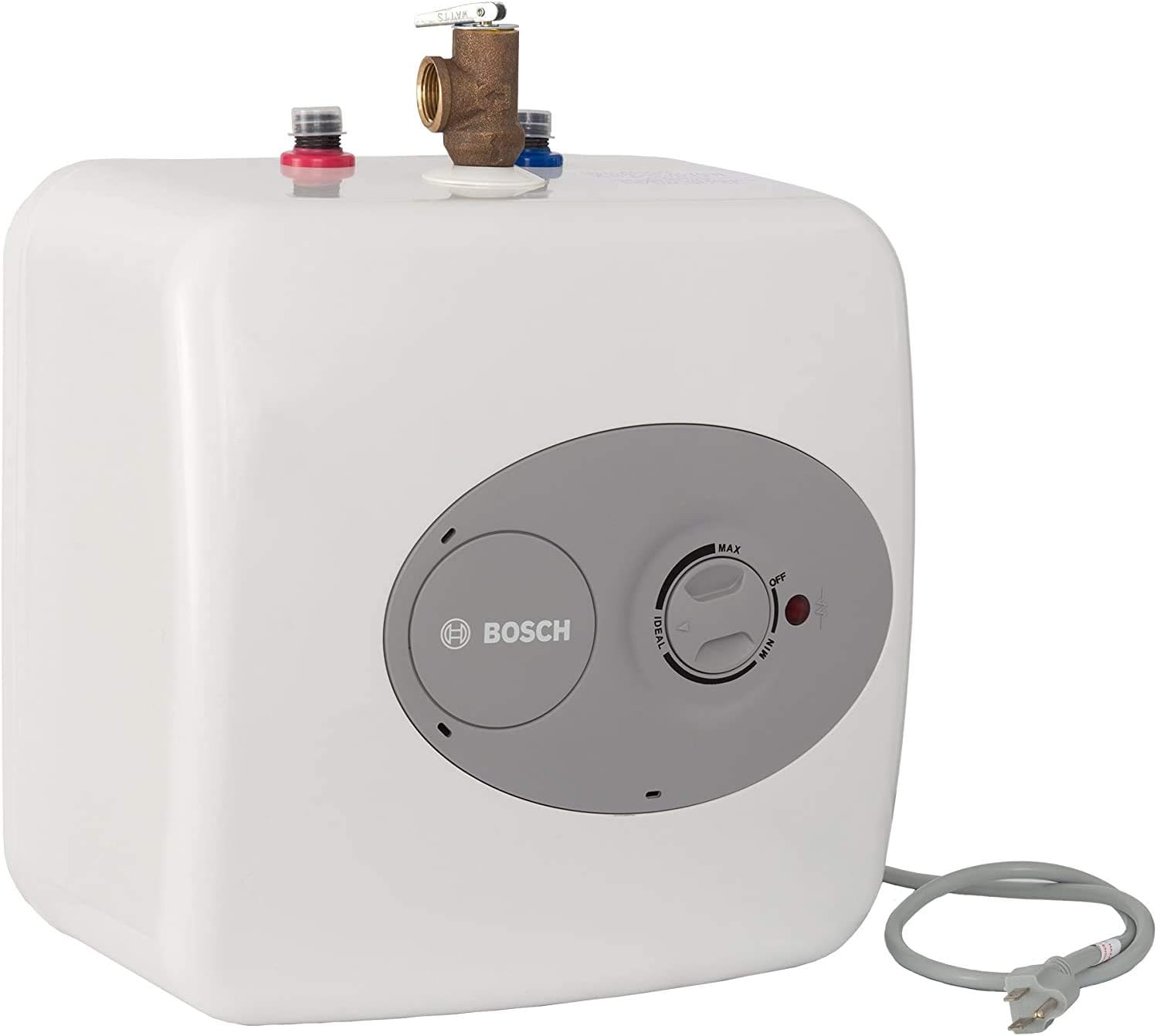
Bosch Tronic 3000T ES2.5 Mini-Tank
| Capacity | 2.5 gallons |
|---|---|
| Wattage | 1440 watts |
| Voltage | 120 volts |
| Maximum Temperature | 140 °F |
| Efficiency | 98% |
The Bosch Tronic 3000T ES2.5 is a compact point-of-use electric mini-tank that fits under a sink or mounts on a wall to provide hot water quickly without running the main water heater. It plugs into a 120 V outlet or can be hardwired and uses a 1440 W element to heat a 2.5-gallon glass-lined tank, offering a fast recovery so two sinks can be served in many typical scenarios. An external temperature dial and a temperature-and-pressure relief valve give straightforward control and safety, while the included bracket and lightweight design make shelf, wall, or floor mounting simple. The glass-lined tank helps durability and thermal efficiency is listed at 98%, which keeps standby heat loss low. Limitations are inherent to the size: capacity is small so it is best for point-of-use tasks like handwashing or a single kitchen sink, and very heavy or continuous hot-water demands will require a larger or whole-house solution.
Best for: Buyers who want a reliable, proven point-of-use heater to eliminate wait time for hot water at a sink and value established product reviews and conservative performance claims.
Less Ideal for: Homes that need whole-house hot water or frequent high-volume use such as showers and multiple simultaneous taps should choose a larger tank or a dedicated on-demand system.
- Point-of-use design provides hot water quickly at a sink without running a distant tank
- Plugs into a 120 V outlet for easy independent installation or can be integrated inline
- Glass-lined tank improves durability and resists corrosion
- External temperature dial and T&P relief valve offer simple control and safety
- Included mounting bracket allows shelf, wall, or floor installation
- 2.5-gallon capacity is limited for showering or prolonged use
- 1440 W power means slower recovery than higher-wattage instant heaters for heavy demand
Verdict: A compact, efficient point-of-use mini-tank that reliably delivers near-instant hot water at a sink for buyers prioritizing proven performance and low standby loss.
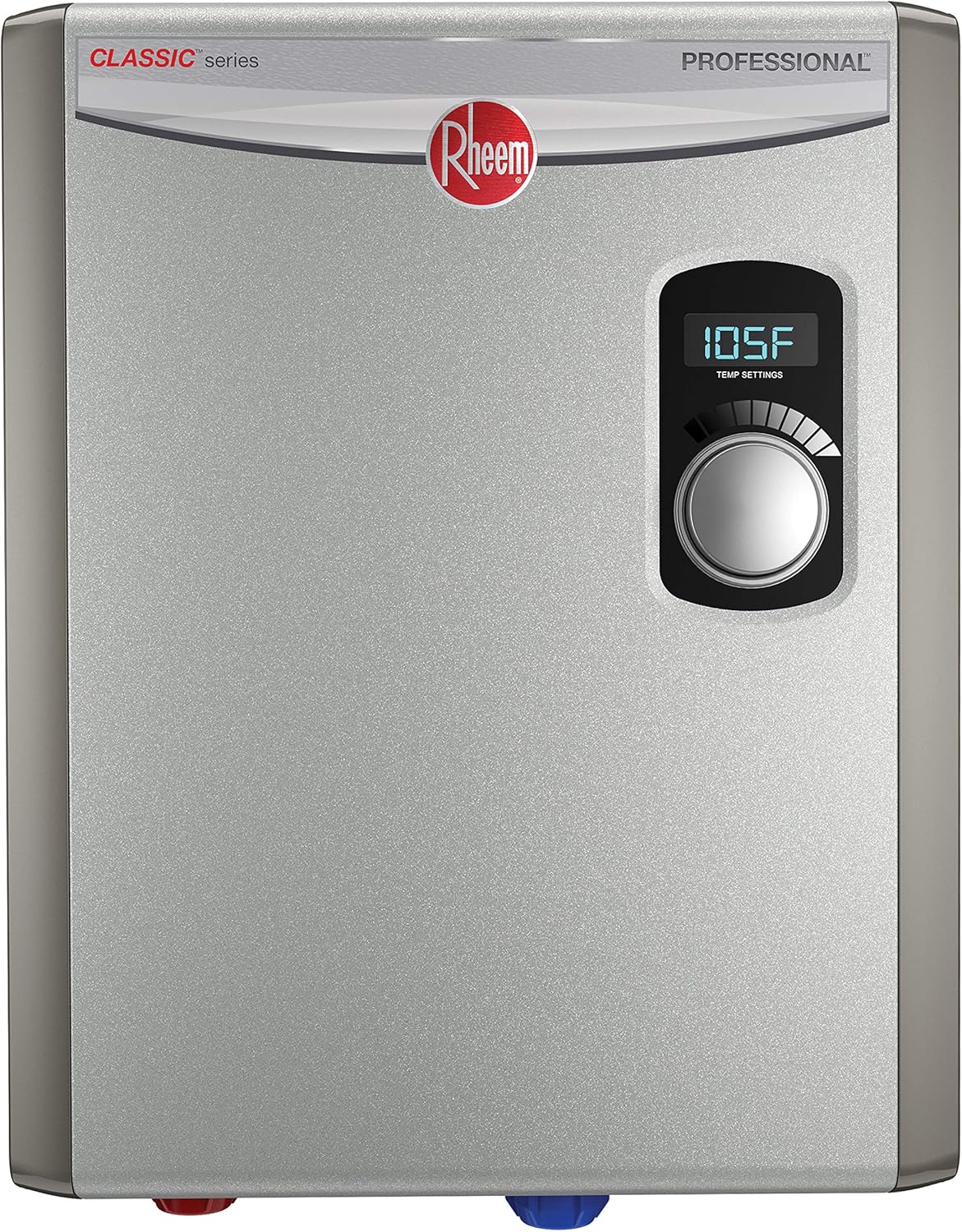
Rheem RTEX-18 Tankless Electric
| Wattage | 18000 watts |
|---|---|
| Voltage | 240 volts |
| Flow Rate | 4.4 gpm |
| Maximum Temperature | 140 °F |
| Efficiency | 99.8% |
The Rheem RTEX-18 is an 18 kW tankless electric water heater built to provide on-demand hot water for mid-range whole-home applications. It uses self-modulating electronics to adjust power to demand, a digital LED temperature display for precise setpoint control, and two field-serviceable copper heating elements. Typical use is mounting on a wall in a central location to supply continuous hot water for a shower and multiple sinks without the standby losses of a tank. The unit supports up to about 4.4 GPM and reaches temperatures up to 140°F, and it requires 240V electrical service and appropriate circuit breakers. Practical benefits include smaller footprint, no venting requirement, and potential energy savings because it only draws power when water flows. Important limitations are that its 4.4 GPM rating means it may struggle to run multiple high-flow fixtures simultaneously in cold climates and it needs substantial electrical capacity and properly sized breakers during installation.
Best for: Buyers who prioritize energy efficiency and reliable on-demand hot water and who prefer a compact, wall-mounted unit that reduces standby losses and frees up storage space.
Less Ideal for: Homes without adequate 240V electrical capacity or households that routinely run multiple high-flow showers simultaneously should consider higher-capacity or alternative solutions.
- On-demand heating with self-modulating control for improved energy use
- Digital LED temperature control for accurate setpoint adjustment
- Compact wall-mounted design that saves space and needs no venting
- Field-serviceable dual copper heating elements for easier maintenance
- Requires high-voltage 240V electrical supply and multiple breakers for proper operation
- Flow rate (up to 4.4 GPM) may not support several full-flow fixtures at once in cold inlet conditions
Verdict: Choose the RTEX-18 if you want a compact, energy-smart electric tankless heater that delivers continuous hot water while cutting standby energy loss.
Choosing the Right Efficient Water Heater: Key Factors to Consider
Energy Efficiency Ratings
Efficiency ratings show how much of the energy input actually becomes usable hot water. Higher ratings reduce fuel or electricity consumption over time and lower operating costs.
When comparing efficient water heaters, pay attention to standardized metrics such as Uniform Energy Factor or energy factor equivalents for the technology. Small differences in ratings can add up over years, especially in households with high hot-water use. Also consider standby losses for storage tanks and part-load efficiency for variable-demand homes.
Fuel Type and Operating Costs
The fuel source affects both running costs and installation needs. Electric units tend to be simpler to install but may cost more to operate depending on local electricity rates. Gas-fired units often have faster recovery but need proper venting and gas supply.
Estimate annual operating cost using local fuel prices and expected hot-water consumption. Consider whether your home's service can support a switch in fuel type, since changing from gas to electric or vice versa may require additional electrical upgrades or venting work.
Tank Capacity and Recovery Speed
Capacity determines how much hot water is available before the heater needs time to recover. Recovery speed indicates how quickly the unit can reheatthe water after a draw. Together these two factors define whether a unit can support peak demand like back-to-back showers or simultaneous dishwasher and laundry loads.
For families, higher capacity or faster recovery prevents shortfalls during peak use. Smaller households may prioritize very efficient smaller units or tankless technologies with high flow rates. Match capacity and recovery to typical household patterns rather than maximum possible usage to optimize efficiency.
Installation Complexity and Retrofit Considerations
Installation complexity affects upfront cost and how disruptive a replacement will be. Tankless and high-efficiency units sometimes require upgraded gas lines, dedicated electrical circuits, or new venting. Storage tanks need floor or platform space and may require changes to plumbing layout.
Assess whether the existing location and utility services can support the new unit without major remodeling. Simple drop-in replacements are less expensive and faster, while retrofits that change fuel types or location increase time and labor.
Durability and Maintenance Requirements
Durability influences total ownership cost through service frequency and component longevity. Look for accessible serviceable parts, corrosion-resistant materials, and straightforward diagnostics. Regular maintenance tasks such as anode replacement, flushing, or descaling should be manageable.
Consider water quality in your area since hard water accelerates scale buildup and can reduce efficiency and element life. Units with easier access to replaceable components lower long-term service costs and downtime.
Warranty and Support Options
Warranty length and terms provide protection against early failures and can indicate manufacturer confidence in durability. Understand what components are covered, any pro‑rata clauses, and whether labor is included.
Also evaluate the availability of local service technicians familiar with the technology. A longer warranty is less valuable if service support is scarce in your region.
Sizing Your Home's Hot Water Needs
Estimate daily hot-water consumption by adding typical uses such as showers, dishwashing, and laundry. Calculate peak-hour demand to determine whether a storage tank or a high-flow tankless system better fits your household.
Smaller households often benefit from compact high-efficiency tanks or point-of-use units, while larger homes may need larger storage capacity or a system with a high recovery rate.
- List typical fixtures and approximate gallons per use
- Determine simultaneous demand during busiest hour
- Factor in future household changes such as family growth or remodels
Tank Vs Tankless Vs Heat Pump Options
Each technology trades off efficiency, complexity, and performance. Traditional tanks are simple and can be very efficient when well insulated. Tankless units eliminate standby losses and can be highly efficient for intermittent demand, but they require high flow capability and sometimes upgrades to utilities. Heat pump water heaters are among the most efficient electrically powered options but need adequate space and ambient conditions for optimal performance.
- Tanks: lower installation complexity, potential standby losses
- Tankless: no standby loss, variable flow performance
- Heat pump: highest electric efficiency, needs space and ambient heat
Placement, Venting, and Noise Considerations
Where you install the unit affects venting, noise, and heat exchange. Gas and hybrid units require proper venting to the exterior. Heat pump models may produce sound during operation and benefit from placement in a utility room or insulated closet.
Keep routing of hot-water lines short where possible to reduce heat loss and wait time. For installations near living spaces, consider units and placements that minimize operational noise.
- Check venting clearance and route to exterior
- Plan for condensate drainage on high-efficiency units
- Locate close to primary hot-water usage to reduce lag
Long-Term Cost: Energy Use and Maintenance
Compare projected annual energy use plus routine maintenance costs rather than focusing only on purchase price. Highly efficient units can pay back higher upfront costs over time, but only if installation and service needs are reasonable.
Factor in expected component replacements, the effect of local water hardness on maintenance frequency, and likely fuel-price trends when estimating lifecycle cost.
- Estimate annual energy consumption using local rates
- Include routine service tasks and part replacements
- Adjust projections for water quality and household usage changes
How We Chose the Best Efficient Water Heater
Our editorial selection focused on machines that deliver measurable energy savings while remaining realistic for typical household installation and maintenance. We screened candidates for verified efficiency ratings, realistic recovery rates, and compatibility with common plumbing and electrical setups. Long-term durability and accessible serviceability were required to avoid frequent replacements or expensive repairs. We prioritized units that offer meaningful reductions in standby or heating energy for the expected hot-water load, while still providing recovery times that meet family needs. Ease of installation and retrofit potential were important since some buyers will replace an older tank or switch fuel types. We excluded products with unverified efficiency claims, exotic custom installations, or models that require specialized infrastructure beyond standard residential service. Final selections emphasize energy use per gallon, recovery speed, installation complexity, and maintenance needs. These are the dimensions that most affect lifecycle cost and daily performance for efficient water heaters.
Our full evaluation process is outlined in our review methodology.
FAQ
How do I determine the right size water heater for my home?
Start by estimating peak-hour hot-water demand from showers, appliances, and fixtures. For storage tanks use the first-hour rating; for tankless match the flow rate in gallons per minute and the required temperature rise for simultaneous uses.
Are heat pump water heaters worth it for a typical garage installation?
Heat pump units can be very efficient in spaces that stay within recommended ambient temperature ranges. If your garage stays warm enough year-round and you have room for airflow and condensate handling, they often provide better long-term operating costs than standard electric tanks.
Will a tankless unit save money if our household uses a lot of hot water?
Tankless can save energy by eliminating standby losses, but savings depend on usage pattern. Households with high continuous demand may need multiple or larger units to avoid flow limits, which affects upfront cost and installation complexity.
What maintenance keeps a water heater running efficiently?
Routine maintenance includes flushing storage tanks to remove sediment, inspecting and replacing sacrificial anodes, descaling for areas with hard water, and checking venting and pressure-relief devices. Regular service preserves efficiency and extends component life.
Can I install a more efficient unit in the same spot as my old heater?
Often a like-for-like replacement is possible, but some high-efficiency technologies require different venting, condensate management, or electrical upgrades. Inspect the existing space and utility services before finalizing a purchase to avoid unexpected retrofit work.
Final Verdict
Focus on the combination of efficiency rating, flow or recovery capacity, and installation demands when choosing an efficient water heater. Prioritize the metric that most affects your household costs and comfort: energy use for long-term savings, or recovery and capacity for uninterrupted supply. Balance likely installation complexity and maintenance needs against expected operating savings. With those tradeoffs clear, you can select an efficient water heater that fits both your plumbing setup and daily hot-water patterns.