
Note: This article contains affiliate links. If you click on these links and make a purchase, we may earn a small commission at no extra cost to you. This helps support our research and content. Read our full affiliate disclosure here.
If your home runs on well water, selecting the right tankless water heater matters for reliability and long-term upkeep. Well systems often deliver variable flow and carry more sediment or minerals than municipal supplies, so you need a unit that tolerates particulates, provides stable flow-based temperature control, and resists scale. This guide covers seven top tankless water heaters for well water. Each has been shortlisted for performance characteristics that matter for wells, including flow capacity, sediment and scale handling, frost protection for off-grid setups, and serviceability. Read on to see which technical features and installation choices make the most sense for your house or cottage before you look at specific models.
Top Picks at a Glance
| Best Overall The best all-around choice for most situations | WINTEMP 27kW Tankless Water Heater |  |
| Best Quality Built to a higher standard if you want something more solid | Rinnai RX199iN Tankless Water Heater |  |
| Best Value The sweet spot between price and what you get | EcoSmart ECO 18 Tankless Water Heater |  |
| Best Budget The cheapest option that still gets the job done reliably | xwdzswgs 3000W Tankless Water Heater |  |
| Top Rated A top-rated pick with lots of positive feedback | EcoSmart ECO 11 Tankless Water Heater |  |
| Most Popular A crowd favorite that many people choose with confidence | Rheem RTEX-18 Tankless Electric Water Heater |  |
| Best Seller A high-volume bestseller chosen again and again | Orbek RV Tankless Water Heater 60k BTU |  |
WINTEMP 27kW Tankless Water Heater

| Wattage | 27000 watts |
|---|---|
| Voltage | 240 volts |
| Flow Rate | 6.5 gpm |
| Maximum Temperature | 140 °F |
| Mount Type | Wall |
The WINTEMP WN27 is a wall-mounted 27 kW electric tankless heater designed to supply on-demand hot water for whole-house or multi-bath use in compatible electrical installations. It uses self-modulating control to vary power with incoming water temperature and flow, which helps keep outlet temperature stable while reducing energy draw when demand is low. Typical use is for showers, sinks, and laundry where continuous hot water is preferred; the unit advertises up to 6.5 gallons per minute and a maximum outlet temperature of 140°F. Notable features include an LED display, temperature lock, multiple safety protections (leakage, overheat, dry-fire) and ETL certification, plus Wi‑Fi control for remote temperature adjustment. Practical benefits are compact, wall-mounted footprint and near-instant hot water without a storage tank. Important limitations are the high electrical requirement — 3×40 A breakers, heavy gauge wiring and a large household service recommended — and performance will vary with incoming groundwater temperature, so flow at full temperature may be lower in cold well-water conditions.
Best for: Buyers who want a compact, high-output electric tankless heater for continuous hot water and are prepared to accommodate the necessary electrical upgrades and professional installation.
Less Ideal for: Homes without sufficient electrical service or buyers with very cold well water who need higher flow rates at low inlet temperatures should consider gas models or larger electric systems instead.
- High peak output rated up to 6.5 GPM for simultaneous fixtures in mild inlet temperatures
- Self-modulating control improves temperature stability and reduces energy use when demand is low
- Multiple built-in safety features and ETL certification for safer operation
- Wi‑Fi remote control and LED display allow convenient temperature adjustments
- Compact wall-mounted design saves space compared with tank heaters
- Requires substantial electrical service and three 40 A double-pole breakers, which may need professional electrical upgrades
- Actual hot flow rate depends on incoming water temperature so output can drop with cold well water
Verdict: If you need a compact electric tankless unit that can deliver near whole-house flow with efficient self-modulating control and Wi‑Fi management, the WINTEMP 27 kW is a strong fit provided your electrical service can support it.
Rinnai RX199iN Tankless Water Heater

| Power Source | Gas Powered |
|---|---|
| Flow Rate | 11 gpm |
| Heat Output | 199000 british thermal units |
| Efficiency | UEF .98 |
| Mount Type | Wall |
The Rinnai RX199iN is a compact, high-output condensing tankless water heater aimed at households that need strong continuous flow. It delivers up to 11.1 gallons per minute and 199,000 BTU, so it can run multiple fixtures or whole-home well systems with heavy demand. The unit is convertible between natural gas and propane and can be installed indoors or outdoors using the Versa Vent, which adds installation flexibility for homes with limited mechanical room space. Notable features include Smart Sense gas control for stable combustion, an easy interface, a Quick Flush routine to simplify maintenance, and industry-leading efficiency at UEF 0.98 to reduce operating costs. Wi-Fi control is available via an optional module for monitoring and troubleshooting. Important practical considerations are that professional installation is recommended, and as a high-capacity condensing unit it requires appropriate venting and condensate management, which can add complexity on well-water setups. For buyers prioritizing peak flow, energy efficiency, and compact footprint, the RX199iN offers strong real-world performance.
Best for: Buyers who need reliable, high-flow on-demand hot water for whole-house use and who prioritize peak performance and energy efficiency in a compact unit.
Less Ideal for: Those seeking a plug-and-play or DIY-friendly replacement for a simple small household where lower flow or a non-condensing unit would suffice.
- Very high flow capacity (up to 11.1 GPM) suitable for multiple simultaneous fixtures
- Super-high energy efficiency (UEF 0.98) lowers fuel consumption compared with conventional units
- Convertible to natural gas or propane and supports indoor or outdoor installation with Versa Vent
- Quick Flush feature and Smart Sense gas control simplify maintenance and stable operation
- Requires professional installation and proper condensate/venting arrangements
- High-capacity condensing design may require more complex installation considerations on well systems
Verdict: Choose the RX199iN when you need a compact, high-flow, energy-efficient tankless heater capable of meeting whole-house or heavy-demand well water systems.
EcoSmart ECO 18 Tankless Water Heater

| Wattage | 18000 watts |
|---|---|
| Voltage | 240 volts |
| Flow Rate | 3.51 gpm |
| Efficiency | 99.8 % |
| Mount Type | Wall |
The EcoSmart ECO 18 is an 18 kW, 240V electric tankless water heater built for on-demand domestic hot water in warmer incoming-water climates. It uses self-modulating technology and a digital temperature controller that adjusts output in 1 degree increments, so it maintains set temperatures while running only when needed. In practice the unit can produce roughly 2.5 to 3.5 gallons per minute depending on inlet temperature, which is enough for one shower and a sink or two low-flow fixtures in very warm regions. Installation requires two 40A double-pole breakers and two 8 AWG wires, and the compact wall mount saves space compared with a tank. The main benefits are continuous hot water without standby losses, precise temperature control, and high electrical efficiency. Limitations are its dependence on relatively warm inlet water — performance drops in cold climates — and the electrical upgrade required for safe installation, which can add cost and complexity for homes on well water that may need additional filtration or pressure considerations.
Best for: Buyers who want a compact, efficient electric tankless unit to replace a small tank or serve a single bathroom in regions with relatively warm groundwater and who prioritize precise temperature control and low standby losses.
Less Ideal for: Homes with very cold well water, large simultaneous hot-water demands, or properties that cannot accommodate the required electrical upgrade should consider higher-capacity or gas-fired options.
- On-demand heating with digital temperature control in 1 degree increments
- High electrical efficiency with self-modulating output
- Compact wall-mounted design saves space
- Capable of about 2.5–3.5 GPM in warmer inlet conditions
- Not sized for multiple full-flow showers in cold inlet water conditions
- Requires substantial electrical capacity and proper wiring for installation
Verdict: A compact, energy-efficient electric tankless heater best for single-bath installs in warmer well-water climates where precise temperature control and low standby loss matter.
xwdzswgs 3000W Tankless Water Heater

| Power | 3000W |
|---|---|
| Power Source | ac (110V) |
| Mount Type | Wall (vertical only) |
| Maximum Temperature | 122 °F |
This 3000W electric tankless unit is a compact point-of-use heater intended for under-sink or small-space installations where instant hot water is needed. It heats water quickly at low flow rates and displays outlet temperature on an LED panel with user-selectable Celsius or Fahrenheit. The unit is designed for vertical wall mounting and includes safety features such as dry-boil protection, leakage protection, IPX4 splash resistance, and automatic shutoff for overheating. Installation is straightforward for someone comfortable with basic plumbing and electrical work; it uses a 1/2 inch NPT interface and comes with mounting screws and a manual. Important limitations are its low flow capacity — the listing warns it is not suitable for showers and recommends specific wiring and a 32A trip switch — and the requirement to install vertically to avoid errors. For budget buyers needing instant hot water at a sink, kitchenette, RV, or small apartment, it provides a small, energy-efficient solution, but it is not a replacement for whole-house or shower-capable units.
Best for: Buyers on a budget who need a small, energy-efficient point-of-use heater for a sink, RV, or kitchenette and who can follow electrical installation guidance or hire a tradesperson.
Less Ideal for: People looking for a whole-house or shower-capable tankless heater or anyone unable to provide the recommended electrical circuit and vertical installation.
- Compact, space-saving under-sink design suitable for tight spaces
- Fast heating with 3000W element for instant hot water at low flow
- LED temperature display with Celsius/Fahrenheit option
- Multiple safety protections including dry-boil and leakage protection
- Not suitable for showers due to low flow capacity
- Requires vertical installation and specific electrical wiring (recommend ≥2.5 mm² and 32A trip switch)
Verdict: A budget-friendly, compact 3000W point-of-use tankless heater that delivers quick hot water for sinks and small spaces when vertical installation and proper electrical supply are available.
EcoSmart ECO 11 Tankless Water Heater

| Heat Output | 11 KW |
|---|---|
| Wattage | 13000 watts |
| Voltage | 220 volts |
| Flow Rate | 3.1 gpm |
| Maximum Temperature | 140 °F |
The EcoSmart ECO 11 is a small, wall-mounted electric tankless heater built for point-of-use needs like a single bathroom, sink, or office breakroom. It heats water as it flows through the unit using self-modulating technology that adjusts power to match demand, and the digital temperature control lets you set the output in 1 degree increments. With a flow range roughly between 1.3 and 3.1 gallons per minute depending on inlet temperature, it can reliably supply one shower or a sink in warmer climates and is often used where space and standby energy loss are concerns. Installation requires a 240V circuit and appropriate breaker/amperage capacity, so electrical planning is important. The unit is compact and simple to mount, and the LED display gives straightforward feedback, but its modest flow rate and 11 kW output mean it is not suited for whole-house use or multiple simultaneous high-flow fixtures. For low-flow or single-fixture sites it delivers consistent, energy-efficient hot water with minimal footprint.
Best for: Buyers who prioritize dependable, space-saving on-demand hot water for a single bathroom, sink, or small point-of-use installation and want a unit with simple controls and efficient operation.
Less Ideal for: Homes needing whole-house hot water, multiple simultaneous showers, or higher flow rates should choose a larger-capacity model or multi-unit solution.
- Compact wall-mounted design saves floor space and fits tight installations
- Self-modulating technology adjusts energy use to demand for higher efficiency
- Digital temperature control with 1 degree increments for precise setpoint
- Suitable for point-of-use applications like a single shower or sink
- LED display provides clear operating information
- Limited flow rate (approx. 1.3–3.1 gpm) restricts use to low-flow or single-fixture situations
- Requires appropriate 240V electrical circuit and sufficient amperage, which may need an electrician
Verdict: Choose the ECO 11 when you need a compact, energy-efficient tankless unit that reliably delivers on-demand hot water for a single fixture or small point-of-use installation.
Rheem RTEX-18 Tankless Electric Water Heater
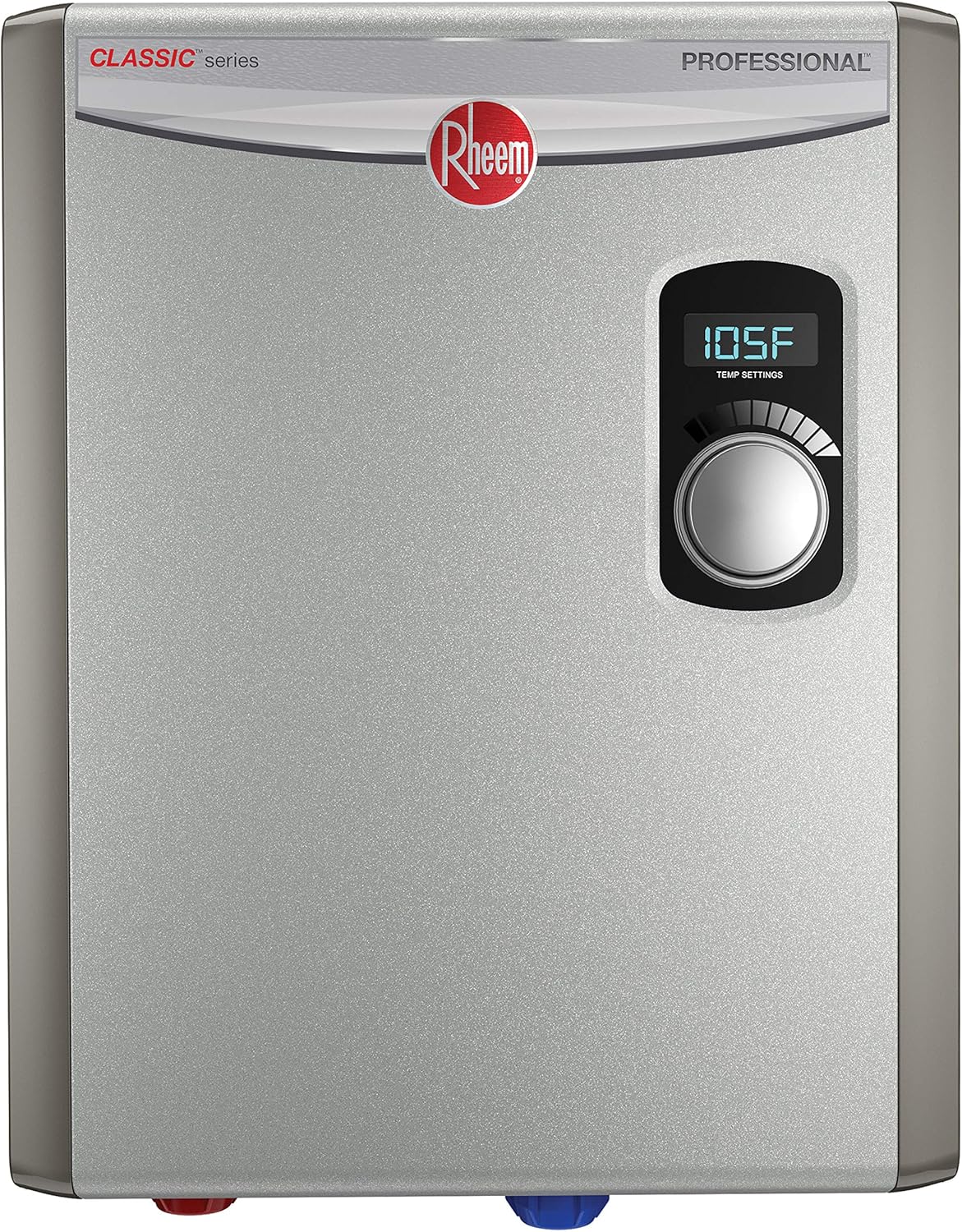
| Wattage | 18000 watts |
|---|---|
| Voltage | 240 volts |
| Flow Rate | 4.4 gpm |
| Maximum Temperature | 140 °F |
| Efficiency | 99.8% |
The Rheem RTEX-18 is a compact, wall-mounted tankless electric unit that provides on-demand hot water for mid-size homes or single-shower whole-home setups. It uses self-modulating electronics and two copper immersion heating elements to adjust power to the current flow, which improves efficiency and helps maintain a stable outlet temperature controlled via the front LED thermostat. Installation is straightforward with bottom 3/4-inch NPT water connections and no venting required, and the unit's small footprint frees up space compared with a conventional tank. Practical benefits include up to 4.4 gallons per minute flow rate suitable for one or two fixtures depending on groundwater temperature, and high reported efficiency from the self-modulation. Important limitations are that performance depends on inlet water temperature so it may not sustain multiple simultaneous hot showers in cold climates, and it requires adequate 240V electrical service and the specified breaker configuration for safe operation.
Best for: Buyers who want a space-saving whole-home electric tankless solution with good user feedback and measurable efficiency gains, and who prioritize reliable, on-demand hot water over maximum multi-shower capacity.
Less Ideal for: Homes with very cold well water or households needing high simultaneous hot-water demand from multiple showers should consider higher-kW models or alternative systems.
- Self-modulating power adapts to demand for improved energy efficiency
- Digital LED temperature control for precise setpoint adjustments
- Compact, wall-mounted design saves space and needs no venting
- Durable, field-serviceable copper heating elements
- Flow rate (4.4 GPM) can be limited by cold inlet water, reducing simultaneous fixture capacity
- Requires 240V electrical circuit and appropriate breakers for installation
Verdict: Choose the RTEX-18 if you want a compact, energy-smart electric tankless heater that reliably delivers on-demand hot water for mid-range whole-home use.
Orbek RV Tankless Water Heater 60k BTU

| Power Source | Liquid Propane |
|---|---|
| Voltage | 12 volts DC |
| Flow Rate | 3.5 gpm |
| Maximum Temperature | 123 °F |
| Mount Type | Door Mount |
The Orbek RV Tankless Water Heater is a 12V propane-powered, on-demand unit built for RV use and replacement installations. It produces continuous hot water via a 60,000 BTU burner and a copper heat exchanger, and it is typically used for showers, dishwashing, and other freshwater points on the road. Notable features include a smart remote for temperature control (95°F–123°F), built-in freeze and flame-failure protections, an internal pressure-reducing valve, and brushless DC fans that help maintain performance at higher elevations. The unit installs to standard RV door cutouts and uses common NPT water connections and 12V DC power, so it can be fitted without specialty plumbing in many rigs. Practical benefits are steady hot flow for successive uses and reduced propane waste because the burner only runs when hot water is demanded. Important limitations are that it requires a proper 12V supply or converter, propane hookup, and correct cutout size, so buyers should confirm electrical and venting compatibility before replacing a well water or tank heater in an RV.
Best for: Buyers who prioritize reliable, continuous hot water in an RV and want a factory-quality tankless replacement that includes safety protections and high-altitude performance.
Less Ideal for: Do not pick this if you lack a compatible 12V/propan e setup or have a nonstandard RV opening and do not want to modify cabinetry or wiring.
- Continuous on-demand hot water with a 60,000 BTU burner for sustained flow
- High-altitude-capable design using oxygen-free copper exchanger and brushless DC fans
- Multiple safety features including freeze protection, flame-failure and dry combustion protection
- Smart remote control for easy temperature adjustment and error-code display
- Built-in 150 PSI pressure-reducing valve simplifies installation and reduces auxiliary purchases
- Requires a 12V DC power source or an AC-to-DC converter and a propane supply to operate
- Intended for standard RV door cutouts so nonstandard openings may need modification
Verdict: A dependable propane 12V tankless replacement for RVs that need continuous on-demand hot water with built-in safety and altitude-ready performance.
Choosing the Right Tankless Water Heater for Well Water: Key Factors to Consider
Flow Capacity and Household Demand
A tankless unit must supply enough gallons per minute at the temperature rise you need. Calculate the peak combined demand for showers, dishwashers, and laundry, then match that to the unit's rated flow at your expected inlet temperature. Under-sizing leads to slow warm-up and fluctuating output.
For well-water setups, flow consistency can vary with pump cycles or simultaneous draws. Choose a model whose minimum activation flow and modulation characteristics work with your well pump behavior to avoid short cycling and temperature swings.
Sediment and Particulate Handling
Well water often carries sand, rust, and organic debris that can clog fine passages. Units with replaceable inlet strainers, serviceable screens, or larger internal clearances handle particulates better than designs with tiny, inaccessible passages.
Plan to add or maintain a pre-filter or sediment trap ahead of the heater. The heater's tolerance for particulates affects how often you need to clean filters and whether the warranty remains valid when particulates are present.
Scale and Mineral Control
Hardness minerals cause scale inside heat exchangers and reduce thermal transfer over time. Some tankless designs include scale-detection features, easier access for chemical descaling, or recommend inline softening or conditioning.
If your well water tests hard, prioritizing scale-management options will lengthen service intervals and maintain output. Regular flushing and following manufacturer descaling guidance are essential to prevent efficiency loss and component damage.
Minimum Flow and Pump Compatibility
Every tankless unit has a minimum flow rate needed to activate heating. Well pumps and pressure tanks can create surgey or low-flow conditions that never reach that threshold, causing inconsistent heating or repeated cold starts.
Verify that the chosen heater's activation flow matches your system behavior. If necessary, adjust pressure tank settings, install a buffer tank, or choose a unit with a lower minimum activation flow to ensure steady performance.
Installation Location and Venting
Placement affects maintenance access and freeze risk. In colder climates or unheated basements, choose a unit and installation that include freeze protection or easy draining options. Proper venting reduces condensation and corrosion risk when combustion units are used.
Consider how much clearance is available for piping and future servicing. Removable panels and accessible filters make routine maintenance simpler, which is important when the heater sits near a well pump or in a tight utility room.
Maintenance Needs and Serviceability
Maintenance frequency depends on water quality and system features. Look for units with accessible panels, easy-to-reach inlet strainers, and straightforward descaling procedures. Compatibility with common service tools can lower repair time if a technician must intervene.
Evaluating how simple it is to flush, replace filters, or swap components helps you estimate ongoing maintenance costs and downtime. Prioritize designs that allow homeowners or local technicians to perform routine service without extensive disassembly.
Testing Your Well Water First
Before selecting a tankless heater, run a comprehensive water test to measure hardness, iron, manganese, pH, and sediment load. Those results determine which pretreatment steps are necessary and whether a particular unit's scale-management features will suffice.
If iron or manganese levels are elevated, plan for filters that target those contaminants before the heater. Correct pretreatment reduces maintenance and extends the life of internal components.
- Collect samples during typical pump cycles for representative results
- Look for hardness in grains per gallon or ppm to size water softeners
- Test for visible sediment by letting a sample settle in a clear jar overnight
Pre-Filtration and Pretreatment Options
A layered approach to filtration works best for well water. Start with a sediment filter to capture sand and grit, then add chemical or catalytic filters for iron and manganese if needed. A softener or conditioning system helps prevent scale formation.
- Use washable or replaceable sediment cartridges sized for your particulate load
- Consider a backwashing filter when iron or organic material is intermittent
- Place filters upstream of the heater with service valves for easy servicing
Managing Freeze Risk and Off-Season Protection
Homes with seasonal use or exposed plumbing need a freeze plan. Some tankless units offer built-in freeze protection or electrical elements to prevent damage in cold spaces. If your heater is in an area that can freeze, ensure drains and isolation valves are installed so the unit can be winterized.
Insulation of nearby piping and maintaining a minimal ambient temperature around the unit are simple ways to reduce winter risk and avoid costly repairs.
- Install isolation valves to allow full draining before freezes
- Insulate exposed supply and output lines
- Verify any built-in freeze protection functions reliably at local winter temperatures
Sizing for Temperature Rise, Not Just GPM
Tankless ratings list flow at a specific temperature rise. Estimate inlet water temperature for your location and calculate the needed rise to reach comfortable hot-water setpoints. A system that achieves high GPM at a small temperature rise may struggle when ground water is very cold.
Factor in simultaneous uses and avoid relying on marginal performance at the absolute top of the unit's curve, especially for homes with well water where supply temperature and pump behavior can vary.
- Measure typical incoming water temperature in winter for accurate sizing
- Plan for a buffer margin beyond peak expected demand
- Remember that lowering peak draw or staggering uses can let a smaller unit perform adequately
Routine Maintenance Checklist
Establish a maintenance routine that includes inspecting and cleaning inlet strainers, flushing the heat exchanger to remove scale, and checking for leaks or corrosion. Frequency depends on water quality and whether you use a softener or other pretreatment.
Keep a simple service log to track descaling dates, filter changes, and any irregular pump behavior so you can spot trends before they lead to failures.
- Flush the exchanger at least annually; increase frequency with harder water
- Replace or clean sediment filters based on visible clogging or pressure drop
- Check electrical connections and venting components during routine service
How We Chose the Best Tankless Water Heater for Well Water
We focused on attributes that directly affect performance and longevity when a tankless system operates on well water. Key evaluation criteria included flow rate at temperature rise, sediment and particulate tolerance, scale management or descaling options, and durability for expected water chemistry. We also weighed installation flexibility, such as venting options and minimum flow requirements, plus maintenance accessibility for routine flushing or filter servicing. Products with poor filtration or no scale-control strategy were excluded. Units that require extremely high incoming water quality to function reliably were also filtered out because well-water systems commonly have more particulates and mineral content. Our shortlist emphasizes models that balance realistic field conditions with dependable hot-water delivery. Editorial judgment prioritized measurable specs and homeowner-facing features over marketing claims. We considered ease of access to replaceable components, presence of serviceable filters, and clarity of installation requirements that affect long-term maintenance. The result is a set of options suited to real-world well-water conditions and typical household demand.
Our full evaluation process is outlined in our review methodology.
FAQ
Can a tankless water heater work with low-flow well pumps?
Often, but it depends on the model's minimum activation flow and your pump's behavior. Units with low minimum flow rates or use of a small buffer tank help avoid short cycling when the pump delivers variable flows.
Do I need a water softener with a tankless heater on well water?
Not always, but if hardness is high, a softener or conditioning system can greatly reduce scale and service frequency. Test hardness first to decide whether softening is cost-effective for your situation.
How often should I flush a tankless heater on well water?
Frequency depends on mineral content and filtration. With moderate hardness, annual flushing is common. Harder water or limited pretreatment may require more frequent descaling and inspection.
Will sediment damage a tankless unit quickly?
Sediment can clog strainers and narrow passages, increasing wear and reducing efficiency. Proper pre-filtration and accessible inlet screens prevent rapid damage and reduce maintenance interruptions.
Can I install a tankless heater in an unheated well house?
You can, but frost protection and winterization are critical. Choose a unit with freeze-resistant features or ensure the space is heated and piping can be drained or insulated to prevent freeze damage.
Final Verdict
When selecting a tankless water heater for well water, prioritize technical fit over marketing claims. Focus on flow capacity at the temperature rise you need, how the unit handles sediment and mineral buildup, and whether installation details match your pump and space constraints. Regular maintenance and appropriate pretreatment are essential to preserve performance. Balance upfront installation complexity against long-term serviceability. If you size the unit correctly, add sensible filtration, and plan for descaling, a tankless system can deliver reliable, on-demand hot water on a well supply for many years.