
Note: This article contains affiliate links. If you click on these links and make a purchase, we may earn a small commission at no extra cost to you. This helps support our research and content. Read our full affiliate disclosure here.
If you live where incoming water is near freezing, choosing the right electric tankless water heater matters. Cold inlet temperatures reduce output and can cause cycling, so you need a unit sized and specified for sustained hot-water delivery in winter conditions. This guide shortlists the top electric tankless water heaters for cold climates and explains the technical tradeoffs that determine performance. We evaluate peak and continuous flow, temperature rise at low inlet temps, energy efficiency, and built-in freeze protection so you can pick a model that meets real household demand. Read on for concise buying guidance and the factors that separate models that work reliably in severe cold from those better suited to milder climates.
Top Picks at a Glance
| Best Overall The best all-around choice for most situations | EcoSmart ECO 18 Tankless Water Heater |  |
| Best Quality Built to a higher standard if you want something more solid | Stiebel Eltron Tempra 29 Trend |  |
| Best Value The sweet spot between price and what you get | ThermoMate Tankless Water Heater ET045CAN4 |  |
| Best Budget The cheapest option that still gets the job done reliably | Daordaer Tankless Water Heater QR-N6Q5 |  |
| Top Rated A top-rated pick with lots of positive feedback | thermomate EH270 27kW Tankless Heater |  |
| Most Popular A crowd favorite that many people choose with confidence | EcoSmart ECO 11 Tankless Water Heater |  |
| Best Seller A high-volume bestseller chosen again and again | Rheem RTEX-18 Tankless Electric Water Heater |  |
EcoSmart ECO 18 Tankless Water Heater

| Wattage | 18000 watts |
|---|---|
| Voltage | 240 volts |
| Flow Rate | 3.51 gpm |
| Efficiency | 99.8 % |
The EcoSmart ECO 18 is a compact electric tankless unit that delivers on-demand hot water for a small household or single bathroom. It uses 18 kW at 240 V with self-modulating technology and a digital temperature controller that lets you set water temperature in 1 degree increments. In practice this model can reliably supply about 2.5+ gallons per minute when inlet water is around 62 F, which is enough for one shower plus a sink and in warmer regions can support two showers when the incoming water is warmer. Installation requires two 40 A double-pole breakers and 8-gauge wiring, and the unit mounts on the wall to save space. The main benefit is consistent, immediate hot water without a tank and a lifetime warranty on the electronics and heating element. Important limits are clear: performance drops with colder inlet temperatures, so this model is undersized for cold-climate homes or larger simultaneous hot water demands, and proper electrical capacity is mandatory for safe operation.
Best for: Buyers seeking a space-saving electric tankless unit for a small home or point-of-use application in milder climates who prioritize precise temperature control and energy-efficient on-demand hot water.
Less Ideal for: Homes in cold climates with low inlet water temperatures or households needing multiple simultaneous high-flow fixtures should consider higher-capacity or whole-house alternatives.
- Compact wall-mounted design saves space and is easy to place near point-of-use.
- Digital temperature control with 1 degree increments for precise setpoint management.
- Self-modulating 18 kW output adjusts power to flow for improved efficiency.
- Lifetime warranty on electronics and heating element for long-term coverage.
- Rated performance assumes relatively warm incoming water; capacity falls in cold climates.
- Requires significant dedicated electrical circuiting (two 40 A breakers and 8 AWG wiring).
Verdict: Choose the ECO 18 if you want a compact, efficient electric tankless heater with precise digital control for single-bathpoint use in milder climates.
Stiebel Eltron Tempra 29 Trend

| Wattage | 28.8 KW |
|---|---|
| Voltage | 240 volts |
| Flow Rate | 9.5 gpm |
| Maximum Temperature | 140 °F |
| Mount Type | Wall |
The Tempra 29 Trend is a high-output electric tankless water heater aimed at whole-house performance in colder climates. It uses self-modulating electronics and a copper heating element to deliver up to 9.5 gpm and maintain a stable set temperature shown on a digital LED display, providing continuous hot water for multiple bathrooms when sized correctly. The unit is wall-mounted and compact compared with tank alternatives and requires hard wiring and substantial electrical service to support its 28.8 kW draw. Practical benefits include silent operation, precise temperature control, and energy savings from on-demand heating and auto-modulation. Important limitations are the heavy electrical requirements—multiple 40 A breakers and a recommended 200 A service—and the need to size the unit for incoming groundwater temperatures in cold climates to ensure adequate flow at desired temperatures. Installation complexity and wiring costs can be significant compared with lower-power models, but the Tempra 29 Trend is built for consistent high-demand performance.
Best for: Buyers who prioritize strong, continuous hot-water performance in cold climates and are prepared to upgrade electrical service and invest in professional installation.
Less Ideal for: Those with limited electrical capacity, tight installation budgets, or small point-of-use needs should consider lower-power or tank-style alternatives.
- High 28.8 kW output supports multiple simultaneous showers in moderate to cold climates
- Self-modulating electronics maximize energy efficiency by matching power to demand
- Digital LED temperature display for accurate, easy control
- Compact wall-mounted design saves space compared with tank heaters
- Quiet operation with a durable copper heating system
- Requires substantial electrical service and multiple high-amperage breakers
- Higher installation complexity and upfront wiring costs compared with lower-power units
- May need careful sizing for very cold groundwater to maintain high flow at hot setpoints
Verdict: Choose the Tempra 29 Trend when you need robust, continuous hot water delivery in cold climates and can support its high electrical demands.
ThermoMate Tankless Water Heater ET045CAN4

| Wattage | 4500 watts |
|---|---|
| Power Source | ac |
| Maximum Temperature | 131 °F |
| Special Features | Self-modulating Power, Cast Aluminum Heating Element, Stainless Steel Water Tube, Touch Control Panel, Waterproof |
This ThermoMate tankless unit delivers on-demand hot water for a single sink by using a 4,500W heating system and self‑modulating power control. It is typically installed under or over a sink for point‑of‑use applications in kitchens, salons, or small service counters and provides a temperature range from 85°F to 131°F with 1°F increments on a touch digital display. The design separates a cast aluminum heating element from the water tube and uses a SUS 304 stainless steel water tube to reduce scale and corrosion risk, and the compact footprint and IP25 splash resistance make it easy to fit in tight spaces. Important limitations for cold-climate use: at a 35°F inlet rise it delivers about 0.85 GPM, so flow and performance drop significantly with colder incoming water and it requires dedicated 120V hardwiring to a 40A double pole breaker and 8 AWG minimum wiring. For single-sink hot water needs where space and efficient on-demand heating matter, it is a practical choice; buyers should plan electrical upgrades and expect limited flow in very cold climates.
Best for: Buyers who need a compact, energy‑efficient point‑of‑use heater to supply one sink with precise temperature control and who can accommodate the required electrical hookup.
Less Ideal for: Homes seeking whole‑house hot water or higher flow rates in very cold climates should consider larger capacity solutions rather than this single‑sink unit.
- Self‑modulating power improves energy efficiency by adjusting output to demand
- Digital touch panel with 1°F increments and temperature display for precise control
- Compact form factor fits under sinks and tight spaces
- Cast aluminum heating element separated from water and stainless steel water tube to reduce scale and corrosion
- Limited flow rate (about 0.85 GPM at 35°F rise), reducing performance in very cold inlet temperatures
- Requires 120V hardwiring to a 40A double pole breaker and 8 AWG wiring, which may need electrical upgrades
Verdict: A compact, efficient point‑of‑use electric tankless heater that gives precise temperature control for a single sink when you can provide the required 40A hardwired circuit.
Daordaer Tankless Water Heater QR-N6Q5

| Power Source | Electric |
|---|---|
| Wattage | 3 KW |
| Voltage | 110 volts |
| Flow Rate | 1.6 gpm |
| Maximum Temperature | 131 °F |
This compact Daordaer tankless unit is a budget-oriented electric on-demand heater designed for point-of-use installation at sinks or small bathroom fixtures. It delivers up to 3000 watts and a stated flow rate of 1.6 gpm, producing hot water in about 20 seconds with an adjustable maximum around 131°F; controls are via a touch panel or included remote which makes temperature changes convenient and keeps wet hands off the unit. Safety features include dry-heat protection, high-temperature cutoff, and electrical leakage protection, and the slim wall-mount ABS body saves floor space. Because it is 110V/3000W, its heating capacity is limited in very cold incoming water and it is best for single-fixture use rather than whole-house supply in cold climates. Installation is straightforward for someone comfortable with basic plumbing and electrical work, but the product requires a suitably sized breaker and proper wiring to avoid tripping. For a low-cost, space-saving point-of-use solution this unit performs as expected, but expect reduced flow or lower outlet temperatures in very cold conditions.
Best for: Buyers seeking an affordable, space-saving point-of-use heater for a single sink or small bathroom who prioritize low upfront cost and simple digital controls.
Less Ideal for: Homes needing whole-house hot water in cold climates or multi-fixture simultaneous use should choose a higher-capacity or purpose-built cold-climate model instead.
- Compact wall-mount design saves space and fits under sinks or small bathrooms
- Remote and touch controls allow easy temperature adjustments without wet hands
- Built-in safety protections including dry-heat, high-temp cutoff, and leakage protection
- Rapid heat-up with on-demand operation and low standby energy use
- 110V/3000W power and 1.6 gpm flow limit performance in very cold incoming water
- Requires appropriate circuit breaker and wiring to avoid tripping during use
Verdict: A low-cost, compact on-demand electric heater that works well as a point-of-use solution where space and budget are the primary concerns.
thermomate EH270 27kW Tankless Heater

| Wattage | 27 KW |
|---|---|
| Voltage | 240 volts |
| Flow Rate | 6.6 gpm |
| Maximum Temperature | 140 °F |
| Maximum Pressure | 150 psi |
The ThermoMate EH270 is a high‑capacity electric tankless unit intended for whole‑house use in colder climates where higher flow and temperature rise are required. It delivers a maximum 6.6 GPM and supports temperatures up to 140°F while using an intelligent self‑modulating control that adjusts heat output to inlet temperature and flow for steady delivery. The unit uses a cast aluminum heating block and alloy elements to resist scale and corrosion, and it includes multiple safety protections and ETL listing for North American standards. Installation requires significant electrical work — three 40A double‑pole breakers and three runs of 8 AWG copper — so expect professional wiring and a 150A service check. Practical benefits include near‑instant hot water without a storage tank, space savings from a compact wall mount, and high thermal efficiency that reduces standby losses. Limitations are the substantial electrical demand and the need to size the unit carefully for very cold incoming water; in extremely low inlet temperatures you may see reduced simultaneous fixture capacity compared with gas or higher‑powered systems.
Best for: Buyers who prioritize a reliable, high‑output electric tankless heater for whole‑house hot water in cold climates and who are prepared to update electrical service for a robust, factory‑tested unit.
Less Ideal for: People with limited main electrical capacity, minimal wiring budget, or those who prefer lower‑cost plug‑and‑play solutions should consider alternatives.
- High 27 kW output supports up to 6.6 GPM for multiple fixtures running at once
- Self‑modulating control maintains stable outlet temperature across varying flow and inlet temps
- Cast aluminum heating block and corrosion‑resistant elements reduce scale and extend life
- ETL listing and built‑in protections for over‑temperature, leakage, and surge improve safety
- Compact wall‑mounted design saves floor space compared with tank heaters
- Requires substantial electrical capacity and three dedicated 40A double‑pole breakers
- May deliver lower simultaneous hot flow in very cold inlet water compared with higher power or gas units
Verdict: Choose the ThermoMate EH270 when you need a reliable, high‑output electric tankless heater that maintains stable hot water delivery in cold climates and you can support its substantial electrical requirements.
EcoSmart ECO 11 Tankless Water Heater

| Wattage | 13000 watts |
|---|---|
| Voltage | 220 volts |
| Flow Rate | 3.1 gpm |
| Maximum Temperature | 140 °F |
| Maximum Pressure | 8 bar |
The EcoSmart ECO 11 is a 13 kW, 240 V electric tankless heater built for point-of-use needs like a single bathroom or sink. It uses self-modulating technology to heat water only when needed and offers digital temperature control in 1 degree increments and an LED display for straightforward adjustments. In practice the unit is very small and wall-mounted, making it easy to install near the fixture to reduce wait time for hot water. Performance depends strongly on inlet temperature and flow rate; the ECO 11 produces roughly 1.3 to 3.1 gpm depending on incoming water temperature, so it will support one shower in colder climates or two in warmer areas. The unit is energy efficient and carries a lifetime electronics and element warranty, but it requires adequate electrical service and correct sizing to meet demand in cold climates. For buyers who size it appropriately the ECO 11 provides reliable, space-saving on-demand hot water, though it is not intended as a whole-house solution in cold regions.
Best for: Buyers seeking a reliable, space-saving point-of-use heater who prioritize verified performance and consistent on-demand hot water for a single bathroom or sink.
Less Ideal for: Homes needing whole-house hot water in cold climates or buyers who cannot provide the required dedicated electrical circuit should look for higher-capacity solutions.
- Self-modulating technology heats only what is needed for better efficiency
- Compact wall-mounted design saves floor space and allows point-of-use installation
- Digital temperature control with 1 degree increments and LED display for precise settings
- Provides up to about 3.1 gallons per minute depending on inlet water temperature
- 13 kW output is limited for whole-house use in cold climates and may only support one shower
- Requires significant dedicated electrical circuit capacity for proper installation
Verdict: A compact, energy-efficient point-of-use tankless heater that delivers precise on-demand hot water when sized correctly for a single bathroom or sink.
Rheem RTEX-18 Tankless Electric Water Heater
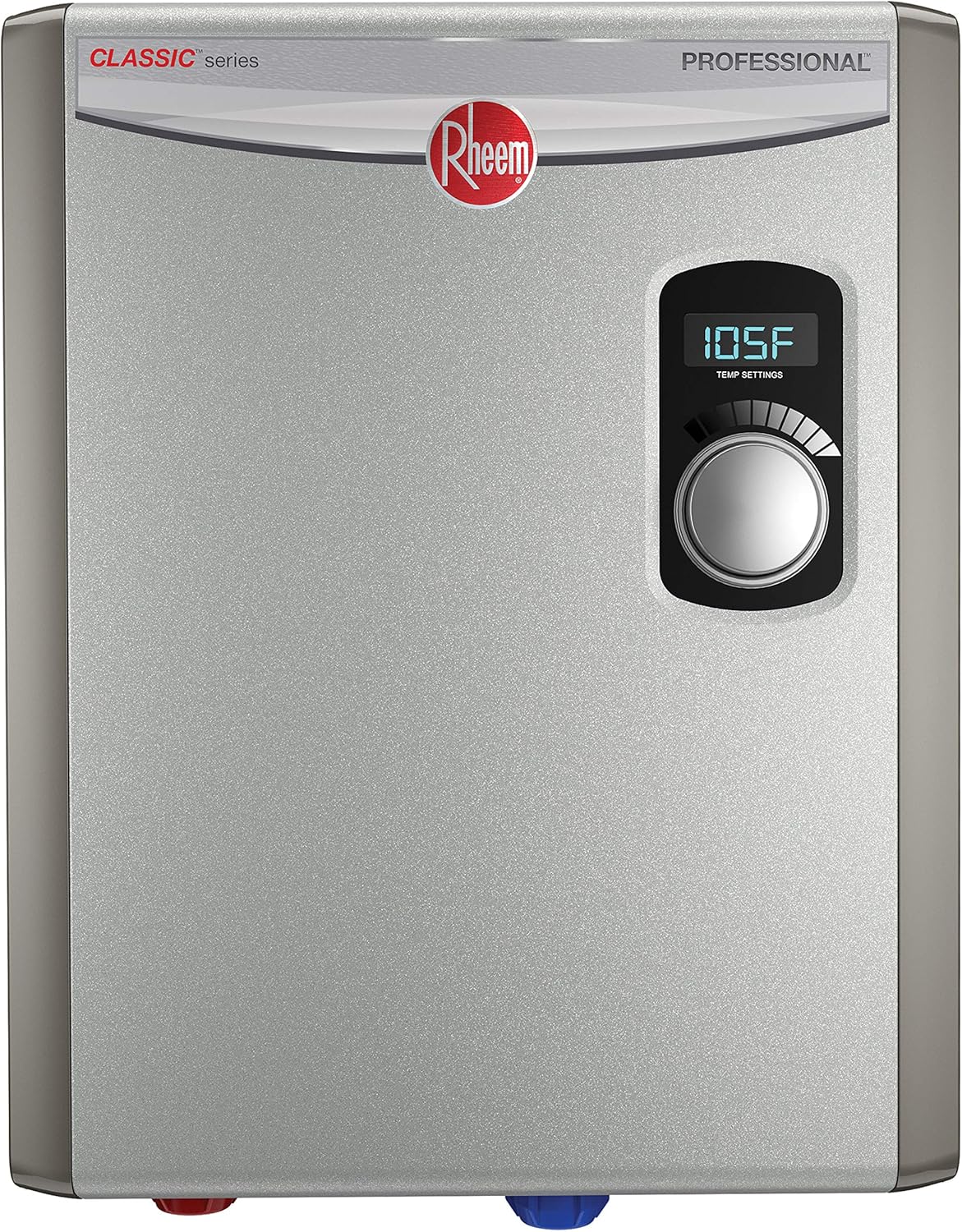
| Wattage | 18000 watts |
|---|---|
| Voltage | 240 volts |
| Flow Rate | 4.4 gpm |
| Maximum Temperature | 140 °F |
| Efficiency | 99.8% |
The Rheem RTEX-18 is a wall-mounted 18 kW tankless electric water heater intended for whole-home or single-shower applications in moderate climates. It heats water on demand using two field-serviceable copper immersion elements and a self-modulating control that adjusts power to match flow, which helps reduce standby energy use. The front LED temperature display makes setpoint changes straightforward and the unit requires no venting, so it fits in closets or utility spaces. Practical benefits include a compact footprint that saves space compared with storage tanks and a claimed flow rate up to 4.4 gpm, enough for one shower plus other low-flow outlets in many homes. Important limitations are its 18 kW power level and 240V electrical requirement, which mean performance will drop in very cold inlet-water conditions and installation may need multi-breaker wiring. Buyers in cold climates should verify incoming groundwater temperature and expected simultaneous demand to avoid reduced flow or temperature rise under heavy loads.
Best for: Buyers who prioritize reliable, energy-efficient on-demand hot water and want a compact, low-maintenance electric solution for a single shower or modest whole-home use in milder cold-climate areas.
Less Ideal for: Homes in very cold regions with low inlet temperatures or households that need simultaneous high-flow hot water for multiple showers and appliances should consider higher-kW units or other solutions.
- On-demand heating with self-modulating controls for efficient energy use
- Digital LED temperature display for precise setpoint adjustment
- Compact, wall-mounted design that frees floor space and needs no venting
- Field-serviceable copper heating elements for easier maintenance
- 18 kW output may not sustain multiple full-flow showers in cold climates
- Requires 240V electrical service and multiple breaker capacity for installation
Verdict: Choose the RTEX-18 if you want a compact, efficient 240V electric tankless heater that reliably delivers on-demand hot water for a single shower or modest whole-home needs in milder cold-climate conditions.
Choosing the Right Electric Tankless Water Heater for Cold Climates: Key Factors to Consider
Low-Temperature Temperature Rise
How much hot-water outlet temperature the heater can produce when inlet water is very cold determines whether it can meet household demand in winter. Manufacturers sometimes list temperature rise curves at various flow rates; those curves show the maximum flow the unit can sustain while delivering a given delta-T. Paying attention to these numbers helps you match a unit to expected winter inlet temps and the uses you need, such as showers or simultaneous laundry and dishwashing.
Underestimating required temperature rise often leads to short showers and inconsistent taps. For cold climates choose a unit whose temperature-rise performance at expected inlet temperatures still provides your target outlet temperature at realistic household flow rates.
Continuous Flow Rate
Continuous flow rate is the steady gallons-per-minute a heater can deliver at a specified temperature rise. In practice you should select a heater with enough continuous flow to cover simultaneous uses you expect during peak winter demand, such as a shower plus a dishwasher or washing machine.
Sizing by peak instantaneous flow keeps hot water available without extreme drawdown. Look at the flow-rate numbers tied to the temperature-rise curves, not just the maximum flow quoted at minimal temperature rise, so you get real-world performance estimates for cold inlet conditions.
Freeze Protection and Controls
Built-in freeze protection minimizes the risk of pipe and element damage when ambient or pipe temperatures drop below freezing. Effective systems include thermostatically controlled internal heaters, automatic drainback features, or integrated algorithms that run circulator or element cycles to prevent freezing.
Evaluate whether the unit has active freeze prevention rated for your lowest expected ambient temperatures and whether it provides clear status indicators or alarms. Relying solely on external insulation and user-applied heat tape is riskier than choosing a heater with proven internal safeguards for cold climates.
Electrical Capacity and Installation Needs
Electric tankless heaters demand significant electrical capacity, especially models sized to handle large temperature rises. Confirm your home electrical service, breaker space, and wiring can support the unit's maximum amp draw and recommended multi-pole breakers.
Installation complexity affects total project cost and feasibility. Consider whether your panel can accept new dedicated breakers and whether installers in your area routinely handle the required three-phase or high-amp single-phase wiring. Units that require unusual service upgrades may not be practical for all homes.
Durability and Corrosion Resistance
Materials, water-quality tolerance, and serviceability affect how long a tankless electric heater will last under cold-climate stress. Units exposed to mineralized or acidic water should use corrosion-resistant elements, coated heating assemblies, and easily replaceable parts.
Look for accessible service panels and clear replacement procedures for elements and thermostats. Features like replaceable heating cartridges and robust seals reduce long-term maintenance headaches in harsh environments.
Sizing a Tankless Unit for Winter Demand
Sizing for cold climates starts by estimating the flow rates and temperature increases for each simultaneous fixture. Calculate the required temperature rise by subtracting expected winter inlet temperature from your desired outlet temperature. Add the flow rates for fixtures you expect to run at the same time to find the continuous flow target the heater must meet at that delta-T.
- Measure or estimate worst-case inlet water temperature during cold months.
- Decide on target outlet temperature for showers and appliances.
- Sum expected concurrent flows to establish required continuous GPM at the calculated temperature rise.
Electrical Upgrades and Professional Installation
Large electric tankless units often need multiple dedicated breakers and heavy-gauge wiring. Before buying, have an electrician confirm panel capacity, breaker availability, and whether your service requires an upgrade to handle the unit's full load. Professional installation ensures safety and proper commissioning, including verifying element sequencing and freeze-protection programming.
- Verify main service amperage and available breaker slots.
- Confirm wiring gauge and conduit needs for the unit's maximum load.
- Ensure installer tests freeze protection and documents wiring and settings.
Freeze Protection Best Practices
Even with internal freeze protection, good site practices reduce freeze risk. Insulate exposed pipes, consider small conditioned enclosures for outdoor or unconditioned installations, and use thermostatic mixing valves to prevent scalding while allowing lower storage temperatures. Regularly test any active freeze-prevention functions and replace batteries or maintain power to control circuits during winter outages.
- Insulate all exposed plumbing runs and the unit's inlet lines.
- Install in conditioned or sheltered spaces when possible.
- Test freeze-protection cycles annually before the cold season.
Maintenance and Water Quality Management
Hard water and mineral buildup reduce element life and diminish heat transfer, which is particularly problematic when the unit must meet large temperature rises. Regular descaling, sediment filter service, and water-softening options preserve performance and reduce the risk of element failure in cold-weather operation. Keep a maintenance schedule and check element condition if your unit shows reduced flow or longer heat-up times.
- Install pre-filters or softeners if local water is hard.
- Follow manufacturer recommended descaling intervals.
- Check for leaks and corrosion during each maintenance visit.
How We Chose the Best Electric Tankless Water Heater for Cold Climates
To assemble this list we focused on attributes that directly affect winter performance and long-term reliability in cold climates. Primary evaluation criteria included measurable temperature rise at low inlet temperatures, continuous flow rate at target temperature increases, the presence and effectiveness of freeze protection or heating elements, certified electrical safety and thermal controls, and real-world durability features like corrosion-resistant materials and accessible service points. We prioritized units that demonstrate predictable output when inlet water is below 40 F and that include specific anti-freeze or hard-freeze mitigation rather than relying solely on user-installed insulation. Electrical capacity and recommended wiring were evaluated to ensure the unit can be installed safely on typical residential service panels. We excluded products designed only for temperate climates, point-of-use only units that cannot supply whole-home demands in cold conditions, and any units lacking documented low-temperature performance data. The result is a shortlist of models that meet the practical needs of homeowners facing consistently cold inlet water and winter freeze risk.
Our full evaluation process is outlined in our review methodology.
FAQ
Will an electric tankless heater work in very cold climates?
Often yes, but performance depends on the unit's rated temperature rise at low inlet temperatures and the available electrical capacity. Choose a model specified for the inlet temps you expect and sized to meet your peak simultaneous flow demands.
Do I need special wiring for a high-capacity electric tankless heater?
Usually yes. High-capacity units require dedicated breakers and heavy-gauge wiring. An electrician should verify panel capacity and recommend any necessary upgrades before purchase.
Can I install an electric tankless heater outdoors in cold areas?
You can, but outdoor installations must have robust freeze protection and weatherproofing. Placing the unit in a conditioned or insulated enclosure reduces freeze risk and simplifies maintenance.
How often should I descale a tankless electric heater in hard-water areas?
Frequency depends on water hardness and usage, but many owners descale annually or more often if buildup is rapid. Regular checks of flow and element condition help determine the right interval.
Will insulating pipes eliminate the need for internal freeze protection?
No. Insulation reduces heat loss but does not guarantee protection during prolonged subfreezing conditions or power outages. Built-in freeze prevention provides active protection that insulation alone cannot ensure.
Final Verdict
For cold climates, prioritize a unit that delivers the necessary temperature rise at your expected winter inlet temperatures and that provides reliable freeze protection and clear electrical specifications. Balance continuous flow needs against the practical limits of your home electrical service and the cost of any required upgrades. Regular maintenance and water-quality management will sustain winter performance and extend service life. Focus on fitment to your household simultaneous demand and the unit's documented low-temperature performance. With the right sizing and installation, an electric tankless water heater can provide consistent winter hot water with minimal downtime.