
Note: This article contains affiliate links. If you click on these links and make a purchase, we may earn a small commission at no extra cost to you. This helps support our research and content. Read our full affiliate disclosure here.
Choosing the right energy-efficient electric water heater can cut household energy use and keep a steady supply of hot water for daily chores. You want a unit that balances low operating cost with fast recovery and dependable performance for showers, laundry, and dishwashing. This guide shortlists seven top-performing options that suit different home sizes and usage patterns. We focus on measurable criteria like energy factor, recovery rate, tank size, and installation needs so you can pick the best fit for your home. Below are the editors' top energy-conscious choices, followed by practical buying guidance and answers to common homeowner questions.
Top Picks at a Glance
| Best Overall The best all-around choice for most situations | Senville SENWH-HP50US 50-Gallon |  |
| Best Quality Built to a higher standard if you want something more solid | Rinnai REHP65 Heat Pump Water Heater |  |
| Best Value The sweet spot between price and what you get | EcoSmart ECO 11 Tankless Water Heater |  |
| Best Budget The cheapest option that still gets the job done reliably | xwdzswgs Tankless Water Heater | 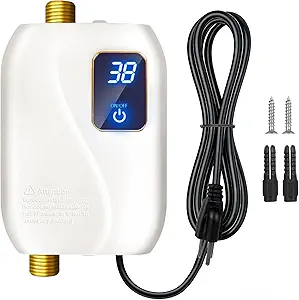 |
| Top Rated A top-rated pick with lots of positive feedback | Bosch Tronic 3000 T ES8 7-Gallon |  |
| Most Popular A crowd favorite that many people choose with confidence | EcoSmart ECO 18 Tankless Water Heater |  |
| Best Seller A high-volume bestseller chosen again and again | Rheem RTEX-18 Tankless Electric Water Heater |  |
Senville SENWH-HP50US 50-Gallon

| Capacity | 50 gallons |
|---|---|
| UEF | 3.75 |
| First Hour Rating | 69 Gal FHR |
| Power Source | dc |
The Senville SENWH-HP50US is a hybrid heat pump electric water heater built to cut household water heating energy use while providing steady hot water for medium to large homes. It uses a heat pump to extract ambient heat and transfer it to the tank, which yields a high 3.75 UEF and an advertised 69-gallon first hour rating, so multiple showers, laundry, and dishwashing can be handled without rapid depletion. Typical use favors installations in conditioned or semi-conditioned spaces where the heat pump can work efficiently; the unit also includes backup electric resistance heating for higher-demand periods. Notable benefits are the ENERGY STAR qualification, UL and AHRI certifications, and a compressor warranty that supports long-term operation. Trade-offs include its physical footprint and weight compared with standard electric tanks and the need for adequate clearance and ambient temperature for optimal efficiency. For buyers focused on lowering operating costs and long-term savings, this unit offers a clear efficiency advantage over conventional electric water heaters.
Best for: Homeowners who want to cut water-heating energy bills and need reliable hot water for medium to large households while accepting the installation needs of a hybrid unit.
Less Ideal for: People with very small spaces, unconditioned locations with low ambient temperatures, or those seeking the cheapest upfront purchase and simplest installation.
- High 3.75 UEF and ENERGY STAR certification that reduce energy consumption
- 69-gallon first hour rating suitable for simultaneous household hot water use
- Hybrid heat pump design greatly lowers electricity use versus standard electric heaters
- UL and AHRI certifications indicate safety and performance compliance
- Long compressor warranty and multi-year parts coverage for durability
- Large physical footprint and heavy weight require sufficient installation space
- Performance depends on ambient air temperature and adequate clearance
- Higher upfront cost and more complex installation than basic electric tanks
Verdict: Choose this hybrid heat pump water heater if you prioritize long-term energy savings and reliable hot-water supply for a medium to large household.
Rinnai REHP65 Heat Pump Water Heater

| Capacity | 65 gallons |
|---|---|
| Power Source | ac_dc |
| Voltage | 240 volts |
| Special Features | Heat Pump Technology, Demand-Response Enabled |
The Rinnai REHP65 is a 65‑gallon electric heat pump water heater built to cut energy use while meeting strong household hot water demand. It pulls heat from ambient air using heat pump technology and delivers up to 80 gallons in the first hour, making it suitable for families with overlapping showers and appliance use. The unit is Energy Star certified with a high UEF (listed as 3.90–4.00), which translates to lower operating costs versus conventional electric tanks, and it supports demand‑response via a CTA‑2045 port to reduce consumption during grid peaks. The glass‑lined steel tank and factory certifications (UL, AHRI, NSF) point to durable, code‑friendly construction, and Rinnai backs the product with long residential tank and parts coverage. Practical considerations: it runs on 240V/30A service and uses R134a refrigerant, so installation should be planned with an electrician and HVAC or water‑heating pro; the unit is large and heavy, so professional handling is recommended. For buyers prioritizing year‑over‑year energy savings and reliable hot water delivery, the REHP65 is a strong, high‑efficiency option.
Best for: Buyers who prioritize long‑term energy savings and reliable high‑volume hot water for a busy household and are prepared to arrange proper electrical and HVAC installation.
Less Ideal for: People looking for a plug‑and‑play or compact solution for small apartments or households with minimal hot water demand should consider smaller or simpler electric water heaters.
- High first‑hour delivery (up to 80 gallons) suitable for heavy simultaneous hot water use
- Energy Star certification and high UEF for lower operating costs compared with standard electric tanks
- Demand‑response enabled via CTA‑2045 port to reduce peak‑time energy consumption
- Durable glass‑lined steel tank with multiple factory safety and efficiency certifications
- Requires 240V/30A electrical supply and professional installation
- Large, heavy unit that will need adequate space and handling during replacement
Verdict: Choose the REHP65 if you want a high‑capacity, Energy Star heat pump water heater that cuts operating costs while delivering strong first‑hour hot water performance.
EcoSmart ECO 11 Tankless Water Heater

| Wattage | 13000 watts |
|---|---|
| Voltage | 220 volts |
| Flow Rate | 3.1 gpm |
| Maximum Temperature | 140 °F |
| Heat Output | 11 KW |
The EcoSmart ECO 11 is a compact, wall-mounted electric tankless water heater intended for small point-of-use needs like a single bathroom or sink. It uses self-modulating electronics to heat water on demand, maintaining temperature within one degree of the setpoint and cutting standby energy loss compared with tank heaters. Installation is typically at or near the fixture to reduce wait time for hot water, and the digital temperature control lets you dial settings precisely. With a flow rate of roughly 1.3 to 3.1 gpm depending on inlet temperature, it handles low-flow showers and sinks reliably but is not sized for multiple full-flow showers in cold climates. The unit is lightweight and space-saving, and the LED display and lifetime warranty on core components add confidence in durability. Buyers should plan for the correct electrical supply and breaker sizing before purchase since tankless electric units require substantial amperage. For energy-conscious homeowners looking to replace a small tank or add point-of-use hot water, the ECO 11 is a focused, efficient option.
Best for: Buyers who prioritize energy efficiency and want a compact point-of-use solution for a single bathroom, sink, or small office breakroom and who plan installations around electrical requirements.
Less Ideal for: Large households that need simultaneous hot water for multiple showers or whole-home replacement should choose a higher-capacity unit or a different solution.
- Compact wall-mounted design saves floor space and is easy to place at point of use
- Self-modulating technology adjusts power to demand for improved energy efficiency
- Digital temperature control and LED display provide precise, one-degree adjustments
- Suitable flow range for a single shower or sink in warmer climates
- Lifetime warranty on electronics, heat exchanger, and element
- Limited flow capacity not intended for multiple full-flow showers in colder climates
- Requires a high-amperage electrical circuit and proper wiring for installation
Verdict: Choose the ECO 11 when you need a compact, energy-efficient point-of-use electric tankless heater that reliably supplies a single shower or sink on demand.
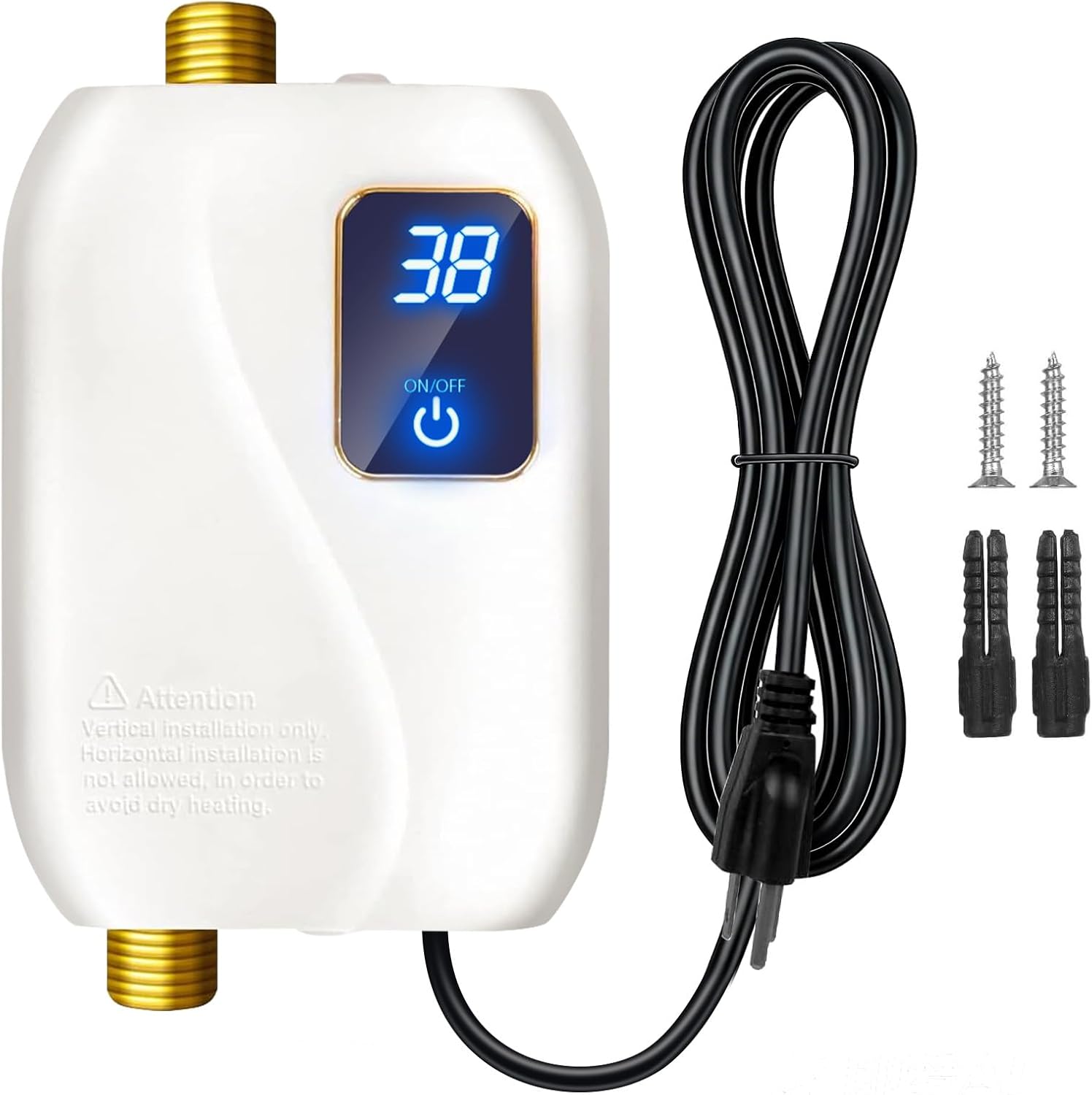
xwdzswgs Tankless Water Heater
| Power Source | ac |
|---|---|
| Maximum Temperature | 131 °F |
| Heat Output | 10236 british thermal units |
| Special Features | Dry Combustion Protection, LED Display, Lightweight |
This compact 110V tankless unit is a point-of-use electric heater designed to deliver near-instant hot water for sinks and small fixtures without a storage tank. It mounts vertically and uses a 3000W element with an LED display that lets you switch between Fahrenheit and Celsius and monitor outlet temperature. The unit includes multiple safety features such as IPX4 waterproofing, dry-fire protection, leakage protection, and automatic shutoff for overheating. Installation is straightforward for someone comfortable with basic plumbing and electrical work because it uses standard 1/2 inch NPT fittings and pre-drilled mounting holes, but it does require a dedicated circuit and recommended wiring and trip switch sizes. Performance is best at low-flow applications like kitchen sinks, RV sinks, and utility basins rather than showers, since flow rate strongly affects outlet temperature. For buyers looking to save space and avoid standby heat losses, this model is efficient and simple, though its point-of-use capacity limits it to small fixtures rather than whole-bath hot water supply.
Best for: Buyers on a tight budget who need an efficient, space-saving source of hot water for a single sink, RV, or small utility area and who can handle or hire straightforward electrical and plumbing installation.
Less Ideal for: Homes that need whole-bath or multi-fixture hot water or anyone seeking a high-flow solution for showers should look at larger-capacity units instead.
- On-demand heating eliminates standby heat loss for point-of-use fixtures
- Compact vertical design frees up space under sinks and in small installations
- Multiple safety protections including dry-fire, leakage protection, and IPX4 splash resistance
- LED digital display with Celsius/Fahrenheit switching for easy temperature readout
- Intended for low-flow applications and not suitable for shower use
- Requires proper electrical wiring and a dedicated circuit with recommended trip switch size
Verdict: A budget-friendly, compact on-demand heater that delivers efficient hot water for single fixtures where space and energy savings matter most.
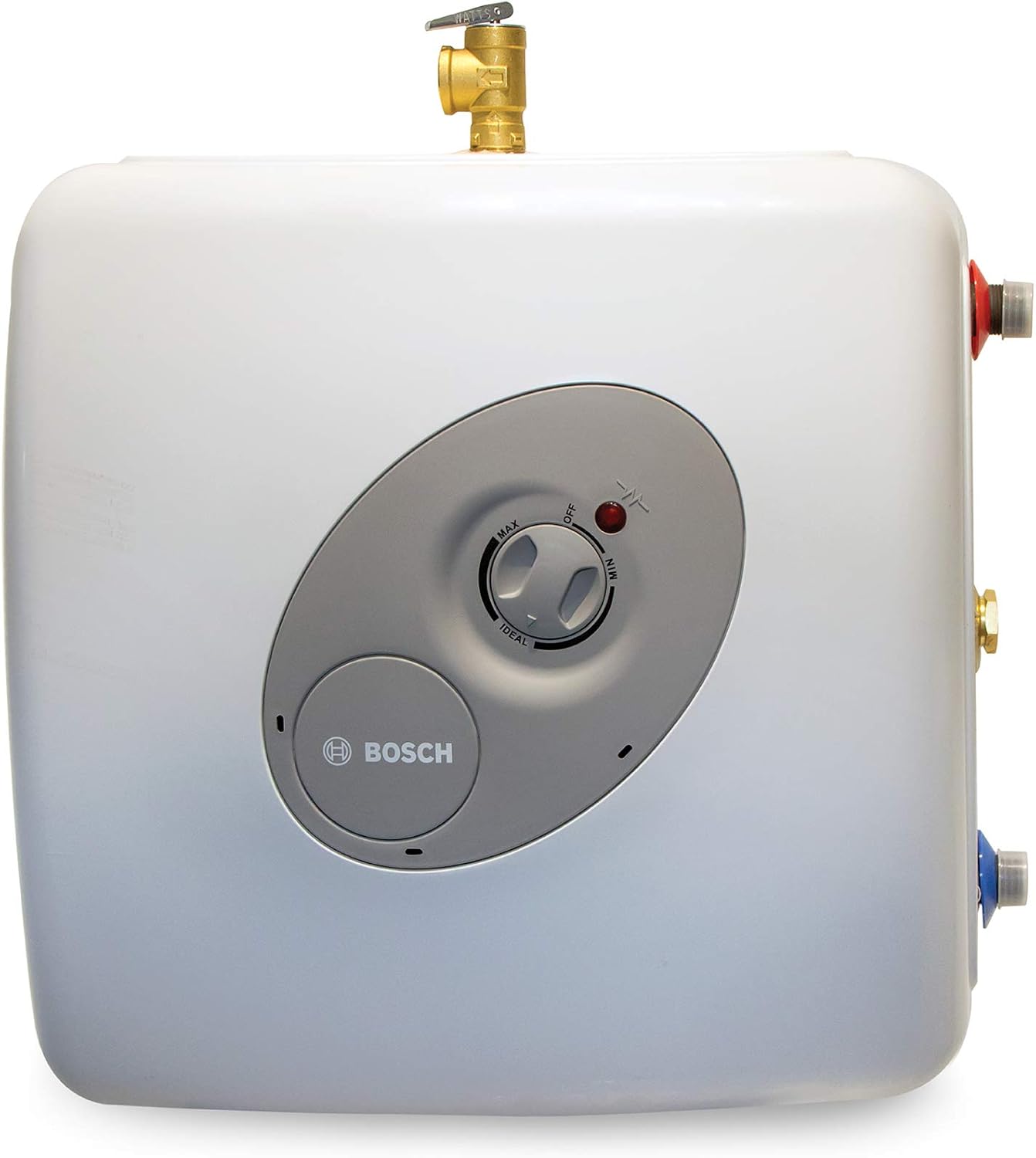
Bosch Tronic 3000 T ES8 7-Gallon
| Capacity | 7 gallons |
|---|---|
| Wattage | 1440 watts |
| Voltage | 120 volts |
| Maximum Temperature | 145 °F |
| Maximum Pressure | 150 psi |
The Bosch Tronic 3000 T ES8 is a compact 7-gallon electric mini-tank that provides near-instant hot water at a single fixture or as a buffer for a tankless system. It installs under a sink, on a shelf, or wall-mounted (vertical mounting required for wall) and is hard-wired to the home electrical supply. The unit uses a 1440 W element with thick CFC-free foam insulation and a glass-lined tank to minimize standby heat loss and maintain a high thermal efficiency of about 98 percent. Temperature is user-adjustable via an external dial and the package includes a temperature-and-pressure relief valve for safety. Practical benefits include faster hot water delivery at remote sinks, simple installation into an existing cold line, and the ability to operate as either a standalone source or supplement to reduce cold-water sandwiching with tankless heaters. Limits include the small 7-gallon capacity that is suitable for single-point use rather than whole-house needs and the requirement to hard-wire the unit for this model which may need an electrician for installation.
Best for: Buyers who prioritize a dependable, energy-efficient way to get fast hot water at one sink or to stabilize supply for a tankless system and value a durable, well-insulated unit.
Less Ideal for: Homes that need whole-house hot water or multiple simultaneous hot-water draws should choose a larger or whole-house heater instead.
- High thermal efficiency (about 98%) reduces standby heat loss
- Glass-lined tank and thick insulation improve durability and retention
- Flexible mounting options: shelf, floor, or vertical wall mount
- Includes temperature-and-pressure relief valve for safety
- External temperature dial for straightforward temperature control
- 7-gallon capacity limits use to single sinks or point-of-use applications
- Hard-wired electrical connection required for this model, increasing installation complexity
Verdict: Choose the Bosch Tronic 3000 T ES8 when you want a compact, energy-efficient, and reliable point-of-use heater to deliver fast hot water at a single fixture or to support a tankless system.
EcoSmart ECO 18 Tankless Water Heater

| Wattage | 18000 watts |
|---|---|
| Voltage | 240 volts |
| Flow Rate | 3.51 gpm |
| Efficiency | 99.8 % |
The EcoSmart ECO 18 is a compact electric tankless water heater that provides on-demand hot water using self-modulating smart technology. It is typically wall-mounted near supply plumbing and wired to a 240V feed with two 40A double pole breakers, and it is intended for climates where incoming water is about 62°F or warmer. The unit can heat roughly 2.5 to 3.5 gallons per minute, which equates to one shower plus a sink at lower inlet temperatures and can run two showers simultaneously in warmer regions. The digital temperature control lets you dial temperature in 1°F increments for precise comfort, and the manufacturer rates efficiency at 99.8 percent so you avoid standby losses associated with tanks. Practical benefits include a small footprint, lifetime coverage on core components, and simpler long-term energy usage for intermittent hot-water draws. Limitations to consider are the need for adequate electrical capacity and that its flow and multi-fixture performance depend heavily on incoming water temperature, so it may underperform in cold-climate installations without a larger model.
Best for: Buyers who prioritize energy efficiency and want a compact, on-demand electric solution for warm to moderate climates and who are comfortable confirming electrical requirements before purchase.
Less Ideal for: Homes in cold regions with low incoming water temperatures or properties without the required 240V electrical capacity without costly upgrades.
- High heating efficiency (listed at 99.8%) reduces standby energy loss compared with tank heaters
- Compact wall-mounted design saves space in utility areas
- Digital temperature control with 1-degree increments for precise temperature setting
- Lifetime warranty on electronics, heat exchanger, and element covers major components
- Requires a 240V circuit with two 40A breakers and 8 AWG wiring which may need electrical upgrades
- Performance (gpm and ability to run multiple fixtures) depends on incoming water temperature and is limited in cold climates
Verdict: Choose the ECO 18 if you want a space-saving, highly efficient electric tankless heater that delivers precise on-demand hot water in warmer climates.
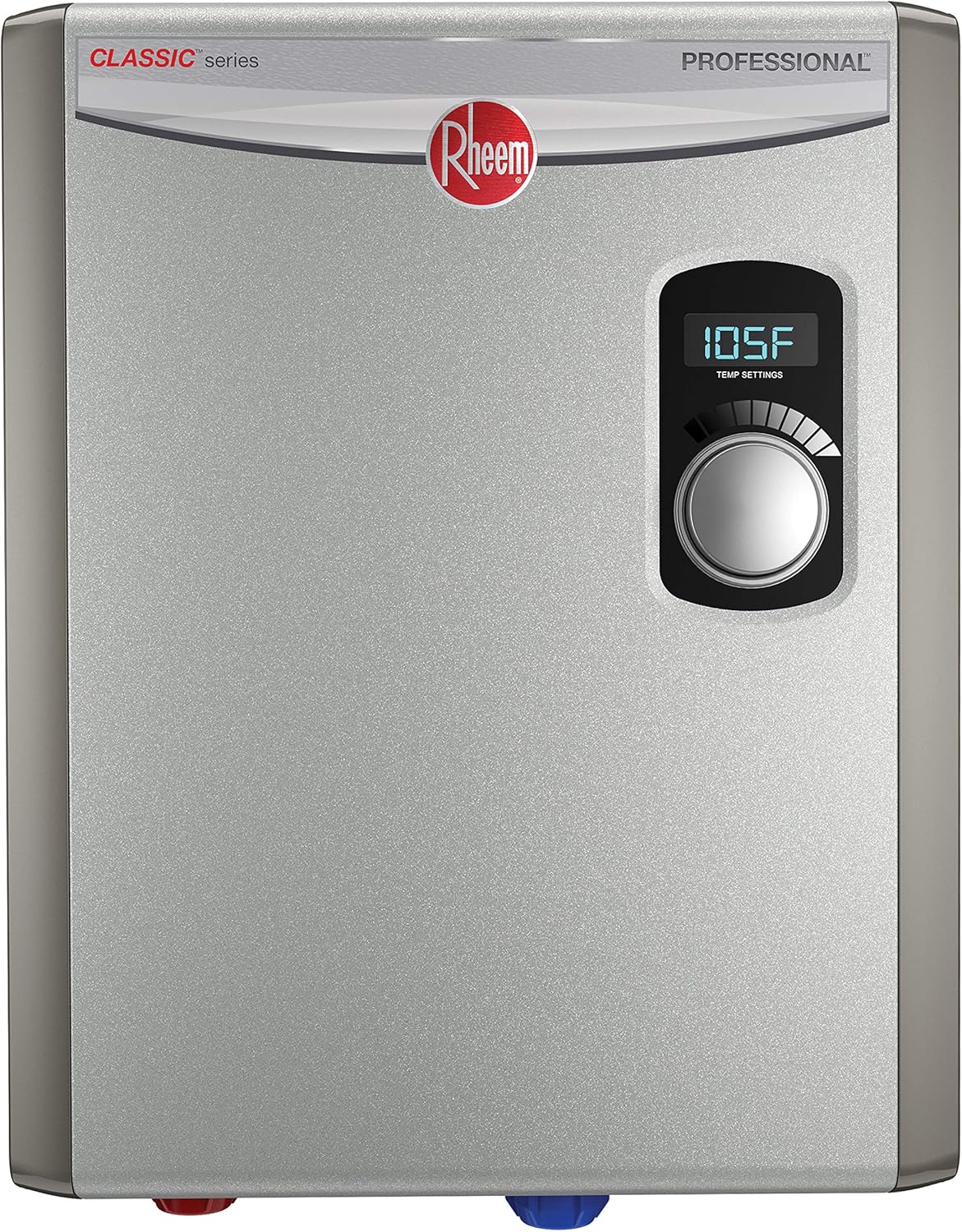
Rheem RTEX-18 Tankless Electric Water Heater
| Power Source | AC Power |
|---|---|
| Wattage | 18000 watts |
| Voltage | 240 volts |
| Flow Rate | 4.4 gpm |
| Maximum Temperature | 140 °F |
The Rheem RTEX-18 is a compact tankless electric heater designed to provide on‑demand hot water for mid‑range whole‑home applications. It mounts on the wall and uses self‑modulating 18 kW elements to adjust power to the flow, which helps the unit run efficiently when hot water is needed. The front LED digital thermostat gives degree‑accurate temperature control and the unit claims up to 4.4 gpm flow rate, enough for single to dual fixture use depending on inlet temperature. Installation is straightforward with 3/4 inch NPT water connections and no venting required, and the serviceable copper heating elements simplify repairs. The main benefits are steady hot water supply, reduced standby energy compared with tank systems, and a small footprint that frees up space. Limitations to consider are the electrical load requirement for an 18 kW unit and that performance depends on incoming water temperature and household demand, so larger homes or simultaneous heavy use may need a higher capacity model or multiple units.
Best for: Buyers who prioritize dependable, energy‑efficient hot water on demand and want a compact, low‑standby option for mid‑sized homes or point‑of‑use installs.
Less Ideal for: Large households with multiple showers running at once or homes without the necessary electrical service should consider higher‑capacity solutions or alternate configurations.
- Self‑modulating 18 kW elements adjust power to match demand for better efficiency
- LED digital thermostat with degree‑accurate temperature control
- Compact wall‑mount design saves space and requires no venting
- Serviceable copper heating elements simplify maintenance and repairs
- Flow rate (up to 4.4 gpm) may be insufficient for simultaneous heavy hot water use in larger homes
- Requires substantial dedicated electrical capacity for 18 kW operation
Verdict: Choose the Rheem RTEX-18 if you want a compact, energy‑smart tankless electric heater that delivers on‑demand hot water with precise temperature control for mid‑range household needs.
Choosing the Right Energy-Efficient Electric Water Heater: Key Factors to Consider
Energy Efficiency and Standby Loss
Energy efficiency determines long-term operating cost. Look for a high energy factor or low standby heat loss rating to reduce electricity consumption during idle periods.
Standby loss matters for tank-style electric heaters because stored hot water radiates heat into the surrounding space. Better insulation, lower standby loss rates, and features like heat-trap fittings will cut monthly energy use, especially in homes with intermittent hot-water demand.
Recovery Rate and First-Hour Rating
Recovery rate tells you how many gallons the heater can raise to usable temperature per hour. Faster recovery prevents cold-water gaps after consecutive showers or loads of laundry.
First-hour rating combines usable tank capacity with recovery performance to indicate the volume of hot water available during peak demand. If your household frequently uses hot water simultaneously, prioritize higher recovery and first-hour numbers to avoid running out.
Tank Capacity and Household Size
Choosing the correct tank size reduces energy waste and ensures sufficient hot water. Small households often do well with lower-capacity tanks and lower standby losses, while larger families may need bigger tanks or higher recovery rates.
Oversizing increases standby losses, while undersizing risks frequent cold-water interruptions. Match tank capacity to peak-hour hot-water needs and consider typical appliance temps when estimating demand.
Electrical Requirements and Installation
Electric water heaters draw significant current. Verify that your home's electrical panel can supply the required amperage and that circuit wiring meets code for the unit you select.
Installation complexity affects total upfront cost and feasibility. Some high-efficiency models need dedicated circuits or larger service sizes. Plan for safe placement, ventilation where required, and accessibility for maintenance when assessing installation needs.
Build Quality and Expected Service Life
Durable internal components and quality tank materials reduce repairs and extend service life. Look for corrosion-resistant tank linings, robust element access, and straightforward anode replacement.
A longer expected lifespan can offset higher initial costs. Consider how serviceability and replacement-part availability influence long-term ownership experience.
Warranty and Support
A clear, substantial warranty provides financial protection against premature failures. Check the duration and what components are covered, including tank and heating elements.
Warranty terms reveal manufacturer confidence and can signal likely real-world durability. Also evaluate how easy it is to access authorized service or replacement parts locally.
Sizing a Unit for Your Home
Estimate peak hour demand by totaling simultaneous hot-water uses, such as showers, dishwasher cycles, and laundry. Use typical gallons-per-use figures to build a realistic peak-hour profile rather than guessing by household headcount.
After calculating peak needs, select a tank capacity and recovery combination that meets or slightly exceeds that number. If your electrical service limits recovery options, prioritize a larger tank over higher recovery to supply more stored hot water.
- Smaller homes: prioritize low standby loss and moderate capacity.
- Larger households: prioritize higher first-hour rating and recovery.
- If limited by panel capacity: increase tank size rather than recovery rate.
Installation Considerations and Permits
Electric water heaters usually require a dedicated circuit and space for safe operation. Check local electrical codes and whether a permit or inspection is necessary before installation.
Think through placement for maintenance access and condensation management. Positioning near major hot-water draws shortens pipe runs and reduces heat loss, but ensure electrical clearances are maintained.
- Confirm circuit breaker size and wiring gauge matches unit requirements.
- Plan for an accessible drain pan and pressure-relief valve routing.
- Account for clearance around the unit for element access and anode replacement.
Reducing Operating Costs Beyond the Heater
Insulate hot-water pipes to reduce distribution losses, and lower thermostat settings slightly to save energy without sacrificing comfort. These small measures compound the efficiency gains of a high-rated heater.
Consider timers or smart controls where applicable to reduce heat retention during long absences. While electric tanks maintain temperature constantly, targeted scheduling can trim unnecessary run time in some households.
- Pipe insulation for long runs.
- Lower thermostat to 120 degrees Fahrenheit for most uses.
- Use low-flow fixtures to stretch available hot water during peak times.
Maintenance Tips to Preserve Efficiency
Regularly flushing the tank removes sediment that reduces heat transfer and increases energy use. Check and replace sacrificial anodes as recommended to retard corrosion and extend tank life.
Test the temperature-pressure relief valve periodically and replace heating elements if signs of reduced performance appear. Simple maintenance keeps standby losses and recovery performance near original specifications.
- Flush tank annually or more often in hard-water areas.
- Inspect and replace anode rods as needed.
- Schedule element checks if recovery slows noticeably.
Common Installation Pitfalls to Avoid
Oversizing based solely on the idea of never running out of hot water increases standby losses and operating cost. Match size to realistic demand and prioritize insulation quality.
Ignoring electrical service limits can lead to deferred upgrades and unexpected installation delays. Confirm panel capacity early in the selection process and consult a licensed electrician if uncertain.
- Do not assume higher wattage is always better; it requires matching electrical capacity.
- Avoid placing units in unconditioned spaces without additional insulation.
- Never skip local permit checks and code requirements for electrical connections.
How We Chose the Best Energy-Efficient Electric Water Heater
We shortlisted units that deliver measurable savings without sacrificing hot-water reliability. Our selection filters prioritized energy performance, practical capacity, and compatibility with typical household electrical setups. We excluded units that lack verified efficiency ratings or that require unusual electrical infrastructure for average homes. Key evaluation criteria included steady-state energy factor and standby losses to estimate operating cost; first-hour recovery and recovery rate to judge how quickly a home regains hot water after heavy use; appropriate tank capacities and available configurations for different household sizes; build quality and warranty terms to indicate expected lifespan; and installation complexity and compatibility with standard residential electrical panels. We also considered ease of maintenance and accessibility of replaceable components, since long-term ownership costs can offset initial efficiency gains. Products were compared on these concrete dimensions rather than brand reputation alone. Units that failed to provide clear efficiency or recovery specifications, or that required commercial-grade electrical upgrades for typical homes, were excluded from consideration.
Our full evaluation process is outlined in our review methodology.
FAQ
How much can an energy-efficient electric water heater save on my electric bill?
Savings depend on current unit efficiency, household hot-water use, and local electricity rates. Upgrading from a very old, poorly insulated tank usually yields the biggest savings, while gains are smaller when replacing a relatively modern, efficient unit.
Can I install a high-efficiency electric water heater in my existing electrical panel?
It depends on the unit's amperage and your panel capacity. Many high-recovery electric units require larger breakers or dedicated circuits. Check the unit specifications and consult an electrician to confirm compatibility.
Is a larger tank better for efficiency?
Not necessarily. Larger tanks hold more hot water but increase standby heat loss. The most efficient choice balances tank size with insulation quality and household demand, avoiding excessive stored volume relative to typical use.
How often should I flush my electric water heater tank?
Flushing once a year is a reasonable baseline. Homes with hard water or heavy sediment buildup may need more frequent flushing to maintain efficiency and element life.
Will lowering the thermostat save a lot of energy?
Lowering the thermostat to around 120 degrees Fahrenheit reduces heat loss and can cut energy use moderately. The exact savings depend on usage patterns and standby losses of the specific unit.
Final Verdict
Prioritize energy factor, recovery rate, and the right tank capacity when choosing an energy-efficient electric water heater. Balance faster recovery against electrical requirements, and avoid oversizing which increases standby losses. Focus on units that match your peak-hour needs, have solid warranties, and are straightforward to install and service. Choosing with these tradeoffs in mind will deliver dependable hot water while minimizing operating costs over the long term.